REVIEW 3 major objections 5 minor 36 references
Search-agent accuracy is governed by retrieval recall, not search effort.
Reviewed by Pith at T0; open to challenge. T0 means a machine referee read the full paper against a public rubric. the ladder, T0–T4 →
2026-08-04 18:22 UTC pith:JULDF2DX
load-bearing objection Solid trajectory-level diagnosis with a strong central dissociation, but the failure-mode split relies on an untested 'in hand' equivalence that could shift per-agent prescriptions. the 3 major comments →
Diagnosing Search Behavior and Failure Modes in Long-Horizon Search Agents
The pith
A machine-rendered reading of the paper's core claim, the machinery that carries it, and where it could break.
Core claim
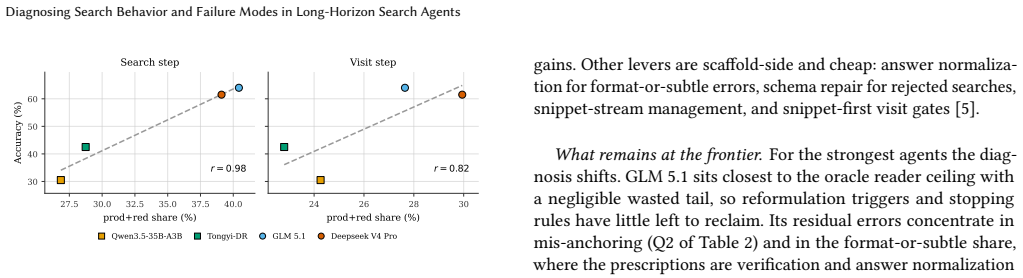
The central claim is that search effort and answer quality are only weakly aligned: across six agents, neither search volume nor context spend predicts accuracy, while cumulative retrieval recall is the dominant correlate (Pearson r = 0.99 cross-agent). Within the same question, agents that retrieve gold evidence answer correctly 73.8% of the time versus 2.2% for agents that miss it. The paper attributes most errors to retrieval gaps—evidence never surfaced—especially directional gaps where the agent never reaches the right topic neighborhood. A smaller but significant share are utilization gaps, where evidence was in hand yet the answer was wrong, partly due to formatting artifacts. The str
What carries the argument
The central object is the episode-level trace: each trajectory is divided into search episodes, and for each episode the agent's retrieved document ids are checked against human-annotated evidence sets. Cumulative recall up to episode k is the measure that tracks accuracy; the failure taxonomy based on whether gold evidence ever appears in the trace separates retrieval gaps from utilization gaps. The attribution is deterministic because it relies on fixed qrels rather than an LLM judge, making the retrieval-side metrics comparable across agents.
Load-bearing premise
The diagnosis assumes a gold document is 'in hand' as soon as it appears in the top-5 search results, even if the agent never opens the document and the 512-token snippet may not contain the decisive passage.
What would settle it
Check every question labeled a utilization gap: did the agent actually open the gold-graded document, and does the snippet contain the passage that determines the answer? If many utilization-gap cases rest on unopened documents whose decisive passage never entered the model's input, then the retrieval-gap share is understated and the per-agent prescriptions shift.
If this is right
- A search-budget cap near the twentieth episode retains 86–92% of each agent's accuracy, because gold evidence arrives early or not at all, so later turns are mostly low-yield.
- For weaker agents, the main repair is query-side: stop re-issuing near-identical queries, recognize failed hypotheses, and pivot to new angles that land on evidence.
- For stronger agents, the remaining headroom is verification and answer normalization, not additional retrieval, since they already approach the oracle-reader ceiling.
- Harness-level changes—deduplicating snippets, gating visits to low-value pages, and stopping when sufficient evidence has been retrieved—can reclaim wasted context without hurting accuracy.
Where Pith is reading between the lines
- This retrieval-versus-utilization dichotomy likely generalizes to other long-horizon tool-use settings (e.g., code agents or scientific literature search), where the same distinction between 'evidence never found' and 'evidence found but misused' may govern failure.
- The near-zero 2.2% success rate without gold retrieval suggests closed-book parametric knowledge contributes little to these answers, so future evaluations should focus on retrieval and reader ceilings rather than model memorization.
- A natural extension would be to train or prompt agents with a stopping rule based on cumulative evidence saturation; the paper's dAcc_K numbers provide an upper bound on how much accuracy such a rule could preserve.
Editorial analysis
A structured set of objections, weighed in public.
Referee Report
Summary. The paper proposes a trajectory-level diagnostic framework for long-horizon search agents. On BrowseComp-Plus, with the retrieval model and ReAct harness held fixed, it compares six agents of different scales and decomposes failures into 'retrieval gaps' (gold evidence never surfaced) and 'utilization gaps' (evidence surfaced but answer still wrong). It reports five main findings: (1) search effort is weakly aligned with accuracy; (2) cumulative retrieval recall tracks accuracy more strongly than effort; (3) failures split unevenly into retrieval and utilization gaps with different prescriptions; (4) useful evidence appears early and trajectories continue with wasted low-yield episodes; and (5) stronger agents search more cleanly rather than more. The paper includes a within-question fixed-effect analysis, an oracle-reader ceiling, and a smaller open-web validation on BrowseComp.
Significance. If the findings hold, they are practically important: they redirect improvement effort from scaling compute/context toward query formulation and evidence utilization. The paper's controlled setup is a genuine strength: a fixed retriever and harness across six agents, human-annotated document-level qrels for deterministic retrieval-side metrics, bootstrap intervals for the main correlations, within-question fixed-effect regressions, an oracle-reader ladder, and an open-web replication. The main risk is that the failure taxonomy and the headline recall–accuracy dissociation rest on an untested equivalence between 'gold document id appears in top-5 search results' and 'the agent had the decisive evidence in hand.' This is a load-bearing issue because the RG/UG split and the per-agent prescriptions depend on it.
major comments (3)
- [§4.2, §4.3] The definitions of R_k, C_k, and G* treat a gold document as 'surfaced' when its id appears in the top-5 search results, regardless of whether the agent ever visited the document or whether its 512-token snippet contained the decisive passage. Since BrowseComp-Plus qrels are document-level, a snippet can be drawn from an irrelevant section. This inflates the utilization-gap share and deflates the retrieval-gap share, and the per-agent prescriptions in §5 (e.g., Kimi K2.6 as utilization-bound with 52.0% UG, gpt-oss-120b as boundary-heavy) rely directly on that split. The paper reports no check that surfaced documents had their key content visible in the snippet or were actually read. I recommend a sensitivity analysis that recomputes G* (and hence RG/UG) using (a) only documents actually visited and (b) only search results whose snippet contains a gold-answer-supporting passage, and repor
- [§4.3] Incompletes are folded into the RG/UG classification by the same rule ('Incompletes ... are folded in by the same rule'). For Tongyi-DR, 38.0% of rollouts terminate from context-window overflow, and the paper's own answered-only analysis shows its RG share drops from 56.9% to 39.0% and Kimi K2.6's from 48.0% to 24.4%. The full-set split in Figure 2b and the per-agent discussion in §5 are thus partly driven by trajectories that never emitted an answer. The footnote about the overflow subset being systematically harder suggests these are not missing-at-random. The paper should report the prescriptions based on both the full-set and answered-only splits, and explicitly state which split supports which recommendation, especially Tongyi-DR's 'missing stopping rule' characterization.
- [§4.6] The within-question gold-hit disagreement analysis (retrieving agents answer correctly 73.8% vs. 2.2% on the 366 disagreement questions) uses the same top-5 'surfaced' definition. If gold documents frequently appear in result lists without the decisive content being visible, then some 'retrieving' agents are actually answering without having read the relevant passage, and the strong 73.8% contrast may overstate the direct role of retrieval as opposed to the agent's own ability to extract from snippets. The authors should disentangle 'retrieved in top-5' from 'actually read/visible' by conditioning on visits or snippet-level passage matches, or at minimum report the visit rate for gold documents in the disagreement questions.
minor comments (5)
- [§3.2 / Table 1] The table header 'Search Visit Ctx (K) Q/turn' is dense; consider separating units (e.g., 'Ctx (K tokens)') and clarifying that Search/Visit are counts per question. Also, the 'mean (median)' labeling in the caption could be more explicit per column.
- [§4.5] The Jaccard thresholds for repeat/pivot (0.85, 0.25) and the error-similarity boundaries in §4.3 are presented without sensitivity analysis. A brief note on how the conclusions change under, say, thresholds of 0.9/0.3 or 0.8/0.2 would strengthen confidence that the query-discipline results are not threshold artifacts.
- [§4.6] The panel drops 'too-short runs' but the criterion is unspecified. Please state the minimum trajectory length and confirm that dropping is not differential across agents or question difficulty.
- [§4.2] The definition of dAcc_K in the equation uses set notation with absolute values that may confuse; also the footnote 2 caveat about hard truncation is important and could be moved into the main text since the headline 'K=20 cap retains 86–92% of accuracy' depends on it.
- [References / notation] Some references appear to be future-dated (2026); please verify the arXiv identifiers and dates are correct. Also, the symbol |C_{min(K,M)}(ξ)| should be explicitly the cardinality of the set, not an absolute value.
Circularity Check
No significant circularity: the effort/recall dissociation and the RG/UG splits are measured quantities, not fitted or definitional re-statements of the conclusion.
full rationale
The paper's central claims are empirical: answer accuracy is compared against measured search volume, context spend, and qrels-based cumulative recall; the 0.99 correlation and the within-question 73.8% vs 2.2% contrast come from trajectory data and human-annotated qrels, not from fitting the outcome. The RG/UG taxonomy is defined by whether a gold document id appears in the cumulative search results before a wrong answer, and the attached prescriptions ('better queries repair RG, better verification UG') do follow from that partitioning, but the per-agent shares, the subtype decomposition, and the oracle-reader headroom are measured rather than assumed. The benchmark (BrowseComp-Plus) and qrels are external, with no author overlap, and no load-bearing result rests on a self-citation. The skeptic's concern that 'surfaced' means the id appeared in top-5 results even if the 512-token snippet lacked the decisive passage is a plausible construct-validity threat to the failure-mode decomposition, but it is not a circular reduction: the classification is an operationalization, not a derivation of the conclusion from itself. Accordingly no circular step meets the evidentiary bar.
Axiom & Free-Parameter Ledger
free parameters (6)
- Repeat-query Jaccard threshold =
0.85
- Pivot Jaccard threshold =
<0.25
- Padded recall truncation K =
25
- Error-similarity boundaries =
0.85 and 0.60
- Top-K retrieval results =
5
- Snippet truncation length =
512 tokens
axioms (5)
- domain assumption BrowseComp-Plus human-annotated qrels are correct and complete; the gold set marks documents whose content is sufficient to derive the gold answer.
- ad hoc to paper A gold document id appearing in top-5 search results counts as evidence 'surfaced' and available to the agent, regardless of whether the agent visited it or whether the 512-token snippet exposed the decisive content.
- domain assumption GPT-4o (gpt-4o-2024-08-06, temperature 0) is a valid oracle for answer correctness and for the open-web relevance and sufficiency judgments.
- domain assumption The shared ReAct harness and Qwen3-Embedding-8B retriever isolate agent behavior, so differences in recall and query discipline are attributable to the agents rather than the environment.
- domain assumption Six agents, three mid-scale and three frontier-scale, are representative of the current deep-search agent population.
Cite this review
Pith. "Pith review of Diagnosing Search Behavior and Failure Modes in Long-Horizon Search Agents." pith.science (2026). https://pith.science/paper/JULDF2DX
@misc{pith2026260801913,
  author       = {Pith},
  title        = {Pith review of: Diagnosing Search Behavior and Failure Modes in Long-Horizon Search Agents},
  year         = {2026},
  howpublished = {\url{https://pith.science/paper/JULDF2DX}},
  note         = {Machine review of arXiv:2608.01913}
}
read the original abstract
Deep search agents answer difficult information-seeking questions by iteratively issuing search queries to gather supporting evidence, but it remains unclear whether and how greater search effort leads to better answers. We study these questions through a trajectory-level diagnosis of long-horizon search agents. Using human-annotated document-level relevance judgments, we evaluate the evidence retrieved at each search step and separate two stages of agent behavior: what evidence an agent retrieves and how effectively it uses that evidence. This distinction further allows us to decompose failures into retrieval gaps, where the necessary evidence is never found, and utilization gaps, where relevant evidence is retrieved but not used correctly. With the retrieval model and evaluation harness held fixed, we compare six agents on BrowseComp-Plus and further validate our findings on BrowseComp with an open-web search API. Across settings, we find that search effort and answer quality are only weakly aligned. Answer accuracy is better correlated with the quality of retrieved evidence, especially cumulative retrieval recall, than with the number of searches or the amount of context consumed. Useful evidence often appears early in the trajectory, yet agents tend to continue searching, producing a long tail of low-yield retrieval steps. At the query level, exploratory reformulations remain useful, but the best-performing agents issue far fewer redundant queries. Overall, by systematically characterizing the search behavior and failure modes of long-horizon search agents, this work points to practical directions for building better deep research systems, including stronger query formulation, more effective evidence selection and context management, and stopping criteria based on whether sufficient supporting evidence has been retrieved.
Figures


Reference graph
Works this paper leans on
-
[1]
Leif Azzopardi. 2014. Modelling Interaction with Economic Models of Search. InProceedings of the 37th International ACM SIGIR Conference on Research and Development in Information Retrieval. 3–12
2014
-
[2]
Marcia J. Bates. 1989. The Design of Browsing and Berrypicking Techniques for the Online Search Interface. Online Review, 13(5). Pages 407–424
1989
-
[3]
Pan, Wen Zhang, Huajun Chen, Fan Yang, Zenan Zhou, and Weipeng Chen
Mingyang Chen, Tianpeng Li, Haoze Sun, Yijie Zhou, Chenzheng Zhu, Haofen Wang, Jeff Z. Pan, Wen Zhang, Huajun Chen, Fan Yang, Zenan Zhou, and Weipeng Chen. 2025. ReSearch: Learning to Reason with Search for LLMs via Reinforce- ment Learning. arXiv:2503.19470 https://arxiv.org/abs/2503.19470
Pith/arXiv arXiv 2025
-
[4]
Yanyu Chen, Jiyue Jiang, Jiahong Liu, Yifei Zhang, Xiao Guo, and Irwin King
-
[5]
Zijian Chen, Xueguang Ma, Shengyao Zhuang, Jimmy Lin, Akari Asai, and Victor Zhong. 2026. AgentIR: Reasoning-Aware Retrieval for Deep Research Agents. arXiv:2603.04384 https://arxiv.org/abs/2603.04384
arXiv 2026
-
[6]
Zijian Chen, Xueguang Ma, Shengyao Zhuang, Ping Nie, Kai Zou, Andrew Liu, Joshua Green, Kshama Patel, Ruoxi Meng, Mingyi Su, Sahel Sharifymoghad- dam, Yanxi Li, Haoran Hong, Xinyu Shi, Xuye Liu, Nandan Thakur, Crystina Zhang, Luyu Gao, Wenhu Chen, and Jimmy Lin. 2025. BrowseComp-Plus: A More Fair and Transparent Evaluation Benchmark of Deep-Research Agent...
Pith/arXiv arXiv 2025
-
[7]
João Coelho, Jingjie Ning, Jingyuan He, Kangrui Mao, Abhijay Paladugu, Pranav Setlur, Jiahe Jin, Jamie Callan, João Magalhães, Bruno Martins, and Chenyan Xiong. 2025. DeepResearchGym: A Free, Transparent, and Reproducible Evalua- tion Sandbox for Deep Research. arXiv:2505.19253 https://arxiv.org/abs/2505. 19253
arXiv 2025
-
[8]
Alejandro Cuadron, Dacheng Li, Wenjie Ma, Xingyao Wang, Yichuan Wang, Siyuan Zhuang, Shu Liu, Luis Gaspar Schroeder, Tian Xia, Huanzhi Mao, Nicholas Thumiger, Aditya Desai, Ion Stoica, Ana Klimovic, Graham Neubig, and Joseph E. Gonzalez. 2025. The Danger of Overthinking: Examining the Reasoning-Action Dilemma in Agentic Tasks. arXiv:2502.08235 https://arx...
Pith/arXiv arXiv 2025
-
[9]
DeepSeek-AI. 2026. DeepSeek-V4: Towards Highly Efficient Million-Token Con- text Intelligence
2026
-
[10]
Yuwen Du, Rui Ye, Shuo Tang, Xinyu Zhu, Yijun Lu, Yuzhu Cai, and Siheng Chen. 2026. OpenSeeker: Democratizing Frontier Search Agents by Fully Open- Sourcing Training Data. arXiv:2603.15594 https://arxiv.org/abs/2603.15594
arXiv 2026
-
[11]
Efthimiadis
Jeff Huang and Efthimis N. Efthimiadis. 2009. Analyzing and Evaluating Query Reformulation Strategies in Web Search Logs. InProceedings of the 18th ACM Conference on Information and Knowledge Management. 77–86
2009
-
[12]
Bowen Jin, Hansi Zeng, Zhenrui Yue, Jinsung Yoon, Sercan Arik, Dong Wang, Hamed Zamani, and Jiawei Han. 2025. Search-R1: Training LLMs to Reason and Leverage Search Engines with Reinforcement Learning. arXiv:2503.09516 https://arxiv.org/abs/2503.09516
Pith/arXiv arXiv 2025
-
[13]
Kimi Team. 2026. Kimi K2.6 Technical Report. Technical report
2026
-
[14]
Kuan Li, Zhongwang Zhang, Huifeng Yin, Liwen Zhang, Litu Ou, Jialong Wu, Wenbiao Yin, Baixuan Li, Zhengwei Tao, Xinyu Wang, Weizhou Shen, Junkai Zhang, Dingchu Zhang, Xixi Wu, Yong Jiang, Ming Yan, Pengjun Xie, Fei Huang, and Jingren Zhou. 2025. WebSailor: Navigating Super-human Reasoning for Web Agent. arXiv:2507.02592 https://arxiv.org/abs/2507.02592
Pith/arXiv arXiv 2025
-
[15]
Xiaoxi Li, Guanting Dong, Jiajie Jin, Yuyao Zhang, Yujia Zhou, Yutao Zhu, Peitian Zhang, and Zhicheng Dou. 2025. Search-o1: Agentic Search-Enhanced Large Reasoning Models. arXiv:2501.05366 https://arxiv.org/abs/2501.05366
Pith/arXiv arXiv 2025
-
[16]
Xiaoxi Li, Jiajie Jin, Guanting Dong, Hongjin Qian, Yutao Zhu, Yongkang Wu, Ji- Rong Wen, and Zhicheng Dou. 2025. WebThinker: Empowering Large Reasoning Models with Deep Research Capability. arXiv:2504.21776 https://arxiv.org/abs/ 2504.21776
Pith/arXiv arXiv 2025
-
[17]
Zhuofeng Li, Dongfu Jiang, Xueguang Ma, Haoxiang Zhang, Ping Nie, Yuyu Zhang, Kai Zou, Jianwen Xie, Yu Zhang, and Wenhu Chen. 2026. OpenResearcher: A Fully Open Pipeline for Long-Horizon Deep Research Trajectory Synthesis. arXiv:2603.20278 https://arxiv.org/abs/2603.20278
arXiv 2026
-
[18]
Jingjie Ning, João Coelho, Yibo Kong, Yunfan Long, Bruno Martins, João Magal- hães, Jamie Callan, and Chenyan Xiong. 2026. Agentic Search in the Wild: Intents and Trajectory Dynamics from 14M+ Real Search Requests. arXiv:2601.17617 https://arxiv.org/abs/2601.17617
Pith/arXiv arXiv 2026
-
[19]
OpenAI. 2025. gpt-oss-120b and gpt-oss-20b Model Card. arXiv preprint arXiv:2508.10925
Pith/arXiv arXiv 2025
-
[20]
Litu Ou, Kuan Li, Huifeng Yin, Liwen Zhang, Zhongwang Zhang, Xixi Wu, Rui Ye, Zile Qiao, Yong Jiang, Pengjun Xie, Fei Huang, and Jingren Zhou. 2025. BrowseC- onf: Confidence-Guided Test-Time Scaling for Web Agents. arXiv:2510.23458 https://arxiv.org/abs/2510.23458
arXiv 2025
-
[21]
Qwen Team. 2025. Qwen3 Technical Report.arXiv preprint arXiv:2505.09388 (2025)
Pith/arXiv arXiv 2025
-
[22]
Soo Young Rieh and Hong (Iris) Xie. 2006. Analysis of Multiple Query Reformu- lations on the Web: The Interactive Information Retrieval Context.Information Processing & Management42, 3 (2006), 751–768
2006
-
[23]
Zhengliang Shi, Yiqun Chen, Haitao Li, Weiwei Sun, Shiyu Ni, Yougang Lyu, Run-Ze Fan, Bowen Jin, Yixuan Weng, Minjun Zhu, Qiujie Xie, Xinyu Guo, Qu Yang, Jiayi Wu, Jujia Zhao, Xiaqiang Tang, Xinbei Ma, Cunxiang Wang, Jiaxin Mao, Qingyao Ai, Jen-Tse Huang, Wenxuan Wang, Yue Zhang, Yiming Yang, Zhaopeng Tu, and Zhaochun Ren. 2025. Deep Research: A Systemati...
arXiv 2025
-
[24]
Zhongxiang Sun, Qipeng Wang, Weijie Yu, Jingxuan Yang, Haolang Lu, and Jun Xu. 2026. Deep Search with Hierarchical Meta-Cognitive Monitoring Inspired by Cognitive Neuroscience. arXiv:2601.23188 https://arxiv.org/abs/2601.23188
arXiv 2026
-
[25]
MiroMind Team, Song Bai, Lidong Bing, Carson Chen, Guanzheng Chen, Yuntao Chen, Zhe Chen, Ziyi Chen, Jifeng Dai, Xuan Dong, Wenhan Dou, Yue Deng, Yunjie Fu, Junqi Ge, Chenxia Han, Tammy Huang, Zhenhang Huang, Jerry Jiao, Shilei Jiang, Tianyu Jiao, Xiaoqi Jian, Lei Lei, Ruilin Li, Ryan Luo, Tiantong Li, Xiang Lin, Ziyuan Liu, Zhiqi Li, Jie Ni, Qiang Ren, P...
Pith/arXiv arXiv 2025
-
[26]
Tongyi DeepResearch Team, Baixuan Li, Bo Zhang, Dingchu Zhang, Fei Huang, Guangyu Li, Guoxin Chen, Huifeng Yin, Jialong Wu, Jingren Zhou, Kuan Li, Liangcai Su, Litu Ou, Liwen Zhang, Pengjun Xie, Rui Ye, Wenbiao Yin, Xinmiao Yu, Xinyu Wang, Xixi Wu, Xuanzhong Chen, Yida Zhao, Zhen Zhang, Zhengwei Tao, Zhongwang Zhang, Zile Qiao, Chenxi Wang, Donglei Yu, Ga...
Pith/arXiv arXiv 2025
-
[27]
Hongru Wang, Cheng Qian, Wanjun Zhong, Xiusi Chen, Jiahao Qiu, Shijue Huang, Bowen Jin, Mengdi Wang, Kam-Fai Wong, and Heng Ji. 2025. OTC: Optimal Tool Calls via Reinforcement Learning. arXiv:2504.14870 https://arxiv. org/abs/2504.14870
Pith/arXiv arXiv 2025
-
[28]
Jason Wei, Zhiqing Sun, Spencer Papay, Scott McKinney, Jeffrey Han, Isa Fulford, Hyung Won Chung, Alex Tachard Passos, William Fedus, and Amelia Glaese
-
[29]
Yunjia Xi, Jianghao Lin, Yongzhao Xiao, Zheli Zhou, Rong Shan, Te Gao, Ji- achen Zhu, Weiwen Liu, Yong Yu, and Weinan Zhang. 2025. A Survey of LLM- based Deep Search Agents: Paradigm, Optimization, Evaluation, and Challenges. arXiv:2508.05668 https://arxiv.org/abs/2508.05668
Pith/arXiv arXiv 2025
-
[30]
Shunyu Yao, Jeffrey Zhao, Dian Yu, Nan Du, Izhak Shafran, Karthik Narasimhan, and Yuan Cao. 2023. ReAct: Synergizing Reasoning and Acting in Language Models.arXiv preprint arXiv:2210.03629(2023). doi:10.48550/arXiv.2210.03629
-
[31]
Lisl Zach. 2005. When Is “Enough” Enough? Modeling the Information-Seeking and Stopping Behavior of Senior Arts Administrators.Journal of the American Society for Information Science and Technology56, 1 (2005), 23–35
2005
-
[32]
Aohan Zeng, Xin Lv, Zhenyu Hou, Zhengxiao Du, Qinkai Zheng, Bin Chen, Da Yin, Chendi Ge, Chenghua Huang, Chengxing Xie, et al. 2026. Glm-5: from vibe coding to agentic engineering.arXiv preprint arXiv:2602.15763(2026)
Pith/arXiv arXiv 2026
-
[33]
Yanzhao Zhang, Mingxin Li, Dingkun Long, Xin Zhang, Huan Lin, Baosong Yang, Pengjun Xie, An Yang, Dayiheng Liu, Junyang Lin, Fei Huang, and Jingren Zhou
-
[36]
Qwen3 Embedding: Advancing Text Embedding and Reranking Through Foundation Models.arXiv preprint arXiv:2506.05176(2025)
Pith/arXiv arXiv 2025
-
[2025]
arXiv:2504.12516 https://arxiv.org/abs/2504.12516
BrowseComp: A Simple Yet Challenging Benchmark for Browsing Agents. arXiv:2504.12516 https://arxiv.org/abs/2504.12516
-
[2026]
arXiv:2602.21230 https://arxiv.org/abs/2602.21230
TRACE: Trajectory-Aware Comprehensive Evaluation for Deep Research Agents. arXiv:2602.21230 https://arxiv.org/abs/2602.21230
This paper was first reviewed by deepseek-v4-flash on August 4, 2026.
discussion (0)
Sign in with ORCID, Apple, or X to comment. Anyone can read and Pith papers without signing in.