REVIEW 4 major objections 7 minor 18 references
Less Traffic, Better Outcomes: Competition-Aware Request Dispatch in Real-Time Ad Exchanges
T0 review · 4 major / 7 minor · reviewed 2026-08-05 · deepseek-v4-flash
Pith's one-line read Selective dispatch cut DSP request volume 34% while raising net ad revenue 4.6%.
desk verdict A serious production-scale study of exchange-side request dispatch; the direction is likely right, but the headline revenue effect is not fully identified because of pre-trend and interference. read the letter →
The pith
A machine-rendered reading of the paper's core claim, the machinery that carries it, and where it could break.
The reading
What carries the argument
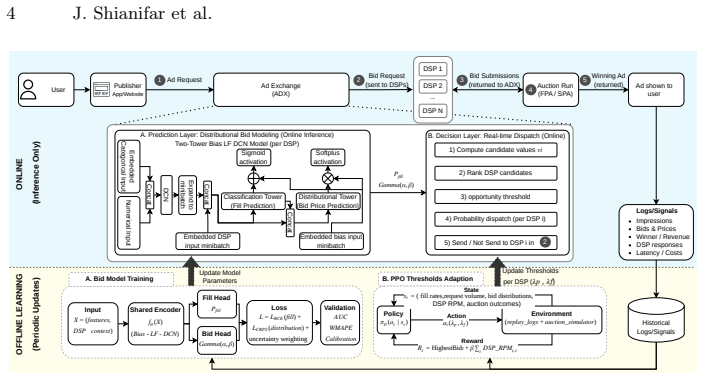
The carrying mechanism is the competition-aware forwarding probability formula: pfwd_i = p_min + (1 - p_min) * pcomp_i * Gfill_i. Here pcomp_i is the predicted probability that DSP i's bid exceeds the adjusted competition threshold lambda_p * tau, tau is the K-th largest opportunity value among all candidates for that request, and Gfill_i is a smooth gate on low fill probability. The opportunity value for each request–DSP pair is pfill * alpha/beta from a Gamma-distributed bid model, so the exchange ranks DSPs by expected marginal contribution to the auction, not by response rate. This object carries the argument because it converts a prediction problem into a per-request probabilistic routi
What would settle it
Extend the E4 pre-period to 28 days on the same traffic and rerun the Ratio-DID: if the -9.1% pre-drift in DSP requests continues growing or the +4.6% revenue effect shrinks to zero, the central claim is falsified. A cleaner test swaps treated and control bucket roles for a fresh month: if the revenue lift does not follow the treatment assignment, the effect is not causal.
Extended reading notes
Core claim
The central claim is that over-distribution itself weakens auction outcomes: when exchanges blast every request to all DSPs, bidders throttle under compute and budget constraints, so the same inventory yields lower effective competition. The paper's discovery is that a selective forwarding policy can break this cycle. For each request, the exchange computes an opportunity value v_i = pfill_i * E[bid] from a distributional bid model, ranks candidate DSPs and guaranteed demand, sets a competition threshold tau as the K-th largest value, and forwards to DSP i with probability based on the estimated chance its bid beats lambda_p * tau. Per-DSP thresholds are adapted offline with PPO on aggregate
Load-bearing premise
The result is causal only if, absent the policy, the treated hash bucket's trend in revenue and request volume would have matched the pooled control buckets, and if cutting requests in the treated bucket does not change how the same DSPs behave in the control buckets.
Editorial extensions
If this is right
- Exchanges can cut DSP request volume by about a third without sacrificing revenue—and in the full deployment, revenue rose 4.6% in the recent 14-day window.
- Fill rates and revenue per thousand DSP requests jump: roughly +42% and +59% in E4's recent window, meaning the requests that remain are the ones DSPs actually compete for.
- Aggregate auction metrics can be misleading: Low-RPM traffic dominates volume and drives a negative highest-bid effect, while Mid-RPM traffic drives the revenue gain; optimization should be stratified.
- Selective dispatch surfaces comparative advantage: different DSPs respond differently, with one concentrating bidding and another raising bid prices and eCPC, so a one-size-fits-all traffic policy leaves value on the table.
- The policy improves the downstream funnel—net clicks rise 3.0% despite slightly fewer impressions—so cutting low-quality request volume does not uniformly hurt delivery.
Reading between the lines
- Editorial: if the mechanism generalizes, exchanges running header-bidding waterfalls could use the same competition-aware gating to reduce bidder call-outs, replacing the common 'send to everyone' default.
- Editorial: the exploration floor p_min maintains counterfactual coverage; this implies the system's own action space is biased toward low-cost exploration, so long-run estimates of the policy's value could be conservative.
- Editorial: because all hash buckets share the same DSPs, the measured revenue lift may partly reflect DSP repacing toward the treated bucket; a cleaner test would isolate DSPs or use separate demand pods, at the cost of fewer control units.
- Editorial: a testable extension is to train the bid-distribution model on segment-level counterfactuals from the exploration floor to project whether deeper suppression in Low-RPM traffic would raise revenue further than the current 34% reduction.
Signed reviews
Editorial analysis
A structured set of objections, weighed in public.
Referee Report
Summary. The paper proposes a competition-aware request dispatch framework for real-time bidding (RTB) ad exchanges. For each request–DSP pair, the system estimates the probability of a bid and the conditional bid distribution, computes a competition threshold from all candidate opportunity values, and forwards probabilistically with per-DSP thresholds that are periodically adapted offline by PPO. The authors evaluate the framework in an offline simulator and in four sequential production experiments on a platform serving over 20 billion daily requests. The headline result, stated in Section 5.2, is that in the full multi-DSP deployment (E4), the policy reduces DSP requests by 34.2% and increases net revenue by 4.6% (p < 0.001) in a recent 14-day window, with stratified and per-DSP analyses claiming heterogeneous but generally positive effects on monetization efficiency.
Significance. If the causal claims hold, this is a practically significant result: it challenges the industry default of forwarding nearly all requests and shows that selective, competition-aware dispatch can simultaneously reduce load and improve revenue at production scale. The paper's strengths include genuine online experiments with permutation tests, sequential deployments E1–E3 to E4, stratified diagnostics, and explicit operational guardrails. The authors also honestly acknowledge limitations such as not isolating DSP strategy adaptation and relying on a single exchange environment. However, the causal identification of the headline effects rests on Ratio-DID with a treated bucket and pooled controls, and the manuscript does not yet provide sufficient evidence for the parallel-trends and no-interference assumptions. The reward function also makes 'less traffic' partly an optimization objective, and key hyperparameters are unreported. The result is promising but should be treated as provisional until the identification concerns are addressed.
major comments (4)
- [§4.2, Table 4, Eq. (13)] The Ratio-DID estimator assumes parallel multiplicative trends between bucket D and pooled controls A+B+C. Table 4 reports a pre-period drift of -9.1% in DSP requests in the treated bucket, roughly 27% of the reported -34.2% treatment effect, and -1.1% drift in net revenue. The paper dismisses this as 'small relative to expected treatment effects,' but that is not a statistical test of parallel trends. A pre-existing differential trend could continue into the post-period and inflate both the request and revenue effects. Please report formal pre-trend diagnostics (placebo interventions, period-by-period ratios, or trend-extrapolation bounds) and show the daily ratio time series underlying Figure 2, which is currently unreadable.
- [§4.2, Table 6] The no-interference (SUTVA) assumption underlying the comparison D vs. A+B+C is violated by construction: the same DSPs serve all hash buckets, so reducing request volume in bucket D can change DSP budget pacing, throttling, and bidding behavior globally, affecting the control buckets. The paper itself notes delayed DSP adaptation and interaction effects. This is a load-bearing threat because the controls may not represent the counterfactual trajectory of the treated bucket. Please provide evidence that control-bucket DSP behavior (response rates, bid levels, budget utilization) was unchanged in the post-period, or use a design that separates treated and control DSPs/campaigns, or bound the possible interference bias.
- [§3.3, Eq. (11)] The PPO reward is R_t = HighestBid_t + beta * sum_i DSP_RPM_i,t. Since DSP_RPM is revenue per thousand DSP requests, reducing request volume mechanically increases the reward even if total revenue is unchanged. Thus the 'less traffic' outcome is partly an optimization target, not an independent empirical finding. The net revenue increase is separately measured and potentially meaningful, but beta is 'selected empirically' with no reported value, no selection procedure, and no sensitivity analysis. Without this, it is impossible to assess how much of the result depends on the reward trade-off. Please report beta, the exploration floor p_min, and sensitivity of the headline metrics to both.
- [§5.2, Table 6] The headline result is based on the 'recent 14-day' and 'recent 7-day' windows, chosen after observing the data and motivated by an initial adaptation period. No pre-registration, pre-specified analysis plan, or multiple-testing correction is provided. The full 20-day estimate of net revenue is +2.9%, which is smaller and still significant, but the reader cannot tell whether the selected windows reflect true adaptation or overfitting to noise. Please specify the primary window in advance or justify the adaptation window with pre-specified rules, and report all windows with appropriate multiplicity control.
minor comments (7)
- [Figure 2] The rendered figure is a long string of '/uni0000...' escape codes and is unreadable. Please regenerate the figure correctly and add a clear description of what is plotted, including the adaptation window.
- [Table 6] The significance notation includes ** in the table, but the legend only defines *** and *. Add ** to the legend.
- [§4.1, Table 2] The 'Simple baseline' in Table 2 is not defined. Also, the table reports mean ± standard deviation but no test of whether the WMAPE differences are statistically significant; please clarify.
- [§3.2, Eq. (6)] The gate Gfill_i uses logit(pfill_i), which is undefined at pfill_i = 0 or 1. Please describe the numerical safeguards used in production, or use a bounded transformation.
- [§3.3] PPO hyperparameters, update frequency, and convergence diagnostics are not reported. Since threshold adaptation is central to the method, include at least the update cadence, clip range, and a plot of the reward or threshold trajectories.
- [§5.2] The phrase 'top-N DSPs (covering more than 80% of total DSP traffic)' in Section 4.2 is not reflected in Table 6 or the abstract, which simply says 'full multi-DSP deployment.' Please be precise about N and the coverage in the abstract.
- [§2, Reference [2]] Bulow and Klemperer (1996) is cited to support the claim that bidder participation is a key determinant of auction efficiency and pricing, but that paper is about auctions versus negotiations, not about participation in RTB settings. A more directly relevant reference would strengthen the motivation.
Circularity Check
Reward Eq. (11) encodes 'less traffic' as an explicit objective, so the request-reduction headline is partly self-definitional; net revenue remains independent.
-
self definitional
[Section 3.3, Eq. (11); headline results in Table 6]
"The reward balances auction value and request efficiency: R_t = HighestBid_t + β Σ_i DSP_RPM_i,t (11) where DSP_RPM denotes revenue per thousand DSP requests and β controls the trade-off between auction-level value and request efficiency. β was selected empirically in the experiments."
DSP_RPM is defined as revenue per thousand DSP requests, so Eq. (11) is algebraically R_t = HighestBid_t + β·1000·Revenue_t/Requests_t. Holding revenue and highest bid fixed, every reduction in DSP requests mechanically increases the reward. The PPO loop (Eqs. 9–11) is therefore explicitly rewarded for producing the headline 'DSP requests −34.2%' and 'RPM +59.0%' in Table 6. Those numbers are direct manifestations of the fitted objective, not independent predictions. The +4.6% net revenue is not itself a reward term and is measured against pooled controls, so the 'better outcomes' half retains independent content; only the 'less traffic' half reduces by construction.
full rationale
The paper's central 'better outcomes' claim — net revenue +4.6% (p<0.001) in Table 6 — is not itself the PPO reward: Eq. (11) contains HighestBid and DSP_RPM, not net revenue, and the revenue lift is measured against pooled control buckets A+B+C. That part of the claim has independent empirical grounding. However, the 'less traffic' half of the title claim is built directly into the reward via DSP_RPM, whose denominator is DSP request volume. The policy is thus optimized to cut requests, and the reported −34.2% request reduction and +59% RPM are consequences of the chosen objective, with β selected empirically and not reported. This is a partial, not total, circularity. No load-bearing self-citation chains appear: the cited methods (DCN, PPO, CRPS, etc.) are external, and the online evaluation uses a concurrent production control. The pre-period drift in Table 4 is a causal-identification threat rather than a circularity and does not affect this score.
Assumptions & free parameters
free parameters (2)
- beta (reward trade-off)
- p_min exploration floor
assumptions (6)
- domain assumption Bid values follow a Gamma distribution conditional on fill (Eq. 2)
- ad hoc to paper Competition threshold tau = v^(K) equals the K-th largest opportunity value (Eq. 4)
- ad hoc to paper Reward R_t = HighestBid_t + beta * sum_i DSP_RPM_i,t is an appropriate proxy for long-run monetization (Eq. 11)
- domain assumption Ratio-DID parallel trends holds for treated bucket D vs. pooled controls A+B+C (Eqs. 12-13)
- domain assumption No interference between hash buckets (SUTVA)
- domain assumption The bid model's predictions p_fill and Gamma(alpha, beta) are well calibrated
Cite this review
Pith. "Pith review of Less Traffic, Better Outcomes: Competition-Aware Request Dispatch in Real-Time Ad Exchanges." pith.science (2026). https://pith.science/paper/7ZWSR2D2
@misc{pith2026260803705,
  author       = {Pith},
  title        = {Pith review of: Less Traffic, Better Outcomes: Competition-Aware Request Dispatch in Real-Time Ad Exchanges},
  year         = {2026},
  howpublished = {\url{https://pith.science/paper/7ZWSR2D2}},
  note         = {Machine review of arXiv:2608.03705}
}
read the original abstract
Real-time bidding (RTB) ad exchanges typically forward nearly all incoming requests to demand-side platforms (DSPs), even though only a small fraction receive bids. This over-distribution weakens auction outcomes: DSPs throttle participation under compute and budget constraints, reducing the effective use of limited bidding capacity. We present a competition-aware request dispatch framework that uses distributional bid prediction and probabilistic forwarding to decide whether each request should be sent to each DSP. The system adapts per-DSP thresholds over time through lightweight policy optimization to track non-stationary market conditions. We evaluate the framework through four sequential online experiments on a production platform serving over 20 billion daily requests. A full multi-DSP deployment reduces DSP request volume under the policy by 34.2% while increasing net revenue by 4.6% (p<0.001) in a recent 14-day window after an initial DSP adaptation period. Further analysis highlights strong heterogeneity across traffic segments and reveals that aggregate metrics can be misleading. Segment-level and per-DSP analyses suggest that the policy surfaces comparative advantages among DSPs, improving monetized outcomes without increasing overall request volume.
Figures

Reference graph
Works this paper leans on
-
[1]
Agarwal, D., Ghosh, S., Wei, K., You, S.: Budget pacing for targeted online ad- vertisements at linkedin. In: Proceedings of the 20th ACM SIGKDD international conference on Knowledge discovery and data mining. pp. 1613–1619 (2014)
work page 2014
-
[2]
The American Economic Review pp
Bulow, J., Klemperer, P.: Auctions versus negotiations. The American Economic Review pp. 180–194 (1996)
work page 1996
-
[3]
In: Proceedings of the tenth ACM international conference on web search and data mining
Cai, H., Ren, K., Zhang, W., Malialis, K., Wang, J., Yu, Y., Guo, D.: Real-time bidding by reinforcement learning in display advertising. In: Proceedings of the tenth ACM international conference on web search and data mining. pp. 661–670 (2017)
work page 2017
-
[4]
In: Proceedings of the ACM on Web Conference 2025
Fan, Z., Hu, L., Wang, R., Ma, Z., Wang, Y., Ye, Q., Shen, W.: Two-stage auction design in online advertising. In: Proceedings of the ACM on Web Conference 2025. pp. 3571–3585 (2025)
work page 2025
-
[5]
Journal of the American Statistical Association102(477), 359–378 (2007)
Gneiting, T., Raftery, A.E.: Strictly proper scoring rules, prediction, and estima- tion. Journal of the American Statistical Association102(477), 359–378 (2007). https://doi.org/10.1198/016214506000001437
-
[6]
In: Proceedings of the 31st ACM SIGKDD Conference on Knowledge Discovery and Data Mining V
Hu, K., Zhang, S., Wu, L., Dai, Y., Lu, M., Qiang, Y., Li, M.: Learning adaptive reserve price in display advertising. In: Proceedings of the 31st ACM SIGKDD Conference on Knowledge Discovery and Data Mining V. 1. pp. 2282–2291 (2025)
work page 2025
-
[7]
In: Proceedings of the IEEE conference on computer vision and pattern recognition
Kendall, A., Gal, Y., Cipolla, R.: Multi-task learning using uncertainty to weigh losses for scene geometry and semantics. In: Proceedings of the IEEE conference on computer vision and pattern recognition. pp. 7482–7491 (2018) Less Traffic, Better Outcomes 13
work page 2018
-
[8]
In: Proceedings of the ACM Web Conference 2022
Liao, G., Wang, Z., Wu, X., Shi, X., Zhang, C., Wang, Y., Wang, X., Wang, D.: Cross dqn: Cross deep q network for ads allocation in feed. In: Proceedings of the ACM Web Conference 2022. pp. 401–409 (2022)
work page 2022
Show all 18 references
-
[9]
In: Proceed- ings of the Internet Measurement Conference
Pachilakis, M., Papadopoulos, P., Markatos, E.P., Kourtellis, N.: No more chasing waterfalls: a measurement study of the header bidding ad-ecosystem. In: Proceed- ings of the Internet Measurement Conference. pp. 280–293 (2019)
2019
-
[10]
In: Proceedings of the 25th ACM SIGKDD internationalconferenceon knowledge discovery&data mining.pp.363–372(2019)
Ren, K., Qin, J., Zheng, L., Yang, Z., Zhang, W., Yu, Y.: Deep landscape forecast- ing for real-time bidding advertising. In: Proceedings of the 25th ACM SIGKDD internationalconferenceon knowledge discovery&data mining.pp.363–372(2019)
2019
-
[11]
arXiv preprint arXiv:1707.06347 (2017)
Schulman, J., Wolski, F., Dhariwal, P., Radford, A., Klimov, O.: Proximal policy optimization algorithms. arXiv preprint arXiv:1707.06347 (2017)
2017 arXiv
-
[12]
In: Proceedings of the ADKDD’17, pp
Wang, R., Fu, B., Fu, G., Wang, M.: Deep & cross network for ad click predictions. In: Proceedings of the ADKDD’17, pp. 1–7 (2017)
2017
-
[13]
In: Proceedings of the web conference 2021
Wang, R., Shivanna, R., Cheng, D., Jain, S., Lin, D., Hong, L., Chi, E.: Dcn v2: Improved deep & cross network and practical lessons for web-scale learning to rank systems. In: Proceedings of the web conference 2021. pp. 1785–1797 (2021)
2021
-
[14]
In: Proceedings of the 29th ACM SIGKDD Conference on Knowledge Discovery and Data Mining
Wei, P., Chen, Y., Liu, S., Wang, L., Zheng, B.: Rltp: Reinforcement learning to pace for delayed impression modeling in preloaded ads. In: Proceedings of the 29th ACM SIGKDD Conference on Knowledge Discovery and Data Mining. pp. 5204–5214 (2023)
2023
-
[15]
arXiv preprint arXiv:1809.03152 (2018)
Wu, D., Chen, C., Yang, X., Chen, X., Tan, Q., Xu, J., Gai, K.: A multi-agent rein- forcement learning method for impression allocation in online display advertising. arXiv preprint arXiv:1809.03152 (2018)
2018 arXiv
-
[16]
In: Proceedings of the 27th ACM International Conference on Information and Knowledge Management
Wu, D., Chen, X., Yang, X., Wang, H., Tan, Q., Zhang, X., Xu, J., Gai, K.: Budget constrained bidding by model-free reinforcement learning in display advertising. In: Proceedings of the 27th ACM International Conference on Information and Knowledge Management. pp. 1443–1451 (2018)
2018
-
[17]
In: Proceedings of the 21th ACM SIGKDD international conference on knowledge discovery and data mining
Xu, J., Lee, K.c., Li, W., Qi, H., Lu, Q.: Smart pacing for effective online ad campaign optimization. In: Proceedings of the 21th ACM SIGKDD international conference on knowledge discovery and data mining. pp. 2217–2226 (2015)
2015
-
[18]
In: Proceedings of the 20th ACM SIGKDD international conference on Knowledge discovery and data mining
Zhang, W., Yuan, S., Wang, J.: Optimal real-time bidding for display advertising. In: Proceedings of the 20th ACM SIGKDD international conference on Knowledge discovery and data mining. pp. 1077–1086 (2014)
2014
Reviewed August 5, 2026 · model on record in the stance chip above.
Discussion (0). Continue with ORCID to comment.