REVIEW 2 major objections 5 minor 58 references
A 38.4M-triple, 1.6M-entity knowledge base is constructed directly from an LLM, with on-the-fly disambiguation of synonymy and homonymy.
Reviewed by Pith at T0; open to challenge. T0 means a machine referee read the full paper against a public rubric. the ladder, T0–T4 →
GPTKB 2.0 constructs a 38.4-million-triple knowledge base directly from an LLM, resolving duplicate and ambiguous names at scale without external identifiers.
T0 review reviewed 2026-08-05 challenge →
load-bearing objection Genuinely the first million-scale LLM-native KB with explicit canonicalization, but the synonymy claim is measured in the pipeline's own blind spot — send it to review, and push for data and a dissimilar-duplicate audit. the 2 major comments →
GPTKB 2.0: Direct Construction of Disambiguated Knowledge Bases from Large Language Models
The pith
A machine-rendered reading of the paper's core claim, the machinery that carries it, and where it could break.
The reading
Core claim
GPTKB 2.0 claims that the two classic failure modes of string-based KB construction—synonymy (same entity, different names) and homonymy (same name, different entities)—can be resolved on the fly while an LLM is generating the KB, without consulting any external identifier inventory. The pipeline starts from a single seed entity and recursively elicits triples; every object mention is passed through a two-round named-entity disambiguation that uses the eliciting triple as context. If the mention matches an existing entity's description it is merged and its label added as an alias; if not, it is committed as a new entity with a generated description. Run at scale, this produced 38.4M triples
What carries the argument
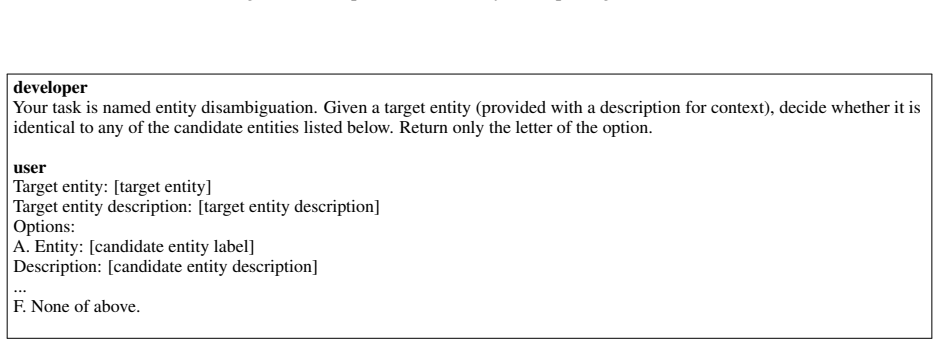
The load-bearing mechanism is context-guided named-entity disambiguation (NED) in two rounds. In round one, the source triple supplies the context: the model sees the target label, the triple it came from, and descriptions of the top label-similar candidates, and chooses match, new, or unsure. New entities receive a generated one-sentence description, which feeds round two: for labels with many homonyms, candidates sharing the exact label are ranked by description similarity and the model again decides match or new. Around this, guarded parallelization clusters pending mentions by label embedding and processes them only after the earliest mention of a label has been resolved, preventing conc
Load-bearing premise
The load-bearing premise is that the LLM's identity decisions—made from a source triple and candidate descriptions—stay accurate across tens of millions of choices, even though they are checked on only a few hundred manually labeled cases, and the synonymy-split check only searches among label-similar neighbors.
What would settle it
Resolve a random sample of 500 triple-object mentions from the released KB against an independent inventory (human annotation or an external KB) and compare merge/split outcomes with GPTKB 2.0's IDs; a large disagreement would show the IDs are internally consistent but not anchored to real-world identity. A cheaper test: search for synonymous duplicates with dissimilar surface forms (e.g., nicknames, translations) among sampled entities—the paper's own split-accuracy estimate does not cover these.
If this is right
- Knowledge base construction no longer needs a curated identifier scaffold; an LLM's parametric knowledge can be materialized into a queryable, disambiguated KB starting from a single seed entity.
- A meaningful share of the resulting KB (36.8% of sampled entities) is absent from Wikidata, concentrated in the long tail, so LLM-native construction can complement curated KBs where coverage is thinnest.
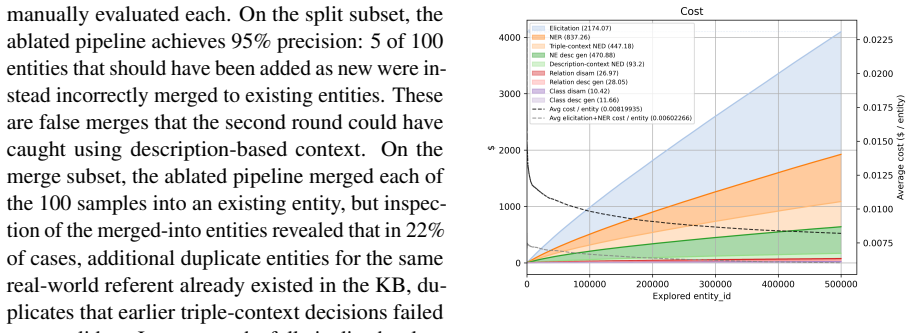
- With roughly 47.7M API calls, a 70-day run, and a reported cost of $6,992, disambiguated construction at this scale is economically feasible, not just a theoretical design.
- The two-round NED with intermediate description generation is what keeps high-density homonyms (e.g., 309 distinct entities labeled 'Faculty of Law') separate while still merging synonyms.
- The data model makes the result directly browsable and queryable via SPARQL, enabling aggregate statistical analyses such as gender and regional bias audits.
Where Pith is reading between the lines
- The same two-round disambiguation design could transfer to domain-specific KBs (biomedical, legal, cultural) where synonymy and homonymy are dense, as long as a seed entity and a context triple are available; the paper only demonstrates the open-domain case.
- Because split accuracy is measured only among label-similar neighbors, an obvious extension is a targeted audit for synonymous duplicates with dissimilar surface forms (e.g., nicknames or translations); the reported 95% split-accuracy figure would likely drop somewhat under that test.
- If the identity judgments are stable, the declining per-entity cost as the KB grows suggests the pipeline becomes cheaper with scale—merging and caching accelerate—so the marginal cost of a much larger KB could be small, though undetected duplicate accumulation is the main risk.
Editorial analysis
A structured set of objections, weighed in public.
Referee Report
Summary. The paper introduces GPTKB 2.0, a pipeline for constructing a disambiguated knowledge base directly from LLM parametric knowledge without linking to external identifiers such as Wikipedia or Wikidata. Starting from a seed entity, the pipeline alternates triple elicitation, NER, and a two-round NED process (triple-context and description-context) with label- and description-embedding candidate retrieval, guarded parallelization, and caching. The authors report a materialized KB of 38.4M triples, 1.59M entities, 207.6K relations, and 66.5K classes, with 36.8% of sampled entities novel to Wikidata. They further report manual and LLM-based evaluations indicating over 90% precision for NED, triples, and entities, and claim this is the first million-scale LLM-native KB with explicit internal canonicalization of entities, relations, and classes.
Significance. If the canonicalization claims hold, this is a substantial advance for LLM-native knowledge base construction. The engineering contributions are real: the guarded-parallelization and caching design makes on-the-fly disambiguation feasible at tens of millions of decisions, and the cost/scaling analysis is unusually concrete. The authors are also honest about several limitations, including missing provenance and time-static facts. The manual evaluation, while small, is a genuine external check and goes beyond many prior LLM-KB papers. However, the paper's central contribution is the claim that synonymy is 'addressed at scale,' and the current evaluation has a structural blind spot for label-dissimilar duplicates. That gap is load-bearing for the canonicalization claim and needs to be closed or the claim needs to be substantially qualified.
major comments (2)
- [§3.2.3, §5.1] The synonymy-split evaluation is circular with respect to the pipeline's retrieval mechanism. The pipeline retrieves candidates only by label-embedding similarity (§3.2.3, top-5), while the split evaluation samples the top-20 label-embedding neighbors of each entity. A true duplicate whose surface label is not embedding-similar is therefore never proposed in either the pipeline or the evaluation. The paper acknowledges that 'duplicates with very different surface forms may go undetected' but then downplays this as 'slightly lower' accuracy. Since free-form elicitation can easily produce paraphrases or translations, and since Description-Context NED is restricted to exact-label high-density homonyms, the pipeline has no mechanism at all to merge label-dissimilar synonyms. Consequently, the consolidation statistics in Contribution 2 (2,316,275 surface labels → 1,592,185 entities) are not y
- [§5.1, §5.3, Table 3] The paper's central quantitative claim of '>90% precision for all of NED, triples, and entities' is not statistically supported as stated. Each NED direction is evaluated on only 100 manually annotated cases, and triple/entity factuality on 200 cases, with no confidence intervals. For example, the observed synonym-merge precision is 91%, whose 95% confidence interval is roughly [83.6, 95.5], so the data are consistent with true precision below 90%. The human triple evaluation also involved the authors themselves, with agreement reported as 90/100 on a subsample. I would ask the authors to report binomial confidence intervals for all headline numbers, and either increase the sample sizes for the cells that anchor the 'over 90%' claim or soften the claim accordingly.
minor comments (5)
- [Figure 1] Caption contains a typo: 'syonymy' should be 'synonymy'.
- [Appendix C] 'Tabel 5' should be 'Table 5'.
- [§5.2] The baseline comparison sentence 'there are a total of 365 entities that are memberOf the Eurozone, while in GPTKB 2.0, there are only 30.1' is garbled: '30.1' is not meaningful for an entity count, and the footnote explanation should be moved into the main text or made clearer.
- [Abstract / §6.1] The abstract says the KB is available at https://gptkb.org/, while the full text says it is anonymously available at https://materialized-kb.org/. This inconsistency should be resolved.
- [Table 3] The rows 'Merge correct 94.5%' and 'Split correct 97.5%' are averages of the four per-cell numbers in §5.1. This should be stated explicitly, as the reader might otherwise expect a single NED accuracy figure.
Circularity Check
Synonym-split evaluation is self-sampling: the 95% split accuracy is measured on label-embedding neighbors, the same retrieval that defines the pipeline's only synonym-merge mechanism, so label-dissimilar duplicates are invisible by construction.
specific steps
-
self definitional
[Section 5.1, 'Split Accuracy' (synonym splits); cf. Section 3.2.3, Triple-Context NED]
"For synonym splits, exhaustively checking the entire KB for synonymous duplicates is infeasible, so we approximate through targeted sampling. For each of 100 random entities, we retrieve the top-20 nearest neighbors by label embedding similarity and manually check whether any candidate refers to the same real-world entity. For 95 of 100 samples (95%), no synonymous duplicate is found. This estimate captures only duplicates whose labels are embedding-similar to the sampled entity; duplicates with very different surface forms may go undetected, so the true synonym split accuracy could be slightl"
Both the pipeline's only synonym-merge mechanism and the split-accuracy sample are defined by the same label-embedding retrieval. Section 3.2.3 retrieves NED candidates 'by label embedding similarity'; Section 5.1 samples 'the top-20 nearest neighbors by label embedding similarity'. A label-dissimilar synonym is never proposed to the LLM in Triple-Context NED, so it becomes a new entity; the same retrieval also keeps it out of the annotator's candidate list. The 95% figure is therefore an upper bound on 'no duplicate among label-similar neighbors,' not a measurement of the true duplicate rate. The paper's caveat that the true accuracy 'could be slightly lower' understates this: the evaluation cannot, by construction, detect the failure mode the pipeline cannot address. Since the consolidat
full rationale
The construction pipeline itself is not fully circular: triples are elicited from an LLM, NER/NED is context-guided, and independent grounding is provided by 400 human NED annotations, 200 human triple/entity verifications, and web-search-based LLM verification with an LLM- ablation. No load-bearing self-citation chain or imported uniqueness theorem was found; self-citations (e.g., seed choice mirroring Hu et al. 2025, seed-irrelevance via Giordano & Razniewski) are not central to the disambiguation claim. However, the synonym-split evaluation is partially circular: its candidate sample is generated by the same label-embedding similarity used in Triple-Context NED candidate retrieval, so the 95% result cannot detect the error mode the pipeline is structurally unable to merge, namely label-dissimilar synonyms. The paper explicitly acknowledges this limitation in the same paragraph but frames it as 'slightly lower'; in a KB built from free-form LLM elicitation, where paraphrases and translations are common, the unmeasured error mode could be material. Because Contribution 2's consolidation statistics are the principal evidence for 'addresses synonymy at scale,' the central claim is not fully validated on this axis. Score 6 reflects one load-bearing but explicitly acknowledged partial circularity; it is not a fully circular derivation.
Axiom & Free-Parameter Ledger
free parameters (5)
- top-k NED candidates =
5
- caching and guarded parallelization threshold =
50
- embedding model =
Qwen3-Embedding-4B
- seed entity =
Vannevar Bush
- LLM role assignment =
GPT-5.1 for elicitation and description generation; GPT-5-mini for NER and NED
axioms (4)
- domain assumption The semantic graph of general world knowledge has a giant connected component reachable from any reasonable seed.
- domain assumption The LLM's NED decisions, given the source triple and candidate descriptions, are reliable proxies for real-world entity identity.
- domain assumption A textual description plus unique ID is sufficient to keep entities distinguishable; any two elements differ in label or description.
- domain assumption Web-retrieved snippets and agentic LLM judging are valid evidence for factuality.
Cite this review
Pith. "Pith review of GPTKB 2.0: Direct Construction of Disambiguated Knowledge Bases from Large Language Models." pith.science (2026). https://pith.science/paper/ZHRUXFJG
@misc{pith2026260803729,
  author       = {Pith},
  title        = {Pith review of: GPTKB 2.0: Direct Construction of Disambiguated Knowledge Bases from Large Language Models},
  year         = {2026},
  howpublished = {\url{https://pith.science/paper/ZHRUXFJG}},
  note         = {Machine review of arXiv:2608.03729}
}
read the original abstract
Automated Knowledge Base Construction (AKBC) is a core NLP task, and recent work proposes generating knowledge bases directly from large language models (LLMs), treating the model itself as the knowledge source. However, LLMs natively possess no representation of entities, leading to duplicate entries as well as conflations. We propose GPTKB 2.0, a methodology for constructing disambiguated KBs directly from LLMs. GPTKB 2.0 incorporates on-the-fly disambiguation of entities, relations and classes, and is meticulously designed to satisfy both scalability and disambiguation accuracy. We analyze the central design decisions and characterize the trade-offs between accuracy, scale, and cost. We execute GPTKB 2.0 at scale, obtaining a materialized KB containing over 1M disambiguated entities and 38.4M triples. This represents the first million-scale LLM-native KB with explicit internal canonicalization of entities, relations, and classes, a significant departure from prior Wikimedia-centric works. GPTKB 2.0 is available at https://gptkb.org/.
Figures






Reference graph
Works this paper leans on
-
[1]
Enabling LLM Knowledge Analysis via Extensive Materialization
Hu, Yujia and Nguyen, Tuan-Phong and Ghosh, Shrestha and Razniewski, Simon. Enabling LLM Knowledge Analysis via Extensive Materialization. Proceedings of the 63rd Annual Meeting of the Association for Computational Linguistics (Volume 1: Long Papers). 2025. doi:10.18653/v1/2025.acl-long.789
-
[2]
Yujia Hu and Tuan. Fortieth. 2026 , url =. doi:10.1609/AAAI.V40I48.42354 , timestamp =
-
[3]
Generating Domain-Specific Knowledge Graphs from Large Language Models
Parovi \'c , Marinela and Li, Ze and Du, Jinhua. Generating Domain-Specific Knowledge Graphs from Large Language Models. Findings of the Association for Computational Linguistics: ACL 2025. 2025. doi:10.18653/v1/2025.findings-acl.602
-
[4]
arXiv preprint arXiv:2402.06738 , url=
EntGPT: Entity Linking with Generative Large Language Models , author=. arXiv preprint arXiv:2402.06738 , url=
-
[5]
Robust Disambiguation of Named Entities in Text
Hoffart, Johannes and Yosef, Mohamed Amir and Bordino, Ilaria and F. Robust Disambiguation of Named Entities in Text. Proceedings of the 2011 Conference on Empirical Methods in Natural Language Processing. 2011
2011
-
[6]
Mining the Mind: What 100M Beliefs Reveal About Frontier
Ghosh, Shrestha and Giordano, Luca and Hu, Yujia and Nguyen, Tuan-Phong and Razniewski, Simon , journal=. Mining the Mind: What 100M Beliefs Reveal About Frontier
-
[7]
Zero-Shot Entity Linking by Reading Entity Descriptions
Logeswaran, Lajanugen and Chang, Ming-Wei and Lee, Kenton and Toutanova, Kristina and Devlin, Jacob and Lee, Honglak. Zero-Shot Entity Linking by Reading Entity Descriptions. Proceedings of the 57th Annual Meeting of the Association for Computational Linguistics. 2019. doi:10.18653/v1/P19-1335
-
[8]
Extract, Define, Canonicalize: An LLM -based Framework for Knowledge Graph Construction
Zhang, Bowen and Soh, Harold. Extract, Define, Canonicalize: An LLM -based Framework for Knowledge Graph Construction. Proceedings of the 2024 Conference on Empirical Methods in Natural Language Processing. 2024. doi:10.18653/v1/2024.emnlp-main.548
-
[9]
Extracting Patterns and Relations from the World Wide Web , booktitle =
Sergey Brin , editor =. Extracting Patterns and Relations from the World Wide Web , booktitle =. 1998 , url =. doi:10.1007/10704656\_11 , timestamp =
-
[10]
Eugene Agichtein and Luis Gravano , title =. Proceedings of the Fifth. 2000 , url =. doi:10.1145/336597.336644 , timestamp =
-
[11]
Cafarella and Oren Etzioni and Stephen Soderland , editor =
Alexander Yates and Michele Banko and Matthew Broadhead and Michael J. Cafarella and Oren Etzioni and Stephen Soderland , editor =. TextRunner: Open Information Extraction on the Web , booktitle =. 2007 , url =
work page 2007
-
[12]
Canonicalizing Open Knowledge Bases , year =
Gal\'. Canonicalizing Open Knowledge Bases , year =. Proceedings of the 23rd ACM International Conference on Conference on Information and Knowledge Management , pages =. doi:10.1145/2661829.2662073 , abstract =
-
[13]
Vashishth, Shikhar and Jain, Prince and Talukdar, Partha , title =. 2018 , isbn =. doi:10.1145/3178876.3186030 , booktitle =
arXiv 2018
- [14]
-
[15]
Can Foundation Models Wrangle Your Data? , year =
Narayan, Avanika and Chami, Ines and Orr, Laurel and R\'. Can Foundation Models Wrangle Your Data? , year =. Proc. VLDB Endow. , month = dec, pages =. doi:10.14778/3574245.3574258 , abstract =
-
[16]
Schema Generation for Large Knowledge Graphs Using Large Language Models
Zhang, Bohui and He, Yuan and Pintscher, Lydia and Mero \ n o-Pe \ n uela, Albert and Simperl, Elena. Schema Generation for Large Knowledge Graphs Using Large Language Models. Findings of the Association for Computational Linguistics: EMNLP 2025. 2025. doi:10.18653/v1/2025.findings-emnlp.671
-
[17]
Data & Knowledge Engineering , volume=
Frameworks for entity matching: A comparison , author=. Data & Knowledge Engineering , volume=. 2010 , publisher=
work page 2010
-
[18]
Wikidata: a free collaborative knowledgebase , journal =
Denny Vrandecic and Markus Kr. Wikidata: a free collaborative knowledgebase , journal =. 2014 , url =. doi:10.1145/2629489 , timestamp =
doi:10.1145/2629489 2014
-
[19]
S. DBpedia:. The Semantic Web, 6th International Semantic Web Conference, 2nd Asian Semantic Web Conference,. 2007 , url =. doi:10.1007/978-3-540-76298-0\_52 , timestamp =
-
[20]
Loubna Ben Allal and Anton Lozhkov and Daniel van Strien , title =
-
[21]
Language Models as Knowledge Bases?
Petroni, Fabio and Rockt. Language Models as Knowledge Bases?. Proceedings of the 2019 Conference on Empirical Methods in Natural Language Processing and the 9th International Joint Conference on Natural Language Processing (EMNLP-IJCNLP). 2019. doi:10.18653/v1/D19-1250
-
[22]
ACM collective intelligence conference , year=
Gender bias and stereotypes in large language models , author=. ACM collective intelligence conference , year=
-
[23]
Suchanek and Gjergji Kasneci and Gerhard Weikum , editor =
Fabian M. Suchanek and Gjergji Kasneci and Gerhard Weikum , editor =. Yago: a core of semantic knowledge , booktitle =. 2007 , url =. doi:10.1145/1242572.1242667 , timestamp =
arXiv 2007
-
[24]
Crawling The Internal Knowledge-Base of Language Models , booktitle =
Roi Cohen and Mor Geva and Jonathan Berant and Amir Globerson , editor =. Crawling The Internal Knowledge-Base of Language Models , booktitle =. 2023 , url =. doi:10.18653/V1/2023.FINDINGS-EACL.139 , timestamp =
-
[25]
and Araki, Jun and Neubig, Graham
Jiang, Zhengbao and Xu, Frank F. and Araki, Jun and Neubig, Graham. How Can We Know What Language Models Know?. TACL. 2020. doi:10.1162/tacl_a_00324
-
[26]
Evaluating the Knowledge Base Completion Potential of
Veseli, Blerta and Razniewski, Simon and Kalo, Jan-Christoph and Weikum, Gerhard , booktitle=. Evaluating the Knowledge Base Completion Potential of. 2023 , doi=
work page 2023
-
[27]
Andrew Carlson and Justin Betteridge and Bryan Kisiel and Burr Settles and Estevam R. Hruschka Jr. and Tom M. Mitchell , editor =. Toward an Architecture for Never-Ending Language Learning , booktitle =. 2010 , url =. doi:10.1609/AAAI.V24I1.7519 , timestamp =
-
[28]
Discovering emerging entities with ambiguous names , booktitle =
Johannes Hoffart and Yasemin Altun and Gerhard Weikum , editor =. Discovering emerging entities with ambiguous names , booktitle =. 2014 , url =. doi:10.1145/2566486.2568003 , timestamp =
arXiv 2014
- [29]
-
[30]
Thorsten Ruprechter and Tiago Santos and Denis Helic , title =. Appl. Netw. Sci. , volume =. 2020 , url =. doi:10.1007/S41109-020-00305-Y , timestamp =
-
[31]
Mark Steyvers and Joshua B. Tenenbaum , title =. Cogn. Sci. , volume =. 2005 , url =. doi:10.1207/S15516709COG2901\_3 , timestamp =
-
[32]
The Knowledge Awakens: Keeping Knowledge Bases Fresh with Emerging Entities , booktitle =
Johannes Hoffart and Dragan Milchevski and Gerhard Weikum and Avishek Anand and Jaspreet Singh , editor =. The Knowledge Awakens: Keeping Knowledge Bases Fresh with Emerging Entities , booktitle =. 2016 , url =. doi:10.1145/2872518.2890537 , timestamp =
-
[33]
Luca Giordano and Simon Razniewski , editor =. Foundations of. Findings of EACL , year =
-
[34]
Xing and Zhiting Hu , editor =
Shibo Hao and Bowen Tan and Kaiwen Tang and Bin Ni and Xiyan Shao and Hengzhe Zhang and Eric P. Xing and Zhiting Hu , editor =. BertNet: Harvesting Knowledge Graphs with Arbitrary Relations from Pretrained Language Models , booktitle =. 2023 , url =. doi:10.18653/V1/2023.FINDINGS-ACL.309 , timestamp =
-
[35]
FA ct S core: Fine-grained Atomic Evaluation of Factual Precision in Long Form Text Generation
Min, Sewon and Krishna, Kalpesh and Lyu, Xinxi and Lewis, Mike and Yih, Wen-tau and Koh, Pang and Iyyer, Mohit and Zettlemoyer, Luke and Hajishirzi, Hannaneh. FA ct S core: Fine-grained Atomic Evaluation of Factual Precision in Long Form Text Generation. Proceedings of the 2023 Conference on Empirical Methods in Natural Language Processing. 2023. doi:10.1...
-
[36]
V eri S core: Evaluating the factuality of verifiable claims in long-form text generation
Song, Yixiao and Kim, Yekyung and Iyyer, Mohit. V eri S core: Evaluating the factuality of verifiable claims in long-form text generation. Findings of the Association for Computational Linguistics: EMNLP 2024. 2024. doi:10.18653/v1/2024.findings-emnlp.552
-
[37]
Proceedings of the ACM Web Conference 2026 , pages=
WiNELL: Wikipedia Never-Ending Updating with LLM Agents , author=. Proceedings of the ACM Web Conference 2026 , pages=
work page 2026
-
[38]
Proceedings of the ACM Web Conference 2026 , pages =
Gangi Reddy, Revanth and Dixit, Tanay and Qin, Jiaxin and Qian, Cheng and Lee, Daniel and Han, Jiawei and Small, Kevin and Fan, Xing and Sarikaya, Ruhi and Ji, Heng , title =. Proceedings of the ACM Web Conference 2026 , pages =. 2026 , isbn =. doi:10.1145/3774904.3792695 , abstract =
-
[39]
Proceedings of the 2011 Conference on Empirical Methods in Natural Language Processing,
Anthony Fader and Stephen Soderland and Oren Etzioni , title =. Proceedings of the 2011 Conference on Empirical Methods in Natural Language Processing,. 2011 , url =
work page 2011
-
[40]
Berglund, Lukas and Tong, Meg and Kaufmann, Maximilian and Balesni, Mikita and Stickland, Asa Cooper and Korbak, Tomasz and Evans, Owain , year=2024, doi=. The Reversal Curse:
work page 2024
-
[41]
How Much Knowledge Can You Pack Into the Parameters of a Language Model?
Roberts, Adam and Raffel, Colin and Shazeer, Noam. How Much Knowledge Can You Pack Into the Parameters of a Language Model?. EMNLP. 2020. doi:10.18653/v1/2020.emnlp-main.437
-
[42]
Can Generative Pre-trained Language Models Serve As Knowledge Bases for Closed-book
Cunxiang Wang and Pai Liu and Yue Zhang , journal=. Can Generative Pre-trained Language Models Serve As Knowledge Bases for Closed-book. 2021 , url=
work page 2021
-
[43]
Head-to-Tail: How Knowledgeable are Large Language Models ( LLM s)? A
Sun, Kai and Xu, Yifan and Zha, Hanwen and Liu, Yue and Dong, Xin Luna. Head-to-Tail: How Knowledgeable are Large Language Models ( LLM s)? A . K . A . Will LLM s Replace Knowledge Graphs?. NAACL. 2024. doi:10.18653/v1/2024.naacl-long.18
-
[44]
Availability: A heuristic for judging frequency and probability , journal =. 1973 , issn =. doi:https://doi.org/10.1016/0010-0285(73)90033-9 , url =
-
[45]
Nguyen, Tuan-Phong and Razniewski, Simon and Weikum, Gerhard , title =. Proceedings of the 33rd ACM International Conference on Information and Knowledge Management , pages =. 2024 , isbn =. doi:10.1145/3627673.3679768 , abstract =
-
[46]
Wenzek, Guillaume and Lachaux, Marie-Anne and Conneau, Alexis and Chaudhary, Vishrav and Guzm. LREC , year=
-
[47]
Workshop on Commonsense Representation and Reasoning (CSRR) , year=
Materialized Knowledge Bases from Commonsense Transformers , author=. Workshop on Commonsense Representation and Reasoning (CSRR) , year=
-
[48]
Foundations and Trends in Databases , volume=
Machine knowledge: Creation and curation of comprehensive knowledge bases , author=. Foundations and Trends in Databases , volume=. 2021 , publisher=
work page 2021
-
[49]
Andrea Moro and Alessandro Raganato and Roberto Navigli , title =. Trans. Assoc. Comput. Linguistics , volume =. 2014 , url =. doi:10.1162/TACL\_A\_00179 , timestamp =
doi:10.1162/tacl 2014
-
[50]
Roberto Navigli , title =. 2009 , url =. doi:10.1145/1459352.1459355 , timestamp =
-
[51]
How much is a Triple? Estimating the Cost of Knowledge Graph Creation , booktitle =
Heiko Paulheim , editor =. How much is a Triple? Estimating the Cost of Knowledge Graph Creation , booktitle =. 2018 , url =
work page 2018
-
[52]
doi:10.5281/zenodo.19910437 , url =
Razniewski, Simon and Ghosh, Shrestha and Giordano, Luca and Hu, Yujia and Kowalzik, Josua and Nguyen, Tuan-Phong , title =. doi:10.5281/zenodo.19910437 , url =
-
[53]
16th International Conference on Computational Linguistics, Proceedings of the Conference,
Eneko Agirre and German Rigau , title =. 16th International Conference on Computational Linguistics, Proceedings of the Conference,. 1996 , url =
work page 1996
-
[54]
WIREs Data Mining and Knowledge Discovery , volume =
Murtagh, Fionn and Contreras, Pedro , title =. WIREs Data Mining and Knowledge Discovery , volume =. doi:https://doi.org/10.1002/widm.53 , url =. https://wires.onlinelibrary.wiley.com/doi/pdf/10.1002/widm.53 , abstract =
- [55]
-
[56]
2025 , eprint=
Qwen3 Embedding: Advancing Text Embedding and Reranking Through Foundation Models , author=. 2025 , eprint=
2025
-
[57]
Luan, Yi and He, Luheng and Ostendorf, Mari and Hajishirzi, Hannaneh. Multi-Task Identification of Entities, Relations, and Coreference for Scientific Knowledge Graph Construction. Proceedings of the 2018 Conference on Empirical Methods in Natural Language Processing. 2018. doi:10.18653/v1/D18-1360
-
[58]
End-to-End Construction of NLP Knowledge Graph
Mondal, Ishani and Hou, Yufang and Jochim, Charles. End-to-End Construction of NLP Knowledge Graph. Findings of the Association for Computational Linguistics: ACL-IJCNLP 2021. 2021. doi:10.18653/v1/2021.findings-acl.165
This paper was first reviewed by deepseek-v4-flash on August 5, 2026.
discussion (0)
Sign in with ORCID, Apple, or X to comment. Anyone can read and Pith papers without signing in.