REVIEW 3 major objections 5 minor 45 references
Direct versus resolved photons in DPS in photoproduction on proton and nuclei
T0 review · 3 major / 5 minor · reviewed 2026-08-08 · deepseek-v4-flash
Pith's one-line read Resolved-photon 1⊗2 splitting raises DPS cross sections by a factor of about 1.6 in photoproduction, with direct photons taking over for charm dijets beyond $x_\gamma \ge 0.2$–$0.4$.
desk verdict Useful and honest model-dependent estimate of 1⊗2 contributions to resolved-photon DPS; the 1.6 needs a sensitivity analysis before being quoted as a number. read the letter →
The pith
A machine-rendered reading of the paper's core claim, the machinery that carries it, and where it could break.
The reading
What carries the argument
The machinery is the 1⊗2 splitting contribution to the double parton distribution: one parton from the resolved photon (1⊗2u) or from the target nucleon (1⊗2d) splits perturbatively into two partons, each initiating one hard subprocess, in addition to the conventional 2⊗2 mean-field term in which two independent partons from each side collide. For resolved photons the photon is modeled through vector dominance as a rho meson, giving the single-pole two-gluon form factor $F^\gamma_{2g}(\Delta)=1/(1+\Delta^2/m_\rho^2)$, while the proton side uses the dipole form $F_{2g}(\Delta)=1/(1+\Delta^2/m_g^2)^2$. The transverse-momentum integrals of these form factors, the geometric coefficients $U$, set the relative normalization of 2⊗2, 1⊗2u, and 1⊗2d; comparing those coefficients together with the DGLAP splitting functions produces the factor-1.6 enhancement and the direct-versus-resolved ratios. For direct photons the central object is instead the photon splitting into a quark–antiquark dipole whose transverse-momentum integral enters the direct-photon cross section directly.
What would settle it
Measure the DPS rate for two charm-plus-gluon dijets in photoproduction at the EIC as a function of $x_\gamma$: the paper predicts direct-photon dominance for $x_\gamma \ge 0.2$–$0.4$, so observing the direct-to-resolved ratio staying near unity in that region, or observing a resolved-photon rate that matches the pure 2⊗2 mean-field prediction without the factor-1.6 enhancement, would contradict the central claim.
Extended reading notes
Core claim
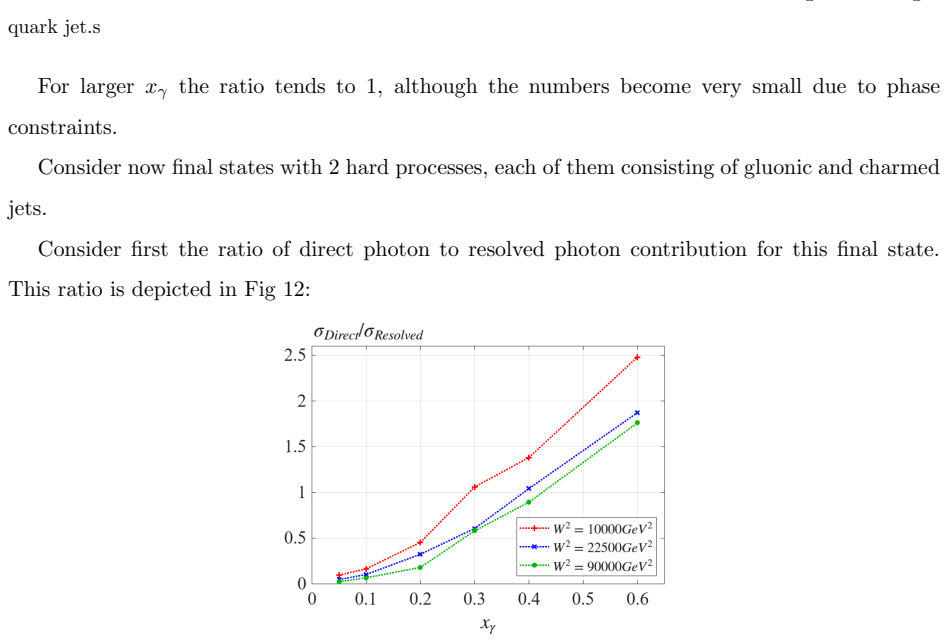
The paper claims that the 1⊗2 contributions to resolved-photon DPS are not a small correction. Even with hard-process transverse momenta around 3 GeV, the two splitting mechanisms together enhance the resolved-photon DPS cross section by a factor of order 1.6 over the 2⊗2 mean-field prediction over a wide range of the parton fraction $x_\gamma$, with the enhancement peaking near $x_\gamma\sim 0.2$–$0.4$ and falling only at the kinematic boundary. For final states of two gluon-plus-charm dijets, the direct photon contribution becomes dominant once $x_\gamma \ge 0.2$–$0.4$ (depending on energy), so the bulk of the DPS rate at larger $x_\gamma$ comes from direct photons; for light-quark-plus-gluon dijets the direct and resolved contributions become comparable only near $x_\gamma\sim 0.9$. On nuclear targets the direct-to-resolved ratio is enhanced because the $A^{4/3}$ term suppresses the 1⊗2u contribution, so the direct-photon dominance region starts at smaller $x_\gamma$ than on the proton.
Load-bearing premise
The entire resolved-photon program assumes the photon's two-parton distribution is the rho-meson one, with a single-pole form factor $1/(1+\Delta^2/m_\rho^2)$; if the true distribution differs at moderate transverse momenta, the factor 1.6 and the $x_\gamma$ boundaries shift.
Editorial extensions
If this is right
- EIC event generators for photoproduction must include the 1⊗2u and 1⊗2d contributions, otherwise resolved-photon DPS rates are underestimated by up to a factor of about 1.6 over a large part of the phase space.
- The charm-plus-gluon final state offers a handle to isolate direct-photon DPS: for $x_\gamma \ge 0.2$–$0.4$ direct photons dominate, so this kinematical region can be used to study the direct-photon mechanism and the photon structure.
- For light-quark-plus-gluon dijets, resolved photons dominate over direct photons through most of the accessible range, with the two becoming comparable only near $x_\gamma\sim 0.9$.
- Photon–nucleus collisions strengthen the direct-photon dominance because the $A^{4/3}$ two-nucleon term suppresses the 1⊗2u contribution, extending the direct-photon region to smaller $x_\gamma$.
- The density of DPS events in resolved-photon photoproduction peaks around $x_\gamma\sim 0.05$–$0.2$ depending on energy, so EIC measurements should be designed to cover that kinematic region.
Reading between the lines
- If the single-pole rho-dominance form factor is replaced by a photon two-parton distribution with a different transverse-momentum dependence, the factor 1.6 and the quoted $x_\gamma$ boundaries would likely move; computing the same ratios under an alternative photon-structure model would bracket the model uncertainty.
- The same 1⊗2 formalism should be applicable to resolved-photon DPS in ultraperipheral heavy-ion collisions at the LHC, where the $A^{4/3}$ nuclear enhancement may amplify the splitting contribution beyond what is visible at the EIC.
- The predicted sharp direct-photon threshold in the charm dijet channel could serve as a diagnostic of photon structure: a scan of the direct-to-resolved ratio across $x_\gamma=0.1$–$0.6$ at fixed energy would distinguish the rho-dominance form from alternatives.
Editorial analysis
A structured set of objections, weighed in public.
Referee Report
Summary. The paper studies double parton scattering (DPS) in photoproduction at EIC and HERA, focusing on the relative roles of direct and resolved photons. For resolved photons, it computes the 2⊗2 mean-field contribution and the two 1⊗2 mechanisms (parton from the photon splitting, 1⊗2u, and parton from the nucleon splitting, 1⊗2d), using vector dominance to model the photon GPD as a rho meson with a single-pole form factor. The central quantitative result is that 1⊗2 processes increase the resolved-photon DPS by a factor of order 1.6 relative to the 2⊗2 mean-field result in a wide x_γ region. The paper also compares direct and resolved photon contributions for final states with gluon+light-quark and gluon+charm jets, finding that direct photons dominate for charm at x_γ ≥ 0.3–0.4 (and at smaller x_γ for nuclear targets), and that resolved photons dominate at small x_γ. The nuclear case is treated by replacing the proton form factor with a nuclear profile function, leading to an A^{4/3} enhancement for interactions with two different nucleons.
Significance. The paper provides an explicit calculation of the 1⊗2 mechanisms in resolved-photon photoproduction, a contribution that has not been numerically evaluated before in this context. If the quoted enhancement factor is robust, the result is important for planning MPI measurements at EIC and for improving event generators. The paper also offers a practical handle for separating direct and resolved photon contributions via charm final states. The main strengths are the use of established pQCD DPS formalism and analytic treatment of the geometric enhancement factors; however, the quantitative predictions depend on several model parameters (Q0^2, m_g, κ, and the vector-dominance form factor) and no sensitivity study is provided, so the precision of the factor 1.6 is not yet established.
major comments (3)
- [II.A.2, Eqs. (19) and (21)] The definitions of the 1⊗2 splitting functions are incomplete as written. The displayed formulas contain only an integral over d²k_t, but the arguments x_1/(yz) and x_2/(y(1−z)) imply that y and z are also integration variables. No dy, dz, or associated phase-space factors are shown, and the integration ranges for y and z (e.g., 0<y<1, 0<z<1) are not stated. Since these integrals are the basis for the central 1.6 enhancement factor, the numerical results cannot be reproduced from the paper without this information.
- [III, Figs. 5–8 and Conclusions] The paper quotes the 1⊗2-induced enhancement factor as 'up to 1.6' without any uncertainty or sensitivity analysis. The size of the 1⊗2u and 1⊗2d contributions is controlled by the lower limit Q0^2 ≈ 0.5 GeV² in the k_t integration in Eq. (19) (and by m_c = 1.3 GeV for charm final states). For the minijet scales used (p_t ~ 3 GeV, Q² ~ 9 GeV²), changing Q0^2 in the plausible interval 0.25–1 GeV² changes ln(Q²/Q0²) by roughly 30%, and the DGLAP Green's functions in the integrand can amplify this into a larger shift in the ratio. The authors should provide a sensitivity scan over Q0^2, m_g, κ, and the form-factor parameters, and quote the resulting range for the enhancement factor, before the factor 1.6 can be taken as a robust prediction.
- [II.A.1, Eqs. (11)–(12) and Conclusion] The resolved-photon calculation relies entirely on the vector-dominance assumption that the photon two-gluon form factor equals the rho-meson form factor, modelled as a single pole 1/(1+Δ²/m_ρ²). The paper itself notes in the Conclusion that vector dominance does not give a full description of the photon structure for large x_γ, which is exactly the region where the direct-versus-resolved comparison is made. As a cross-check, the authors should test an alternative form factor (e.g., a dipole with a different mass scale, or a form factor including a second pole) and show that the factor 1.6 and the x_γ boundaries for charm dominance are not strong artifacts of this choice.
minor comments (5)
- [Throughout] The manuscript contains many typos, e.g., 'it s boundaries' in the abstract, 'reeolved' in the Introduction, 'final staes' in the caption of Fig. 15, and '1⊗2 u ,1⊗2 u' in the captions of Figs. 7 and 8 (should be 1⊗2 u and 1⊗2 d).
- [Eq. (13)] The analytic expression for U contains notation like 'm2 gm2 ρ' that is difficult to read; please use consistent superscript formatting and perhaps define intermediate results.
- [Eq. (20)] There is a double comma 'x4,, Q1^2' and the text 'fγ are thenPDFs of the photon' is garbled; please correct.
- [Figs. 5–15] The figures are not included in the manuscript text; since the results are central, the authors should ensure the figures are legible and that the captions clearly define what ratios are plotted (e.g., (2⊗2+1⊗2u+1⊗2d)/2⊗2 vs. individual contributions).
- [References [31], [32]] References [31] and [32] are the original LO GRV PDFs; please comment on the possible effect of using modern NNLO PDF sets on the numerical results.
Circularity Check
No significant circularity: the factor 1.6 is an output of an explicit calculation built on external, non-fitted inputs.
full rationale
The paper's central quantitative claim, that 1⊗2 processes increase resolved-photon DPS by a factor of order 1.6, is obtained by direct numerical evaluation of Eqs. (19) and (21), which combine DGLAP splitting kernels, PDFs from GRV (Refs. [31,32]), and the two-gluon form-factor parameters m_g (from HERA exclusive J/psi analyses, Ref. [29]) and m_rho (the known rho mass). No parameter is fitted to reproduce the factor 1.6 or the x_gamma boundaries; the result is a computed consequence of previously published, externally grounded ingredients. The 1⊗2 formalism is cited from the authors' earlier work [7,9], but the present paper performs the new resolved-photon calculation itself rather than merely restating a prior conclusion. The vector-dominance model for the photon GPD (Eqs. 11-12, 16) is an explicit physics assumption, not a self-referential definition, and the paper openly states that vector dominance may fail for large x_gamma. Concerns about sensitivity to the starting scale Q0^2 or to the rho-dominance form factor are legitimate robustness questions, but they do not constitute circularity because the prediction is not equivalent to its inputs by construction. The derivation chain is self-contained against external benchmarks, and the claimed enhancement is an unforced numerical outcome.
Assumptions & free parameters
free parameters (4)
- m_g (two-gluon formfactor mass scale of proton) =
~1 GeV; m_g² = 8/δ, δ from Eq. 9
- κ (vector dominance coefficient) =
2 (range 1-2 stated)
- f_ρ²/(4π) =
~0.5 GeV²
- Q_0² (starting scale for DGLAP evolution in 1⊗2) =
0.5 GeV² (light); m_c² for charm
assumptions (7)
- domain assumption Resolved photon GPD factorizes as f_γ(x,Q²) times a single-pole two-gluon formfactor 1/(1+Δ²/m_ρ²), with the photon PDF proportional to the ρ PDF (vector dominance).
- domain assumption Proton double GPD factorizes in the mean field approximation, G_2(x1,x2,Δ)=G_1(x1,Δ)G_1(x2,Δ), with dipole two-gluon formfactor F_2g=1/(1+Δ²/m_g²)².
- domain assumption The 1⊗2 mechanism is described by DGLAP splitting kernels and double DGLAP functions D_AB with lower integration limit Q_0²≈0.5 GeV² (charm: m_c²).
- domain assumption Direct photon DPS cross section is given by Eq. 23, taken from prior work Refs. [23,24].
- domain assumption Photon and proton PDFs are taken from GRV parametrizations (Refs. [31,32]).
- domain assumption Nuclear density is the Woods-Saxon profile with parameters from Refs. [34,35] (Eq. 30).
- domain assumption Proton mass neglected: p²=q²=0.
Cite this review
Pith. "Pith review of Direct versus resolved photons in DPS in photoproduction on proton and nuclei." pith.science (2026). https://pith.science/paper/OLQ4WD7W
@misc{pith2026260804259,
  author       = {Pith},
  title        = {Pith review of: Direct versus resolved photons in DPS in photoproduction on proton and nuclei},
  year         = {2026},
  howpublished = {\url{https://pith.science/paper/OLQ4WD7W}},
  note         = {Machine review of arXiv:2608.04259}
}
abstract
We study the process of double parton scattering (DPS) associated with the photoproduction at a future Electron-Ion collider (EIC) and HERA. We show that in the case of the resolved photon the 1 to 2 processes lead, even at small transverse momenta of the hard processes , to the increase of the DPS by a factor of order 1.6 in the significant part of the phase space, relative to the predictions of the mean field based models . Moreover we study the kinematic region where direct photon contribution is dominant and show it s boundaries for charm and light quark jets. For charmed jets we see that the relevant region is $x_\gamma\ge 0.2-0.4$. This region is even enhanced if we consider the photoproduction on the nuclei.
Figures


Figures from the paper (12 more)




Reference graph
Works this paper leans on
-
[21]
A. V. Manohar and W. J. Waalewijn, Phys. Rev. D85(2012) 114009
work page 2012
-
[1]
the mean field contribution to the DPS initiated by resolved photon is changed by a factor 1.6 forx γ ≥0.1 relative to standard 2⊗2 mean field contribution. The study of DPS in EIC will allow to reach kinematics of largex, in addition to central kinematics of orderx∼0.001−0.01 that is available at LHC and TEV ATRON
-
[2]
(10) and the last equality in Eq
dσ24 dt2 . (10) and the last equality in Eq. 10 is valid if we neglect the dependence ofm g on x. Consider now the case of the resolved photon– proton collisions. Due to the vector dominance we can expect that the GPD of the resolved photon is proportional to GPD of the vector meson. We shall assume the same factorization for the GPD 1 in the mean field a...
-
[3]
dσ13 dt1 dσ24 dt2 (18) wheref p are PDFs of the proton. The. function 1DA BC (x1, x2, Q2 1, Q2
-
[4]
is the part of the photon double GPD corresponding to the split of the parton A in the resolved photon into two: partons B and C. 1DA BC (x3, x4, Q1, Q2) = Z d2kt (2π)2 ΦA BC (z)f A γ (y, k2 t ) ×D AC(x1/(yz), k2 t , Q2 1)DAB(x2/(y(1−z)), k 2 t , Q2 2)/(y2z(1−z)k 2 t ) (19) Here ΦA BC is the splitting vertex, which is equal to the correspondingA→BCDGLAP k...
-
[5]
The corresponding formfactor U is now justm 2 ρ/(4π)
is the part of the parton GPD corresponding, to split of the parton iA n proton into two: 1DA BC (x3, x4, Q1, Q2) = Z d2kt (2π)2 ΦA BC (z)f A p (y, k2 t ) 9 ×D AC(x3/(yz), k2 t , Q2 1)DAB(x4(y(1−z)), k 2 t , Q2 2)/(y2z(1−z)k 2 t ) (21) where Φ is the splitting vertex, andf p is the PDF of the splitting parton in the nucleon. The corresponding formfactor U...
-
[6]
1 z(1−z) × M 2 (x1x3 √x1x3)16π(yW 2)3/2 q x1x3yW 2 −4Q 2 1 × M 2 (x2x4 √x2x4)16π(yW 2)3/2 q x1x3yW 2 −4Q 2 2 ×U(x 3, x4)f(x 3, Q2 1)fg(x4, Q2 2) 10 (23) In this section we use the following DGLAP vertices: Φg gg = 2N c(z/(1−z) + (1−z)/z+z(1−z)) Φg q¯q = 1 2 (z2 + (1−z) 2) Φq qg =c F (1 +z 2)/(1−z) (24) The matrix elements of the corresponding hard process...
-
[7]
The formfactorF A(∆,−∆) is the nucleus body form factor, while the formfactorUis defined by Eq
dσ dt1 dσ dt2 Z d2∆ (2π)2 F ′ A(∆,−∆) (25) where D is the two parton GPD of the projectile nucleon or photon,and F ′ A(∆,−∆) =F A(∆,−∆) +AU(∆).(26) A is the total number of the nucleons in the nucleus. The formfactorF A(∆,−∆) is the nucleus body form factor, while the formfactorUis defined by Eq. 15. The first term corresponds to the processes when two pa...
Show all 45 references
-
[8]
The two charm two gluon jets final state becomes dominant atx γ ∼0.2−0.4, depending on the energy,
-
[9]
Our results indicate that vector dominance does not give full description of the photon structure for largex γ
The direct photons become dominant even for smallerx γ for photoproduction on the nuclei for the same energy and luminosity. Our results indicate that vector dominance does not give full description of the photon structure for largex γ
-
[10]
Paver and D
N. Paver and D. Treleani, Nuovo Cim. A70(1982) 215
1982
-
[11]
Mekhfi, Phys
M. Mekhfi, Phys. Rev. D32, 2371 (1985)
1985
-
[12]
Gaunt and W.J
J.R. Gaunt and W.J. Stirling, JHEP1003, 005 (2010)
2010
-
[13]
Blok, Yu
B. Blok, Yu. Dokshitzer, L. Frankfurt and M. Strikman, Phys. Rev. D83, 071501 (2011)
2011
-
[14]
Diehl, PoS DIS2010(2010) 223
M. Diehl, PoS DIS2010(2010) 223
2010
-
[15]
Gaunt and W.J
J.R. Gaunt and W.J. Stirling, JHEP1106, 048 (2011)
2011
-
[16]
Blok, Yu
B. Blok, Yu. Dokshitser, L. Frankfurt and M. Strikman, Eur. Phys. J. C72, 1963 (2012) 20
2012
-
[17]
Diehl, D
M. Diehl, D. Ostermeier and A. Schafer, JHEP1203(2012) 089
2012
-
[18]
Blok, Yu
B. Blok, Yu. Dokshitser, L. Frankfurt and M. Strikman, arXiv:1206.5594v1 [hep-ph] (unpublished)
-
[19]
B. Blok, Y. Dokshitzer, L. Frankfurt and M. Strikman, Eur. Phys. J. C74(2014) 2926
2014
-
[20]
Diehl, J
M. Diehl, J. R. Gaunt and K. Sch¨ onwald, JHEP1706(2017) 083
2017
-
[22]
Strikman and D
M. Strikman and D. Treleani, Phys. Rev. Lett.88(2002), 031801 doi:10.1103/PhysRevLett.88.031801 [arXiv:hep-ph/0111468 [hep-ph]]
2002 arXiv
-
[23]
B. Blok, M. Strikman and U. A. Wiedemann, Eur. Phys. J. C73(2013) no.6, 2433
2013
-
[24]
Adv. Ser. Direct. High Energy Phys.29(2018) 2019, P. Bartalini and J. Gaunt Editors
2018
-
[25]
Yung, private communication
H. Yung, private communication
-
[26]
J. M. Butterworth, J. R. Forshaw and M. H. Seymour, Z. Phys. C72(1996), 637-646
1996
-
[27]
H1 and Zeus Collaborations, Eur. Phys. J. C 72, 1995 (2012). arXiv:1203.1170 [hep-ph]
2012 arXiv
-
[28]
Jung (H1 and ZEUS Collaborations), in Proceedings 40th Inter- national Symposium on Multiparti- cle Dynamics (ISMD 2010) 21– 25 Sept 2010, ed
H. Jung (H1 and ZEUS Collaborations), in Proceedings 40th Inter- national Symposium on Multiparti- cle Dynamics (ISMD 2010) 21– 25 Sept 2010, ed. by P. Van Mechelen,University of Antwerp, Belgium, pp 69–74. http://indico.cern.ch/conferenceDisplay.py? confId=68643. arXiv:1012.1...
2010 arXiv
-
[29]
A. J. Baltz, G. Baur, D. d’Enterria, L. Frankfurt, F. Gelis, V. Guzey, K. Hencken, Y. Kharlov, M. Klasen and S. R. Klein,et al.Phys. Rept.458(2008), 1-171
2008
-
[30]
F. A. Ceccopieri and M. Rinaldi, Phys. Rev. D105(2022) no.1, L011501 doi:10.1103/PhysRevD.105.L011501 [arXiv:2103.13480 [hep-ph]]
2022 arXiv
-
[31]
J. M. Butterworth, I. Helenius, J. J. J. Castella, B. Pattengale, S. Sanjrani and M. Wing, SciPost Phys. 17(2024) no.6, 158
2024
-
[32]
Blok and M
B. Blok and M. Strikman, Eur. Phys. J. C74(2014) no.12, 3214 doi:10.1140/epjc/s10052-014-3214-7 [arXiv:1410.5064 [hep-ph]]
2014 arXiv
-
[33]
Blok and R
B. Blok and R. Segev, Phys. Rev. D113(2026) no.1, 014009
2026
-
[34]
Feynman, Photon-hadron interactions, Westview press, 1972
R. Feynman, Photon-hadron interactions, Westview press, 1972
1972
-
[35]
Frixione, M
S. Frixione, M. L. Mangano, P. Nason and G. Ridolfi, Phys. Lett. B319(1993), 339-345
1993
-
[36]
R. K. Ellis, W. J. Stirling and B. R. Webber, Camb. Monogr. Part. Phys. Nucl. Phys. Cos- mol.8(1996), 1-435 Cambridge University Press, 2011, ISBN 978-0-511-82328-2, 978-0-521-54589-1 doi:10.1017/CBO9780511628788
1996 doi
-
[37]
Diehl, Phys
M. Diehl, Phys. Rept.388(2003), 41-277
2003
-
[38]
Frankfurt, M
L. Frankfurt, M. Strikman and C. Weiss, Phys. Rev. D83(2011), 054012 doi:10.1103/PhysRevD.83.054012 [arXiv:1009.2559 [hep-ph]]
2011 arXiv
-
[39]
Broniowski and E
W. Broniowski and E. Ruiz Arriola, Phys. Lett. B574(2003), 57-64
2003
-
[40]
Gluck, E
M. Gluck, E. Reya and A. Vogt, Phys. Rev. D46(1992), 1973-1979 doi:10.1103/PhysRevD.46.1973
1992 doi
-
[41]
Gl¨ uck, E
M. Gl¨ uck, E. Reya and A. Vogt, Eur. Phys. J. C5(1998), 461-470 doi:10.1007/s100520050289 [arXiv:hep-ph/9806404 [hep-ph]]
1998 arXiv
-
[42]
Y. L. Dokshitzer, D. Diakonov and S. I. Troian, Phys. Rept.58(1980), 269-395. 21
1980
-
[43]
C. M. Tarbert, D. P. Watts, D. I. Glazier, P. Aguar, J. Ahrens, J. R. M. Annand, H. J. Arends, R. Beck, V. Bekrenev and B. Boillat,et al.Phys. Rev. Lett.112(2014) no.24, 242502 doi:10.1103/PhysRevLett.112.242502 [arXiv:1311.0168 [nucl-ex]]
2014 arXiv
-
[44]
Warda, X
M. Warda, X. Vinas, X. Roca-Maza and M. Centelles, Phys. Rev. C81(2010), 054309 doi:10.1103/PhysRevC.81.054309 [arXiv:1003.5225 [nucl-th]]
2010 arXiv
-
[45]
Blok and F
B. Blok and F. A. Ceccopieri, Eur. Phys. J. C80(2020) no.8, 762
2020
Reviewed August 8, 2026 · model on record in the stance chip above.
Discussion (0). Continue with ORCID to comment.