REVIEW 3 major objections 5 minor 20 references
Quantum-information fingerprints of partial dynamical symmetry in the interacting boson model
T0 review · 3 major / 5 minor · reviewed 2026-08-15 · deepseek-v4-flash
Pith's one-line read One variance flags which nuclear-model states keep exact symmetry
desk verdict The numerical story is substantial, but the central variance diagnostic rests on a false injectivity premise that the stress-test correctly identifies. read the letter →
The pith
A machine-rendered reading of the paper's core claim, the machinery that carries it, and where it could break.
The reading
What carries the argument
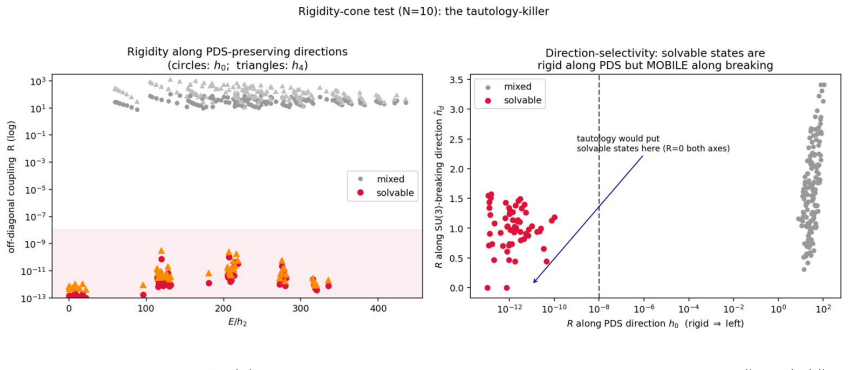
The central object is the label variance of a quadratic Casimir, $\mathrm{Var}_\psi(\hat{C}_2[G]) = \sum_\lambda P_\lambda [f_2(\lambda) - \langle \hat{C}_2 \rangle]^2$, built from the block probabilities $P_\lambda(\psi) = \|\Pi_\lambda |\psi\rangle\|^2$ over the irreducible-representation blocks of a chosen subalgebra $G$. Theorem 1 identifies its vanishing with the vanishing of the block-coherence entropy $S_G(\psi) = -\sum_\lambda P_\lambda \ln P_\lambda$ and with unit block purity $P_G(\psi) = \sum_\lambda P_\lambda^2$; each condition holds exactly when $|\psi\rangle$ lies in a single block. A second mechanism, the cone rigidity $R_D = \|Q_D |\psi\rangle\|$, measures the first-order response of an eigenstate to a deformation along the direction $D$, vanishing on the solvable states along the PDS-preserving directions $h_0$ and $h_4$ while remaining of order one along the symmetry-breaking direction $\hat{n}_d$. The paper uses the variance as the primary diagnostic because it needs only two expectation values and no explicit block decomposition.
What would settle it
Compute the full set of quadratic-Casimir eigenvalues for the SU(3) and O(5) blocks within the sd-IBM Hilbert space at the boson numbers studied and check for collisions between distinct irreps; if any two distinct irreps share an eigenvalue, then a superposition of those two irreps would have zero label variance while carrying two labels, refuting the exact equivalence claimed in Theorem 1.
Extended reading notes
Core claim
The central claim is that in the $sd$-interacting boson model partial dynamical symmetry is detected not by the magnitude of bipartite entanglement but by the label variance $\mathrm{Var}_\psi(\hat{C}_2[G])$ of a subalgebra's quadratic Casimir, namely $\mathrm{Var}_\psi(\hat{C}_2[G]) = \sum_\lambda P_\lambda [f_2(\lambda) - \langle \hat{C}_2 \rangle]^2$, where $P_\lambda$ is the squared projection of the state onto the irreducible-representation block $\lambda$. The paper proves that this variance, the block-coherence entropy, and the block impurity all vanish together, and that they vanish precisely when the state occupies a single block and therefore carries an exact label. On the solvable subset of the SU(3)-PDS Hamiltonian the variance is zero to numerical precision while on the mixed states it scales as $O(N^2)$; at the first-order critical point the same dichotomy appears as a solvable subset amid maximal mixing, and at the second-order critical point a single conserved seniority label is shared by every state. The same criterion, applied at representative $^{168}\mathrm{Er}$ parameters, partitions the spectrum into the rotational band and the mixed background from wavefunctions alone. The paper claims the equivalence for any subalgebra with a quadratic Casimir but is explicit that the demonstrated separating power is for this model and these examples.
Load-bearing premise
The argument that zero label variance means one exact symmetry label assumes that no two distinct labels of the chosen subalgebra produce the same value of its quadratic Casimir in the model space; the paper asserts this one-to-one matching without proof.
Editorial extensions
If this is right
- A fitted interacting-boson Hamiltonian can be classified state by state: the label variance assigns each eigenstate a reproducible number, so the qualitative claim that some states are solvable and others mixed becomes a graded output with no separate spectral fit.
- At the first-order critical point the diagnostic finds a solvable subset amid maximal mixing, and at the second-order critical point it finds one conserved label shared by the whole spectrum, so the fingerprint itself carries the order of the transition.
- Because the label variance is uncorrelated with multipartite entanglement and with magic, it is an independent quantum-information axis rather than a restatement of either resource.
- The block-purity face makes the 'purity' and 'coherence' vocabulary of the quasi-dynamical-symmetry literature literal, and it demonstrates that a state can be block-pure while maximally entangled across the $s$-$d$ bipartition.
- With the degeneracy-resolved Casimir measurement, the diagnostic can be evaluated on variationally prepared qubit eigenstates, giving a hardware-compatible readout that survives the arbitrary rotations variational solvers return inside degenerate energy levels.
Reading between the lines
- The same variance diagnostic should transfer to IBM-2 and to Bose-Fermi variants, where the relevant subalgebra Casimirs are already known; the paper names this as future work but does not test it.
- Because a large label variance predicts anomalous inter-band $B(E2)$ strengths, a quantitative map from per-state variance to measured branching-ratio deviations is a testable extension the paper explicitly leaves open.
- The direction-selective rigidity suggests a fit-free device protocol—evolve prepared states under two members of a PDS-preserving operator family and threshold the drift—for which the paper supplies the Trotterized evolution primitive but does not run the protocol.
- If the one-to-one Casimir-eigenvalue premise survives in other algebras, the same $0$-versus-$O(N^2)$ dichotomy could serve as a general screening tool for candidate partial-dynamical-symmetry nuclei across fitted parameter libraries.
Signed reviews
Editorial analysis
A structured set of objections, weighed in public.
Referee Report
Summary. The paper introduces a state-resolved quantum-information diagnostic for partial dynamical symmetry (PDS) in the sd interacting boson model. The proposed quantity is the variance of a subalgebra Casimir, Var_psi(C2[G]), which the author claims is equivalent to a block-coherence entropy and a block impurity and vanishes iff the state carries a single irreducible-representation label. Using exact diagonalization, the paper reports that at stable SU(3)-PDS points, at Leviatan's first- and second-order critical Hamiltonians, and at 168Er-like parameters, the variance is zero on the solvable subset and O(N^2) on mixed states, while bipartite s-d entanglement magnitude does not separate the two classes. The paper also encodes the model on qubits, prepares eigenstates variationally, and discusses the degeneracy resolution needed for readout. It is careful about limitations and makes no claim of quantum advantage.
Significance. If correct, the diagnostic would convert the qualitative notion of PDS into a fit-independent, state-by-state structural number, and the paper is commendably honest about scope and limitations. It contains useful numerical verification of operator identities (Eq. (4)) and of the variance formula (Eq. (10)), and it clearly separates algebraic exact results from example-specific numerics. However, the central equivalence rests on an injectivity premise for Casimir eigenvalues that is false for SU(3), so the variance face of the diagnostic does not currently certify a unique irrep label. The block-purity and block-coherence faces do not require that premise and may repair the claim, but the numerical pipeline and figures are built on the variance.
major comments (3)
- [Sec. 3, Theorem 1 (Eq. (10))] The proof of Theorem 1 asserts 'Distinct irreps have distinct Casimir eigenvalues in the model space' and uses this injectivity to infer that Var=0 iff the state occupies a single block. This premise is false for SU(3) at N=6: the irreps (6,0) and (0,6) are both contained in the U(6) irrep [6], and in the paper's normalization C2(lambda,mu)=lambda^2+mu^2+lambda*mu+3lambda+3mu is symmetric, so C2(6,0)=C2(0,6)=54. Thus the normalized state |psi>=(|(6,0),L=0>+|(0,6),L=0>)/sqrt(2) satisfies Var_psi(C2[SU(3)])=0 even though S_G=ln2 and P_G=1/2; equivalently, condition (b) does not imply (a). Since the paper's solvability classification uses the threshold Var<1e-6, any eigenstate that is a mixture of conjugate irreps with equal Casimir value would be reported as solvable. The numerical results at N=6 (where the solvable tower itself includes (0,6)) and at larger N do not check whether the Hamiltonians of Eqs. (1), (5), and (6) couple conjugate irreps. Please either prove injectivity for the specific algebras and boson numbers used, or replace the variance by the block purity P_G or the block coherence S_G (which do not require injectivity) in the diagnostic and re-run the state counts and figures.
- [Sec. 10.2] The degeneracy-resolution readout proposed for prepared states, namely 'measure C2[G] and diagonalize it within the degenerate energy window', does not resolve the conjugate-irrep degeneracy described above, because states in (6,0) and (0,6) have exactly the same C2 eigenvalue. A VQD-prepared state that is an equal mixture of these two label-carrying states would pass the degeneracy-resolved variance test and be classified as solvable. The fix using P_G or S_G, or an additional label that separates conjugate irreps, needs to be incorporated before the hardware-readout claim is made.
- [Sec. 11 (Summary and outlook)] The closing claim that 'the equivalence of Theorem 1 holds generally for any subalgebra with a quadratic Casimir' is too strong. For any algebra whose Weyl group identifies conjugate highest weights, which is exactly the SU(3) case at hand, the quadratic Casimir cannot separate all irreps, so the variance face of the equivalence is not general. The generality statement should be restricted to the block-purity/block-coherence faces or to algebras for which the injectivity is established.
minor comments (5)
- [Throughout] The notation 's|d' appears as a single token in several places (for example, 's|dentanglement' in the Fig. 1 caption and elsewhere); it should be typeset as 's-d' or 's|d' with a space.
- [Fig. 2] The caption reports R less than about 3e-10 and R greater than about 70 without stating the normalization or the precise N values per panel; the text defines R_D, but the caption should be self-contained.
- [Sec. 8] The QFI values (5.2 versus 3.9 at N=6, etc.) are given without specifying the generator normalization or the number of states in each group; since the author states that only qualitative separations are robust, this caveat should appear in the main text where the numbers are quoted.
- [Eq. (5)] The operator P^dagger_2(beta0) is written with a normalization factor sqrt(7/2) but the second-quantized tensor normalization is not fully specified; the relation to Eq. (1) at beta0=sqrt(2) is verified numerically but not shown algebraically.
- [Reproducibility] The numerical results are not accompanied by a data or code repository; given the precision claims (3e-10, 1e-14), providing the diagonalization code or a data file would materially aid verification.
Circularity Check
Minor definitional circularity in the zero-on-solvable claim, but the independent numerical content is not reduced to the paper's inputs.
-
self definitional
[Abstract; Sec. 3, Theorem 1 and Eqs. (7)-(10); Sec. 4 stable-point results]
"Resolved state by state, this quantity is zero on the solvable subset and of order N^2 on the mixed states (Abstract); "Each of these three quantities vanishes exactly when |ψ⟩ occupies a single block, as the following elementary statement records. Its point is not the proof but that the same physical condition—an exact irrep label—is read simultaneously as a variance, as a coherence, and as a purity" (Sec. 3)."
The solvable subset is defined by the PDS condition of carrying exact irrep labels, so Theorem 1's equivalence (Var=0 iff a single label) makes the reported vanishing on solvable states a direct consequence of the definition rather than an independent discovery. The paper explicitly calls the statement elementary and says its point is not the proof. The non-circular content is carried by the numerically established O(N^2) scale on mixed states, cone rigidity along PDS-preserving directions, entanglement non-separation, the two distinct criticality fingerprints, and the qubit encoding, none of which follows from the definition alone.
full rationale
The paper's derivation chain is largely self-contained and externally benchmarked. Theorem 1 is an elementary equivalence between vanishing label variance, zero block coherence, unit block purity, and occupation of a single irrep block; the paper verifies its Eq. (10) numerically. The zero-on-solvable property is indeed true by construction because the solvable states are, by Leviatan's PDS construction, states with exact irrep labels, and the paper itself flags this as not the point. The independent contribution lies in the state-resolved numerical separations: mixed states have variance of order N^2, solvable states are rigid along PDS-preserving directions while mobile along symmetry-breaking directions, entanglement magnitude does not separate the two classes, first- and second-order critical points show qualitatively different label-variance fingerprints, and the qubit encoding reproduces the diagnostic under degeneracy resolution. None of these reduces to the definition of the label variance. The 168Er section fits λ to reproduce E(2+) but explicitly disclaims that recovering the rotor is built into the Hamiltonian, and the diagnostic partition itself uses wavefunctions alone. The citations to Leviatan and Kremer supply the PDS and QDS constructions used as inputs; they are not a self-citation chain that forces the paper's conclusions. The unproved injectivity assertion in Theorem 1 ('Distinct irreps have distinct Casimir eigenvalues in the model space') is a correctness risk rather than a circularity, and the specific conjugate-irrep counterexample suggested is not established for the IBM model space; in any case, an injectivity failure would make Theorem 1 false, not circular. Overall, the central diagnostic claim has a definitional core that is acknowledged, while the load-bearing numerical findings are independent.
Assumptions & free parameters
free parameters (4)
- solvable/mixed label-variance threshold =
10^-6
- lambda (rotational parameter) =
0.013 MeV
- h0 (PDS Hamiltonian coefficient) =
0.008 MeV
- h2 (PDS Hamiltonian coefficient) =
0.004 MeV
assumptions (3)
- standard math Distinct irreps in the IBM model space have distinct Casimir eigenvalues f^2(lambda) for SU(3) and O(5).
- domain assumption The solvable eigenstates of Leviatan's PDS Hamiltonians in Eqs. (1), (5), and (6) are exactly the ground and gamma bands (plus two U(5) states in the first-order case).
- standard math Exact diagonalization in the M=0 block captures exactly one representative of every angular-momentum multiplet and is sufficient for the state-resolved statistics.
Cite this review
Pith. "Pith review of Quantum-information fingerprints of partial dynamical symmetry in the interacting boson model." pith.science (2026). https://pith.science/paper/XKXVG3L3
@misc{pith2026260804486,
  author       = {Pith},
  title        = {Pith review of: Quantum-information fingerprints of partial dynamical symmetry in the interacting boson model},
  year         = {2026},
  howpublished = {\url{https://pith.science/paper/XKXVG3L3}},
  note         = {Machine review of arXiv:2608.04486}
}
abstract
Partial dynamical symmetry (PDS) is an algebraic structure in which a prescribed symmetry is neither exact nor completely broken: a subset of eigenstates keeps good quantum numbers and remains solvable while the rest of the spectrum mixes. PDS is currently identified from spectroscopic data, band-head energies, level systematics, and $B(E2)$ ratios. We ask whether it also has a purely structural signature in the eigenstates, and find that it does, though not in the magnitude of entanglement. The natural diagnostic is the variance of a symmetry Casimir, the label variance $\Var\,\C[G]$, which we show coincides with a block-coherence entropy and a block impurity: all three vanish exactly when a state carries a single irreducible-representation label. Resolved state by state, this quantity is zero on the solvable subset and of order $N^2$ on the mixed states, at stable symmetry points and at Leviatan's first- and second-order critical points, where it takes two distinct forms set by the order of the transition. The magnitude of bipartite entanglement, by contrast, does not separate solvable from mixed states and drifts even where the labels are exact. We anchor the analysis in $^{168}$Er, connect the block purity to the ``purity/coherence'' language of the quasi-dynamical-symmetry literature, and show the label variance is uncorrelated with multipartite entanglement and with magic. Finally we encode the model on a qubit register and prepare its solvable and mixed eigenstates variationally, as a step toward evaluating the diagnostic on a quantum device.
Figures


Figures from the paper (5 more)


Reference graph
Works this paper leans on
-
[6]
Partial Dynamical Symmetry at Critical-Points of Quantum Phase Transitions
A. Leviatan, “Partial dynamical symmetry at critical points of quantum phase transitions,” Phys. Rev. Lett.98, 242502 (2007), nucl-th/0703048. 12
work page Pith review arXiv 2007
-
[1]
F. Iachello and A. Arima,The Interacting Boson Model(Cambridge University Press, Cambridge, 1987)
work page 1987
-
[2]
Symmetries of the interacting boson model
P. Van Isacker, “Symmetries of the interacting boson model,” Front. Phys. (2018), arXiv:1808.10181
work page Pith review arXiv 2018
-
[3]
Partial Dynamical Symmetry in Deformed Nuclei
A. Leviatan, “Partial dynamical symmetry in deformed nuclei,” Phys. Rev. Lett.77, 818 (1996), nucl-th/9606049
work page Pith review arXiv 1996
-
[4]
Y . Alhassid and A. Leviatan, “Partial dynamical symmetry,” J. Phys. A25, L1265 (1992)
work page 1992
-
[5]
A. Leviatan, “Partial dynamical symmetries,” Prog. Part. Nucl. Phys.66, 93 (2011)
work page 2011
-
[7]
SU(3) partial dynamical symmetry and nuclear shapes
A. Leviatan, “SU(3) partial dynamical symmetry and nuclear shapes,” Eur. Phys. J. Special Topics229, 2405 (2020), arXiv:2010.10951
work page Pith review arXiv 2020
-
[8]
The survival of rotor andSU(3)bands under strong spin-orbit symmetry mixing,
P. Rochford and D. J. Rowe, “The survival of rotor andSU(3)bands under strong spin-orbit symmetry mixing,” Phys. Lett. B210, 5 (1988)
work page 1988
Show all 20 references
-
[9]
Dynamic structure and embedded representations in physics: The group theory of the adiabatic approximation,
D. J. Rowe, P. Rochford, and J. Repka, “Dynamic structure and embedded representations in physics: The group theory of the adiabatic approximation,” J. Math. Phys.29, 572 (1988)
1988
-
[10]
Linking partial and quasi dynamical symmetries in rotational nuclei,
C. Kremeret al., “Linking partial and quasi dynamical symmetries in rotational nuclei,” Phys. Rev. C89, 041302(R) (2014); Erratum Phys. Rev. C92, 039902 (2015), arXiv:1404.3826
2014 arXiv
-
[11]
Entanglement entropy as a signature of quantum phase transi- tions in the interacting boson model,
M. A. Jafarizadeh, M. Ghapanvari, and N. Amiri, “Entanglement entropy as a signature of quantum phase transi- tions in the interacting boson model,” Phys. Rev. C105, 014307 (2022)
2022
-
[12]
Quantum phase transitions in the Casten pyramid via entanglement entropy,
M. Ghapanvariet al., “Quantum phase transitions in the Casten pyramid via entanglement entropy,” Sci. Rep.15, 21168 (2025); and Nucl. Phys. A1053, 122960 (2025)
2025
-
[13]
Entanglement in the shell model,
A. Pérez-Obiolet al., “Entanglement in the shell model,” Eur. Phys. J. A59, 240 (2023), arXiv:2307.05197; Erratum EPJA62, 2 (2026)
2023 arXiv
-
[14]
Entanglement study in the island of inversion region,
R. M. Shinde and P. C. Srivastava, “Entanglement study in the island of inversion region,” Phys. Rev. C113, 064307 (2026), arXiv:2601.06544
2026 arXiv
-
[15]
Quantum magic and multipartite entanglement in nuclei,
F. Brökemeier, S. M. Hengstenberg, J. W. T. Keeble, C. E. P. Robin, F. Rocco, and M. J. Savage, “Quantum magic and multipartite entanglement in nuclei,” Phys. Rev. C111, 034317 (2025), arXiv:2409.12064
2025 arXiv
-
[16]
Variational quantum computation of excited states,
O. Higgott, D. Wang, and S. Brierley, “Variational quantum computation of excited states,” Quantum3, 156 (2019)
2019
-
[17]
Qiskit: An open-source framework for quantum computing
Qiskit contributors, “Qiskit: An open-source framework for quantum computing” (2024); Aer statevector simu- lator, version 2.5
2024
-
[18]
Advancing quantum simulations of the nuclear shell model with Gray- code-based resource-efficient protocols,
N. Singh, P. Siwach, and P. Arumugam, “Advancing quantum simulations of the nuclear shell model with Gray- code-based resource-efficient protocols,” Phys. Rev. C112, 034320 (2025)
2025
-
[19]
A digital quantum simulation of the Agassi model,
P. Pérez-Fernández, J.-M. Arias, J.-E. García-Ramos, and L. Lamata, “A digital quantum simulation of the Agassi model,” Phys. Lett. B829, 137133 (2022), arXiv:2105.02834
2022 arXiv
-
[20]
Nuclear physics in the era of quantum computing and quantum machine learning,
J.-E. García-Ramos, A. Sáiz, J. M. Arias, L. Lamata, and P. Pérez-Fernández, “Nuclear physics in the era of quantum computing and quantum machine learning,” Adv. Quantum Technol.8, 2300219 (2024). 13
2024
Reviewed August 15, 2026 · model on record in the stance chip above.
Discussion (0). Continue with ORCID to comment.