REVIEW 4 major objections 4 minor 78 references
First Results on Nucleon Resonance Electroexcitation Amplitudes from $ep \to e'\pi^+\pi^-p'$ Cross Sections at $W$ from $1.56-1.76$ GeV and $Q^2$ from $2.0-5.0$ GeV$^2$
T0 review · 4 major / 4 minor · reviewed 2026-08-06 · deepseek-v4-flash
Pith's one-line read First electroexcitation amplitudes of six nucleon resonances are extracted from pi+pi-p data, including a new N'(1720)3/2+ state.
desk verdict Fills a real kinematic gap and the N(1675)/N(1680) cross-channel consistency is solid, but the N'(1720) claim needs a fit without the state. read the letter →
The pith
A machine-rendered reading of the paper's core claim, the machinery that carries it, and where it could break.
The reading
What carries the argument
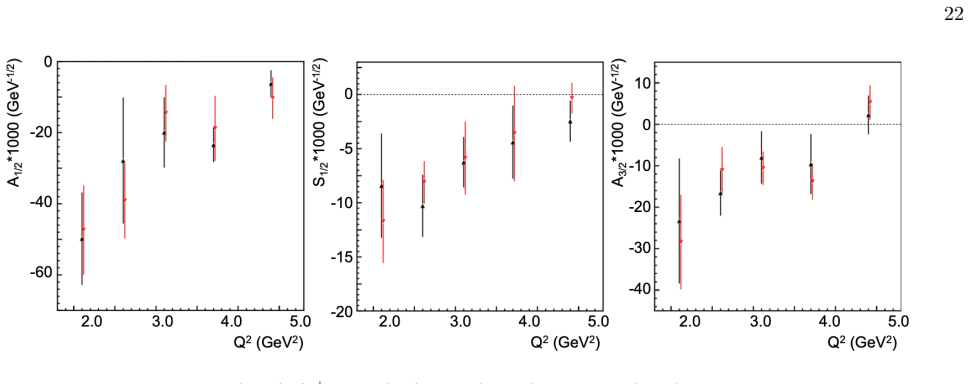
The central object is the set of $\gamma_v p N^*$ electrocouplings $A_{1/2}$, $A_{3/2}$, and $S_{1/2}$, the photon-transition amplitudes that encode how virtual photons excite each nucleon resonance. The machinery that carries the extraction is the JM23 reaction model, a phenomenological description of $\gamma_v p \to \pi^+\pi^-p'$ built from $\pi^-\Delta^{++}$, $\pi^+\Delta^0$, $\rho p$, $\pi^+N(1520)$, and $\pi^+N(1680)$ subchannels plus direct two-pion mechanisms, with $s$-channel resonances described by a unitarized Breit-Wigner ansatz. Fits to nine one-fold differential cross sections in overlapping $W$ intervals allow the resonant amplitudes to be isolated and averaged, and the consistency of parameters across those intervals is the main internal check on the separation.
What would settle it
Refit the same nine one-fold differential cross sections with an alternative non-resonant parameterization, for example with different $t$-channel forms or additional contact-term degrees of freedom, and check whether the extracted $A_{1/2}$, $A_{3/2}$, and $S_{1/2}$ for $\Delta(1700)3/2^-$ and $N'(1720)3/2^+$ move outside the quoted uncertainties.
Extended reading notes
Core claim
The paper's central claim is that the JM23 reaction model, fitted to nine one-fold $\pi^+\pi^-p$ differential cross sections measured on a proton target, can separate resonant from non-resonant contributions in the third resonance region and thereby yield the $\gamma_v p N^*$ electrocouplings $A_{1/2}$, $A_{3/2}$, and $S_{1/2}$ for six resonances. The results for $N(1675)5/2^-$ and $N(1680)5/2^+$ are consistent with the amplitudes obtained independently from $\pi N$ electroproduction, and the model requires both the established $N(1720)3/2^+$ and a second, nearby $N'(1720)3/2^+$ state with distinct decay patterns to describe the data up to $Q^2 = 5.0$ GeV$^2$. The paper further argues that the resonance masses and hadronic decay widths extracted from the fits do not vary with $Q^2$, which it reads as evidence that these states are genuine $s$-channel excitations with an inner core of three dressed quarks.
Load-bearing premise
The load-bearing premise is that the JM23 model's non-resonant amplitudes, which are adjusted in the fits, describe the background well enough that the $s$-channel resonant strength is not absorbed into those background terms; if that fails, the extracted electrocouplings are not genuine resonance parameters.
Editorial extensions
If this is right
- First electrocouplings for $\Delta(1700)3/2^-$ and $N(1720)3/2^+$ become available for $Q^2 > 2$ GeV$^2$, where these resonances' dominant $\pi\pi N$ decays make this channel the primary probe.
- The agreement between $\pi N$ and $\pi^+\pi^-p$ extractions for $N(1675)5/2^-$ and $N(1680)5/2^+$ supports using either channel independently for resonance parameters in the third resonance region.
- The $N'(1720)3/2^+$ state, previously seen only below $Q^2 = 1.5$ GeV$^2$, is shown to persist up to $Q^2 = 5$ GeV$^2$ with $Q^2$-independent mass and widths, strengthening the case that it is a real baryon state.
- The $Q^2$-independent masses and hadronic widths of the six resonances become empirical evidence that they are excited as $s$-channel states with a dressed-quark core, providing direct input for calculations of hadron mass emergence from strong QCD.
- The measured $Q^2$ evolution of the electrocouplings, including the longitudinal dominance of $\Delta(1700)3/2^-$, offers a new testing ground for models of dynamical chiral symmetry breaking.
Reading between the lines
- If the same fit strategy is carried into the 12-GeV energy regime, the $\pi^+\pi^-p$ channel could map electrocouplings for other 'missing' resonances over a wider $Q^2$ range, since the method does not rely on the $\pi N$ decay branch that makes such states hard to see in single-pion data.
- The striking difference between the longitudinal-dominated $\Delta(1700)3/2^-$ excitation and the transverse-dominated $\Delta(1232)3/2^+$ excitation, if confirmed, would make chiral-partner pairs a sharper diagnostic of the mechanism behind hadron mass than the resonance spectrum alone.
- A direct test would be to rerun the same fits with a completely different non-resonant model; if the extracted amplitudes move outside the quoted uncertainties, the model-dependence is larger than the paper's internal consistency checks suggest.
- The near-coincidence of results across overlapping $W$ intervals hints that the dominant uncertainty budget is set by the non-resonant parameterization rather than by the data statistics, so future experiments should focus on kinematics that constrain the background.
Editorial analysis
A structured set of objections, weighed in public.
Referee Report
Summary. The paper analyzes CLAS pi+pi-p electroproduction differential cross sections at W=1.56-1.76 GeV and Q2=2.0-5.0 GeV2 with the JM23 reaction model, extracting gamma_v p N* electrocouplings and hadronic decay parameters for Delta(1600)3/2+, N(1675)5/2-, N(1680)5/2+, Delta(1700)3/2-, N(1720)3/2+, and a new N'(1720)3/2+ state. The results for N(1675) and N(1680) are reported to be consistent with independent CLAS piN analyses, and the paper presents the first electrocouplings for Delta(1700) and N(1720) at Q2>2.0 GeV2. The main evidence for the new N'(1720) state is the good fit quality with Q2-independent masses and widths across the full Q2 range, together with differences in decay patterns and electrocouplings relative to the conventional N(1720).
Significance. If the extraction is reliable, the paper provides a substantial extension of the empirical knowledge of nucleon resonance electroexcitation into the third resonance region at high Q2, with genuinely useful constraints for continuum Schwinger methods, quark models, and future coupled-channel analyses. The cross-channel consistency for N(1675) and N(1680) between piN and pi+pi-p analyses is a real strength, as is the internal consistency across overlapping W intervals. The claimed observation of a new N'(1720)3/2+ state with a measured Q2 evolution would be an important result for the physics of 'missing' resonances. However, the significance is tempered by the strong model dependence of the extraction and by the absence of a direct test of whether the data actually require the new state.
major comments (4)
- [Section IV E and Table XV] The central claim that the new N'(1720)3/2+ state contributes to the pi+pi-p cross sections at Q2=2-5 GeV2 is not supported by a fit that excludes the state. All fits in Section III include N'(1720) in the resonance set (Table IV), and the selection criterion chi2/d.p.<1 in Table VII is applied only within this two-state model. To demonstrate that the data require the new state, the paper should report the chi2/d.p. and the resulting N(1720) parameters from a fit without N'(1720), and show whether the non-resonant amplitudes can compensate for its absence. Without such a test, the statement in Section IV E that the data 'conclusively demonstrated' contributions from both states is overstated.
- [Section III, Table VII] The description of the fit selection procedure is not sufficient to assess the statistical meaning of the extracted parameter uncertainties. The text says 'we selected the computed cross sections that were closest to the data and satisfied the condition chi2/d.p. < chi2_max/d.p.', but it does not state how the trial parameter sets are generated, how many fits enter the selection, or whether the selected set provides coverage of the parameter space. If only fits below an acceptance threshold are kept, the central values in Eqs. (3)-(5) and the RMS dispersions in Tables XI-XVIII may be biased and the uncertainties underestimated. Please specify the fitting algorithm, the number of trials, and the criteria used to define the 'closest' fits.
- [Section IV E] The argument that Q2-independent hadronic masses and widths for N'(1720) provide 'nearly model-independent evidence' for its existence is not decisive. The non-resonant amplitudes are renormalized independently in each (W,Q2) bin through the fitted magnitudes of contact terms, pi+N(1520), pi+N(1680), and direct-2pi mechanisms (Section III), so the fitted electrocouplings carry the Q2 dependence and a broad resonance-like enhancement near W~1.72 GeV could in principle be absorbed by these flexible backgrounds. A sharper test would be a fit with the non-resonant parameterization fixed from a global analysis or varied in a controlled way to see whether the N'(1720) amplitude remains required.
- [Section II B and Section IV E] There is an internal inconsistency in the treatment of N(1720)-N'(1720) mixing. Section II B states that transitions N(1720)3/2+ <-> N'(1720)3/2+ are incorporated into the JM23 model through the dressed resonance propagator, while Section IV E states that the distinct decay patterns of the two states 'prevents their mixing'. These statements cannot both be true. Please clarify which implementation is actually used, and quantify how the mixing transition affects the extracted electrocouplings of the two states.
minor comments (4)
- [Abstract] In the first sentence, 'electroexcitation amplitudes or the gamma_vpN* electrocouplings' should be 'electroexcitation amplitudes of the gamma_vpN* electrocouplings' or similar, since 'or' appears to be a typo.
- [Section IV B, Tables IX and X] The text appropriately cautions that the small uncertainties on the masses and widths of N(1675) and N(1680) should be interpreted with care because other decay modes were kept fixed; this caveat should also be stated in the conclusions where the Q2-independence of the widths is used as evidence of an s-channel origin.
- [Figures 3-5] The captions say that 'only the statistical uncertainties are shown, except for the particular data points ... dominated by systematic uncertainties', but the figures do not identify which points those are. Please add an explicit marker or explanation so the reader can distinguish the two classes of data points.
- [Conclusions and Outlook] Reference [75] appears to be a 1980 proceedings contribution on group-theoretical methods, not a work on lattice QCD, and does not seem to support the statement that progress is being made in lattice simulations of resonance physics. Please check and correct this citation.
Circularity Check
Extraction is largely self-contained, but the 'new N'(1720) observed' claim is partially circular because the state is inserted as a free fit input before being presented as a demonstrated output.
-
fitted input called prediction
[Sec. II B (Table IV), Sec. III, and Sec. IV E]
"The JM23 model incorporates contributions from all well-established N* states listed in Table IV. ... Analysis of the CLAS data on the pi+ pi- p differential cross sections in the third resonance region [37], performed within the JM23 meson-baryon reaction model [15], conclusively demonstrated contributions from both the conventional N(1720)3/2+ [42] and the new N'(1720)3/2+ [38] resonances."
N'(1720)3/2+ is included a priori in Table IV of the JM23 model with mass and width ranges taken from the authors' own Ref. [38]. The fits in Sec. III vary the electrocouplings of this state as a free parameter, and the chi2/d.p.<1 selection criterion (Table VII) is applied only within this two-state model. No fit without N'(1720) is reported, and the non-resonant amplitudes are renormalized independently in each (W,Q2) bin (contact terms, pi+N(1520), up to six direct-2pi parameters per Q2 bin). The conclusion that the new state's contributions are 'conclusively demonstrated' therefore restates the model choice to include it, rather than providing an independent test; a fitted amplitude for an assumed state is renamed as evidence for that state's existence.
full rationale
The main derivation chain is a normal fit-and-extract analysis: the JM23 model is adjusted to nine one-fold differential cross sections, and the electrocouplings are extracted from fitted resonant amplitudes. Fitted parameters are not circular merely because they are fitted. The N(1675)5/2- and N(1680)5/2+ results are checked against independent CLAS pi N analyses (Ref. [9]), and the Delta(1600)3/2+ comparison uses CSM predictions that predate these data, providing genuine external grounding. The single clear circularity concern is the N'(1720)3/2+ claim: the state is already present in the model and in the same group's prior analysis [38], and the paper offers no null-model fit or significance test against a model without it. This is a partial circularity in one highlighted sub-claim, not in the core extraction machinery, so the score is 4 rather than higher. The paper's argument that Q2-independent hadronic widths prove an s-channel origin is a model-discrimination argument, but without a no-N'(1720) alternative it does not resolve the circularity.
Assumptions & free parameters
free parameters (7)
- Non-resonant contact-term amplitudes in pi-Delta++ and pi+Delta0 subchannels =
one per Q2 bin, values not tabulated
- Magnitudes of pi+N(1520) and pi+N(1680) subchannel amplitudes =
per (W,Q2) bin
- Direct 2pi production amplitude magnitudes =
up to six per Q2 bin
- W-independent multiplicative factors for non-resonant amplitudes =
one per Q2 bin, mean about 1, sigma about 20%
- Breit-Wigner masses and partial widths Gamma_piDelta, Gamma_rhop for resonances in 1.6-1.76 GeV =
within PDG intervals, see Tables VIII-X, XIII, XV, XVII
- Electrocouplings of 1.9-2.0 GeV resonances (N(1900), Delta(1905), Delta(1920), Delta(1950)) =
from quark models [43,44], tuned to 1.9<W<2.0 data, kept fixed
- Electrocouplings of N(1440), N(1520), Delta(1600) =
within ranges from Ref [15]
assumptions (8)
- domain assumption Single-photon exchange approximation for the virtual photon cross sections
- domain assumption Completeness of JM23 mechanisms: the amplitude is a superposition of pi-Delta++, pi+Delta0, rho p, pi+N(1520), pi+N(1680), and direct 2pi contributions
- ad hoc to paper Negligible contribution of N(1710)1/2+
- domain assumption Unitarized Breit-Wigner ansatz with specific resonance transition couplings represents resonant amplitudes
- domain assumption Interpolation of five-fold cross sections from d5tau to d5tau' and d5tau'' is accurate
- domain assumption The one-fold differential cross sections from Ref [37] are correct
- domain assumption PDG masses, widths, and branching fractions for high-mass resonances (1.9-2.0 GeV) are accurate
- domain assumption CSM calculations provide a valid QCD-connected framework for interpreting electrocouplings (EHM/DCSB)
invented entities (1)
-
N'(1720)3/2+ baryon state
independent evidence
Cite this review
Pith. "Pith review of First Results on Nucleon Resonance Electroexcitation Amplitudes from $ep \to e'\pi^+\pi^-p'$ Cross Sections at $W$ from $1.56-1.76$ GeV and $Q^2$ from $2.0-5.0$ GeV$^2$." pith.science (2026). https://pith.science/paper/FNXMAVYL
@misc{pith2026260804997,
  author       = {Pith},
  title        = {Pith review of: First Results on Nucleon Resonance Electroexcitation Amplitudes from $ep \to e'\pi^+\pi^-p'$ Cross Sections at $W$ from $1.56-1.76$ GeV and $Q^2$ from $2.0-5.0$ GeV$^2$},
  year         = {2026},
  howpublished = {\url{https://pith.science/paper/FNXMAVYL}},
  note         = {Machine review of arXiv:2608.04997}
}
abstract
The first results on the electroexcitation amplitudes or the $\gamma_vpN^*$ electrocouplings for nucleon resonances ($N^*$s) in the third resonance region are presented. They were obtained from $\pi^+\pi^-p$ electroproduction differential cross sections measured with the CLAS detector and analyzed using the Jefferson Lab-Moscow State University (JM) reaction model. The analysis covers the invariant mass range of the final-state hadrons $W$ from 1.56 to 1.76~GeV and virtual photon four-momentum squared $Q^2$ from 2.0 to 5.0~GeV$^2$. Consistent results on the electroexcitation amplitudes of the $N(1675)5/2^-$ and $N(1680)5/2^+$ obtained from independent analyses of both $\pi N$ and $\pi^+\pi^-p$ final states, demonstrate the capability of reaction models to extract the $\gamma_v p N^*$ electrocouplings for $N^*$s in the third resonance region. Also, for the first time, the electrocouplings of the $\Delta(1700)3/2^-$ and $N(1720)3/2^+$, which predominantly decay into $\pi\pi N$ final states, have become available for $Q^2 > 2.0$~GeV$^2$. Finally, contributions from a new $N'(1720)3/2^+$ baryon state to the $\pi^+\pi^-p$ differential cross sections have been observed for $Q^2 < 5.0$~GeV$^2$. The new results on resonance electrocouplings in the third resonance region offer new opportunities to explore various aspects of the strong QCD regime responsible for the generation of nucleon excited states, in particular, shedding light on the emergence of hadron mass in connection with dynamical chiral symmetry breaking.
Figures


Figures from the paper (15 more)



Reference graph
Works this paper leans on
-
[1]
V. D. Burkert, EPJ Web Conf.241, 01004 (2020)
work page 2020
-
[2]
V. I. Mokeev and D. S. Carman, Few Body Syst.63, 59 (2022)
2022
-
[3]
S. J. Brodskyet al., Int. J. Mod. Phys. E29, 2030006 (2020)
work page 2020
-
[4]
B. A. Meckinget al., Nucl. Instrum. Meth. A503, 513 (2003)
2003
-
[5]
D. S. Carman, K. Joo, and V. I. Mokeev, Few Body Syst.61, 29 (2020)
work page 2020
-
[6]
I. G. Aznauryan and V. D. Burkert, Prog. Part. Nucl. 24 Phys.67, 1 (2012)
work page 2012
-
[7]
I. G. Aznauryan, Phys. Rev. C67, 015209 (2003)
work page 2003
-
[8]
I. G. Aznauryanet al.(CLAS Collaboration), Phys. Rev. C80, 055203 (2009)
work page 2009
Show all 78 references
-
[9]
Parket al.(CLAS Collaboration), Phys
K. Parket al.(CLAS Collaboration), Phys. Rev. C91, 045203 (2015)
2015
-
[10]
Tiator, D
L. Tiator, D. Drechsel, S. S. Kamalov, and M. Vander- haeghen, Eur. Phys. J. ST198, 141 (2011)
2011
-
[11]
Denizliet al.(CLAS Collaboration), Phys
H. Denizliet al.(CLAS Collaboration), Phys. Rev. C76, 015204 (2007)
2007
-
[12]
V. I. Mokeev, V. D. Burkert, T.-S. H. Lee, L. Elouadrhiri, G. V. Fedotov, and B. S. Ishkhanov, Phys. Rev. C80, 045212 (2009)
2009
-
[13]
V. I. Mokeevet al.(CLAS Collaboration), Phys. Rev. C 86, 035203 (2012)
2012
-
[14]
V. I. Mokeev, V. D. Burkert, D. S. Carman, L. Elouadrhiri, G. V. Fedotov, E. N. Golovatch, R. W. Gothe, K. Hicks, B. S. Ishkhanov, E. L. Isupov, and I. Skorodumina, Phys. Rev. C93, 025206 (2016)
2016
-
[15]
V. I. Mokeev, P. Achenbach, V. D. Burkert, D. S. Car- man, R. W. Gothe, A. N. Hiller Blin, E. L. Isupov, K. Joo, K. Neupane, and A. Trivedi, Phys. Rev. C108, 025204 (2023)
2023
-
[16]
Y.-F. Wang, M. D¨ oring, J. Hergenrather, M. Mai, T. Mart, U.-G. Meißner, D. R¨ onchen, and R. Workman (J¨ ulich-Bonn-Washington), Phys. Rev. Lett.133, 101901 (2024)
2024
-
[17]
Kamano, Few Body Syst.59, 24 (2018)
H. Kamano, Few Body Syst.59, 24 (2018)
2018
-
[18]
Cui, J.-L
Z.-F. Cui, J.-L. Zhang, D. Binosi, F. de Soto, C. Mezrag, J. Papavassiliou, C. D. Roberts, J. Rodr ´ ıguez-Quintero, J. Segovia, and S. Zafeiropoulos, Chin. Phys. C44, 083102 (2020)
2020
-
[19]
A. N. Hiller Blinet al., Phys. Rev. C100, 035201 (2019)
2019
-
[20]
A. N. Hiller Blin, W. Melnitchouk, V. I. Mokeev, V. D. Burkert, V. V. Chesnokov, A. Pilloni, and A. P. Szczepa- niak, Phys. Rev. C104, 025201 (2021)
2021
-
[21]
A. N. Hiller Blin, V. I. Mokeev, and W. Melnitchouk, Phys. Rev. C107, 035202 (2023)
2023
-
[22]
V. D. Burkert and C. D. Roberts, Rev. Mod. Phys.91, 011003 (2019)
2019
-
[23]
Segovia, I
J. Segovia, I. C. Clo¨ et, C. D. Roberts, and S. M. Schmidt, Few Body Syst.55, 1185 (2014)
2014
-
[24]
Segovia, B
J. Segovia, B. El-Bennich, E. Rojas, I. C. Clo¨ et, C. D. Roberts, S.-S. Xu, and H.-S. Zong, Phys. Rev. Lett.115, 171801 (2015)
2015
-
[25]
G. V. Fedotovet al.(CLAS Collaboration), Phys. Rev. C79, 015204 (2009)
2009
-
[26]
Ripaniet al.(CLAS Collaboration), Phys
M. Ripaniet al.(CLAS Collaboration), Phys. Rev. Lett. 91, 022002 (2003)
2003
-
[27]
I. G. Aznauryan and V. D. Burkert, Phys. Rev. C92, 015203 (2015)
2015
-
[28]
I. G. Aznauryan and V. D. Burkert, Few Body Syst.59, 98 (2018)
2018
-
[29]
Ramalho and M
G. Ramalho and M. T. Pe˜ na, Prog. Part. Nucl. Phys. 136, 104097 (2024)
2024
-
[30]
Sirca, Acta Phys
S. Sirca, Acta Phys. Polon. B57, 2 (2026)
2026
-
[31]
I. T. Obukhovsky, A. Faessler, D. K. Fedorov, T. Gutsche, and V. E. Lyubovitskij, Phys. Rev. D100, 094013 (2019)
2019
-
[32]
M. Ding, C. D. Roberts, and S. M. Schmidt, Particles 6, 57 (2023)
2023
-
[33]
D. S. Carman, R. W. Gothe, V. I. Mokeev, and C. D. Roberts, Particles6, 416 (2023)
2023
-
[34]
Achenbach, D
P. Achenbach, D. S. Carman, R. W. Gothe, K. Joo, V. I. Mokeev, and C. D. Roberts, Symmetry17, 1106 (2025)
2025
-
[35]
I. G. Aznauryan, V. D. Burkert, G. V. Fedotov, B. S. Ishkhanov, and V. I. Mokeev, Phys. Rev. C72, 045201 (2005)
2005
-
[36]
E. L. Isupovet al.(CLAS Collaboration), Phys. Rev. C 96, 025209 (2017)
2017
-
[37]
Trivediet al., (2026), arXiv:2607.06793 [nucl-ex]
A. Trivediet al., (2026), arXiv:2607.06793 [nucl-ex]
2026 arXiv
-
[38]
V. I. Mokeevet al., Phys. Lett. B805, 135457 (2020)
2020
-
[39]
Byckling and K
E. Byckling and K. Kajantie,Particle Kinematics: (Chapters I-VI, X)(University of Jyvaskyla, Jyvaskyla, Finland, 1971)
1971
-
[40]
Ripaniet al., Nucl
M. Ripaniet al., Nucl. Phys. A672, 220 (2000)
2000
-
[41]
Golovatchet al.(CLAS Collaboration), Phys
E. Golovatchet al.(CLAS Collaboration), Phys. Lett. B 788, 371 (2019)
2019
-
[42]
Navaset al.(Particle Data Group), Phys
S. Navaset al.(Particle Data Group), Phys. Rev. D110, 030001 (2024)
2024
-
[43]
Ronniger and B
M. Ronniger and B. C. Metsch, Eur. Phys. J. A49, 8 (2013)
2013
-
[44]
M. M. Giannini and E. Santopinto, Chin. J. Phys.53, 020301 (2015)
2015
-
[45]
I. J. R. Aitchison, Nucl. Phys. A189, 417 (1972)
1972
-
[46]
Kamano, B
H. Kamano, B. Julia-Diaz, T. S. H. Lee, A. Matsuyama, and T. Sato, Phys. Rev. C79, 025206 (2009)
2009
-
[47]
S¨ oding, Phys
P. S¨ oding, Phys. Lett.19, 702 (1966)
1966
-
[48]
D. G. Casselet al., Phys. Rev. D24, 2787 (1981)
1981
-
[49]
I. J. R. Aitchison and J. J. Brehm, Phys. Rev. D17, 3072 (1978)
1978
-
[50]
I. J. R. Aitchison and J. J. Brehm, Phys. Rev. D20, 1119 (1979)
1979
-
[51]
L. Liu, C. Chen, Y. Lu, C. D. Roberts, and J. Segovia, Phys. Rev. D105, 114047 (2022)
2022
-
[52]
Y. Lu, C. Chen, Z.-F. Cui, C. D. Roberts, S. M. Schmidt, J. Segovia, and H. S. Zong, Phys. Rev. D100, 034001 (2019)
2019
-
[53]
Cheng, L
P. Cheng, L. Liu, Y. Lu, and C. D. Roberts, Acta Phys. Polon. B57, 2 (2026)
2026
-
[54]
Hockley, C
L. Hockley, C. Abell, D. Leinweber, and A. Thomas, Phys. Rev. D111, 076027 (2025)
2025
-
[55]
G. V. Fedotovet al.(CLAS Collaboration), Phys. Rev. C98, 025203 (2018)
2018
-
[56]
A. J. G. Hey and J. Weyers, Phys. Lett. B48, 69 (1974)
1974
-
[57]
Babcock and J
J. Babcock and J. L. Rosner, Annals Phys.96, 191 (1976)
1976
-
[58]
W. N. Cottingham and I. H. Dunbar, Z. Phys. C2, 41 (1979)
1979
-
[59]
V. D. Burkert, R. De Vita, M. Battaglieri, M. Ripani, and V. Mokeev, Phys. Rev. C67, 035204 (2003)
2003
-
[60]
I. G. Aznauryan and A. S. Bagdasaryan, Yad. Fiz.41, 249 (1985), [Sov. J. Nucl. Phys.41, 158 (1985)]
1985
-
[61]
Santopinto and M
E. Santopinto and M. M. Giannini, Phys. Rev. C86, 065202 (2012)
2012
-
[62]
Merten, U
D. Merten, U. L¨ oring, B. Metsch, and H. Petry, Eur. Phys. J. A18, 193 (2003)
2003
-
[63]
Julia-Diaz, T
B. Julia-Diaz, T. S. H. Lee, A. Matsuyama, T. Sato, and L. C. Smith, Phys. Rev. C77, 045205 (2008)
2008
-
[64]
Horn and C
T. Horn and C. D. Roberts, J. Phys. G43, 073001 (2016)
2016
-
[65]
C. D. Roberts, Few Body Syst.58, 5 (2017)
2017
-
[66]
R. T. Cahill, C. D. Roberts, and J. Praschifka, Phys. Rev. D36, 2804 (1987)
1987
-
[67]
M. Y. Barabanovet al., Prog. Part. Nucl. Phys.116, 103835 (2021)
2021
-
[68]
Cheng, Z
P. Cheng, Z. Q. Yao, D. Binosi, Y. Lu, and C. D. Roberts, Eur. Phys. J. A61, 255 (2025)
2025
-
[69]
Y. Lu, C. Chen, C. D. Roberts, J. Segovia, S.-S. Xu, and 25 H.-S. Zong, Phys. Rev. C96, 015208 (2017)
2017
-
[70]
Albino, G
L. Albino, G. Paredes-Torres, K. Raya, A. Bashir, and J. Segovia, Phys. Rev. D112, 054025 (2025)
2025
-
[71]
L. Liu, C. Chen, and C. D. Roberts, Phys. Rev. D107, 014002 (2023)
2023
-
[72]
Kamano, S
H. Kamano, S. X. Nakamura, T. S. H. Lee, and T. Sato, Phys. Rev. C88, 035209 (2013)
2013
-
[73]
Santopinto and J
E. Santopinto and J. Ferretti, Phys. Rev. C92, 025202 (2015)
2015
-
[74]
V. E. Lyubovitskij and I. Schmidt, Phys. Rev. D102, 094008 (2020)
2020
-
[75]
Chen, in9th International Colloquium on Group Theoretical Methods in Physics(1980) pp
J.-Q. Chen, in9th International Colloquium on Group Theoretical Methods in Physics(1980) pp. 468–472
1980
-
[76]
Morningstar, Acta Phys
C. Morningstar, Acta Phys. Polon. B57, 2 (2026)
2026
-
[77]
Burkert, G
V. Burkert, G. Eichmann, and E. Klempt, Prog. Part. Nucl. Phys.146, 104214 (2026)
2026
-
[78]
Segovia, C
J. Segovia, C. D. Roberts, and S. M. Schmidt, Phys. Lett. B750, 100 (2015)
2015
Reviewed August 6, 2026 · model on record in the stance chip above.
Discussion (0). Sign in to comment.