REVIEW 4 major objections 5 minor 52 references
Robust and Efficient Motion Reasoning for Privacy-Aware Classroom Incident Recognition
T0 review · 4 major / 5 minor · reviewed 2026-08-06 · deepseek-v4-flash
Pith's one-line read A small pose-only model trained on generated classroom videos can recognize incidents and transfer to real CCTV footage.
desk verdict A useful pilot benchmark for classroom incident recognition, with a real evaluation-protocol flaw that leaves the headline gains unverified. read the letter →
The pith
A machine-rendered reading of the paper's core claim, the machinery that carries it, and where it could break.
The reading
What carries the argument
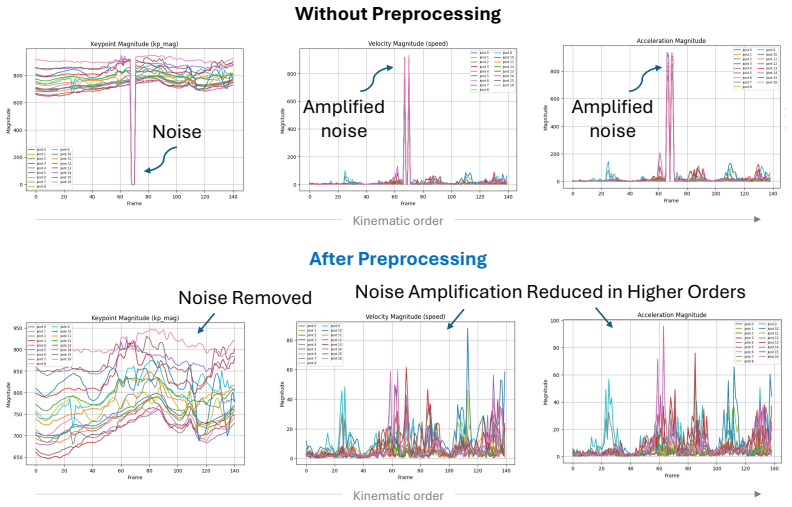
The load-bearing mechanism is a two-stage pipeline. First, joint trajectories are denoised (missing frames interpolated and trajectories smoothed with a filtering step) and then expanded into a hierarchy of kinematic orders via recursive finite differences: velocity $v_t^a=(j_t^a-j_{t-\delta}^a)/\delta$ and acceleration $a_t^a=(v_t^a-v_{t-\delta}^a)/\delta$, with the general $n$-th order defined recursively. Each order feeds an order-specific graph-convolutional backbone; their projected latent features are combined by weighted averaging with weights $w_0=1.0, w_1=0.8, w_2=0.2$. Second, a multi-objective distillation objective (temperature-scaled KL divergence between teacher and student softmax distributions plus a standard cross-entropy term, with weights $\lambda_{KD}=0.3$, $\lambda_{Cls}=1.0$) compresses the fused teacher into a student that sees only zeroth-order positions. The student then carries the multi-order motion reasoning implicitly, so inference runs a single small stream.
What would settle it
Compute keypoint confidence, frame-to-frame joint displacement, and sequence-length statistics for the synthetic and real sets, then retrain the student on synthetic poses perturbed to match the real statistics; if accuracy falls back to baseline levels, the transfer is explained by pose-distribution similarity, whereas if it stays near 63.41%, the kinematic-distillation claim is supported.
Extended reading notes
Core claim
The central claim is that classroom incidents—falling, punching, jumping, kicking, throwing, running, sitting—can be recognized from skeletal trajectories alone, and that a deliberately small model can do it better than larger pose-based baselines. The method works by representing each action at three kinematic orders (joint positions, velocities, accelerations), training separate backbones on each, and fusing their latent features into a teacher. A multi-objective distillation loss then trains a student, roughly one-sixth the teacher's size and one-tenth the inference cost of the compared baselines, to match the teacher's softened class probabilities while operating only on zeroth-order joint positions. On the paper's synthetic test split the student reports 71.78% accuracy versus 70.54% for the strongest baseline (PoseC3D); without any fine-tuning on real data it reports 63.41% on the real-world split versus 59.23% for the strongest baseline (MSG3D). The paper interprets these numbers as evidence that the distilled student internalizes velocity- and acceleration-like reasoning from the teacher, and that pose abstraction plus denoised kinematic features transfer across the synthetic-to-real gap.
Load-bearing premise
The transfer claim depends on the assumption that the joint positions extracted from generated videos resemble those extracted from real classroom CCTV footage well enough to train on; the paper does not report a distributional comparison of the extracted poses, so if the two differ systematically, the 63.41% figure may reflect dataset similarity rather than method robustness.
Editorial extensions
If this is right
- A deployed recognizer could run on joint trajectories only, so the institution holding CCTV footage never has to share raw frames with the model.
- The student's compute and parameter footprint is about one-tenth that of the compared pose-based baselines, which puts it in range of inexpensive edge hardware.
- Training on generated CCTV-style videos transfers to real classroom footage without fine-tuning, meaning synthetic data can stand in for incidents that are too rare or unsafe to record.
- Distillation lets a single-order student match or beat a multi-order teacher, so velocity and acceleration reasoning can be had without computing derivatives at inference.
Reading between the lines
- Editorial inference: the same generate-then-distill recipe could be adapted to other privacy-sensitive monitoring settings—elder-care homes, changing rooms, or special-education classrooms—where incident data is scarce and identifiable footage is off-limits.
- Editorial inference: the paper does not compare against models that see raw RGB frames or vision-language embeddings; such a comparison would show how much accuracy is traded away for the privacy and efficiency the pose-only student buys.
- Editorial inference: a direct test of the transfer claim would be to train the same student on real poses only and compare with the synthetic-trained model; the gap would quantify how much of the 63.41% comes from the synthetic data rather than from the distillation itself.
- Editorial inference: because the background class is a large meta-class, per-class confusion matrices for the seven incident classes plus background would reveal whether the headline accuracy hides systematic confusion between, say, kicking and running; the paper reports such gains mainly for kick, sit, and run in the appendix.
Editorial analysis
A structured set of objections, weighed in public.
Referee Report
Summary. This pilot study targets privacy-aware classroom incident recognition from pose sequences. The authors construct a new hybrid benchmark of 1,296 synthetic CCTV-style classroom videos plus 574 real-world pose samples, and propose a method that builds hierarchical kinematic representations (positions, velocities, accelerations) into a multi-order teacher that is distilled into a small single-order student operating only on joint positions. Experiments on the synthetic split claim the student reaches 71.78% accuracy, outperforming pose-based baselines such as PoseC3D, and 63.41% zero-shot accuracy on the real-world split. The paper also reports efficiency gains and promises public release of the benchmark and code.
Significance. If the performance claims hold, the paper would make a useful contribution: a new privacy-oriented dataset, a clearly described and computationally efficient skeleton-based method, and a zero-shot synthetic-to-real transfer protocol. The manuscript is generally well written, the equations for kinematic features and distillation are standard and correctly formulated, and the authors are explicit about the pilot nature of the study. However, the central quantitative claims currently rest on an evaluation protocol that selects hyperparameters on the test set and on differences that are close to the sampling noise of the reported test sizes. The significance is therefore conditional on a stronger evaluation that separates model selection from final reporting and provides uncertainty estimates.
major comments (4)
- [§5.1, §5.3, Figure 8] The paper defines an 80/20 train/test split in §5.1, but §5.3 describes sweeping fusion weights (w0, w1, w2) and distillation loss weight λ_KD over a grid and selecting the best accuracy, all without mentioning any validation split. This means the reported 71.78% synthetic accuracy is a selected maximum on the same 20% test set, not an unbiased estimate. The student model carried into the zero-shot real-world evaluation (§5.2) was also chosen under this protocol. The authors should introduce a proper validation split (or nested cross-validation), select hyperparameters on it, and then report test accuracy with the final fixed configuration.
- [Table 1, §5.1] The claimed 1.24-point improvement over PoseC3D corresponds to roughly 3 clips on a test set of about 260 clips, and the 4.18-point lead over MSG3D in Table 2 is about 1.4 standard errors on the 574 real-world clips. No confidence intervals, repeated seeds, or significance tests are reported. Given the small sample sizes and the hyperparameter selection issue, the central claim that the method 'outperforms substantially larger baselines' is not statistically established. The authors should report accuracies with confidence intervals (e.g., bootstrap or multiple seeds) and, where possible, a paired test across the same test clips.
- [§3.1, §5.2] The zero-shot synthetic-to-real transfer results depend on the assumption that YOLO-extracted pose sequences from generated videos and real CCTV footage are comparable. The paper does not report pose-detection accuracy, per-domain pose statistics, or any distribution analysis for the pose features on either domain. Furthermore, the synthetic pipeline includes a manual quality filter in which three authors and preschool teachers discard videos that do not look realistic; this curation may reduce the domain gap by construction. Without reporting pose-quality metrics and a domain-shift analysis, the 63.41% transfer number cannot be separated from dataset similarity or curation effects. The authors should add quantitative pose-quality measures (e.g., detection confidence, joint visibility, trajectory smoothness) on both synthetic and real sets and compare their distributions.
- [§5.3, Figure 8 (3)] The ablation shows that the distilled student outperforms its own multi-order teacher. This is surprising and the paper's explanation (smaller size leads to more transferable representations) is speculative. Because the teacher and student are not evaluated with the same hyperparameter selection protocol—the teacher uses the manually set {w0,w1,w2}={1.0,0.8,0.2} and the student's λ_KD is tuned on the test set—this specific claim may be an artifact of test-set tuning. The authors should either provide a comparison where both teacher and student use the same validation-based selection, or temper the claim.
minor comments (5)
- [Figure 2, caption and text] The text in §1 says 'Performance & GFLOPs are along Y & X-axes' while the caption says 'Performance & GFLOPs are along Y & X-axes, respectively'; please make the axis labels explicit and consistent, and indicate whether the circle diameter represents parameters or model size.
- [Eq. (7)] The notation z_t and z_s for teacher and student logits could be confused with the time index t used in the kinematic equations. Consider renaming to z_tea and z_stu or using an unambiguous superscript.
- [§5.3, Figure 8 (1)] The text says 'we sweep each weight w from 0 to 1 with a step size of 0.1' but the figure appears to show a two-dimensional surface over w0 and w1 with w2 fixed at 0.2. Please clarify the exact grid and the number of trials.
- [§5.1 and Figure 2] The paper alternates between 'one-tenth of the parameters' and 'one-tenth of the computational cost.' These are different claims; please specify which is reported and provide both parameter counts and FLOPs in a consistent table.
- [§3.3, 'Realworld Dataset'] The real-world dataset section is very brief. Please specify how the 574 samples are distributed across the eight classes (seven actions plus background), how many distinct classrooms/subjects are involved, and how temporal boundaries were annotated.
Circularity Check
No significant circularity; the reported accuracies are empirical measurements, not reductions to fitted inputs or self-citations.
full rationale
The derivation chain is self-contained. Equations (1)-(3) define velocity and acceleration as finite differences of joint positions; these are feature transformations, not redefinitions of the action labels. Equation (6) is a convex combination of order-specific representations, and Equation (10) is a standard classification-plus-KL distillation loss; neither encodes the reported accuracies by construction. The student's outputs are learned from teacher soft targets and ground-truth labels, so the 71.78% and 63.41% numbers are empirical measurements, not identities. No load-bearing self-citations appear; references [10] and [11] are external baselines and toolboxes, and NTURGBD pretraining is an external benchmark. The only near-concern is hyperparameter selection: Section 5.3 sweeps fusion weights and lambda_KD and reports the best test accuracy, which is a fitting and selection-bias issue rather than circularity, because the chosen weights do not mathematically force the reported performance. No uniqueness theorem, renamed known result, or ansatz-smuggling-by-self-citation is present. The zero-shot synthetic-to-real evaluation is an external target that does not reduce to any fitted parameter of the method.
Assumptions & free parameters
free parameters (4)
- Fusion weights w0, w1, w2 =
1.0, 0.8, 0.2
- Distillation loss weight lambda_KD =
0.3
- Distillation temperature tau =
4
- Temporal interval delta =
not reported (assumed 1)
assumptions (4)
- domain assumption YOLO pose estimates on both synthetic and real footage are accurate enough that higher-order kinematic features encode true motion rather than detector noise.
- domain assumption The manually filtered set of generated videos and teacher-validated annotations is a faithful proxy for real classroom incidents.
- standard math Standard knowledge distillation assumptions: softened teacher logits convey beneficial inter-class structure to the student.
- domain assumption Anonymized pose keypoints are sufficient to protect student privacy in deployment when raw video is discarded.
Cite this review
Pith. "Pith review of Robust and Efficient Motion Reasoning for Privacy-Aware Classroom Incident Recognition." pith.science (2026). https://pith.science/paper/C6QX7VS6
@misc{pith2026260805115,
  author       = {Pith},
  title        = {Pith review of: Robust and Efficient Motion Reasoning for Privacy-Aware Classroom Incident Recognition},
  year         = {2026},
  howpublished = {\url{https://pith.science/paper/C6QX7VS6}},
  note         = {Machine review of arXiv:2608.05115}
}
read the original abstract
Can computer vision help make classrooms safer? In this pilot study, we investigate privacy-aware and computationally efficient classroom incident recognition from CCTV-style observations. This setting remains underexplored, with limited benchmarks and few methods designed for the privacy, efficiency, and generalization demands of real-world deployment. We introduce a novel hybrid benchmark combining generative CCTV-style videos with real-world classroom pose data, and propose a lightweight, but robust motion-reasoning framework motivated by the observation that many incidents differ more in motion direction, speed, acceleration, and intensity than in pose alone. To that end, our method first constructs hierarchical kinematic representations of human actions. Our method then distills hierarchical, multi-order kinematic reasoning from a large teacher into a much smaller single-order student, enabling efficient per-person inference while preserving expressive motion understanding. Experiments show that our model outperforms substantially larger baselines at less than one-tenth of their computational cost, while also demonstrating stronger out-of-domain motion reasoning and zero-shot synthetic-to-real generalization. We will publicly release the benchmark, codebase, and supporting tools to facilitate further research in privacy-aware classroom safety.
Figures


Figures from the paper (5 more)




Reference graph
Works this paper leans on
-
[1]
A Sheik Abdullah, S Geetha, AB Abdul Aziz, and Utkarsh Mishra. Design of automated model for inspecting and eval- uating handwritten answer scripts: A pedagogical approach with nlp and deep learning.Alexandria engineering journal, 108:764–788, 2024. 2
work page 2024
-
[2]
Blessing Isoyiza Adeika, Pelumi Olaitan Abiodun, and Olu- dare Adegbola Owolabi. Transforming pedagogical assess- ment: Ai and computer vision-enhanced classroom observa- tions for experiment-centric learning environments. In2024 ASEE Annual Conference & Exposition, 2024. 2
work page 2024
-
[3]
Do deep nets really need to be deep?Advances in neural information processing systems, 27, 2014
Lei J Ba and Rich Caruana. Do deep nets really need to be deep?Advances in neural information processing systems, 27, 2014. 2
work page 2014
-
[4]
Cristian Bucilu ˇa, Rich Caruana, and Alexandru Niculescu- Mizil. Model compression. InProceedings of the 12th ACM SIGKDD international conference on Knowledge discovery and data mining, pages 535–541, 2006. 2
work page 2006
-
[5]
Ivo Bueno, Ruikun Hou, Babette B¨uhler, Tim F¨utterer, James Drimalla, Jonathan K Foster, Peter Youngs, Peter Gerjets, Ulrich Trautwein, and Enkelejda Kasneci. Exploring au- tomated recognition of instructional activity and discourse from multimodal classroom data. InProceedings of the IEEE/CVF Winter Conference on Applications of Computer Vision, pages 6...
work page 2026
-
[6]
Haoxin Chen, Menghan Xia, Yingqing He, Yong Zhang, Xiaodong Cun, Shaoshu Yang, Jinbo Xing, Yaofang Liu, Qifeng Chen, Xintao Wang, Chao Weng, and Ying Shan. VideoCrafter1: Open diffusion models for high-quality video generation.arXiv preprint arXiv:2310.19512, 2023. 3
-
[7]
Channel-wise topology refinement graph convolution for skeleton-based action recognition
Yuxin Chen, Ziqi Zhang, Chunfeng Yuan, Bing Li, Ying Deng, and Weiming Hu. Channel-wise topology refinement graph convolution for skeleton-based action recognition. In Proceedings of the IEEE/CVF International Conference on Computer Vision, pages 13359–13368, 2021. 9
work page 2021
-
[8]
Engagement detection in online learning: a review.Smart Learning Envi- ronments, 6(1):1–20, 2019
M Dewan, Mahbub Murshed, and Fuhua Lin. Engagement detection in online learning: a review.Smart Learning Envi- ronments, 6(1):1–20, 2019. 2
work page 2019
Show all 52 references
-
[9]
Bullying10k: A large-scale neuromorphic dataset towards privacy-preserving bullying recognition.Advances in Neural Information Processing Systems, 36:1923–1937,
Yiting Dong, Yang Li, Dongcheng Zhao, Guobin Shen, and Yi Zeng. Bullying10k: A large-scale neuromorphic dataset towards privacy-preserving bullying recognition.Advances in Neural Information Processing Systems, 36:1923–1937,
1923
-
[10]
Pyskl: Towards good practices for skeleton action recogni- tion
Haodong Duan, Jiaqi Wang, Kai Chen, and Dahua Lin. Pyskl: Towards good practices for skeleton action recogni- tion. InProceedings of the 30th ACM International Confer- ence on Multimedia, pages 7351–7354, 2022. 8, 9, 10
2022
-
[11]
Revisiting skeleton-based action recognition
Haodong Duan, Yue Zhao, Kai Chen, Dahua Lin, and Bo Dai. Revisiting skeleton-based action recognition. InPro- ceedings of the IEEE/CVF conference on computer vision and pattern recognition, pages 2969–2978, 2022. 3, 9
2022
-
[12]
Tim F ¨utterer, Patricia Goldberg, Babette B ¨uhler, Vlasta Sikimi´c, Ulrich Trautwein, Peter Gerjets, Kathleen St ¨urmer, and Enkelejda Kasneci. Artificial intelligence in classroom management: A systematic review on educational purposes, technical implementations, and ethica...
-
[13]
Seedance 1.0: Exploring the boundaries of video generation models.arXiv preprint arXiv:2506.09113,
Yu Gao, Haoyuan Guo, Tuyen Hoang, Weilin Huang, Lu Jiang, Fangyuan Kong, Huixia Li, Jiashi Li, Liang Li, Xi- aojie Li, et al. Seedance 1.0: Exploring the boundaries of video generation models.arXiv preprint arXiv:2506.09113,
-
[14]
Bk-sad: A large scale dataset for student activity recognition.JST: Smart Systems and Devices, 2023
Nguyen Van Giang, Nguyen Gia Chan, Nguyen Tuan Hung, Quang Dich, and Trinh Cong Dong. Bk-sad: A large scale dataset for student activity recognition.JST: Smart Systems and Devices, 2023. 3
2023
-
[15]
Attentive or not? toward a machine learning approach to assessing students’ visible en- gagement in classroom instruction.Educational Psychology Review, 33(1):27–49, 2021
Patricia Goldberg, ¨Omer S ¨umer, Kathleen St ¨urmer, Wolf- gang Wagner, Richard G¨ollner, Peter Gerjets, Enkelejda Kas- neci, and Ulrich Trautwein. Attentive or not? toward a machine learning approach to assessing students’ visible en- gagement in classroom instruction.Educat...
2021
-
[16]
LTX-Video: Realtime video latent diffusion.arXiv preprint arXiv:2501.00103, 2025
Yoav HaCohen, Nisan Chiprut, Benny Brazowski, Daniel Shalem, Dudu Moshe, Eitan Richardson, Eran Levin, Guy Shiran, Nir Zabari, Ori Gordon, Poriya Panet, Sapir Weiss- buch, Victor Kulikov, Yaki Bitterman, Zeev Melumian, and Ofir Bibi. LTX-Video: Realtime video latent diffusion....
2025 arXiv
-
[17]
Distill- ing the knowledge in a neural network.arXiv preprint arXiv:1503.02531, 2015
Geoffrey Hinton, Oriol Vinyals, and Jeff Dean. Distill- ing the knowledge in a neural network.arXiv preprint arXiv:1503.02531, 2015. 2
2015 arXiv
-
[18]
Kingma, Ben Poole, Mohammad Norouzi, David J
Jonathan Ho, William Chan, Chitwan Saharia, Jay Whang, Ruiqi Gao, Alexey Gritsenko, Diederik P. Kingma, Ben Poole, Mohammad Norouzi, David J. Fleet, and Tim Sali- mans. Imagen Video: High definition video generation with diffusion models.arXiv preprint arXiv:2210.02303, 2022. 3
-
[19]
CogVideo: Large-scale pretraining for text-to-video generation via transformers.arXiv preprint arXiv:2205.15868, 2022
Wenyi Hong, Ming Ding, Wendi Zheng, Xinghan Liu, and Jie Tang. CogVideo: Large-scale pretraining for text-to-video generation via transformers.arXiv preprint arXiv:2205.15868, 2022. 3
2022 arXiv
-
[20]
Ultralytics YOLO, 2023
Glenn Jocher, Jing Qiu, and Ayush Chaurasia. Ultralytics YOLO, 2023. 8
2023
-
[21]
Black, David W
Angjoo Kanazawa, Michael J. Black, David W. Jacobs, and Jitendra Malik. End-to-end recovery of human shape and pose. InComputer Vision and Pattern Recognition (CVPR),
-
[22]
The kinetics hu- 11 man action video dataset.arXiv preprint arXiv:1705.06950,
Will Kay, Joao Carreira, Karen Simonyan, Brian Zhang, Chloe Hillier, Sudheendra Vijayanarasimhan, Fabio Viola, Tim Green, Trevor Back, Paul Natsev, et al. The kinetics hu- 11 man action video dataset.arXiv preprint arXiv:1705.06950,
-
[23]
Kling-Omni technical report.arXiv preprint arXiv:2512.16776, 2025
Kling Team. Kling-Omni technical report.arXiv preprint arXiv:2512.16776, 2025. 3
2025 arXiv
-
[24]
Muhammed Kocabas, Nikos Athanasiou, and Michael J. Black. Vibe: Video inference for human body pose and shape estimation. InThe IEEE Conference on Computer Vi- sion and Pattern Recognition (CVPR), 2020. 3
2020
-
[25]
Computer vision in stem education research
Gyeonggeon Lee and Xiaoming Zhai. Computer vision in stem education research. InArtificial Intelligence for STEM Education Research: Advanced Methods and Applications, pages 113–141. Springer, 2026. 2
2026
-
[26]
Ntu rgb+ d 120: A large- scale benchmark for 3d human activity understanding.IEEE transactions on pattern analysis and machine intelligence, 42(10):2684–2701, 2019
Jun Liu, Amir Shahroudy, Mauricio Perez, Gang Wang, Ling-Yu Duan, and Alex C Kot. Ntu rgb+ d 120: A large- scale benchmark for 3d human activity understanding.IEEE transactions on pattern analysis and machine intelligence, 42(10):2684–2701, 2019. 3, 9
2019
-
[27]
Classroom be- havior recognition using computer vision: A systematic re- view.Sensors, 25(2), 2025
Qingtang Liu, Xinyu Jiang, and Ruyi Jiang. Classroom be- havior recognition using computer vision: A systematic re- view.Sensors, 25(2), 2025. 2
2025
-
[28]
Disentangling and unifying graph convo- lutions for skeleton-based action recognition
Ziyu Liu, Hongwen Zhang, Zhenghao Chen, Zhiyong Wang, and Wanli Ouyang. Disentangling and unifying graph convo- lutions for skeleton-based action recognition. InProceedings of the IEEE/CVF conference on computer vision and pattern recognition, pages 143–152, 2020. 9
2020
-
[29]
Matthew Loper, Naureen Mahmood, Javier Romero, Gerard Pons-Moll, and Michael J. Black. SMPL: A skinned multi- person linear model.ACM Transactions on Graphics, (Proc. SIGGRAPH Asia), 34(6):248:1–248:16, 2015. 3
2015
-
[30]
Video generation models as world simula- tors.https : / / openai
OpenAI. Video generation models as world simula- tors.https : / / openai . com / index / video - generation - models - as - world - simulators/,
-
[31]
Sora 2 is here.https://openai.com/ index/sora-2/, 2025
OpenAI. Sora 2 is here.https://openai.com/ index/sora-2/, 2025. Accessed: 2026-05-11. 3
2025
-
[32]
Curran Associates Inc., Red Hook, NY , USA, 2019
Adam Paszke, Sam Gross, Francisco Massa, Adam Lerer, James Bradbury, Gregory Chanan, Trevor Killeen, Zeming Lin, Natalia Gimelshein, Luca Antiga, Alban Desmaison, Andreas K ¨opf, Edward Yang, Zach DeVito, Martin Raison, Alykhan Tejani, Sasank Chilamkurthy, Benoit Steiner, Lu F...
2019
-
[33]
Georgios Pavlakos, Vasileios Choutas, Nima Ghorbani, Timo Bolkart, Ahmed A. A. Osman, Dimitrios Tzionas, and Michael J. Black. Expressive body capture: 3d hands, face, and body from a single image. InProceedings IEEE Conf. on Computer Vision and Pattern Recognition (CVPR), 2019. 3
2019
-
[34]
Learning graph convolutional network for skeleton-based human action recognition by neural searching
Wei Peng, Xiaopeng Hong, Haoyu Chen, and Guoying Zhao. Learning graph convolutional network for skeleton-based human action recognition by neural searching. InProceed- ings of the AAAI conference on artificial intelligence, pages 2669–2676, 2020. 3
2020
-
[35]
You only look once: Unified, real-time object de- tection
Joseph Redmon, Santosh Divvala, Ross Girshick, and Ali Farhadi. You only look once: Unified, real-time object de- tection. InProceedings of the IEEE conference on computer vision and pattern recognition, pages 779–788, 2016. 8
2016
-
[36]
Ntu rgb+d: A large scale dataset for 3d human activity anal- ysis
Amir Shahroudy, Jun Liu, Tian-Tsong Ng, and Gang Wang. Ntu rgb+d: A large scale dataset for 3d human activity anal- ysis. InProceedings of the IEEE conference on computer vision and pattern recognition, pages 1010–1019, 2016. 3
2016
-
[37]
Finegym: A hierarchical video dataset for fine-grained action under- standing
Dian Shao, Yue Zhao, Bo Dai, and Dahua Lin. Finegym: A hierarchical video dataset for fine-grained action under- standing. InProceedings of the IEEE/CVF conference on computer vision and pattern recognition, pages 2616–2625,
-
[38]
Two- stream adaptive graph convolutional networks for skeleton- based action recognition
Lei Shi, Yifan Zhang, Jian Cheng, and Hanqing Lu. Two- stream adaptive graph convolutional networks for skeleton- based action recognition. In2019 IEEE/CVF Conference on Computer Vision and Pattern Recognition (CVPR), pages 12018–12027. IEEE, 2019. 3
2019
-
[39]
Skeleton-based action recognition with multi-stream adap- tive graph convolutional networks.IEEE Transactions on Image Processing, 29:9532–9545, 2020
Lei Shi, Yifan Zhang, Jian Cheng, and Hanqing Lu. Skeleton-based action recognition with multi-stream adap- tive graph convolutional networks.IEEE Transactions on Image Processing, 29:9532–9545, 2020. 9
2020
-
[40]
Make-a-video: Text-to-video generation without text-video data
Uriel Singer, Adam Polyak, Thomas Hayes, Xi Yin, Jie An, Songyang Zhang, Qiyuan Hu, Harry Yang, Oron Ashual, Oran Gafni, Devi Parikh, Sonal Gupta, and Yaniv Taigman. Make-a-video: Text-to-video generation without text-video data. InInternational Conference on Learning Represen...
2023
-
[41]
Wan: Open and ad- vanced large-scale video generative models.arXiv preprint arXiv:2503.20314, 2025
Team Wan, Ang Wang, Baole Ai, et al. Wan: Open and ad- vanced large-scale video generative models.arXiv preprint arXiv:2503.20314, 2025. 3
2025 arXiv
-
[42]
Ordinal-aware multimodal engagement recognition for collaborative learning
Nha Tran, Dat Ly, Phi Ta, Hung Nguyen, and Hien D Nguyen. Ordinal-aware multimodal engagement recognition for collaborative learning. InProceedings of the IEEE/CVF Winter Conference on Applications of Computer Vision, pages 2424–2433, 2026. 2
2026
-
[43]
MoCoGAN: Decomposing motion and content for video generation
Sergey Tulyakov, Ming-Yu Liu, Xiaodong Yang, and Jan Kautz. MoCoGAN: Decomposing motion and content for video generation. InProceedings of the IEEE Conference on Computer Vision and Pattern Recognition, pages 1526– 1535, 2018. 3
2018
-
[44]
Learning from synthetic humans
Gul Varol, Javier Romero, Xavier Martin, Naureen Mah- mood, Michael J Black, Ivan Laptev, and Cordelia Schmid. Learning from synthetic humans. InProceedings of the IEEE conference on computer vision and pattern recogni- tion, pages 109–117, 2017. 3
2017
-
[45]
Synthetic humans for action recognition from un- seen viewpoints
G ¨ul Varol, Ivan Laptev, Cordelia Schmid, and Andrew Zis- serman. Synthetic humans for action recognition from un- seen viewpoints. InIJCV, 2021. 3
2021
-
[46]
Phenaki: Variable length video generation from open domain textual description.arXiv preprint arXiv:2210.02399, 2022
Ruben Villegas, Mohammad Babaeizadeh, Pieter-Jan Kin- dermans, Hernan Moraldo, Han Zhang, Mohammad Taghi Saffar, Santiago Castro, Julius Kunze, and Dumitru Erhan. Phenaki: Variable length video generation from open domain textual description.arXiv preprint arXiv:2210.02399, 2022. 3
-
[47]
Generating videos with scene dynamics
Carl V ondrick, Hamed Pirsiavash, and Antonio Torralba. Generating videos with scene dynamics. InAdvances in Neu- ral Information Processing Systems, pages 613–621, 2016. 3
2016
-
[48]
Aric: An activity recognition dataset in classroom surveillance images, 2024
Linfeng Xu, Fanman Meng, Qingbo Wu, Lili Pan, Heqian Qiu, Lanxiao Wang, Kailong Chen, Kanglei Geng, Yilei Qian, Haojie Wang, Shuchang Zhou, Shimou Ling, Zejia 12 Liu, Nanlin Chen, Yingjie Xu, Shaoxu Cheng, Bowen Tan, Ziyong Xu, and Hongliang Li. Aric: An activity recognition d...
2024
-
[49]
Spatial tempo- ral graph convolutional networks for skeleton-based action recognition
Sijie Yan, Yuanjun Xiong, and Dahua Lin. Spatial tempo- ral graph convolutional networks for skeleton-based action recognition. InThirty-second AAAI conference on artificial intelligence, 2018. 3
2018
-
[50]
VideoGPT: Video generation using VQ-V AE and transformers.arXiv preprint arXiv:2104.10157, 2021
Wilson Yan, Yunzhi Zhang, Pieter Abbeel, and Aravind Srinivas. VideoGPT: Video generation using VQ-V AE and transformers.arXiv preprint arXiv:2104.10157, 2021. 3
2021 arXiv
-
[51]
Scb-dataset: A dataset for detecting student class- room behavior.arXiv preprint arXiv:2304.02488, 2023
Fan Yang. Scb-dataset: A dataset for detecting student class- room behavior.arXiv preprint arXiv:2304.02488, 2023. 3 13
2023 arXiv
-
[2024]
Accessed: 2026-05-11. 3
2026
Reviewed August 6, 2026 · model on record in the stance chip above.
Discussion (0). Sign in to comment.