REVIEW 5 minor 49 references
Marginal Matching Does Not License Factorized Sampling: Auditing Conditional Style Leakage in Factorized Generative Models
T0 review · 0 major / 5 minor · reviewed 2026-08-08 · deepseek-v4-flash
Pith's one-line read The paper establishes that matching a style latent's marginal distribution to a Gaussian prior places no constraint on its class-conditional distributions: a latent can be exactly N(0,I) in aggregate while carrying maximal label…
desk verdict Sound math, honest scoping, and a genuinely useful audit framework—held back by a code-availability contradiction and single-seed headline tables, but worth refereeing. read the letter →
The pith
A machine-rendered reading of the paper's core claim, the machinery that carries it, and where it could break.
The reading
What carries the argument
The carrying object is the exact KL decomposition of Theorem 1, written as $$M_{\mathrm{fact}} = I_q(z_c; z_s \mid y) + \mathbb{E}_y[\operatorname{KL}(q(z_c \mid y) \| p(z_c \mid y))] + I_q(z_s; y) + \operatorname{KL}(q(z_s) \| p(z_s)),$$ with all four terms nonnegative. Proposition 1 is the extremal case where only the style-leakage term is nonzero and maximal. The diagnostics are finite-sample proxies: global MMD for the style-prior term, inter-class mean separation and linear-probe accuracy for the leakage term, the class-conditional semantic loss for the semantic-prior term, and a within-class permutation JointMMD for the dependence term. Corollary 2's data-processing inequality provides the one-way bridge from latent mismatch to image-space mismatch, which is why the paper adds decoder-level interventions rather than stopping at latent statistics.
What would settle it
The Proposition 1 construction itself is the falsifier of any claim that a marginal divergence certifies independence: sample z_s~N(0,I) in a few lines of code, partition its support into K equal-probability regions, and define y as the region index; every marginal divergence reports zero while a probe recovers y perfectly. For the empirical generalization, train the same architectures with deliberately class-balanced style supervision to push I(z_s;y) to the floor while keeping global MMD near zero, and check whether probe accuracy approaches chance.
Extended reading notes
Core claim
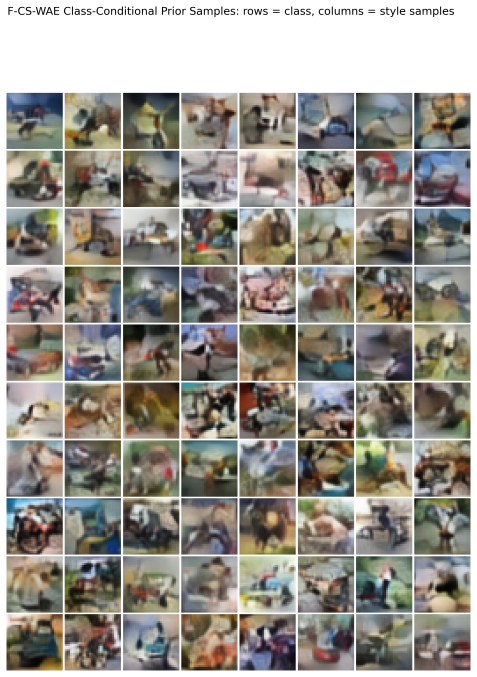
The central discovery is that 'marginal matching licenses factorized sampling' is false as a logical implication and incomplete as a practice. Proposition 1 constructs a random variable z_s ~ N(0,I) and defines y as a deterministic function of equal-mass regions of z_s, so q(z_s)=N(0,I) exactly and I(z_s;y)=log K: every divergence on the marginal is zero while the label is maximally recoverable. Theorem 1 decomposes the factorized-sampling mismatch Mfact into four nonnegative terms—within-class z_c-z_s dependence, semantic-prior mismatch, style leakage I(z_s;y), and global style-prior mismatch—so valid sampling requires all four to vanish. Consequently, class-invariant style is necessary but not sufficient, and the audit shows the failure is real in trained models: global MMD near zero coexists with linear-probe recovery of 74–100 percent and, for the case-study model, an external classifier assigns naive samples to the requested class only 16 percent of the time.
Load-bearing premise
The paper's warning is scoped to the standard factorized sampler that draws the style code independently from the aggregate prior p(z_s)=N(0,I); if a practitioner instead samples style from a class-conditional distribution, the 'necessary' part of Corollary 1 no longer speaks to that sampling procedure.
Editorial extensions
If this is right
- Global MMD, or any divergence computed on the aggregate style distribution, cannot be reported as evidence of class-invariant style; the same number is compatible with maximal label information.
- A factorized model can pass reconstruction, clustering, and aggregate-prior diagnostics while failing class-conditional generation, so those metrics should be supplemented with conditional diagnostics.
- Removing style leakage alone cannot yield valid factorized sampling; the semantic prior and within-class z_c-z_s independence must also be matched.
- Remedies that attack the leakage term through different mechanisms reduce probe accuracy to 21–46 percent but leave within-class dependence almost unchanged; only a joint term-4 target moves that proxy substantially.
- A post-hoc class-conditional style prior can repair naive generation on MNIST (external Gen-ACC 0.97) but transfers poorly to CIFAR-10 (0.41), where an empirical style bank does better (0.88).
Reading between the lines
- The no-certificate result extends beyond generative models: any representation-learning claim of the form 'the representation is invariant because a marginal moment matches' inherits the same gap, so fairness or robustness claims based on aggregate matching should be audited with conditional probes.
- The four-term decomposition suggests a direct information-theoretic audit that estimates I(z_s;y) and I(z_c;z_s|y) with variational bounds rather than proxy statistics; the paper's proxy-based JointMMD leaves this unmeasured.
- Because the paper's perturbations are one-at-a-time, a natural testable extension is a joint sweep on CIFAR-10 combining smaller style capacity, no auxiliary classifier, and per-class style MMD, where individual effects are largest and the authors note joint perturbations remain untested.
- The Proposition 1 construction is a template for constructing worst-case counterexamples to any proposed marginal certificate, so future divergence-based certificates should be tested against it.
Editorial analysis
A structured set of objections, weighed in public.
Referee Report
Summary. The paper argues that in factorized generative models, matching the marginal distribution of a style latent z_s to a fixed prior (e.g., N(0,I)) does not certify that z_s is independent of the class label y. It proves this via an adversarial construction (Proposition 1) showing that q(z_s) can be exactly N(0,I) while I(z_s;y)=log K, and via an exact four-term decomposition of the KL mismatch between the encoder's class-conditional latent distribution and the factorized sampler's distribution (Theorem 1). The paper then audits a case-study model (F-CS-WAE) and four latent baselines, reporting that near-zero global MMD coexists with high linear-probe label recovery from z_s, and evaluates several mitigation strategies. The central theoretical claim is that marginal-only diagnostics cannot certify class-invariance, and that removing style leakage is necessary but not sufficient for valid factorized sampling.
Significance. The theoretical contribution is sound and important. Proposition 1 is a clean non-identifiability result, and Theorem 1 provides a useful decomposition that clarifies the logical structure of factorized-sampling validity. The empirical audit is thoughtfully designed: it uses an independent external classifier, a fixed evaluation subset, and permutation nulls for the JointMMD proxy, and it explicitly reports limitations such as single-seed estimates and dataset-dependent transfer. The paper is honest about what the empirical results can and cannot show, and the central claim does not depend on the exact single-seed numbers. If the code and checkpoints are released as promised, the audit should be reproducible. The main weaknesses are presentation and reproducibility details rather than technical errors.
minor comments (5)
- [Abstract / Supplementary K.8] The abstract contains the line "Code: https://github.com/DngBack/CS-WAE", while Supplementary Section K.8 states "The present anonymous submission does not claim an available code URL." These statements are contradictory and should be reconciled; if the code is not yet public, remove the URL from the abstract or explicitly state that it will be released with the camera-ready version.
- [Throughout (Method, Related Work, Diagnostics)] Several cross-references appear as empty placeholders, e.g., "the intervention in Section is needed" in the discussion following Corollary 2, "Section tests whether removing that warmup matters" in the Method section, and "the per-class style MMD in Section is a direct instantiation" in Related Work. These missing section numbers should be fixed before publication.
- [Tables 2, 3, 4, 5 / Section K.2] The main-text tables report point estimates without indicating seed counts in their captions; Section K.2 and Table 14 provide seed IDs, but a reader of the main text cannot tell which entries are single-seed and which are multi-seed means. Please add a footnote to each table caption or a sentence in the main text directing readers to Table 14, and consider moving the five-seed replication numbers from Supplementary J.1-J.2 into the main text for the headline claims.
- [Table 2 / Abstract] The abstract states that the case-study model and four baselines achieve "near-zero global MMD", but WAE-MMD's global MMD in Table 2 is 0.0576, which the text itself notes is 30-300x the other rows and suggests its regularizer had not converged. The phrase "near-zero" should be restricted to the rows for which the permutation-null calibration in Supplementary J.4 does not reject, or a threshold should be stated explicitly.
- [Proposition 1] The notation q(z_s|y) is used in Proposition 1 without an explicit definition. In the adversarial construction, y is defined as a deterministic function of z_s, so q(z_s|y) is the conditional distribution under the joint distribution induced by that map; making this explicit in the statement would improve clarity.
Circularity Check
No significant circularity: the central impossibility result is proven by an explicit construction, and the four-term decomposition is a chain-rule identity; the empirical audit measures rather than fits the conclusion.
full rationale
The paper's central claim—that matching q(zs) to N(0,I) does not certify zs ⊥ y—is established by Proposition 1, which constructs y as a measurable function of zs over an equal-probability partition while leaving q(zs)=N(0,I) untouched. This is an existence proof from stated assumptions, not a fitted parameter or a self-citation: the proof is immediate from the definitions (H(y|zs)=0 and P(y=k)=1/K), and the paper explicitly calls it adversarial and worst-case. Theorem 1 is a standard chain-rule/KL-expansion identity, proved in the supplementary material by inserting ±log q(zc|k) and ±log q(zs), and does not presuppose the conclusion; Corollary 1's necessity-but-not-sufficiency follows from non-negativity of KL/MI. The empirical sections measure proxies (MMD, Δinter, LP, JointMMD) on saved checkpoints and explicitly disavow estimating Mfact, so no quantity is fitted and then relabeled as a prediction. The factorized-sampler scope (zs drawn independently from p(zs)) is stated explicitly in the definition of the factorized sampler, making the 'necessary but not sufficient' claim a scope-boundary rather than a hidden assumption. No load-bearing self-citation or imported uniqueness theorem appears. The only in-scope irregularity is a reproducibility contradiction—the abstract lists a GitHub URL while Section K.8 says the anonymous submission claims no code URL—but that does not affect the logical derivation.
Assumptions & free parameters
free parameters (2)
- tau (conditional prior scale) =
0.25
- delta (per-class style MMD weight) =
swept 0 to 3
assumptions (4)
- standard math A non-atomic Gaussian measure on R^d admits a measurable partition {A_k}_{k=1}^K with P(z_s in A_k)=1/K for each k.
- domain assumption The standard factorized sampler draws z_s from the aggregate prior p(z_s)=N(0,I) independently of the class y, jointly with z_c ~ p(z_c|y).
- standard math The KL chain rule and the data-processing inequality hold for the encoder's class-conditional distributions.
- domain assumption Per-class style distributions q(z_s|y=k) can be estimated from a fixed held-out evaluation subset.
Cite this review
Pith. "Pith review of Marginal Matching Does Not License Factorized Sampling: Auditing Conditional Style Leakage in Factorized Generative Models." pith.science (2026). https://pith.science/paper/WB4GQXCV
@misc{pith2026260805243,
  author       = {Pith},
  title        = {Pith review of: Marginal Matching Does Not License Factorized Sampling: Auditing Conditional Style Leakage in Factorized Generative Models},
  year         = {2026},
  howpublished = {\url{https://pith.science/paper/WB4GQXCV}},
  note         = {Machine review of arXiv:2608.05243}
}
read the original abstract
Factorized generative models commonly regularize a latent style variable z_s by matching its marginal distribution to a fixed Gaussian prior and interpret this as evidence that the style representation is independent of class information. We show that this interpretation is incorrect. Matching only the marginal distribution places no constraint on the class-conditional distributions, allowing the latent style to remain highly predictive of the label despite appearing perfectly Gaussian in aggregate. We derive an exact decomposition showing that this mismatch is one of four conditions required for factorized sampling, and demonstrate that eliminating it is necessary but not sufficient to obtain the intended factorization. Empirically, our case-study model and four representative latent baselines achieve near-zero global MMD while still allowing a linear probe to recover class labels with 74%--100% accuracy (10% chance level). Our model reaches 99.15% clustering accuracy, whereas externally evaluated class-conditional generation succeeds only 16% of the time. This leakage remains under six independent perturbations involving model capacity, curriculum, prior geometry, and supervision across two datasets. Four mitigation strategies reduce probe accuracy to 21%--46%, although they leave within-class dependence largely unchanged. A post-hoc conditional prior improves externally evaluated class generation to 0.97 on MNIST without retraining but reaches only 0.41 on CIFAR-10, while an empirical style bank achieves 0.88 on CIFAR-10. These results demonstrate that no divergence computed solely on the marginal distribution of the style latent can certify independence from class labels, and that reporting marginal statistics alone does not verify the property commonly claimed in factorized generative models.
Figures


Figures from the paper (10 more)


Reference graph
Works this paper leans on
-
[1]
arXiv preprint arXiv:1312.6114 , year=
Auto-Encoding Variational Bayes , author=. arXiv preprint arXiv:1312.6114 , year=
-
[2]
arXiv preprint arXiv:1711.01558 , year=
Wasserstein Auto-Encoders , author=. arXiv preprint arXiv:1711.01558 , year=
-
[3]
arXiv preprint arXiv:1611.05148 , year=
Variational Deep Embedding: An Unsupervised and Generative Approach to Clustering , author=. arXiv preprint arXiv:1611.05148 , year=
-
[4]
arXiv preprint arXiv:1511.06335 , year=
Unsupervised Deep Embedding for Clustering Analysis , author=. arXiv preprint arXiv:1511.06335 , year=
-
[5]
arXiv preprint arXiv:1804.00891 , year=
Hyperspherical Variational Auto-Encoders , author=. arXiv preprint arXiv:1804.00891 , year=
-
[6]
Hyperspherical Variational Autoencoders Using Efficient Spherical Cauchy Distribution
Hyperspherical Variational Autoencoders Using Efficient Spherical Cauchy Distribution , author=. arXiv preprint arXiv:2506.21278 , year=
-
[7]
arXiv preprint arXiv:2206.08780 , year=
Spherical Sliced-Wasserstein , author=. arXiv preprint arXiv:2206.08780 , year=
-
[8]
arXiv preprint arXiv:1804.01947 , year=
Sliced-Wasserstein Autoencoder: An Embarrassingly Simple Generative Model , author=. arXiv preprint arXiv:1804.01947 , year=
Show all 49 references
-
[9]
Journal of Machine Learning Research , volume=
A Kernel Two-Sample Test , author=. Journal of Machine Learning Research , volume=
-
[10]
International Conference on Algorithmic Learning Theory , pages=
Measuring Statistical Dependence with Hilbert-Schmidt Norms , author=. International Conference on Algorithmic Learning Theory , pages=. 2005 , organization=
2005
-
[11]
Heusel, Martin and Ramsauer, Hubert and Unterthiner, Thomas and Nessler, Bernhard and Hochreiter, Sepp , booktitle=
-
[12]
Proceedings of the IEEE Conference on Computer Vision and Pattern Recognition , year=
The Unreasonable Effectiveness of Deep Features as a Perceptual Metric , author=. Proceedings of the IEEE Conference on Computer Vision and Pattern Recognition , year=
-
[13]
Fashion-
Xiao, Han and Rasul, Kashif and Vollgraf, Roland , journal=. Fashion-
-
[14]
Proceedings of the IEEE , volume=
Gradient-Based Learning Applied to Document Recognition , author=. Proceedings of the IEEE , volume=
-
[15]
Learning Multiple Layers of Features from Tiny Images , author=
-
[16]
Chen, Xi and Duan, Yan and Houthooft, Rein and Schulman, John and Sutskever, Ilya and Abbeel, Pieter , journal=
-
[17]
arXiv preprint arXiv:1802.05983 , year=
Disentangling by Factorising , author=. arXiv preprint arXiv:1802.05983 , year=
-
[18]
arXiv preprint arXiv:1802.04942 , year=
Isolating Sources of Disentanglement in Variational Autoencoders , author=. arXiv preprint arXiv:1802.04942 , year=
-
[19]
Higgins, Irina and Matthey, Loic and Pal, Arka and Burgess, Christopher and Glorot, Xavier and Botvinick, Matthew and Mohamed, Shakir and Lerchner, Alexander , journal=
-
[20]
Advances in Neural Information Processing Systems , year=
Semi-Supervised Learning with Deep Generative Models , author=. Advances in Neural Information Processing Systems , year=
-
[21]
Advances in Neural Information Processing Systems , year=
Learning Structured Output Representation using Deep Conditional Generative Models , author=. Advances in Neural Information Processing Systems , year=
-
[22]
Proceedings of the IEEE/CVF Conference on Computer Vision and Pattern Recognition , year=
A Style-Based Generator Architecture for Generative Adversarial Networks , author=. Proceedings of the IEEE/CVF Conference on Computer Vision and Pattern Recognition , year=
-
[23]
Proceedings of the International Joint Conference on Artificial Intelligence , pages=
Improved Deep Embedded Clustering with Local Structure Preservation , author=. Proceedings of the International Joint Conference on Artificial Intelligence , pages=
-
[24]
Deep Learning , author=
-
[25]
and Johnson, Matthew J
Hoffman, Matthew D. and Johnson, Matthew J. , booktitle=
-
[26]
arXiv preprint arXiv:1511.00830 , year=
The Variational Fair Autoencoder , author=. arXiv preprint arXiv:1511.00830 , year=
-
[27]
International Conference on Machine Learning , pages=
Unsupervised Domain Adaptation by Backpropagation , author=. International Conference on Machine Learning , pages=
-
[28]
Advances in Neural Information Processing Systems , year=
Fader Networks: Manipulating Images by Sliding Attributes , author=. Advances in Neural Information Processing Systems , year=
-
[29]
Advances in Neural Information Processing Systems , pages=
Invariant Representations without Adversarial Training , author=. Advances in Neural Information Processing Systems , pages=
-
[30]
Neural Computation , volume=
Separating Style and Content with Bilinear Models , author=. Neural Computation , volume=. 2000 , doi=
2000
-
[31]
Advances in Neural Information Processing Systems , volume=
Disentangling Factors of Variation in Deep Representation Using Adversarial Training , author=. Advances in Neural Information Processing Systems , volume=
-
[32]
Proceedings of the AAAI Conference on Artificial Intelligence , volume=
Multi-Level Variational Autoencoder: Learning Disentangled Representations from Grouped Observations , author=. Proceedings of the AAAI Conference on Artificial Intelligence , volume=. 2018 , doi=
2018
-
[33]
Proceedings of the European Conference on Computer Vision , pages=
Disentangling Factors of Variation with Cycle-Consistent Variational Auto-Encoders , author=. Proceedings of the European Conference on Computer Vision , pages=
-
[34]
Advances in Neural Information Processing Systems , volume=
Learning Latent Subspaces in Variational Autoencoders , author=. Advances in Neural Information Processing Systems , volume=
-
[35]
Disentangling Latent Space for
Zheng, Zhilin and Sun, Li , booktitle=. Disentangling Latent Space for
-
[36]
and Louizos, Christos and Welling, Max , booktitle=
Ilse, Maximilian and Tomczak, Jakub M. and Louizos, Christos and Welling, Max , booktitle=
-
[37]
International Conference on Learning Representations , year=
Demystifying Inter-Class Disentanglement , author=. International Conference on Learning Representations , year=
-
[38]
arXiv preprint arXiv:1810.00110 , year=
Open-Ended Content-Style Recombination via Leakage Filtering , author=. arXiv preprint arXiv:1810.00110 , year=
-
[39]
International Conference on Learning Representations , year=
Variational Inference of Disentangled Latent Concepts from Unlabeled Observations , author=. International Conference on Learning Representations , year=
-
[40]
Proceedings of the 36th International Conference on Machine Learning , series=
Challenging Common Assumptions in the Unsupervised Learning of Disentangled Representations , author=. Proceedings of the 36th International Conference on Machine Learning , series=
-
[41]
Proceedings of the 37th International Conference on Machine Learning , series=
Weakly-Supervised Disentanglement without Compromises , author=. Proceedings of the 37th International Conference on Machine Learning , series=
-
[42]
Proceedings of the European Conference on Computer Vision , pages=
Multimodal Unsupervised Image-to-Image Translation , author=. Proceedings of the European Conference on Computer Vision , pages=
-
[43]
Proceedings of the European Conference on Computer Vision , pages=
Diverse Image-to-Image Translation via Disentangled Representations , author=. Proceedings of the European Conference on Computer Vision , pages=
-
[44]
Advances in Neural Information Processing Systems , volume=
Multi-Mapping Image-to-Image Translation via Learning Disentanglement , author=. Advances in Neural Information Processing Systems , volume=
-
[45]
International Conference on Learning Representations , year=
Unsupervised Disentanglement of Content and Style via Variance-Invariance Constraints , author=. International Conference on Learning Representations , year=
-
[46]
Proceedings of the IEEE/CVF International Conference on Computer Vision , pages=
Ma, Pingchuan and Yang, Xiaopei and Li, Yusong and Gui, Ming and Krause, Felix and Schusterbauer, Johannes and Ommer, Bj. Proceedings of the IEEE/CVF International Conference on Computer Vision , pages=
-
[47]
International Conference on Learning Representations , year=
Less is More: Masking Elements in Image Condition Features Avoids Content Leakages in Style Transfer Diffusion Models , author=. International Conference on Learning Representations , year=
-
[48]
Proceedings of the IEEE Conference on Computer Vision and Pattern Recognition , pages=
Rethinking the Inception Architecture for Computer Vision , author=. Proceedings of the IEEE Conference on Computer Vision and Pattern Recognition , pages=
-
[49]
Proceedings of the British Machine Vision Conference , year=
Wide Residual Networks , author=. Proceedings of the British Machine Vision Conference , year=
Reviewed August 8, 2026 · model on record in the stance chip above.
Discussion (0). Continue with ORCID to comment.