REVIEW 3 major objections 5 minor 48 references
Millisecond-Scale Neural Operator Surrogates for Double-Null Free-Boundary Grad-Shafranov Equilibria
T0 review · 3 major / 5 minor · reviewed 2026-08-08 · deepseek-v4-flash
Pith's one-line read A geometry-conditioned Fourier Neural Operator can reproduce constrained double-null tokamak equilibria to 0.05% field error and sub-centimeter critical-point accuracy in milliseconds.
desk verdict A solid, well-scoped FNO surrogate for FreeGS double-null equilibria with strong accuracy and latency numbers, but the 'GS residual' diagnostic is weaker than the abstract suggests because it compares the predicted Laplacian to the ground-truth RHS, not to the RHS evaluated on the predicted field. read the letter →
The pith
A machine-rendered reading of the paper's core claim, the machinery that carries it, and where it could break.
The reading
What carries the argument
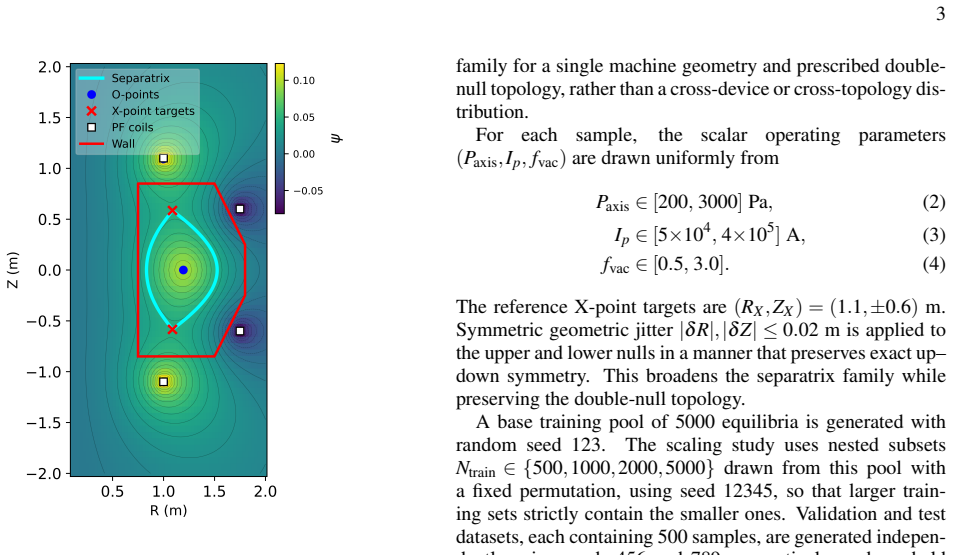
The central object is the operator G mapping nine gridded input channels -- spatial coordinates (R,Z), broadcast scalars (P_axis, I_p, f_vac), and broadcast lower and upper X-point coordinates -- to the poloidal-flux field psi(R,Z). The architecture is a Fourier Neural Operator with four spectral-convolution layers, 16 by 16 retained modes per dimension, width 64, and 4.77 million parameters; each layer performs a truncated spectral convolution K v = $F^{{-1}}$(R(k) F[v]), whose global mixing matches the elliptic, globally coupled nature of the Grad-Shafranov equation. The explicit X-point conditioning is what anchors the double-null topology and makes the map a constrained design surrogate rather than a diagnostic reconstruction from measurements.
What would settle it
Generate the same operating points with an independent, finer-grid free-boundary Grad-Shafranov solver and compare its flux fields and critical points with the network's predictions; if agreement is materially worse than the 0.052% L2 error and sub-0.2 cm X-point errors reported against the training solver, the physical-accuracy claim fails. Alternatively, run the finite-difference residual diagnostic on the same fields with a stricter solver-internal residual norm or a 129 by 129 grid; a predicted-versus-truth gap much larger than the current 0.998 ratio would falsify the physics-consistency claim.
Extended reading notes
Core claim
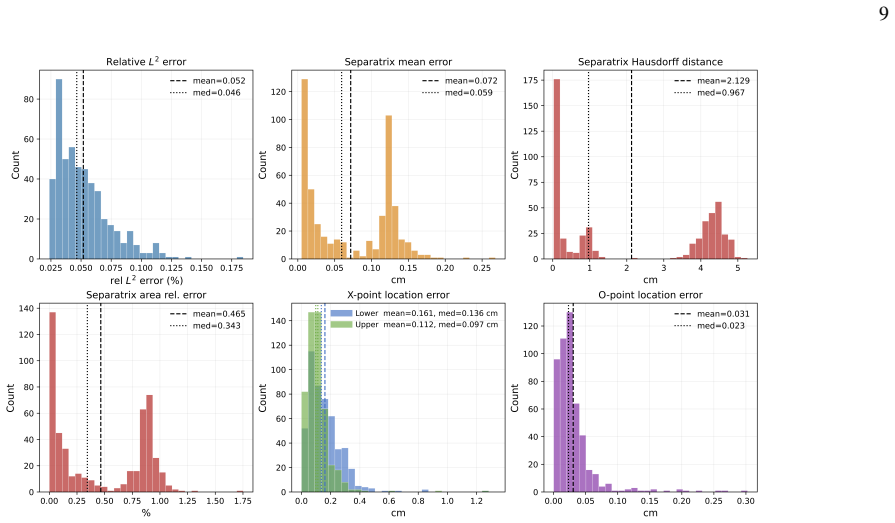
The central claim is that, within a single fixed machine geometry and prescribed double-null topology, a geometry-conditioned Fourier Neural Operator learns the constrained forward map from spatial coordinates, scalar operating parameters, and X-point locations to the poloidal-flux field, and that the result is accurate enough to serve as a surrogate for iterative equilibrium solves. The evidence is a 500-sample test set on which the best model attains mean relative L2 error 0.052%, physical RMSE 1.54e-5 Wb, separatrix mean deviation 0.072 cm, upper and lower X-point errors 0.112 and 0.161 cm, and O-point error 0.031 cm. An external finite-difference Grad-Shafranov residual gives mean 2.29 on predicted fields, indistinguishable from the 2.29 plus or minus 0.06 baseline on the ground-truth fields. The paper also claims test error follows an approximate N to the minus 0.68 power law over training sizes 500 to 5000, GPU and CPU speedups of about 640 times and 69 times, and a p95/median latency ratio of 1.01. The intended reading is that the learned surrogate can replace cold-started iterative solves in speed-critical loops, not that it generalizes across devices or topologies.
Load-bearing premise
The load-bearing premise is that the solver-generated equilibria used as training labels are the correct ground truth; every reported accuracy number is an agreement with that solver, and if the solver's constrained solutions are wrong or grid-dependent, the surrogate inherits those errors.
Editorial extensions
If this is right
- In the tested operating range, equilibrium evaluation drops from a median of roughly 1.77 s with the iterative solver to 2.77 ms on GPU and 25.6 ms on CPU, with p95/median 1.01, making equilibrium calls affordable inside control and optimization loops.
- The separatrix is reproduced with 0.072 cm mean closest-point deviation, both X-points within 0.2 cm, and the O-point at 0.031 cm, so divertor geometry and critical-point structure survive at sub-millimeter scale.
- Predicted fields pass the same finite-difference Grad-Shafranov residual test as the ground-truth fields, with mean 2.29 versus baseline 2.29 plus or minus 0.06, so the surrogate's agreement is not merely label memorization.
- Test error scales as roughly N to the minus 0.68 with training data over 500 to 5000 samples, so the controlled equilibrium family is learnable with systematic, better-than-random improvement.
- The surrogate is scoped to one machine geometry and one topology; it does not claim cross-device transfer, and it is an X-point-conditioned design map rather than an actuator-to-equilibrium model.
Reading between the lines
- The paper leaves implicit that its X-point conditioning doubles as an ablation-ready control handle: setting those coordinates to measured values would let the same network annotate reconstructed equilibria, not only prescribe them.
- A natural next test is to train with random vertical flips of every sample; the reported 0.161 cm versus 0.112 cm upper/lower X-point asymmetry would be expected to vanish, since the data-generation pipeline is exactly symmetric.
- Because the 0.05% field error concentrates near the X-point pinch, replacing the pure L2 loss with a physics-residual or shape-aware term could shrink the heavy Hausdorff tail without changing the architecture.
- If the N to the minus 0.68 trend continues, training on tens of thousands of equilibria could plausibly push field error toward 0.01%, but the four-point fit is not a reliable law; the same pipeline could be tested on single-null and snowflake topologies.
Editorial analysis
A structured set of objections, weighed in public.
Referee Report
Summary. The paper trains a geometry-conditioned Fourier Neural Operator (FNO) to approximate the forward map from spatial coordinates, scalar operating parameters (P_axis, I_p, f_vac), and prescribed X-point coordinates to the poloidal-flux field for constrained double-null free-boundary Grad-Shafranov equilibria generated by FreeGS on a fixed test-tokamak geometry. On a held-out test set, the best model achieves a mean relative L2 error of 0.052%, sub-millimeter X-point and O-point localization, millisecond-scale inference on GPU and CPU, and an external finite-difference residual whose mean value matches the FreeGS baseline. The paper explicitly scopes the contribution to one topology and one machine geometry, and presents the N^-0.68 scaling and the residual comparison as comparative diagnostics rather than definitive physical laws. The central claim is that, within this fixed geometry and topology, the learned operator can replace cold-started FreeGS solves in speed-critical loops without meaningful loss of accuracy.
Significance. If the accuracy and latency claims hold, the paper is a solid contribution to the neural-surrogate literature for plasma equilibrium: it addresses a constrained free-boundary setting with explicit geometry conditioning, uses a controlled data-generation pipeline with a 100% acceptance rate, performs held-out evaluation with three initialization seeds for field-level metrics, and documents near-deterministic inference latency. These strengths make the core speedup and field-accuracy results credible within the stated scope. However, the physics-consistency claim in the abstract and Section III D is overstated: the reported residual diagnostic compares the predicted Laplacian with the ground-truth right-hand side, not with the right-hand side evaluated on the predicted field, so it does not actually test whether the predicted field satisfies the Grad-Shafranov equation. This is a load-bearing validation gap that must be addressed before the paper is accepted.
major comments (3)
- [§II D, Eq. (11), and §III D] The residual defined in Eq. (11) uses RHS_true, the right-hand side evaluated on the ground-truth equilibrium, rather than RHS(ψ_pred). Because the Grad-Shafranov right-hand side depends on ψ through p(ψ) and F(ψ), this diagnostic only measures how close Δ*ψ_pred is to Δ*ψ_true; it does not test whether the predicted field satisfies the GS equation with its own source term. The abstract's statement that predicted fields 'satisfy an external finite-difference GS residual evaluation' is therefore not supported by the reported quantity. I recommend computing the residual with RHS evaluated on ψ_pred (using the same profile functions) and reporting that value, or explicitly rephrasing the claim as Laplacian agreement with the ground-truth source.
- [§III D] Even accepting the diagnostic as defined, the comparison has low power: the FreeGS baseline itself has mean residual 2.29±0.06, and the FNO mean is 2.29. The test therefore cannot resolve discrepancies smaller than roughly ±0.06 normalized units, while the claimed field-level accuracy (relative L2 ≈5×10^-4, physical RMSE ≈1.5×10^-5 Wb) is far below that resolution. The phrase 'indistinguishable' should be accompanied by an explicit statement of the diagnostic resolution, and the physics-consistency conclusion should be correspondingly weakened unless a proper RHS(ψ_pred) residual is reported.
- [§III B, Table II] All geometry-aware metrics in Table II are reported for the single validation-selected best model (N=5000, seed 3), with no seed-to-seed spread or confidence intervals. Since Table I shows that field-level error varies across the three initializations, the reader cannot assess whether the sub-0.2 cm X-point and 0.031 cm O-point accuracy are stable properties of the trained operator or partly an artifact of seed selection. Reporting the three-seed range for the geometry metrics (or at least for the X/O-point errors) would make the headline geometric claims robust.
minor comments (5)
- [§II A, Eq. (10)] Equation (10) writes the right-hand side as -μ0 R^2 dp/dψ - F dF/dψ, while Eq. (1) uses the equivalent form -μ0 R^2 dp/dψ - (1/2) dF^2/dψ; using one notation consistently would reduce the chance of confusion about the profile conventions.
- [§II D, Eq. (11)] The plasma mask Ω_i used to restrict the residual norm is never defined; please specify how interior points are selected (for example, ψ_true < ψ_bndry or a fixed spatial region).
- [§II C, Eq. (7)] Equation (7) is written with unnormalized norms, but the text states that all reported relative L2 errors are computed in normalized units; making the normalization explicit in the equation would remove an ambiguity.
- [§III A, Eq. (12)] The power-law exponent N^-0.68 is fit over only four training sizes with no confidence interval; the paper already calls this suggestive, but adding a bootstrap interval or a direct statement that the exponent is not statistically robust would strengthen the presentation.
- [Data and code availability] The data and code are listed as available 'upon reasonable request'; for a neural-operator paper whose reproducibility depends on exact data splits, training configuration, and evaluation code, a public repository would be preferable.
Circularity Check
The physics-consistency residual in Eq. 11 is defined against the ground-truth RHS, so it reduces to a comparison of Laplacians derived from the training target; the main surrogate accuracy and speed claims remain independent.
-
self definitional
[Section II D, Eq. (11); results reported in Section III D]
"The ground-truth right-hand side, RHStrue = −µ0 R^2 dp/dψ − F dF/dψ, is loaded directly from the pre-computed dpdpsi and FdFdpsi fields stored in the dataset, evaluated on the corresponding ground-truth equilibrium. The per-sample normalized residual is Ri = ∥∆⋆ψpred − RHStrue∥2,Ωi / ∥RHStrue∥2,Ωi."
Because the GS source term depends on ψ through p(ψ) and F(ψ), a genuine residual for a predicted field would use RHS(ψ_pred). Equation 11 instead compares Δ*ψ_pred with RHStrue, which equals Δ*ψ_true up to the same finite-difference truncation. The reported mean residual of 2.29 therefore measures ‖Δ*(ψ_pred − ψ_true)‖/‖RHStrue‖, a derivative of the field-level MSE that was the training objective, not whether ψ_pred satisfies the Grad–Shafranov equation with its own source term. The claim that the predicted fields 'satisfy an external finite-difference GS residual evaluation' is thus entailed by construction from the training-target comparison, and the indistinguishability from the FreeGS baseline is a smoothness/truncation sanity check rather than an independent physics validation.
full rationale
The core contribution is a supervised learning pipeline: FreeGS generates ground-truth equilibria, an FNO is trained with an MSE loss on ψ, and held-out field accuracy, geometry-aware metrics, and inference latency are measured against FreeGS outputs. That central surrogate claim is not circular; it is a standard empirical accuracy and speed evaluation. The only reduction-by-construction is the finite-difference GS residual diagnostic of Eq. 11, which uses the ground-truth RHS rather than the RHS evaluated on the predicted field. Since the GS RHS is a function of ψ, this residual reduces to comparing the Laplacian of the prediction with the Laplacian of the ground truth, i.e., a smoothed derivative of the training loss. The paper is transparent that the absolute residual is a comparative diagnostic with a nonzero baseline, but the abstract and summary phrase 'satisfy an external finite-difference GS residual evaluation' overstates what is verified. No load-bearing self-citations or imported uniqueness theorems appear; the FNO architecture and FreeGS solver are cited as standard external tools. The X-point and O-point localization metrics are consistency checks on the conditioning inputs rather than independent predictions, but they do not constitute circular derivations. Overall circularity is partial and confined to one validation claim, while the main accuracy and speed results stand independently.
Assumptions & free parameters
free parameters (5)
- FNO trainable weights =
4,770,241 parameters
- Normalization statistics =
training-set mean and standard deviation of inputs and target
- Architecture hyperparameters =
4 Fourier layers, n_modes=(16,16), width=64
- Training hyperparameters =
learning rate 1e-3, weight decay 1e-4, batch size 16, early stopping patience 75
- Power-law exponent =
-0.68
assumptions (5)
- domain assumption The Grad-Shafranov equation is the governing model for axisymmetric ideal MHD equilibrium.
- domain assumption FreeGS constrained double-null solutions are ground truth for the forward map.
- domain assumption Fixed profile shapes with scalar amplitudes (Paxis, Ip, fvac) define a well-posed equilibrium family.
- domain assumption The finite-difference GS residual computed with ground-truth RHS is a valid physics-consistency diagnostic.
- standard math FNO can approximate the solution operator of this parametric elliptic PDE family.
Cite this review
Pith. "Pith review of Millisecond-Scale Neural Operator Surrogates for Double-Null Free-Boundary Grad-Shafranov Equilibria." pith.science (2026). https://pith.science/paper/5SMFRNTB
@misc{pith2026260805555,
  author       = {Pith},
  title        = {Pith review of: Millisecond-Scale Neural Operator Surrogates for Double-Null Free-Boundary Grad-Shafranov Equilibria},
  year         = {2026},
  howpublished = {\url{https://pith.science/paper/5SMFRNTB}},
  note         = {Machine review of arXiv:2608.05555}
}
abstract
The Grad-Shafranov (GS) equation governs ideal magnetohydrodynamic equilibrium in tokamak plasmas. Free-boundary GS solvers are central to diverted-equilibrium modeling, but nonlinear Picard iteration introduces computational cost and sample-dependent latency that can become prohibitive in optimization, modeling, and control-oriented loops. Here we train a geometrically conditioned Fourier Neural Operator (FNO) to learn a constrained forward map from spatial coordinates, scalar operating parameters $(P_{\mathrm{axis}}, I_p, f_{\mathrm{vac}})$, and prescribed X-point locations to the poloidal-flux field $\psi(R,Z)$. The model is trained on a controlled family of constrained double-null free-boundary equilibria generated with \textsc{FreeGS} for a single fixed machine geometry and prescribed topology. The best model achieves a mean relative $L^2$ error of $0.05\%$, with test error following an empirical $N^{-0.68}$ power law over $N_{\mathrm{train}}\in\{500,1000,2000,5000\}$. It recovers both X-points to within $0.2$ cm and localizes the O-point to $0.03$ cm. As a physics-consistency diagnostic, the predicted fields satisfy an external finite-difference GS residual evaluation at the same level as the ground-truth fields, with mean normalized residual $2.29$, indistinguishable from the $2.29\pm0.06$ \textsc{FreeGS} baseline using the same diagnostic. The trained FNO evaluates one equilibrium in $2.77$ ms on GPU and $25.6$ ms on CPU, corresponding to speedups of ${\sim}640\times$ and ${\sim}69\times$ relative to \textsc{FreeGS} as configured here, with near-deterministic latency (p95/median $=1.01$). These results show that neural-operator surrogates can provide accurate, geometrically precise, millisecond-scale equilibrium evaluations for magnetic-confinement fusion workflows within a prescribed topology and machine geometry.
Figures


Figures from the paper (5 more)




Reference graph
Works this paper leans on
-
[1]
Grad, H. and Rubin, H. , title =. Proceedings of the Second. 1958 , publisher =
work page 1958
-
[2]
Shafranov, V. D. , title =. Soviet Physics JETP , volume =. 1958 , url=
work page 1958
- [3]
-
[4]
Freidberg, Jeffrey P. , year=. Ideal MHD , publisher=
-
[5]
Elman, Howard C. and Liang, Jiaxing and S. Multilevel Monte Carlo methods for the. Computer Physics Communications , volume =. 2024 , month = jan, doi =
work page 2024
-
[6]
Madireddy, S. and Ak. Physics of Plasmas , volume =. 2024 , month = sep, doi =
work page 2024
-
[7]
Lao, L.L. and St. John, H. and Stambaugh, R.D. and Kellman, A.G. and Pfeiffer, W. , title =. Nuclear Fusion , abstract =. 1985 , month =. doi:10.1088/0029-5515/25/11/007 , url =
-
[8]
J.R. Ferron and M.L. Walker and L.L. Lao and H.E. St. John and D.A. Humphreys and J.A. Leuer , title =. Nuclear Fusion , abstract =. 1998 , month =. doi:10.1088/0029-5515/38/7/308 , url =
Show all 48 references
-
[9]
Moret and B.P
J.-M. Moret and B.P. Duval and H.B. Le and S. Coda and F. Felici and H. Reimerdes , keywords =. Tokamak equilibrium reconstruction code LIUQE and its real time implementation , journal =. 2015 , issn =. doi:https://doi.org/10.1016/j.fusengdes.2014.09.019 , url =
2015 doi
-
[10]
and FreeGS contributors , title =
Dudson, Benjamin D. and FreeGS contributors , title =. 2026 , note =
2026
-
[11]
2026 , eprint=
A Library for Learning Neural Operators , author=. 2026 , eprint=
2026
-
[12]
2026 , eprint=
Fourier Neural Operators Explained: A Practical Perspective , author=. 2026 , eprint=
2026
-
[13]
Journal of Machine Learning Research , year =
Nikola Kovachki and Zongyi Li and Burigede Liu and Kamyar Azizzadenesheli and Kaushik Bhattacharya and Andrew Stuart and Anima Anandkumar , title =. Journal of Machine Learning Research , year =
-
[14]
Nature Machine Intelligence , volume =
Lu, Lu and Jin, Pengzhan and Pang, Guofei and Zhang, Zhongqiang and Karniadakis, George Em , title =. Nature Machine Intelligence , volume =. 2021 , doi =
2021
-
[15]
International Conference on Learning Representations , year =
Li, Zongyi and Kovachki, Nikola and Azizzadenesheli, Kamyar and Liu, Burigede and Bhattacharya, Kaushik and Stuart, Andrew and Anandkumar, Anima , title =. International Conference on Learning Representations , year =
-
[16]
Advances in Neural Information Processing Systems , volume=
Geometry-informed neural operator for large-scale 3d pdes , author=. Advances in Neural Information Processing Systems , volume=
-
[17]
ACM / IMS J
Li, Zongyi and Zheng, Hongkai and Kovachki, Nikola and Jin, David and Chen, Haoxuan and Liu, Burigede and Azizzadenesheli, Kamyar and Anandkumar, Anima , title =. ACM / IMS J. Data Sci. , month = may, articleno =. 2024 , issue_date =. doi:10.1145/3648506 , abstract =
2024 doi
-
[18]
and Svyatkovskiy, A
Kates-Harbeck, J. and Svyatkovskiy, A. and Tang, W. , title =. Nature , volume =. 2019 , doi =
2019
-
[19]
Nature , volume =
Degrave, Jonas and Felici, Federico and Buchli, Jonas and Neunert, Michael and Tracey, Brendan and Carpanese, Francesco and Ewalds, Timo and Hafner, Roland and Abdolmaleki, Abbas and de Las Casas, Diego and Donner, Craig and Fritz, Lutz and Galperti, Cristian and Huber, Andrea...
2022
-
[20]
and Kim, B
Seo, Jaemin and Na, Y.-S. and Kim, B. and Lee, C.Y. and Park, M.S. and Park, S.J. and Lee, Y.H. , title =. Nuclear Fusion , abstract =. 2021 , month =. doi:10.1088/1741-4326/ac121b , url =
2021 doi
-
[21]
Nature Communications , keywords =
Highest fusion performance without harmful edge energy bursts in tokamak. Nature Communications , keywords =. doi:10.1038/s41467-024-48415-w , archivePrefix =. 2405.05452 , primaryClass =
-
[22]
and Rea, Cristina and So, Oswin and Dawson, Charles and Garnier, Darren T
Wang, Allen M. and Rea, Cristina and So, Oswin and Dawson, Charles and Garnier, Darren T. and Fan, Chuchu , title =. Communications Physics , volume =. 2025 , doi =
2025
-
[23]
Nature Communications , keywords =
Learning plasma dynamics and robust rampdown trajectories with predict-first experiments at TCV. Nature Communications , keywords =. doi:10.1038/s41467-025-63917-x , archivePrefix =. 2502.12327 , primaryClass =
-
[24]
Communications Physics , volume =
Wu, Niannian and Yang, Zongyu and Li, Rongpeng and Wei, Ning and Chen, Yihang and Dong, Qianyun and Li, Jiyuan and Zheng, Guohui and Gong, Xinwen and Gao, Feng and Li, Bo and Xu, Min and Zhao, Zhifeng and Zhong, Wulyu , title =. Communications Physics , volume =. 2025 , doi =
2025
-
[25]
Montes, K. J. and Rea, C. and Granetz, R. S. and Tinguely, R. A. and Eidietis, N. and Meneghini, O. M. and Chen, D. L. and Shen, B. and Xiao, B. J. and Erickson, K. and Boyer, M. D. , title =. Nuclear Fusion , volume =. 2019 , doi =
2019
-
[26]
and Montes, K
Rea, C. and Montes, K. J. and Erickson, K. G. and Granetz, R. S. and Tinguely, R. A. , title =. Nuclear Fusion , volume =. 2019 , month = jul, doi =
2019
-
[27]
and Pau, A
Rea, Christina and Montes, Kevin J. and Pau, A. and Granetz, R. S. and Sauter, O. , title =. Fusion Science and Technology , volume =. 2020 , month = sep, doi =
2020
-
[28]
Communications Physics , volume =
Zheng, Wei and Xue, Fengming and Chen, Zhongyong and Chen, Dalong and Guo, Bihao and Shen, Chengshuo and Ai, Xinkun and Wang, Nengchao and Zhang, Ming and Ding, Yonghua and Chen, Zhipeng and Yang, Zhoujun and Shen, Biao and Xiao, Bingjia and Pan, Yuan , title =. Communications...
2023
-
[29]
Contributions to Plasma Physics , volume =
Tang, William and Dong, Ge and Barr, Jayson and Erickson, Keith and Conlin, Rory and Boyer, Dan and Kates-Harbeck, Julian and Felker, Kyle and Rea, Cristina and Logan, Nikolas and Svyatkovskiy, Alexey and Feibush, Eliot and Abbatte, Joseph and Clement, Mitchell and Grierson, B...
2023
-
[30]
Journal of Fusion Energy , volume =
Spangher, Lucas and Bonotto, Matteo and Arnold, William and Chayapathy, Dhruva and Gallingani, Tommaso and Spangher, Alexander and Cannarile, Francesco and Bigoni, Daniele and de Marchi, Eliana and Rea, Cristina , title =. Journal of Fusion Energy , volume =. 2025 , month = may, doi =
2025
-
[31]
and Smith, S.P
Meneghini, O. and Smith, S.P. and Snyder, P.B. and Staebler, G.M. and Candy, J. and Belli, E. and Lao, L. and Kostuk, M. and Luce, T. and Luda, T. and Park, J.M. and Poli, F. , title =. Nuclear Fusion , abstract =. 2017 , month =. doi:10.1088/1741-4326/aa7776 , url =
2017 doi
-
[32]
Wai, J. T. and Boyer, M. D. and Kolemen, E. , title =. Nuclear Fusion , volume =. 2022 , doi =
2022
-
[33]
and Perdikaris, P
Raissi, M. and Perdikaris, P. and Karniadakis, G. E. , title =. Journal of Computational Physics , volume =. 2019 , doi =
2019
-
[34]
and Gaur, Rahul and Pan, Shaowu and Landreman, Matt and Dorland, William , title =
Jang, Byoungchan and Kaptanoglu, Alan A. and Gaur, Rahul and Pan, Shaowu and Landreman, Matt and Dorland, William , title =. Physics of Plasmas , volume =. 2024 , doi =
2024
-
[35]
and Kim, I
Seo, J. and Kim, I. H. and Nam, H. , title =. Nuclear Engineering and Technology , volume =. 2024 , month = dec, doi =
2024
-
[36]
Joung, Semin and Kim, Jaewook and Kwak, Sehyun and Bak, J. G. and Lee, S. G. and Han, H. S. and Kim, H. S. and Lee, Geunho and Kwon, Daeho and Ghim, Y.-C. , title =. Nuclear Fusion , volume =. 2020 , doi =
2020
-
[37]
and Kim, Jaewook and Kwak, Sehyun and Kwon, Daeho and Sung, C
Joung, Semin and Ghim, Y.-C. and Kim, Jaewook and Kwak, Sehyun and Kwon, Daeho and Sung, C. and Kim, D. and Kim, Hyun-Seok and Bak, J. G. and Yoon, S. W. , title =. Scientific Reports , volume =. 2023 , month = sep, doi =
2023
-
[38]
AIP Advances , volume =
Lu, Jingjing and Hu, Youjun and Xiang, Nong and Sun, Youwen , title =. AIP Advances , volume =. 2023 , month = jul, doi =
2023
-
[39]
McClenaghan, J. and Ak. Augmenting machine learning of. Physics of Plasmas , volume =. 2024 , doi =
2024
-
[40]
Nuclear Fusion , volume =
Gopakumar, Vignesh and Pamela, Stanislas and Zanisi, Lorenzo and Li, Zongyi and Gray, Ander and Brennand, Daniel and Bhatia, Nitesh and Stathopoulos, Gregory and Kusner, Matt and Deisenroth, Marc Peter and Anandkumar, Anima , title =. Nuclear Fusion , volume =. 2024 , doi =
2024
-
[41]
Nuclear Fusion , volume =
Carey, Naomi and Zanisi, Lorenzo and Pamela, Stanislas and Gopakumar, Vignesh and Omotani, John and Buchanan, James and Brandstetter, Johannes and Paischer, Fabian and Galletti, Gianluca and Setinek, Paul , title =. Nuclear Fusion , volume =. 2025 , month = sep, doi =
2025
-
[42]
and Hutter, F
Loshchilov, I. and Hutter, F. , title =. International Conference on Learning Representations , year =
-
[43]
and Sabbagh, S.A
Park, Y.S. and Sabbagh, S.A. and Berkery, J.W. and Bialek, J.M. and Jeon, Y.M. and Hahn, S.H. and Eidietis, N. and Evans, T.E. and Yoon, S.W. and Ahn, J.-W. and Kim, J. and Yang, H.L. and You, K.-I. and Bae, Y.S. and Chung, J. and Kwon, M. and Oh, Y.K. and Kim, W.-C. and Kim, ...
2011 doi
-
[44]
Plasma Science and Technology , abstract =
Wan Yuanxi and Li Jiangang and Weng Peide and theEAST team , title =. Plasma Science and Technology , abstract =. 2006 , month =. doi:10.1088/1009-0630/8/3/01 , url =
2006 doi
-
[45]
and Adebayo-Ige, P.O
Munaretto, S. and Adebayo-Ige, P.O. and Anand, H. and Avdeeva, G. and Baek, S.G. and Barada, K. and Belli, E. and Belova, E.V. and Berkery, J.W. and Bernard, T.N. and Bertelli, N. and Bonofiglo, P. and Bonoli, P.T. and Boyer, M.D. and Candy, J. and Chang, C.S. and Chung, H. an...
2026
-
[46]
Carpanese and M
Cristian Galperti and Federico Felici and Trang Vu and Olivier Sauter and F. Carpanese and M. Kong and G. Marceca and A. Merle and A. Pau and A. Perek and F. Pesamosca and M. Baquero-Ruiz and S. Coda and J. Decker and B. Duval and M. Gospodarczyk and A. Karpushov and S. Marchi...
2024
-
[47]
and Campbell, D.J
Shimada, M. and Campbell, D.J. and Mukhovatov, V. and Fujiwara, M. and Kirneva, N. and Lackner, K. and Nagami, M. and Pustovitov, V.D. and Uckan, N. and Wesley, J. and Asakura, N. and Costley, A.E. and Donné, A.J.H. and Doyle, E.J. and Fasoli, A. and Gormezano, C. and Gribov, ...
2007
-
[48]
Journal of Plasma Physics , keywords =
Overview of the SPARC tokamak. Journal of Plasma Physics , keywords =. doi:10.1017/S0022377820001257 , adsurl =
Reviewed August 8, 2026 · model on record in the stance chip above.
Discussion (0). Continue with ORCID to comment.