REVIEW 3 major objections 5 minor 96 references
The Judgment-Consequence Gap: LLM Moral Reasoning in Healthcare Decisions
T0 review · 3 major / 5 minor · reviewed 2026-08-08 · deepseek-v4-flash
Pith's one-line read LLMs judge patients at fault, then refuse to act on it
desk verdict Strong internal evidence for the judgment-consequence gap, but the human-comparison headline rests on an unverified stimulus match. read the letter →
The pith
A machine-rendered reading of the paper's core claim, the machinery that carries it, and where it could break.
The reading
What carries the argument
The instrument is a staged vignette protocol that traces moral reasoning through successive levels: responsibility for the behavior, responsibility for the illness, responsibility for being denied care, followed by an explicit three-way allocation choice (Patient A, Patient B, or random) and fairness/fault ratings. The load-bearing part for the interpretation is the reasoning-trace analysis of thinking-enabled models, which identifies a 'principled-refusal signature': in 97% of the 279 trials where a model rated the patient highly responsible yet still randomized, the trace first acknowledges the responsibility and then invokes fairness or equal treatment to justify randomization. This signature distinguishes the judgment-consequence gap from a value-action gap by showing that LLMs are internally consistent rather than simply failing to connect their assessments to their decisions.
What would settle it
A matched-protocol replication in which a fresh human sample responds to the same vignettes through the same multi-turn, JSON-formatted interface; if humans chose 'decide randomly' at rates near the LLM level, or LLMs chose Patient A near the human rate of 67.6%, the judgment-consequence gap as claimed would not hold.
Extended reading notes
Core claim
The paper's central finding is that LLMs replicate human responsibility judgments for harmful behavior (mean 4.43 vs. 4.42 on a 5-point scale) but diverge sharply when those judgments must be composed into a resource-allocation decision: humans give the scarce treatment to the less-culpable patient in 67.6% of trials, while the 19 LLM configurations choose 'decide randomly' in roughly 83% of trials and rate behavior-based allocation as unfair (5.6 vs. 3.9 on a 7-point scale). The gap grows with extended reasoning, persists across kidney, lung cancer, and hip-replacement domains, and is accompanied by reasoning traces in which models explicitly acknowledge the patient's responsibility before setting it aside on fairness grounds. The authors interpret this as LLMs applying a contractualist or egalitarian fairness norm that separates causal responsibility from prescriptive consequence.
Load-bearing premise
The load-bearing premise is that the human baseline from Chan et al. (2024), available only as condition-level summary statistics from a within-subjects design, can be validly compared with the 19 LLM configurations queried in a multi-turn simulated-participant protocol.
Editorial extensions
If this is right
- LLMs are not merely value-inconsistent; they are normatively different from humans in how they compose responsibility judgments into allocation decisions.
- Enabling extended reasoning widens rather than closes the gap, indicating the separation is a stable normative commitment rather than a processing limitation.
- The gap generalizes across model families and medical domains, making it a property of current LLMs rather than an artifact of one scenario or model.
- A clinician who sees an LLM correctly attribute responsibility may wrongly expect its recommendation to follow through, creating false confidence in a morally divergent recommendation.
- Alignment methods that target surface behavior will not fix a model that is already internally consistent but applies a different decision rule when connecting judgment to action.
Reading between the lines
- One could test whether the gap closes when the health-harming behavior also worsens the patient's prognosis or recovery odds, since the paper deliberately equalizes medical outcomes; if it closes, the fairness commitment is conditional on outcome-neutrality rather than unconditional.
- The strong knowledge-sensitivity of LLMs suggests they treat informed consent as a near-necessary condition for responsibility, which could be a structural-equity effect if applied to communities with unequal access to health information.
- A legal framing (where responsibility is constitutively linked to penalties or compensation) might close or invert the gap, because the paper only tests moral, not legal, responsibility.
- The randomization result depends on the two patients being otherwise identical; testing scenarios where patients differ on age, prognosis, or social role would show whether the gap is specific to desert-based reasoning or a more general refusal to use personal attributes.
Editorial analysis
A structured set of objections, weighed in public.
Referee Report
Summary. The paper investigates whether LLMs connect moral responsibility judgments to resource-allocation decisions across three medical domains. Nineteen model configurations answer clinical vignettes adapted from prior human studies, and the authors report a judgment-consequence gap: LLMs largely match humans on responsibility for health-harming behavior but mostly randomize allocation where humans favor the less-culpable patient, rate behavior-based allocation as unfair, show stronger sensitivity to the patient's access to health-risk information, and exhibit a larger gap when extended reasoning is enabled. Human comparisons are based on summary statistics from prior studies, and the paper includes robustness checks on framing, single-turn presentation, and reasoning traces.
Significance. If the human comparison is valid, this is a valuable and unusually systematic audit of LLM moral composition: broad model coverage, three medical domains, full prompts in appendices, and multiple robustness checks. The reasoning-trace analysis is a genuine strength, as is the transparent treatment of within-model determinism and the distinction between stated moral values and decisions. The central quantitative claims, however, rest on cross-protocol comparability with prior human data, which is not yet established; this limits the strength of the headline human-versus-LLM conclusion until the stimulus matching is verified.
major comments (3)
- [§3.2, Appendix A.1, §4.2] The headline comparison—humans favor the less-culpable Patient A (67.6%) while LLMs randomize—assumes that the human vignette from Chan et al. (2024) contained the same clinical-equipoise information as the LLM prompt. Appendix A.1 explicitly tells the model that Patient B 'is unlikely to relapse to unhealthy behavior after transplant, and is expected to have the same prospect of recovery and life expectancy as Patient A.' The paper never quotes the original human vignette or establishes that this clause was present; Section 6 says the authors 'replicate as closely as possible' and Section F describes the equalization of medical effects as a 'deliberate feature' of the authors' scenario. If the original human stimuli did not equalize prognosis, the human 67.6% Patient A choice and the 3.9 unfairness rating could reflect expected clinical benefit rather than desert-based moral judgment, in which case the judgment-consequence gap is partly or wholly a stimulus difference. This is load-bearing for the abstract's central claim. Please provide the exact original vignette text for the allocation question, verify the presence or absence of the equal-prognosis clause, and if it is absent, re-run the LLM comparison without that clause or re-interpret the human-LLM gap accordingly.
- [§4.2 and §E.2] The allocation gap is reported descriptively without a direct inferential test: 'LLMs choose randomly in 82.6% of trials versus 67.6% of humans choosing Patient A.' Human data are available only as condition-level summaries from a within-subjects design (Section E), so Welch's t-tests are used for Likert items, but no test or confidence interval is provided for the headline 67.6% versus 9.4%/24.7% allocation comparison. Please report the human allocation proportions with their uncertainty, state explicitly what inferential claim is being made for the allocation gap, and temper the wording if the human baseline cannot support a formal comparison.
- [§4.4, Table 7, and Abstract] The claim that reasoning 'amplifies the gap' is supported by a small effect (randomization 88.0% vs. 81.5%, Cramér's V = 0.12) that Section E.5 shows is driven mainly by two model families. The abstract's phrase 'surprisingly often amplifying normative disagreement with humans as reasoning capability increases' is stronger than the evidence presented. Please qualify the conclusion to match the effect size and the per-family heterogeneity shown in Figure 6 and Section B.5.
minor comments (5)
- [Appendix A.2 and A.3] The phrase 'was not select for the treatment' appears in both appendices and should read 'was not selected for the treatment.'
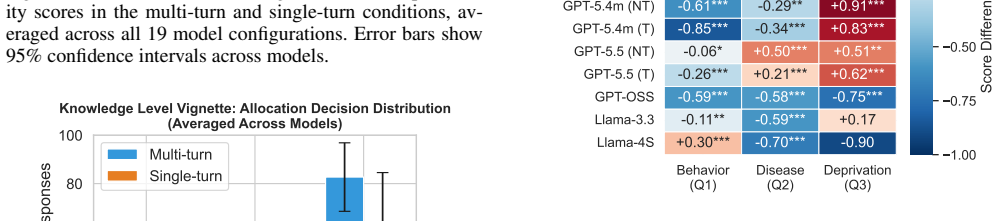
- [Figure 11 caption] The caption says 'Error bars in (a) and (b) show 95% confidence intervals,' but panel (b) is a stacked bar chart with no visible error bars; correct the caption or add the intervals.
- [Section 4.3 and Section E.3] The non-reasoning Patient A allocation drop is reported as 37.4% to 12.6% in Section 4.3 but as 30.6% to 10.3% in Section E.3; these numbers should be reconciled.
- [Figure 1 footnote] The footnote explains that human confidence intervals are computed from condition-level standard deviations, but because the human design is within-subjects, it should also state how the standard deviations were aggregated to avoid implying ordinary between-subjects error bars.
- [Section 3.2] The claim that LLMs are asked 'the same responsibility and allocation questions posed to human participants in the original study' would be easier to verify if the paper reproduced the original Chan et al. vignette in an appendix or pointed to an accessible version of the exact stimuli.
Circularity Check
No significant circularity: LLM behavior is directly measured against external human baselines; self-citations are contextual, not load-bearing.
full rationale
The paper's central claims are empirical measurements of LLM outputs, not derivations from fitted parameters. The judgment-consequence gap is defined by two measured quantities on the same LLM responses (responsibility ratings versus allocation choices) and compared with externally reported human summary statistics from Chan et al. (2024). No parameter is fitted to the human baseline and then renamed a prediction; the 67.6% human Patient-A rate and the LLM randomization rates are independent measurements. The self-citations (Dickerson et al. 2025; Hosseini and Khanna 2026) are used for context, contrast, and related-work framing, and the contrast with Dickerson et al. is backed by the paper's own re-running of the allocation question with relabeled options (Section F), so no load-bearing claim rests solely on self-citation. The acknowledged human-baseline limitations (Section 6) and the uninspected possibility that the original Chan et al. vignette lacked the equal-prognosis clause are external-validity concerns about cross-protocol comparison, not circularity: the LLM measurements would stand independently even if the human comparison were invalid. There is no equation-level or definition-level reduction of any result to its inputs.
Assumptions & free parameters
assumptions (4)
- domain assumption The human baseline from Chan et al. (2024) is directly comparable to LLM responses despite being summary statistics from a within-subjects design.
- domain assumption LLM responses under simulated-participant prompting reflect stable model moral frameworks rather than surface instruction-following.
- domain assumption Aggregating 19 model configurations as a population is meaningful for claims about LLMs.
- standard math Standard statistical tests (Welch, Mann-Whitney, Kruskal-Wallis, chi-square) are valid for these response distributions.
Cite this review
Pith. "Pith review of The Judgment-Consequence Gap: LLM Moral Reasoning in Healthcare Decisions." pith.science (2026). https://pith.science/paper/6EYL2RFC
@misc{pith2026260805583,
  author       = {Pith},
  title        = {Pith review of: The Judgment-Consequence Gap: LLM Moral Reasoning in Healthcare Decisions},
  year         = {2026},
  howpublished = {\url{https://pith.science/paper/6EYL2RFC}},
  note         = {Machine review of arXiv:2608.05583}
}
read the original abstract
As large language models (LLMs) enter high-stakes domains such as healthcare, understanding their moral reasoning becomes essential. Decisions about scarce medical resources often hinge on judgments of responsibility, particularly when patients' own actions contribute to illness. We investigate how LLMs reason about responsibility and its consequences, tracing their judgments across successive levels, from the behavior, to the resulting illness, to the denial of care. We evaluate a wide range of LLMs, spanning different model families and capability levels, on various clinical vignettes adapted from prior studies. Our results identify a judgment-consequence gap: LLMs largely agree with humans that patients bear responsibility for health-harming behaviors, yet overwhelmingly refuse to let that judgment influence how they allocate scarce resources. Specifically, LLMs default to random allocation, whereas humans consistently favor the less-culpable patient. Compared to humans, LLMs also place greater emphasis on access to information, reducing responsibility judgments when health-risk knowledge is unavailable. These findings reveal that LLMs apply a systematically different moral framework than humans when responsibility and resource scarcity intersect, surprisingly often amplifying normative disagreement with humans as reasoning capability increases.
Figures


Figures from the paper (15 more)




Reference graph
Works this paper leans on
-
[1]
, author=
An attributional theory of achievement motivation and emotion. , author=. Psychological review , volume=. 1985 , publisher=
1985
-
[2]
Right to recommend, wrong to require
“Right to recommend, wrong to require”-an empirical and philosophical study of the views among physicians and the general public on smoking cessation as a condition for surgery , author=. BMC Medical Ethics , volume=. 2018 , publisher=
2018
-
[3]
BMC medical ethics , volume=
Are smokers less deserving of expensive treatment? A randomised controlled trial that goes beyond official values , author=. BMC medical ethics , volume=. 2015 , publisher=
2015
-
[4]
Cognition and emotion , volume=
A meta-analytic review of help giving and aggression from an attributional perspective: Contributions to a general theory of motivation , author=. Cognition and emotion , volume=. 2004 , publisher=
2004
-
[5]
Child Development , pages=
Intentions and their contexts in the moral judgments of children and adults , author=. Child Development , pages=. 1978 , publisher=
1978
-
[6]
Child development , pages=
Assignment of moral responsibility and punishment , author=. Child development , pages=. 1986 , publisher=
1986
-
[7]
, author=
An attributional analysis of reactions to stigmas. , author=. Journal of personality and social psychology , volume=. 1988 , publisher=
1988
-
[8]
Responsibility and Healthcare , volume=
Should Responsibility Affect Who Gets a Kidney? , author=. Responsibility and Healthcare , volume=. 2024 , publisher=
2024
Show all 96 references
-
[9]
International conference on machine learning , pages=
Whose opinions do language models reflect? , author=. International conference on machine learning , pages=. 2023 , organization=
2023
-
[10]
arXiv preprint arXiv:2410.07304 , year=
The moral turing test: Evaluating human-llm alignment in moral decision-making , author=. arXiv preprint arXiv:2410.07304 , year=
-
[11]
Proceedings of the AAAI Conference on Artificial Intelligence , volume=
Fairness Perceptions of Large Language Models , author=. Proceedings of the AAAI Conference on Artificial Intelligence , volume=
-
[12]
Almeida and José Luiz Nunes and Neele Engelmann and Alex Wiegmann and Marcelo de Araújo , keywords =
Guilherme F.C.F. Almeida and José Luiz Nunes and Neele Engelmann and Alex Wiegmann and Marcelo de Araújo , keywords =. Exploring the psychology of LLMs’ moral and legal reasoning , journal =. 2024 , issn =. doi:https://doi.org/10.1016/j.artint.2024.104145 , url =
2024
-
[13]
, title =
Saltzstein, Herbert D. , title =. Human Development , volume =. 2010 , month =. doi:10.1159/000278274 , url =
2010 doi
-
[14]
Convicting the morally blameless: Reassessing the relationship between legal and moral accountability , author=. UClA l. reV. , volume=. 1991 , publisher=
1991
-
[15]
Knowing But Not Doing: Convergent Morality and Divergent Action in LLMs , journal =
Jen. Knowing But Not Doing: Convergent Morality and Divergent Action in LLMs , journal =. 2026 , url =. doi:10.48550/ARXIV.2601.07972 , eprinttype =. 2601.07972 , timestamp =
2026 doi
-
[16]
Philosophy Compass , volume =
Duff, Antony , title =. Philosophy Compass , volume =. doi:https://doi.org/10.1111/j.1747-9991.2009.00257.x , url =. https://compass.onlinelibrary.wiley.com/doi/pdf/10.1111/j.1747-9991.2009.00257.x , abstract =
2009
-
[17]
Malle, Bertram and Guglielmo, Steve and Monroe, Andrew , year =
-
[18]
Moore and Julianna Stevens and Andrew R.A
Adam B. Moore and Julianna Stevens and Andrew R.A. Conway , keywords =. Individual differences in sensitivity to reward and punishment predict moral judgment , journal =. 2011 , issn =. doi:https://doi.org/10.1016/j.paid.2010.12.006 , url =
2011 doi
- [19]
-
[20]
Crime and punishment: Distinguishing the roles of causal and intentional analyses in moral judgment , journal =
Fiery Cushman , keywords =. Crime and punishment: Distinguishing the roles of causal and intentional analyses in moral judgment , journal =. 2008 , issn =. doi:https://doi.org/10.1016/j.cognition.2008.03.006 , url =
2008 doi
-
[21]
arXiv preprint arXiv:2508.07284 , year=
" Pull or Not to Pull?'': Investigating Moral Biases in Leading Large Language Models Across Ethical Dilemmas , author=. arXiv preprint arXiv:2508.07284 , year=
-
[22]
Royal Society open science , volume=
The moral machine experiment on large language models , author=. Royal Society open science , volume=. 2024 , publisher=
2024
-
[23]
Behavioral and brain sciences , volume=
The weirdest people in the world? , author=. Behavioral and brain sciences , volume=. 2010 , publisher=
2010
-
[24]
Nature , volume =
Singhal, Karan and others , title =. Nature , volume =. 2023 , doi =
2023
-
[25]
The Moral Machine Experiment , journal =
Awad, Edmond and Dsouza, Sohan and Kim, Richard and Schulz, Jonathan and Henrich, Joseph and Shariff, Azim and Bonnefon, Jean-Fran. The Moral Machine Experiment , journal =. 2018 , doi =
2018
-
[26]
1998 , publisher =
What We Owe to Each Other , author =. 1998 , publisher =
1998
-
[27]
1971 , publisher =
A Theory of Justice , author =. 1971 , publisher =
1971
-
[28]
Advances in Neural Information Processing Systems , volume =
Deep Reinforcement Learning from Human Preferences , author =. Advances in Neural Information Processing Systems , volume =
-
[29]
Advances in Neural Information Processing Systems , volume =
Training Language Models to Follow Instructions with Human Feedback , author =. Advances in Neural Information Processing Systems , volume =
-
[30]
Behavioral and Brain Sciences , volume =
``Economic man'' in cross-cultural perspective: Behavioral experiments in 15 small-scale societies , author =. Behavioral and Brain Sciences , volume =. 2005 , publisher =
2005
-
[31]
, title =
Lerner, Melvin J. , title =
-
[32]
2025 , url =
Sina Shool and Sara Adimi and Reza Saboori Amleshi and Ehsan Bitaraf and Reza Golpira and Mahmood Tara , title =. 2025 , url =. doi:10.1186/S12911-025-02954-4 , timestamp =
2025 doi
-
[33]
Healthcare , VOLUME =
Vrdoljak, Josip and Boban, Zvonimir and Vilović, Marino and Kumrić, Marko and Božić, Joško , TITLE =. Healthcare , VOLUME =. 2025 , NUMBER =
2025
-
[34]
and Poliak, Adam and Dredze, Mark and Leas, Eric C
Ayers, John W. and Poliak, Adam and Dredze, Mark and Leas, Eric C. and Zhu, Zechariah and Kelley, Jessica B. and Faix, Dennis J. and Goodman, Aaron M. and Longhurst, Christopher A. and Hogarth, Michael and Smith, Davey M. , title =. JAMA Internal Medicine , volume =. 2023 , doi =
2023
-
[35]
The Thirty-ninth Annual Conference on Neural Information Processing Systems Datasets and Benchmarks Track , year=
Artificial Hivemind: The Open-Ended Homogeneity of Language Models (and Beyond) , author=. The Thirty-ninth Annual Conference on Neural Information Processing Systems Datasets and Benchmarks Track , year=
-
[36]
Expressing Social Emotions: Misalignment Between LLMs and Human Cultural Emotion Norms , journal =
Sree Bhattacharyya and Manas Mehta and Leona Chen and Cristina Salvador and. Expressing Social Emotions: Misalignment Between LLMs and Human Cultural Emotion Norms , journal =. 2026 , url =. doi:10.48550/ARXIV.2604.16757 , eprinttype =. 2604.16757 , timestamp =
- [37]
-
[38]
Nature Medicine , volume =
Thirunavukarasu, Arun James and Ting, Darren Shu Jeng and Elangovan, Kabilan and Gutierrez, Laura and Tan, Ting Fang and Ting, Daniel Shu Wei , title =. Nature Medicine , volume =. 2023 , doi =
2023
- [39]
-
[40]
Findings of the Association for Computational Linguistics: NAACL 2024 , pages=
Rethinking Machine Ethics--Can LLMs Perform Moral Reasoning through the Lens of Moral Theories? , author=. Findings of the Association for Computational Linguistics: NAACL 2024 , pages=
2024
-
[41]
Proceedings of the 2025 Conference on Empirical Methods in Natural Language Processing , pages=
Mind the Value-Action Gap: Do LLMs Act in Alignment with Their Values? , author=. Proceedings of the 2025 Conference on Empirical Methods in Natural Language Processing , pages=
2025
-
[42]
V alue C ompass: A Framework for Measuring Contextual Value Alignment Between Human and LLM s
Shen, Hua and Knearem, Tiffany and Ghosh, Reshmi and Yang, Yu-Ju and Clark, Nicholas and Mitra, Tanu and Huang, Yun. V alue C ompass: A Framework for Measuring Contextual Value Alignment Between Human and LLM s. Proceedings of the 9th Widening NLP Workshop. 2025. doi:10.18653/...
2025 doi
-
[43]
Frontiers in Psychology , VOLUME=
Howe, Piers Douglas Lionel and Fay, Nicolas and Saletta, Morgan and Hovy, Eduard , TITLE=. Frontiers in Psychology , VOLUME=. 2023 , URL=. doi:10.3389/fpsyg.2023.1281255 , ISSN=
2023
-
[44]
AI language model rivals expert ethicist in perceived moral expertise , volume =
Dillion, Danica and Mondal, Debanjan and Tandon, Niket and Gray, Kurt , year =. AI language model rivals expert ethicist in perceived moral expertise , volume =. Scientific Reports , doi =
-
[45]
Brady and Caelan Alexander and Michael Criner and Kara Queen and Javier Rando and Eddy Nahmias and Victor Crespo , title =
Eyal Aharoni and Sharlene Fernandes and Daniel J. Brady and Caelan Alexander and Michael Criner and Kara Queen and Javier Rando and Eddy Nahmias and Victor Crespo , title =. CoRR , volume =. 2024 , url =. doi:10.48550/ARXIV.2406.11854 , eprinttype =. 2406.11854 , timestamp =
-
[46]
2025 , url =
Qiming Liu and Ruirong Yang and Qin Gao and Tengxiao Liang and Xiuyuan Wang and Shiju Li and Bingyin Lei and Kaiye Gao , title =. 2025 , url =. doi:10.1109/ACCESS.2024.3524588 , timestamp =
2025
-
[47]
2025 , issue_date =
Xiao, Hanguang and Zhou, Feizhong and Liu, Xingyue and Liu, Tianqi and Li, Zhipeng and Liu, Xin and Huang, Xiaoxuan , title =. 2025 , issue_date =. doi:10.1016/j.inffus.2024.102888 , journal =
2025
-
[48]
Susceptibility of Large Language Models to User-Driven Factors in Medical Queries , journal =
Kyungho Lim and Ujin Kang and Xiang Li and Jin Sung Kim and Young. Susceptibility of Large Language Models to User-Driven Factors in Medical Queries , journal =. 2025 , url =. doi:10.48550/ARXIV.2503.22746 , eprinttype =. 2503.22746 , timestamp =
-
[49]
2022 , doi =
Kempt, Hendrik and Nagel, Saskia K , title =. 2022 , doi =. https://jme.bmj.com/content/48/4/222.full.pdf , journal =
2022
-
[50]
I’m afraid I can’t let you do that, Doctor
“I’m afraid I can’t let you do that, Doctor”: meaningful disagreements with AI in medical contexts , author=. AI & society , volume=. 2023 , publisher=
2023
-
[51]
Kohane and Arjun K
Kun-Hsing Yu and Elizabeth Healey and Tze-Yun Leong and Isaac S. Kohane and Arjun K. Manrai , title =. New England Journal of Medicine , volume =. 2024 , doi =. https://www.nejm.org/doi/pdf/10.1056/NEJMra2214183 , abstract =
2024 doi
-
[52]
arXiv preprint arXiv:2411.10109 , volume=
Generative agent simulations of 1,000 people , author=. arXiv preprint arXiv:2411.10109 , volume=
-
[53]
arXiv preprint arXiv:2504.00727 , year=
Personality-Driven Decision-Making in LLM-Based Autonomous Agents , author=. arXiv preprint arXiv:2504.00727 , year=
-
[54]
Two Tales of Persona in LLMs:
Yu. Two Tales of Persona in LLMs:. Findings of the Association for Computational Linguistics:. 2024 , url =
2024
-
[55]
Patterns , volume=
A normative framework for artificial intelligence as a sociotechnical system in healthcare , author=. Patterns , volume=. 2023 , publisher=
2023
-
[56]
A moral analysis of intelligent decision-support systems in diagnostics through the lens of Luciano Floridi’s information ethics , title =
Dmytro Mykhailov , pages =. A moral analysis of intelligent decision-support systems in diagnostics through the lens of Luciano Floridi’s information ethics , title =. Human Affairs , doi =. 2021 , lastchecked =
2021
-
[57]
IEEE access , volume=
A review of applying large language models in healthcare , author=. IEEE access , volume=. 2024 , publisher=
2024
-
[58]
Advances in Neural Information Processing Systems , volume=
Medjourney: Benchmark and evaluation of large language models over patient clinical journey , author=. Advances in Neural Information Processing Systems , volume=
-
[59]
Advances in Neural Information Processing Systems , volume=
Mdagents: An adaptive collaboration of llms for medical decision-making , author=. Advances in Neural Information Processing Systems , volume=
-
[60]
Advances in Neural Information Processing Systems , volume=
Mediq: Question-asking llms and a benchmark for reliable interactive clinical reasoning , author=. Advances in Neural Information Processing Systems , volume=
-
[61]
arXiv preprint arXiv:2512.05982 , year=
FlockVote: LLM-Empowered Agent-Based Modeling for Simulating US Presidential Elections , author=. arXiv preprint arXiv:2512.05982 , year=
-
[62]
Humanities and Social Sciences Communications , year=
Leveraging LLM-based agents for social science research: insights from citation network simulations , author=. Humanities and Social Sciences Communications , year=
-
[63]
International Conference on Learning Representations , volume=
Sotopia: Interactive evaluation for social intelligence in language agents , author=. International Conference on Learning Representations , volume=
-
[64]
Proceedings of the 62nd Annual Meeting of the Association for Computational Linguistics (Volume 1: Long Papers) , pages=
Sotopia- : Interactive learning of socially intelligent language agents , author=. Proceedings of the 62nd Annual Meeting of the Association for Computational Linguistics (Volume 1: Long Papers) , pages=
-
[65]
Advances in neural information processing systems , volume=
Can large language model agents simulate human trust behavior? , author=. Advances in neural information processing systems , volume=
-
[66]
arXiv preprint arXiv:2506.12078 , year=
Modeling earth-scale human-like societies with one billion agents , author=. arXiv preprint arXiv:2506.12078 , year=
-
[67]
arXiv preprint arXiv:2508.06950 , year=
Large language models do not simulate human psychology , author=. arXiv preprint arXiv:2508.06950 , year=
-
[68]
Proceedings of the 2025 CHI Conference on Human Factors in Computing Systems , pages=
Simulacrum of stories: Examining large language models as qualitative research participants , author=. Proceedings of the 2025 CHI Conference on Human Factors in Computing Systems , pages=
2025
-
[69]
New England Journal of Medicine , volume=
Fair allocation of scarce medical resources in the time of Covid-19 , author=. New England Journal of Medicine , volume=. 2020 , publisher=
2020
-
[70]
The lancet , volume=
Principles for allocation of scarce medical interventions , author=. The lancet , volume=. 2009 , publisher=
2009
-
[71]
, author=
Decisions concerning the allocation of scarce medical resources. , author=. Journal of Social Behavior & Personality , volume=
-
[72]
Psychology and Psychotherapy: Theory, Research and Practice , volume=
The allocation of scarce medical resources across medical conditions , author=. Psychology and Psychotherapy: Theory, Research and Practice , volume=. 2002 , publisher=
2002
-
[73]
PloS one , volume=
How to fairly allocate scarce medical resources: ethical argumentation under scrutiny by health professionals and lay people , author=. PloS one , volume=. 2016 , publisher=
2016
-
[74]
BMC Medical Ethics , volume=
Which features of patients are morally relevant in ventilator triage? A survey of the UK public , author=. BMC Medical Ethics , volume=. 2022 , publisher=
2022
-
[75]
Artificial Intelligence , volume=
Adapting a kidney exchange algorithm to align with human values , author=. Artificial Intelligence , volume=. 2020 , publisher=
2020
-
[76]
Proceedings of the AAAI Conference on Artificial Intelligence , volume=
Indecision modeling , author=. Proceedings of the AAAI Conference on Artificial Intelligence , volume=
-
[77]
Proceedings of the AAAI Conference on Artificial Intelligence , volume=
Moral Change or Noise? On Problems of Aligning AI With Temporally Unstable Human Feedback , author=. Proceedings of the AAAI Conference on Artificial Intelligence , volume=
-
[78]
arXiv preprint arXiv:2506.00079 , year=
Who Gets the Kidney? Human-AI Alignment, Indecision, and Moral Values , author=. arXiv preprint arXiv:2506.00079 , year=
-
[79]
Advances in Neural Information Processing Systems , volume=
Distributive fairness in large language models: Evaluating alignment with human values , author=. Advances in Neural Information Processing Systems , volume=
- [80]
-
[81]
The Fourteenth International Conference on Learning Representations , year=
SimBench: Benchmarking the Ability of Large Language Models to Simulate Human Behaviors , author=. The Fourteenth International Conference on Learning Representations , year=
-
[82]
Marcel Binz and others , title =. Nat. , volume =
-
[83]
Richardson and Austin C
Jacy Reese Anthis and Ryan Liu and Sean M. Richardson and Austin C. Kozlowski and Bernard Koch and James A. Evans and Erik Brynjolfsson and Michael S. Bernstein , title =. CoRR , volume =. 2025 , url =. doi:10.48550/ARXIV.2504.02234 , eprinttype =. 2504.02234 , timestamp =
-
[84]
Language Model Fine-Tuning on Scaled Survey Data for Predicting Distributions of Public Opinions
Suh, Joseph and Jahanparast, Erfan and Moon, Suhong and Kang, Minwoo and Chang, Serina. Language Model Fine-Tuning on Scaled Survey Data for Predicting Distributions of Public Opinions. Proceedings of the 63rd Annual Meeting of the Association for Computational Linguistics (Vo...
2025 doi
-
[85]
9th International Conference on Learning Representations,
Dan Hendrycks and Collin Burns and Steven Basart and Andrew Critch and Jerry Li and Dawn Song and Jacob Steinhardt , title =. 9th International Conference on Learning Representations,. 2021 , url =
2021
-
[86]
Hwang and Chandra Bhagavatula and Ronan Le Bras and Jenny T
Liwei Jiang and Jena D. Hwang and Chandra Bhagavatula and Ronan Le Bras and Jenny T. Liang and Sydney Levine and Jesse Dodge and Keisuke Sakaguchi and Maxwell Forbes and Jack Hessel and Jonathan Borchardt and Taylor Sorensen and Saadia Gabriel and Yulia Tsvetkov and Oren Etzio...
2025 doi
-
[87]
When to Make Exceptions: Exploring Language Models as Accounts of Human Moral Judgment , booktitle =
Zhijing Jin and Sydney Levine and Fernando Gonzalez Adauto and Ojasv Kamal and Maarten Sap and Mrinmaya Sachan and Rada Mihalcea and Josh Tenenbaum and Bernhard Sch. When to Make Exceptions: Exploring Language Models as Accounts of Human Moral Judgment , booktitle =. 2022 , url =
2022
-
[88]
, title =
Scherrer, Nino and Sh, Claudia and Feder, Amir and Blei, David M. , title =. Proceedings of the 37th International Conference on Neural Information Processing Systems , articleno =. 2023 , publisher =
2023
-
[89]
Collins and Donald Apakama and Mahmud Omar and Benjamin S
Vera Sorin and Panagiotis Korfiatis and Jeremy D. Collins and Donald Apakama and Mahmud Omar and Benjamin S. Glicksberg and Mei. Socio-Demographic Modifiers Shape Large Language Models' Ethical Decisions , journal =. 2025 , url =. doi:10.1007/S41666-025-00211-X , timestamp =
2025 doi
-
[90]
Bernstein , editor =
Akaash Kolluri and Shengguang Wu and Joon Sung Park and Michael S. Bernstein , editor =. Finetuning LLMs for Human Behavior Prediction in Social Science Experiments , booktitle =. 2025 , url =. doi:10.18653/V1/2025.EMNLP-MAIN.1530 , timestamp =
2025 doi
-
[91]
2026 , howpublished =
Introducing. 2026 , howpublished =
2026
-
[92]
Introducing gpt-oss , year =
-
[93]
2026 , howpublished =
2026
-
[94]
2025 , howpublished =
Introducing. 2025 , howpublished =
2025
-
[95]
2025 , howpublished =
The. 2025 , howpublished =
2025
-
[96]
2024 , howpublished =
2024
Reviewed August 8, 2026 · model on record in the stance chip above.
Discussion (0). Continue with ORCID to comment.