REVIEW 2 major objections 6 minor 72 references
X-ray Driven Trihydrogen Formation on Silica Nanosurfaces
T0 review · 2 major / 6 minor · reviewed 2026-08-08 · deepseek-v4-flash
Pith's one-line read X-ray charging of hydrated silica nanoparticles creates V/nm surface fields that set the relative yields of H+, H2+, and H3+, enabling the canonical interstellar reaction H2+ + H2 → H3+ + H to proceed on the surface.
desk verdict Real new observation — X-ray-driven H3+ on hydrated silica — but the field-dominance claim rests on a calibration that may not transfer across particle sizes. read the letter →
The pith
A machine-rendered reading of the paper's core claim, the machinery that carries it, and where it could break.
The reading
What carries the argument
The load-bearing object is the per-shot surface electric field $E = Ne/(4\pi\epsilon_0 R^2)$, computed by counting the electrons $N$ ejected from a particle of measured radius $R$ and treating the particle as a uniformly charged sphere. It is the independent variable that collapses the data: binning the hydrogen ion yields by $E$ rather than by fluence, size, composition, or aggregation brings the relative yields of $\mathrm{H^+}$, $\mathrm{H_2^+}$, and $\mathrm{H_3^+}$ onto common curves. The mechanism carrying the chemistry is field-driven interfacial charge transfer: at fields of a few V/nm, the water-derived O 2p states are tilted into the gap region of the silica surface, increasing the driving force and hybridization for hole localization in the water layer, so that holes transfer from silica into adsorbed water within about 60 fs, fragmenting water and generating the $\mathrm{H_2}$ and $\mathrm{H_2^+}$ precursors of the canonical reaction.
What would settle it
Measure the absolute charge of individual X-ray-irradiated nanoparticles independently—for example by charge detection mass spectrometry of the ejected ion plume or by laser-induced electron detachment from the charged particle—and compare the derived surface field to $E = Ne/(4\pi\epsilon_0 R^2)$; a discrepancy that grows systematically with field would show the collapse is an artifact of the electron-counting proxy.
Extended reading notes
Core claim
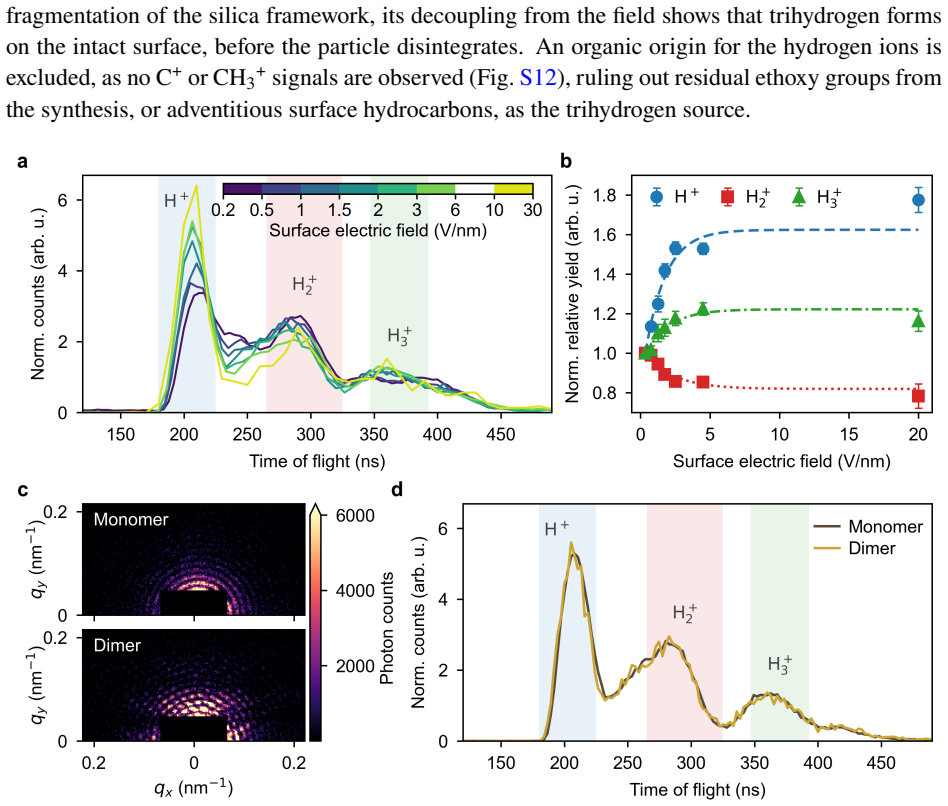
The paper's central claim is that the self-induced surface electric field on X-ray-charged hydrated silica nanoparticles is the dominant parameter governing the relative yields of $\mathrm{H^+}$, $\mathrm{H_2^+}$, and $\mathrm{H_3^+}$, independent of particle size (500, 300, and 100 nm $\mathrm{SiO_2}$ and 150 nm Au@$\mathrm{SiO_2}$ core-shell), composition, and aggregation. Using coincidence measurements of ion velocity-map imaging, electron time-of-flight, and coherent diffractive imaging on individual particles, the authors assign every shot a field $E = Ne/(4\pi\epsilon_0 R^2)$ and find that the yields of $\mathrm{H^+}$ and $\mathrm{H_3^+}$ rise while $\mathrm{H_2^+}$ falls along a common curve. The field acts upstream of the barrier-free proton-hop reaction: it drives interfacial charge transfer from silica valence states into the adsorbed water layer, fragments water, and sets the balance of the $\mathrm{H_2}$ and $\mathrm{H_2^+}$ precursors. The canonical reaction then proceeds on the intact surface, and the same field dependence appears for the water-ion yield while the silica-framework ions show no monotonic field dependence and the gas-phase argon reference stays flat. The conclusion is that field-driven charge transfer at V/nm fields is a unifying mechanism between radiation-dominated astrophysical environments and field-driven surface catalysis.
Load-bearing premise
The central load-bearing premise is that the per-shot electron count is a reliable, order-preserving measure of the net charge escaping each particle, so that the surface field $E = Ne/(4\pi\epsilon_0 R^2)$ can be assigned to every shot and used to collapse the data; if the electron signal stops tracking the charge at high fields, the apparent common curves could be a binning artifact.
Editorial extensions
If this is right
- Interstellar grains in X-ray-dominated regions gain a concrete route to $\mathrm{H_3^+}$ through the canonical reaction on water-covered silicate surfaces, with the yield set by the local surface field rather than by grain size alone.
- Radiation-driven surface chemistry on nanoparticles can be parameterized by a single intensive quantity—the self-induced surface field—so laboratory results on one particle size can be transferred to another at matched field.
- The field ordering of the $\mathrm{H^+}$, $\mathrm{H_2^+}$, and $\mathrm{H_3^+}$ yields persists above the warm-dense-matter transition, indicating that the field remains the controlling parameter even as the particle begins to enter a plasma-like regime.
- The multimodal single-particle approach ties an individual particle's chemistry to its charge state and structure shot-by-shot, resolving heterogeneity that ensemble measurements would obscure.
- The V/nm fields produced by X-ray charging offer an electrode-free driving voltage for surface catalysis, with the same mechanism potentially steering selectivity in reactions such as hydrogen evolution and $\mathrm{CO_2}$ reduction.
Reading between the lines
- Editorial inference: if the field is truly the controlling parameter, astrochemical models of $\mathrm{H_3^+}$ production in X-ray-dominated regions should use the grain-surface field (which scales as $N/R^2$ per charging event) as the rate-determining variable, rather than fluence or absorbed dose alone.
- Editorial inference: the common-curve collapse implies a testable universal scaling—any two grains with the same $E$ should give the same relative $\mathrm{H^+}$/$\mathrm{H_2^+}$/$\mathrm{H_3^+}$ yields regardless of material or aggregation; extending the measurement to other ice mantles or oxide substrates would probe whether the universality holds beyond hydrated silica.
- Editorial inference: by analogy with band bending at semiconductor photoelectrodes, the field-driven hole-transfer picture may be a general design principle for radiation-driven catalysis on wide-bandgap insulators, so other hydrated oxide surfaces under X-ray irradiation should show similar field-controlled ion yields.
Editorial analysis
A structured set of objections, weighed in public.
Referee Report
Summary. The manuscript reports a single-particle X-ray free-electron laser experiment on hydrated silica nanoparticles (500, 300, and 100 nm SiO2 and 150 nm Au@SiO2) at 1.88 keV, combining ion velocity-map imaging, electron time-of-flight spectroscopy, and coherent diffractive imaging. The authors assign a per-shot surface electric field from the eTOF electron count via E = Ne/(4πε0R^2), bin the relative yields of H+, H2+, and H3+ by this field, and report that the yields collapse onto common curves across particle size, composition, and monomer/dimer morphology. Density functional theory and nonadiabatic quantum molecular dynamics simulations are used to argue that the field drives interfacial hole transfer and water fragmentation, supplying H2 and H2+ for the canonical reaction H2+ + H2 -> H3+ + H. The paper concludes that the self-induced surface field is the dominant parameter governing the hydrogen ion yields and that the canonical trihydrogen reaction proceeds on hydrated silica under radiation-driven ionization.
Significance. If the field-control and common-curve results hold, this is a significant advance: it connects radiation-driven charging of nanograins to field-driven interfacial chemistry, proposes a plausible new route to H3+ on interstellar dust, and extends the analogy to band bending in photoelectrocatalysis. The experimental analysis has notable strengths: shot-level bootstrap uncertainties with validation against permutation and jackknife, multiple intensity windows including strictly sub-transition selections, a field-insensitive Ar3+ reference, CNN-based monomer/dimer classification with F1 > 0.99, and open data and code availability. The main risk is the field calibration: the per-shot field axis is not independently verified for the smaller particles and higher fields, so the central cross-size collapse needs a size-resolved check before the dominance claim can be accepted.
major comments (2)
- [Data Analysis; Eq. (2); SI A.8] The per-shot surface field is obtained from the eTOF electron count with a single global calibration constant that is established on 500 nm particles over 0–2 V/nm and then applied to all sizes and up to roughly 7 V/nm. The eTOF integration window (100–200 ns) captures a fraction of the emitted electrons that depends on the retarding surface potential V = E·R, which differs by a factor of five between 500 nm and 100 nm particles at the same nominal E. SI A.8 acknowledges that the captured fraction drops from about 90% to about 75% with intensity, but it does not demonstrate that this fraction is a common function of E independent of R. If the collection efficiency is not the same function of E for every particle size, the fields for the 100 nm and 300 nm particles are systematically misassigned, and the collapse in Fig. 3(b) could be an artifact of the field axis rather than evidence for field control. This is load-bearing for the cross-size claim, so I request a size-resolved cross-check (e.g., SIMION Si+ kinetic-energy fields for each diameter) or an explicit demonstration that the eTOF detection efficiency depends only on E and not on R.
- [Field-Dependent Trihydrogen Formation; Outlook] The manuscript overstates the mechanistic conclusion. The data show field-dependent H3+ yields and the presence of H2+, but they do not directly establish that H3+ is formed by the canonical reaction H2+ + H2 -> H3+ + H. Neutral H2 is inferred from water-fragmentation chemistry rather than detected, and alternative pathways (for example H2+ + H2O, or H3+ from a transient H3O+ intermediate) are not excluded by the present measurements. The abstract and Outlook state that the canonical reaction proceeds on the surface; that claim should be softened to 'consistent with' or supported by additional evidence such as deuterated-water experiments, coincidence detection of H2, or kinetic modeling that rules out competing channels.
minor comments (6)
- [SI A.12] The dimer surface-field superposition should specify the exact evaluation point and formula (surface point, center, or interparticle midpoint). The matched-field monomer/dimer comparison is sensitive to this choice, especially for contact pairs.
- [Methods; SI A.7] The main analysis window of 500–2000 ion counts includes data above the WDM transition for the 100 nm particles, for which the transition is estimated at about 1500 counts. The strictly sub-transition windows in Fig. S10 are reassuring, but the main Fig. 3(b) should either use a window that is sub-transition for all particle types or state the overlap clearly in the caption.
- [SI A.8] The statement that 'the two independent measures agree over their common range' is only qualitative; please provide a quantitative comparison (for example, a residual plot or deviation statistics) for the electron-counting field versus the SIMION Si+ kinetic-energy field over 0–2 V/nm.
- [Unified Field-Driven Mechanism] The absence of an H3O+ signal is explained by dissociative electron recombination, but this is an assumption rather than a directly measured channel. The text should label this as a hypothesis, not a demonstrated step.
- [SI A.10] The CNN classifier is trained with synthetic dimer diffraction patterns generated by the coherent sum of two isolated spheres. The high validation F1-score is encouraging, but the authors should state that the classifier may not generalize to fused or necked aggregates, which would not present as two-sphere diffraction patterns.
- [Throughout] The field range is described as 'roughly two orders of magnitude,' but the quoted fields (0.57–7.3 V/nm in SI A.8, with a 0–2 V/nm range for the 500 nm particles) span closer to one and a half orders of magnitude; please reconcile the quoted range or define it precisely.
Circularity Check
No significant circularity: the field-yield collapse is a nontrivial empirical result, not built into Eq. S2, and the self-citations are supporting rather than load-bearing.
full rationale
The derivation chain runs from the measured electron yield to the surface field via Eq. S2, E = Ne/(4pi*eps0*R^2), and then to the field-binned relative yields of H+, H2+, and H3+. This is not circular: the relative hydrogen-ion yields are not inputs to Eq. S2, which uses only the total electron count, the TEM-measured particle radius, and physical constants. Nothing in Eq. S2 forces the yields of different species, different particle sizes (126-504 nm), different compositions, or monomer versus dimer events to fall on common curves; the collapse in Fig. 3(b) and the matched-field monomer/dimer overlap in Fig. 3(d) are nontrivial empirical outcomes. The SIMION cross-check fixes only a multiplicative calibration constant over 0-2 V/nm for the 500 nm particles; it does not define the yield ratios, and the inverse-square size scaling is an independent geometric input. For dimers, the effective field is computed from measured electron counts and diffraction-derived separations, so the coincident TOF spectra are not forced by construction. Refs. [26] and [38] include overlapping authors, but they are used for consistency and model setup; the paper's own GPAW and QXMD simulations reproduce the field-driven hole transfer, so the self-citations are not load-bearing. The main caveat is a measurement systematic rather than circularity: SI A.8 states that the fixed eTOF window captures an intensity-dependent electron fraction, from about 90% at low field to about 75% at the highest fields, and the paper does not demonstrate that this fraction is independent of particle radius. A size-dependent electron collection efficiency could affect the absolute field scale and the cross-size collapse, but this is an experimental validity concern, not a definitional reduction of the predicted yields to the fitted input.
Assumptions & free parameters
free parameters (4)
- eTOF electron count conversion factor (g*eta) =
not quoted; set by matching SIMION over 0-2 V/nm
- effective electron emission yield per absorbed photon =
2 (assumed)
- near-surface energy deposition shell thickness =
approx. 10 nm
- exponential fit parameters for H+, H2+, H3+ yields versus field =
not reported numerically in the main text
assumptions (7)
- domain assumption Each nanoparticle behaves as a uniformly charged conducting sphere; the external field is E = Ne/(4πε0R^2) and is independent of the dielectric constant.
- domain assumption The eTOF signal integrated in the 100-200 ns window is a faithful monotonic proxy for the number of emitted electrons.
- domain assumption Neutral H2 is produced on the surface by recombination of H atoms from water dimer dissociation and radiolysis.
- ad hoc to paper The absence of H3O+ is explained by dissociative electron recombination that also supplies H atoms for H2.
- domain assumption A static uniform applied field in the DFT/NAQMD slab model represents the nanoparticle's long-range charging field.
- domain assumption The canonical reaction H2+ + H2 -> H3+ + H is barrier-free and proceeds at the Langevin capture rate.
- domain assumption The CNN monomer/dimer labels are accurate despite training with synthetic dimer diffraction patterns.
Cite this review
Pith. "Pith review of X-ray Driven Trihydrogen Formation on Silica Nanosurfaces." pith.science (2026). https://pith.science/paper/IKFRWWN6
@misc{pith2026260805590,
  author       = {Pith},
  title        = {Pith review of: X-ray Driven Trihydrogen Formation on Silica Nanosurfaces},
  year         = {2026},
  howpublished = {\url{https://pith.science/paper/IKFRWWN6}},
  note         = {Machine review of arXiv:2608.05590}
}
abstract
The trihydrogen cation ($\mathrm{H_3^+}$) initiates the ion-molecule reactions that build molecular complexity in interstellar space. Whether its canonical formation reaction, $\mathrm{H_2^+ + H_2 \rightarrow H_3^+ + H}$, proceeds on inorganic surfaces under radiation-driven ionization has remained untested. Here we drive $\mathrm{H_3^+}$ formation on hydrated silica nanoparticles using intense 1.88 keV X-ray pulses, combining ion velocity map imaging, electron time-of-flight spectroscopy, and single-particle coherent diffractive imaging to resolve this chemistry on individual particles. The self-induced surface electric field on the V/nm scale drives interfacial charge transfer and water fragmentation. This field is the dominant parameter governing the relative yields of $\mathrm{H^+}$, $\mathrm{H_2^+}$, and $\mathrm{H_3^+}$ across particle size, composition, and aggregation. Density functional theory and nonadiabatic quantum molecular dynamics simulations trace this field-driven charge transfer, directly analogous to band bending at semiconductor photoelectrodes. These results establish surface-field-driven charge transfer as a unifying mechanism between radiation dominated astrophysical environments and field-driven surface catalysis.
Figures


Figures from the paper (1 more)

Reference graph
Works this paper leans on
-
[1]
Tennyson, J. Spectroscopy of H3+: planets, chaos and the Universe.Reports on Progress in Physics 58, 421–476 (1995)
work page 1995
-
[2]
Lowry, T. M. The uniqueness of hydrogen.Journal of the Society of Chemical Industry42, 43–47 (1923)
work page 1923
-
[3]
The ion chemistry of interstellar clouds.Chemical Reviews92, 1473–1485 (1992)
Smith, D. The ion chemistry of interstellar clouds.Chemical Reviews92, 1473–1485 (1992)
work page 1992
-
[4]
Smith, D. & Španěl, P. Dissociative recombination of H3+ and some other interstellar ions: a controversy resolved.International Journal of Mass Spectrometry and Ion Processes129, 163–182 (1993)
work page 1993
-
[5]
McCall, B. J., Geballe, T. R., Hinkle, K. H. & Oka, T. Detection of H3+ in the Diffuse Interstellar Medium Toward Cygnus OB2 No. 12.Science279, 1910–1913 (1998)
work page 1998
-
[6]
McCall, B. J.et al.An enhanced cosmic-ray flux towards persei inferred from a laboratory study of the H3+-e- recombination rate.Nature422, 500–502 (2003)
work page 2003
-
[7]
Thomson, J. XIX.Further experiments on positive rays.The London, Edinburgh, and Dublin Philo- sophical Magazine and Journal of Science24, 209–253 (1912)
work page 1912
-
[8]
Hogness,T.R.&Lunn,E.G. TheIonizationofHydrogenbyElectronImpactasInterpretedbyPositive Ray Analysis.Physical Review26, 44–55 (1925)
work page 1925
Show all 72 references
-
[9]
Interstellar H3+.Chemical Reviews113, 8738–8761 (2013)
Oka, T. Interstellar H3+.Chemical Reviews113, 8738–8761 (2013)
2013
-
[10]
& Jagod, M.-F
Oka, T. & Jagod, M.-F. Infrared spectrum of H as an astronomical probe.J. Chem. Soc., Faraday Trans.89, 2147–2154 (1993)
1993
-
[11]
& Hochlaf, M
Palaudoux, J. & Hochlaf, M. Formation of H3+ through Chloromethane Dication Fragmentation.ACS Earth and Space Chemistry3, 980–985 (2019)
2019
-
[12]
Burrows,M.D.,Ryan,S.R.,Lamb,W.E.&McIntyre,L.C. StudiesofH+,H2+,andH3+dissociative ionization fragments from methane, ethane, methanol, ethanol, and some deuterated methanols using electron-impact excitation and a time-of-flight method incorporating mass analysis.The Journal of...
1979
-
[13]
& Bapat, B
Sharma, V. & Bapat, B. Determination of active sites for H atom rearrangement in dissociative ionization of ethanol.The Journal of Chemical Physics125, 044305 (2006)
2006
-
[14]
& Bapat, B
Kushawaha, R. & Bapat, B. Fragmentation dynamics of the methanol dication.Chemical Physics Letters463, 42–46 (2008)
2008
-
[15]
FormationofH3+duetoIntramolecularBond Rearrangement in Doubly Charged Methanol.Physical Review Letters97, 213201 (2006)
De,S.,Rajput,J.,Roy,A.,Ghosh,P.N.&Safvan,C.P. FormationofH3+duetoIntramolecularBond Rearrangement in Doubly Charged Methanol.Physical Review Letters97, 213201 (2006)
2006
-
[16]
& Nakano, H
Furukawa, Y., Hoshina, K., Yamanouchi, K. & Nakano, H. Ejection of triatomic hydrogen molecular ion from methanol in intense laser fields.Chemical Physics Letters414, 117–121 (2005). 15
2005
-
[17]
Okino,T.etal.Coincidencemomentumimagingofejectionofhydrogenmolecularionsfrommethanol in intense laser fields.Chemical Physics Letters419, 223–227 (2006)
2006
-
[18]
Kaziannis,S.etal.TheejectionoftriatomicmolecularhydrogenionsH3+producedbytheinteraction ofbenzenemoleculeswithultrafastlaserpulses.TheJournalofChemicalPhysics131,144308(2009)
2009
-
[19]
Ekanayake, N.et al.Mechanisms and time-resolved dynamics for trihydrogen cation (H3+) formation from organic molecules in strong laser fields.Scientific Reports7, 4703 (2017)
2017
-
[20]
Ekanayake,N.etal.H2roamingchemistryandtheformationofH3+fromorganicmoleculesinstrong laser fields.Nature Communications9, 5186 (2018)
2018
-
[21]
& Eland, J
Ruhl, E., Price, S., Leach, S. & Eland, J. Charge separation mass spectrometry: Part 2. Methyl compounds.International Journal of Mass Spectrometry and Ion Processes97, 175–201 (1990)
1990
-
[22]
& Hubin-Franskin, M.-J
Thissen, R., Simon, M. & Hubin-Franskin, M.-J. Fragmentation of methyl chloride photoexcited near Cl (2p) by mass spectrometry.The Journal of Chemical Physics101, 7548–7553 (1994)
1994
-
[23]
Eland, J. H. D. The Origin of Primary H+3 Ions in Mass Spectra.Rapid Communications in Mass Spectrometry10, 1560–1562 (1996)
1996
-
[24]
Pilling, S.et al.Production of H+3 via photodissociation of organic molecules in interstellar clouds: H+3 photoproduction in interstellar clouds.Monthly Notices of the Royal Astronomical Society375, 1488–1494 (2007)
2007
-
[25]
Alghabra,M.S.etal.Anomalousformationoftrihydrogencationsfromwateronnanoparticles.Nature Communications12, 3839 (2021)
2021
-
[26]
Dagar, R.et al.Tracking surface charge dynamics on single nanoparticles.Science Advances10, eadp1890 (2024)
2024
-
[27]
Dagar, R.et al.Trihydrogen Formation on Gold Nanoparticles in Strong Laser Fields.Nano Letters 26, 1599–1607 (2026)
2026
-
[28]
ObservationsoftheIcyUniverse.AnnualReviewof Astronomy and Astrophysics53, 541–581 (2015)
Boogert,A.A., Gerakines,P.A.&Whittet,D.C. ObservationsoftheIcyUniverse.AnnualReviewof Astronomy and Astrophysics53, 541–581 (2015)
2015
-
[29]
K.et al.An Ice Age JWST inventory of dense molecular cloud ices.Nature Astronomy 7, 431–443 (2023)
McClure, M. K.et al.An Ice Age JWST inventory of dense molecular cloud ices.Nature Astronomy 7, 431–443 (2023)
2023
-
[30]
PhotodissociationandX-Ray-DominatedRegions.Annual Review of Astronomy and Astrophysics60, 247–318 (2022)
Wolfire,M.G.,Vallini,L.&Chevance,M. PhotodissociationandX-Ray-DominatedRegions.Annual Review of Astronomy and Astrophysics60, 247–318 (2022)
2022
-
[31]
S., Rumpl, W
Mathis, J. S., Rumpl, W. & Nordsieck, K. H. The size distribution of interstellar grains.The Astro- physical Journal217, 425 (1977)
1977
-
[32]
Weingartner, J. C. & Draine, B. T. Dust Grain-Size Distributions and Extinction in the Milky Way, Large Magellanic Cloud, and Small Magellanic Cloud.The Astrophysical Journal548, 296 (2001). 16
2001
-
[33]
Applied Sciences7, 592 (2017)
Tschentscher, T.et al.Photon Beam Transport and Scientific Instruments at the European XFEL. Applied Sciences7, 592 (2017)
2017
-
[34]
Decking, W.et al.A MHz-repetition-rate hard X-ray free-electron laser driven by a superconducting linear accelerator.Nature Photonics14, 391–397 (2020)
2020
-
[35]
Kuster, M.et al.The 1-Megapixel pnCCD detector for the Small Quantum Systems Instrument at the EuropeanXFEL:systemandoperationaspects.JournalofSynchrotronRadiation28,576–587(2021)
2021
-
[36]
simionforthepersonalcomputerinreflection.InternationalJournalofMassSpectrometry 200, 3–25 (2000)
Dahl,D.A. simionforthepersonalcomputerinreflection.InternationalJournalofMassSpectrometry 200, 3–25 (2000)
2000
-
[37]
& Eastman, D
DiStefano, T. & Eastman, D. The band edge of amorphous SiO2 by photoinjection and photoconduc- tivity measurements.Solid State Communications9, 2259–2261 (1971)
1971
-
[38]
M.et al.Catalysis in Extreme Field Environments: A Case Study of Strongly Ionized SiO2 Nanoparticle Surfaces.Journal of the American Chemical Society146, 27563–27570 (2024)
Linker, T. M.et al.Catalysis in Extreme Field Environments: A Case Study of Strongly Ionized SiO2 Nanoparticle Surfaces.Journal of the American Chemical Society146, 27563–27570 (2024)
2024
-
[39]
& Stace, A
Angel, L. & Stace, A. Dissociation patterns of (H2O)+ cluster ions, for n=2–6.Chemical Physics Letters345, 277–281 (2001)
2001
-
[40]
& Slavíček, P
Svoboda, O., Hollas, D., Ončák, M. & Slavíček, P. Reaction selectivity in an ionized water dimer: nonadiabatic ab initio dynamics simulations.Phys. Chem. Chem. Phys.15, 11531–11542 (2013)
2013
-
[41]
Mi,D.etal.Formationofprotonatedwater-hydrogenclustersinaniontrapmassspectrometeratroom temperature.Physical Chemistry Chemical Physics24, 7180–7184 (2022)
2022
-
[42]
SourceofMolecularHydrogeninHigh-TemperatureWaterRadiolysis
Sterniczuk,M.&Bartels,D.M. SourceofMolecularHydrogeninHigh-TemperatureWaterRadiolysis. The Journal of Physical Chemistry A120, 200–209 (2016)
2016
-
[43]
& Zucker, D
Berger, M., Hubbell, J., Seltzer, S., Coursey, J. & Zucker, D. Xcom: Photon cross section database (version 1.2) (1999)
1999
-
[44]
P., Moretto-Capelle, P., Sence, M
Casta, R., Champeaux, J. P., Moretto-Capelle, P., Sence, M. & Cafarelli, P. Electron and photon emissions from gold nanoparticles irradiated by X-ray photons.Journal of Nanoparticle Research17, 3 (2015)
2015
-
[45]
& Medvedev, N
Lipp, V., Milov, I. & Medvedev, N. Quantifying electron cascade size in various irradiated materials for free-electron laser applications.Journal of Synchrotron Radiation29, 323–330 (2022)
2022
-
[46]
Fulldimensionalpotentialenergysurfacefor the ground state of H4+ system based on triatomic-in-molecules formalism.The Journal of Chemical Physics139, 184302 (2013)
Sanz-Sanz,C.,Roncero,O.,Paniagua,M.&Aguado,A. Fulldimensionalpotentialenergysurfacefor the ground state of H4+ system based on triatomic-in-molecules formalism.The Journal of Chemical Physics139, 184302 (2013)
2013
-
[47]
& Gerlich, D
Savić, I., Schlemmer, S. & Gerlich, D. Formation of H3+ in Collisions of H2+ with H2 Studied in a Guided Ion Beam Instrument.ChemPhysChem21, 1429–1435 (2020)
2020
-
[48]
Neau,A.etal.DissociativerecombinationofD3O+andH3O+: Absolutecrosssectionsandbranching ratios.The Journal of Chemical Physics113, 1762–1770 (2000). 17
2000
-
[49]
& Hirao, K
Furuhama, A., Dupuis, M. & Hirao, K. Reactions associated with ionization in water: A direct ab initiodynamicsstudyofionizationin(H2O)17.TheJournalofChemicalPhysics124,164310(2006)
2006
-
[50]
Journal of Physics B: Atomic, Molecular and Optical Physics55, 144001 (2022)
Bromberger, H.et al.Shot-by-shot 250 kHz 3D ion and MHz photoelectron imaging using Timepix3. Journal of Physics B: Atomic, Molecular and Optical Physics55, 144001 (2022)
2022
-
[51]
Wiley, W. C. & McLaren, I. H. Time-of-Flight Mass Spectrometer with Improved Resolution.Review of Scientific Instruments26, 1150–1157 (1955)
1955
-
[52]
Eppink, A. T. J. B. & Parker, D. H. Velocity map imaging of ions and electrons using electrostatic lenses: Application in photoelectron and photofragment ion imaging of molecular oxygen.Review of Scientific Instruments68, 3477–3484 (1997)
1997
-
[53]
& Sayre, D
Miao, J., Charalambous, P., Kirz, J. & Sayre, D. Extending the methodology of X-ray crystallography to allow imaging of micrometre-sized non-crystalline specimens.Nature400, 342–344 (1999)
1999
-
[54]
Computational microscopy with coherent diffractive imaging and ptychography.Nature637, 281–295 (2025)
Miao, J. Computational microscopy with coherent diffractive imaging and ptychography.Nature637, 281–295 (2025)
2025
-
[55]
& Van Blaaderen, A
Graf, C. & Van Blaaderen, A. Metallodielectric Colloidal Core-Shell Particles for Photonic Applica- tions.Langmuir18, 524–534 (2002)
2002
-
[56]
Jurek, Z., Son, S.-K., Ziaja, B. & Santra, R.XMDYNandXATOM: versatile simulation tools for quantitative modeling of X-ray free-electron laser induced dynamics of matter.Journal of Applied Crystallography49, 1048–1056 (2016)
2016
-
[57]
J.et al.GPAW: An open Python package for electronic structure calculations.The Journal of Chemical Physics160, 092503 (2024)
Mortensen, J. J.et al.GPAW: An open Python package for electronic structure calculations.The Journal of Chemical Physics160, 092503 (2024)
2024
-
[58]
Blöchl, P. E. Projector augmented-wave method.Physical Review B50, 17953–17979 (1994)
1994
-
[59]
GeneralizedGradientApproximationMadeSimple.Physical Review Letters77, 3865–3868 (1996)
Perdew,J.P.,Burke,K.&Ernzerhof,M. GeneralizedGradientApproximationMadeSimple.Physical Review Letters77, 3865–3868 (1996)
1996
-
[60]
& Krieg, H
Grimme, S., Antony, J., Ehrlich, S. & Krieg, H. A consistent and accurateab initioparametrization of density functional dispersion correction (DFT-D) for the 94 elements H-Pu.The Journal of Chemical Physics132, 154104 (2010)
2010
-
[61]
Computer Physics Communications184, 1–8 (2013)
Shimojo,F.etal.Largenonadiabaticquantummoleculardynamicssimulationsonparallelcomputers. Computer Physics Communications184, 1–8 (2013)
2013
-
[62]
SoftwareX10, 100307 (2019)
Shimojo, F.et al.QXMD: An open-source program for nonadiabatic quantum molecular dynamics. SoftwareX10, 100307 (2019)
2019
-
[63]
Tully, J. C. Molecular dynamics with electronic transitions.The Journal of Chemical Physics93, 1061–1071 (1990)
1990
-
[64]
Time-of-flightmassspectrometry(concepts,achievements,andprospects).International Journal of Mass Spectrometry206, 251–266 (2001)
Mamyrin,B. Time-of-flightmassspectrometry(concepts,achievements,andprospects).International Journal of Mass Spectrometry206, 251–266 (2001). 18
2001
-
[65]
inChapter3-DissociativeRecombinationofH3+IonswithElectrons: Theory and Experiment(eds Arimondo, E., Berman, P
Johnsen,R.&Guberman,S.L. inChapter3-DissociativeRecombinationofH3+IonswithElectrons: Theory and Experiment(eds Arimondo, E., Berman, P. & Lin, C.)Advances In Atomic, Molecular, and Optical Physics, Vol. 59 75–128 (Academic Press, 2010)
2010
-
[66]
The Journal of Chemical Physics147, 013940 (2017)
Michaelsen,T.etal.Imagingstate-to-statereactivescatteringintheAr++H2chargetransferreaction. The Journal of Chemical Physics147, 013940 (2017)
2017
-
[67]
& Ramaker, D
Van Riessen, G., Thurgate, S. & Ramaker, D. Auger-photoelectron coincidence spectroscopy of SiO2. Journal of Electron Spectroscopy and Related Phenomena161, 150–159 (2007)
2007
-
[68]
Huang, Y.et al.Nanometer-Scale Acoustic Wave Packets Generated by Stochastic Core-Level Pho- toionization Events.Physical Review X14, 041010 (2024)
2024
-
[69]
V., Lehtinen, K
Schweigert, I. V., Lehtinen, K. E. J., Carrier, M. J. & Zachariah, M. R. Structure and properties of silica nanoclusters at high temperatures.Physical Review B65, 235410 (2002)
2002
-
[70]
Zhuravlev, L. T. Concentration of hydroxyl groups on the surface of amorphous silicas.Langmuir3, 316–318 (1987). 19 A Supplementary Text A.1 Single-Event Charging of Interstellar Grains The correspondence between this experiment and X-ray dominated interstellar environments re...
1987
-
[71]
1(c)):𝑡0=7.45ns,𝑘=2.062×10 −7 s
Voltage Setting 1 (Fig. 1(c)):𝑡0=7.45ns,𝑘=2.062×10 −7 s
-
[72]
Voltage Setting 2 (all remaining figures):𝑡0=6.82ns,𝑘=2.450×10 −7 s. Fixing the exponent is justified rather than assumed: unconstrained fits return exponents of 2.013and2.018across the two voltage settings, statistically indistinguishable from2given the finite width of the pe...
Reviewed August 8, 2026 · model on record in the stance chip above.
Discussion (0). Continue with ORCID to comment.