REVIEW 1 major objections 5 minor 50 references
A Universal Control Budget for First-Passage Kinetics
T0 review · 1 major / 5 minor · reviewed 2026-08-07 · deepseek-v4-flash
Pith's one-line read A universal control budget for first-passage kinetics: each rate sensitivity lies in $[-1,1]$ and the sensitivities sum to $-1$.
desk verdict A clean, genuinely new unit bound on MFPT sensitivities, with a proof that holds up once you supply the missing proof of the imported response identity. read the letter →
The pith
A machine-rendered reading of the paper's core claim, the machinery that carries it, and where it could break.
The reading
What carries the argument
The central object is the redirection map: delete the absorbing target $B$ and send each absorption edge back to the source $A$ at the same rate, creating an irreducible network whose stationary absorption current equals the reciprocal MFPT, $J^{\rm red}_{A\to B}=1/\tau_{A\to B}$. This converts a transient first-passage quantity into a steady-state current, so the response identity for Markov jump processes, Eq. (5), can be applied to each channel flux. The unit bound for a single rate follows from two inequalities on the redirected graph: the MFPT triangle inequality squeezes the hitting-time difference between the two legs of the perturbed edge, and the traffic–MFPT (Kac) inequality $\tilde j_e(\tilde\tau_{n_e\to\tilde m_e}+\tilde\tau_{\tilde m_e\to n_e})\le 1$ bounds that commute by the edge traffic. For the source/edge bookkeeping, Eq. (9), $s_e=\tilde j_e(\tau_{m_e\to B}-\tau_{n_e\to B})$, re-expresses each sensitivity as expected traversals per completion times remaining wait removed, from which barrier, state, and group bounds follow.
What would settle it
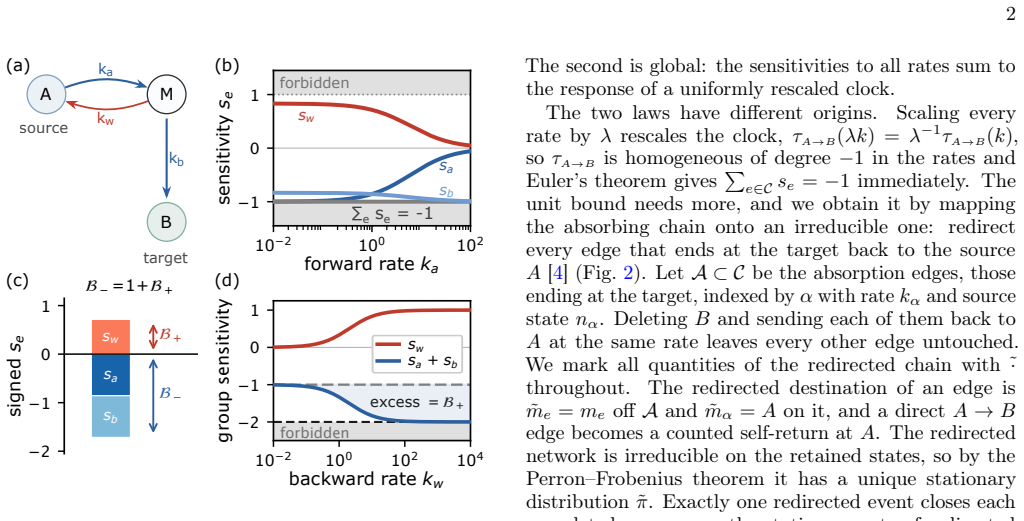
Solve the linear equations $Q\nu=-\delta_A$ for a candidate absorbing network, compute each $s_e=(k_e/\tau)\mathbf{1}^\top \partial\nu/\partial k_e$ by exact linear algebra, and search for an edge with $|s_e|>1$; one such edge in any finite chain with positive rates would falsify the unit bound. A cheaper check is the minimal chain $A\to M\to B$ with backward rate $k_w$: the closed form $\tau=(k_a+k_w+k_b)/(k_a k_b)$ implies $s_w\to +1$ and $s_a+s_b\to -2$ as $k_w\to\infty$, so the predicted approach to those limits is directly testable by arithmetic.
Extended reading notes
Core claim
On the paper's own terms, the discovery is a pair of exact constraints on how the mean first-passage time $\tau_{A\to B}$ responds to microscopic rate changes in any finite Markov chain with a source $A$, an absorbing target $B$, and positive rates. For each directed edge $e$, the logarithmic sensitivity $s_e$ satisfies $-1 \le s_e \le 1$, and the full set satisfies $\sum_e s_e = -1$. The summation rule follows from Euler's theorem because $\tau$ is homogeneous of degree $-1$ in the rates under a uniform clock rescaling; the unit bound is obtained by redirecting all absorption edges back to $A$, so the reciprocal MFPT becomes the stationary current of a recycled process, and then applying a channel-flux response identity together with triangle and Kac-type inequalities to show each channel flux responds within $[-1,1]$. The paper further derives structured consequences: a two-way barrier perturbation has sensitivity bounded by $1-\rho_{uv}$, where $\rho_{uv}$ is the traversal ratio of the edge; a state-energy perturbation has sensitivity exactly $-\tilde\pi_v$, the stationary occupancy share, and hence partitions the unit budget across states; and in kinetic proofreading the discrimination gain equals the delaying budget, so it is capped by the number of checkpoints $m$, with the binding step forced to absorb the remaining speeding budget.
Load-bearing premise
The proof of the unit bound depends on a formula, taken from the authors' earlier paper and not proved here, describing how each recycled current changes when a rate changes; if that formula does not hold after absorption channels are redirected, the bound $|s_e|\le1$ fails.
Editorial extensions
If this is right
- For any single rate perturbation, the mean completion time can move by at most the fractional change of that rate; no one microscopic step is ever more than fully rate-limiting.
- Uniformly rescaling all rates leaves $\sum_e s_e=-1$, so any speeding sensitivity in excess of the first unit must be paid for by an equal delaying budget on other edges.
- A barrier that scales both directions of an edge controls completion only through the net current: when forward and backward traffic balance, the barrier's sensitivity vanishes.
- A state-energy shift has sensitivity equal to minus that state's stationary occupancy share, so the completion time is controlled by a partition of one across states.
- Kinetic proofreading can discriminate by at most the number of checkpoints, and operating near that cap forces the binding step to carry nearly unit concentration sensitivity.
Reading between the lines
- Editorial inference: the summation rule should extend to any observable homogeneous in the rates, such as higher first-passage moments or splitting probabilities, but the unit bound likely does not; computing sensitivities of the variance on the minimal chain would test whether the local law is special to the mean.
- Editorial inference: the budget gives a parameter-free diagnostic for kinetic assays: a measured sensitivity near $+1$ on a reset edge signals that the remaining speeding budget is nearly exhausted, so a fitted model must show the compensating $-2$ across productive edges; checking this on published kinetic schemes for motors or channel gating is a direct test.
- Editorial inference: the proofreading result suggests a general tradeoff for any proofreading cascade, namely that each checkpoint buys at most one power of selectivity and the price in concentration sensitivity grows as the cap is approached; a testable extension would be to measure the discrimination gain and binding-edge sensitivity in a reconstituted proofreading system and compare with Eq. (1
Editorial analysis
A structured set of objections, weighed in public.
Referee Report
Summary. The paper establishes two universal laws for the logarithmic sensitivity s_e = ∂ log τ_{A→B}/∂ log k_e of the mean first-passage time in a finite Markov chain with absorbing target B: the single-edge bound |s_e| ≤ 1 and the summation rule Σ_e s_e = -1 (Eq. (3)). The proof maps the absorbing chain to an irreducible chain by redirecting absorption edges to the source, so the reciprocal MFPT becomes a stationary current; the channel-flux response identity (Eq. (5)) from the authors' prior work, together with triangle and Kac inequalities, bounds each channel response in [-1,1], and convex averaging yields the local bound. The paper then interprets the two laws as a conserved control budget (B_- = 1 + B_+), derives consequences for barrier and state perturbations, and applies the budget to kinetic proofreading, finding a discrimination cap Δ ≤ m and a concentration-sensitivity tradeoff |s_a| ≥ max(0, 1 + Δ - m). Appendices prove the channel-average identity and a same-source group bound, and a final appendix documents exact linear-algebra numerical methods.
Significance. If correct, the result is a remarkably general constraint on kinetic control: no individual rate can move the MFPT by more than its own fractional change, and uniform rescaling always leaves one unit of net speeding budget after cancellations. The proof combines a clean redirection argument with exact linear-algebra checks and random-network numerics, and the proofreading application gives a falsifiable bound (D ≤ f^m) and a sharp concentration-robustness tradeoff. The paper ships reproducible numerical procedures and closed-form formulas, and the central derivation is mostly self-contained. The main caveat is that the load-bearing response identity Eq. (5) is quoted from an overlapping-author preprint rather than proved here; this is a completeness issue for a standalone publication, not a demonstrated error in the central claim.
major comments (1)
- [Section II, Eq. (5)] The unit bound -1 ≤ s_e ≤ 1 rests entirely on the channel-flux response identity (5), which is imported from Ref. [9], an arXiv preprint by the same authors, without proof or a precise statement of hypotheses. Since this is the only externally loaded step and the central claim collapses if the identity fails, the manuscript should either prove Eq. (5) in an appendix or quote a published version with a full derivation; a citation to an unreviewed preprint is not sufficient for a load-bearing identity in a standalone paper. This is a completeness issue rather than an observed error, so I expect it to be fixable by adding a self-contained proof.
minor comments (5)
- [Introduction, first paragraph] The word 'timming' should be 'timing'.
- [Section III, Eq. (8)] The notation 'N± count the edges with s_e ≷ 0' is ambiguous; please define N_+ and N_- explicitly as the numbers of edges with positive and negative sensitivity.
- [Section II, traffic-MFPT inequality] The sentence 'a firing leaves the process at the destination and it must return to the source before firing again' is imprecise, because the inter-firing interval includes both the return and the subsequent wait for the edge to fire. Please state the decomposition explicitly as j_e(τ_{n_e→m_e} + τ_{m_e→n_e}) ≤ 1, with the strong-Markov-property argument spelled out.
- [Appendix A] The orientation of the generator (column versus row convention) should be declared at the start of the appendix; as written, the Kac equation ∑_z W_{zy} τ̃_{z→y} = 1/π̃_y - 1 can be confusing without this convention.
- [Section V, Eq. (16)] When deriving |s_a| ≥ max(0, 1 + Δ - m), state explicitly that this uses the unit bound on each forward-edge sensitivity |s_fi| ≤ 1, so the remaining budget must be carried by the binding edge.
Circularity Check
No significant circularity: the main theorems are derived from homogeneity, redirection, and a general response identity, not assumed.
full rationale
The derivation chain is not circular. The summation rule sum_e s_e = -1 follows directly from Euler's theorem applied to the homogeneity relation tau(lambda k) = lambda^{-1} tau(k), as stated in Section II. The local unit bound -1 <= s_e <= 1 is proved rather than assumed: the paper redirects absorption edges to the source, equates the recycled current with 1/tau, invokes the channel-flux response identity (Eq. 5), and then applies the triangle inequality and the Kac/traffic-motivated inequality j_e(tau_{n_e->m_e}+tau_{m_e->n_e}) <= 1 to squeeze each channel-flux response into [-1,1]. Eq. (5) is quoted from the authors' own prior work (ref [9]), so it is a self-citation, but it is a general steady-state response identity and not the target bound; the substance of the unit-bound proof lies in the subsequent inequalities. Appendix D further cross-validates every sensitivity against exact linear algebra, although it does not independently verify Eq. (5) itself. The kinetic-proofreading cap Delta <= m and the cost identity |s_a| >= max(0,1+Delta-m) follow from the edge-count bound and the explicit closed form Eq. (14), not from the conclusion. No fitted parameter is renamed as a prediction, and no known result is merely relabeled. The only caveat is a completeness issue: Eq. (5) is asserted by citation rather than proved in this manuscript, but that is not a logical circularity.
Assumptions & free parameters
assumptions (6)
- domain assumption Channel-flux response identity, Eq (5): d log j_alpha / d log k_e = (tau_{n_e to n_alpha} - tau_{m_e to n_alpha}) j_e + delta_{e alpha}.
- domain assumption Finite CTMC, positive rates, B reached almost surely in finite mean; absorption edges redirected to A make an irreducible chain with unique stationary distribution.
- standard math Kac recurrence / Palm inversion formula for stationary edge-firing point processes.
- standard math MFPT triangle inequalities on the redirected graph.
- standard math Backward equation identity sum_{e:n_e=v} k_e (tau_{m_e to B} - tau_{v to B}) = -1.
- domain assumption Energetic-discrimination limit for proofreading: only reset rates differ between right and wrong substrates, k_W_ui = f k_R_ui, f >= 1; forward rates identical.
Cite this review
Pith. "Pith review of A Universal Control Budget for First-Passage Kinetics." pith.science (2026). https://pith.science/paper/T4BFFIEG
@misc{pith2026260806368,
  author       = {Pith},
  title        = {Pith review of: A Universal Control Budget for First-Passage Kinetics},
  year         = {2026},
  howpublished = {\url{https://pith.science/paper/T4BFFIEG}},
  note         = {Machine review of arXiv:2608.06368}
}
read the original abstract
The first-passage time is the natural observable of reaction completion, yet how its mean responds to a rate change has lacked a general constraint. We show that the logarithmic sensitivity of the mean first-passage time of any finite Markov chain to any rate is bounded by one in magnitude, and that these sensitivities sum to -1. Together the two laws form a conserved control budget: speeding completion through some transitions must be paid for by others, and a coordinated change shifts the completion time only as far as the budget allows. Raising an activation barrier or shifting the depth of a well moves many rates at once, yet neither can shift the completion time further than a single rate could. The budget caps kinetic-proofreading discrimination at the checkpoint count, and prices it in sensitivity to substrate concentration.
Figures


Figures from the paper (1 more)

Reference graph
Works this paper leans on
- [9]
-
[1]
Redner,A Guide to First-Passage Processes(Cam- bridge University Press, 2001)
S. Redner,A Guide to First-Passage Processes(Cam- bridge University Press, 2001)
2001
-
[2]
S. Condamin, O. Bénichou, V. Tejedor, R. Voituriez, and J. Klafter, First-passage times in complex scale-invariant media, Nature450, 77 (2007)
work page 2007
-
[3]
O. Bénichou and R. Voituriez, From first-passage times of random walks in confinement to geometry-controlled kinetics, Phys. Rep.539, 225 (2014)
work page 2014
-
[4]
T. L. Hill,Free Energy Transduction and Biochemical Cycle Kinetics(Springer-Verlag, New York, 1989)
1989
-
[5]
C. L. Kussius and G. K. Popescu, Kinetic basis of par- tial agonism at nmda receptors, Nat. Neurosci.12, 1114 (2009)
work page 2009
-
[6]
R. D. Vale and R. A. Milligan, The way things move: Looking under the hood of molecular motor proteins, Science288, 88 (2000)
work page 2000
-
[7]
K. B. Gromadski and M. V. Rodnina, Kinetic determi- nants of high-fidelity tRNA discrimination on the ribo- some, Mol. Cell13, 191 (2004)
work page 2004
Show all 50 references
-
[8]
J. A. Owen, T. R. Gingrich, and J. M. Horowitz, Universal thermodynamic bounds on nonequilibrium response with biochemical applications, Phys. Rev. X10, 011066 (2020)
2020
-
[10]
Aslyamov and M
T. Aslyamov and M. Esposito, Nonequilibrium response for Markov jump processes: Exact results and tight bounds, Phys. Rev. Lett.132, 037101 (2024)
2024
-
[11]
Aslyamov and M
T. Aslyamov and M. Esposito, General theory of static response for Markov jump processes, Phys. Rev. Lett. 133, 107103 (2024)
2024
-
[12]
P. E. Harunari, S. Dal Cengio, V. Lecomte, and M. Polet- tini, Mutual linearity of nonequilibrium network currents, Phys. Rev. Lett.133, 047401 (2024)
2024
-
[13]
Dal Cengio, P
S. Dal Cengio, P. E. Harunari, V. Lecomte, and M. Po- lettini, Mutual multilinearity of nonequilibrium network currents, SciPost Phys.19, 111 (2025)
2025
-
[14]
Bebon and T
R. Bebon and T. Speck, Mutual linearity is a generic property of steady-state Markov networks, Phys. Rev. Lett.136, 137401 (2026)
2026
-
[15]
Z. Wang, C. Wang, and J. Ren, Sensitivity analysis of cycle flux response in nonequilibrium dynamics, J. Chem. Phys.165, 044105 (2026)
2026
-
[16]
Fancher and J
S. Fancher and J. M. Horowitz, Topological build- ing blocks of nonequilibrium response (2026), arXiv:2607.12096 [cond-mat.stat-mech]
2026 arXiv
-
[17]
Katayama, R
K. Katayama, R. Nagayama, and S. Ito, Diagrammatic expressions for steady-state distribution and static re- sponses in population dynamics, Phys. Rev. Research8, 013312 (2026)
2026
-
[18]
Goerlich, A
R. Goerlich, A. Tartar, Y. Roichman, and I. M. Sokolov, Fluctuation-response relation for a nonequilibrium system with resolved Markovian embedding, Phys. Rev. E114, 014138 (2026)
2026
-
[19]
Klett and B
K. Klett and B. Lindner, Fluctuation-response relations and response-response relations for membrane voltage and spike train of stochastic integrate-and-fire neurons, Phys. Rev. E112, 044404 (2025)
2025
-
[20]
Aslyamov, K
T. Aslyamov, K. Ptaszyński, and M. Esposito, Nonequi- librium fluctuation-response relations: From identities to bounds, Phys. Rev. Lett.134, 157101 (2025)
2025
-
[21]
Liu and J
K. Liu and J. Gu, Dynamical activity universally bounds precision of response in Markovian nonequilibrium sys- tems, Commun. Phys.8, 62 (2025)
2025
-
[22]
J.ZhengandZ.Lu,Universalresponseinequalitiesbeyond steady states via trajectory information geometry, Phys. Rev. E112, L012103 (2025)
2025
-
[23]
Zheng and Z
J. Zheng and Z. Lu, Unified linear fluctuation-response theory arbitrarily far from equilibrium, Phys. Rev. E112, 064103 (2025)
2025
-
[24]
Kwon, H.-M
E. Kwon, H.-M. Chun, H. Park, and J. S. Lee, Fluctuation- response inequalities for kinetic and entropic perturba- tions, Phys. Rev. Lett.135, 097101 (2025)
2025
-
[25]
Dechant, Finite-frequency fluctuation-response inequal- ity, Phys
A. Dechant, Finite-frequency fluctuation-response inequal- ity, Phys. Rev. Lett.136, 207101 (2026)
2026
-
[26]
Gao, H.-M
Q. Gao, H.-M. Chun, and J. M. Horowitz, Thermo- dynamic constraints on kinetic perturbations of homo- geneous driven diffusions, Europhys. Lett.146, 31001 (2024)
2024
-
[27]
Khodabandehlou, C
F. Khodabandehlou, C. Maes, and K. Netočný, Affine relationships between steady currents, J. Phys. A: Math. Theor.58, 155002 (2025)
2025
-
[28]
Kamp and A
F. Kamp and A. Szabo, Fluxes, first passage times, and the reduction of Hill diagrams, Cell Biophys.12, 145 (1988)
1988
-
[29]
J. J. Hopfield, Kinetic proofreading: A new mechanism for reducing errors in biosynthetic processes requiring high specificity, Proc. Natl. Acad. Sci. U.S.A.71, 4135 (1974)
1974
-
[30]
Ninio, Kinetic amplification of enzyme discrimination, Biochimie57, 587 (1975)
J. Ninio, Kinetic amplification of enzyme discrimination, Biochimie57, 587 (1975)
1975
-
[31]
Rao and L
R. Rao and L. Peliti, Thermodynamics of accuracy in kinetic proofreading: Dissipation and efficiency trade-offs, J. Stat. Mech.: Theory Exp.2015(6), P06001
2015
-
[32]
Kumar, K
P. Kumar, K. Banerjee, and G. Gangopadhyay, Interplay of energy, dissipation, and error in kinetic proofreading: Control via concentration and binding energy, Physica A 603, 127735 (2022)
2022
-
[33]
Sekimoto, Derivation of the first passage time distri- bution for Markovian process on discrete network (2021), arXiv:2110.02216 [cond-mat.stat-mech]
K. Sekimoto, Derivation of the first passage time distri- bution for Markovian process on discrete network (2021), arXiv:2110.02216 [cond-mat.stat-mech]
2021 arXiv
-
[34]
D. R. Cox,Renewal Theory(Methuen, 1962)
1962
-
[35]
D. J. Daley and D. Vere-Jones,An Introduction to the Theory of Point Processes, Vol. I: Elementary Theory and Methods, 2nd ed. (Springer, New York, 2003)
2003
-
[36]
Kacser and J
H. Kacser and J. A. Burns, The control of flux, Symp. Soc. Exp. Biol.27, 65 (1973)
1973
-
[37]
Heinrich and T
R. Heinrich and T. A. Rapoport, A linear steady-state treatment of enzymatic chains: General properties, con- trol and effector strength, Eur. J. Biochem.42, 89 (1974)
1974
-
[38]
D. A. Fell, Metabolic control analysis: A survey of its theoretical and experimental development, Biochem. J. 286, 313 (1992)
1992
-
[39]
Meléndez-Hevia, N
E. Meléndez-Hevia, N. V. Torres, J. Sicilia, and H. Kacser, Control analysis of transition times in metabolic systems, Biochem. J.265, 195 (1990)
1990
-
[40]
Liu, Simple proofs of the summation and connec- tivity theorems in metabolic control analysis (2025), arXiv:2501.12519 [q-bio.MN]
W. Liu, Simple proofs of the summation and connec- tivity theorems in metabolic control analysis (2025), arXiv:2501.12519 [q-bio.MN]
2025 arXiv
-
[41]
Murugan, D
A. Murugan, D. A. Huse, and S. Leibler, Speed, dissipa- tion, and error in kinetic proofreading, Proc. Natl. Acad. Sci. U.S.A.109, 12034 (2012). 9
2012
-
[42]
T. W. McKeithan, Kinetic proofreading in T-cell receptor signal transduction, Proc. Natl. Acad. Sci. U.S.A.92, 5042 (1995)
1995
-
[43]
Sartori and S
P. Sartori and S. Pigolotti, Kinetic versus energetic dis- crimination in biological copying, Phys. Rev. Lett.110, 188101 (2013)
2013
-
[44]
Eslami-Mossallam, M
B. Eslami-Mossallam, M. Klein, C. van der Smagt, K. van der Sanden, S. K. Jones, Jr., J. A. Hawkins, I. J. Finkel- stein, and M. Depken, A kinetic model predicts SpCas9 activity, improves off-target classification, and reveals the physical basis of targeting fidelity, Nat. Com...
2022
-
[45]
B. E. Clancy, W. M. Behnke-Parks, J. O. L. Andreasson, S. S. Rosenfeld, and S. M. Block, A universal pathway for kinesin stepping, Nat. Struct. Mol. Biol.18, 1020 (2011)
2011
-
[46]
M. Rief, R. S. Rock, A. D. Mehta, M. S. Mooseker, R. E. Cheney, and J. A. Spudich, Myosin-v stepping kinetics: A molecular model for processivity, Proc. Natl. Acad. Sci. U.S.A.97, 9482 (2000)
2000
-
[47]
T. R. Gingrich and J. M. Horowitz, Fundamental bounds on first passage time fluctuations for currents, Phys. Rev. Lett.119, 170601 (2017)
2017
-
[48]
A. Pal, S. Reuveni, and S. Rahav, Thermodynamic uncer- tainty relation for first-passage times on markov chains, Phys. Rev. Research3, L032034 (2021)
2021
-
[49]
Hiura and S.-i
K. Hiura and S.-i. Sasa, Kinetic uncertainty relation on first-passage time for accumulated current, Phys. Rev. E 103, L050103 (2021)
2021
-
[50]
D. M. Busiello, S. Liang, and S. Pigolotti, Non-equilibrium symmetry of cyclic first-passage times, New J. Phys.28, 064602 (2026)
2026
Reviewed August 7, 2026 · model on record in the stance chip above.
Discussion (0). Continue with ORCID to comment.