REVIEW 4 major objections 6 minor 24 references
Pre-Inference Routing for Cost-Efficient Document Field Extraction
T0 review · 4 major / 6 minor · reviewed 2026-08-10 · deepseek-v4-flash
Pith's one-line read The paper claims that pre-inference routing of each document to a cheap or expensive extractor pays off exactly when the cheap model fails often enough and those failures are predictable from visible page features — and that a small…
desk verdict A genuinely honest and useful paper on when pre-inference routing pays for document extraction; the headline cost numbers sit on a single-draw noise floor that needs de-noising before the savings claim is final. read the letter →
The pith
A machine-rendered reading of the paper's core claim, the machinery that carries it, and where it could break.
The reading
What carries the argument
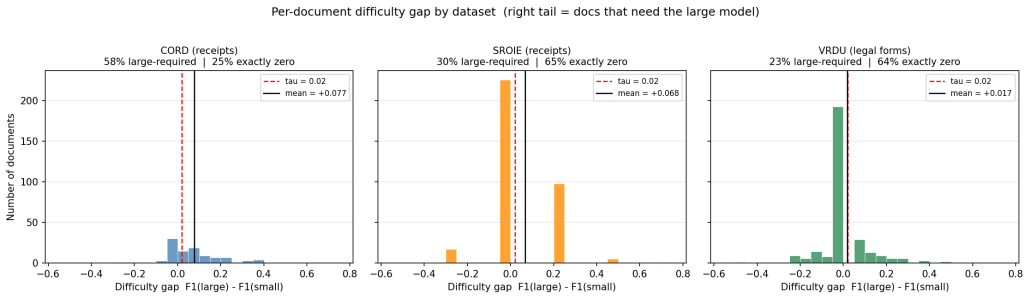
The load-bearing object is the two-condition diagnostic, operationalized as the headroom fraction and the routing AUC. Headroom is the share of documents labeled large-required by the gap rule $y(d)=\mathbf{1}[g(d)>\tau]$ with $g(d)=q_\ell(d)-q_s(d)$; feature-detectability is the cross-validated AUC of a calibrated random forest that maps 13 pre-inference features — OCR confidence and its variance, token fragmentation, blur, contrast, word-height variation, line crowding and density, aspect ratio, item density, and token count — to that label. The decision side sweeps the router's probability threshold across a cost–quality Pareto frontier, choosing the cheapest point within a tolerance $\delta=0.02$ F1 of always using the large tier, under a token-based cost model in which the tier pair is priced at a clean 5× ratio (and a second pair at 3×). A field-type canonical scorer, which compares money as numbers, dates by components, and text by normalized exact match, keeps harmless reformatting from being counted as extraction failure.
What would settle it
Take a corpus the diagnostic flags as routable on a 100–200 document pilot (headroom near or above 40% and routing AUC near or above 0.7), deploy the router on a held-out set with the threshold fixed on the pilot, and measure the realized saving at the 0.02 F1 tolerance; a realized saving far below the reported scale, or a quality loss beyond tolerance, would falsify the two-condition claim. A more direct check of the measurement floor: re-extract the pilot set several times per (tier, document), average the F1, and recompute the headroom fraction — if the averaged headroom moves by more than the reported savings margins, the headline numbers sit on single-draw noise rather than on stable document difficulty.
Extended reading notes
Core claim
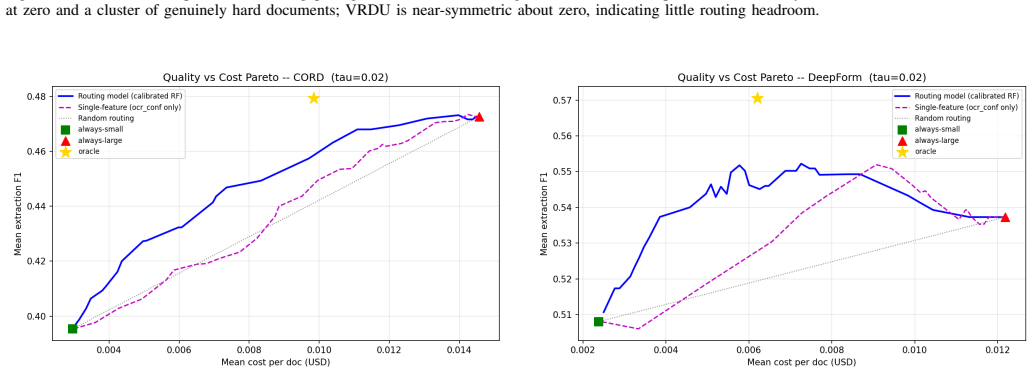
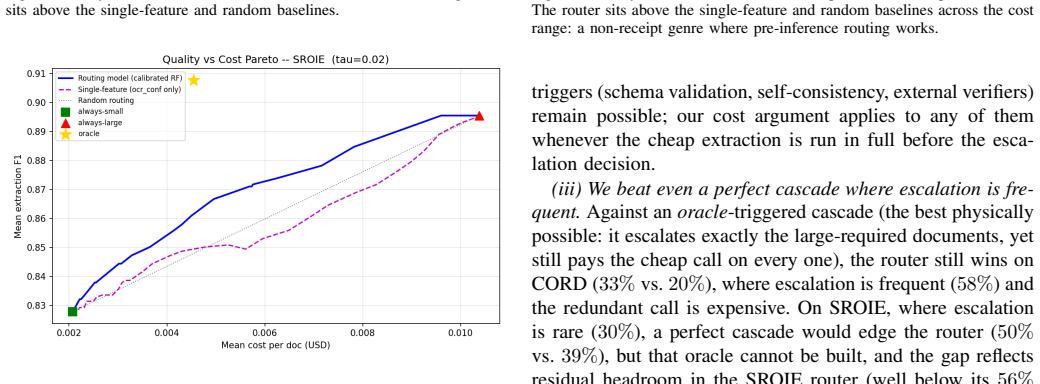
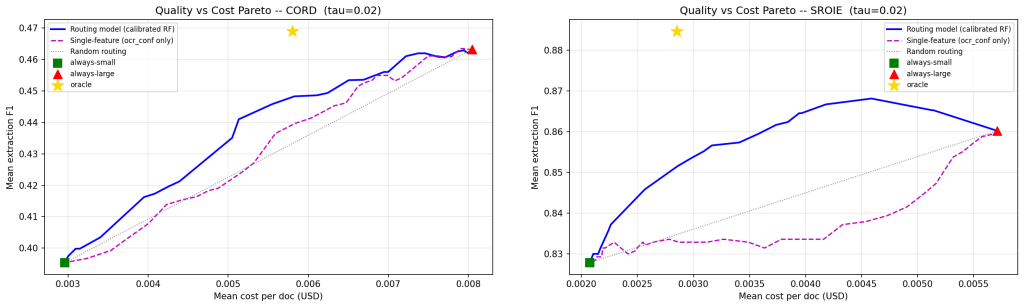
The paper's central claim is that whether document routing works for a corpus is itself predictable, and it reduces to two measurable conditions. The first is headroom: the fraction of documents whose quality gap $g(d)=q_\ell(d)-q_s(d)$ between the expensive and cheap extraction tier exceeds a tolerance $\tau=0.02$ F1; the second is feature-detectability: the AUC with which a router can predict that gap from 13 pre-inference features computed from the page image, OCR text, and box geometry. On six datasets spanning five genres, routing succeeds where both conditions are favorable — pooled receipts (held-out AUC 0.707; 31–33% savings) and the degraded ad-buy forms (held-out AUC 0.916; 77% savings at within-0.02-F1 quality) — and fails where either is absent. The paper also establishes two negative results that delimit the method: a bag-of-words text router matches the engineered features, so the bottleneck is the genre rather than the router, and the router does not transfer across datasets, even within a genre, so it must be refit per deployment.
Load-bearing premise
Each document's difficulty label is the F1 gap between two single stochastic extraction runs, and the 0.02 tolerance sits inside the measured decoding noise (per-document F1 standard deviation about 0.02), so near-threshold labels, and the savings measured against them, rest on a noisy measurement floor.
Editorial extensions
If this is right
- On a new corpus, a small labeled pilot that measures headroom and feature-detectability tells you in advance whether pre-inference routing will save money; both pilot predictions the paper ran were correct.
- Where the diagnostic says route, the savings are substantial at the stated quality tolerance: 31–33% on receipts and 77% on degraded ad-buy forms, with the no-peek threshold check confirming the saving is not a test-set artifact.
- Pre-inference routing is strictly cheaper than a confidence cascade under full-document re-extraction, because a cascade pays the cheap extraction on every document before deciding; where escalation is frequent, routing beats even a perfect-trigger oracle cascade.
- The router must be refit per dataset: transfer fails across genres and even across two receipt datasets, so a deployed router needs its own labeled sample on the target corpus.
- The effect persists across two model pairs with 5× and 3× cost ratios, so the savings are not an artifact of one particular price gap.
Reading between the lines
- The two-condition diagnostic may be the more durable result than the router: it can serve as a cheap go/no-go gate before committing to routing, cascading, or fine-tuning on any new corpus.
- Because a bag-of-words text router matches the engineered image and layout features, detectable difficulty seems to live in the document's surface lexicon and structure rather than in fine-grained image quality; a testable extension is whether an OCR-free vision-language extractor, which sees the page directly, changes the headroom and predictability on genres the diagnostic currently calls unrout
- The paper's own measurement floor (per-document F1 standard deviation about 0.02, with roughly 20% of near-threshold documents flipping label under averaging) implies that a few re-extractions per document on the pilot would sharpen the headroom estimate at trivial cost, and headroom should ideally be reported with its own confidence interval.
Signed reviews
Editorial analysis
A structured set of objections, weighed in public.
Referee Report
Summary. The paper studies pre-inference routing for structured document field extraction: choose a cheap or expensive LLM per document based on 13 intrinsic features (OCR quality, image quality, layout, content/structure) before any extraction call. Documents are labeled large-required when the per-document F1 gap exceeds tau=0.02; a calibrated random forest estimates P(large-required), and the operating threshold is selected to minimize cost subject to Q(t) >= Q_large - delta with delta=0.02. Experiments on CORD/SROIE receipts, DeepForm ad-buy forms, DocILE invoices, POIE nutrition labels, and VRDU report that routing saves 31-33% on receipts and 77% on DeepForm, does not help on invoices/nutrition/VRDU, does not transfer across genres, and is robust to model pair (5x and 3x cost ratios), to canonical vs strict scoring, and to a tau sweep. The paper also compares pre-inference routing with confidence cascades, reports a no-peek threshold-transfer protocol, and releases code.
Significance. If the savings figures survive scrutiny, the paper makes a practical contribution: a two-condition diagnostic (routing headroom and feature-detectable difficulty) with conservative field-type canonical scoring, a threshold-free AUC as a selection-free metric, and explicit negative results on genres where routing fails. Strengths include held-out bootstrap CIs on the receipt savings, threshold-transfer checks, replication on a second model pair, and the observation that a bag-of-words router matches engineered features, which supports the claim that the genre, not the router design, is the binding constraint. The main gap is statistical: every F1 label and the quality constraint in Eq. (4) are computed from a single stochastic extraction per (tier, document), and the tolerance delta equals the measured per-document F1 noise, so the central cost-savings claim is not yet fully established. The DeepForm 77% headline also lacks uncertainty quantification, and the relationship between the no-peek and frontier SROIE savings is inconsistent across tables.
major comments (4)
- [Sec. IV-D and Sec. VI] All oracle labels, training targets, and the quality constraint in Eq. (4) are computed from one stochastic extraction per (tier, document) at the provider's default sampling. The paper's own re-extraction pilot reports per-document F1 standard deviation of about 0.02 and about 20% label flips within 0.10 F1 of tau under averaging; since tau=delta=0.02, the label boundary sits on this noise floor. The no-peek threshold in Sec. V-F is selected on training predictions to satisfy Q(t) >= Q_large - delta using the same single draws that define the labels, so the constraint can be satisfied on the realized draw even if the expected Q(t) is below the tolerance. AUC stability across tau (Table X) does not resolve this, because the cost claim depends on the operating point and the boundary. Please re-run with averaged F1 over several draws for both labels and evaluation, or provide an explicit bound showing the worst-case expected Q(t) under the measured noise, before the headline savings are reported.
- [Sec. V-C, Table VII] Both CORD and SROIE are described as clearing the predefined success criterion (cutting cost by at least 30% within 2 F1 points), but the reported bootstrap 95% CIs are [26,42]% for CORD and [27,35]% for SROIE; both include values below 30%. The point estimates clear the criterion, but the uncertainty does not rule out failing it. Please report the fraction of bootstrap resamples meeting the >=30% criterion, or present the success claim together with the CI explicitly stated.
- [Table VII vs Table X and Sec. V-F] At tau=0.02, Table VII reports a SROIE saving of 31%, while Table X reports 39%, Table IX lists the RF route as 39%, and Sec. V-F calls 39% the achievable frontier and 31% the no-peek threshold result. If Table VII is meant to report the no-peek threshold-transfer saving, the caption must state this; as written, a reader sees a direct contradiction among the headline tables. Please harmonize the labels so that each table states explicitly whether the saving is the evaluation-set frontier value or the blind-threshold value.
- [Table VIII] The DeepForm headline of 77% cost saving is reported on a 100-document held-out test without a confidence interval, and the observed quality gap is exactly 0.020, equal to delta; with the noise floor described in Sec. VI, this point estimate is fragile. Please provide a bootstrap CI for the saving and a CI for the quality-constraint margin, or present the 77% result as preliminary rather than as a headline number.
minor comments (6)
- [Abstract and Introduction] The claim that a small labeled pilot can predict whether routing will work is based on only two positive pilot runs; please present this as an anecdotal illustration, or add at least one pilot on a genre where the diagnostic predicts routing should fail.
- [Sec. IV-C] The statement that setting tau=delta is for simplicity should be clarified: delta is a user-chosen deployment tolerance, while tau is a modeling choice, and a mismatch between them would change the training labels. The paper should state explicitly that the reported numbers hold for delta=0.02 and that delta was not swept.
- [Sec. V-D] The DeepForm feature-signal-gated pilot is mentioned as confirming both conditions, but no pilot numbers (headroom, pilot AUC) are reported; please include the pilot results so the reader can assess the two-case pilot claim.
- [Table XI] The DeepForm CI for the RF-minus-text difference is reported in the text but not in the table; moving it to the table would avoid confusion.
- [Sec. V-D] The term half-tolerance generalization buffer is used for the DeepForm threshold selection but is never defined; please define it or replace it with the explicit threshold-selection rule.
- [References] Several references contain stray spaces in author initials (for example, refs. 5 and 12 print V . with a space); please clean up the bibliography formatting.
Circularity Check
No significant circularity: labels come from real extraction gaps, thresholds are selected without test peeking, and no load-bearing self-citation.
full rationale
The paper's derivation chain is self-contained and externally grounded. Oracle labels y(d)=1[q_l(d)-q_s(d)>tau] in Sec. IV-C are computed from actual held-out extraction F1 gaps, not from the router; the router is trained only on pre-inference features (Sec. III-D) that are explicitly leakage-resistant (annotation-derived signals removed, Sec. III-D). The headline savings are not fit: the operating point (4) is optimized on training predictions and applied blind to test (Sec. V-F), and the threshold-free AUC (Table IV) requires no threshold at all. The equality tau=delta=0.02 is an explicit design decision (Sec. IV-C), not a fitted parameter, and the paper sweeps tau (Table X), showing savings and AUC are stable. The DeepForm and receipt savings are evaluated against the full held-out quality constraint Q(t)>=Q_large-delta, and the paper reports that the no-peek threshold transfers within tolerance. The two-condition diagnostic (headroom + feature-detectable difficulty) is empirically validated against negative genres (DocILE, POIE) that fail one condition, so the conditions are not definitional restatements of success. There are no load-bearing self-citations: all references are external benchmarks or prior routing work, and no uniqueness theorem is imported from the author's own prior work. The single-draw F1 variance concern (Sec. VI) is a measurement-robustness issue, not a circular reduction: the labels, AUC, and savings are not constructed to equal their inputs, and the paper explicitly quantifies the noise floor.
Assumptions & free parameters
free parameters (3)
- Oracle threshold tau and quality tolerance delta =
0.02 for both, swept over {0.01, 0.02, 0.05}
- Router operating threshold t* =
Selected per dataset and model pair from training or out-of-fold predictions; no single value
- DeepForm half-tolerance generalization buffer =
Not quantified beyond half of delta
assumptions (4)
- domain assumption Field-level F1 with a field-type canonical matching rule is a valid measure of extraction quality.
- domain assumption One stochastic extraction draw per (tier, document) estimates the expected F1 gap well enough for labels and savings.
- domain assumption The 13 pre-inference features, or bag-of-words text, capture document difficulty that is observable before extraction.
- ad hoc to paper Equating the oracle label threshold tau with the deployed quality tolerance delta is without loss.
Cite this review
Pith. "Pith review of Pre-Inference Routing for Cost-Efficient Document Field Extraction." pith.science (2026). https://pith.science/paper/SQLAYOGK
@misc{pith2026260806607,
  author       = {Pith},
  title        = {Pith review of: Pre-Inference Routing for Cost-Efficient Document Field Extraction},
  year         = {2026},
  howpublished = {\url{https://pith.science/paper/SQLAYOGK}},
  note         = {Machine review of arXiv:2608.06607}
}
read the original abstract
Most document-extraction systems use a single model for all documents. This is simple but can be costly for easy cases and less effective for difficult ones. We examine whether we can predict a document's difficulty before extraction using inexpensive, document-based signals, and use this to choose between a cheaper and a stronger extractor. We find that routing only helps if two conditions hold: the cheaper model fails often enough to make routing worthwhile, and those failures can be predicted from visible features such as image quality and layout. We turn these into a practical test and apply it to five genres. When both conditions are met, the calibrated router reduces cost by 31-33% on receipts and 77% on degraded ad-buy forms while keeping quality within 0.02 F1 of always choosing the large model. Routing does not help if either condition is missing, as with clean digital invoices or nutrition labels that are already easy to read. A small labeled pilot can predict whether routing will work, and in the two cases where we ran it first, the prediction was correct. A simple bag-of-words router works about as well as engineered features, showing that the main limit is the genre, not the router design; we use interpretable features to help explain which genres can be routed. The router must be retrained for each dataset and does not transfer across datasets, even within the same genre. These results hold for two model pairs with cost differences of 5x and 3x.
Figures
Figures from the paper (1 more)
Reference graph
Works this paper leans on
-
[1]
S. Somerstep, F. Maia Polo, A. F. M. de Oliveira, P. Mangal, M. Silva, O. Bhardwaj, M. Yurochkin, and S. Maity. CARROT: A Cost Aware Rate Optimal Router. arXiv:2502.03261, 2025
arXiv 2025
-
[2]
Z. Pan, K. Zhang, Y . Zhao, and Y . Han. Route to Reason: Adaptive Routing for LLM and Reasoning Strategy Selection. arXiv:2505.19435, 2025
arXiv 2025
-
[3]
X. Wang, Y . Liu, W. Cheng, X. Zhao, Z. Chen, W. Yu, Y . Fu, and H. Chen. MixLLM: Dynamic Routing in Mixed Large Language Mod- els. InProc. NAACL-HLT, pp. 10912–10922, 2025. arXiv:2502.18482
arXiv 2025
-
[4]
H. Ma, G. Lai, and H.-J. Ye. MMR-Bench: A Comprehensive Bench- mark for Multimodal LLM Routing. InECCV, 2026. https://github.com/ Hunter-Wrynn/MMR-Bench
work page 2026
-
[5]
D. Ding, A. Mallick, S. Zhang, C. Wang, D. Madrigal, M. Hipolito Garcia, M. Xia, L. V . S. Lakshmanan, Q. Wu, and V . R ¨uhle. BEST- Route: Adaptive LLM Routing with Test-Time Optimal Compute. arXiv:2506.22716, 2025
arXiv 2025
- [6]
-
[7]
Cost-Aware Model Orchestration for LLM-based Systems
D. Smirnova, H. Nasiri, M. Adamska, Z. Yu, and P. Garraghan. Cost- Aware Model Orchestration for LLM-based Systems. InProc. EuroML- Sys, 2026. arXiv:2512.01099
work page Pith review arXiv 2026
-
[8]
A. Sindhu and A. Suresh. Agent-Based Generative AI Model for Cost- Aware Automation in Machine Learning Pipelines.IEEE Access, 2025
work page 2025
Show all 24 references
-
[9]
Moslem and J
Y . Moslem and J. D. Kelleher. Dynamic Model Routing and Cascading for Efficient LLM Inference: A Survey. arXiv:2603.04445, 2026
2026 arXiv
-
[10]
L. Chen, M. Zaharia, and J. Zou. FrugalGPT: How to Use Large Language Models While Reducing Cost and Improving Performance. arXiv:2305.05176, 2023
2023 arXiv
-
[11]
I. Ong, A. Almahairi, V . Wu, W.-L. Chiang, T. Wu, J. E. Gonzalez, M. W. Kadous, and I. Stoica. RouteLLM: Learning to Route LLMs with Preference Data. arXiv:2406.18665, 2024
2024 arXiv
-
[12]
D. Ding, A. Mallick, C. Wang, R. Sim, S. Mukherjee, V . R ¨uhle, L. V . S. Lakshmanan, and A. H. Awadallah. Hybrid LLM: Cost-Efficient and Quality-Aware Query Routing. InICLR, 2024
2024
-
[13]
Madras, T
D. Madras, T. Pitassi, and R. Zemel. Predict Responsibly: Improving Fairness and Accuracy by Learning to Defer. InNeurIPS, 2018
2018
-
[14]
Geifman and R
Y . Geifman and R. El-Yaniv. Selective Classification for Deep Neural Networks. InNeurIPS, 2017
2017
-
[15]
Huang, T
Y . Huang, T. Lv, L. Cui, Y . Lu, and F. Wei. LayoutLMv3: Pre-training for Document AI with Unified Text and Image Masking. InACM Multimedia, 2022
2022
-
[16]
G. Kim, T. Hong, M. Yim, J. Nam, J. Park, J. Yim, W. Hwang, S. Yun, D. Han, and S. Park. OCR-free Document Understanding Transformer (Donut). InECCV, 2022
2022
-
[17]
S. Park, S. Shin, B. Lee, J. Lee, J. Surh, M. Seo, and H. Lee. CORD: A Consolidated Receipt Dataset for Post-OCR Parsing. InNeurIPS Workshop on Document Intelligence, 2019
2019
-
[18]
Huang, K
Z. Huang, K. Chen, J. He, X. Bai, D. Karatzas, S. Lu, and C. V . Jawahar. ICDAR2019 Competition on Scanned Receipt OCR and Information Extraction (SROIE). InICDAR, 2019
2019
-
[19]
Jaume, H
G. Jaume, H. K. Ekenel, and J.-P. Thiran. FUNSD: A Dataset for Form Understanding in Noisy Scanned Documents. InICDAR-OST, 2019
2019
-
[20]
Z. Wang, Y . Zhou, W. Wei, C.-Y . Lee, and S. Tata. VRDU: A Benchmark for Visually-rich Document Understanding. InKDD, 2023
2023
-
[21]
Svetlichnaya
S. Svetlichnaya. DeepForm: Understand Structured Documents at Scale. Weights & Biases, 2020. https://wandb.ai/stacey/deepform v1. Distributed via the DUE benchmark [22]
2020
-
[22]
Borchmann, M
Ł. Borchmann, M. Pietruszka, T. Stanisławek, D. Jurkiewicz, M. Tur´oski, K. Szyndler, and F. Grali ´nski. DUE: End-to-End Document Understanding Benchmark. InNeurIPS Datasets and Benchmarks, 2021
2021
-
[23]
ˇSimsa, M
ˇS. ˇSimsa, M. ˇSulc, M. U ˇriˇc´aˇr, Y . Patel, A. Hamdi, M. Koci ´an, M. Skalick´y, J. Matas, A. Doucet, M. Coustaty, and D. Karatzas. DocILE Benchmark for Document Information Localization and Extraction. In ICDAR, 2023
2023
-
[24]
Kuang, W
J. Kuang, W. Hua, D. Liang, M. Yang, D. Jiang, B. Ren, and X. Bai. Visual Information Extraction in the Wild: Practical Dataset and End- to-End Solution (POIE). InICDAR, 2023
2023
Reviewed August 10, 2026 · model on record in the stance chip above.
Discussion (0). Continue with ORCID to comment.