REVIEW 2 major objections 5 minor 111 references
A causal magnetic black hole with finite self-energy
T0 review · 2 major / 5 minor · reviewed 2026-08-15 · deepseek-v4-flash
Pith's one-line read This paper builds a magnetically charged nonlinear-electrodynamics black hole with finite self-energy, a single horizon, and no inner Cauchy horizon, while keeping the center singular.
desk verdict Solid analytic construction of a magnetic NLED black hole; the one-horizon theorem holds, but the exponent-restriction claim is stronger than what is proven. read the letter →
The pith
A machine-rendered reading of the paper's core claim, the machinery that carries it, and where it could break.
The reading
What carries the argument
The central object is the positive mixture of power kernels $\mathcal{L}_\mu(F)=\int \mathcal{L}_{\beta,\gamma}(F)\,d\mu(\beta,\gamma)$ with $\mathcal{L}_{\beta,\gamma}(F)=((1+\beta F)^{1-\gamma}-1)/[\beta(1-\gamma)]$, restricted to support $1/4<\gamma\le 1/2$. Positivity of the measure makes $\mathcal{L}_\mu$ a Bernstein function of $F$, so the inequalities $\mathcal{L}>0$, $\mathcal{L}_F>0$, $\Phi=\mathcal{L}_F+2F\mathcal{L}_{FF}>0$, and $0<\kappa_{\rm em}=\Phi/\mathcal{L}_F\le 1$ hold term by term; these encode the energy conditions and the subluminal extraordinary photon cone. The argument then runs through the mass equation $m'(r)=r^2\mathcal{L}(Q_m^2/2r^4)$, whose integral for the two-kernel model is evaluated exactly in lower incomplete $\beta$ functions, and through the identity $f'(r)=2D(r)/r^2$ with $D'(r)=2r^2(2F\mathcal{L}_F-\mathcal{L})>0$, which yields the strict monotonicity of $f$ and the one-horizon theorem. The same machinery produces the effective photon metrics for the ordinary and extraordinary branches and the thermodynamic first law with variable couplings.
What would settle it
Compute the coupled gravitational–electromagnetic quasinormal spectrum for the two-kernel solution (for example at the Table I parameter sets) and look for any mode with positive imaginary part; an unstable mode would show that the sufficient conditions used for the exterior do not cover this singular-center spacetime. Alternatively, scan the $M_0\ge 0$ parameter space numerically for any case with $f'(r)\le 0$ at some $r>0$ or with two positive roots of $f$, which would contradict Lemma 1.
Extended reading notes
Core claim
The paper's central discovery is that requiring finite magnetic self-energy, a causal and subluminal electromagnetic cone, the standard energy conditions, and a Maxwell weak-field limit singles out the exponent window $1/4<\gamma\le 1/2$ for concave power kernels, and that the minimal positive mixture with $\gamma_1=1/3$, $\gamma_2=1/2$ yields an exact magnetic black hole solution with metric function $f(r)=1-2m(r)/r$ expressed through incomplete $\beta$ functions. The load-bearing result (Lemma 1) states that for $Q_m\neq 0$ and $M_0\ge 0$, $f'(r)>0$ for all $r>0$, so $f$ has at most one positive root. Hence the black-hole branch has exactly one event horizon, no inner Cauchy horizon, and no finite-radius extremal horizon; the center remains a curvature singularity, with spacelike, timelike, or null singularity depending on whether the solution is on the black-hole, horizonless, or critical branch. The same construction gives positive Hawking temperature, negative fixed-charge heat capacity for representative families, and a birefringent optical sector in which the extraordinary photon branch shifts the shadow critical curve outward, partly compensating the shadow reduction caused by magnetic charge.
Load-bearing premise
The stability part of the central claim rests on applying the quoted sufficient stability conditions to a spacetime whose center is singular; if those conditions do not apply to a non-regular center with unusual boundary behavior, the exterior-stability statement has no independent support.
Editorial extensions
If this is right
- Within the $M_0\ge 0$ sector, every solution in this family has at most one horizon: no inner Cauchy horizon and no finite-radius extremal horizon, so the causal structure is strictly one-horizon and the maximal extension has spacelike singular boundaries.
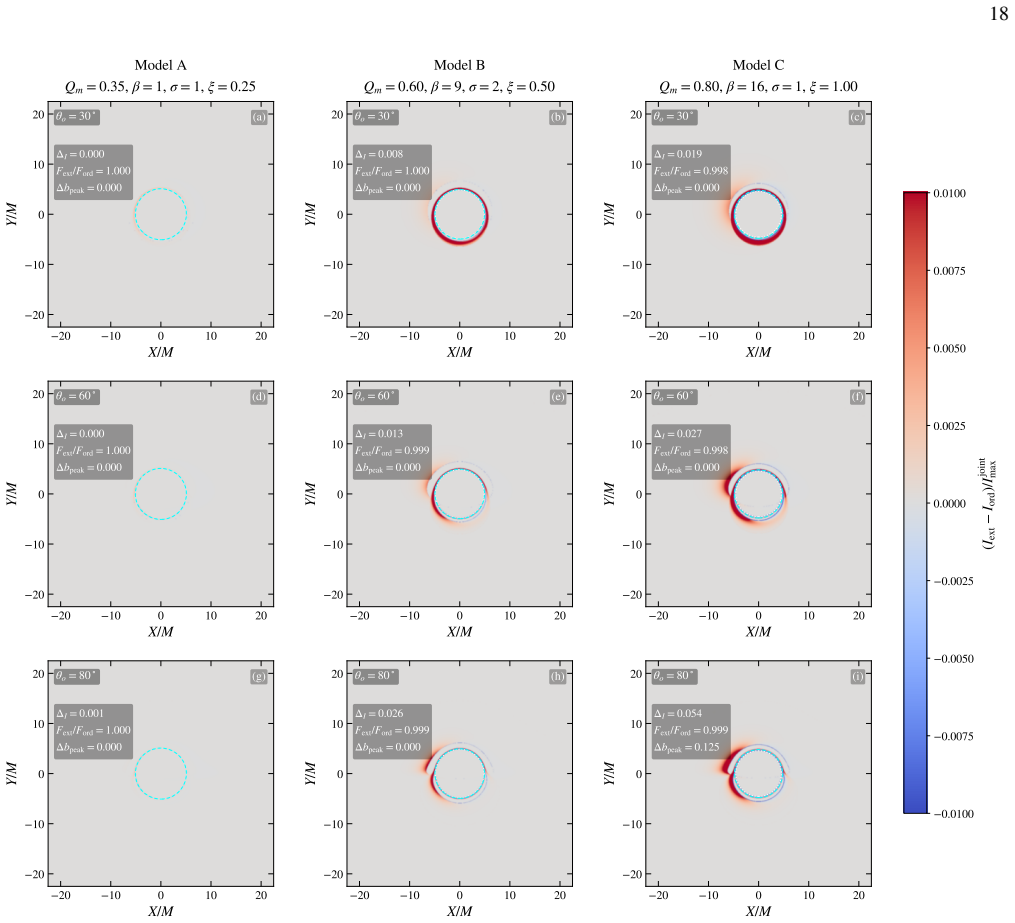
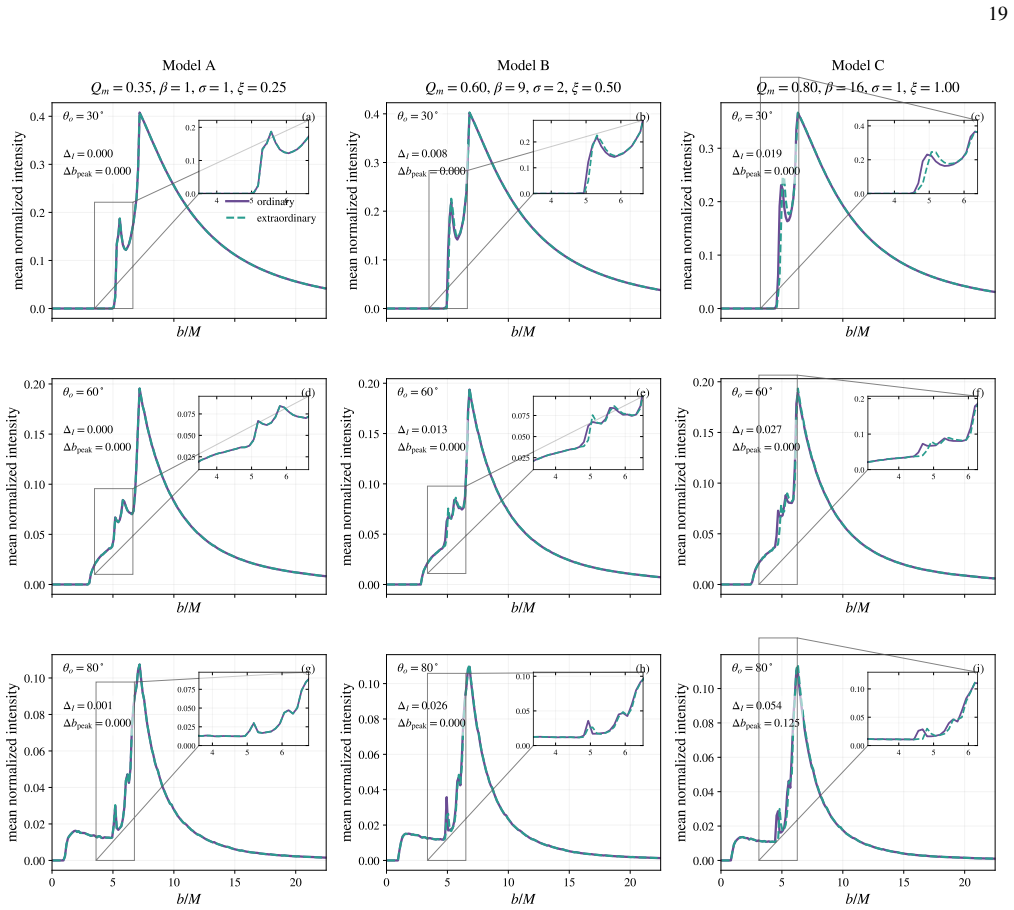
- The electromagnetic sector is birefringent: photons split into ordinary and extraordinary branches, and for strong nonlinear coupling the extraordinary shadow diameter can be several percent larger than the ordinary one, partially offsetting the magnetic-charge reduction.
- The representative black-hole families have positive temperature at every finite horizon radius and negative fixed-charge heat capacity, so they are locally unstable in the asymptotically flat canonical ensemble.
- Finite electromagnetic self-energy fixes the lower bound $\gamma>1/4$ and causal propagation fixes the upper bound $\gamma\le 1/2$; any positive mixture of such kernels automatically satisfies the weak, dominant, and strong energy conditions and a causal photon cone.
- The weak-field expansion recovers the Reissner–Nordström form $f(r)=1-2M/r+Q_m^2/r^2+\dots$, so the model is a controlled deformation of the charged black hole rather than a regularized alternative.
Reading between the lines
- Editorial inference: because the proof of Lemma 1 uses only $\mathcal{L}>0$, $\mathcal{L}_F>0$, and $2F\mathcal{L}_F-\mathcal{L}>0$, the one-horizon conclusion may hold for any NLED Lagrangian obeying those inequalities, not only for the explicit power-mixture family; this would extend the no-Cauchy-horizon result to a broader class of theories.
- Editorial inference: the illustrative shadow scan suggests a testable separation—if EHT-like critical-curve measurements are compared at fixed mass, a preference for the extraordinary branch would imply a larger magnetic charge than an ordinary-branch analysis would infer.
- Editorial inference: a rotating counterpart, if constructed, would likely show polarization-dependent shadow edges because the extraordinary branch changes the effective angular metric; searching for such an edge could distinguish this model from single-metric NLED families.
Signed reviews
Editorial analysis
A structured set of objections, weighed in public.
Referee Report
Summary. The paper proposes an NLED model for a static, spherically symmetric magnetic black hole. The Lagrangian is a positive normalized mixture of power kernels; finite magnetic self-energy selects gamma > 1/4 and positivity of the characteristic factor Phi selects (the authors claim) gamma <= 1/2. For the two-kernel representative with gamma_1 = 1/3 and gamma_2 = 1/2, the mass function is obtained exactly in terms of incomplete beta functions. The central theorem (Lemma 1) proves f'(r) > 0 for Q_m != 0 and M_0 >= 0, hence at most one horizon, no inner Cauchy horizon, and no finite-radius extremal horizon; for the one-horizon branches the maximal extension is constructed in Kruskal and Penrose coordinates. The paper then derives thermodynamic quantities, ordinary and extraordinary photon metrics, shadow radii, an illustrative EHT band, and ISCO-truncated thin-disk images. The authors are transparent that the EHT comparison is illustrative and that stability is based on cited sufficient conditions.
Significance. The paper's main value is a rare exact NLED magnetic black hole that combines finite electromagnetic self-energy, causal photon propagation, standard energy conditions, and a strict one-horizon causal structure without imposing a regular center. Lemma 1 is sound, and its one-line proof is verifiable; the incomplete-beta mass function is a concrete new result. The optical analysis correctly treats the spacetime metric and the extraordinary effective metric as separate, and it gives a useful qualitative prediction that the extraordinary branch partially compensates the shadow reduction from magnetic charge. The manuscript ships code and clearly labels the EHT comparison as illustrative rather than as a fit. If the typographical inconsistencies in the boundary-branch formulas and the overstatement of the exponent restriction are corrected, the paper will be a solid contribution.
major comments (2)
- [Section III, Eqs. (14)-(17); abstract; Section XIII] The paper states that causal magnetic propagation 'requires' gamma <= 1/2 and that the interval 1/4 < gamma <= 1/2 follows from finiteness plus causality. What Eq. (17) actually proves is a sufficient condition: every kernel with gamma <= 1/2 contributes a positive term to Phi, so a positive mixture of such kernels has Phi > 0. It does not prove necessity, because a kernel with gamma > 1/2 contributes a negative term that decays as F^{-gamma} at large F, while a kernel with gamma < 1/2 contributes a positive term that decays more slowly. For example, a measure 0.9 delta(gamma=0.4) + 0.1 delta(gamma=0.6) with equal beta gives Phi(0)=1 and positive Phi on a logarithmic grid at large F. The exact two-kernel model is unaffected because it uses only admissible kernels, but the abstract and Section XIII should be rephrased to say that the interval is a constructive/sufficient restriction on the chosen family, or a proof of necessity should be supplied.
- [Section VI, Eq. (47); Section VII E, Eq. (70)] The pure-boundary-branch formulas are mutually inconsistent and appear to contain typos. From Eq. (22) with xi=1 and F=Q_m^2/(2r^4), one finds L ~ sqrt(2)|Q_m|/(sqrt(sigma beta) r^2) as r -> 0, hence m' ~ sqrt(2)|Q_m|/sqrt(sigma beta) and f(0+) = 1 - 2 sqrt(2) lambda / sqrt(sigma). Eq. (47) instead writes f(0+) = 1 - 2/(sqrt(2) lambda sqrt(sigma)), and Eq. (70) writes f(0+) = 1 - (2/sqrt(2)) lambda sqrt(sigma). Neither expression vanishes at the stated critical value lambda_c = sqrt(sigma)/(2 sqrt(2)) except for special choices of sigma, although that vanishing is precisely what defines the threshold in Eq. (48). These formulas should be corrected, since the horizonless condition and the null-singularity threshold of the boundary branch depend on them.
minor comments (5)
- [Section V, Eq. (41)] The stability claim in Section V is stronger than what is verified: the paper checks the algebraic conditions of Eq. (11) but does not verify the full hypotheses of the theorems in Refs. [57, 61], such as regularity assumptions that may be needed for the perturbation analysis. Since the authors already state in Section XIII that a direct coupled perturbation spectrum is needed, please add a short caveat directly after Eq. (41) and adjust the wording 'Thus the sufficient stability conditions... hold' to 'the algebraic sufficient conditions... are satisfied'.
- [Section III, Eq. (19)] The weak-field expansion is written as L(F) = F - (F^2/2) integral gamma beta dmu + O(F^3). It would be helpful to state explicitly that the linear coefficient is fixed by the normalization of the measure, since this is the reason the Maxwell weak-field limit holds for every positive mixture.
- [Section VI, Eq. (46)] The quantity lambda = |Q_m| sqrt(beta) has unusual dimensions in the conventions G=c=1; please state the chosen dimensions of Q_m and beta, or normalize lambda by a reference scale, so the boundary-branch conditions in Eqs. (47)-(48) are dimensionally transparent.
- [Figures 3-5] The text labels the three examples A_c, B_c, and C_c, while the figures use the shorter labels A, B, and C. Please add a sentence to each caption identifying the correspondence, or use the same labels in the text and figures.
- [Section XII, Eqs. (99)-(102)] The residual maps and the quantity Delta b_peak are described with care, but the radial bin-width limitation of Delta b_peak is mentioned only in the text. Please add one sentence in the caption of Fig. 12 noting that Delta b_peak is bin-limited and that Table II provides the continuous critical-impact-parameter measure.
Circularity Check
No significant circularity: the construction is self-contained and the central claims do not reduce to fitted inputs or self-citations.
full rationale
The paper's derivation chain is self-contained. The NLED model is defined by the kernel in Eq. (12) and the positive mixture in Eq. (13); the derivatives (15)-(17) are computed directly, the energy conditions follow from Eqs. (37)-(39), and the exterior stability check uses the externally stated sufficient conditions in Eq. (11), verified through Eq. (41). The central one-horizon theorem (Lemma 1) is proved from the monotonicity of D(r), which uses only the field equations and the previously established positivity of 2F L_F - L. No fitted parameter is renamed as a prediction: the benchmark models in Table I are chosen by hand, and the EHT band in Eq. (92) is explicitly described as illustrative and not a likelihood analysis. The paper's only self-citation, Ref. [69], appears as contextual contrast and as an example of a direct perturbation calculation that the authors explicitly do not claim to perform; it is not load-bearing for the geometry, thermodynamics, or optical results. The abstract's statement that a positive mixture 'restricts' the exponent to 1/4 < gamma <= 1/2 is an overstatement, since Eq. (17) establishes a sufficient condition for each kernel rather than a necessary condition for arbitrary positive mixtures; however, this is a logical precision issue, not a circular reduction, and it does not affect the two-kernel model, whose inequalities are checked directly. The repeated caveats that the stability analysis relies on sufficient criteria and does not replace a direct coupled perturbation spectrum are limitations, not circular steps.
Assumptions & free parameters
free parameters (7)
- gamma_1 =
1/3
- gamma_2 =
1/2
- beta =
Varies by example: 1, 9, and 16 in optical models; 1 in causal examples.
- sigma =
1, 2, or 4 in the examples.
- xi =
0.25, 0.50, or 1.00 in the examples.
- Q_m =
Q_m/M = 0.35, 0.60, and 0.80 for optical benchmarks; Q_m = 1 or 0.8 in causal examples.
- M_0 =
0 in causal examples; 0.445M, 0.420M, and 0.474M in optical benchmarks.
assumptions (5)
- domain assumption The action is S = (1/16*pi) * integral(d^4x sqrt(-g)(R - 4 L(F))) with standard Einstein-NLED field equations.
- domain assumption The spacetime is static and spherically symmetric with line element (6), and the only electromagnetic field is a magnetic monopole with F = Q_m^2/(2 r^4), where the Bianchi identity fixes Q_m.
- domain assumption The extraordinary photon branch is described by the effective metric (9) and the subluminality factor kappa_em = Phi/L_F, following Novello et al. and Schellstede et al.
- domain assumption The linear-stability conditions L > 0, L_F > 0, and 0 < f*kappa_em < 3 outside the horizon are sufficient for stability of a magnetic black hole, according to Moreno-Sarbach and Nomura-Yoshida-Soda.
- domain assumption Black hole thermodynamics uses the standard area law S = pi*r_+^2, the Hawking temperature from surface gravity, and a first law extended to variable NLED couplings.
Cite this review
Pith. "Pith review of A causal magnetic black hole with finite self-energy." pith.science (2026). https://pith.science/paper/ETGSIAFS
@misc{pith2026260806639,
  author       = {Pith},
  title        = {Pith review of: A causal magnetic black hole with finite self-energy},
  year         = {2026},
  howpublished = {\url{https://pith.science/paper/ETGSIAFS}},
  note         = {Machine review of arXiv:2608.06639}
}
abstract
We construct a nonlinear electrodynamics (NLED) model for a static magnetic black hole. Rather than imposing a regular center, we require a Maxwell weak-field limit, finite magnetic self-energy, a positive and subluminal electromagnetic cone, the standard energy conditions, and a static exterior that satisfies known sufficient stability criteria. A positive mixture of power kernels restricts the exponent to $1/4<\gamma\leq1/2$. For the minimal two-kernel model, with $\gamma_1=1/3$ and $\gamma_2=1/2$, the field equations admit an exact solution in terms of incomplete beta functions. For the branches with nonnegative Schwarzschild mass parameter $M_0$, the metric function is strictly increasing, so there is at most one positive-radius horizon and no inner Cauchy horizon. We construct the maximal extension and show that the black-hole, horizonless, and critical branches have spacelike, timelike, and null singularities, respectively. The representative black-hole families have positive temperature and negative fixed-charge heat capacity. Electromagnetic waves split into ordinary and extraordinary optical branches. We calculate their photon spheres, shadow radii, instability rates, and illustrative Event Horizon Telescope size bands. We also construct ISCO-truncated thin-disk images. The full images remain close, but jointly normalized residual maps and radial profiles reveal a coherent branch-dependent shift near the lensed inner edge and the critical region. The extraordinary branch moves the critical curve outward and partly compensates the shadow reduction caused by magnetic charge.
Figures


Figures from the paper (9 more)


Reference graph
Works this paper leans on
-
[1]
Born, Modified field equations with a finite radius of the electron, Nature132, 282 (1933)
M. Born, Modified field equations with a finite radius of the electron, Nature132, 282 (1933)
1933
-
[2]
1+ 𝑏4 𝑟4 1−𝛾 −1 # d𝑟= 𝑏3(1−𝛾) 3 𝐵 1 4,𝛾− 1 4 .(32) We prove this result in Appendix A. The two-kernel self-energy is 𝐸em=(𝑄2 𝑚/2)3/4 3𝛽1/4
(14) The positive measure makesL𝜇 a Bernstein function ofF[85] and preserves the physical inequalities derived below. Direct differentiation gives LF = ∫ (1+𝛽F) −𝛾 d𝜇>0,(15) LFF =− ∫ 𝛾𝛽(1+𝛽F) −𝛾−1 d𝜇<0,(16) Φ= ∫ 1+(1−2𝛾)𝛽F (1+𝛽F) 𝛾+1 d𝜇>0.(17) SinceLFF <0, we also have0<Φ≤L F and therefore 0<𝜅 em≤1.(18) These inequalities hold at every magnetic field stre...
2000
-
[3]
Born and L
M. Born and L. Infeld, Foundations of the new field theory, Proc. R. Soc. Lond. A144, 425 (1934)
1934
-
[4]
Heisenberg and H
W. Heisenberg and H. Euler, Folgerungen aus der Diracschen theorie des positrons, Z. Phys.98, 714 (1936)
1936
-
[5]
Plebański,Lectures on Non-Linear Electrodynamics(NORDITA, Copenhagen, 1970)
J. Plebański,Lectures on Non-Linear Electrodynamics(NORDITA, Copenhagen, 1970)
1970
-
[6]
Białynicki-Birula and Z
I. Białynicki-Birula and Z. Białynicka-Birula, Nonlinear effects in quantum electrodynamics, inQuantum Electrodynamics, edited by T. Kinoshita (World Scientific, 1990) pp. 226–310
1990
-
[7]
G. W. Gibbons and D. A. Rasheed, Electric-magnetic duality rotations in nonlinear electrodynamics, Nucl. Phys. B454, 185 (1995), hep-th/9506035
arXiv 1995
-
[8]
G. W. Gibbons and C. A. R. Herdeiro, Born–Infeld theory and stringy causality, Phys. Rev. D63, 064006 (2001), hep-th/0008052
arXiv 2001
Show all 111 references
-
[9]
Bandos, K
I. Bandos, K. Lechner, D. Sorokin, and P. K. Townsend, A non-linear duality-invariant conformal extension of Maxwell’s equations, Phys. Rev. D102, 121703 (2020), 2007.09092
2020 arXiv
-
[10]
D. P. Sorokin, Introductory notes on non-linear electrodynamics and its applications, Fortschr. Phys.70, 2200092 (2022), 2112.12118
2022 arXiv
-
[11]
J. G. Russo and P. K. Townsend, Causality and energy conditions in nonlinear electrodynamics, J. High Energy Phys.06(2024), 191, 2404.09994
2024 arXiv
-
[12]
Boillat, Nonlinear electrodynamics: Lagrangians and equations of motion, J
G. Boillat, Nonlinear electrodynamics: Lagrangians and equations of motion, J. Math. Phys.11, 941 (1970)
1970
-
[13]
Novello, V
M. Novello, V. A. De Lorenci, J. M. Salim, and R. Klippert, Geometrical aspects of light propagation in nonlinear electrodynamics, Phys. Rev. D61, 045001 (2000), gr-qc/9911085
2000 arXiv
-
[14]
Y. N. Obukhov and G. F. Rubilar, Fresnel analysis of wave propagation in nonlinear electrodynamics, Phys. Rev. D66, 024042 (2002), gr-qc/0204028
2002 arXiv
-
[15]
A. E. Shabad and V. V. Usov, Effective Lagrangian in nonlinear electrodynamics and its properties of causality and unitarity, Phys. Rev. D 83, 105006 (2011), 1101.2343
2011 arXiv
-
[16]
G. O. Schellstede, V. Perlick, and C. Lämmerzahl, On causality in nonlinear vacuum electrodynamics of the Plebański class, Ann. Phys. (Berlin)528, 738 (2016), 1604.02545
2016 arXiv
-
[17]
Bretón, Born–Infeld black hole in the isolated horizon framework, Phys
N. Bretón, Born–Infeld black hole in the isolated horizon framework, Phys. Rev. D67, 124004 (2003), hep-th/0301254. 22
2003 arXiv
-
[18]
Fernando and D
S. Fernando and D. Krug, Charged black hole solutions in Einstein–Born–Infeld gravity with a cosmological constant, Gen. Relativ. Gravit.35, 129 (2003), hep-th/0306120
2003 arXiv
-
[19]
Cai, D.-W
R.-G. Cai, D.-W. Pang, and A. Wang, Born–Infeld black holes in (A)dS spaces, Phys. Rev. D70, 124034 (2004), hep-th/0410158
2004 arXiv
-
[20]
T. K. Dey, Born–Infeld black holes in the presence of a cosmological constant, Phys. Lett. B595, 484 (2004), hep-th/0406169
2004 arXiv
-
[21]
Fernando, Thermodynamics of Born–Infeld–anti-de Sitter black holes in the grand canonical ensemble, Phys
S. Fernando, Thermodynamics of Born–Infeld–anti-de Sitter black holes in the grand canonical ensemble, Phys. Rev. D74, 104032 (2006), hep-th/0608040
2006 arXiv
-
[22]
Ayón-Beato and A
E. Ayón-Beato and A. García, Regular black hole in general relativity coupled to nonlinear electrodynamics, Phys. Rev. Lett.80, 5056 (1998), gr-qc/9911046
1998 arXiv
-
[23]
Ayón-Beato and A
E. Ayón-Beato and A. García, New regular black hole solution from nonlinear electrodynamics, Phys. Lett. B464, 25 (1999), hep-th/9911174
1999 arXiv
-
[24]
Ayón-Beato and A
E. Ayón-Beato and A. García, The Bardeen model as a nonlinear magnetic monopole, Phys. Lett. B493, 149 (2000), gr-qc/0009077
2000 arXiv
-
[25]
Ayón-Beato and A
E. Ayón-Beato and A. García, Four-parametric regular black hole solution, Gen. Relativ. Gravit.37, 635 (2005), hep-th/0403229
2005 arXiv
-
[26]
Cataldo and A
M. Cataldo and A. García, Regular (2+1)-dimensional black holes within nonlinear electrodynamics, Phys. Rev. D61, 084003 (2000)
2000
-
[27]
Dymnikova, Regular electrically charged vacuum structures with de Sitter centre in nonlinear electrodynamics coupled to general relativity, Class
I. Dymnikova, Regular electrically charged vacuum structures with de Sitter centre in nonlinear electrodynamics coupled to general relativity, Class. Quantum Grav.21, 4417 (2004), gr-qc/0407072
2004 arXiv
-
[28]
K. A. Bronnikov, Regular magnetic black holes and monopoles from nonlinear electrodynamics, Phys. Rev. D63, 044005 (2001), gr-qc/0006014
2001 arXiv
-
[29]
Ma, Magnetically charged regular black hole in a model of nonlinear electrodynamics, Ann
M.-S. Ma, Magnetically charged regular black hole in a model of nonlinear electrodynamics, Ann. Phys.362, 529 (2015), 1509.05580
2015 arXiv
-
[30]
Fan and X
Z.-Y. Fan and X. Wang, Construction of regular black holes in general relativity, Phys. Rev. D94, 124027 (2016), 1610.02636
2016 arXiv
-
[31]
S. I. Kruglov, Born–Infeld-type electrodynamics and magnetic black holes, Ann. Phys.383, 550 (2017), 1707.04495
2017 arXiv
-
[32]
construction of regular black holes in general relativity
K. A. Bronnikov, Comment on “construction of regular black holes in general relativity”, Phys. Rev. D96, 128501 (2017), 1712.04342
2017 arXiv
-
[33]
M. E. Rodrigues, M. V. d. S. Silva, and A. S. de Siqueira, Regular multihorizon black holes in general relativity, Phys. Rev. D102, 084038 (2020)
2020
-
[34]
K. A. Bronnikov, Regular black holes as an alternative to black bounce, Phys. Rev. D110, 024021 (2024)
2024
-
[35]
Alencar, K
G. Alencar, K. A. Bronnikov, M. E. Rodrigues, D. Sáez-Chillón Gómez, and M. V. d. S. Silva, On black bounce space-times in non-linear electrodynamics, Eur. Phys. J. C84, 745 (2024)
2024
-
[36]
Li and H
Z.-C. Li and H. Lü, Regular electric black holes from Einstein–Maxwell–scalar gravity, Phys. Rev. D110, 104046 (2024)
2024
-
[37]
Contreras, M
E. Contreras, M. Carrasco-Hidalgo, P. Bargueño, and A. G. Suvorov, General framework for the spontaneous scalarization of regular black holes, Phys. Rev. D112, 124053 (2025)
2025
-
[38]
Bokulić, E
A. Bokulić, E. Franzin, T. Jurić, and I. Smolić, Lagrangian reverse engineering for regular black holes, Phys. Lett. B853, 138750 (2024), 2311.17151
2024 arXiv
-
[39]
Bokulić, T
A. Bokulić, T. Jurić, and I. Smolić, Conundrum of regular black holes with nonlinear electromagnetic fields, Phys. Rev. D113, 024044 (2026), 2510.23711
2026
-
[40]
Tsuda, R
R. Tsuda, R. Suzuki, and S. Tomizawa, Existence conditions of nonsingular dyonic black holes in nonlinear electrodynamics, Phys. Scr. 101, 105005 (2026), 2308.02146
2026
-
[41]
A. A. García-Díaz, AdS–dS stationary rotating black hole exact solution within Einstein–nonlinear electrodynamics, Ann. Phys.441, 168880 (2022), 2201.10682
2022 arXiv
-
[42]
Ayón-Beato, Unveiling the electrodynamics of the first nonlinearly charged rotating black hole, Ann
E. Ayón-Beato, Unveiling the electrodynamics of the first nonlinearly charged rotating black hole, Ann. Phys.469, 169771 (2024), 2203.12809
2024 arXiv
-
[43]
Ayón-Beato, D
E. Ayón-Beato, D. Flores-Alfonso, and M. Hassaine, Nonlinearly charging the conformally dressed black holes preserving duality and conformal invariance, Phys. Rev. D110, 064027 (2024), 2404.08753
2024 arXiv
-
[44]
Y.Verbin,B.Puliçe,A.Övgün,andH.Huang,Newblackholesolutionsofsecondandfirstorderformulationsofnonlinearelectrodynamics, Phys. Rev. D111, 084061 (2025), 2412.20989
2025 arXiv
-
[45]
Bokulić and C
A. Bokulić and C. A. R. Herdeiro, Exact multiblack hole spacetimes in Einstein–ModMax theory, Phys. Rev. D111, 064046 (2025)
2025
-
[46]
Barrientos, A
J. Barrientos, A. Cisterna, M. Hassaïne, and K. Pallikaris, Electromagnetized black holes and swirling backgrounds in nonlinear electrodynamics: The ModMax case, Phys. Lett. B860, 139214 (2025), 2409.12336
2025 arXiv
-
[47]
K. A. Bronnikov, Regular black holes sourced by nonlinear electrodynamics, inRegular Black Holes: Towards a New Paradigm of Gravitational Collapse, Springer Series in Astrophysics and Cosmology, edited by C. Bambi (Springer, Singapore, 2023) pp. 37–67, 2211.00743
2023 arXiv
-
[48]
De Felice and S
A. De Felice and S. Tsujikawa, Nonsingular black holes and spherically symmetric objects in nonlinear electrodynamics with a scalar field, Phys. Rev. D111, 064051 (2025)
2025
-
[49]
De Felice and S
A. De Felice and S. Tsujikawa, Instability of nonsingular black holes in nonlinear electrodynamics, Phys. Rev. Lett.134, 081401 (2025), 2410.00314
2025 arXiv
-
[50]
J. G. Russo and P. K. Townsend, Black holes and causal nonlinear electrodynamics, arXiv e-prints (2026), 2601.07789
2026 arXiv
-
[51]
Y. Abe, M. Médevielle, T. Noumi, and K. Yoshimura, Causality constraints on black hole thermodynamics in nonlinear electrodynamics, J. High Energy Phys.06(2026), 007, 2505.23483
2026 arXiv
-
[52]
C.-Y. Chen, A. De Felice, S. Tsujikawa, and T. Sano, Vector Horndeski black holes in nonlinear electrodynamics, Phys. Rev. D113, 024027 (2026)
2026
-
[53]
T. Hale, R. A. Hennigar, and D. Kubizňák, Excising Cauchy horizons with nonlinear electrodynamics, Phys. Rev. D113, L061502 (2026), 2506.20802
2026 arXiv
-
[54]
Y.-S. An, L. Li, and F.-G. Yang, No Cauchy horizon theorem for nonlinear electrodynamics black holes with charged scalar hairs, Phys. Rev. D104, 024040 (2021), 2106.01069
2021 arXiv
-
[55]
Lee and Y
W. Lee and Y. S. Myung, Anisotropic matter and nonlinear electromagnetics black holes, Eur. Phys. J. C86, 525 (2026). 23
2026
-
[56]
Pinedo Soto and V
J. Pinedo Soto and V. P. Frolov, Charged black holes in quasitopological gravity coupled to Born–Infeld nonlinear electrodynamics, Phys. Rev. D113, 124044 (2026)
2026
-
[57]
Smarr, Mass formula for Kerr black holes, Phys
L. Smarr, Mass formula for Kerr black holes, Phys. Rev. Lett.30, 71 (1973)
1973
-
[58]
Moreno and O
C. Moreno and O. Sarbach, Stability properties of black holes in self-gravitating nonlinear electrodynamics, Phys. Rev. D67, 024028 (2003), gr-qc/0208090
2003 arXiv
-
[59]
Zhang and S
Y. Zhang and S. Gao, First law and Smarr formula of black hole mechanics in nonlinear gauge theories, Class. Quantum Grav.35, 145007 (2018), 1610.01237
2018 arXiv
-
[60]
Bokulić, T
A. Bokulić, T. Jurić, and I. Smolić, Black hole thermodynamics in the presence of nonlinear electromagnetic fields, Phys. Rev. D103, 124059 (2021), 2102.06213
2021 arXiv
-
[61]
P. Wang, H. Wu, and H. Yang, Thermodynamics of nonlinear electrodynamics black holes and the validity of weak cosmic censorship at charged particle absorption, Eur. Phys. J. C79, 572 (2019)
2019
-
[62]
Nomura, D
K. Nomura, D. Yoshida, and J. Soda, Stability of magnetic black holes in general nonlinear electrodynamics, Phys. Rev. D101, 124026 (2020), 2004.07560
2020 arXiv
-
[63]
Nomura and D
K. Nomura and D. Yoshida, Quasinormal modes of charged black holes with corrections from nonlinear electrodynamics, Phys. Rev. D 105, 044006 (2022), 2111.06273
2022 arXiv
-
[64]
R. G. Daghigh, M. D. Green, G. Morey, and G. Kunstatter, Gravitational and electromagnetic radiation from an electrically charged black hole in general nonlinear electrodynamics, Phys. Rev. D105, 024055 (2022), 2106.04038
2022 arXiv
-
[65]
Balart and S
L. Balart and S. Fernando, Thermodynamics and heat engines of black holes with Born–Infeld-type electrodynamics, Mod. Phys. Lett. A 36, 2150102 (2021), 2103.15040
2021 arXiv
-
[66]
Cai and Y.-G
X.-C. Cai and Y.-G. Miao, Quasinormal modes and shadows of a new family of Ayón-Beato–García black holes, Phys. Rev. D103, 124050 (2021), 2104.09725
2021 arXiv
-
[67]
Hegde, A
K. Hegde, A. N. Kumara, C. L. A. Rizwan, M. S. Ali, and K. M. Ajith, Thermodynamics, photon sphere and thermodynamic geometry of Ayón-Beato–García spacetime, Int. J. Mod. Phys. A40, 2550115 (2025), 2104.08091
2025
-
[68]
Croney, R
L. Croney, R. Gregory, and C. J. Ramírez-Valdez, Thermodynamics of dyonic black holes in non-linear electrodynamics, J. High Energy Phys.10(2025), 013, 2506.06437
2025
-
[69]
Liang, D
J. Liang, D. Liu, and Z.-W. Long, Quasinormal modes and greybody factors of black holes corrected by nonlinear electrodynamics, Eur. Phys. J. C86, 17 (2026)
2026
-
[70]
Fathi, A
M. Fathi, A. Guzmán, and J. R. Villanueva, Quasinormal modes of a static black hole in nonlinear electrodynamics, Eur. Phys. J. C86, 587 (2026)
2026
-
[71]
Perlick, O
V. Perlick, O. Y. Tsupko, and G. S. Bisnovatyi-Kogan, Influence of a plasma on the shadow of a spherically symmetric black hole, Phys. Rev. D92, 104031 (2015), 1507.04217
2015 arXiv
-
[72]
M. A. A. de Paula, H. C. D. Lima Junior, P. V. P. Cunha, and L. C. B. Crispino, Electrically charged regular black holes in nonlinear electrodynamics: Light rings, shadows, and gravitational lensing, Phys. Rev. D108, 084029 (2023), 2305.04776
2023 arXiv
-
[73]
M. A. A. de Paula, H. C. D. Lima, P. V. P. Cunha, C. A. R. Herdeiro, and L. C. B. Crispino, Two shadows of a single black hole: Vacuum birefringence phenomena within Einstein–nonlinear-electrodynamics, Phys. Rev. D114, 024043 (2026), 2603.17007
2026 arXiv
-
[74]
C. A. Escobar, Effective-metric formulation of Casimir energies in nonlinear scalar and electromagnetic theories, Phys. Rev. D114, 025010 (2026), 2606.17221
2026 arXiv
-
[75]
Okyay and A
M. Okyay and A. Övgün, Nonlinear electrodynamics effects on the black hole shadow, deflection angle, quasinormal modes and greybody factors, J. Cosmol. Astropart. Phys.01(2022), 009, 2108.07766
2022 arXiv
-
[76]
Uniyal, R
A. Uniyal, R. C. Pantig, and A. Övgün, Probing a nonlinear electrodynamics black hole with thin accretion disk, shadow, and deflection angle with M87* and Sgr A* from EHT, Phys. Dark Univ.40, 101178 (2023), 2205.11072
2023 arXiv
-
[77]
Uniyal, S
A. Uniyal, S. Chakrabarti, M. Fathi, and A. Övgün, Observational signatures: Shadow cast by the effective metric of photons for black holes with rational non-linear electrodynamics, Ann. Phys.462, 169614 (2024), 2309.13680
2024 arXiv
-
[78]
Uniyal, S
A. Uniyal, S. Chakrabarti, R. C. Pantig, and A. Övgün, Nonlinearly charged black holes: Shadow and thin-accretion disk, New Astron. 111, 102249 (2024), 2303.07174
2024 arXiv
-
[79]
Lambiase, D
G. Lambiase, D. J. Gogoi, R. C. Pantig, and A. Övgün, Shadow and quasinormal modes of the rotating Einstein–Euler–Heisenberg black holes, Phys. Dark Univ.48, 101886 (2025), 2406.18300
2025 arXiv
-
[80]
I. I. Çimdiker, A. Övgün, and Y. Verbin, Optical and orbital characterization of spherically symmetric static black holes of self-gravitating new nonlinear electrodynamics model, Phys. Rev. D114, 024032 (2026), 2603.10097
2026 arXiv
-
[81]
U.Uktamov, A.Övgün, R.C.Pantig,andB.Ahmedov,Horizon-brightenedaccelerationradiationandopticalsignaturesofgenericregular black holes from nonlinear electrodynamics, Eur. Phys. J. C86, 631 (2026), 2602.15077
2026
-
[82]
M. A. Raza, J. Rayimbaev, F. Sarikulov, M. Zubair, B. Ahmedov, and Z. Stuchlík, Shadow of novel rotating black hole in general relativity coupled to nonlinear electrodynamics and constraints from EHT results, Phys. Dark Univ.44, 101488 (2024), 2311.15784
2024 arXiv
-
[83]
M. A. A. de Paula, L. C. S. Leite, S. R. Dolan, and L. C. B. Crispino, Absorption and unbounded superradiance in a static regular black hole spacetime, Phys. Rev. D109, 064053 (2024), 2401.01767
2024 arXiv
-
[84]
Sarkar, N
S. Sarkar, N. Sarkar, H. H. Shah, P. Balo, and F. Rahaman, Deflection angle of regular black holes in nonlinear electrodynamics: Gauss–Bonnet theorem, time delay, shadow, and greybody bound, Phys. Lett. B870, 139905 (2025)
2025
-
[85]
Saleem, B
A. Saleem, B. Majeed, Z. Ali, A. Ditta, A. Alimova, P. Channuie, and F. Atamurotov, Impact of nonlinear electrodynamics on particle motion around a charged black hole with matter coupling, Eur. Phys. J. C86, 7 (2026)
2026
-
[86]
R. L. Schilling, R. Song, and Z. Vondraček,Bernstein Functions: Theory and Applications, 2nd ed. (De Gruyter, Berlin, 2012)
2012
-
[87]
8.17: Incomplete beta functions,https://dlmf.nist.gov/8.17 (2026), accessed 29 July 2026
NIST Digital Library of Mathematical Functions, Sec. 8.17: Incomplete beta functions,https://dlmf.nist.gov/8.17 (2026), accessed 29 July 2026
2026
-
[88]
I. S. Gradshteyn and I. M. Ryzhik,Table of Integrals, Series, and Products, 8th ed. (Academic Press, 2015)
2015
-
[89]
Barriola and A
M. Barriola and A. Vilenkin, Gravitational field of a global monopole, Phys. Rev. Lett.63, 341 (1989). 24
1989
-
[90]
A. S. Eddington, A comparison of Whitehead’s and Einstein’s formulae, Nature113, 192 (1924)
1924
-
[91]
Finkelstein, Past-future asymmetry of the gravitational field of a point particle, Phys
D. Finkelstein, Past-future asymmetry of the gravitational field of a point particle, Phys. Rev.110, 965 (1958)
1958
-
[92]
M. D. Kruskal, Maximal extension of Schwarzschild metric, Phys. Rev.119, 1743 (1960)
1960
-
[93]
Szekeres, On the singularities of a Riemannian manifold, Publ
G. Szekeres, On the singularities of a Riemannian manifold, Publ. Math. Debrecen7, 285 (1960)
1960
-
[94]
Penrose, Gravitational collapse and space-time singularities, Phys
R. Penrose, Gravitational collapse and space-time singularities, Phys. Rev. Lett.14, 57 (1965)
1965
-
[95]
S. W. Hawking and G. F. R. Ellis,The Large Scale Structure of Space-Time(Cambridge University Press, Cambridge, 1973)
1973
-
[96]
R. M. Wald,General Relativity(University of Chicago Press, Chicago, 1984)
1984
-
[97]
V. P. Frolov and I. D. Novikov,Black Hole Physics: Basic Concepts and New Developments(Kluwer Academic, Dordrecht, 1998)
1998
-
[98]
J. D. Bekenstein, Black holes and entropy, Phys. Rev. D7, 2333 (1973)
1973
-
[99]
S. W. Hawking, Particle creation by black holes, Commun. Math. Phys.43, 199 (1975)
1975
-
[100]
R. M. Wald, Black hole entropy is the Noether charge, Phys. Rev. D48, R3427 (1993), gr-qc/9307038
1993 arXiv
-
[101]
D. N. Page and K. S. Thorne, Disk-accretion onto a black hole. Time-averaged structure of accretion disk, Astrophys. J.191, 499 (1974)
1974
-
[102]
Luminet, Image of a spherical black hole with thin accretion disk, Astron
J.-P. Luminet, Image of a spherical black hole with thin accretion disk, Astron. Astrophys.75, 228 (1979)
1979
-
[103]
Event Horizon Telescope Collaboration, First M87 Event Horizon Telescope results. VI. The shadow and mass of the central black hole, Astrophys. J. Lett.875, L6 (2019), 1906.11243
2019 arXiv
-
[104]
EventHorizonTelescopeCollaboration,FirstSagittariusA*EventHorizonTelescoperesults.VI.Testingtheblackholemetric,Astrophys. J. Lett.930, L17 (2022)
2022
-
[105]
S. E. Gralla, D. E. Holz, and R. M. Wald, Black hole shadows, photon rings, and lensing rings, Phys. Rev. D100, 024018 (2019), 1906.00873
2019 arXiv
-
[106]
Cheng and P
L. Cheng and P. Wang, Rotating black holes in Einstein–Born–Infeld theory, arXiv e-prints (2025), 2507.00879
2025 arXiv
-
[107]
T. Hale, R. A. Hennigar, and D. Kubizňák, Rotating extremal black holes in Einstein–Born–Infeld theory, J. High Energy Phys.01(2026), 155, 2509.13099
2026
-
[108]
Meurer, C
A. Meurer, C. P. Smith, M. Paprocki,et al., SymPy: symbolic computing in Python, PeerJ Comput. Sci.3, e103 (2017)
2017
-
[109]
C. R. Harris, K. J. Millman, S. J. van der Walt,et al., Array programming with NumPy, Nature585, 357 (2020)
2020
-
[110]
Virtanen, R
P. Virtanen, R. Gommers, T. E. Oliphant,et al., SciPy 1.0: fundamental algorithms for scientific computing in Python, Nat. Methods17, 261 (2020)
2020
-
[111]
J. D. Hunter, Matplotlib: a 2D graphics environment, Comput. Sci. Eng.9, 90 (2007)
2007
Reviewed August 15, 2026 · model on record in the stance chip above.
Discussion (0). Continue with ORCID to comment.