REVIEW 1 major objections 6 minor 126 references
Fugacity-Resolved Stabilizer Entropy in Critical Quantum Chains: Discrete Selberg Sums and Exactly Solvable R\'enyi Indices
T0 review · 1 major / 6 minor · reviewed 2026-08-10 · deepseek-v4-flash
Pith's one-line read The paper proves an exact termwise mapping from the critical Ising stabilizer entropy to a checkerboard discrete Selberg gas, with closed-form generating functions at Rényi indices 1/2, 1, and 2.
desk verdict A careful exact-solvability paper with one localized unproved identity (H19) gating the alpha=4 unit-fugacity collapse; the mapping and product formulas stand independently. read the letter →
The pith
A machine-rendered reading of the paper's core claim, the machinery that carries it, and where it could break.
The reading
What carries the argument
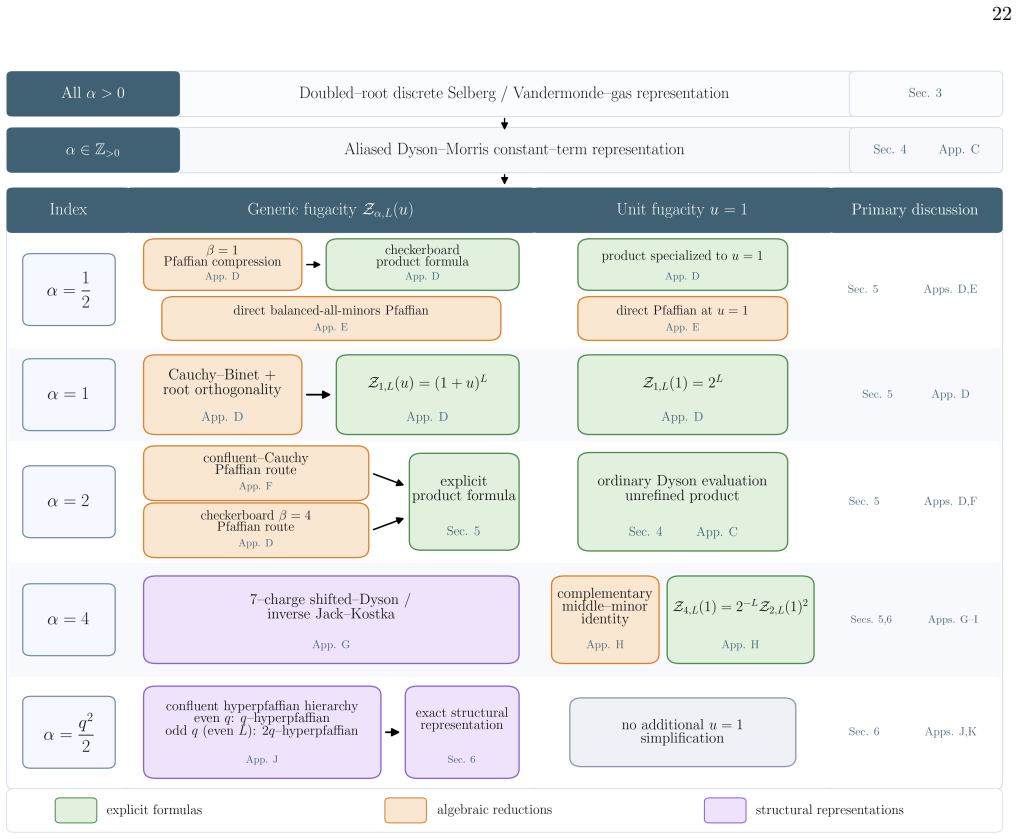
The load-bearing object is the termwise identity of Eq. (28): Cauchy's determinant formula converts each balanced minor $|\det G[S,T]|$ of the half-shift correlation matrix into, up to a factor $L^{L/2}$, the Vandermonde weight $|\Delta(U)|$ of a half-filled subset $U$ of the doubled root lattice $\Omega_{2L}$, with the fugacity $u$ recording occupation of one interlaced sublattice. For positive integer $\alpha$, finite Fourier bandwidth turns the root-of-unity measure into a finite aliased Dyson–Morris constant term; at the classical indices $\alpha=\tfrac12,1,2$, de Bruijn Pfaffians, Cauchy–Binet determinants, and confluent Pfaffians compress the sum to products; at $\alpha=4$, charge neutrality organizes the shifted-Dyson expansion into a seven-charge family whose coefficients are rectangular inverse Jack–Kostka coefficients.
What would settle it
For N=2L with L=2,3,4, compute both sides of the identity in Eq. (H19) with exact rational arithmetic; the identity fails if the two sides differ. One can also verify the claimed unit-fugacity collapse, Eq. (60), by directly enumerating all half-filled subsets for L up to 6.
Extended reading notes
Core claim
The paper introduces the fugacity-resolved balanced all-minors partition function $Z_{\alpha,L}(u)=\sum_{k} u^k \sum_{|S|=|T|=k}|\det G[S,T]|^{2\alpha}$ for the critical transverse-field Ising ground state and proves the exact termwise bijection $Z_{\alpha,L}(u)=L^{-\alpha L}\sum_{U\subseteq\Omega_{2L},\,|U|=L} u^{|U\cap X|}|\Delta(U)|^{2\alpha}$, valid for every real $\alpha>0$. It then derives the consequences: at $\alpha=\tfrac12$ the sum is an ordinary Pfaffian and equals a product of $2\times2$ block factors; at $\alpha=1$ it equals $(1+u)^L$; at $\alpha=2$ it equals a product over reflected $4\times4$ blocks; and at $\alpha=4$ the generic-fugacity partition function is a neutral seven-charge shifted-Dyson sum with rectangular inverse Jack–Kostka coefficients, while the unit-fugacity value collapses to $Z_{4,L}(1)=2^{-L}Z_{2,L}(1)^2$ through a complementary middle-minor identity. These exact formulas determine the balanced Majorana degree distribution, which complement symmetry centers at $L/2$ and which converges to Gaussian limits at the three classical indices after variance rescaling.
Load-bearing premise
The paper's unit-fugacity α=4 collapse relies on an unproved identity in Appendix H about a trigonometric Cauchy matrix; if that identity is false, the collapse fails, while the Selberg mapping and the α=1/2,1,2 formulas stand independently.
Editorial extensions
If this is right
- For every real $\alpha>0$, the full fugacity polynomial is exactly a half-filled discrete Selberg sum, so all cumulants of the balanced Majorana degree are in principle determined by that ensemble.
- At $\alpha=\tfrac12,1,2$, the balanced-degree distribution is exactly given by product formulas: binomial at $\alpha=1$, variance $(\tfrac12-\tfrac1\pi)L$ at $\alpha=\tfrac12$, and variance $\tfrac{L}{4}(H_{2L}-\tfrac12 H_L)\sim \tfrac{L}{8}\log L$ at $\alpha=2$.
- After centering and rescaling by the standard deviation, the degree distribution converges to a standard Gaussian at $\alpha=\tfrac12,1$, and $2$, despite the different fluctuation scales.
- At $\alpha=4$ and unit fugacity, $Z_{4,L}(1)=2^{-L}Z_{2,L}(1)^2$, so the unrefined fourth-Rényi moment is product-solvable even though the generic-fugacity polynomial is not.
- The computational-basis Shannon–Rényi entropy of the range-$m$ XX chain factorizes over $m$ squeezed sublattices, so the TFI all-minors problem is the common finite-size building block for those entropies as well.
Reading between the lines
- If the same fugacity technique were applied to symmetry-resolved or support-resolved Pauli degrees beyond the balanced Majorana degree, it could yield exact counting statistics for other Gaussian states; this extension is not claimed in the paper.
- The logarithmic variance growth at $\alpha=2$ indicates a counting-field nonanalyticity in the thermodynamic cumulant generating function, and one could test whether subleading corrections converge in a nonstandard scaling window in $1/\log L$.
- The zeros of $Z_{\alpha,L}(u)$ in the complex fugacity plane, which the paper leaves open, may encode the reorganization from central-peak to bimodal and endpoint-dominated degree profiles at larger $\alpha$.
- The $\alpha=4$ seven-charge Jack–Kostka representation could become computationally effective if the rectangular inverse Jack–Kostka coefficients obey closed recurrences; the paper states that this is open, so a testable extension is to search for such recurrences for small $L$.
Editorial analysis
A structured set of objections, weighed in public.
Referee Report
Summary. The paper introduces a fugacity-resolved all-minors partition function Z_{\alpha,L}(u) for the ground state of the critical transverse-field Ising chain, resolving the balanced Majorana degree of contributing Pauli strings. The main results are: (i) a termwise exact map from the all-minors sum to a checkerboard-weighted half-filled discrete Selberg ensemble on the doubled root-of-unity lattice (Eq. 28), valid for every real α>0; (ii) a finite aliased Dyson constant-term representation for positive integer α (Eq. 40); (iii) exact product formulas at α=1/2, 1, 2 (Eqs. 47, 54, 55); (iv) at α=4, a generic-fugacity rectangular inverse Jack–Kostka representation (Eq. 59) and a unit-fugacity collapse Z_{4,L}(1)=2^{−L}Z_{2,L}(1)^2 (Eq. 60); and (v) exact balanced-degree statistics at these indices, including exact binomiality at α=1, variance ≈(1/2−1/π)L at α=1/2, variance ≈(L/8)log L at α=2, and Gaussian scaling limits at all three indices. The paper also derives a Shannon–Rényi factorization for the range-m XX chains (Appendix B) and the stabilizer-decimation and Haldane–Shastry escort reductions of Sec. II.
Significance. The paper is a serious and largely successful exercise in exact finite-size analysis. The main conceptual contribution—resolving the Pauli-degree counting statistics of stabilizer entropy in a critical free-fermion chain and identifying the result as a checkerboard discrete Selberg/Dyson ensemble—is new, and the derivations at α=1/2, 1, 2 are supported by appendix proofs and by consistency checks: the unit-fugacity values reproduce Refs. [5,36,38], and the α=1/2 polynomial is obtained via two independent Pfaffian routes (Sec. V B, Appendices D and E). The counting-statistics section yields concrete, falsifiable predictions (binomial law, variance asymptotics, Gaussian limits) from parameter-free product formulas. The paper is exemplary in its honest treatment of computational status, distinguishing closed products, polynomial-size compressions, and exact structural representations, and claims no hardness or algorithmic results beyond what is proved (Sec. VI D, Appendix K). The one load-bearing gap is the unproved identity H19 underpinning the advertised unit-fugacity α=4 collapse; this is localized and does not affect the Selberg mapping or the α=1/2, 1, 2 results.
major comments (1)
- [Appendix H, Eqs. (H16)–(H19) and Eq. (60)] The unit-fugacity collapse Z_{4,L}(1) = 2^{−L}Z_{2,L}(1)^2 (Eq. 60), advertised in the abstract and in Table II, rests entirely on the identity (H17), Σ_{U,|U|=L} det H[U,U^c]^2 = 2L det H, which the text calls “the required finite identity” and then reduces to the even-cardinality-subset identity (H19). Neither (H17) nor (H19) is proved: H.2 states that (H18) “follows by expanding the two complementary minors… and grouping” (a plausible but still only sketched general identity), and then asserts that for the trigonometric matrix H the sum “collapses” to 2L det H with no derivation; the text itself says H19 is “the only place where the special form of H is used.” This is a genuine proof gap in a load-bearing claim: if H19 were false, Eq. (60) and the derived Jack identity (G19) would fail. The concern is localized—the checkerboard Selberg mapping (Eq. 28), the α=1/2, 1, 2 product formulas (Eqs. 47, 54, 55), the Gaussian limits, and the generic-fugacity Jack–Kostka representation (Eq. 59) are independent of H19. I verified the smallest nontrivial case N=4 (L=2): both sides of (H17)/(H19) equal 9/4, and Eq. (60) then reproduces the half-filled Dyson-gas value of Ref. [5], so the identity is plausibly correct; nevertheless, as written the paper does not prove its advertised α=4 collapse. Please supply a complete proof of (H19)—for instance from the explicit spectrum (H23) or from a complementary-minor/Pfaffian identity—or explicitly mark Eq. (60) as conjectural.
minor comments (6)
- [Sec. III B, Eq. (27)] The termwise Cauchy reduction leading to (27) is presented in compressed form; a fuller bookkeeping of the root-product identities would make the foundational identity (28) easier to check. I verified Eq. (27) in the nontrivial case L=2, S={0}, T={1}, where |Δ(U)| = √2 = L^{L/2}|det G[S,T]|, so this is purely an exposition request.
- [Appendix D, Eqs. (D28)–(D32)] The geometric-series evaluation of S(P,Q) and the reduction to the reflected-mode entries A^{(1)}_{−t,t} are stated without derivation; since Eqs. (47) and (55) are headline product formulas, a few lines showing the summation would make Appendix D self-contained.
- [Sec. VII E, Eq. (100)] The characteristic-function remainder is quoted as O(1/log^2 L); the expansion of Eq. (99) in powers of sin(t/2σ) gives t-dependent remainders such as O(t^4/(L log L)) and O(Σ_r A_r^2 t^4/σ^4) = O(t^4/(L log^2 L)), which still vanish for each fixed t. The CLT conclusion is unaffected, but the stated bound is stronger than what the displayed argument shows and should be restated.
- [Appendix G, Eq. (G8)] The Jack-convention fix is made in one phrase, “in the convention α_Jack = 1/4” (Eq. 59); since the scalar product (G8) contains D_4(x) = ∏_{i≠j}(1−x_i/x_j)^4, writing explicitly 1/α_Jack = 4 would remove ambiguity for readers who use the convention in which the parameter multiplies the power-sum norm.
- [Appendix D, around Eq. (D30)] The displayed formula for S(P,Q) in Eq. (D30) is garbled as typeset (“S(P,Q) = N zP 1 + 1 zP 1 − 1”); please ensure the geometric-series identity and the adjacent evaluation in Eq. (D32) are displayed cleanly, and state which root z_1 is being used.
- [Sec. VI D and Appendix K] The careful distinction between arithmetic-cost and bit-complexity, and the explicit refusal to claim hardness without a reduction, is a strength; consider moving the “what a hardness statement would require” paragraph (Appendix K.5) into the main text, since it directly addresses a natural reader objection to the α=4 section.
Circularity Check
No significant circularity: the fugacity-resolved Selberg map and the α = 1/2, 1, 2 product formulas are derived in-paper from the half-shift matrix; prior self-citations are benchmarks or motivation, not inputs. The only flagged weakness is the unproved finite trigonometric identity (H19) behind the α = 4 unit-fugacity collapse, which is a proof gap rather than a circular step.
full rationale
The core derivation is self-contained. Eq. (18) defines Zα,L(u) directly from the balanced minors |det G[S,T]|^{2α} of the half-shift matrix G. Section III then proves a termwise bijection U(S,T) = X_S ∪ Y_{T^c} and the Cauchy reduction |Δ(U(S,T))| = L^{L/2} |det G[S,T]|, giving the discrete Selberg representation in Eq. (28) for every real α > 0. This is a proof from Wick's theorem and the Cauchy determinant formula, with no fitted parameters; fugacity u and Rényi index α are free variables. The product formulas at α = 1/2, 1, 2 (Eqs. (47), (54), (55)) are derived in Appendices D–F through de Bruijn, Cauchy–Binet, and confluent Pfaffian compressions; the cited unrefined values of Refs. [5, 36, 38] are used as consistency checks or benchmarks, not as inputs to those derivations. At α = 4, Eq. (59) is an exact structural conversion to a neutral seven-charge shifted-Dyson sum and an inverse rectangular Jack–Kostka coefficient, derived in Appendix G from the aliased constant-term representation. The unit-fugacity collapse Z4,L(1) = 2^{-L} Z2,L(1)^2 (Eq. (60)) does depend on Appendix H, which states the finite identity (H19), Σ_{P even} det H[P,P] det H[P^c,P^c] = 2L det H, and does not prove it; this is an explicit unproved lemma and a proof gap, but it is not a circular reduction, because the identity is not equivalent to the claimed output by construction and is checked numerically for small N by the authors. Table I invokes Ref. [36], co-authored by M.A.R., for the TFI–XX correspondence and stabilizer decimation identities; these are motivational reductions that connect the all-minors problem to other entropies, but they are not used to prove Eq. (28) or the special-index formulas. No load-bearing claim reduces by definition to its own inputs, and no fitted quantity is relabeled as a prediction. The score 1 reflects the minor presence of non-load-bearing self-citations and the flagged unproved identity, not circularity of the central derivation.
Assumptions & free parameters
assumptions (9)
- standard math Wick's theorem for the TFI Gaussian ground state converts balanced Pauli expectation values into minors of G.
- standard math The half-shift matrix G admits a Cauchy factorization and root-product identities giving |Δ(U(S,T))| = L^{L/2} |det G[S,T]| (Eq. 27).
- standard math For integer α, the Dyson Laurent polynomial has finite Fourier bandwidth, so the weighted Dirac comb truncates exactly to the finite alias kernel K_{α,u} inside constant-term extraction.
- standard math The finite de Bruijn identity evaluates ordered absolute-Vandermonde subset sums as an ordinary Pfaffian.
- standard math Dyson's constant-term identity CT_{x1,...,xL} D_α(x) = (αL)!/(α!)^L.
- standard math Finite-variable Jack polynomial orthogonality and the inverse Jack-Kostka expansion with Jack parameter 1/4.
- ad hoc to paper The universal complementary middle-minor identity (H18) and the specialized trigonometric Cauchy collapse H19.
- domain assumption The TFI-XX stabilizer-Shannon correspondence of Ref. [36] and the matching boundary-sector and no-zero-mode assumptions.
- domain assumption The half-filled XX and Haldane-Shastry ground-state probability escort relation p_HS ∝ p_XX^2.
Cite this review
Pith. "Pith review of Fugacity-Resolved Stabilizer Entropy in Critical Quantum Chains: Discrete Selberg Sums and Exactly Solvable R\'enyi Indices." pith.science (2026). https://pith.science/paper/HWXI4RZT
@misc{pith2026260806995,
  author       = {Pith},
  title        = {Pith review of: Fugacity-Resolved Stabilizer Entropy in Critical Quantum Chains: Discrete Selberg Sums and Exactly Solvable R\'enyi Indices},
  year         = {2026},
  howpublished = {\url{https://pith.science/paper/HWXI4RZT}},
  note         = {Machine review of arXiv:2608.06995}
}
abstract
Stabilizer R\'enyi entropy quantifies the nonstabilizerness of a quantum state through R\'enyi moments of its Pauli expectation-value distribution. Its standard form sums over Pauli-string degrees and retains only the total R\'enyi weight. We introduce a fugacity-resolved partition function for the critical transverse-field Ising chain that resolves this degree in the balanced Majorana representation and generates its full counting statistics. This Ising problem extends beyond a single model: exact decimation identities and the correspondence with the half-filled \(XX\) chain establish it as a common finite-size building block for stabilizer and computational-basis Shannon--R\'enyi entropies. We map the fugacity-resolved all-minors sum, for every positive R\'enyi index, to a checkerboard-weighted discrete Selberg ensemble on a half-filled doubled root lattice. For positive integer indices, it reduces to a finite aliased Dyson constant term. At \(\alpha=\tfrac12,1,2\), determinant and Pfaffian compressions yield product formulas. At \(\alpha=4\), the generic-fugacity problem admits an exact inverse Jack--Kostka representation, while at unit fugacity a complementary middle-minor identity relates it to the square of the \(\alpha=2\) result. These generating functions determine the balanced-degree statistics. Complement symmetry makes the distribution symmetric about \(k=L/2\), with an index-dependent width. It is exactly binomial at \(\alpha=1\), has variance proportional to \(L\) at \(\alpha=\tfrac12\), and develops an \(L\log L\) enhancement at \(\alpha=2\). After variance rescaling, the centered distributions converge to Gaussian limits at all three indices. Beyond these solvable cases, finite-size numerics reveal an evolution from a central peak to a symmetric bimodal profile and eventually to endpoint dominance as the R\'enyi index increases.
Figures


Figures from the paper (3 more)


Reference graph
Works this paper leans on
-
[5]
It follows from the factorization of the computational-basis probability distribution of the XX m chain, and does not rely on the stabilizer-minor decimation theorem
Relation to the TFI stabilizer entropy The result above is purely a Shannon–R´ enyi identity. It follows from the factorization of the computational-basis probability distribution of the XX m chain, and does not rely on the stabilizer-minor decimation theorem. We now combine this Shannon identity with the TFI– XX relation of Ref. [ 36]. With the stabilize...
-
[1]
F ourier coefficients of the weighted Dirac comb Let θa = πa/L and ζa = eiθa , with a = 0, . . . ,2L− 1. Since ζ L a = (−1)a, the one-root weight on the doubled root lattice can be written as wu(ζa) = 1 +u 2 + u−1 2 (−1)a.(C1) This gives weight u on the even sublattice and weight 1 on the odd sublattice. The weighted Dirac comb is AL,u(θ) = 2π 2L−1X a=0 w...
-
[2]
Finite alias truncation for integerα The finite truncation of the comb is the only step where the assumption α∈Z >0 is needed. For integer α, the circular Vandermonde weight becomes the Laurent poly- nomial Dα(x) = LY i,j=1 i̸=j 1− xi xj α .(C9) In every monomial of Dα(x), the exponent mj of any fixed variablex j satisfies −α(L−1)≤m j ≤α(L−1).(C10) On the...
-
[3]
, nL−1), with nj ∈ {0, 1}, be a computational-basis configuration of the original length-L chain
F actorization of computational-basis probabilities Letn= ( n0, n1, . . . , nL−1), with nj ∈ {0, 1}, be a computational-basis configuration of the original length-L chain. Define In = diag(2n0 −1,2n 1 −1, . . . ,2nL−1 −1).(B15) For a number-conserving Gaussian state, the probability of the configurationnis pn = det IL −I nG 2 .(B16) We now split the confi...
-
[4]
(B20) gives Z XX m,ϕ α (L) = X n pXX m,ϕ n (L) α = X n(0),...,n(m−1) m−1Y r=0 h pXX,(r,ϕ) n(r) (ℓ) iα = m−1Y r=0 X n(r) h pXX,(r,ϕ) n(r) (ℓ) iα
R´ enyi partition sums and entropy For a state|Ψ⟩with computational-basis probabilities pn, define the Shannon–R´ enyi partition sum by Zα[Ψ] = X n pα n.(B22) For the XX m state, the probability factorization in Eq. (B20) gives Z XX m,ϕ α (L) = X n pXX m,ϕ n (L) α = X n(0),...,n(m−1) m−1Y r=0 h pXX,(r,ϕ) n(r) (ℓ) iα = m−1Y r=0 X n(r) h pXX,(r,ϕ) n(r) (ℓ) ...
-
[6]
Set a = α− 1 and t = Lθ
T rigonometric and Dirichlet-kernel forms of the alias kernel The finite alias kernel also admits useful trigonometric forms. Set a = α− 1 and t = Lθ. Since cq(u) = ( u + (−1)q)/2, the kernel can be written as Kα,u(eiθ) = 1 2 [uD α−1(Lθ) +D α−1(Lθ+π)],(C12) where Dn(t) = nX q=−n eiqt = sin (n+ 1 2 )t sin(t/2) (C13) is the finite Dirichlet kernel, with the...
-
[7]
(C20) The prefactor comes from the product of the L Fourier- comb factors, namelyL −αL(2L)L = 2L/L(α−1)L
Ordinary Dyson versus aliased Dyson For integer α, inserting the finite alias kernel into the constant-term representation gives Zα,L(u) = 2L L!L (α−1)L CTx1,...,xL Dα(x) LY j=1 Kα,u(xj) . (C20) The prefactor comes from the product of the L Fourier- comb factors, namelyL −αL(2L)L = 2L/L(α−1)L. This should be distinguished from the ordinary Dyson id...
-
[8]
For alias chargesq 1,
Shifted Dyson coefficients and small alias sectors Expanding the alias kernels gives a finite sum of shifted Dyson coefficients. For alias chargesq 1, . . . , qL, define Cα,L(q1, . . . , qL) = CTx1,...,xL Dα(x) LY j=1 xqj L j .(C24) Thus the aliased constant-term formula can be written as Zα,L(u) = 2L L!L (α−1)L α−1X q1,...,qL=−(α−1) × LY j=1 c...
Show all 126 references
-
[9]
Several special values are useful
Special fugacity values and consistency checks The fugacity u keeps track of the number |U∩X| of selected roots on the even sublattice. Several special values are useful. At u = 1, one obtains the unrefined all-minors sum relevant for the stabilizer and Shannon–R´ enyi entropi...
-
[10]
, N−1.(D1) We assign a one-body weight wa to each root za and write w= (w 0,
Generic weighted half-filled root ensemble LetN= 2L, and za =e 2πia/N =e πia/L, a= 0, . . . , N−1.(D1) We assign a one-body weight wa to each root za and write w= (w 0, . . . , wN−1 ). For an ordered half-filled subset A={a 1 <· · ·< aL} ⊂ {0, . . . , N−1}, define ∆A = ∆(za1 ,...
-
[11]
The ordered subset sum can then be evaluated by the finite de Bruijn identity
Generic-weight ordered-root Pfaffian atβ= 1 At β = 1, the absolute Vandermonde becomes a single determinant once the selected roots are placed in circular order. The ordered subset sum can then be evaluated by the finite de Bruijn identity. Introduce the centered set of modes ...
-
[12]
Introduce theL×LToeplitz moment matrix M(2) rs [w] = N−1X a=0 wazr−s a =bwr−s, r, s= 0,
Generic-weight Andr´ eief determinant atβ= 2 At β = 2, the Vandermonde weight is a product of two ordinary determinants, so the half-filled subset sum is evaluated by the finite Cauchy–Binet, or Andr´ eief, identity. Introduce theL×LToeplitz moment matrix M(2) rs [w] = N−1X a=...
-
[13]
The resulting half-filled subset sum is com- pressed to an ordinary Pfaffian
Generic-weight confluent Pfaffian atβ= 4 At β = 4, the fourth power of the Vandermonde is linearized by a multiplicity-two confluent Vandermonde determinant. The resulting half-filled subset sum is com- pressed to an ordinary Pfaffian. Let pr(z) =z r, p ′ r(z) =rz r−1, r= 0, ....
-
[14]
(D4), one may equivalently write wa(u) =c+dz L a , c= 1 +u 2 , d= u−1 2 ,(D26) becausez L a = (−1)a
Checkerboard specialization and explicit formulas For the checkerboard weight in Eq. (D4), one may equivalently write wa(u) =c+dz L a , c= 1 +u 2 , d= u−1 2 ,(D26) becausez L a = (−1)a. Its Fourier moments obey bwm(u) = N−1X a=0 wa(u)zm a = L(1 +u), m≡0 (mod 2L), L(u...
-
[15]
Table V makes the distinction between the two lev- els explicit
Generic-weight compressions and checkerboard outcomes The three generic-weight compressions are collected in Table V. Table V makes the distinction between the two lev- els explicit. The determinant and Pfaffian compressions exist for arbitrary one-body weights. The closed fug...
-
[16]
,rL−1,c L−1)
Antisymmetric lift and periodic selector For each j∈ [L], introduce the lifted labelsr j = 2j and cj = 2j+ 1, ordered as (r0,c 0,r 1,c 1, . . . ,rL−1,c L−1). The 2L×2Lantisymmetric lift ofGis defined by A(G)rj ,ck =G jk ,A(G) ck,rj =−G jk ,(E1) with vanishingr-randc-cblocks. F...
-
[17]
T ermwise cancellation of the minor signs Let S={s 1 <· · ·< sk}, T={t 1 <· · ·< tk}, and define N<(S, T) = # (s, t)∈S×T:s < t , N>(S, T) = # (s, t)∈S×T:s > t . Setm=|S∩T|, so that N<(S, T) +N>(S, T) +m=k 2.(E6) With xj = π(j+ 1 2 )/L and yj = πj/L, the trigonometric Cauchy id...
-
[18]
(E6), (E8), and (E9) gives sgn Pf A(G)I(S,T) = (−1) P s∈S s+P t∈T t+k−m.(E10) We now evaluate the corresponding principal Pfaffian of the selector
detX, one obtains Pf A(G)I(S,T) = (−1)( k 2)+N>(S,T) detG[S, T].(E9) Combining Eqs. (E6), (E8), and (E9) gives sgn Pf A(G)I(S,T) = (−1) P s∈S s+P t∈T t+k−m.(E10) We now evaluate the corresponding principal Pfaffian of the selector. The pair swap reverses the two selected label...
-
[19]
Principal-Pfaffian summation and fugacity For arbitrary antisymmetric 2L× 2L matrices X and Y, (−1)LPf X I 2L −I2L −Y = X I⊆{0,...,2L−1} |I|even Pf(X I )Pf(Y I ), (E13) with the empty principal Pfaffian equal to one. This follows directly from the perfect-matching expansion: i...
-
[20]
There, the arbitrary-weight β = 4 ensemble was reduced to the 2 L× 2L confluent de Bruijn Pfaffian Z (4) L [w] =L −2LPfB (4)[w]
Checkerboard block factorization of the weighted β= 4Pfaffian We begin with the route inherited directly from Ap- pendix D. There, the arbitrary-weight β = 4 ensemble was reduced to the 2 L× 2L confluent de Bruijn Pfaffian Z (4) L [w] =L −2LPfB (4)[w]. We now specialize that g...
-
[21]
We index the sites by j, k= 0,
Confluent-Cauchy compression of the all-minors sum We now turn to a second, independent Pfaffian organi- zation that starts directly from the balanced all-minors sum and does not use the generic-weight root-ensemble Pfaffian of Appendix D. We index the sites by j, k= 0, . . . ...
-
[22]
The weighted-root route first maps the balanced all- minors problem to the half-filled doubled-root ensemble
Relation between the two Pfaffian organizations The two Pfaffian representations act at different stages of the reformulation. The weighted-root route first maps the balanced all- minors problem to the half-filled doubled-root ensemble. The generic β = 4 ensemble then admits t...
-
[23]
(G2) Expanding the one-body kernels assigns to every vari- able xj a charge ℓj ∈ {−3,− 2,− 1, 0, 1, 2, 3}
Neutral seven-charge sectors Atα= 4, the aliased constant-term formula reads Z4,L(u) = 2L L!L 3L CTx1,...,xL D4(x) LY j=1 K4,u(xj) , (G1) where D4(x) = LY i,j=1 i̸=j 1− xi xj 4 and K4,u(x) = 3X m=−3 cm(u)xmL, cm(u) = 1 +u 2 , meven, u−1 2 , modd. (G2) Expanding ...
-
[24]
Sorting these nonnegative expo- nents gives the partition λ(ν) = (6L) ν3 (5L)ν2 (4L)ν1 (3L)ν0 (2L)ν−1 (L)ν−2 (0)ν−3
Reduction to a rectangular Jack coefficient For a neutral charge sequence, shift the exponents by defining γj = (ℓj + 3)L. Sorting these nonnegative expo- nents gives the partition λ(ν) = (6L) ν3 (5L)ν2 (4L)ν1 (3L)ν0 (2L)ν−1 (L)ν−2 (0)ν−3 . (G6) Neutrality implies|λ(ν)| = 3L2,...
-
[25]
(G15) Its shift vector is ( ℓ1L,
Shifted-Dyson and flow forms The same sector coefficient is the disturbed-Dyson co- efficient C4,L(ν) = [x−ℓ1L 1 · · ·x−ℓLL L ] Y i̸=j 1− xi xj 4 , LX i=1 ℓi = 0. (G15) Its shift vector is ( ℓ1L, . . . , ℓLL), so every nonzero com- ponent grows linearly with the number of vari...
-
[26]
The surviving charges are−2,0,2, and neutrality gives ν−2 =ν 2 =r, ν 0 =L−2r,0≤r≤ L 2
The unrefined specialization At u = 1, all odd charges vanish. The surviving charges are−2,0,2, and neutrality gives ν−2 =ν 2 =r, ν 0 =L−2r,0≤r≤ L 2 . The corresponding partition is λr = (5L)r(3L)L−2r(L)r.(G17) Equation (G14) then reduces to Z4,L(1) = 2L L3L (4L)! L!(4!)L ⌊L/2...
-
[27]
Complementary Cauchy reduction At u = 1 and α = 4, the discrete Selberg representation gives Z4,L(1) =L −4L X U⊂I N |U|=L |∆(U)| 8.(H2) We now rewrite the eighth power of the Vandermonde determinant in terms of Cauchy minors between U and its complement. Let CU V= 1 ωa −ω b a∈...
-
[28]
Forω a =e 2πia/N , ωa −ω b = 2iexp πi(a+b) N sin π(a−b) N .(H12) Therefore 1 ωa −ω b =−iexp − πi(a+b) N 1 2 sin[π(a−b)/N]
The finite trigonometric Cauchy matrix We now remove harmless phases from the root differ- ences. Forω a =e 2πia/N , ωa −ω b = 2iexp πi(a+b) N sin π(a−b) N .(H12) Therefore 1 ωa −ω b =−iexp − πi(a+b) N 1 2 sin[π(a−b)/N] . (H13) The exponential factors are products of row and c...
-
[29]
The matrix H is diago- nalized by anti-periodic Fourier modes
Spectrum and determinant ofH It remains to evaluate detH . The matrix H is diago- nalized by anti-periodic Fourier modes. Let ψq(a) = exp 2πi N q+ 1 2 a , q= 0, . . . , N−1. (H20) These modes obey ψq(a + N ) = −ψq(a), matching the anti-periodicity of the kernel 1 2 sin[π(a−b)/...
-
[30]
(H25) into Eq
Final evaluation and relation toα= 2 Substituting Eq. (H25) into Eq. (H16), we find Z4,L(1) = 4L L2L 2−L (2L−1)!! 2 = 2L L2L (2L−1)!! 2 .(H26) This proves Eq. (H1). Finally, using theα= 2 unrefined value Z2,L(1) = 2L(2L−1)!! LL ,(H27) we obtain the exact finite-size relation Z...
-
[31]
Independent replicas versus the diagonal replica constraint It is useful to separate two different two-replica sums. Schematically, the α = 2 generating function can be written as Z2,L(u) = X U u|U∩X| WU ,(I3) where U is a half-filled root subset and WU is the corre- sponding ...
-
[32]
Let θ1, θ2, θ3, θ4 be Grassmann variables
The local Gaussian criterion We recall the elementary four-leg Gaussian criterion in the affine chart where the vacuum coefficient is nonzero. Let θ1, θ2, θ3, θ4 be Grassmann variables. A general even tensor has the form T(θ) =T ∅ + X 1≤i<j≤4 Tijθiθj +T 1234θ1θ2θ3θ4.(I6) A Gau...
-
[33]
In each replica, selecting one root contributes a local degree-two form
F ailure of Gaussianity in the confluent local encoding The four Grassmann legs arise from the specific confluent-Pfaffian encoding used for the α = 2 ensem- ble. In each replica, selecting one root contributes a local degree-two form. We denote the occupied monomials of the t...
-
[34]
This is a global identity for the fully summed unrefined partition function
Why theu= 1identity is not contradicted Atu= 1, the final scalar quantity satisfies Z4,L(1) = 2−LZ2,L(1)2. This is a global identity for the fully summed unrefined partition function. It is produced by the complementary middle-minor identity proved in Appendix H. It does not r...
-
[35]
First, it does not exclude a tautological matrix encoding of the final polynomial
Scope of the obstruction The obstruction has a deliberately limited scope. First, it does not exclude a tautological matrix encoding of the final polynomial. If p(u) =a dud +· · ·+a0 and C is the companion matrix of the associated monic polynomial, then p(u) =a d det(uI−C). Mo...
-
[36]
It does not imply a direct fugacity-resolved doubling of the α = 2 Pfaffian
Conclusion The identity Z4,L(1) = 2−LZ2,L(1)2 is a global unrefined collapse. It does not imply a direct fugacity-resolved doubling of the α = 2 Pfaffian. The required local diagonal two-replica tensor is quartic and violates the four-leg Pl¨ ucker/matchgate relation. Hence th...
-
[37]
, q−1 ordered inside each physical node
Multiplicity-qconfluent Cauchy identity Fora≥0, let Da x = 1 a! ∂a ∂xa .(J3) For the generic Cauchy kernel Cij = 1 xi +y j , define the localq×qconfluent block C(q)(x, y) = Da xDb y 1 x+y q−1 a,b=0 .(J4) Its entries are C(q) ab (x, y) = (−1)a+b a+b a 1 (x+y) a+b+1 .(J5) Let E=...
-
[38]
,erM−1 , and volume form volV =e 0 ∧ · · · ∧ erM−1
Phase-corrected confluent V andermonde blades Let r be even and let V have dimension rM , ordered basise 0, . . . ,erM−1 , and volume form volV =e 0 ∧ · · · ∧ erM−1 . For Ω∈Λ rV, define 1 M! Ω∧M = HPf r(Ω) volV .(J12) 42 At r = 2, this is the ordinary Pfaffian. Odd exterior de...
-
[39]
Even and oddqsummation For evenq, define Ωq[w] = 2L−1X a=0 β(q) a [w]∈Λ qVq.(J20) Because even q-forms commute and every β(q) a is decom- posable, 1 L! Ωq[w]∧L = X a1<···<aL β(q) a1 [w]∧ · · · ∧β(q) aL [w].(J21) Using Eq. (D3), Z (q2) L [w] =L −q2L/2χq,L HPf q(Ωq[w]).(J22) For...
-
[40]
exact representation
Checkerboard sparsity and computational status For even q, let I = {i1 <· · ·< iq} ⊆ {0, . . . , qL−1}. The coefficient ofe i1 ∧ · · · ∧eiq inω q(z) is ωq,I (z) = ∆(i1, . . . , iq) q−1Y a=0 a! z|I|−q(q−1)/2 ,(J26) and therefore Ωq,I [w] = ∆(i1, . . . , iq) q−1Y a=0 a! 2L−1X b=...
-
[41]
Computational tasks The polynomial Zα,L(u) = LX k=0 akuk supports several distinct computational tasks: (i) evaluate Zα,L(u0) at one specified numerical fugac- ityu 0; (ii) produce all coefficientsa 0, . . . , aL; (iii) produce a compressed exact symbolic representation of the...
-
[42]
Using 2L L ∼ 4L √ πL , the number of minors grows exponentially with the phys- ical system size
Direct enumeration and classical compressions The original all-minors definition contains LX k=0 L k 2 = 2L L (K1) terms. Using 2L L ∼ 4L √ πL , the number of minors grows exponentially with the phys- ical system size. The polynomial cost of evaluating each individual determin...
-
[43]
Neutral sectors atα= 4 At α = 4, the generic-fugacity Jack–Kostka representa- tion is organized by neutral seven-charge vectors 3X m=−3 νm =L, 3X m=−3 mνm = 0, ν m ≥0.(K2) Ignoring the neutrality constraint gives the elementary bound |NL| ≤ L+ 6 6 .(K3) Thus the number of mult...
-
[44]
The perfect-square hierarchy of Appendix J therefore gives one exact finite algebraic object, but for r >2 it does not inherit the standard cubic algorithm of an ordinary Pfaffian
Hyperpfaffian representations For an even r-form on a space of dimension rM , the unrestricted coordinate expansion of its hyperpfaffian contains (rM)! M!(r!) M (K5) set-partition terms before any sparsity or cancellation is used. The perfect-square hierarchy of Appendix J the...
-
[45]
A formal hardness theorem would have to specify the input model, the required output, the encoding of L and u, and an explicit reduction from a known hard problem
What a hardness statement would require The present problem is a highly structured one- parameter family, not an arbitrary-input matrix problem. A formal hardness theorem would have to specify the input model, the required output, the encoding of L and u, and an explicit reduc...
-
[46]
Calabrese and J
P. Calabrese and J. Cardy,Entanglement entropy and con- formal field theory, J. Phys. A: Math. Theor.42, 504005 (2009)
2009
-
[47]
St´ ephan, S
J.-M. St´ ephan, S. Furukawa, G. Misguich, and V. Pasquier, Shannon and entanglement entropies of one- and two- dimensional critical wave functions, Phys. Rev. B80, 184421 (2009)
2009
-
[48]
St´ ephan, G
J.-M. St´ ephan, G. Misguich, and V. Pasquier,R´ enyi entropy of a line in two-dimensional Ising models, Phys. Rev. B82, 125455 (2010)
2010
-
[49]
F. C. Alcaraz and M. A. Rajabpour,Universal behavior of the Shannon mutual information of critical quantum chains, Phys. Rev. Lett.111, 017201 (2013)
2013
-
[50]
St´ ephan,Shannon and R´ enyi mutual information in quantum critical spin chains, Phys
J.-M. St´ ephan,Shannon and R´ enyi mutual information in quantum critical spin chains, Phys. Rev. B90, 045424 (2014)
2014
-
[51]
F. C. Alcaraz and M. A. Rajabpour,Universal behavior of the Shannon and R´ enyi mutual information of quantum critical chains, Phys. Rev. B90, 075132 (2014)
2014
-
[52]
D. J. Luitz, F. Alet, and N. Laflorencie,Universal behavior beyond multifractality in quantum many-body systems, Phys. Rev. Lett.112, 057203 (2014)
2014
-
[53]
Tarighi, R
B. Tarighi, R. Khasseh, M. N. Najafi, and M. A. Ra- jabpour,Universal logarithmic correction to R´ enyi (Shan- non) entropy in generic systems of critical quadratic fermions, Phys. Rev. B105, 245109 (2022)
2022
-
[54]
Gottesman,Stabilizer Codes and Quantum Error Cor- rection, Ph.D
D. Gottesman,Stabilizer Codes and Quantum Error Cor- rection, Ph.D. thesis, California Institute of Technology (1997); arXiv:quant-ph/9705052
1997 arXiv
-
[55]
Bravyi and A
S. Bravyi and A. Kitaev,Universal quantum computation with ideal Clifford gates and noisy ancillas, Phys. Rev. A 71, 022316 (2005)
2005
-
[56]
Veitch, C
V. Veitch, C. Ferrie, D. Gross, and J. Emerson,Negative quasi-probability as a resource for quantum computation, New J. Phys.14, 113011 (2012)
2012
-
[57]
Howard, J
M. Howard, J. Wallman, V. Veitch, and J. Emerson, Contextuality supplies the magic for quantum computation, Nature510, 351–355 (2014)
2014
-
[58]
Veitch, S
V. Veitch, S. A. H. Mousavian, D. Gottesman, and J. Emerson,The resource theory of stabilizer quantum computation, New J. Phys.16, 013009 (2014)
2014
-
[59]
Howard and E
M. Howard and E. Campbell,Application of a resource theory for magic states to fault-tolerant quantum comput- ing, Phys. Rev. Lett.118, 090501 (2017)
2017
-
[60]
Leone, S
L. Leone, S. F. E. Oliviero, and A. Hamma,Stabilizer R´ enyi entropy, Phys. Rev. Lett.128, 050402 (2022)
2022
-
[61]
S. F. E. Oliviero, L. Leone, A. Hamma, and S. Lloyd, Measuring magic on a quantum processor, npj Quantum Inf.8, 148 (2022)
2022
-
[62]
Haug and L
T. Haug and L. Piroli,Stabilizer entropies and nonstabi- lizerness monotones, Quantum7, 1092 (2023)
2023
-
[63]
T. Haug, S. Lee, and M. S. Kim,Efficient quantum al- gorithms for stabilizer entropies, Phys. Rev. Lett.132, 240602 (2024)
2024
-
[64]
Leone and L
L. Leone and L. Bittel,Stabilizer entropies are mono- tones for magic-state resource theory, Phys. Rev. A110, L040403 (2024)
2024
-
[65]
Haug and L
T. Haug and L. Piroli,Quantifying nonstabilizerness of matrix product states, Phys. Rev. B107, 035148 (2023)
2023
-
[66]
Lami and M
G. Lami and M. Collura,Unveiling the stabilizer group of a matrix product state, Phys. Rev. Lett.133, 010602 (2024)
2024
-
[67]
P. S. Tarabunga, E. Tirrito, T. Chanda, and M. Dal- monte,Many-body magic via Pauli-Markov chains: From 45 criticality to gauge theories, PRX Quantum4, 040317 (2023)
2023
-
[68]
P. S. Tarabunga, E. Tirrito, M. C. Ba˜ nuls, and M. Dal- monte,Nonstabilizerness via matrix product states in the Pauli basis, Phys. Rev. Lett.133, 010601 (2024)
2024
-
[69]
Y.-M. Ding, Z. Wang, and Z. Yan,Evaluating many- body stabilizer R´ enyi entropy by sampling reduced Pauli strings: singularities, volume law, and nonlocal magic, PRX Quantum6, 030328 (2025)
2025
-
[70]
G. E. Fux, B. B´ eri, R. Fazio, and E. Tirrito,Disentangling magic states with classically simulable quantum circuits, arXiv:2410.09001 (2024)
2024
-
[71]
M. Frau, P. S. Tarabunga, M. Collura, M. Dalmonte, and E. Tirrito,Nonstabilizerness versus entanglement in matrix product states, Phys. Rev. B110, 045101 (2024)
2024
-
[72]
C. Fan, X. Qian, H.-C. Zhang, R.-Z. Huang, M. Qin, and T. Xiang,Disentangling critical quantum spin chains with Clifford circuits, Phys. Rev. B111, 085121 (2025)
2025
-
[73]
M. Frau, P. S. Tarabunga, M. Collura, E. Tirrito, and M. Dalmonte,Stabilizer disentangling of conformal field theories, SciPost Phys.18, 165 (2025)
2025
-
[74]
Collura, J
M. Collura, J. De Nardis, V. Alba, and G. Lami,The non-stabilizerness of fermionic Gaussian states, Quantum 10, 2036 (2026)
2026
-
[75]
Sarkar, C
S. Sarkar, C. Mukhopadhyay, and A. Bayat,Characteri- zation of quantum many-body phases using magic, New J. Phys.22, 083077 (2020)
2020
-
[76]
C. D. White, C. Cao, and B. Swingle,Conformal field theories are magical, Phys. Rev. B103, 075145 (2021)
2021
-
[77]
P. S. Tarabunga,Critical behaviors of non-stabilizerness in quantum spin chains, Quantum8, 1413 (2024)
2024
-
[78]
S. F. E. Oliviero, L. Leone, and A. Hamma,Magic-state resource theory for the ground state of the transverse-field Ising model, Phys. Rev. A106, 042426 (2022)
2022
-
[79]
Hoshino, M
M. Hoshino, M. Oshikawa, and Y. Ashida,Stabilizer R´ enyi entropy and conformal field theory, Phys. Rev. X 16, 011037 (2026)
2026
-
[80]
Hoshino and Y
M. Hoshino and Y. Ashida,Stabilizer R´ enyi entropy en- codes fusion rules of topological defects and boundaries, Phys. Rev. Lett.136, 080402 (2026)
2026
-
[81]
E. A. Ramirez Trino and M. A. Rajabpour,Stabilizer– Shannon R´ enyi equivalence: Exact results for quantum critical chains, arXiv:2509.10700 (2025)
2025 arXiv
-
[82]
Khasseh and M
R. Khasseh and M. A. Rajabpour,Hidden conformal boundary data in finite-temperature stabilizer entropy, arXiv:2606.08606 (2026)
2026 arXiv
-
[83]
Khasseh, E
R. Khasseh, E. A. Ramirez Trino, and M. A. Rajabpour, Universal crossovers of stabilizer entropy beyond critical- ity, arXiv:2606.13810 (2026)
2026
-
[84]
E. Lieb, T. Schultz, and D. Mattis,Two soluble models of an antiferromagnetic chain, Ann. Phys.16, 407–466 (1961)
1961
-
[85]
Peschel,Calculation of reduced density matrices from correlation functions, J
I. Peschel,Calculation of reduced density matrices from correlation functions, J. Phys. A: Math. Gen.36, L205– L208 (2003)
2003
-
[86]
Peschel and V
I. Peschel and V. Eisler,Reduced density matrices and entanglement entropy in free lattice models, J. Phys. A: Math. Theor.42, 504003 (2009)
2009
-
[87]
Tarighi, R
B. Tarighi, R. Khasseh, and M. A. Rajabpour,Efficient representation of Gaussian fermionic pure states in non- computational bases, Phys. Rev. A109, 062214 (2024)
2024
-
[88]
M. A. Rajabpour, M. A. Seifi Mirjafarlou, and R. Khas- seh,Explicit Pfaffian formula for amplitudes of fermionic Gaussian pure states in arbitrary Pauli bases, Phys. Rev. B111, 235102 (2025)
2025
-
[89]
Gaudin,Gaz coulombien discret ` a une dimension, J
M. Gaudin,Gaz coulombien discret ` a une dimension, J. Phys. France34, 511–522 (1973)
1973
-
[90]
M. L. Mehta and G. C. Mehta,Discrete Coulomb gas in one dimension: Correlation functions, J. Math. Phys.16, 1256–1258 (1975)
1975
-
[91]
Sutherland,Exact results for a quantum many-body problem in one dimension, Phys
B. Sutherland,Exact results for a quantum many-body problem in one dimension, Phys. Rev. A4, 2019–2021 (1971)
1971
-
[92]
F. D. M. Haldane,Exact Jastrow–Gutzwiller resonating- valence-bond ground state of the spin- 1 2 antiferromagnetic Heisenberg chain with1 /r2 exchange, Phys. Rev. Lett. 60, 635–638 (1988)
1988
-
[93]
B. S. Shastry,Exact solution of an S = 1/2Heisenberg an- tiferromagnetic chain with long-ranged interactions, Phys. Rev. Lett.60, 639–642 (1988)
1988
-
[94]
Lamers and D
J. Lamers and D. Serban,From fermionic spin-Calogero– Sutherland models to the Haldane–Shastry chain by freez- ing, J. Phys. A: Math. Theor.57, 235205 (2024)
2024
-
[95]
St´ ephan and F
J.-M. St´ ephan and F. Pollmann,Full counting statistics in the Haldane–Shastry chain, Phys. Rev. B95, 035119 (2017)
2017
-
[96]
D. A. Ivanov, A. G. Abanov, and V. V. Cheianov,Count- ing free fermions on a line: Fisher–Hartwig asymptotics for Toeplitz determinants, J. Phys. A: Math. Theor.46, 085003 (2013)
2013
-
[97]
Groha, F
S. Groha, F. H. L. Essler, and P. Calabrese,Full counting statistics in the transverse-field Ising chain, SciPost Phys. 4, 043 (2018)
2018
-
[98]
F. Ares, M. A. Rajabpour, and J. Viti,Full counting statis- tics and symmetry-resolved entanglement in free fermionic systems, J. Stat. Mech.2021, 083111 (2021)
2021
-
[99]
N. G. de Bruijn,On some multiple integrals involving determinants, J. Indian Math. Soc. (N.S.)19, 133–151 (1955)
1955
-
[100]
Selberg,Bemerkninger om et multipelt integral, Norsk Mat
A. Selberg,Bemerkninger om et multipelt integral, Norsk Mat. Tidsskr.26, 71–78 (1944)
1944
-
[101]
F. J. Dyson,Statistical theory of the energy levels of complex systems. I, J. Math. Phys.3, 140–156 (1962)
1962
-
[102]
K. G. Wilson,Proof of a conjecture by Dyson, J. Math. Phys.3, 1040–1043 (1962)
1962
-
[103]
W. G. Morris,Constant Term Identities for Finite and Affine Root Systems: Conjectures and Theorems, Ph.D. thesis, University of Wisconsin–Madison (1982)
1982
-
[104]
P. J. Forrester and S. O. Warnaar,The importance of the Selberg integral, Bull. Amer. Math. Soc. (N.S.)45, 489–534 (2008)
2008
-
[105]
I. M. Gessel, L. Lv, G. Xin, and Y. Zhou,A unified elementary approach to the Dyson, Morris, Aomoto, and Forrester constant term identities, J. Combin. Theory Ser. A115, 1417–1435 (2008)
2008
-
[106]
K. W. J. Kadell,A Dyson constant term orthogonality relation, J. Combin. Theory Ser. A89, 291–297 (2000)
2000
-
[107]
A. V. Sills and D. Zeilberger,Disturbing the Dyson conjec- ture (in a GOOD way), Experiment. Math.15, 187–191 (2006)
2006
-
[108]
L. Lv, G. Xin, and Y. Zhou,Two coefficients of the Dyson product, Electron. J. Combin.15, R36 (2008)
2008
-
[109]
S. B. Ekhad and D. Zeilberger,How to extend K´ arolyi and Nagy’s proof of the Zeilberger–Bressoud q-Dyson theorem in order to evaluate any coefficient of the q-Dyson product, arXiv:1308.2983 (2013)
2013 arXiv
-
[110]
K´ arolyi, A
G. K´ arolyi, A. Lascoux, and S. O. Warnaar,Constant 46 term identities and Poincar´ e polynomials, Trans. Amer. Math. Soc.367, 6809–6836 (2015)
2015
-
[111]
Zhou,On the q-Dyson orthogonality problem, Adv
Y. Zhou,On the q-Dyson orthogonality problem, Adv. in Appl. Math.130, 102224 (2021)
2021
-
[112]
Zhou,A recursion for a symmetric function general- ization of the q-Dyson constant term identity, J
Y. Zhou,A recursion for a symmetric function general- ization of the q-Dyson constant term identity, J. Combin. Theory Ser. A182, 105475 (2021)
2021
-
[113]
Huang, W
Z. Huang, W. Jiang, and Y. Zhou,A generalization of Kadell’s orthogonality ex-conjecture, arXiv:2603.08041 (2026)
2026 arXiv
-
[114]
I. G. Macdonald,Symmetric Functions and Hall Polyno- mials, 2nd ed., Oxford University Press, Oxford (1995)
1995
-
[115]
R. P. Stanley,Some combinatorial properties of Jack symmetric functions, Adv. Math.77, 76–115 (1989)
1989
-
[116]
Knop and S
F. Knop and S. Sahi,A recursion and a combinatorial formula for Jack polynomials, Invent. Math.128, 9–22 (1997)
1997
-
[117]
Lapointe, A
L. Lapointe, A. Lascoux, and J. Morse,Determinantal expression and recursion for Jack polynomials, Electron. J. Combin.7, Note 1 (2000)
2000
-
[118]
T. W. Cai,Macdonald symmetric functions of rectangular shapes, arXiv:1308.3821 (2013)
2013 arXiv
-
[119]
Luque and J.-Y
J.-G. Luque and J.-Y. Thibon,Hankel hyperdeterminants and Selberg integrals, J. Phys. A: Math. Gen.36, 5267– 5292 (2003)
2003
-
[120]
Matsumoto,Hyperdeterminantal expressions for Jack functions of rectangular shapes, J
S. Matsumoto,Hyperdeterminantal expressions for Jack functions of rectangular shapes, J. Algebra320, 612–632 (2008)
2008
-
[121]
E˘ gecio˘ glu and J
¨O. E˘ gecio˘ glu and J. B. Remmel,A combinatorial in- terpretation of the inverse Kostka matrix, Linear and Multilinear Algebra26, 59–84 (1990)
1990
-
[122]
Duan,On the inverse Kostka matrix, J
H. Duan,On the inverse Kostka matrix, J. Combin. The- ory Ser. A103, 363–376 (2003)
2003
-
[123]
Narayanan,On the complexity of computing Kostka numbers and Littlewood–Richardson coefficients, J
H. Narayanan,On the complexity of computing Kostka numbers and Littlewood–Richardson coefficients, J. Alge- braic Combin.24, 347–354 (2006)
2006
-
[124]
Demmel and P
J. Demmel and P. Koev,Accurate and efficient evaluation of Schur and Jack functions, Math. Comp.75, 223–239 (2006)
2006
-
[125]
C. D. Sinclair,Ensemble averages when β is a square integer, Monatsh. Math.166, 121–144 (2012)
2012
-
[126]
C. D. Sinclair and J. M. Wells,Hyperpfaffian correla- tions for beta-ensembles: beta an even square integer, arXiv:2509.05487 (2025)
2025 arXiv
Reviewed August 10, 2026 · model on record in the stance chip above.
Discussion (0). Continue with ORCID to comment.