REVIEW 2 major objections 3 minor 21 references
A Unified Framework for Dynamic Reward Shaping in Reinforcement Learning
T0 review · 2 major / 3 minor · reviewed 2026-08-12 · deepseek-v4-flash
Pith's one-line read The paper proposes a unified taxonomy for dynamic reward shaping and shows that, across the methods it reviews, exact optimality preservation arises only when the shaping signal is revised by accumulated experience, never when it is tuned…
desk verdict A useful, carefully hedged taxonomy with a real internal inconsistency: the G1 labels for value-derived T2 entries contradict the paper's own Remark 1(iii), and the central 'G1 only under T2' claim is weaker than the table suggests. read the letter →
The pith
A machine-rendered reading of the paper's core claim, the machinery that carries it, and where it could break.
The reading
What carries the argument
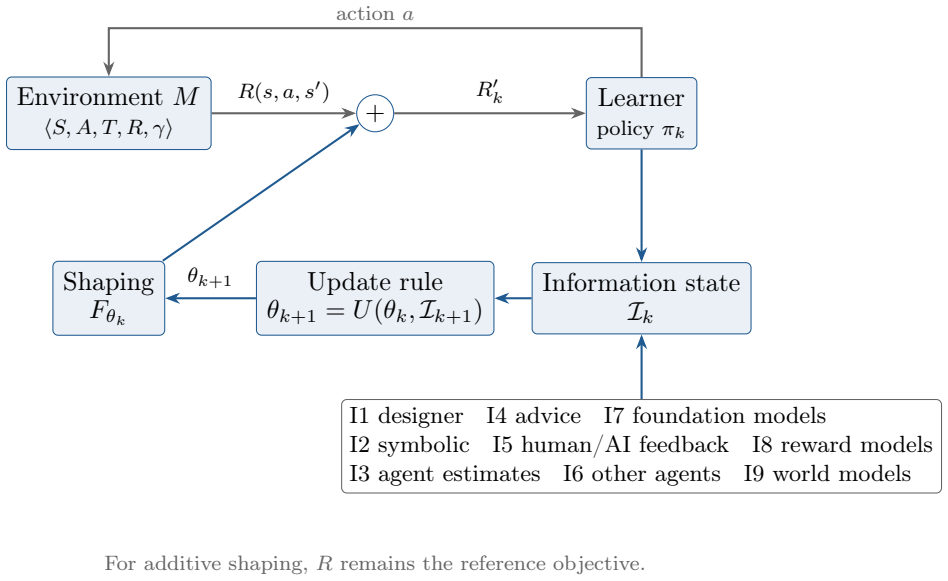
The framework's load-bearing object is a four-part taxonomy. Mechanism classes C1–C4 separate additive dynamic shaping (the only class that inherits the invariance theorems) from reward replacement, reward redistribution or relabelling, and reward-adjacent guidance; temporal signatures T1–T5 plus S separate schedule-, experience-, performance-, structure-, and interaction-driven revision from mere state dependence; information sources I1–I9 name what drives the revision; and guarantee classes G1–G5 rank what is actually proved, from exact structural preservation down to purely empirical reports. The identity carrying the theoretical content is the telescoping pairing of time-indexed potentials, $F_k(s,a,s') = \gamma\Phi_{k+1}(s') - \Phi_k(s)$, whose discounted sum collapses to a boundary term that is the same constant for every policy, provided the potential version at departure and at arrival are chronological. On the implementation side the machinery is a trilemma: replay storage cannot simultaneously keep the index pairing intact, preserve the reward the transition was actually given, and give the critic a stationary regression target; the review catalogues storage policies and which property each forfeits.
What would settle it
Run a systematic, query-logged database search for peer-reviewed additive reward-shaping methods whose signal is revised by an outer loop against measured task return and whose paper proves preservation of the exact optimal-policy set; finding one, or constructing a tabular MDP with a known optimal policy in which a performance-driven update rule provably satisfies the chronological potential pairing at every update, would refute the observed emptiness of the T3–G1 cell.
Extended reading notes
Core claim
The paper claims that training-time revision of reward guidance is a distinct, organising phenomenon worth its own analytical apparatus, and that a single information-conditioned picture captures it: the learner consumes $R'_k = R + F_{\theta_k}$ while an update rule $\theta_{k+1} = U(\theta_k, \mathcal{I}_{k+1})$ revises the shaping term as information accumulates. Within that picture the decisive distinction is parametric revision, the rule itself changes, versus state-dependent variation, a fixed rule evaluated on a moving argument such as a belief or a plan index; only the former counts as dynamic. The review then consolidates the theory governing safety: the time-indexed potential form $F_k(s,a,s') = \gamma\Phi_{k+1}(s') - \Phi_k(s)$ preserves the optimal-policy set when the paired potentials are chronological, and that guarantee belongs only to additive dynamic shaping proper (class C1). Its measured finding, over the twenty-one audited C1 methods, is that every exact-preservation (G1) entry adapts through experience (T2), such as value estimates, visitation statistics, or correction terms, while the cell pairing performance-driven adaptation (T3) with G1 is empty; the paper is explicit that this describes its reviewed set, not a proof of impossibility. It further argues that in deep-RL practice the guarantee is conditional: replay recomputation, bootstrapped critics fed by the same value function that supplies the potential, terminal potentials, and reward normalisation each create conditions the classical theorems do not cover.
Load-bearing premise
The review's central patterns, especially the empty cell joining performance-driven adaptation with exact preservation, depend on the candidate set being representative of the field, but that set was assembled by citation tracing from a theory seed rather than a systematic database search, so the empty cells could be artifacts of selection rather than properties of the field.
Editorial extensions
If this is right
- A designer who needs exact optimality preservation should derive the shaping signal from the agent's own experience, such as value estimates, visitations, or prediction errors, and cast it as a consistently paired potential; an outer loop that tunes the signal against measured return buys measured performance but, in the reviewed record, not preservation.
- The empty T3–G1 cell points to the route most likely to combine rich information sources with exact guarantees: constrain the learned object to an invariant form and let any information source supply its content, learning the potential rather than the reward.
- Implementation is where guarantees die: recomputing only one term of a replayed transition from a later potential breaks the telescoping identity, while consistently recomputing both terms under one current potential replaces the dynamic construction by a sequence of static problems.
- Claims of a benefit from dynamism should rest on a frozen-adaptation baseline alongside an unshaped baseline and the best static potential; without the frozen baseline, an apparent gain may come from the content of the shaping signal rather than from adaptation itself.
- The taxonomy converts method families into a design space where sparse cells are informative: interaction-driven adaptation appears in the reviewed set only as reward replacement or policy-level guidance, never as additive shaping.
Reading between the lines
- If the empty T3–G1 cell survives a broader systematic audit, it would amount to a design law for the field: a performance-driven outer loop either forgoes exact preservation or must impose an additional structural constraint, such as forcing every update to land on a valid potential, a step the paper leaves as an open question rather than a theorem.
- The reward-versus-advantage argument, made in the paper for human feedback, plausibly extends to intrinsic-motivation and value-derived signals, which are also defined relative to the learner's current behaviour; whether treating them as advantages rather than rewards explains observed instabilities is a testable hypothesis.
- The replay trilemma predicts a concrete experimental outcome no reviewed study isolates: storing paired potentials with each transition versus recomputing both terms under a current potential should differ measurably in off-policy deep RL, since the two policies trade the chronological identity against static structure in different ways.
- A rate-of-change theory connecting potential-update frequency to critic stability could turn the central tuning knob of dynamic shaping into an analyzable quantity; a natural conjecture is an analogue of target-network lag, bounding how many critic updates may separate consecutive potential versions.
Editorial analysis
A structured set of objections, weighed in public.
Referee Report
Summary. This review paper proposes a unified analytical framework for dynamic reward shaping and neighbouring adaptive reward mechanisms in reinforcement learning. It formalises dynamic shaping as an information-conditioned process (Eqs. 2-4), separates parametric revision of a shaping rule from state-dependent variation of a fixed rule, and introduces four mechanism classes (C1 additive shaping, C2 reward replacement, C3 redistribution/relabelling, C4 reward-adjacent guidance), three taxonomy dimensions (temporal signatures T1-T5 plus S, information sources I1-I9, guarantee classes G1-G5), and a classification of twelve method families in Table 3. The central findings, explicitly framed as observations about the reviewed set rather than theorems, are that among reviewed C1 methods exact optimality preservation (G1) arises only under experience-driven adaptation (T2), that no performance-driven (T3) method attains G1 (Figure 5), and that agent-internal estimates (I3) are the most frequent information source. The paper also provides an implementation audit of replay, bootstrapped critics, multi-step returns, terminal conditions, and reward normalisation (Section 5.4), a practical decision guide (Table 5), evaluation reporting standards (Table 7), and thirteen open research directions.
Significance. Should the classification be accepted, the framework is a genuinely useful organising device for a fragmented literature, and the paper's self-auditing machinery is exemplary in conception: Table 2 records exact conclusions and information-timing assumptions per theorem; unverifiable claims are marked with a double dagger and excluded from Figure 5's counts; the DPBA entry is reclassified to G5† with its documented refutation; Remark 2 and Figure 9 give a clean separation of index pairing, faithful reconstruction, and target stationarity under replay; and the search protocol's limits are disclosed in unusual detail (Section 1.1, Appendix A.1), with all counts explicitly scoped to the reviewed candidate pool. The taxonomy's empty cells are stated as falsifiable claims about that pool, with the broader compliance audit explicitly delegated to future work, and the historical narrative of Section 5.1 is honestly hedged as a plausible reading.
major comments (2)
- [§3.4/Table 3 vs. §2.4 Remark 1(iii)] Table 3 and Remark 1(iii) are in direct tension. Table 3 assigns G1 to “Online shaping-reward learning” (Grześ and Kudenko 2010) and “Bootstrapped shaping” (Adamczyk et al. 2025), both C1/T2/I3, and Figure 5 counts them among the six T2-G1 entries this review can stand behind. Both potentials, however, are read from the learner's own concurrently learned value estimates, which is exactly the learner-internal case Remark 1(iii) excludes: “Invariance in the original stationary MDP over S does not follow and should not be claimed.” Table 2's Theorem 2 row likewise restricts original-S guarantees to potentials depending solely on k or a Markov sufficient statistic, and the paper states that establishing stationarity of a learner-augmented process is “a further, non-trivial step that this review does not take.” The two entries are absent from Table 2, so the audit trail promised by that table's header (“a G1-G3 assignment in Table 3 can be checked against its source”) does not exist for precisely the assignments at issue. Section 4.2 reports for Adamczyk et al. only “convergence results for the tabular setting,” which under the paper's own definitions (G1 structural preservation, G2 exact recovery in the limit, G3 other formal result) is a G2/G3-type claim rather than a G1 claim. Unless the cited papers prove an original-MDP invariance theorem for the online update process, the G1 labels are earned only by the frozen-potential sub-claim (a trivial application of Theorem 1), which does not certify the dynamic process to which the T2 label refers. There is also an asymmetry of audit standards: GRM and VLM-guided potentials are excluded from Figure 5 because their G1 claims could not be independently verified, whereas Remark 1(iii) affirmatively says these two claims should not be made, which is a stronger reason for exclusion. The authors should either supply the missing bridging theorem, or reclassify the entries (e.g., as G2 for the tabular convergence result) and propagate the change to Figure 5's counts, Section 3.5's first pattern, and Table 5's safety-critical row, which currently recommends value-derived potentials as a “G1 (structural)” route.
- [§3.3-3.5, Table 3] The G1 category is applied over different decision processes without Table 3 recording which. For the static and time-indexed PBRS rows, G1 is structural preservation over the original MDP S. For BAMDP shaping, the G1 meta-RL row is a claim over the belief/history-augmented BAMDP (“necessary and sufficient… for the shaped BAMDP's optimal algorithm to remain Bayes-optimal”), as Table 2 correctly documents, while ADOPS's G1 is conditional on behaviourally enforced tie/dominance conditions computed from the learner's own estimates (Eq. 9). Section 3.5's sentence “every G1 entry adapts through experience-driven read-outs (T2)” therefore aggregates guarantees stated at different levels, and Section 3.4's “Basis of the audited G3 and G4 assignments” paragraph supplies the evidentiary basis for G3/G4 but not for the G1 rows. I recommend (i) adding a column or footnote to Table 3 stating the decision process over which each G1/G2/G3 claim is made (original S, augmented (s,k), belief/history, BAMDP, product MDP), and (ii) adding the remaining G1 rows (Grześ and Kudenko 2010; Adamczyk et al. 2025; Devlin et al. 2014) to Table 2, so that the pattern statements of Section 3.5 and the “guarantee reachable” column of Table 5 are checkable from the paper's own audit tables.
minor comments (3)
- [§3.5] The phrase “The empty T1 column” is imprecise: Figure 5's T1 row contains one G3 entry (heuristic-guided RL), so what is empty is the T1-G1 cell, not the whole column; rewording would prevent a misreading of the count.
- [§1.1, App. A.1] The inclusion criterion “sharpens a class boundary in Section 2.2” is partly circular, since the C1-C4 classes are the framework's own contribution; restating it operationally (for example, as a method that the literature describes as shaping but that classifies differently under Section 2.2) would make the protocol more reproducible.
- [§4.11] The replay-recomputation distinction (mismatched pairing versus consistent current-potential relabelling) is explained three times: Remark 2(ii), Section 4.11, and Section 5.4/Figure 9. A forward cross-reference from Section 4.11 to Section 5.4 would shorten the repeated discussion without loss of precision.
Circularity Check
No significant circularity: the review's taxonomy is explicitly defined rather than fitted, and its central observation is qualified as an observation about the reviewed set, not a theorem.
full rationale
The paper is a review and taxonomy, not a derivation. Its central claims are statements about its reviewed candidate set, and its categories are introduced as the paper's own analytical apparatus. The paper explicitly says: 'The taxonomy that follows ... is this review's own organising apparatus, not settled terminology from the reviewed field,' and 'The taxonomy and the C1–C4 mechanism classification introduced in this review constitute an analytical synthesis of the reviewed literature rather than terminology adopted from individual source papers.' The observation that exact optimality preservation occurs only under experience-driven adaptation is explicitly qualified: 'This is an observation about the reviewed literature, not a theorem.' G1 assignments in Table 3 are made by comparing each cited method against external theorems from Ng et al. 1999, Devlin and Kudenko 2012, and Forbes et al. 2024a,b, 2025, not by consulting the taxonomy's own labels. The paper further excludes unverified entries and non-C1 entries from the counts in Figure 5, and explicitly notes that the empty T1 column is 'a similar artefact of selection rather than a theoretical barrier.' The self-citations (Bahrpeyma et al. 2023 and Bahrpeyma and Reichelt 2022) appear only in Section 6 as application examples and are not load-bearing for the framework's central claims. The skeptic's concern about G1 labels for value-derived T2 entries conflicting with Remark 1(iii) is a potential correctness or consistency issue in the classification, but it is not circularity: the G1 label is not defined in terms of T2, and the observation does not derive G1 from T2 by construction. No step in the paper reduces a claimed result to its own inputs, so no circular step can be exhibited.
Assumptions & free parameters
assumptions (4)
- standard math Standard MDP formulation with discount factor gamma and bounded reward
- ad hoc to paper The C1-C4 mechanism classes, T1-T5 temporal signatures, and G1-G5 guarantee classes are definitions adopted by the review
- domain assumption The candidate set in Table 3 is representative of the field of dynamic reward shaping
- domain assumption The cited theorems (Ng et al. 1999, Devlin and Kudenko 2012, Forbes et al., Lidayan et al.) are correct as summarized
Cite this review
Pith. "Pith review of A Unified Framework for Dynamic Reward Shaping in Reinforcement Learning." pith.science (2026). https://pith.science/paper/DBVE6DG6
@misc{pith2026260808158,
  author       = {Pith},
  title        = {Pith review of: A Unified Framework for Dynamic Reward Shaping in Reinforcement Learning},
  year         = {2026},
  howpublished = {\url{https://pith.science/paper/DBVE6DG6}},
  note         = {Machine review of arXiv:2608.08158}
}
read the original abstract
Sparse, delayed, and weakly informative rewards remain central obstacles to efficient reinforcement learning. Reward shaping addresses these limitations by supplementing the task reward with an auxiliary signal that can accelerate learning while, in the classical setting, the original objective remains the evaluation criterion. Established theory guarantees safety for fixed shaping signals: potential-based reward shaping preserves optimal policies when the auxiliary term is the discounted difference of a time-invariant potential. In contemporary reinforcement learning systems, however, both the learner and the information available for guidance evolve during training: value estimates improve, novelty diminishes, feedback shifts, and predictive models are refined. Adaptive reward mechanisms occur across exploration, Bayesian inference, human-in-the-loop learning, automated reward design, and foundation-model-based approaches. This study introduces a unified analytical framework for comparing dynamic reward shaping and neighbouring adaptive reward mechanisms. The proposed framework distinguishes parametric revision from state-dependent variation, separates additive shaping from reward replacement and reward-adjacent guidance, and organises existing methods along temporal, informational, and theoretical dimensions. Using this framework, twelve method families are comparatively analysed. The framework further highlights the conditions under which optimality guarantees survive contemporary deep reinforcement learning pipelines, replay buffers, bootstrapped critics, and reward normalisation, while exposing the unresolved relationship between adaptation rate and learner stability.
Figures


Figures from the paper (7 more)


Reference graph
Works this paper leans on
-
[10]
1109/ISIEA58477.2023.10298642. Yuntao Bai, Saurav Kadavath, Sandipan Kundu, Amanda Askell, Jackson Kernion, Andy Jones, Anna Chen, Anna Goldie, Azalia Mirhoseini, Cameron McKinnon, et al. Constitutional AI: Harmlessness from AI feedback. arXiv:2212.08073,
-
[11]
doi: 10.1609/aaai.v32i1.11694. Yujing Hu, Weixun Wang, Hangtian Jia, Yixiang Wang, Yingfeng Chen, Jianye Hao, Feng Wu, and Changjie Fan. Learning to utilize shaping rewards: A new approach of reward shaping. In Advances in Neural Information Processing Systems (NeurIPS),
-
[12]
Adaptive Reward Design for Reinforcement Learning
Preprint: arXiv:2412.10917. Adam Laud and Gerald DeJong. The influence of reward on the speed of reinforcement learning: An analysis of shaping. InProceedings of the Twentieth International Conference on Machine Learning (ICML), pages 440–447,
-
[15]
Improving the Effectiveness of Potential-Based Reward Shaping in Reinforcement Learning
Henrik Müller and Daniel Kudenko. Improving the effectiveness of potential-based reward shaping in reinforcement learning. arXiv:2502.01307,
-
[16]
Automating Potential-based Reward Shaping with Vision Language Model Guidance
Henrik Müller and Daniel Kudenko. Automating potential-based reward shaping with vision lan- guage model guidance. arXiv:2606.27180,
-
[18]
Offline Reinforcement Learning with Imputed Rewards
Carlo Romeo and Andrew D. Bagdanov. Offline reinforcement learning with imputed rewards. arXiv:2407.10839,
-
[19]
Training language models with language feedback
Jérémy Scheurer, Jon Ander Campos, Jun Shern Chan, Angelica Chen, Kyunghyun Cho, and Ethan Perez. Training language models with language feedback. arXiv:2204.14146,
- [20]
Show all 21 references
-
[21]
Preprint: arXiv:2503.15724
doi: 10.1109/IROS60139.2025.11247039. Preprint: arXiv:2503.15724. Garrett Warnell, Nicholas R. Waytowich, Vernon Lawhern, and Peter Stone. Deep TAMER: Inter- active agent shaping in high-dimensional state spaces. InProceedings of the Thirty-Second AAAI Conference on Artificial...
2025
-
[2003]
SLOPE: Optimistic potential landscape shaping for model-based reinforcement learning
Yao-Hui Li, Zeyu Wang, Xin Li, Wei Pang, Yingfang Yuan, Zhengkun Chen, Boya Zhang, Riashat Islam, Alex Lamb, and Yonggang Zhang. SLOPE: Optimistic potential landscape shaping for model-based reinforcement learning. arXiv:2602.03201,
-
[2004]
Concrete problems in AI safety
Dario Amodei, Chris Olah, Jacob Steinhardt, Paul Christiano, John Schulman, and Dan Mané. Concrete problems in AI safety. arXiv:1606.06565,
-
[2010]
Kakade, and Sergey Levine
Abhishek Gupta, Aldo Pacchiano, Yuexiang Zhai, Sham M. Kakade, and Sergey Levine. Unpack- ing reward shaping: Understanding the benefits of reward engineering on sample complexity. arXiv:2210.09579,
-
[2016]
Extracting heuristics from large language models for reward shaping in reinforce- ment learning
Siddhant Bhambri, Amrita Bhattacharjee, Durgesh Kalwar, Lin Guan, Huan Liu, and Subbarao Kambhampati. Extracting heuristics from large language models for reward shaping in reinforce- ment learning. arXiv:2405.15194,
-
[2017]
Vision-language models as a source of rewards
Kate Baumli, Satinder Baveja, Feryal Behbahani, Harris Chan, Gheorghe Comanici, Sebastian Flennerhag, Maxime Gazeau, Kristian Holsheimer, Dan Horgan, Michael Laskin, Clare Lyle, Hussain Masoom, Kay McKinney, Volodymyr Mnih, Alexander Neitz, Dmitry Nikulin, Fabio Pardo, Jack Pa...
-
[2018]
Forbes, Nitish Gupta, Leonardo Villalobos-Arias, Colin M
Grant C. Forbes, Nitish Gupta, Leonardo Villalobos-Arias, Colin M. Potts, Arnav Jhala, and David L. Roberts. Potential-based reward shaping for intrinsic motivation. InProceedings of the 23rd International Conference on Autonomous Agents and Multiagent Systems (AAMAS), 2024a. ...
-
[2020]
Comprehensive overview of reward engineering and shaping in advancing reinforcement learning applications
66 Sinan Ibrahim, Mostafa Mostafa, Ali Jnadi, Hadi Salloum, and Pavel Osinenko. Comprehensive overview of reward engineering and shaping in advancing reinforcement learning applications. arXiv:2408.10215,
-
[2021]
Preprint: arXiv:2104.06411
doi: 10.1109/ACCESS.2021.3090364. Preprint: arXiv:2104.06411. Long Ouyang, Jeffrey Wu, Xu Jiang, Diogo Almeida, Carroll L. Wainwright, Pamela Mishkin, Chong Zhang, Sandhini Agarwal, Katarina Slama, Alex Ray, et al. Training language models to follow instructions with human fee...
2021
-
[2022]
2022.1027340
doi: 10.3389/frobt. 2022.1027340. Fouad Bahrpeyma, Anand Sunilkumar, and Dirk Reichelt. Application of reinforcement learning to UR10 positioning for prioritized multi-step inspection in NVIDIA omniverse. In2023 IEEE Symposium on Industrial Electronics & Applications (ISIEA), ...
2022
-
[2023]
InfoRM: Mit- igating reward hacking in RLHF via information-theoretic reward modeling
Yuchun Miao, Sen Zhang, Liang Ding, Rong Bao, Lefei Zhang, and Dacheng Tao. InfoRM: Mit- igating reward hacking in RLHF via information-theoretic reward modeling. arXiv:2402.09345,
-
[2024]
Taylor, Anna Harutyunyan, and Michael Bowling
Paniz Behboudian, Yash Satsangi, Matthew E. Taylor, Anna Harutyunyan, and Michael Bowling. Useful policy invariant shaping from arbitrary advice. arXiv:2011.01297,
2011 arXiv
-
[2025]
AdrianK.AgoginoandKaganTumer
doi: 10.1609/aaai.v39i15.33679. AdrianK.AgoginoandKaganTumer. Unifyingtemporalandstructuralcreditassignmentproblems. 63 InProceedings of the Third International Joint Conference on Autonomous Agents and Multiagent Systems, pages 980–987,
Reviewed August 12, 2026 · model on record in the stance chip above.
Discussion (0). Continue with ORCID to comment.