REVIEW 2 major objections 5 minor 46 references
High-Capacity Generalized Hopfield Networks
T0 review · 2 major / 5 minor · reviewed 2026-08-12 · deepseek-v4-flash
Pith's one-line read This paper claims that Hopfield networks on CP^{d-1} store far more patterns than vector or binary Hopfields because recall is top-eigenvector alignment of a spiked memory kernel, with alpha_c rising from 0.62 at d=3 to about 40 at d=8.
desk verdict A genuinely new CP^{d-1} Hopfield family with a top-eigenvector recall rule and replica-predicted capacity that grows with d; the d>=5 predictions rest on RS only, so the main number needs numerical corroboration before I'd bank on it. read the letter →
The pith
A machine-rendered reading of the paper's core claim, the machinery that carries it, and where it could break.
The reading
What carries the argument
The load-bearing object is the memory kernel K_i = sum_mu $O_mu^{{(i)}}$ |xi_mu^i><xi_mu^i|, a d x d Hermitian matrix built from stored memories weighted by their overlaps with the current state. The update rule sends neuron i to the top eigenvector of K_i. The argument works by embedding $CP^{{d-1}}$ into the real space of SU(d) Gell-Mann generators, so the nonlinear manifold constraints become linear algebra in an auxiliary Hilbert space; in the replica treatment the disorder-averaged kernel takes the form m (v0·$\lambda$) + $\sigma$ (z·$\lambda$), i.e. a spike plus a GUE matrix, whose top eigenvector is relatively stable. The capacity curve comes from solving the T=0 replica-symmetric equations m = E_z[...], $sigma^{2}$ = $\alpha$ $C^{2}$ L / (1-g)^2, with C=2/(d(d+1)).
What would settle it
A calculation that evaluates the Parisi replica-symmetry-breaking corrections to the alpha_c equation and finds the capacity curve shifted substantially, or a direct numerical retrieval experiment on $CP^{{d-1}}$ at d=5 or d=6 that shows no stable recall near the predicted alpha_c of about 6.6 or 13.6, would settle the claim.
Extended reading notes
Core claim
The central claim is that placing Hopfield neurons and memories on the complex projective spaces $CP^{{d-1}}$ = SU(d)/U(d-1) instead of spheres reverses the usual capacity trend: the critical storage load alpha_c grows steeply with d, from about 0.05 at d=2 to about 0.62 (d=3), 2.4 (d=4), and roughly 40 (d=8), rather than decreasing as 1/n. The mechanism is a genuinely different recall rule: a neuron updates by aligning with the top eigenvector of a d x d Hermitian memory kernel, a spiked matrix whose signal eigenvalue is protected from random-matrix crosstalk by a gap. The paper derives this rule from the Lie-algebraic embedding of $CP^{{d-1}}$ into Bloch vectors, computes alpha_c by replica-symmetric saddle-point equations, observes the predicted transition in asynchronous simulations and in generalized Landau-Lifshitz-Gilbert dynamics, and quantizes the model to a Sachdev-Ye-type spin glass.
Load-bearing premise
The calculation treats Haar-random memories as Gaussian random vectors with covariance C=2/(d(d+1)) and ignores higher cumulants, and the replica free energy is assumed symmetric between replicas; if either approximation fails at large d, the predicted alpha_c values shift, and the paper explicitly notes that replica symmetry breaking may correct the large-d numbers.
Editorial extensions
If this is right
- SU(3) networks reach alpha_c about 0.62, more than four times the binary Hopfield value, and SU(4) exceeds two patterns per neuron; if the replica curve holds, SU(8) reaches roughly 40 patterns per neuron.
- Memory recall no longer requires each neuron to point at a stored vector; it only requires the neuron state to sit in the top eigenspace of its memory kernel, which random crosstalk perturbs less.
- Physical dissipative dynamics, namely generalized Landau-Lifshitz-Gilbert equations, restore corrupted stored images in real time for loads below alpha_c, matching algorithmic capacity.
- Quantized SU(d) Hopfields reduce to Sachdev-Ye-type glassy models whose spectra show dark bands (states annihilated by all patterns) and chaotic memory bands, so Hebbian memory is not readable from level statistics alone.
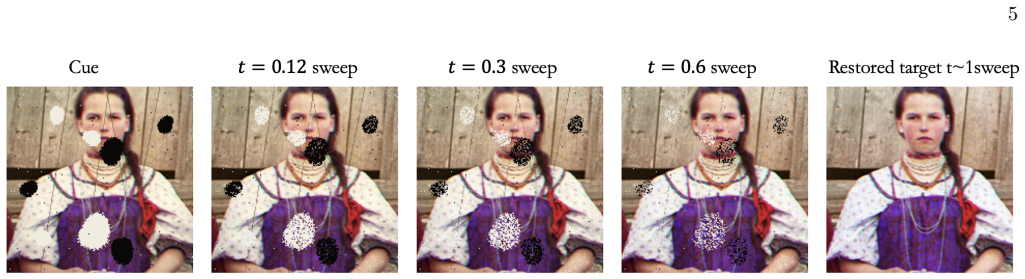
- The RGB encoding/decoding protocol demonstrates that SU(3) neurons can carry real image data, and a single sweep of asynchronous updates restores a corrupted photograph to near-perfect match.
Reading between the lines
- A natural next step is to test whether the same capacity gain appears in other symmetric-space Hopfield networks, since the mechanism depends on top-eigenvector alignment of a spiked kernel rather than on SU(d) specifically; if so, capacity becomes a designable property of the neuron manifold.
- The replica predictions for d=5 through d=8 are untested numerically, and a direct simulation at d=5 or d=6 near the predicted alpha_c would show how much of the rapid growth survives beyond replica symmetry.
- The RGB encoder leaves one phase-like degree of freedom unused per qutrit, so a practical extension could pack that extra degree of freedom into the same SU(3) network at no additional storage cost.
- The observation that Hebbian data is hidden in Wigner-Dyson spectra suggests that genuinely quantum memory would need non-Hebbian, projector-based encodings, with the dark-band/memory-band split as a possible target for such schemes.
Editorial analysis
A structured set of objections, weighed in public.
Referee Report
Summary. The paper defines Hopfield networks whose neurons and memories live on the complex projective space CP^{d-1}, realized through SU(d) coherent states. Using a Lie-algebraic embedding, it derives an update rule in which each neuron aligns with the top eigenvector of a d×d Hermitian memory kernel, in contrast to vector alignment in spherical Hopfield networks. The main quantitative result is a replica-symmetric (RS) saddle-point calculation, Eqs. (29)-(32), predicting a critical storage capacity α_c that grows steeply with d: about 0.05 for d=2, 0.62 for d=3, 2.5 for d=4, and about 40 for d=8. Direct asynchronous-update simulations for d=2,3,4 and Landau-Lifshitz-Gilbert dynamics for d=3 are reported as consistent with the RS curve. The paper also presents a color-image encoding demonstration for SU(3), a generalized LLG recall dynamics, and a quantization of the model leading to Sachdev-Ye-type Hamiltonians, whose spectral statistics are analyzed for the XY case.
Significance. If the predicted capacity growth is correct, the paper identifies a qualitatively new recall mechanism—top-eigenvector alignment of a spiked memory kernel—that is more robust to random-matrix crosstalk than the vector alignment of spherical models. The replica calculation is parameter-free, with no fitted parameters beyond the subjective threshold used in finite-size numerics, and the d=2 and d=3,4 numerics provide nontrivial checks of the RS equations. The LLG dynamics and the image-recovery demonstration strengthen the claim that the recall protocol is physically realizable. The quantum extension is exploratory but connects the model to existing Sachdev-Ye and Richardson-pairing literature. The main weakness is that the large-d values, including the headline α_c≈40 at d=8, rest entirely on the replica-symmetric ansatz, whose stability is not checked and for which no numerical verification above d=4 is provided.
major comments (2)
- [§V.B, Eq. (32) and Fig. 4(b)] The central quantitative claim—that α_c continues to grow steeply to roughly 40 at d=8—is obtained from the replica-symmetric saddle-point equations (32), and the paper explicitly states at the end of §V.B that replica-symmetry-breaking corrections were not explored. For d=2–4 the RS curve is corroborated by direct simulations, but for d≥5 there is no independent check. If the RS retrieval fixed point becomes Almeida-Thouless unstable, or if one-step RSB substantially lowers α_c for large d, the specific high-d values and the 'rapidly growing' claim would be overstated, even if the spiked-eigenvector mechanism survives qualitatively. I therefore ask for either an Almeida-Thouless stability analysis, a one-step RSB calculation, or at least a finite-size numerical scan for SU(5) (and ideally SU(6)) to establish whether the steep rise is real.
- [§IV and Fig. 3] The numerical capacity estimates α_c≈0.62 for SU(3) and α_c≈2.41 for SU(4) are reported without specifying the system sizes N used, the number of disorder realizations, or error bars on the extrapolated values; the text only mentions a linear extrapolation in 1/N. Since these d=3 and d=4 numerics are the main evidence that the RS equations are correct, the absence of these details weakens the empirical validation. The LLG scan in §VIII.C gives an independent SU(3) value (α_c≈0.64), but no analogous LLG or asynchronous-update check exists for d=4 or higher.
minor comments (5)
- [Eqs. (21)–(23)] The Gaussian truncation of Haar-random memories is stated without justification. It is, however, controlled by the central limit theorem in N: each uncondensed memory contributes a term of order N^{-1/2} to the exponent, so higher-than-second cumulants are suppressed by powers of N^{-1/2}. Adding a sentence to this effect would clarify that the approximation is not an ad hoc assumption about the geometry of CP^{d-1}.
- [Eq. (16) and Eq. (17)] The RGB-to-qutrit encoding is described as an injection, but the decoder (17) is followed by clipping to [0,1], which means that for qutrits outside the encoded RGB submanifold the inverse is not exact. The text should state clearly that clipping is part of the decoder and that the exact inverse holds only on the encoded submanifold, otherwise the claim of reversibility is too strong.
- [§V.A, Eq. (19)] The qualitative spiked-matrix picture states that the constant C(d) 'is expected to be order one for d∼3 and to decay as 1/d^2 for d≫1', but no derivation or numerical check of this decay is given. Since the replica calculation provides C(d)=2/[d(d+1)] implicitly, the qualitative discussion could be tied to that expression, which would make the argument more concrete.
- [Fig. 4(b)] The plotted α_c values are given to one decimal place (e.g., 13.6, 24.6, 40.3), but no error estimate for the numerical solution of the RS equations is provided; stating the number of z-samples and the iteration convergence criterion, as is done for d=3 in Fig. 4(a), would help the reader judge the reliability of the high-d points.
- [General] The abstract and introduction describe an 'almost order of magnitude enhancement' starting at d=3; the RS value α_c≈0.62 is more than a factor of ten above the SU(2) value 0.05, so the wording is slightly conservative. The phrase 'order of magnitude' is fine, but the abstract should be careful not to imply the enhancement is limited to a factor of ten when the reported values are actually larger.
Circularity Check
No circularity: the SU(d) capacity prediction is a parameter-free replica calculation, benchmarked by direct simulation and by the d=2 limit.
full rationale
No circular steps were found. The central quantitative claim—α_c(d) growing from ≈0.62 at d=3 to ≈40 at d=8—is obtained by solving the closed replica-symmetric equations (32), which contain no fitted parameters. The only inputs are the known covariance C=2/(d(d+1)) of Haar-random CP^{d-1} memories and the standard Gell-Mann completeness relations (7)–(8). The same equations reproduce the numerically measured α_c≈0.62 for d=3 and ≈2.41 for d=4, and reduce to the known vector/Heisenberg result α_c≈0.05 at d=2, providing an external benchmark. The numerical capacity estimate in Sec. IV uses a stated overlap threshold (m̄_th=1/2) and linear 1/N extrapolation, but these are explicit analysis conventions rather than fitted parameters renamed as predictions. Self-citations appear (Ref. [12] for the Lie-algebraic approach, Refs. [36,37] for the pairing-model analogy, and Ref. [6] for the vector-Hopfield benchmark), but the needed algebra is re-derived in the paper and the capacity result is independently reproduced by the paper's own numerics, so none of these citations is load-bearing. The explicitly admitted absence of RSB corrections for d≥5 (end of Sec. V.B) and the second-order Gaussian truncation of uncondensed memories in Eq. (23) are genuine robustness or correctness risks for the unexplored high-d regime, but they are not circularity: no equation or fitted quantity is equivalent by construction to the claimed prediction.
Assumptions & free parameters
free parameters (2)
- retrieval overlap threshold \bar m_th =
1/2
- LLG damping \lambda =
1
assumptions (5)
- standard math The replica and Hubbard-Stratonovich methods yield the exact quenched free energy for this model in the thermodynamic limit.
- domain assumption Uncondensed Haar-random memories on CP^{d-1} are statistically equivalent to Gaussian vectors with zero mean and covariance C=2/(d(d+1)).
- domain assumption Replica symmetry (m_a=m, q_ab=q) gives the correct retrieval free energy and capacity.
- domain assumption At T=0 the per-site Boltzmann measure is concentrated on the top eigenvector of the memory kernel K.
- domain assumption The generalized Landau-Lifshitz-Gilbert damped dynamics reaches the same retrieval states as the algorithmic asynchronous update.
Cite this review
Pith. "Pith review of High-Capacity Generalized Hopfield Networks." pith.science (2026). https://pith.science/paper/UBV4YIOO
@misc{pith2026260808226,
  author       = {Pith},
  title        = {Pith review of: High-Capacity Generalized Hopfield Networks},
  year         = {2026},
  howpublished = {\url{https://pith.science/paper/UBV4YIOO}},
  note         = {Machine review of arXiv:2608.08226}
}
read the original abstract
Generalized Hopfield networks are introduced where memories and neurons are continuous variables that lie on a Riemannian manifold. We explicitly focus on symmetric spaces associated with the special unitary groups SU(d), and use both numerical and analytical (replica) techniques to demonstrate an almost order of magnitude enhancement in critical capacity over the vector networks starting with d=3 and further rapidly growing with d. To circumvent the non-linear geometric constraints, we use a Lie algebraic method [following V. Galitski, Phys. Rev. A 84, 012118 (2011)] to exactly describe the classical neural network in terms of linear algebra in an auxiliary Hilbert space. It is shown that in contrast to the traditional Hopfield networks, memory recall in SU(d) Hopfields corresponds to neuron alignment along a top eigenvector of a spiked matrix, which is less susceptible to random matrix crosstalk than other models with continuous neuron variables. Physical platforms to realize SU(d) Hopfields are briefly discussed and physical (in addition to algorithmic) recall mechanism is demonstrated, where memory recovery occurs naturally through generalized Landau-Lifshitz-Gilbert dynamics. To illustrate SU(3) memory recall, we introduce a color (RGB) image encoding/decoding protocol and explicitly run image recovery on corrupted cues. Finally, we quantize the generalized Hopfields which are shown to reduce to Sachdev-Ye glassy type of models. Their many-body spectra generally feature two types of dark and memory bands, where the latter exhibits chaotic Wigner-Dyson level statistics that hides Hebbian data.
Figures


Figures from the paper (6 more)


Reference graph
Works this paper leans on
-
[1]
J. J. Hopfield, Neural networks and physical systems with emergent collective computational abilities, Proc. Natl. Acad. Sci. U.S.A.79, 2554 (1982)
1982
-
[2]
D. J. Amit, H. Gutfreund, and H. Sompolinsky, Storing infinite numbers of patterns in a spin-glass model of neu- ral networks, Phys. Rev. Lett.55, 1530 (1985)
1985
-
[3]
D. J. Amit, H. Gutfreund, and H. Sompolinsky, Statisti- cal mechanics of neural networks near saturation, Ann. Phys. (N.Y.)173, 30 (1987)
work page 1987
-
[4]
A. J. Noest, Associative memory in sparse phasor neural networks, Europhys. Lett.6, 469 (1988)
work page 1988
-
[5]
A. J. Noest, Discrete-state phasor neural networks, Phys. Rev. A38, 2196 (1988)
work page 1988
-
[6]
R. D. Barney, S. Bhattacharjee, V. Galitski, K. Agar- wal, and I. Martin, Quantum-stabilized patterns in a vector Hopfield network, arXiv:2606.06597 (2026), arXiv:2606.06597
work page Pith review arXiv 2026
-
[7]
F. Nicoletti, F. D’Amico, and M. Negri, Statistical me- chanics of vector Hopfield network near and above sat- uration, J. Phys. A: Math. Theor.58, 505005 (2025), arXiv:2507.02586
-
[8]
Kanter, Potts-glass models of neural networks, Phys
I. Kanter, Potts-glass models of neural networks, Phys. Rev. A37, 2739 (1988)
work page 1988
Show all 46 references
-
[9]
Kropff and A
E. Kropff and A. Treves, The storage capacity of Potts models for semantic memory retrieval, J. Stat. Mech. 2005, P08010 (2005)
2005
-
[10]
Krotov and J
D. Krotov and J. J. Hopfield, Dense associative mem- ory for pattern recognition, inAdvances in Neural In- formation Processing Systems 29(2016) pp. 1172–1180, arXiv:1606.01164
2016 arXiv
-
[11]
Demircigil, J
M. Demircigil, J. Heusel, M. L¨ owe, S. Upgang, and F. Vermet, On a model of associative memory with huge 14 storage capacity, J. Stat. Phys.168, 288 (2017)
2017
-
[12]
Galitski, Quantum-to-classical correspondence and Hubbard-Stratonovich dynamical systems: A Lie- algebraic approach, Phys
V. Galitski, Quantum-to-classical correspondence and Hubbard-Stratonovich dynamical systems: A Lie- algebraic approach, Phys. Rev. A84, 012118 (2011), arXiv:1012.2873
2011 arXiv
-
[13]
A. M. Perelomov, Coherent states for arbitrary Lie group, Commun. Math. Phys.26, 222 (1972)
1972
-
[14]
Library of Congress, Prints and Photographs Division, The Prokudin-Gorskii collection (1909)
1909
-
[15]
M. L. Mehta,Random Matrices, 3rd ed., Pure and Ap- plied Mathematics, Vol. 142 (Elsevier/Academic Press, Amsterdam, 2004)
2004
-
[16]
J. Baik, G. Ben Arous, and S. P´ ech´ e, Phase transition of the largest eigenvalue for nonnull complex sample covari- ance matrices, Ann. Probab.33, 1643 (2005)
2005
-
[17]
Boll´ e, T
D. Boll´ e, T. M. Nieuwenhuizen, I. P´ erez Castillo, and T. Verbeiren, A spherical Hopfield model, J. Phys. A: Math. Gen.36, 10269 (2003)
2003
-
[18]
S. F. Edwards and P. W. Anderson, Theory of spin glasses, J. Phys. F: Met. Phys.5, 965 (1975)
1975
-
[19]
Sherrington and S
D. Sherrington and S. Kirkpatrick, Solvable model of a spin-glass, Phys. Rev. Lett.35, 1792 (1975)
1975
-
[20]
D. J. Thouless, P. W. Anderson, and R. G. Palmer, Solu- tion of ‘Solvable model of a spin glass’, Philos. Mag.35, 593 (1977)
1977
-
[21]
Parisi, Infinite number of order parameters for spin- glasses, Phys
G. Parisi, Infinite number of order parameters for spin- glasses, Phys. Rev. Lett.43, 1754 (1979)
1979
-
[22]
A. V. Gorshkov, M. Hermele, V. Gurarie, C. Xu, P. S. Julienne, J. Ye, P. Zoller, E. Demler, M. D. Lukin, and A. M. Rey, Two-orbitalSU(N) magnetism with ultracold alkaline-earth atoms, Nat. Phys.6, 289 (2010)
2010
-
[23]
Zhang, M
X. Zhang, M. Bishof, S. L. Bromley, C. V. Kraus, M. S. Safronova, P. Zoller, A. M. Rey, and J. Ye, Spectroscopic observation ofSU(N)-symmetric interactions in Sr or- bital magnetism, Science345, 1467 (2014)
2014
-
[24]
Ringbauer, M
M. Ringbauer, M. Meth, L. Postler, R. Stricker, R. Blatt, P. Schindler, and T. Monz, A universal qudit quantum processor with trapped ions, Nat. Phys.18, 1053 (2022)
2022
-
[25]
Senko, P
C. Senko, P. Richerme, J. Smith, A. Lee, I. Cohen, A. Retzker, and C. Monroe, Realization of a quantum integer-spin chain with controllable interactions, Phys. Rev. X5, 021026 (2015)
2015
-
[26]
B. P. Marsh, D. Atri Schuller, Y. Ji, H. S. Hunt, S. Gan- guli, S. Gopalakrishnan, J. Keeling, and B. L. Lev, High- capacity associative memory in a quantum-optical spin glass, arXiv:2509.12202 (2025), arXiv:2509.12202
2025
-
[27]
B. P. Marsh, Y. Guo, R. M. Kroeze, S. Gopalakrishnan, S. Ganguli, J. Keeling, and B. L. Lev, Enhancing asso- ciative memory recall and storage capacity using confocal cavity QED, Phys. Rev. X11, 021048 (2021)
2021
-
[28]
Gopalakrishnan, B
S. Gopalakrishnan, B. L. Lev, and P. M. Goldbart, Frustration and glassiness in spin models with cavity- mediated interactions, Phys. Rev. Lett.107, 277201 (2011)
2011
-
[29]
Gopalakrishnan, B
S. Gopalakrishnan, B. L. Lev, and P. M. Goldbart, Ex- ploring models of associative memory via cavity quantum electrodynamics, Philos. Mag.92, 353 (2012)
2012
-
[30]
Rotondo, M
P. Rotondo, M. Marcuzzi, J. P. Garrahan, I. Lesanovsky, and M. M¨ uller, Open quantum generalisation of Hopfield neural networks, J. Phys. A: Math. Theor.51, 115301 (2018)
2018
-
[31]
Rebentrost, T
P. Rebentrost, T. R. Bromley, C. Weedbrook, and S. Lloyd, Quantum Hopfield neural network, Phys. Rev. A98, 042308 (2018)
2018
-
[32]
Fiorelli, I
E. Fiorelli, I. Lesanovsky, and M. M¨ uller, Phase diagram of quantum generalized Potts-Hopfield neural networks, New J. Phys.24, 033012 (2022), arXiv:2109.10140
2022 arXiv
-
[33]
B¨ odeker, E
L. B¨ odeker, E. Fiorelli, and M. M¨ uller, Optimal stor- age capacity of quantum Hopfield neural networks, Phys. Rev. Research5, 023074 (2023), arXiv:2210.07894
2023 arXiv
-
[34]
Sachdev and J
S. Sachdev and J. Ye, Gapless spin-fluid ground state in a random quantum Heisenberg magnet, Phys. Rev. Lett. 70, 3339 (1993)
1993
-
[35]
Rosenhaus, An introduction to the SYK model, J
V. Rosenhaus, An introduction to the SYK model, J. Phys. A: Math. Theor.52, 323001 (2019), arXiv:1807.03334
2019 arXiv
-
[36]
Galitski, Nonperturbative quantum dynamics of the order parameter in the BCS pairing model, Phys
V. Galitski, Nonperturbative quantum dynamics of the order parameter in the BCS pairing model, Phys. Rev. B 82, 054511 (2010), arXiv:1003.2237
2010 arXiv
-
[37]
T. A. Sedrakyan and V. Galitski, Boundary Wess- Zumino-Novikov-Witten model from the pairing Hamil- tonian, Phys. Rev. B82, 214502 (2010), arXiv:1005.0544
2010 arXiv
-
[38]
R. W. Richardson, A restricted class of exact eigen- states of the pairing-force Hamiltonian, Phys. Lett.3, 277 (1963)
1963
-
[39]
Dukelsky, S
J. Dukelsky, S. Pittel, and G. Sierra, Colloquium: Ex- actly solvable Richardson-Gaudin models for many-body quantum systems, Rev. Mod. Phys.76, 643 (2004)
2004
-
[40]
D. M. Basko, I. L. Aleiner, and B. L. Altshuler, Metal- insulator transition in a weakly interacting many-electron system with localized single-particle states, Ann. Phys. (N.Y.)321, 1126 (2006)
2006
-
[41]
Oganesyan and D
V. Oganesyan and D. A. Huse, Localization of interacting fermions at high temperature, Phys. Rev. B75, 155111 (2007)
2007
-
[42]
V. A. Marchenko and L. A. Pastur, Distribution of eigen- values for some sets of random matrices, Math. USSR-Sb. 1, 457 (1967)
1967
-
[43]
Bohigas, M
O. Bohigas, M. J. Giannoni, and C. Schmit, Character- ization of chaotic quantum spectra and universality of level fluctuation laws, Phys. Rev. Lett.52, 1 (1984)
1984
-
[44]
V. K. B. Kota, Embedded random matrix ensembles for complexity and chaos in finite interacting particle sys- tems, Phys. Rep.347, 223 (2001)
2001
-
[45]
L. D. Landau and E. M. Lifshitz, On the theory of the dis- persion of magnetic permeability in ferromagnetic bodies, Phys. Z. Sowjetunion8, 153 (1935)
1935
-
[46]
T. L. Gilbert, A phenomenological theory of damping in ferromagnetic materials, IEEE Trans. Magn.40, 3443 (2004)
2004
Reviewed August 12, 2026 · model on record in the stance chip above.
Discussion (0). Continue with ORCID to comment.