REVIEW 3 major objections 3 minor 23 references
From Recovery to Drop-off: How Action Post-training Reduces a VLM's Late-Layer Depth Decodability
T0 review · 3 major / 3 minor · reviewed 2026-08-14 · deepseek-v4-flash
Pith's one-line read Action post-training turns a vision-language model into a robot policy at the cost of depth decodability: the VLA loses depth at every layer and collapses in the final layers, and the collapse is caused by the last MLP writes.
desk verdict Solid mechanistic probing with a real late-MLP finding, but the paper must confirm prompt parity between the VLM and VLA before the cross-model floor and cliff claims are trustworthy. read the letter →
The pith
A machine-rendered reading of the paper's core claim, the machinery that carries it, and where it could break.
The reading
What carries the argument
The load-bearing object is the residual-stream write decomposition: each decoder layer adds its attention and MLP outputs to the stream, $h^\ell = x + \sum_{i=0}^\ell (a^i + m^i)$, so any single write can be removed and the stream re-read. The paper uses this decomposition to sweep three-layer ablation windows over the full stack for both modules and both models, and to probe the accumulated MLP deposits $\sum_{i\le\ell} m^i$ separately from the stream $h^\ell$. The probe is a capacity-matched Dense Prediction Transformer (DPT) head trained at every layer, supervised by a monocular depth teacher. The decomposition turns a descriptive layer-wise gap into a causal intervention: because the final MLP writes are additive terms, deleting them isolates whether their content interferes with depth decodability at the readout.
What would settle it
Train a matched-capacity nonlinear probe on the VLA's final-layer visual-token states; if depth decodability no longer collapses relative to the base VLM, the cliff is a linear-format artifact rather than a loss of represented depth.
Extended reading notes
Core claim
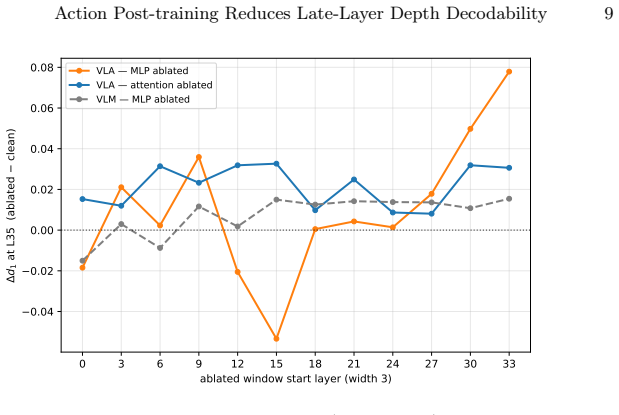
MolmoAct2-LIBERO, a VLA produced by action post-training Molmo2-ER, decodes monocular depth worse than its weight-matched base VLM at every one of the 36 decoder layers, and the gap widens to $0.246$ in $d_1$ at the final layer: over layers 28-35 the base VLM's $d_1$ rises by $+0.040$ while the VLA's falls by $-0.123$, ending at $0.506$ versus $0.752$. A symmetric full-stack ablation sweep, testing MLP versus attention writes in both models across twelve three-layer windows, isolates the cause: zeroing the VLA's last MLP writes (layers 33-35) raises final-layer $d_1$ to $0.584$, recovering the majority of the terminal drop, whereas the same intervention in the base VLM and the attention ablations show no comparable effect. Probing accumulated MLP writes separately from the residual stream explains the dissociation: in the base VLM those deposits out-decode the stream at every layer, while in the VLA the deposits collapse over the final blocks from $d_1\approx 0.68$ to $0.38$, dropping below the stream itself. The paper concludes that action post-training repurposes late MLP computation at the expense of geometric readout, and it is explicit that the ablation probes are single-seed, so the localization rests on the structured module-, layer-, and training-specific dissociation rather than on any isolated cell.
Load-bearing premise
The comparison assumes that a capacity-matched probe measures the same thing in both models, so the floor and cliff reflect what the hidden states represent rather than how linearly action post-training chose to format depth; if depth moved into a nonlinear code, the collapse could be a probe artifact.
Editorial extensions
If this is right
- The terminal cliff is not diffuse degradation: it is carried by the VLA's late MLP writes, since removing just the final three MLP windows restores most of the drop.
- The base VLM's depth information lives primarily in accumulated MLP deposits rather than in the residual stream, so probing writes can expose geometric content that stream probes miss.
- The floor and the cliff are distinct phenomena, so a remedy for one may not repair the other; late-layer write deletion is a proof-of-principle recovery for the cliff only.
- Representation-level recovery from ablation does not imply closed-loop policy improvement; the paper makes no claim that the intervention improves robot behavior.
Reading between the lines
- If the same late-MLP interference appears in other VLA families, a training-time objective that preserves depth decodability in the final MLP blocks could prevent the cliff without altering the action expert.
- A nonlinear probe of matched capacity would separate two readings of the cliff: depth information destroyed versus depth information reformatted into a nonlinear code; the paper's ridge corroboration is within-model only and does not settle this across models.
- The floor's presence at every layer hints that action post-training changes global representational formatting, not just late-layer content; if so, fixing the cliff alone would still leave a sizeable accuracy gap.
- The same ablation sweep could be applied to other spatial primitives such as surface normals, object size, or affordance; if the late-window signature recurs, the cliff generalizes beyond depth.
Editorial analysis
A structured set of objections, weighed in public.
Referee Report
Summary. The paper reports a layerwise probing study comparing depth decodability in a weight-matched VLM/VLA pair, Molmo2-ER and MolmoAct2-LIBERO. Using a capacity-matched DPT head supervised by Depth-Anything-3, the authors measure depth accuracy (d1) at visual-token positions for all 36 decoder layers of both models. They find a persistent floor, with the VLA below the VLM at every layer, and a late-layer cliff, in which the base VLM rises by +0.040 over layers 28–35 while the VLA falls by −0.123. A symmetric ablation sweep over module types (MLP/attention), models (VLA/VLM), and twelve three-layer windows shows that ablating the final MLP window (L33–35) in the VLA raises final-layer d1 from 0.506 to 0.584, recovering the majority of the terminal drop, while attention ablations and the same intervention in the base VLM do not produce comparable recovery. Probing accumulated MLP writes shows that in the base VLM these deposits are more depth-decodable than the residual stream, whereas in the VLA they collapse over the final blocks. The paper concludes that action post-training reduces late-layer depth decodability by repurposing late MLP computation. The claims are empirical and the paper is explicitly self-aware about its single-seed and probe-capacity limitations.
Significance. If the findings hold, the paper provides a valuable mechanistic localization of VLA representation degradation: a specific module and layer window, with a subtractive intervention that recovers a majority of the terminal decodability drop. Strengths include the weight-matched model pair, the explicitly symmetric 2×2×12 ablation design, the use of publicly documented models and teacher, and the paper's unusually honest limitation statements. The ridge corroboration and the module-level decomposition are useful complements to the main probing result. However, two load-bearing issues prevent acceptance in the current form: the cross-model comparison does not state whether the two models receive identical text prompts, and the headline quantitative claims are made without any uncertainty quantification. The paper's contribution is important and potentially publishable, but these points need to be addressed first.
major comments (3)
- [Sec. 4.1; Eqs. (3)–(5)] The probing protocol specifies image inputs, layer taps, and model identities, but never states that Molmo2-ER and MolmoAct2-LIBERO receive identical text prompts when the hidden states are collected. Because the hidden states at visual-token positions are computed by attention over the full multimodal sequence, any difference in text tokens (for example, a LIBERO task instruction for the VLA versus a generic caption for the base VLM) changes the layerwise d1 curves independently of the action-post-training weight changes. This directly threatens the headline floor and cliff, both of which are cross-model comparisons. The ablation localization in Sec. 4.2 is within-model and would survive, but the title's 'reduces' claim and the base-VLM control depend on input comparability. The limitation section acknowledges probe-format confounds but never mentions prompt control. Please report the exact prompt template used for each model and add a control in which both models receive identical prompts, or explicitly ablate text tokens so that the visual hidden states are computed under identical conditioning.
- [Sec. 4.1, Table 2; Supplementary A] All layerwise d1 values and derived quantities (for example, the final-layer gap of 0.246, the terminal slopes +0.040/−0.123, and the ablation deltas in Table 3) come from a single seed with no reported variance. The mid-stack floor is as small as about 0.04 d1, and the base VLM's late 'recovery' is +0.040 over eight layers; without bootstrap intervals over rollouts or at least a small set of probe seeds, the reader cannot assess whether the floor and slope differences are reliable. The single-seed caveat in Sec. 4.2 and the Limitations section is an honest disclosure, but it is not a substitute for uncertainty quantification on the quantities that carry the central claims. Please add confidence intervals or error bars, or explicitly reframe the headline claims as single-seed observations whose quantitative magnitudes are not yet stable.
- [Sec. 3.3, Sec. 4.3, Fig. 5] The limitation stated in Sec. 3.3, that linear probes conflate representational content with representational format, applies equally to the nonlinear DPT-based d1 comparison used for the floor and cliff. Because a fresh DPT head is trained per layer and model, a difference in how depth is formatted (for example, a nonlinear or rotated code) would appear as a drop in decodability even if the same depth information were present. The paper's caveat in Sec. 3.3 is explicitly restricted to ridge scores, but the main d1 result has the same interpretation problem. A concrete control would be to probe late VLA states with a probe trained on VLM late states, or vice versa, or to train a small nonlinear readout and compare. In the absence of such a control, the conclusion in Sec. 4.3 that action post-training 'collapses depth decodability' should be stated as a claim about this probe family, not about geometric information content generally.
minor comments (3)
- [Fig. 4] Figure 4 plots three curves (VLA-MLP, VLA-attention, VLM-MLP), but Table 3 reports a VLM-attention row; the figure does not show the VLM-attention ablation, so the reader cannot visually check the claim that this condition changes d1 by at most +0.010. Please add the VLM-attention curve to the figure or explicitly note in the caption that it is omitted for visual clarity.
- [Sec. 4.2] The statement that the sweep 'causally localizes the cliff to late VLA MLP computation' is slightly broader than the evidence: the cliff spans layers 28–35, while the ablation window covers only layers 33–35. The text distinguishes the terminal drop from the full cliff only implicitly. Please qualify the localization statement so that it refers to the terminal portion of the cliff, or add an ablation of the L28–32 window to establish that the earlier part of the cliff is also affected.
- [Sec. 4.3, Fig. 7] The phrase 'massive-activation artifact' for the L16 MLP write spike in Fig. 7 is unexplained. Either provide a brief quantitative criterion (for example, a norm threshold or comparison with neighboring layers) or cite the massive-activation literature; as written, the label is not verifiable from the figure.
Circularity Check
No circular step found: the central claims are empirical probe measurements and ablation interventions, not derivations that reduce to their own inputs.
full rationale
This paper contains no claimed first-principles derivation whose conclusions are equivalent to its assumptions by construction. The floor and cliff are defined directly from the measured layer-wise d1 curves (Sec. 4.1, Tab. 2), and the causal localization in Sec. 4.2 is an intervention result: zeroing MLP or attention writes over twelve three-layer windows, compared against a shared clean baseline, with the VLA late-MLP condition (+0.078) contrasted to attention (+0.031) and base-VLM (+0.015) controls. Deleting the final MLP writes could in principle leave d1 unchanged or lower it, so the recovery is not forced by Eq. (5). The module-level decomposition in Sec. 4.3 probes accumulated MLP writes as a separate tap site; the deposits-out-decode-stream ordering is an empirical contrast, not an identity, because the deposits are only a component of the residual stream and their measured d1 differs from the stream's. There are no load-bearing self-citations by the present authors; citations to Banani et al., Elhage et al., Wu et al., and the MolmoAct2 model card are external method, template, and model references. The skeptical prompt-matching concern is a validity threat about input comparability, not circularity: even if prompts differed across models, the within-model Sec. 4.2 ablation comparison would still not be an identity. The paper also openly acknowledges its limitations (single-seed ablations, pseudo-ground-truth teacher, and cross-model probe-format conflation), which further supports the absence of a hidden circular reduction.
Assumptions & free parameters
free parameters (1)
- DPT probe capacity and hyperparameters =
41.8M params, width 512, kernel 3, lr 5e-4, batch 8, 20 epochs, depth range [0.001,10]
assumptions (5)
- standard math Residual stream is an additive running sum of per-layer attention and MLP writes (Eq. 5: h^l = h^{l-1} + a^l + m^l).
- domain assumption Molmo2-ER and MolmoAct2-LIBERO are weight-matched, identical at initialization, and differ only by action post-training.
- domain assumption Depth-Anything-3 provides a valid pseudo-ground-truth for depth, with affine alignment at evaluation.
- domain assumption An identical-capacity DPT probe yields comparable decodability measures across models and layers.
- domain assumption Zeroing a module's write during a forward pass is a valid causal intervention on representation content.
Cite this review
Pith. "Pith review of From Recovery to Drop-off: How Action Post-training Reduces a VLM's Late-Layer Depth Decodability." pith.science (2026). https://pith.science/paper/TTXKD4SC
@misc{pith2026260808904,
  author       = {Pith},
  title        = {Pith review of: From Recovery to Drop-off: How Action Post-training Reduces a VLM's Late-Layer Depth Decodability},
  year         = {2026},
  howpublished = {\url{https://pith.science/paper/TTXKD4SC}},
  note         = {Machine review of arXiv:2608.08904}
}
read the original abstract
How much of a vision-language model's (VLM) spatial understanding remains after the action post-training process of building a vision-language-action model (VLA)? We probe depth perception, a primitive of spatiogeometric understanding, from every decoder layer of a weight-matched open-source base VLM/VLA pair: Molmo2-ER and MolmoAct2-LIBERO. First, the VLA decodes depth worse at every layer, a persistent gap we call the floor. Second, the degradation is not uniform: while the base VLM's depth decodability improves through its final layers, the VLA's collapses, an additional late-layer drop we call the cliff. We causally localize the cliff to late-layer MLP interference: ablating the late-layer MLP writes recovers the majority of the terminal decodability cliff, while matched attention ablations and the same intervention in the weight-matched base VLM produce no comparable recovery. A module-level decomposition explains this dissociation: the base VLM carries depth most accessibly in accumulated MLP writes, whereas action post-training collapses depth decodability in the late accumulated writes.
Figures


Figures from the paper (4 more)


Reference graph
Works this paper leans on
-
[1]
Banani, M.E., Raj, A., Maninis, K.K., Kar, A., Li, Y., Rubinstein, M., Sun, D., Guibas, L., Johnson, J., Jampani, V.: Probing the 3D awareness of visual founda- tion models (2024),https://arxiv.org/abs/2404.08636
arXiv 2024
-
[2]
Black, K., Brown, N., Driess, D., Esmail, A., Equi, M., Finn, C., Fusai, N., Groom, L., Hausman, K., Ichter, B., Jakubczak, S., Jones, T., Ke, L., Levine, S., Li-Bell, A., Mothukuri, M., Nair, S., Pertsch, K., Shi, L.X., Tanner, J., Vuong, Q., Walling, A., Wang, H., Zhilinsky, U.:π0: A vision-language-action flow model for general robot control (2024),htt...
arXiv 2024
-
[3]
Bolya, D., Huang, P.Y., Sun, P., Cho, J.H., Madotto, A., Wei, C., Ma, T., Zhi, J., Rajasegaran, J., Rasheed, H., Wang, J., Monteiro, M., Xu, H., Dong, S., Ravi, N., Li, D., Dollár, P., Feichtenhofer, C.: Perception encoder: The best visual embed- dings are not at the output of the network (2025),https://arxiv.org/abs/2504. 13181
work page 2025
-
[4]
Brohan, A., Brown, N., Carbajal, J., Chebotar, Y., Chen, X., Choromanski, K., Ding, T., Driess, D., Dubey, A., Finn, C., Florence, P., Fu, C., Arenas, M.G., Gopalakrishnan, K., Han, K., Hausman, K., Herzog, A., Hsu, J., Ichter, B., Irpan, A., Joshi, N., Julian, R., Kalashnikov, D., Kuang, Y., Leal, I., Lee, L., Lee, T.W.E., Levine, S., Lu, Y., Michalewski...
arXiv 2023
-
[5]
Brohan, A., Brown, N., Carbajal, J., Chebotar, Y., Dabis, J., Finn, C., Gopalakr- ishnan, K., Hausman, K., Herzog, A., Hsu, J., Ibarz, J., Ichter, B., Irpan, A., Jackson, T., Jesmonth, S., Joshi, N.J., Julian, R., Kalashnikov, D., Kuang, Y., Leal, I., Lee, K.H., Levine, S., Lu, Y., Malla, U., Manjunath, D., Mordatch, I., Nachum, O., Parada, C., Peralta, J...
arXiv 2022
-
[6]
Lawrence Erl- baum Associates, 2 edn
Cohen, J.: Statistical Power Analysis for the Behavioral Sciences. Lawrence Erl- baum Associates, 2 edn. (1988)
work page 1988
-
[7]
Driess, D., Springenberg, J.T., Ichter, B., Yu, L., Li-Bell, A., Pertsch, K., Ren, A.Z., Walke, H., Vuong, Q., Shi, L.X., Levine, S.: Knowledge insulating vision- language-action models: Train fast, run fast, generalize better (2025),https:// arxiv.org/abs/2505.23705
arXiv 2025
-
[8]
Transformer Circuits Thread (2021),https: //transformer-circuits.pub/2021/framework/index.html
Elhage, N., Nanda, N., Olsson, C., Henighan, T., Joseph, N., Mann, B., Askell, A., Bai, Y., Chen, A., Conerly, T., DasSarma, N., Drain, D., Ganguli, D., Hatfield- Dodds, Z., Hernandez, D., Jones, A., Kernion, J., Lovitt, L., Ndousse, K., Amodei, D., Brown, T., Clark, J., Kaplan, J., McCandlish, S., Olah, C.: A mathematical framework for transformer circui...
work page 2021
Show all 23 references
-
[9]
Fang, H., Duan, J., Clay, D., Wang, S., Liu, S., Huang, W., Fan, X., Tsai, W.C., Chen, S., Wang, Y.R., Xing, S., Cho, J., Park, J.S., Eftekhar, A., Sushko, P., Farley, K., Wadhwa, A., Harrison, C., Han, W., Lee, Y.C., VanderBilt, E., Hendrix, R., Ellawela, S., Ngoo, L., Chai, ...
2026 arXiv
-
[10]
Geva, M., Caciularu, A., Wang, K.R., Goldberg, Y.: Transformer feed-forward layers build predictions by promoting concepts in the vocabulary space (2022), https://arxiv.org/abs/2203.14680
2022 arXiv
-
[11]
In: Proceedings of the 2021 Conference on Empirical Methods in Natural Language Processing (2021),https://arxiv.org/abs/2012.14913 14 A
Geva, M., Schuster, R., Berant, J., Levy, O.: Transformer feed-forward layers are key-value memories. In: Proceedings of the 2021 Conference on Empirical Methods in Natural Language Processing (2021),https://arxiv.org/abs/2012.14913 14 A. Hackett et al
2021 arXiv
-
[12]
Kachaev, N., Kolosov, M., Zelezetsky, D., Kovalev, A.K., Panov, A.I.: Don’t blind your VLA: Aligning visual representations for OOD generalization (2025),https: //arxiv.org/abs/2510.25616
2025
-
[13]
Kim, M.J., Pertsch, K., Karamcheti, S., Xiao, T., Balakrishna, A., Nair, S., Rafailov, R., Foster, E., Lam, G., Sanketi, P., Vuong, Q., Kollar, T., Burchfiel, B., Tedrake, R., Sadigh, D., Levine, S., Liang, P., Finn, C.: OpenVLA: An open- source vision-language-action model (2...
2024 arXiv
-
[14]
org/abs/2511.10647
Lin, H., Chen, S., Liew, J., Chen, D.Y., Li, Z., Shi, G., Feng, J., Kang, B.: Depth anything 3: Recovering the visual space from any views (2025),https://arxiv. org/abs/2511.10647
2025 arXiv
-
[15]
org/abs/2306.03310
Liu, B., Zhu, Y., Gao, C., Feng, Y., Liu, Q., Zhu, Y., Stone, P.: LIBERO: Bench- marking knowledge transfer for lifelong robot learning (2023),https://arxiv. org/abs/2306.03310
2023 arXiv
-
[16]
In: Advances in Neural Information Processing Systems (2024),https://arxiv.org/abs/2409
Man, Y., Zheng, S., Bao, Z., Hebert, M., Gui, L.Y., Wang, Y.X.: Lexicon3D: Prob- ing visual foundation models for complex 3D scene understanding. In: Advances in Neural Information Processing Systems (2024),https://arxiv.org/abs/2409. 03757
2024
-
[17]
Meng, K., Bau, D., Andonian, A., Belinkov, Y.: Locating and editing factual asso- ciations in GPT (2022),https://arxiv.org/abs/2202.05262
2022 arXiv
-
[18]
Octo Model Team, Ghosh, D., Walke, H., Pertsch, K., Black, K., Mees, O., Dasari, S., Hejna, J., Kreiman, T., Xu, C., Luo, J., Tan, Y.L., Chen, L.Y., Sanketi, P., Vuong, Q., Xiao, T., Sadigh, D., Finn, C., Levine, S.: Octo: An open-source gen- eralist robot policy (2024),https:...
2024 arXiv
-
[19]
Pertsch, K., Stachowicz, K., Ichter, B., Driess, D., Nair, S., Vuong, Q., Mees, O., Finn, C., Levine, S.: Fast: Efficient action tokenization for vision-language-action models (2025),https://arxiv.org/abs/2501.09747
2025 arXiv
-
[20]
Ranftl, R., Bochkovskiy, A., Koltun, V.: Vision transformers for dense prediction (2021),https://arxiv.org/abs/2103.13413
2021 arXiv
-
[21]
Tschannen, M., Gritsenko, A., Wang, X., Naeem, M.F., Alabdulmohsin, I., Parthasarathy, N., Evans, T., Beyer, L., Xia, Y., Mustafa, B., Hénaff, O., Harm- sen, J., Steiner, A., Zhai, X.: SigLIP 2: Multilingual vision-language encoders with improved semantic understanding, locali...
2025 arXiv
-
[22]
Wu, B., Kim, S., Akata, Z.: From drop-off to recovery: A mechanistic analysis of segmentation in MLLMs (2026),https://arxiv.org/abs/2603.17228
2026
-
[23]
The data are LIBERO frames sam- pled at stride 5 per rollout, resized to 256 pixels, with primary and wrist views
Zhang, Z., Chen, X.H., Wang, Y., Sun, Y., Luo, W., Ren, H., Lin, H., Yu, Y.: On the representation degradation in vision-language-action models (2025),https: //openreview.net/forum?id=qR2TjMZ10B, OpenReview preprint 2026 Action Post-training Reduces Late-Layer Depth Decodabili...
2025
Reviewed August 14, 2026 · model on record in the stance chip above.
Discussion (0). Continue with ORCID to comment.