REVIEW 4 major objections 4 minor 28 references
Protection Levels for Vision-Based Pose Estimation
T0 review · 4 major / 4 minor · reviewed 2026-08-14 · deepseek-v4-flash
Pith's one-line read This paper derives protection levels that bound pose-estimation error from faulty keypoints in vision-based aircraft navigation, closing the missing integrity-guarantee step for certifying such systems.
desk verdict A clean RAIM-to-PnP transfer with a real linearization gap between the derived bounds and the stated guarantee. read the letter →
The pith
A machine-rendered reading of the paper's core claim, the machinery that carries it, and where it could break.
The reading
What carries the argument
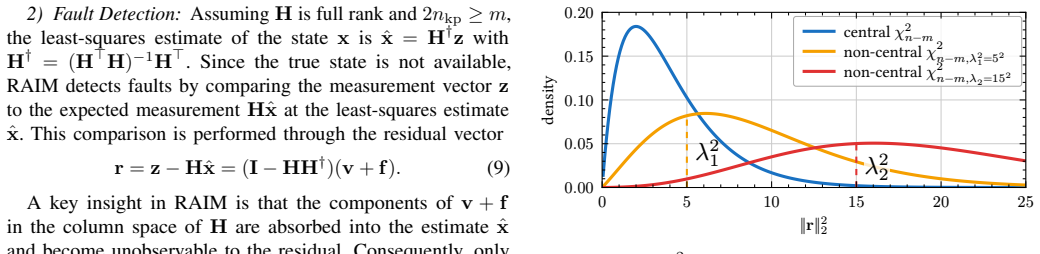
The load-bearing object is the residual-based RAIM protection-level construction translated into canonical vision form. The projection function is linearized around the pose estimate to obtain a whitened observation matrix $H$; faults are restricted to keypoint subsets $S$ through a selector matrix $A_S$; and the failure-mode slope $\bar{g}_{S,j}$ maps a unit detectable residual into the largest possible pose error along axis $j$, computed from the closed form $e_j^\top H^\dagger A_S(A_S^\top (I-HH^\dagger)A_S)^{-1}A_S^\top H^{\dagger\top} e_j$. The detection threshold is set from a continuity budget, and $\bar{\lambda}$ is the non-centrality at which the non-central chi-square residual passes the threshold with the allocated missed-detection probability. The final protection level is the worst-case slope times $\bar{\lambda}$, plus a Gaussian no-fault margin from the propagated pose covariance.
What would settle it
Monte Carlo test: generate many faulted keypoint realizations under a monitored hypothesis $S$, with fault magnitudes at and beyond the missed-detection boundary and directions near the worst-case slope; run the true nonlinear PnP solver and the residual detector. If the empirical frequency of (pose error on axis $j$ exceeding $\mathrm{PL}_j$ while the residual stays below the threshold) exceeds the integrity budget $I_{\mathrm{REQ}}$, or if the linearization remainder alone produces such violations, the central claim fails.
Extended reading notes
Core claim
The paper claims that for each pose axis $j$, the quantity $\mathrm{PL}_j = \max_{S \in \mathcal{S}_{\mathrm{mon}}} \bar{g}_{S,j} \bar{\lambda} + k_{H_0} \sigma_{\beta_j}$ is a conservative per-axis bound that satisfies the integrity-risk equation (23): the probability that the pose error on axis $j$ exceeds $\mathrm{PL}_j$ while the residual detector passes, summed over all monitored fault hypotheses and the no-fault hypothesis, is at most the allocated integrity risk $I_{\mathrm{REQ}}$. The term $\bar{g}_{S,j}$ is the worst-case failure-mode slope of fault set $S$, $\bar{\lambda}$ is the detection-boundary non-centrality scale of the residual chi-square test, and $k_{H_0}\sigma_{\beta_j}$ covers the nominal Gaussian pose noise. The argument carries over for both 3-DOF position estimation and full 6-DOF pose estimation, including orientation axes, and the same construction yields bounds in meters and degrees.
Load-bearing premise
The load-bearing premise is that the first-order Taylor expansion of the projection function around the estimated pose is accurate enough that the fault slopes, residual distribution, and non-centrality parameter computed from the linearized model also describe the true nonlinear pose error; the paper states the bound holds only up to this linearization approximation and does not quantify when it fails.
Editorial extensions
If this is right
- A runtime protection level can be compared directly with an alert limit: whenever $\mathrm{PL}_j$ exceeds the limit, the vision system is marked unavailable and backup navigation is used.
- Protection levels scale linearly with the standard deviation of keypoint pixel noise, so improving keypoint prediction uncertainty directly tightens the integrity bound.
- Adding keypoints improves protection levels: the nominal-noise term decays as $n_{kp}^{-1/2}$ and the fault term as $n_{kp}^{-3/4}$, so measurement redundancy is the main lever at moderate keypoint counts.
- With only the four runway corners in 6-DOF estimation, only single-keypoint faults can be monitored; multi-keypoint fault monitoring requires additional keypoints such as threshold markers or line-angle measurements.
- Full 6-DOF pose estimation can have protection levels an order of magnitude larger than position-only estimation, because weak roll and yaw observability makes orientation faults harder to detect.
Reading between the lines
- A testable extension is to augment the same algorithm with a runtime curvature or residual-consistency check: rejecting poses where the linearization error is large would make the protection level operational rather than approximate.
- The equal split of integrity risk between nominal and fault cases, and the assumed per-keypoint fault prior $P_{kp}$, are placeholders until fault statistics are calibrated from a deployed detector; the reported protection-level values will only become certification-ready after such calibration on real runway imagery.
- Because the protection level is computed from the observation matrix, the noise covariance, and the risk budgets, it could also serve as an integrity input to a multisensor navigation filter that fuses vision with GNSS or inertial data, rather than only as a go/no-go check.
Signed reviews
Editorial analysis
A structured set of objections, weighed in public.
Referee Report
Summary. The paper adapts residual-based RAIM integrity monitoring to vision-based pose estimation (VBPE). It models keypoint predictions as noisy measurements with a fault vector restricted to subsets of keypoints, linearizes the projection function around the pose estimate, whitens the model, and derives per-axis protection levels PL_j = max_S \bar{g}_{S,j} \bar{\lambda} + k_{H0} \sigma_{\beta_j}. The authors claim this PL is a conservative bound satisfying the integrity risk equation Eq. (23) for the true pose error, covering the full 6-DOF pose or 3-DOF position. They further derive asymptotic scaling laws: PL scales linearly with keypoint noise, the nominal term decays as n^{-1/2}_{kp}, and the fault term decays as n^{-3/4}_{kp}. The paper validates the algorithm on a synthetic runway approach, showing along-track PLs dominate, redundancy reduces PLs, and position-only estimation gives roughly an order-of-magnitude tighter bounds.
Significance. If the central guarantee holds, this is a useful and timely contribution: it transfers the integrity-risk accounting of RAIM to learned-keypoint PnP pipelines, covers all six degrees of freedom, and provides a concrete runtime bound that can be compared with an alert limit. The paper's strengths are the clear specification of the algorithm, the use of established RAIM results from the GNSS literature, and the absence of any data fitting in the PL construction itself; the asymptotic predictions are falsifiable and are checked against simulation. However, the central claim is presently established only for a linearized local model, and the manuscript acknowledges this only in passing. The fault-prior and risk-allocation choices also make the guarantee conditional on assumptions that are not validated. These issues are load-bearing for the paper's advertised contribution and need to be addressed before the claim can be accepted as stated.
major comments (4)
- [Section IV-B, Eq. (15) and Eq. (23)] The derivation establishes Eq. (23) only for the linearized model, not for the true nonlinear pose error that appears in Eq. (23). After Eq. (22) the manuscript states that the PL bounds the 'local axial estimation error' 'up to the linearization approximation,' but no bound is given for the dropped higher-order terms in proj(\beta^*) - proj(\hat{\beta}) - H_{raw}\Delta\beta. In particular, the detector residual r is the actual nonlinear reprojection residual, while Eqs. (10)-(11), the threshold (29), the non-centrality scale (31), and the failure-mode slope (26) are exact only when the residual equals (I - HH^\dagger)z from the linear model. Since the computed along-track PLs reach hundreds of meters at 2 km (Fig. 4a), the linearization validity set is plausibly much smaller than the PL, so the claimed HMI bound for the true estimator is not established. Please either prove a two-sided bound on the remainder in terms of the problem data, or restrict the claim to the linearized/local model and support that local regime empirically, for example by Monte Carlo verification that the event in Eq. (23) has probability no larger than IREQ under the actual nonlinear estimator.
- [Section V, Eqs. (36)-(38)] The three asymptotic scaling laws are presented as results but are argued heuristically rather than derived. For example, the claim that the double-normalized \bar{g}^2_{S,j} scales as the inverse of HH^\dagger, and the inference \bar{\lambda} \propto n^{1/4}_{kp} from the means of central and non-central chi-square distributions, do not by themselves determine the quantile-based non-centrality defined by Eq. (31), which depends on the CDF inversion, the risk allocation in Eq. (30), and the threshold in Eq. (29). The n^{-1/2}_{kp} reference line in Fig. 5 is anchored empirically and is not a fitted derivation. If these laws are part of the paper's contribution, supply derivations or precise conditions under which they hold; otherwise state them as empirical observations rather than analytical facts.
- [Section IV-C, Eqs. (24)-(25) and Algorithm 1] The integrity claim is conditional on the assumed per-keypoint fault prior Pkp and on the equal risk split I_H0 = I_HS = IREQ/2. The paper explicitly leaves empirical calibration of keypoint fault probabilities and uncertainty calibration to future work, and Section VII repeats that use requires bounding the detector's fault rate and validating calibration. Because Eq. (23) is a probability inequality, the PL bounds HMI probability only if Pkp and the covariance model describe the actual detector. The abstract and conclusion should state this condition prominently, and the experiments should show sensitivity of the computed PLs to Pkp and to covariance miscalibration.
- [Section IV-C4, Eq. (35)] The PL is computed per axis, and Eq. (23) is applied separately for each component j, each time with the full integrity budget IREQ. If multiple PL_j are to be compared simultaneously with a set of alert limits, the per-axis risk allocation should be specified; otherwise the probability that at least one axis jointly exceeds its alert limit is not bounded by IREQ. Clarify whether IREQ is a per-axis or a system-level budget, and if the latter, how the risk is divided among the six axes.
minor comments (4)
- [Section IV-C1, Eq. (24)] The displayed equation for the hypothesis-level risk allocation has ambiguous notation: 'IHS = P(HS)P S′∈S P(HS′) IHS' appears to be missing a division and overloads the symbol IHS for both the total fault budget and the per-hypothesis budget. Please rewrite with distinct symbols, e.g., I_{H_S} and I_{HS}.
- [Algorithm 1, line 1] The threshold formula uses 1 - CREQ/P(H0); this is only valid when CREQ < P(H0), and no guard is given for cases where the continuity budget exceeds the null-hypothesis probability. Add a check or clamping step.
- [Figure 4] The orientation panel (Fig. 4b) plots roll, pitch, and yaw PLs, but the legend only appears in the caption; please add in-figure labels to distinguish the three curves clearly.
- [Section III-A2, Eq. (3)] The notation \|\cdot\|^2_{\Sigma_k^{-1}} in Eq. (5) is used without definition; a brief definition of the Mahalanobis norm would improve readability.
Circularity Check
No circularity: the protection-level derivation is an adaptation of external RAIM theory to the PnP model; self-citations are contextual and not load-bearing.
full rationale
The derivation chain is not circular. The protection-level construction in Section IV-C is a direct adaptation of residual-based RAIM formulas from the external reference [1]: the worst-case fault direction and slope in Eqs. (27)-(28), the missed-detection non-centrality in Eq. (31), and the final bound in Eq. (35) are taken from the RAIM literature and applied to the whitened linearized PnP observation model of Eq. (22). The algorithm inputs are the linearized observation matrix, the measurement covariance, and user-specified risk budgets; no parameter is fitted to the paper's own output and then renamed as a prediction. The self-citations to [3] and [27] supply pipeline details and uncertainty calibration, but the protection-level result does not reduce to those papers' conclusions by construction. The explicit linearization caveat in Section IV-B is a scope and validity limitation, not a circular step, and the scaling claims in Section V are analytical consequences of the PL formula illustrated in simulation rather than independent external validations. Therefore no circular step is identified.
Assumptions & free parameters
free parameters (3)
- Pkp (per-keypoint failure prior) =
1e-4 (used in experiments)
- Equal risk split IH0 = IHS = IREQ/2 =
0.5/0.5 of IREQ
- smax (maximum monitored simultaneous faults) =
1 (nkp=4), 2 (nkp>=5)
assumptions (8)
- domain assumption The keypoint measurement noise is zero-mean Gaussian with known per-keypoint covariance.
- domain assumption The projection function can be accurately linearized around the pose estimate.
- domain assumption Faults are additive measurement errors of the form f = A_S delta_S.
- domain assumption Keypoint faults occur independently with common probability Pkp.
- standard math The residual vector is exactly Gaussian and chi-squared distributed under the linearized model.
- domain assumption Unmonitored fault hypotheses contribute negligible risk PNM and can be dropped.
- domain assumption The worst-case failure-mode slope and the PL combination from [1] apply to the VBPE setting.
- standard math The detection threshold is set from the continuity risk via the central chi-squared quantile.
Cite this review
Pith. "Pith review of Protection Levels for Vision-Based Pose Estimation." pith.science (2026). https://pith.science/paper/GBWH4Q7A
@misc{pith2026260810023,
  author       = {Pith},
  title        = {Pith review of: Protection Levels for Vision-Based Pose Estimation},
  year         = {2026},
  howpublished = {\url{https://pith.science/paper/GBWH4Q7A}},
  note         = {Machine review of arXiv:2608.10023}
}
abstract
Vision-based navigation complements Global Navigation Satellite Systems, but certification demands integrity guarantees that account for faulty measurements. Previous work presented a probabilistic computer vision pipeline for runway-based pose estimation with fault detection inspired by Receiver Autonomous Integrity Monitoring. This work extends that framework by deriving protection levels, which provide probabilistic bounds on pose error that remain valid under undetected faults. We present an algorithm for computing protection levels for the nonlinear Perspective-$n$-Point problem applied to an aviation setting. The algorithm covers all six degrees of freedom of the aircraft pose (position and orientation) directly. We analyze the effect of measurement redundancy, pixel-level prediction uncertainty, and runway distance on the resulting protection levels. To make the results tangible, we demonstrate tradeoffs in the protection levels on an illustrative runway example.
Figures


Figures from the paper (2 more)


Reference graph
Works this paper leans on
-
[1]
Solution separation versus residual-based RAIM,
M. Joerger, F.-C. Chan, and B. Pervan, “Solution separation versus residual-based RAIM,” NA VIGATION: Journal of the Institute of Navi- gation, vol. 61, no. 4, pp. 273–291, 2014
work page 2014
-
[2]
Minimum aviation system performance standards for local area augmentation system (LAAS),
RTCA Special Committee 159, “Minimum aviation system performance standards for local area augmentation system (LAAS),” RTCA, Inc., Washington, DC, Tech. Rep. DO-245A, 2004
work page 2004
-
[3]
Predictive uncertainty for runtime assurance of a real- time computer vision-based landing system,
R. Valentin, S. M. Katz, A. B. Carneiro, D. Walker, and M. J. Kochenderfer, “Predictive uncertainty for runtime assurance of a real- time computer vision-based landing system,” in Digital Avionics Systems Conference (DASC), 2025, pp. 1–8
work page 2025
-
[4]
EPnP: An accurate O(n) solution to the PnP problem,
V . Lepetit, F. Moreno-Noguer, and P. Fua, “EPnP: An accurate O(n) solution to the PnP problem,” International Journal of Computer Vision , vol. 81, no. 2, pp. 155–166, 2009
work page 2009
-
[5]
Random sample consensus: a paradigm for model fitting with applications to image analysis and automated cartography,
M. A. Fischler and R. C. Bolles, “Random sample consensus: a paradigm for model fitting with applications to image analysis and automated cartography,” Communications of the ACM , vol. 24, no. 6, pp. 381–395, 1981
1981
-
[6]
Leveraging feature uncertainty in the PnP problem,
L. Ferraz Colomina, X. Binefa, and F. Moreno-Noguer, “Leveraging feature uncertainty in the PnP problem,” in British Machine Vision Conference (BMVC), 2014, pp. 1–13
work page 2014
-
[7]
Uncertainty- aware camera pose estimation from points and lines,
A. Vakhitov, L. Ferraz, A. Agudo, and F. Moreno-Noguer, “Uncertainty- aware camera pose estimation from points and lines,” in IEEE Computer Society Conference on Computer Vision and Pattern Recognition (CVPR) , 2021, pp. 4659–4668
work page 2021
-
[8]
H. Yang and M. Pavone, “Object pose estimation with statistical guarantees: Conformal keypoint detection and geometric uncertainty propagation,” in IEEE Computer Society Conference on Computer Vision and Pattern Recognition (CVPR) , 2023, pp. 8947–8958
work page 2023
Show all 28 references
-
[9]
Certifying robustness of learning-based keypoint detection and pose estimation methods,
X. Luo, T. Wei, S. Liu, Z. Wang, L. Mattei-Mendez, T. Loper, J. Neighbor, C. Hutchison, and C. Liu, “Certifying robustness of learning-based keypoint detection and pose estimation methods,” ACM Transactions on Cyber-Physical Systems , vol. 9, no. 2, pp. 1–26, 2025
2025
-
[10]
Certified vision-based state estimation for autonomous landing systems using reachability analysis,
U. Santa Cruz and Y . Shoukry, “Certified vision-based state estimation for autonomous landing systems using reachability analysis,” in IEEE Conference on Decision and Control (CDC) , 2023, pp. 6052–6057
2023
-
[11]
Autonomous GPS integrity monitoring using the pseudorange residual,
B. W. Parkinson and P. Axelrad, “Autonomous GPS integrity monitoring using the pseudorange residual,” NA VIGATION: Journal of the Institute of Navigation , vol. 35, no. 2, pp. 255–274, 1988
1988
-
[12]
Self-contained GPS integrity check using maximum solution separation,
R. G. Brown and P. W. McBurney, “Self-contained GPS integrity check using maximum solution separation,” NA VIGATION: Journal of the Institute of Navigation , vol. 35, no. 1, pp. 41–53, 1988
1988
-
[13]
Navigation system integrity monitoring using redundant measurements,
M. A. Sturza, “Navigation system integrity monitoring using redundant measurements,” NA VIGATION: Journal of the Institute of Navigation , vol. 35, no. 4, pp. 483–501, 1988
1988
-
[14]
A baseline GPS RAIM scheme and a note on the equivalence of three RAIM methods,
R. G. Brown, “A baseline GPS RAIM scheme and a note on the equivalence of three RAIM methods,” NA VIGATION: Journal of the Institute of Navigation , vol. 39, no. 3, pp. 301–316, 1992
1992
-
[15]
Integrated GPS/inertial fault detection availability,
M. Brenner, “Integrated GPS/inertial fault detection availability,” NA V- IGATION: Journal of the Institute of Navigation , vol. 43, no. 2, pp. 111–130, 1996
1996
-
[16]
A multiple hypothesis approach to satellite navigation integrity,
B. S. Pervan, S. P. Pullen, and J. R. Christie, “A multiple hypothesis approach to satellite navigation integrity,” NA VIGATION: Journal of the Institute of Navigation , vol. 45, no. 1, pp. 61–71, 1998
1998
-
[17]
Fault detection and exclusion using solution separation and chi-squared ARAIM,
M. Joerger and B. Pervan, “Fault detection and exclusion using solution separation and chi-squared ARAIM,” IEEE Transactions on Aerospace and Electronic Systems , vol. 52, no. 2, pp. 726–742, 2016
2016
-
[18]
Baseline advanced RAIM user algorithm and possible improvements,
J. Blanch, T. Walter, P. Enge, Y . Lee, B. Pervan, M. Rippl, A. Spletter, and V . Kropp, “Baseline advanced RAIM user algorithm and possible improvements,” IEEE Transactions on Aerospace and Electronic Systems , vol. 51, no. 1, pp. 713–732, 2015
2015
-
[19]
Protection levels after fault exclu- sion for advanced RAIM,
J. Blanch, T. Walter, and P. Enge, “Protection levels after fault exclu- sion for advanced RAIM,” NA VIGATION: Journal of the Institute of Navigation, vol. 64, no. 4, pp. 505–513, 2017
2017
-
[20]
Integrity of laser- based feature extraction and data association,
M. Joerger, M. Jamoom, M. Spenko, and B. Pervan, “Integrity of laser- based feature extraction and data association,” in IEEE/ION Position, Location and Navigation Symposium (PLANS) , 2016, pp. 557–571
2016
-
[21]
Integrity monitoring for all-source navigation enhanced by Kalman filter-based solution separation,
Q. Meng and L.-T. Hsu, “Integrity monitoring for all-source navigation enhanced by Kalman filter-based solution separation,” IEEE Sensors Journal, vol. 21, no. 14, pp. 15 469–15 484, 2020
2020
-
[22]
Sequential integrity monitoring for Kalman filter innovations-based detectors,
C. Tanil, S. Khanafseh, M. Joerger, and B. Pervan, “Sequential integrity monitoring for Kalman filter innovations-based detectors,” in Interna- tional Technical Meeting of the Satellite Division of the Institute of Navigation (ION GNSS+) , 2018, pp. 2440–2455
2018
-
[23]
Data-driven protection levels for camera and 3D map-based safe urban localization,
S. Gupta and G. Gao, “Data-driven protection levels for camera and 3D map-based safe urban localization,” NA VIGATION: Journal of the Institute of Navigation , vol. 68, no. 3, pp. 643–660, 2021
2021
-
[24]
Integrity monitoring of Graph-SLAM using GPS and fish-eye camera,
S. Bhamidipati and G. X. Gao, “Integrity monitoring of Graph-SLAM using GPS and fish-eye camera,” NA VIGATION: Journal of the Institute of Navigation , vol. 67, no. 3, pp. 583–600, 2020
2020
-
[25]
Vision-aided RAIM: A new method for GPS integrity monitoring in approach and landing phase,
L. Fu, J. Zhang, R. Li, X. Cao, and J. Wang, “Vision-aided RAIM: A new method for GPS integrity monitoring in approach and landing phase,” Sensors, vol. 15, no. 9, pp. 22 854–22 873, 2015
2015
-
[26]
Integrity of visual naviga- tion—developments, challenges, and prospects,
C. Zhu, M. Meurer, and C. Günther, “Integrity of visual naviga- tion—developments, challenges, and prospects,” NA VIGATION: Journal of the Institute of Navigation , vol. 69, no. 2, 2022
2022
-
[27]
Probabilistic parameter estimators and calibration metrics for pose estimation from image features,
R. Valentin, S. M. Katz, J. Lee, D. Walker, M. Sorgenfrei, and M. J. Kochenderfer, “Probabilistic parameter estimators and calibration metrics for pose estimation from image features,” in Digital Avionics Systems Conference (DASC). IEEE, 2024, pp. 01–09
2024
-
[28]
LARD–Landing Approach Runway Detection–Dataset for vision-based landing,
M. Ducoffe, M. Carrere, L. Féliers, A. Gauffriau, V . Mussot, C. Pagetti, and T. Sammour, “LARD–Landing Approach Runway Detection–Dataset for vision-based landing,” arXiv preprint arXiv:2304.09938 , 2023
2023 arXiv
Reviewed August 14, 2026 · model on record in the stance chip above.
Discussion (0). Continue with ORCID to comment.