REVIEW 3 major objections 5 minor 48 references
From Prediction to Incrementality: Causal Optimization for Large-Scale Targeting and Recommendation
T0 review · 3 major / 5 minor · reviewed 2026-08-14 · deepseek-v4-flash
Pith's one-line read A production targeting system that optimizes causal incremental effects under budget constraints improved its primary KPI by 7.20% in a live A/B test, supporting the claim that prediction-based ranking misallocates marketing resources.
desk verdict A genuinely integrated production causal-optimization system with a real A/B test, but the training-data treatment definition in §5.1 undermines the causal reading of the +7.20% lift. read the letter →
The pith
A machine-rendered reading of the paper's core claim, the machinery that carries it, and where it could break.
The reading
What carries the argument
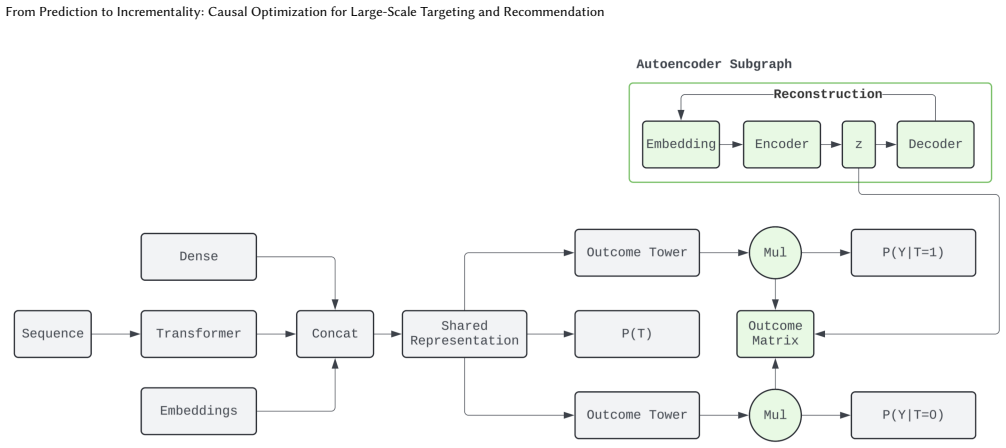
The central object is the DragonBandit policy, which couples three components under one objective: a DragonNet (a neural architecture that jointly estimates treatment and outcome heads from a shared representation, extended here with a Transformer over marketing-touchpoint sequences and product-outcome embeddings) supplies individual incremental scores; a last-layer linearized Laplace approximation turns the trained checkpoint into a Thompson-sampling bandit that draws posterior samples of those scores; and a smoothed dual-decomposition linear program allocates the sampled scores under budget, capacity, and per-user frequency-cap constraints, projecting each user onto the frequency-cap polytope at $O(|I| \log |I|)$ cost per iteration. The mechanism is the coupling itself: causal scoring defines what is optimized, exploration shapes the data the causal model learns from, and the LP makes the allocation feasible at global scale.
What would settle it
In the offline training data, replace the true treatment indicator with a random coin flip while keeping the context and outcome windows. A correctly identified causal model should estimate near-zero incremental effects on this fake treatment; if meaningful nonzero lift appears, the training contrast is capturing non-causal correlation, and the online +7.20% could stem from delivery or selection artifacts rather than true increments.
Extended reading notes
Core claim
The paper's central claim is that the standard predict-then-rank paradigm for targeting and recommendation systematically wastes resources when the business goal is incrementality, because it rewards users who would have converted anyway. To fix this, it proposes optimizing the conditional average treatment effect subject to global business constraints, and instantiates that objective as DragonBandit: a DragonNet-style causal head with a Transformer encoder for touchpoint sequences, Laplace-approximation Thompson sampling over incremental logits, and a dual-decomposition linear program for allocation. A distinctive behavior of the resulting policy is that it can withhold a send when the predicted incremental value is negative. The paper claims this mechanism is what delivered the statistically significant +7.20% lift in the primary long-term-value metric over the deployed propensity-based system.
Load-bearing premise
The load-bearing premise is that all factors that influence both whether a user gets treated and whether they convert are captured in the pre-treatment context, and that every user type has some chance of receiving treatment; if unobserved confounders remain, the incremental scores are biased and the online lift could be a delivery or targeting artifact rather than a genuine causal improvement.
Editorial extensions
If this is right
- Under the paper's claims, a campaign manager should expect higher net return from allocating to predicted incremental lift under budget constraints than from ranking by predicted engagement.
- Under the multi-turn results, a policy that explores over incremental scores will initially trail its greedy counterpart but surpass it after roughly 50 model updates, especially when the training log is biased.
- Under the paper's production lesson, an A/B test on a causal policy should match the treatment arm's delivery and cost envelopes to the business-as-usual arm, otherwise under-delivery masks policy quality.
- Under the online result, a causal, constraint-aware decision layer can replace propensity-based retrieval and ranking tiers at scale without sacrificing feasibility.
Reading between the lines
- An extension the paper leaves implicit is that in markets with high organic conversion, the gap between causal and predictive targeting should widen, because the causal policy's main advantage is withholding from users who would act anyway; this is testable in a segmented online experiment.
- The online +7.20% is an end-to-end measurement; the paper's ablations are the only decomposition of the contribution from causal scoring, exploration, and the LP, so attributing the lift to any single component would require field experiments that disable components one at a time.
- The outcome-embedding layer suggests a route to zero-shot scoring of newly launched products, but the evidence is one held-out product in a synthetically sampled embedding space, so that capability is a hypothesis rather than an established result.
- Because the formulation optimizes any limited intervention under global constraints, the same architecture should transfer to notifications, coupons, and other capacity-limited actions; the paper's marketing deployment is one instance of a more general pattern.
Signed reviews
Editorial analysis
A structured set of objections, weighed in public.
Referee Report
Summary. The paper proposes a decision-centric framework for large-scale targeting and recommendation that replaces predictive scoring with causal effect estimation under global constraints. The framework combines a Transformer-augmented DragonNet causal head for CATE estimation, a Bayesian neural-bandit layer with Laplace-approximation Thompson sampling, and a dual-decomposition solver for constrained linear-programming allocation. The authors report offline simulations on the Open Bandit Dataset, architectural ablations, and an eight-week online A/B test on LinkedIn Feed marketing traffic in which the end-to-end policy achieved a statistically significant +7.20% lift (p=0.041) in a stated-but-undefined primary long-term-value metric. The paper also distills production lessons on causal training-data construction, cost/delivery control, and agentic experiment setup.
Significance. If the central claims hold, the paper makes a useful contribution: it demonstrates that a production-scale system can jointly optimize causal increments and business constraints, and it backs the claim with an external randomized A/B test rather than only offline evaluation. The architectural extensions (Transformer encoder, outcome embeddings, EIF-regularized loss) are plausible and the paper is transparent about several limitations, including the non-exhaustive ablations (Appendix A.1) and the limited zero-shot diagnostic (Appendix A.4). The online experiment is a genuine strength because it evaluates the policy as deployed, and the discussion of under-delivery in Section 5.2 shows an honest attempt to separate policy quality from delivery volume. However, the load-bearing claims are weakened by a treatment-construction mismatch in Section 5.1, an undefined primary metric, and an undescribed synthetic treatment in the offline simulation; these issues must be addressed before the paper can be accepted.
major comments (3)
- [Section 5.1 vs. Section 2.3] Treatment is defined in Section 5.1 as 'at least one qualifying email send, on-platform impression, or video view occurs in [D, D+7)', whereas Section 2.3 optimizes over assignments x_{u,i,t} with objective τ^y_{u,i,t}=f^y_t(u,i,1)-f^y_t(u,i,0), the effect of allocating item i to user u. These are different interventions: the learned CATE is for 'any exposure within a week', a class that includes user-initiated video views and email opens, while the deployed decision is a system-chosen send/impression allocation. Randomizing the anchor date D does not randomize T; it only shifts the observation window. Unconfoundedness (Eq. (1)) is therefore doubtful in the production training distribution, and the CATE scores passed to the LP may be biased toward members with high organic engagement. The online A/B test is a valid comparison of two policies, but it does not by itself establish that the policy is optimizing true incrementality, because a biased CATE changes which members the policy selects. Please either redefine treatment as the system's allocation decision (excluding user-initiated events), or provide a target-trial argument with balance/overlap diagnostics showing that the 'any exposure' contrast identifies the quantity required for the allocation decision.
- [Section 5.5] The headline result '+7.20% lift (p=0.041, 95% CI: [0.31%, 14.09%])' is reported in 'the primary long-term-value metric', but the manuscript never defines this metric, does not state the pre-specified analysis plan, does not report how many outcomes were examined, and does not mention any multiple-comparison correction. Given the borderline p-value of 0.041, the central claim cannot be fully assessed without a precise definition of the metric, the timing and definition of the outcome window, and the multiple-testing context. Please provide this information and, if applicable, a pre-registration or analysis-plan reference.
- [Section 4.1 and Table 2] The OBD simulation maps 34 products to 5 actions and 'constructed a treatment variable that indicates whether a member was exposed to a marketing campaign', but the generative process for this synthetic treatment is not described. The multi-turn simulation refers to 'ground-truth uplifts' and injected bias, yet no formal definition of these quantities is given, so the offline results cannot be independently interpreted or reproduced. In addition, Table 2 reports net returns with ± intervals but does not state the number of simulation replications or whether these are standard deviations, standard errors, or confidence intervals. Please specify the treatment-assignment mechanism, the reward construction including how price is coupled with the logged reward, the number of runs, and the interval construction.
minor comments (5)
- [Section 4.4 / Appendix A.1] The ablation study uses five repeated runs per configuration and reports AUROC/AUUC differences without significance tests or multiple-comparison control; please state whether the observed differences are within the reported 95% confidence intervals.
- [Section 3.2, Eq. (8)] The targeted-regularization loss L_tarreg uses the outcome label Y in a squared error against Ŷ + εψ, but the derivation of this form and its relationship to the standard EIF one-step correction are not fully explained; please clarify how Ŷ is chosen per sample and how the scalar ε is learned.
- [Section 3.3.1 and Eq. (9)] The symbols E_O and E_input_O are used both for the embedding matrix and for its rows; please disambiguate the notation so that the reconstruction loss and the outcome matrix layer are unambiguous.
- [Section 2.3.1] The ridge-regularization criterion γ x̂^T x̂ / (2|c^T x̂|) < 10^-3 depends on the unknown optimal solution x̂; please describe the practical procedure used to choose γ, for instance whether a proxy solution or a one-step estimate is used.
- [Section 5.2, Eq. (14)] The controller update for C_cost,t+1 references C_cost,t but the initial value and the tolerance band around the target are not specified; please state the initialization and how the two-sided LP constraint is derived from the target.
Circularity Check
No material circularity: the headline lift is an independent online A/B measurement, and the self-citations are not load-bearing.
full rationale
The paper's derivation chain is self-contained with respect to its central claim. The CATE definition in Eq. (1) is the standard potential-outcomes identity under unconfoundedness and overlap, and Eq. (3) optimizes sampled incremental scores under explicit constraints; no equation equates a fitted parameter with the reported result. The headline +7.20% lift (Section 5.5) is an eight-week randomized A/B test against the deployed BAU stack, so it is an externally measured outcome rather than a quantity reconstructed from the model's own fitted inputs. Section 5.2's calibrated delivery and cost bounds are engineering controls that equalize delivery between arms, not components that by construction produce the measured LTV lift. The self-citations [27] and [43] appear as background or as labels for the bandit/optimization components, but the serving path described in Section 5.3 uses the paper's own last-layer Laplace Thompson sampling and cites the external ECLIPSE solver [2]; the offline study uses the external Open Bandit Dataset. No load-bearing step reduces to a self-citation or to a fitted input renamed as a prediction, so circularity is not present.
Assumptions & free parameters
free parameters (6)
- ridge perturbation gamma =
selected so that gamma * x_hat^T x_hat / (2 |c^T x_hat|) < 1e-3; exact value not reported
- log-inverse-temperatures nu_t, nu_nt =
initialized to log 14.0 following CLIP, then learned
- reconstruction loss weight lambda_recon =
not reported
- EIF regularizer scalar epsilon =
learnable, not reported
- controller gain kappa and smoothing alpha =
not reported
- simulation cost and volume bounds =
cost $0.1; min/max volumes in Table 1
assumptions (6)
- domain assumption Unconfoundedness: {Y(0),Y(1)} independent of T given X.
- domain assumption Overlap: 0 < e(X) < 1 for all X.
- ad hoc to paper The windowed training-data construction in Section 5.1 makes treatment as-if random given pre-treatment context.
- ad hoc to paper Synthetic treatment and reward in the Open Bandit Dataset simulation faithfully represent an incremental targeting problem.
- domain assumption The linearized Laplace approximation gives valid posterior samples over logits.
- domain assumption Delivery probability p_{u,i} is accurately estimated by the calibrated classifier and reflects future delivery behavior.
Cite this review
Pith. "Pith review of From Prediction to Incrementality: Causal Optimization for Large-Scale Targeting and Recommendation." pith.science (2026). https://pith.science/paper/NYSYJ4GH
@misc{pith2026260810182,
  author       = {Pith},
  title        = {Pith review of: From Prediction to Incrementality: Causal Optimization for Large-Scale Targeting and Recommendation},
  year         = {2026},
  howpublished = {\url{https://pith.science/paper/NYSYJ4GH}},
  note         = {Machine review of arXiv:2608.10182}
}
abstract
Large-scale targeting and recommendation systems are typically built around predictive scores fed into heuristic or local allocation. When the business goal is incremental impact, as in marketing campaigns, incentives, and notifications, this paradigm systematically misallocates resources toward users who would have acted anyway. We present a decision-centric framework that instead optimizes causal effects under global constraints, aligning three components under a single objective: a causal neural network with a Transformer backbone for individual treatment-effect estimation, a Bayesian neural-bandit layer for uncertainty-aware exploration, and a dual-based large-scale linear-programming layer for constrained allocation. The framework also supports sequential context and multi-outcome, attribute-conditioned scoring through a Transformer encoder and outcome embeddings. We evaluate it with offline simulations on a public bandit dataset, targeted architectural ablations, and an online A/B test on LinkedIn Feed marketing traffic. We also distill production lessons on causal training-data construction and cost and delivery control, which were critical to successful deployment. The end-to-end treatment policy delivered a statistically significant $+7.20\%$ lift in the primary long-term-value metric, demonstrating the feasibility of production-scale causal optimization under business constraints.
Figures


Figures from the paper (1 more)

Reference graph
Works this paper leans on
-
[1]
Deepak Agarwal, Shaunak Chatterjee, Yang Yang, and Liang Zhang. 2015. Con- strained optimization for homepage relevance. InProceedings of the 24th Interna- tional Conference on World Wide Web. 375–384
work page 2015
-
[2]
Kinjal Basu, Amol Ghoting, Rahul Mazumder, and Yao Pan. 2020. ECLIPSE: An Extreme-Scale Linear Program Solver for Web-Applications. arXiv:2007.15936 [math.OC] https://arxiv.org/abs/2007.15936
arXiv 2020
-
[3]
Brown, and Constantine Caramanis
Dimitris Bertsimas, David B. Brown, and Constantine Caramanis. 2011. The Theory of Robust Optimization.SIAM Rev.(2011)
work page 2011
-
[4]
Charles Blundell, Julien Cornebise, Koray Kavukcuoglu, and Daan Wierstra
-
[5]
Stephen Bonner and Flavian Vasile. 2018. Causal Embeddings for Recommenda- tion. InProceedings of the 12th ACM Conference on Recommender Systems
work page 2018
-
[6]
Huigang Chen, Totte Harinen, Jeong-Yoon Lee, Mike Yung, and Zhenyu Zhao. 2020. CausalML: Python Package for Causal Machine Learning. arXiv:2002.11631 [cs.CY]
arXiv 2020
-
[7]
Jiaju Chen, Wang Wenjie, Chongming Gao, Peng Wu, Jianxiong Wei, and Qing- song Hua. 2024. Treatment Effect Estimation for User Interest Exploration on Recommender Systems. InProceedings of the 47th International ACM SIGIR Conference on Research and Development in Information Retrieval. 1861–1871
work page 2024
-
[8]
Heng-Tze Cheng, Levent Koc, Jeremiah Harmsen, Tal Shaked, Tushar Chandra, Hrishi Aradhye, Glen Anderson, Greg Corrado, Wei Chai, Mustafa Ispir, Rohan Anil, Zakaria Haque, Lichan Hong, Vihan Jain, Xiaobing Liu, and Hemal Shah
Show all 48 references
-
[9]
Victor Chernozhukov, Denis Chetverikov, Mert Demirer, Esther Duflo, Christian Hansen, Whitney Newey, and James Robins. 2018. Double/debiased machine learning for treatment and structural parameters.The Econometrics Journal21, 1 (01 2018), C1–C68. doi:10.1111/ectj.12097
2018 doi
-
[10]
Paul Covington, Jay Adams, and Emre Sargin. 2016. Deep Neural Networks for YouTube Recommendations. InProceedings of the 10th ACM Conference on Recommender Systems (RecSys ’16). 191–198
2016
-
[11]
Alicia Curth and Mihaela van der Schaar. 2021. On Inductive Biases for Het- erogeneous Treatment Effect Estimation. arXiv:2106.03765 [stat.ML] https: //arxiv.org/abs/2106.03765
2021 arXiv
-
[12]
Erik Daxberger, Agustinus Kristiadi, Alexander Immer, Runa Eschenhagen, Matthias Bauer, and Philipp Hennig. 2021. Laplace redux-effortless bayesian deep learning.Advances in neural information processing systems34 (2021), 20089–20103
2021
-
[13]
Jacob Devlin, Ming-Wei Chang, Kenton Lee, and Kristina Toutanova. 2019. BERT: Pre-training of Deep Bidirectional Transformers for Language Understanding. arXiv:1810.04805 [cs.CL] https://arxiv.org/abs/1810.04805
2019 arXiv
-
[14]
Floris Devriendt, Tias Guns, and Wouter Verbeke. 2020. Learning to rank for uplift modeling.CoRRabs/2002.05897 (2020). arXiv:2002.05897 https://arxiv. org/abs/2002.05897 Changshuai Wei, John Bencina, Phuc Nguyen, Andre Assuncao Silva T Ribeiro, and Benjamin Zelditch
2020 arXiv
-
[15]
Andrew YK Foong, Yingzhen Li, José Miguel Hernández-Lobato, and Richard E Turner. 2019. ’In-Between’Uncertainty in Bayesian Neural Networks.arXiv preprint arXiv:1906.11537(2019)
2019 arXiv
-
[16]
Webb, and Mahsa Salehi
Navid Mohammadi Foumani, Chang Wei Tan, Geoffrey I. Webb, and Mahsa Salehi. 2023. Improving position encoding of transformers for multivariate time series classification.Data Mining and Knowledge Discovery38, 1 (Sept. 2023), 22–48. doi:10.1007/s10618-023-00948-2
2023 doi
-
[17]
Chen Gao, Yu Zheng, Wenjie Wang, Fuli Feng, Xiangnan He, and Yong Li. 2024. Causal inference in recommender systems: A survey and future directions.ACM Transactions on Information Systems42, 4 (2024), 1–32
2024
-
[18]
Pierre Gutierrez and Jean-Yves Gérardy. 2017. Causal Inference and Uplift Modelling: A Review of the Literature. InProceedings of The 3rd International Conference on Predictive Applications and APIs (Proceedings of Machine Learning Research, Vol. 67), Claire Hardgrove, Louis D...
2017
-
[19]
Maximilian Kasy and Anja Sautmann. 2021. Adaptive treatment assignment in experiments for policy choice.Econometrica89, 1 (2021), 113–132
2021
-
[20]
Durk P Kingma, Tim Salimans, and Max Welling. 2015. Variational dropout and the local reparameterization trick.Advances in neural information processing systems28 (2015)
2015
-
[21]
Künzel, Jasjeet S
Sören R. Künzel, Jasjeet S. Sekhon, Peter J. Bickel, and Bin Yu. 2019. Metalearners for estimating heterogeneous treatment effects using machine learning.Pro- ceedings of the National Academy of Sciences116, 10 (Feb. 2019), 4156–4165. doi:10.1073/pnas.1804597116
2019 doi
-
[22]
Lihong Li, Wei Chu, John Langford, and Robert E Schapire. 2010. A contextual- bandit approach to personalized news article recommendation. InProceedings of the 19th international conference on World wide web. 661–670
2010
-
[23]
Rahul Makhijani, Shreya Chakrabarti, Dale Struble, and Yi Liu. 2019. LORE: a large-scale offer recommendation engine with eligibility and capacity constraints. InProceedings of the 13th ACM Conference on Recommender Systems. 160–168
2019
-
[24]
James McInerney, Brian Brost, Praveen Chandar, Rishabh Mehrotra, and Ben- jamin Carterette. 2020. Counterfactual evaluation of slate recommendations with sequential reward interactions. InProceedings of the 26th ACM SIGKDD International Conference on Knowledge Discovery & Data...
2020
-
[25]
Chang Meng, Chenhao Zhai, Xueliang Wang, Shuchang Liu, Xiaoqiang Feng, Lantao Hu, Xiu Li, Han Li, and Kun Gai. 2025. Enhancing Online Video Rec- ommendation via a Coarse-to-fine Dynamic Uplift Modeling Framework. In Proceedings of the 19th ACM Conference on Recommender Systems. 82–92
2025
-
[26]
Brady Neal. 2020. Introduction to causal inference.Course lecture notes (draft) 132 (2020)
2020
-
[27]
Phuc Nguyen, Benjamin Zelditch, Joyce Chen, Rohit Patra, and Changshuai Wei
-
[28]
Geir K Nilsen, Antonella Z Munthe-Kaas, Hans J Skaug, and Morten Brun. 2022. Epistemic uncertainty quantification in deep learning classification by the Delta method.Neural networks145 (2022), 164–176
2022
-
[29]
Nicholas Radcliffe. 2007. Using control groups to target on predicted lift: Building and assessing uplift model.Direct Marketing Analytics Journal(2007), 14–21
2007
-
[30]
Swarnali Raha, Kshitij Khare, and Rohit K Patra. [n. d.]. Computationally Efficient Laplace Approximations for Neural Networks. InNeurIPS 2024 Workshop on Bayesian Decision-making and Uncertainty
2024
-
[31]
Carlos Riquelme, George Tucker, and Jasper Snoek. 2018. Deep bayesian bandits showdown. InInternational conference on learning representations, Vol. 9
2018
-
[32]
Yuta Saito, Shunsuke Aihara, Megumi Matsutani, and Yusuke Narita. 2020. Open bandit dataset and pipeline: Towards realistic and reproducible off-policy evalu- ation.arXiv preprint arXiv:2008.07146(2020)
2020 arXiv
-
[33]
Tobias Schnabel, Adith Swaminathan, Ashudeep Singh, Navin Chandak, and Thorsten Joachims. 2016. Recommendations as Treatments: Debiasing Learning and Evaluation. InProceedings of the 33rd International Conference on Machine Learning
2016
-
[34]
Johansson, and David Sontag
Uri Shalit, Fredrik D. Johansson, and David Sontag. 2017. Estimating Individual Treatment Effect: Generalization Bounds and Algorithms. InProceedings of the 34th International Conference on Machine Learning
2017
-
[35]
Claudia Shi, David Blei, and Victor Veitch. 2019. Adapting Neural Networks for the Estimation of Treatment Effects. InAdvances in Neural Information Processing Systems
2019
-
[36]
Yi Su, Xiangyu Wang, Elaine Ya Le, Liang Liu, Yuening Li, Haokai Lu, Benjamin Lipshitz, Sriraj Badam, Lukasz Heldt, Shuchao Bi, et al. 2024. Long-term value of exploration: measurements, findings and algorithms. InProceedings of the 17th ACM International Conference on Web Sea...
2024
-
[37]
Zexu Sun, Hao Yang, Dugang Liu, Yunpeng Weng, Xing Tang, and Xiuqiang He. 2024. End-to-end cost-effective incentive recommendation under budget constraint with uplift modeling. InProceedings of the 18th ACM Conference on Recommender Systems. 560–569
2024
-
[38]
Adith Swaminathan and Thorsten Joachims. 2015. Batch learning from logged bandit feedback through counterfactual risk minimization.The Journal of Ma- chine Learning Research16, 1 (2015), 1731–1755
2015
-
[39]
Adith Swaminathan and Thorsten Joachims. 2017. Off-Policy Evaluation for Slate Recommendation. InAdvances in Neural Information Processing Systems
2017
-
[40]
van der Laan and Daniel Rubin
Mark J. van der Laan and Daniel Rubin. 2006. Targeted Maximum Likelihood Learning.The International Journal of Biostatistics2, 1 (2006). doi:10.2202/1557- 4679.1043
2006
-
[41]
Gomez, Lukasz Kaiser, and Illia Polosukhin
Ashish Vaswani, Noam Shazeer, Niki Parmar, Jakob Uszkoreit, Llion Jones, Aidan N. Gomez, Lukasz Kaiser, and Illia Polosukhin. 2017. Attention is all you need.Advances in Neural Information Processing Systems(2017)
2017
-
[42]
Yixin Wang, Dawen Liang, Laurent Charlin, and David M Blei. 2018. The decon- founded recommender: A causal inference approach to recommendation.arXiv preprint arXiv:1808.06581
2018 arXiv
-
[43]
Changshuai Wei, Benjamin Zelditch, Joyce Chen, Andre Assuncao Silva T Ribeiro, Jingyi Kenneth Tay, Borja Ocejo Elizondo, Sathiya Keerthi Selvaraj, Aman Gupta, and Licurgo Benemann De Almeida. 2024. Neural optimization with adaptive heuristics for intelligent marketing system. ...
2024
-
[44]
Hamilton, and Jure Leskovec
Rex Ying, Ruining He, Kaifeng Chen, Pong Eksombatchai, William L. Hamilton, and Jure Leskovec. 2018. Graph Convolutional Neural Networks for Web-Scale Recommender Systems. InProceedings of the 24th ACM SIGKDD International Conference on Knowledge Discovery & Data Mining (KDD ’...
2018
-
[45]
Weitong Zhang, Dongruo Zhou, Lihong Li, and Quanquan Gu. 2020. Neural thompson sampling.arXiv preprint arXiv:2010.00827(2020)
2020 arXiv
-
[2015]
arXiv:1505.05424 [stat.ML] https://arxiv.org/abs/1505.05424
Weight Uncertainty in Neural Networks. arXiv:1505.05424 [stat.ML] https://arxiv.org/abs/1505.05424
-
[2016]
InProceedings of the 1st Workshop on Deep Learning for Recommender Systems (DLRS 2016)
Wide & Deep Learning for Recommender Systems. InProceedings of the 1st Workshop on Deep Learning for Recommender Systems (DLRS 2016). 7–10
2016
-
[2026]
BanditLP: Large-Scale Stochastic Optimization for Personalized Recom- mendations.arXiv preprint arXiv:2601.15552(2026)
2026
Reviewed August 14, 2026 · model on record in the stance chip above.
Discussion (0). Continue with ORCID to comment.