REVIEW 4 major objections 5 minor 33 references
Flow Straight to Reality: Perceptually Consistent Flow Matching for Efficient Image Restoration
T0 review · 4 major / 5 minor · reviewed 2026-08-15 · deepseek-v4-flash
Pith's one-line read The paper argues that a single latent flow-matching transport trained with a perceptual consistency loss can match or beat two-stage diffusion restoration pipelines in a few steps with far fewer parameters.
desk verdict A solid incremental flow-matching method with a questionable frontier claim: the FID gains over ELIR likely hold, but without a Pareto sweep you can't tell if it advances the distortion-perception curve or just slides along it. read the letter →
The pith
A machine-rendered reading of the paper's core claim, the machinery that carries it, and where it could break.
The reading
What carries the argument
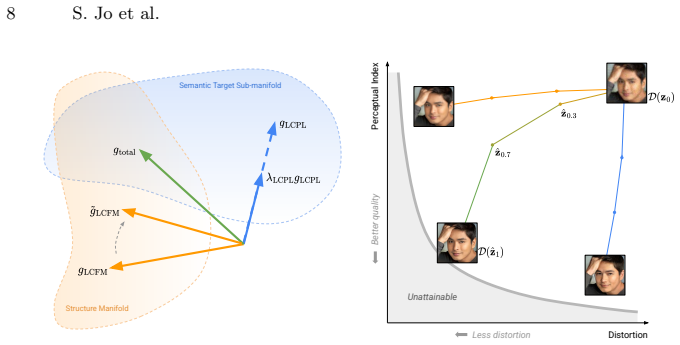
The central object is the learned latent velocity field $v_\theta(z(t), t)$ along the linear interpolation path $z_t = t z_1 + (1-(1-\sigma_{\min})t) z_0$. The latent consistency flow matching objective splits time into $K$ segments and penalizes disagreements between predicted endpoints and velocities at neighboring timesteps, which straightens the trajectory for few-step inference. The Latent Consistency Perceptual Loss (LCPL) applies a perceptual distance, computed from the model's own decoder features or from a latent LPIPS network, between predictions at adjacent timesteps. The conflict-free update projects the structural gradient $g_{\mathrm{LCFM}}$ orthogonal to the perceptual gradient $g_{\mathrm{LCPL}}$ whenever their inner product is negative, so perceptual steering is preserved while only non-conflicting structural updates survive.
What would settle it
Train the same PCFlow setup with the LCPL term computed on random, content-free features (for example, random linear projections of the latent) while keeping every other detail identical; if the reported FID gains over ELIR persist, then the perceptual steering mechanism is not doing the semantic work the paper claims, whereas if the gains vanish, the mechanism is confirmed.
Extended reading notes
Core claim
The central claim is that perceptual realism and structural fidelity need not be resolved by sampling from a posterior or by chaining an MMSE estimator to a generative refiner. PCFlow parameterizes a vector field that transports degraded latents to clean latents along a linear path, and trains it with a consistency objective that makes few-step Euler integration accurate. The new ingredient is to evaluate a perceptual distance between the model's predictions at adjacent timesteps, not just at the endpoint, so the velocity field itself is pushed toward perceptually sharp manifolds. When the structural and perceptual gradients conflict, the update keeps the perceptual direction and removes the conflicting component of the structural direction, with the perceptual weight increasing as the flow approaches the clean image. The paper reports that this yields best FID and NIQE on CelebA-Test and best FID on CelebAdult for blind face restoration, and better FID than ELIR on four other restoration tasks.
Load-bearing premise
The load-bearing premise is that the perceptual loss, evaluated on the model's own neighboring predictions, points toward the true clean-image manifold and not merely toward any sharp-looking manifold, so always keeping the perceptual gradient and trimming the structural gradient cannot steer the flow into structurally wrong but visually sharp images.
Editorial extensions
If this is right
- Direct single-stage transport can replace two-stage MMSE-estimate-then-refine pipelines, since PCFlow beats ELIR in FID without the MMSE estimator.
- Perceptual steering can be added to flow matching without destabilizing training, provided gradient conflicts are projected away and the perceptual weight ramps up with SNR.
- Few-step consistency models with a lightweight backbone can reach diffusion-level perceptual quality, making real-time restoration practical at 42.62 FPS on blind face restoration.
- Because the same recipe improves FID on super-resolution, denoising, inpainting, and colorization, the method is likely transferable to other inverse problems without task-specific redesign.
Reading between the lines
- The ablations suggest the internal decoder features carry more usable perceptual signal for restoration than externally trained LPIPS features; a natural extension is to use the restoration model's own decoder as a general-purpose perceptual metric for other inverse problems.
- The conflict-free projection is a general recipe for any multi-objective generative training where one objective should steer and another should preserve structure, such as text-to-image alignment or video prediction with perceptual losses.
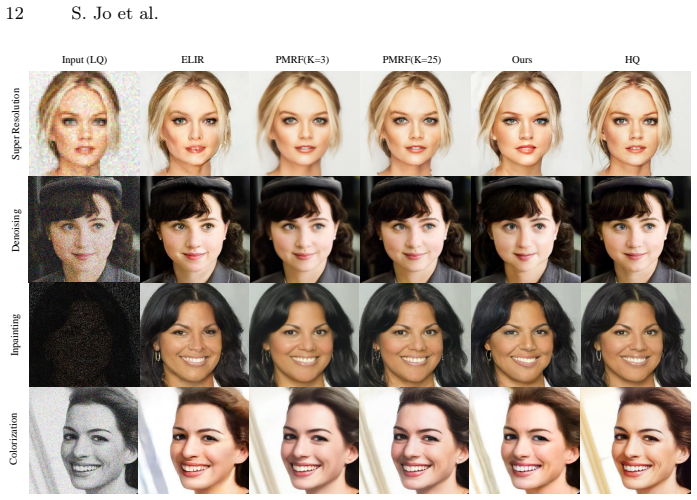
- Because PSNR, SSIM, and LPIPS mostly degrade relative to ELIR and PMRF even as FID improves, the 'better tradeoff' claim is tied to FID and NIQE; a reader should test with human preference studies, especially around the eye-region artifacts the paper mentions.
Signed reviews
Editorial analysis
A structured set of objections, weighed in public.
Referee Report
Summary. The paper proposes PCFlow, a latent consistency flow matching framework for image restoration. The method parameterizes a direct transport from a degraded latent to a clean latent using a latent consistency flow matching objective (LCFM), and adds a latent consistency perceptual loss (LCPL) that enforces perceptual similarity between adjacent trajectory predictions. To stabilize the multi-objective optimization, the paper introduces an asymmetric conflict-free gradient projection that preserves the perceptual gradient and removes conflicting components of the structural gradient. The model is evaluated on blind face restoration, super-resolution, denoising, inpainting, and colorization, reporting improved FID over ELIR at lower parameter counts and inference times, together with ablations of the preheating schedule, conditional versus unconditional flow, encoder fine-tuning, perceptual network choice, and gradient projection direction.
Significance. The reported results are encouraging: the method is clearly specified, the ablations are fairly extensive, and the efficiency gains (32M parameters, 5-step BFR inference, 42.6 FPS) are practically relevant. If the perceptual-quality gains are reproducible, the work would be a useful contribution to efficient generative restoration. However, the central claim of advancing the distortion-perception frontier is not substantiated by the single operating points reported. The paper would be significantly strengthened by a Pareto-style sweep over the perceptual weight and by uncertainty quantification for the headline FID comparisons. As written, the evidence is consistent with the model sliding along an existing trade-off curve rather than expanding it.
major comments (4)
- [Abstract, §4.2 (Tables 1–2), §5] The central claim that PCFlow 'advances the distortion-perception tradeoff frontier' is not supported by the reported single-point comparisons. Across the four tasks in Table 2, PCFlow improves FID over ELIR but PSNR is lower on three of four tasks (23.38 vs. 23.57 for super-resolution, 26.26 vs. 26.67 for denoising, 22.18 vs. 23.15 for colorization), and LPIPS is worse than ELIR on all four tasks (0.3328 vs. 0.3299, 0.2800 vs. 0.2619, 0.2936 vs. 0.2840, 0.3596 vs. 0.3587). In Table 1, MUSIQ (70.35) is lower than CodeFormer, GFPGAN, VQFRv2, and DiffBIR. These measurements are all consistent with moving along the existing distortion-perception curve rather than expanding it. Please provide a Pareto sweep over lambda_LCPL (or an equivalent inference-time control) and compare the resulting distortion-perception frontier with ELIR and PMRF, or revise the claim to describe improved perceptual quality at a given efficiency budget.
- [§3.3, Eqs. (16)–(17), with §3.2, Eq. (13)] The conflict-free update always preserves g_LCPL and removes the conflicting part of g_LCFM. Because L_LCPL is a self-consistency loss between adjacent model predictions f_i(z_t,t) and f_i(z_{t+Δt},t+Δt), it is never anchored to the known clean target z1. The paper does not provide a formal or empirical argument that optimizing this self-consistency steers toward the true clean-image manifold rather than an arbitrary perceptually sharp manifold. In fact, Fig. 5 reports pervasive conflict in low-SNR regimes, where the structural anchor is most needed, and §4.3 concedes occasional eye-region artifacts. Please add an analysis that tracks whether the projection systematically sacrifices structural fidelity, for example by measuring LCFM loss or deviation from the interpolation path under the proposed update, or by comparing LCPL gradients against a ground-truth-anchored perceptual loss.
- [§4.2, Tables 1–2 and Table 5] No error bars, multiple-seed results, or significance tests are reported. The headline FID differences are often small, for example 45.50 vs. 45.42 vs. 44.64 across tasks in Table 2 and 45.42 vs. 45.48 vs. 45.21 across scheduling variants in Table 5. FID differences of 0.1–0.5 can easily be within stochastic variation, and the paper's ranking of methods and component choices relies on such differences. Please report standard deviations over at least three training runs, or bootstrap confidence intervals, for the FID and LPIPS numbers that support the main claims.
- [§4.4, Table 4] The ablation from unconditional (A) to conditional (B) improves FID by 9.06 points but degrades PSNR by 1.23 dB, SSIM by 0.043, and LPIPS by 0.017. The text describes only the FID improvement, without discussing this large fidelity drop. Since the paper argues that directly learning the conditional transport is sufficient for a better trade-off, this result needs a discussion of whether the FID gain reflects a genuine trade-off improvement or simply a different operating point on the distortion-perception curve, especially given that the final configuration also sacrifices PSNR and LPIPS relative to ELIR on most tasks.
minor comments (5)
- [Eq. (12)] The weight w_l should appear inside the summation over l; as written, it reads as a global multiplier rather than per-layer weights.
- [§3.2, Eq. (13)] Please state explicitly how L_percep is instantiated for the internal network. Eq. (12) defines L_internal on z1 and \hat z1, but Eq. (13) applies L_percep to the model predictions f_i(z_t,t) and f_i(z_{t+Δt},t+Δt); clarify whether the decoder features are extracted from those predicted latents.
- [§4.2, Table 1] The FPS values are not accompanied by a specification of the GPU and whether the time includes VAE encoding/decoding; please add a footnote so the efficiency comparison is reproducible.
- [§3.3, Eq. (15)] The sentence 'naively summing the gradients implicitly assumes ⟨∇θLLCFM,∇θLLCPL⟩≥0, which does not hold in practice' is confusing because Eq. (15) is an inequality that would justify naive summation, not an assumption of the method; please rephrase to clarify that the inequality is what naive summation would require.
- [§3.1 and Supplementary Table 1] The main text uses 'number of consistency steps K' while the supplementary table calls it 'CFM segments (K)' and also lists 'Euler steps (M)'; please use consistent terminology to avoid ambiguity.
Circularity Check
No significant circularity: the paper's headline FID/NIQE claims are judged on external benchmark metrics, and the training objectives are anchored to the ground-truth clean latent through the transport path, with no fitted constant fed back as a prediction.
full rationale
The paper's central claim is an empirical one: PCFlow achieves state-of-the-art FID and NIQE on CelebA-Test and the best FID on CelebAdult. These metrics are computed by external, fixed procedures (FID uses Inception features, NIQE is a no-reference statistical measure) and are not constructed from the training losses. The LCPL objective (Eq. 13) is a regularizer that enforces perceptual consistency between the model's own adjacent predictions; while this is self-referential in the sense that it uses the model's features, it does not define the headline evaluation metric, and the paper also evaluates an external E-LatentLPIPS variant (Eq. 11, Supplement Table 5). The transport path in Eq. 4 is defined using the ground-truth clean latent z1, so the consistency objective is anchored to the target rather than being a purely internal fixed point. The conflict-free gradient update (Eqs. 16-17) is an optimization procedure, not a derivation of the result; its benefit is asserted and then tested in ablations (Tables 3-6). No parameter is fitted on the evaluation subset and then reported as a prediction: the model is trained on FFHQ and evaluated on CelebA/LFW/CelebAdult. All citations to ELIR, PMRF, CFM, E-LatentLPIPS, and gradient surgery are to external prior work; there is no self-citation chain and no uniqueness theorem imported from the authors' own previous papers. The paper's honest reporting of degraded PSNR/SSIM/LPIPS and occasional eye-region artifacts (Sec. 4.3) is a statement of the distortion-perception tradeoff, not evidence that a derived quantity reduces to its own input. Overall, the derivation chain is self-contained; the only mildly self-referential element is the internal perceptual loss, which is a design choice rather than a load-bearing prediction, warranting a score of 1 rather than 0.
Assumptions & free parameters
free parameters (7)
- sigma_min =
0.05 (super-res), 0.01 (denoising, colorization), 0.025 (inpainting), 1e-5 (BFR)
- alpha (CFM velocity weight) =
0.001
- Delta_t (consistency interval) =
0.05
- K (number of consistency segments) =
5 for BFR, 3 for other tasks
- lambda_LCPL schedule =
lambda_min=0, lambda_max=0.5, t_min=0.5
- feature weights w_l =
[1, 0.5, 0.25, 0.125, 1]
- preheating epochs =
250
assumptions (6)
- domain assumption The distortion-perception tradeoff curve from Blau & Michaeli and Freirich et al. correctly describes the achievable region.
- domain assumption The consistency flow matching objective (Eq. 5) with stop-gradient correctly straightens the transport path and supports few-step inference.
- domain assumption Tiny AutoEncoder latent space preserves perceptual semantics so that LPIPS-like losses in latent space are meaningful.
- domain assumption VGG or BAPPS-trained features correlate with human perceptual judgments and provide a reliable perceptual distance.
- domain assumption The conditional flow formulation from noise conditioned on degraded input (Eq. 10) is a valid transport between noise and clean latents.
- domain assumption The inner product of gradients is a valid conflict metric, and projecting out conflicting components preserves convergence.
Cite this review
Pith. "Pith review of Flow Straight to Reality: Perceptually Consistent Flow Matching for Efficient Image Restoration." pith.science (2026). https://pith.science/paper/EXOUWYNL
@misc{pith2026260810544,
  author       = {Pith},
  title        = {Pith review of: Flow Straight to Reality: Perceptually Consistent Flow Matching for Efficient Image Restoration},
  year         = {2026},
  howpublished = {\url{https://pith.science/paper/EXOUWYNL}},
  note         = {Machine review of arXiv:2608.10544}
}
read the original abstract
Image restoration is fundamentally constrained by the tradeoff between distortion and perception: minimizing pixel-wise error yields over-smoothed results, whereas optimizing for perceptual realism often introduces structural deviations. Recent approaches attempt to balance this tradeoff via posterior sampling or multi-stage generative pipelines, yet remain computationally expensive and architecturally complex. To overcome these limitations, we propose PCFlow (Perceptually Consistent Flow Matching), a unified framework that directly parameterizes a continuous transport from degraded observations to clean targets, jointly optimizing distortion and perceptual quality. While its latent consistency flow objective drives stable and efficient few-step inference, a Latent Consistency Perceptual Loss (LCPL) imposes semantic constraints directly on the guiding velocity field, steering the dynamics toward visually sharp data manifolds. Furthermore, recognizing the inherent conflict between structural and perceptual consistencies, we integrate a conflict-free gradient projection strategy to stabilize the multi-objective optimization landscape. Combined with lightweight, convolution-only backbone, PCFlow achieves competitive performance across diverse restoration tasks at a fraction of traditional computational costs.
Figures


Figures from the paper (7 more)


Reference graph
Works this paper leans on
-
[1]
Advances in Neural Information Processing Systems36, 61777–61791 (2023)
Adrai, T., Ohayon, G., Elad, M., Michaeli, T.: Deep optimal transport: A practical algorithm for photo-realistic image restoration. Advances in Neural Information Processing Systems36, 61777–61791 (2023)
work page 2023
-
[2]
In: The Eleventh International Conference on Learning Representations (2023)
Albergo, M.S., Vanden-Eijnden, E.: Building normalizing flows with stochastic in- terpolants. In: The Eleventh International Conference on Learning Representations (2023)
2023
-
[3]
In: The Thirteenth International Conference on Learning Representa- tions (2025)
Berrada, T., Astolfi, P., Hall, M., Havasi, M., Benchetrit, Y., Romero-Soriano, A., Alahari, K., Drozdzal, M., Verbeek, J.: Boosting latent diffusion with perceptual objectives. In: The Thirteenth International Conference on Learning Representa- tions (2025)
2025
-
[4]
In: Proceedings of the IEEE conference on computer vision and pattern recognition
Blau, Y., Michaeli, T.: The perception-distortion tradeoff. In: Proceedings of the IEEE conference on computer vision and pattern recognition. pp. 6228–6237 (2018)
2018
-
[5]
In: The Eleventh International Conference on Learning Representations (2023)
Chung, H., Kim, J., Mccann, M.T., Klasky, M.L., Ye, J.C.: Diffusion posterior sam- pling for general noisy inverse problems. In: The Eleventh International Conference on Learning Representations (2023)
2023
-
[6]
In: 36th British Machine Vision Confer- ence 2025, BMVC 2025, Sheffield, UK, November 24-27, 2025
Cohen,E.,Achituve,I.,Diamant,I.,Netzer,A.,Habi,H.V.:Efficientimagerestora- tion via latent consistency flow matching. In: 36th British Machine Vision Confer- ence 2025, BMVC 2025, Sheffield, UK, November 24-27, 2025. BMVA (2025)
work page 2025
-
[7]
arXiv preprint arXiv:2307.08698 (2023)
Dao, Q., Phung, H., Nguyen, B., Tran, A.: Flow matching in latent space. arXiv preprint arXiv:2307.08698 (2023)
arXiv 2023
-
[8]
In: 2009 IEEE Conference on Computer Vision and Pattern Recognition
Deng, J., Dong, W., Socher, R., Li, L.J., Li, K., Fei-Fei, L.: Imagenet: A large-scale hierarchical image database. In: 2009 IEEE Conference on Computer Vision and Pattern Recognition. pp. 248–255 (2009)
2009
Show all 33 references
-
[9]
In: Forty-first international conference on machine learning (2024)
Esser, P., Kulal, S., Blattmann, A., Entezari, R., Müller, J., Saini, H., Levi, Y., Lorenz, D., Sauer, A., Boesel, F., et al.: Scaling rectified flow transformers for high-resolution image synthesis. In: Forty-first international conference on machine learning (2024)
2024
-
[10]
Advances in Neural Information Processing Systems34, 25661– 25672 (2021)
Freirich, D., Michaeli, T., Meir, R.: A theory of the distortion-perception tradeoff in wasserstein space. Advances in Neural Information Processing Systems34, 25661– 25672 (2021)
2021
-
[11]
In: European Conference on Computer Vision
Gu,Y.,Wang,X.,Xie,L.,Dong,C.,Li,G.,Shan,Y.,Cheng,M.M.:Vqfr:Blindface restoration with vector-quantized dictionary and parallel decoder. In: European Conference on Computer Vision. pp. 126–143. Springer (2022)
2022
-
[12]
In: European Conference on Computer Vision
Kang, M., Zhang, R., Barnes, C., Paris, S., Kwak, S., Park, J., Shechtman, E., Zhu, J.Y., Park, T.: Distilling diffusion models into conditional gans. In: European Conference on Computer Vision. pp. 428–447. Springer (2024)
2024
-
[13]
Advances in neural information processing systems35, 23593–23606 (2022)
Kawar, B., Elad, M., Ermon, S., Song, J.: Denoising diffusion restoration models. Advances in neural information processing systems35, 23593–23606 (2022)
2022
-
[14]
In: Proceedings of the IEEE conference on computer vision and pattern recognition
Ledig, C., Theis, L., Huszár, F., Caballero, J., Cunningham, A., Acosta, A., Aitken, A., Tejani, A., Totz, J., Wang, Z., et al.: Photo-realistic single image super- resolution using a generative adversarial network. In: Proceedings of the IEEE conference on computer vision and...
2017
-
[15]
arXiv preprint arXiv:2401.00110 (2023)
Lin, S., Yang, X.: Diffusion model with perceptual loss. arXiv preprint arXiv:2401.00110 (2023)
2023 arXiv
-
[16]
In: European conference on computer vision
Lin, X., He, J., Chen, Z., Lyu, Z., Dai, B., Yu, F., Qiao, Y., Ouyang, W., Dong, C.: Diffbir: Toward blind image restoration with generative diffusion prior. In: European conference on computer vision. pp. 430–448. Springer (2024) Perceptually Consistent Flow Matching for Effi...
2024
-
[17]
In: The Eleventh International Conference on Learning Representations (2023)
Lipman, Y., Chen, R.T.Q., Ben-Hamu, H., Nickel, M., Le, M.: Flow matching for generative modeling. In: The Eleventh International Conference on Learning Representations (2023)
2023
-
[18]
In: The Eleventh International Conference on Learning Representations (2023)
Liu, X., Gong, C., Liu, Q.: Flow straight and fast: Learning to generate and transfer data with rectified flow. In: The Eleventh International Conference on Learning Representations (2023)
2023
-
[19]
In: The Thirteenth International Con- ference on Learning Representations (2025)
Ohayon, G., Michaeli, T., Elad, M.: Posterior-mean rectified flow: Towards mini- mum MSE photo-realistic image restoration. In: The Thirteenth International Con- ference on Learning Representations (2025)
2025
-
[20]
Platen, P.V., Patil, S., Lozhkov, A., Cuenca, P., Lambert, N., Rasul, K., Davaadorj, M., Nair, D., Paul, S., Berman, W., Xu, Y., Liu, S., Wolf, T.: Diffusers: State-of- the-art diffusion models (2022)
2022
-
[21]
IEEE transactions on pattern analysis and ma- chine intelligence45(4), 4713–4726 (2022)
Saharia, C., Ho, J., Chan, W., Salimans, T., Fleet, D.J., Norouzi, M.: Image super- resolution via iterative refinement. IEEE transactions on pattern analysis and ma- chine intelligence45(4), 4713–4726 (2022)
2022
-
[22]
In: International Conference on Learning Representations (2015)
Simonyan, K., Zisserman, A.: Very deep convolutional networks for large-scale im- age recognition. In: International Conference on Learning Representations (2015)
2015
-
[23]
In: International Conference on Learning Representations (2023)
Song, J., Vahdat, A., Mardani, M., Kautz, J.: Pseudoinverse-guided diffusion mod- els for inverse problems. In: International Conference on Learning Representations (2023)
2023
-
[24]
In: Proceedings of the IEEE/CVF conference on com- puter vision and pattern recognition
Wang, X., Li, Y., Zhang, H., Shan, Y.: Towards real-world blind face restoration with generative facial prior. In: Proceedings of the IEEE/CVF conference on com- puter vision and pattern recognition. pp. 9168–9178 (2021)
2021
-
[25]
In: Proceed- ings of the European conference on computer vision (ECCV) workshops
Wang, X., Yu, K., Wu, S., Gu, J., Liu, Y., Dong, C., Qiao, Y., Change Loy, C.: Esrgan: Enhanced super-resolution generative adversarial networks. In: Proceed- ings of the European conference on computer vision (ECCV) workshops. pp. 0–0 (2018)
2018
-
[26]
In: The Eleventh International Conference on Learning Repre- sentations (2023)
Wang, Y., Yu, J., Zhang, J.: Zero-shot image restoration using denoising diffusion null-space model. In: The Eleventh International Conference on Learning Repre- sentations (2023)
2023
-
[27]
Yang, L., Zhang, Z., Zhang, Z., Liu, X., Liu, J., Xu, M., Meng, C., Ermon, S., Zhang, W., CUI, B.: Consistency flow matching: Defining straight flows with ve- locity consistency (2025)
2025
-
[28]
Advances in neural information processing systems33, 5824–5836 (2020)
Yu, T., Kumar, S., Gupta, A., Levine, S., Hausman, K., Finn, C.: Gradient surgery for multi-task learning. Advances in neural information processing systems33, 5824–5836 (2020)
2020
-
[29]
IEEE Transactions on Pattern Analysis and Machine Intelligence46(12), 9991– 10004 (2024)
Yue, Z., Loy, C.C.: Difface: Blind face restoration with diffused error contraction. IEEE Transactions on Pattern Analysis and Machine Intelligence46(12), 9991– 10004 (2024)
2024
-
[30]
In: Proceedings of the IEEE conference on computer vision and pattern recognition
Zhang, R., Isola, P., Efros, A.A., Shechtman, E., Wang, O.: The unreasonable effectiveness of deep features as a perceptual metric. In: Proceedings of the IEEE conference on computer vision and pattern recognition. pp. 586–595 (2018)
2018
-
[31]
Advances in Neural Information Processing Systems 35, 30599–30611 (2022)
Zhou, S., Chan, K., Li, C., Loy, C.C.: Towards robust blind face restoration with codebook lookup transformer. Advances in Neural Information Processing Systems 35, 30599–30611 (2022)
2022
-
[32]
In: Proceedings of the IEEE/CVF Conference on Computer Vision and Pattern Recognition
Zhu, Y., Zhao, W., Li, A., Tang, Y., Zhou, J., Lu, J.: Flowie: Efficient image enhancement via rectified flow. In: Proceedings of the IEEE/CVF Conference on Computer Vision and Pattern Recognition. pp. 13–22 (2024)
2024
-
[33]
In: Proceedings of the 18 S
Zhu, Y., Zhang, K., Liang, J., Cao, J., Wen, B., Timofte, R., Van Gool, L.: De- noising diffusion models for plug-and-play image restoration. In: Proceedings of the 18 S. Jo et al. IEEE/CVF conference on computer vision and pattern recognition. pp. 1219–1229 (2023) Supplementa...
2023
Reviewed August 15, 2026 · model on record in the stance chip above.
Discussion (0). Continue with ORCID to comment.