REVIEW 2 major objections 4 minor 42 references
Operational identifiability of false-vacuum decay rates in the quantum Ising chain
T0 review · 2 major / 4 minor · reviewed 2026-08-15 · deepseek-v4-flash
Pith's one-line read Coherent two-kink amplitudes quantitatively organize finite-time false-vacuum decay in the quantum Ising chain, while the available finite-size data cannot yet support a bulk thermodynamic rate.
desk verdict A careful, honest identifiability study that delivers a solid positive cross-level consistency result and a properly bounded negative claim about bulk-rate extrapolation; the lattice-resolved WKB action and the kinetic-bias control are the genuinely new pieces. read the letter →
The pith
A machine-rendered reading of the paper's core claim, the machinery that carries it, and where it could break.
The reading
What carries the argument
The load-bearing object is the coherent two-kink amplitude set, constructed as an antisymmetrized Wannier–Stark problem for the kink–antikink relative coordinate, with hopping coefficients taken from the exact lattice two-kink dispersion and with the metastable-state coupling $\bar{\Omega}_L$ determining each mode's excitation weight. These amplitudes are used twice: once to evolve the coherent-bubble density whose linear slope is compared with the iMPS survival coefficient on matched windows, and once to project the microscopic bond operator, where the vacuum–pair coherence term $-\frac{1}{2}\mathrm{Re}[b^\dagger a]$ is isolated from the diagonal pair–pair occupation. The semiclassical comparison is carried by the lattice-resolved WKB action $S_{\mathrm{lat}} = \frac{8J}{f}\int_0^{\ln(1/h_\perp)}\sqrt{1-2h_\perp\cosh\kappa+h_\perp^2}\,d\kappa$, which replaces the continuum actions in the fixed-prefactor rate and yields the $4.13\%$ median discrepancy. A separate operational mechanism, the branch-selection screen on the initial magnetization, does the work of deciding which finite-size states are admissible for geometry extrapolation.
What would settle it
Run a new set of periodic chains at $L=48,64,96$ with a preparation protocol that passes the branch screen $m_x(0)>0$ and $|M_{0,g}/M_{\mathrm{th}}-1|\le\epsilon$; if the resulting $1/L$ extrapolated bulk rate disagrees with the matched-window iMPS survival coefficient, after applying the coherent-bubble finite-window correction, by more than the reported $0.857$–$0.921$ band, the paper's cross-level consistency claim would be falsified. Alternatively, re-run the seven bond-channel points at $\chi=256$ and correlation cutoff $N>48$; if the local plateau criteria then pass at points the paper reports as diagnostics rather than rates, its identifiability boundary would need to be redrawn.
Extended reading notes
Core claim
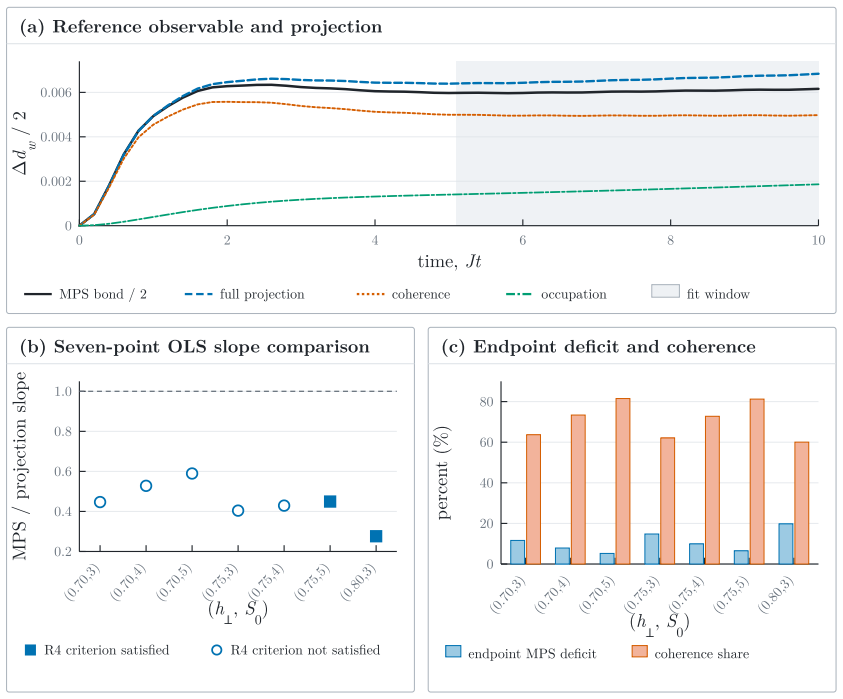
On the paper's own terms, the central discovery is a matched-window consistency law: across all twelve parameter points with non-empty analysis intervals, the infinite-chain iMPS survival coefficient is $0.857$–$0.921$ of the coherent-bubble-theory slope evaluated on the same physical interval, with median $0.902$, while the same coherent amplitudes give magnetization-area slope ratios of $0.809$–$0.953$. The same reduction fails in a channel-specific way at the microscopic bond observable, where vacuum–pair coherence supplies $60.0$–$81.5\%$ of the projected signal and a scalar normalization cannot remove the late-window mismatch. The paper's negative result is equally specific: under its operational branch-selection criterion $m_x(0)>0$ and $|M_{0,g}/M_{\mathrm{th}}-1|\le\epsilon$, no parameter point retains a complete PBC size set, so no three-geometry bulk-rate extrapolation is currently supported. Within the shared two-kink model, the lattice-resolved WKB action reduces the median fixed-prefactor discrepancy against 382 cutoff-admissible coherent-bubble spectra to $4.13\%$, down from $63.01\%$ for the leading continuum action.
Load-bearing premise
The paper's conclusion that no finite-size data set can yet support a bulk thermodynamic rate rests on trusting the initial-magnetization screen as a faithful test of whether a finite chain actually occupies the false-vacuum branch.
Editorial extensions
If this is right
- Future quantum-simulation experiments can use the $0.857$–$0.921$ survival band and the $0.809$–$0.953$ magnetization band as finite-window correction factors when comparing bubble-theory slopes to iMPS observables in this parameter regime.
- The planted coherent-growth test shows that a centred $R^2\simeq 0.9998$ fit can carry a deterministic $15.6$–$31.9\%$ bias under the fixed-velocity $t^2$ conversion, so reporting a fit quality without reporting the kinetic-model mapping is insufficient.
- The branch-screened coverage table, with zero complete PBC size sets at every tested threshold from one to ten percent, redirects the computational target from more fits on existing initial states to new preparation protocols and larger, complete PBC size sets.
- Within the two-kink model, the lattice-resolved action should replace the continuum action for prefactor-fixed rate comparisons: it puts $81.41\%$ of 382 cutoff-admissible spectra within ten percent of the coherent-bubble spectral rate.
- The bond-operator projection rules out the momentum-diagonal-only normalization picture in these coherent windows, implying that any quasiparticle-normalization analysis of the bond channel is incomplete.
Reading between the lines
- If the coherent two-kink reduction continues to hold at larger sizes, the remaining ~10% survival deficit is a systematic model correction that a four-kink or interacting-bubble extension could compute; the paper does not make that extension.
- The same operational protocol—fixing the window from physical scales before looking at slopes, identifying algebraically linked readouts, and screening initial states—could be applied to other real-time nucleation problems, such as gauge-theory simulators or monitored quantum circuits, though the paper does not claim this transfer.
- The failed constrained $1/S_{\mathrm{lat}}$ collapse, with a non-zero intercept when the fit is freed, hints that a complete arbitrary-field lattice prefactor contains action-independent structure; deriving that prefactor without fitting would be the natural next theory step.
- A branch-screened larger PBC set could convert the paper's identifiability boundary into a quantitative three-geometry rate; the paper stops before that measurement and leaves it as an explicit next calculation.
Signed reviews
Editorial analysis
A structured set of objections, weighed in public.
Referee Report
Summary. This paper develops a multilevel identification framework for false-vacuum decay in the one-dimensional quantum Ising chain, separating finite-time lattice observables (L0), coherent-bubble spectral theory (L1), and semiclassical actions (L2). On twelve parameter points with non-empty analysis intervals, the authors report that the iMPS survival coefficient is 0.857–0.921 of the coherent-bubble finite-window slope measured on the same interval, and that magnetization-area slope ratios lie between 0.809 and 0.953. They further find that the nearest-neighbour bond response is dominated by vacuum–pair coherence (60.0–81.5% across seven points satisfying a matched-bond-dimension criterion), and that a scalar normalization cannot remove late-window bond discrepancies. The central finite-size conclusion is negative: under an operational branch-selection screen requiring mx(0)>0 and |M0,g/Mth−1|≤ε, no parameter point has a complete PBC size set, so no three-geometry bulk-rate extrapolation is supported by the present data. Within the shared coherent two-kink model, a lattice-resolved WKB action reduces the median fixed-prefactor discrepancy against 382 cutoff-admissible CBT spectra to 4.13%. The paper is explicit that the thermodynamic-rate interpretation remains contingent on future branch-validated finite-size calculations.
Significance. If the claims hold, the paper would provide a carefully controlled demonstration that coherent two-kink amplitudes quantitatively organize finite-time false-vacuum decay observables in the quantum Ising chain, while delimiting what can and cannot be identified as a thermodynamic rate. The main strengths are the operational discipline: the CBT spectral FGR rate in Section 4.2 contains no fitted normalization or broadening, the lattice WKB action in Section 4.1 is derived from the exact lattice dispersion, the χ=64/128 convergence checks are reported with medians and ranges, and a planted-nucleation recovery test checks the extraction pipeline. These features make the positive L0–L1 correspondence a genuine cross-level check rather than a curve fit. The negative finite-size result is the most consequential claim, however, and it depends on a branch-selection screen whose fidelity is not yet demonstrated; this is the main reason the manuscript needs revision before the conclusions can be accepted as stated.
major comments (2)
- [Sections 3.3, 5.1, and 7.4] The negative finite-size conclusion—no parameter point supports a branch-screened PBC or three-geometry extrapolation (Table 3)—rests entirely on the operational branch-selection criterion of Section 3.3: mx(0)>0 and |M0,g/Mth−1|≤ε. The paper itself notes that M0,g is measured on DMRG states prepared with a selecting field δ=10^-6 that is not removed before the quench, while Mth is the thermodynamic zero-field magnetization. For the shortest PBC sizes (L=24, 32, 48) the two symmetry-broken branches are nearly degenerate, so a tiny selecting field may not fully polarize the state; Section 7.4 states that there is no PBC analogue of the endpoint-pinning control and no pin-removal dynamics. Consequently, varying ε from 1% to 10% tests only the threshold value, not whether the screen is a faithful indicator of branch participation. If some rejected PBC states are actually on the intended branch, the zero-PBC counts and the conclusion that the remaining obstacle is "branch preparation and size coverage" would be preparation artifacts rather than physical ineligibility. Please either validate the screen with an independent branch diagnostic (for example, overlap with the positive-branch ground state, or preparation with field removal followed by relaxation before the quench), or restrict the conclusion explicitly to "under this screen, no eligible data set exists" and state that the stronger physical-ineligibility claim is not established by the present data.
- [Section 5.4 and Table 3] The sensitivity analysis in Section 5.4 shows that only permissive window/threshold variants yield any parameter point with the required geometry coverage in the unscreened baseline analysis, and that none survives the branch screen. This is presented as robustness of the negative result, but it is robustness only with respect to the choice of ε and the fitting window. Because the screen itself is not independently validated, the variants do not address the possibility that the screen has a large false-negative rate for PBC states. Please report, at least for the representative preparation point, how many of the rejected PBC states would pass an alternative branch diagnostic, or explicitly state that the negative result is conditional on the screen's validity and is not a localization of a physical obstacle.
minor comments (4)
- [Section 3.1, Eq. (15)] The transformation −ln[(mx(t)/M0,g+1)/2] is undefined when mx(t)/M0,g ≤ −1, and the text explains that some L=32 high-field cases are outside the transformation domain. Please state this domain condition explicitly in or immediately after Eq. (15), since it is a genuine exclusion criterion and not merely a numerical detail.
- [Section 5.3, Fig. 4] The seven-point OLS slope comparison in Fig. 4(b) mixes filled and open symbols according to whether the R4 plateau criterion is satisfied. Please ensure the caption states explicitly that the filled/open distinction is made on the same physical interval used for the slope comparison, and clarify how the two plateau-passing points are weighted in the reported median slope ratios.
- [Section 6, Eq. (41)] The ΔAIC = −424.2 value is reported without specifying the likelihood model or the number of fitted parameters. Since this is a descriptive comparison of two linear fits, please state the error model and sample size used to compute the AIC values, or present the comparison as a variance-explained diagnostic only.
- [Section 7.4] The phrase "within the tested selecting-field range and two-percent ceiling" is ambiguous: it is not clear whether the ceiling refers to |δ| in units of J or to the relative deviation of M0,g from Mth. Please define this quantity explicitly when discussing the static three-point criterion.
Circularity Check
No significant circularity: the central L0–L1 and L1–L2 comparisons use independent tensor-network data and derived theoretical rates with no fitted normalization.
full rationale
The derivation chain is self-contained at every load-bearing step. The L0–L1 comparison (Section 5.2, Eq. 38) compares iMPS survival coefficients to CBT finite-window slopes computed from the exact two-kink dispersion (Eqs. 29–32) with no fitted normalization; the paper states this explicitly: 'No fitted normalization, artificial broadening, or linewidth parameter is introduced.' The same coherent amplitudes generate the magnetization-area ratios (Section 5.3) and bond projection (Eq. 21) from a derived free-fermion operator, so these are genuine cross-level predictions rather than renamed inputs. The lattice WKB action (Eq. 24) is obtained by continuing the exact dispersion, and the paper explicitly labels the L1–L2 comparison an 'internal benchmark of action-dependent discrepancy under shared assumptions, not an independent model-free validation' (Section 4.2), which is an honest scope restriction rather than a circular reduction. The finite-size branch screen (Section 3.3) is an operational criterion that is not derived from the conclusion it restricts; the paper states it is 'an operational data-sufficiency test, not a universal or sufficient definition of finite-size branch validity.' The retrospective fits in Eqs. (40)–(41) are diagnostic and are not presented as predictions. There are no load-bearing self-citations: the theory inputs cited from [13,14,23] are external prior work, and no uniqueness theorem or ansatz is imported from the present authors' own prior results. Therefore the central results are not equivalent to their inputs by construction.
Assumptions & free parameters
free parameters (5)
- branch-selection tolerance epsilon =
0.10 (tested 0.01-0.10)
- plateau relative-spread threshold delta_plat =
0.10
- matched-chi signal-relative threshold =
0.05
- c1 in eq. (40) =
-0.20276
- a0 and a1 in eq. (41) =
a0=0.10156, a1=-0.66578
assumptions (6)
- domain assumption The MPS time-evolution algorithms (iTEBD, OBC TEBD, PBC TDVP) accurately simulate the exact dynamics at the reported bond dimensions and time steps.
- domain assumption The pre-quench state and dynamics are well described within the vacuum plus zero-total-momentum two-kink sector in the analyzed windows, so eq. (21) and the CBT level structure capture the relevant physics.
- domain assumption The Wannier-Stark/confined kink-antikink description of the weak-longitudinal-field Ising chain (refs [13,14,23]) is valid for the parameter range studied.
- domain assumption The fixed-prefactor construction Gamma_k = (f/2pi) e^{-S_k} is a valid common prefactor for comparing actions.
- standard math The analytic continuation theta = i*kappa gives the correct tunneling path for the lattice WKB action.
- ad hoc to paper The operational branch-selection criterion (mx(0)>0, |M0,g/Mth - 1| <= epsilon) is a faithful test of false-vacuum branch participation in finite systems.
Cite this review
Pith. "Pith review of Operational identifiability of false-vacuum decay rates in the quantum Ising chain." pith.science (2026). https://pith.science/paper/AFDPZWIS
@misc{pith2026260811339,
  author       = {Pith},
  title        = {Pith review of: Operational identifiability of false-vacuum decay rates in the quantum Ising chain},
  year         = {2026},
  howpublished = {\url{https://pith.science/paper/AFDPZWIS}},
  note         = {Machine review of arXiv:2608.11339}
}
read the original abstract
Extracting a thermodynamic nucleation rate from finite-time quantum dynamics requires separating observable decay from estimator and finite-size validity. We develop a multilevel identification framework to real-time tensor-network simulations of false-vacuum decay in the one-dimensional quantum Ising chain. Across twelve parameter points with non-empty analysis intervals, the same coherent two-kink amplitudes semi-quantitatively predict both infinite-chain survival and magnetization dynamics: the survival coefficient has a median lattice-to-theory ratio of 0.902, while the magnetization-area slope ratios span 0.809--0.953. By contrast, the microscopic nearest-neighbour bond response is coherence dominated: vacuum--pair coherence contributes 60.0--81.5\% within the seven parameter points satisfying the matched-bond-dimension convergence criterion, while substantial late-window slope discrepancies remain that cannot be removed by a scalar normalization. The framework establishes reliable finite-time decay coefficients and identifies the additional finite-size and branch-validation requirements for a bulk thermodynamic rate interpretation. Within the two-kink model, a lattice-resolved WKB action reduces the median fixed-prefactor discrepancy with the coherent-bubble spectral calculation to 4.13\%. Quantitative cross-level consistency, observable-dependent reduced-model error, and a thermodynamic-rate interpretation that remains subject to finite-size validation can therefore coexist.
Figures


Figures from the paper (3 more)


Reference graph
Works this paper leans on
-
[1]
Fate of the false vacuum: Semiclassical theory
Sidney Coleman. Fate of the false vacuum: Semiclassical theory. Physical Review D , 15:2929–2936, 1977
work page 1977
-
[2]
Curtis G. Callan and Sidney Coleman. Fate of the false vacuum. ii. first quantum corrections. Physical Review D , 16:1762–1768, 1977
work page 1977
-
[3]
Quantum-statistical metastability
Ian Affleck. Quantum-statistical metastability. Physical Review Letters , 46:388–391, 1981
work page 1981
-
[4]
On gauge invariance and vacuum polarization
Julian Schwinger. On gauge invariance and vacuum polarization. Physical Review, 82:664–679, 1951
work page 1951
-
[5]
William A. Johnson and Robert F. Mehl. Reaction kinetics in processes of nucleation and growth. Transactions of the American Institute of Mining and Metallurgical Engineers, 135:416–458, 1939
work page 1939
-
[6]
A commentary on: Reaction kinetics in processes of nucleation and growth
Katayun Barmak. A commentary on: Reaction kinetics in processes of nucleation and growth. Metallurgical and Materials Transactions A , 41:2711–2775, 2010
work page 2010
-
[7]
Melvin A vrami. Kinetics of phase change. i: General theory. The Journal of Chemical Physics , 7:1103–1112, 1939
work page 1939
-
[8]
Melvin A vrami. Kinetics of phase change. ii: Transformation-time relations for random distribution of nuclei. The Journal of Chemical Physics , 8:212–224, 1940
work page 1940
Show all 42 references
-
[9]
J. S. Langer. Theory of the condensation point. Annals of Physics , 41:108–157, 1967
1967
-
[10]
J. S. Langer. Statistical theory of the decay of metastable states. Annals of Physics, 54:258–275, 1969
1969
-
[11]
The one-dimensional Ising model with a transverse field
Pierre Pfeuty. The one-dimensional Ising model with a transverse field. Annals of Physics , 57:79–90, 1970
1970
-
[12]
McCoy and Tai Tsun Wu
Barry M. McCoy and Tai Tsun Wu. Two-dimensional Ising field theory in a magnetic field: Breakup of the cut in the two-point function. Physical Review D, 18:1259–1267, 1978
1978
-
[13]
S. B. Rutkevich. Decay of the metastable phase in d = 1 and d = 2 Ising models. Physical Review B , 60:14525–14528, 1999
1999
-
[14]
Ising field theory in a magnetic field: Analytic properties of the free energy
Pedro Fonseca and Alexander Zamolodchikov. Ising field theory in a magnetic field: Analytic properties of the free energy. Journal of Statistical Physics , 110:527–590, 2003. 21
2003
-
[15]
Real-time confinement following a quantum quench to a non-integrable model
Márton Kormos, Mario Collura, Gábor Takács, and Pasquale Calabrese. Real-time confinement following a quantum quench to a non-integrable model. Nature Physics, 13:246–249, 2017
2017
-
[16]
Gorshkov, and Markus Heyl
Roberto Verdel, Fangli Liu, Seth Whitsitt, Alexey V. Gorshkov, and Markus Heyl. Real-time dynamics of string breaking in quantum spin chains. Physical Review B , 102:014308, 2020
2020
-
[17]
False vacuum decay in quantum spin chains
Gianluca Lagnese, Federica Maria Surace, Márton Kormos, and Pasquale Calabrese. False vacuum decay in quantum spin chains. Physical Review B , 104:L201106, 2021
2021
-
[18]
Bloch oscillations and the lack of the decay of the false vacuum in a one-dimensional quantum spin chain
Octavio Pomponio, Miklós Antal Werner, Gergely Záránd, and Gábor Takács. Bloch oscillations and the lack of the decay of the false vacuum in a one-dimensional quantum spin chain. SciPost Physics , 12:061, 2022
2022
-
[19]
Mazza, Giuseppe Perfetto, Mario Collura, and Andrea Gambassi
Alessio Lerose, Federica Maria Surace, Paolo P. Mazza, Giuseppe Perfetto, Mario Collura, and Andrea Gambassi. Quasilocalized dynamics from confinement of quantum excitations. Physical Review B , 102:041118(R), 2020
2020
-
[20]
Monte carlo matrix-product-state approach to the false vacuum decay in the monitored quantum Ising chain
Jeffrey Allan Maki, Anna Berti, Iacopo Carusotto, and Alberto Biella. Monte carlo matrix-product-state approach to the false vacuum decay in the monitored quantum Ising chain. SciPost Physics , 15:152, 2023
2023
-
[21]
Real-time dynamics of false vacuum decay
Laura Batini, Aleksandr Chatrchyan, and Jürgen Berges. Real-time dynamics of false vacuum decay. Physical Review D , 109:023502, 2024
2024
-
[22]
Surace, and Andrew Lucas
Chao Yin, Federica M. Surace, and Andrew Lucas. Theory of metastable states in many-body quantum systems. Physical Review X , 15:011064, 2025
2025
- [23]
-
[24]
Hirsbrunner, Pedro L
Siva Darbha, Milan Kornjača, Fangli Liu, Jan Balewski, Mark R. Hirsbrunner, Pedro L. S. Lopes, Sheng-Tao Wang, Roel Van Beeumen, Daan Camps, and Katherine Klymko. False vacuum decay and nucleation dynamics in neutral atom systems. Physical Review B , 110:155103, 2024
2024
-
[25]
Probing false vacuum decay on a cold-atom gauge-theory quantum simulator
Zi-Hang Zhu et al. Probing false vacuum decay on a cold-atom gauge-theory quantum simulator. Physical Review Letters , 2026
2026
-
[26]
Stirring the false vacuum via interacting quantized bubbles on a 5,564-qubit quantum annealer
Jaka Vodeb et al. Stirring the false vacuum via interacting quantized bubbles on a 5,564-qubit quantum annealer. Nature Physics, 21:386–392, 2025
2025
-
[27]
False vacuum decay via bubble formation in ferromagnetic superfluids
Alessandro Zenesini et al. False vacuum decay via bubble formation in ferromagnetic superfluids. Nature Physics, 20:558–563, 2024
2024
-
[28]
Probing false vacuum decay and bubble nucleation in a rydberg atom array
Yu-Xin Chao et al. Probing false vacuum decay and bubble nucleation in a rydberg atom array. Physical Review Letters , 136:120407, 2026
2026
-
[29]
Collisions of false-vacuum bubble walls in a quantum spin chain
Ashley Milsted, Junyu Liu, John Preskill, and Guifré Vidal. Collisions of false-vacuum bubble walls in a quantum spin chain. PRX Quantum , 3:020316, 2022. 22
2022
-
[30]
Karpov, G.-Y
P. Karpov, G.-Y. Zhu, M. Heller, and M. Heyl. Spatiotemporal dynamics of particle collisions in quantum spin chains. Physical Review Research, 4:L032001, 2022
2022
-
[31]
Confinement and entanglement dynamics on a digital quantum computer
Joseph Vovrosh and Johannes Knolle. Confinement and entanglement dynamics on a digital quantum computer. Scientific Reports, 11:11577, 2021
2021
-
[32]
Coherent two-state oscillations in false-vacuum decay regimes
Peiyun Ge, Xiao Wang, Yu-Xin Chao, Rong Lu, and Li You. Coherent two-state oscillations in false-vacuum decay regimes. Physical Review B , 113:184306, 2026
2026
-
[33]
Variations on vacuum decay: The scaling Ising and tricritical Ising field theories
Máté Lencsés, Giuseppe Mussardo, and Gábor Takács. Variations on vacuum decay: The scaling Ising and tricritical Ising field theories. Physical Review D , 106:105003, 2022
2022
-
[34]
Efficient classical simulation of slightly entangled quantum computations
Guifré Vidal. Efficient classical simulation of slightly entangled quantum computations. Physical Review Letters , 91:147902, 2003
2003
-
[35]
Efficient simulation of one-dimensional quantum many-body systems
Guifré Vidal. Efficient simulation of one-dimensional quantum many-body systems. Physical Review Letters , 93:040502, 2004
2004
-
[36]
A. J. Daley, C. Kollath, U. Schollwöck, and G. Vidal. Time-dependent density-matrix renormalization-group using adaptive effective hilbert spaces. Journal of Statistical Mechanics: Theory and Experiment , 2004:P04005, 2004
2004
-
[37]
White and Adrian E
Steven R. White and Adrian E. Feiguin. Real-time evolution using the density matrix renormalization group. Physical Review Letters , 93:076401, 2004
2004
-
[38]
Ignacio Cirac, Tobias J
Jutho Haegeman, J. Ignacio Cirac, Tobias J. Osborne, Iztok Pižorn, Henri Verschelde, and Frank Verstraete. Time-dependent variational principle for quantum lattices. Physical Review Letters , 107:070601, 2011
2011
-
[39]
Unifying time evolution and optimization with matrix product states
Jutho Haegeman, Christian Lubich, Ivan Oseledets, Bart Vandereycken, and Frank Verstraete. Unifying time evolution and optimization with matrix product states. Physical Review B , 94:165116, 2016
2016
-
[40]
Steven R. White. Density matrix formulation for quantum renormalization groups. Physical Review Letters , 69:2863–2866, 1992
1992
-
[41]
The density-matrix renormalization group in the age of matrix product states
Ulrich Schollwöck. The density-matrix renormalization group in the age of matrix product states. Annals of Physics , 326:96–192, 2011
2011
-
[42]
Manmana, Ulrich Schollwöck, and Claudius Hubig
Sebastian Paeckel, Thomas Köhler, Andreas Swoboda, Salvatore R. Manmana, Ulrich Schollwöck, and Claudius Hubig. Time-evolution methods for matrix-product states. Annals of Physics , 411:167998, 2019. 23
2019
Reviewed August 15, 2026 · model on record in the stance chip above.
Discussion (0). Continue with ORCID to comment.