REVIEW 3 major objections 4 minor 18 references
MBA: Multimodal Benchmark and Agents for Real-World Business Ideation
T0 review · 3 major / 4 minor · reviewed 2026-08-16 · deepseek-v4-flash
Pith's one-line read Multimodal AI agents rewarded for creative, grounded ideas beat text-only baselines by up to 77 percent on a new 30K-sample business ideation benchmark.
desk verdict A genuinely new multimodal benchmark and a solid system paper, but the headline performance claims rest entirely on an unvalidated MLLM judge and rubric-optimized rewards. read the letter →
The pith
A machine-rendered reading of the paper's core claim, the machinery that carries it, and where it could break.
The reading
What carries the argument
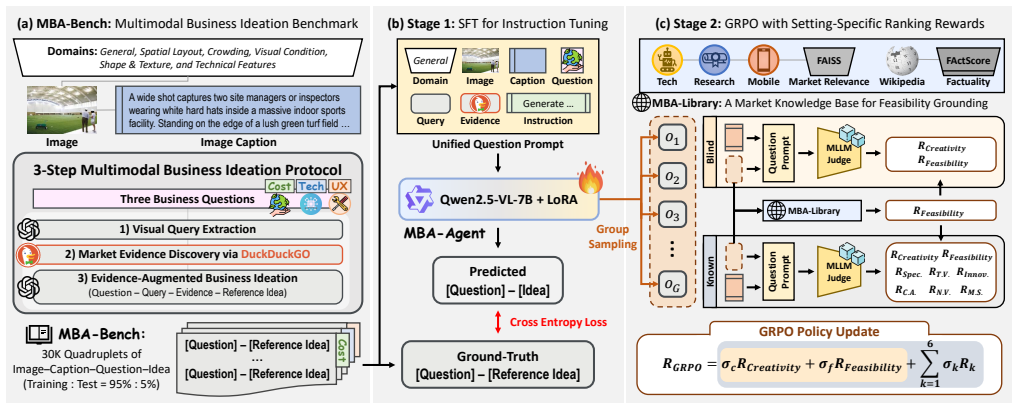
The carrier of the argument is the unified question prompt: each sample fuses the image, an automatic caption, a domain, one of three business questions (cost, technology, user experience), a visually grounded retrieval query, and market evidence retrieved through web search. On top of that, the training signal is a composite reward: creativity, scored by an MLLM judge relative to five reference ideas, and feasibility, computed against MBA-Library, a large web-sourced knowledge base, using embedding similarity for market relevance and FActScore for factuality. These rewards are combined and normalized within sampled groups, then used by group relative policy optimization to update a LoRA-tuned 7B vision-language model. The mechanism that counters the tendency toward conventional ideas is group-relative ranking: because ideas are compared only within a sampled group, judge scale bias is reduced and the policy is pushed toward ideas that are both novel and grounded.
What would settle it
Take the 100 test images, have a panel of entrepreneurs or venture analysts score the same generated ideas on the six PBIG dimensions, and correlate their scores with the InternVL2.5-78B judge scores used in the paper. If the rank correlation is weak, or if human raters prefer the baselines' ideas over MBA-b and MBA-k on creativity and feasibility, the claimed improvement in idea quality is not established.
Extended reading notes
Core claim
The paper's central claim is that visual information is not redundant with its caption for the purpose of finding business opportunities, and that this extra signal can be converted into better ideas by a purpose-trained agent. Concretely, on MBA-Bench, MBA-b outperforms the caption-based baseline by 63.9% and the multimodal baseline by 25.6%, while MBA-k outperforms them by 77.1% and 35.8%, with all ideas judged by an MLLM judge along six dimensions from the PBIG rubric. Creativity is scored as novelty relative to reference ideas; feasibility is scored against a web-sourced library via retrieval similarity and fact verification rather than by a judge alone. Training proceeds in two stages: LoRA supervised fine-tuning on GPT-4o-generated reference ideas, then GRPO with setting-specific rewards, using two objectives for the blind agent MBA-b and all eight for the known-criteria agent MBA-k. The paper claims this keeps a 7B-parameter open model competitive with much larger closed-source systems.
Load-bearing premise
All training rewards and all reported scores come from MLLM judges, and the paper states that direct human evaluation remains future work; the central claim collapses if those judge scores do not track what human experts would call a good business idea.
Editorial extensions
If this is right
- If visual cues drive idea quality, caption-only pipelines, including those built on patents, are missing a large share of the opportunity space.
- A 7B open model with GRPO and judge-based rewards can close most of the gap to closed-source models on structured idea generation, lowering the compute barrier for this task.
- The blind setting shows that a model can be trained for creativity and feasibility without knowing the evaluation rubric, which matches real deployments where criteria are hidden.
- The benchmark's per-domain structure makes it possible to test where visual information matters most, from easily verbalized everyday scenes to technical, spatial, and texture-heavy domains.
- Feasibility can be grounded through retrieval and fact checking rather than judge intuition, reducing hallucination in generated plans.
Reading between the lines
- If judge scores track expert human judgment, the same training recipe could extend to other open-ended generation tasks, such as product naming, marketing copy, or research proposals, wherever the criterion can be decomposed into creativity and feasibility.
- Because all reported gains are measured by an MLLM judge, the training may be optimizing for what judges reward, namely long, structured, concrete-sounding text, rather than commercially viable ideas; a human-preference test on the same test set would settle this.
- Since the image is the only input that differs between the caption and multimodal baselines, MBA-Bench could be reused as a probe for how much visual information any captioning model loses, beyond the ideation task itself.
- A natural extension, which the paper lists as future work, would condition generation on the user's capital, skills, and context, turning idea quality from a universal score into a personal one.
Signed reviews
Editorial analysis
A structured set of objections, weighed in public.
Referee Report
Summary. The paper introduces MBA-Bench, a multimodal benchmark for business ideation consisting of 30K image–caption–question–idea quadruplets across six visual domains, and two agents, MBA-b and MBA-k, trained with LoRA-based SFT followed by GRPO. MBA-b is trained with two reward objectives (creativity and feasibility), while MBA-k additionally optimizes the six PBIG evaluation criteria. All evaluation is performed by an MLLM judge (InternVL2.5-78B) on six business-oriented dimensions. The paper reports that MBA-b outperforms caption-only and multimodal baselines by 63.9% and 25.6%, respectively, and MBA-k by 77.1% and 35.8%, while remaining competitive with closed-source MLLMs.
Significance. If the reported gains reflect genuine improvements in business idea quality, this is a valuable contribution: MBA-Bench is the first multimodal benchmark for business ideation, the dataset and code are released, the training recipe separates the training-time judge from the evaluation-time judge, and the feasibility reward is grounded in an external knowledge library rather than relying solely on an MLLM. The multi-domain design with varying verbalizability is also a useful analytical choice. However, the central claim currently rests entirely on MLLM-as-a-Judge scores with no human validation, and MBA-k is explicitly optimized on the same six criteria used for evaluation. The significance of the paper therefore depends on whether the judge-based scores can be shown to correspond to expert human judgment or to generalizable idea quality.
major comments (3)
- [Section 4.2 / Table 3] The central claim that MBA-b and MBA-k generate better business ideas is supported only by scores from a single MLLM judge, InternVL2.5-78B. The paper itself states, 'Direct human evaluation of our agents on MBA-Bench remains future work.' Without any validation of this judge against expert human ratings, the reported improvements of 63.9%/77.1% and 25.6%/35.8% are, strictly speaking, evidence about the judge's preferences rather than about business idea quality. I ask the authors to add a human evaluation study on a representative subset (e.g., 100–200 ideas), reporting agreement or correlation with the MLLM judge, or to calibrate the judge against existing expert-scored data such as PBIG-Data (Hirota et al. 2026).
- [Section 3.2 / Figure 3c / Table 2] MBA-k's GRPO reward is a weighted sum of the six PBIG evaluation criteria, and evaluation uses those same six criteria. High test scores can therefore be produced by optimizing the rubric rather than by improving the underlying business ideas. This concern is reinforced by ceiling effects in Table 3: Specificity is 3.99/4.00 for MBA-k, Innovativeness is 4.00/5.00, and Section 4.2 itself notes that Specificity is 'tightly concentrated near the upper bound.' To support the claim of genuinely better ideas, the paper should demonstrate that the advantage persists when evaluated under a different rubric, by a judge not used during training, or by human experts.
- [Appendix A.2] All reported results are obtained from a single training run, as stated in Appendix A.2 ('all reported results are obtained from a single run'). The Wilcoxon tests in Table A2 measure differences across test images, not across training seeds. Because SFT and GRPO are stochastic, the headline improvements could be run-specific. The authors should provide results from at least three to five independent training runs, reporting mean and standard deviation for the main comparisons, to establish that the improvements are not an artifact of one seed.
minor comments (4)
- [Table 3] The LLaVA-OneVision-Qwen2-7B row is duplicated in Table 3; one of the entries should be removed or corrected to the intended model.
- [References / Table 1] The RICO dataset is cited as Li et al. 2023, 'RICO: Regularizing the Unobservable for Indoor Compositional Reconstruction,' but the RICO mobile-app dataset used for Spatial Layout is a different resource (Deka et al., 'Rico: A Mobile App Dataset for Building Data-Driven Design Applications'). The citation should be corrected.
- [Section 4.2] The sentence 'MBA-k ... achieves the best performance on both Creativity- and Feasibility-related metrics among all models' is imprecise because Table 3 reports only six PBIG dimensions, not Creativity and Feasibility. Please clarify the mapping from the two training-time rewards to the six reported metrics.
- [Abstract / Table 2] The abstract says 'eight business-oriented dimensions,' but Table 2 lists six business-oriented evaluation dimensions plus two training-time reward objectives (Creativity and Feasibility). Consider using a term such as 'eight reward dimensions' or 'eight objectives' to avoid conflating training rewards with the evaluation rubric.
Circularity Check
No significant circularity: MBA-k's use of the same six PBIG dimensions for reward and evaluation is the disclosed 'known' setting with separate training and evaluation judges, so the benchmark result is empirical rather than definitional.
full rationale
MBA-Bench is an empirical benchmark built from externally sourced datasets (ADE20K, RICO, COCO, VisA, DTD, DeepPCB), an externally defined rubric (PBIG), and an externally proposed judge paradigm (MLLM-as-a-Judge); none of these reduce to the paper's own outputs. The only close candidate for a self-referential loop is that MBA-k's GRPO reward includes the six PBIG dimensions that are also used for test evaluation (Table 2). This design is disclosed as the 'known' setting, the training judge (Qwen2-VL-72B) is distinct from the evaluation judge (InternVL2.5-78B), and the reported gains are against baselines that did not receive this reward, so the result is an empirical optimization outcome rather than a definitional identity. The paper's own statement that 'Direct human evaluation of our agents on MBA-Bench remains future work' (Section 4.2) is an external-validity caveat about the MLLM judge, not evidence of circularity. No load-bearing self-citations, uniqueness theorems, or ansatz-smuggling citations appear; all cited priors (PBIG, MLLM-as-a-Judge, GRPO, datasets) are external and independently checkable.
Assumptions & free parameters
free parameters (3)
- MBA-k reward weights =
Spec. 0.12, T.V. 0.12, Innov. 0.20, C.A. 0.16, N.V. 0.12, M.S. 0.08, Creativity 0.10, Feasibility 0.10
- MBA-b reward weights =
Creativity 0.70, Feasibility 0.30
- Domain image counts =
500, 350, 350, 350, 350, 100
assumptions (5)
- domain assumption MLLM-as-a-Judge scores are a valid proxy for human evaluation of business ideas
- domain assumption The six PBIG metrics are appropriate and sufficient for evaluating business ideation quality
- domain assumption GPT-4o-generated reference ideas are high-quality supervision for SFT
- domain assumption DuckDuckGo web retrieval provides relevant and sufficient market evidence
- domain assumption Visual information not captured in text improves business ideation
invented entities (2)
-
MBA-Bench
independent evidence
-
MBA-Library
independent evidence
Cite this review
Pith. "Pith review of MBA: Multimodal Benchmark and Agents for Real-World Business Ideation." pith.science (2026). https://pith.science/paper/6NRINCI7
@misc{pith2026260811616,
  author       = {Pith},
  title        = {Pith review of: MBA: Multimodal Benchmark and Agents for Real-World Business Ideation},
  year         = {2026},
  howpublished = {\url{https://pith.science/paper/6NRINCI7}},
  note         = {Machine review of arXiv:2608.11616}
}
read the original abstract
Agentic systems powered by large language models (LLMs) have opened new opportunities for business ideation. Yet existing approaches remain confined to a text-only paradigm, despite the inherently multimodal nature of real-world contexts. We thus introduce MBA-Bench, the first multimodal benchmark for training and evaluating business ideation agents, comprising 30K samples across six domains, each domain characterized by distinct visual cues not fully conveyed by text alone. Concretely, we automatically caption images and employ GPT-4o to generate five reference ideas for each of three business questions through retrieval query generation, market evidence retrieval, and evidence-augmented synthesis. Following prior work, we evaluate agents across six business-oriented criteria using MLLM-as-a-Judge. To consider settings where criteria are hidden or disclosed, we present MBA-b and MBA-k for blind and known, respectively. We train both with two novel reward objectives---creativity and feasibility---while MBA-k further optimizes the six disclosed criteria for eight in total. Both are trained via LoRA-based supervised fine-tuning followed by group relative policy optimization with these setting-specific rewards. For extensive experiments on MBA-Bench, we set up two baselines accommodating either captions only or multimodal inputs, with the latter nearing closed-source performance on several metrics. MBA-b and MBA-k outperform caption baselines by 63.9% and 77.1%, and multimodal baselines by 25.6% and 35.8%, respectively.
Figures


Figures from the paper (3 more)


Reference graph
Works this paper leans on
-
[1]
Inspect the actual image to identify the scene type, salient objects, spatial layout, users, activities, and practical constraints
-
[2]
Use the retrieved evidence as market, product, entity, or technical grounding
-
[3]
Generalize the evidence into realistic business patterns rather than copying app/company/entity names. [Critical Constraints]
-
[4]
Sustainable materials for interior design cost reduction
SPot-the-Difference Self-supervised Pre-training for Anomaly Detection and Segmentation. InComputer Vision - ECCV 2022 - 17th European Conference, Tel Aviv, Israel, October23-27,2022,Proceedings,PartXXX,volume13690, 392–408. Springer. Contents A Experimental Details 11 A.1 Device Information . . . . . . . . . . . . . 11 A.2 Implementation Details . . . . ...
work page 2022
-
[5]
Do not invent unsupported technologies, products, or market categories
-
[6]
Do NOT use retrieved app names, company names, or evidence titles as the Topic
-
[7]
Generalize evidence into reusable business concepts. Bad Topic: [Too Good To Go] Good Topic: [Surplus Food Discount Marketplace] Bad Topic: [ARLOOPA] Good Topic: [AR Product Visualization Tool]
-
[8]
Every idea must directly address the target user question
Show all 18 references
-
[9]
Every idea must be visually grounded in the actual image
-
[10]
Every idea should be supported by retrieved evidence when evidence is available
-
[11]
The ideas should be realistic market anchors, not speculative futuristic concepts
-
[15]
App", "Platform
The Topic must be a specific product/service concept, not a broad category such as "App", "Platform", "E-commerce", "AI", or "Furniture"
-
[16]
No intros, no explanations, no citations
Follow the output format exactly. No intros, no explanations, no citations. Do not reveal reasoning. [Output Format]
-
[20]
[Specific Generalized Topic]: [Detailed one-line business idea]
-
[21]
title":
[Specific Generalized Topic]: [Detailed one-line business idea] Figure A7: Prompt template used to construct MBA-Bench. [Task] <TARGET_USER_QUESTION> Use the visible image and the paired context below to generate exactly one grounded business idea. Use only this Q<QUERY_INDEX>...
-
[2022]
Priem, J.; Piwowar, H
Training language models to follow instructions with humanfeedback.Advancesinneuralinformationprocessing systems, 35: 27730–27744. Priem, J.; Piwowar, H. A.; and Orr, R. 2022. OpenAlex: A fully-openindexofscholarlyworks,authors,venues,institu- tions, and concepts.CoRR, abs/220...
2022 arXiv
-
[2025]
Kim,Y.;Park,C.;Jeong,H.;Chan,Y.S.;Xu,X.;McDuff,D.; Lee, H.; Ghassemi, M.; Breazeal, C.; and Park, H
Agent Ideate: A Framework for Product Idea Genera- tionfromPatentsUsingAgenticAI.CoRR,abs/2507.01717. Kim,Y.;Park,C.;Jeong,H.;Chan,Y.S.;Xu,X.;McDuff,D.; Lee, H.; Ghassemi, M.; Breazeal, C.; and Park, H. W. 2024. MDAgents: An Adaptive Collaboration of LLMs for Med- ical Decisio...
2024 arXiv
-
[2026]
Personalized Judges in Business Idea Evaluation: Evidence from Expert Disagreement.CoRR, abs/2604.22517
Aggregate vs. Personalized Judges in Business Idea Evaluation: Evidence from Expert Disagreement.CoRR, abs/2604.22517. Hu,E.J.;Shen,Y.;Wallis,P.;Allen-Zhu,Z.;Li,Y.;Wang,S.; Wang,L.;andChen,W.2022. LoRA:Low-RankAdaptation ofLargeLanguageModels. InTheTenthInternationalCon- feren...
2022 arXiv
Reviewed August 16, 2026 · model on record in the stance chip above.
Discussion (0). Continue with ORCID to comment.