REVIEW 3 major objections 4 minor 108 references
Hybrid-Policy Self-Editing for Composable Unstructured Knowledge Editing
T0 review · 3 major / 4 minor · reviewed 2026-08-16 · deepseek-v4-flash
Pith's one-line read Knowledge edits become composable when the student's own rollout is repaired mid-generation.
desk verdict A genuinely useful plug-in for composable unstructured knowledge editing, with a real but fixable gap: the privileged teacher's correctness is assumed, not verified. read the letter →
The pith
A machine-rendered reading of the paper's core claim, the machinery that carries it, and where it could break.
The reading
What carries the argument
The central object is the per-token hybrid rollout policy $\pi_\rho$ of Eq. (2), a switch between the student $\pi_\theta$ and the privileged model $\pi^\star = \pi_0(\cdot \mid c, x)$ that reads the edit passage in context. The step-in gate of Eq. (3) fires when two conditions hold: the privileged model's log-probability of its greedy token exceeds the student's by more than $\tau$, and that privileged token has confidence above $\kappa$. The gate converts coverage failure into targeted supervision by placing the missing fact tokens onto the student's own trajectory, and the loss of Eq. (4) matches the student to the privileged distribution over those prefixes via forward KL while an NLL term anchors the passage-level objective. The gate self-terminates: as the student internalizes the facts, the privileged–student gap falls below $\tau$ and the hybrid rollout converges to the on-policy rollout.
What would settle it
Take an edit passage engineered so the base model's in-context continuation of a fact is confident but wrong (an internal contradiction, a misleading paraphrase, or an entity whose in-context completion conflicts with the passage), run HPSE, and check whether the student adopts the wrong token. Separately, on a sample of UnKEBench edits, measure the student's probability $\rho$ of each fact token before editing and test whether $\rho < \kappa e^{-\tau}$; if the inequality fails, the theorem's coverage guarantee does not apply even if the method still improves scores.
Extended reading notes
Core claim
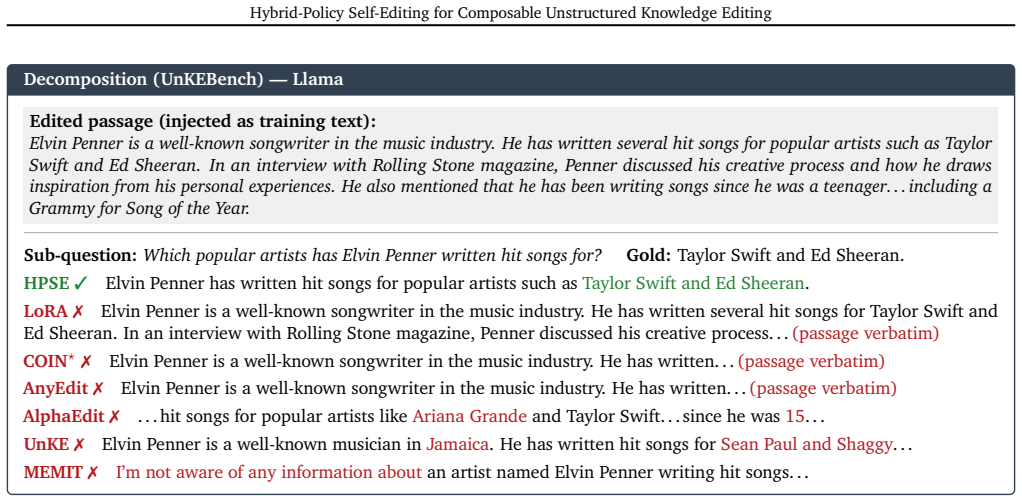
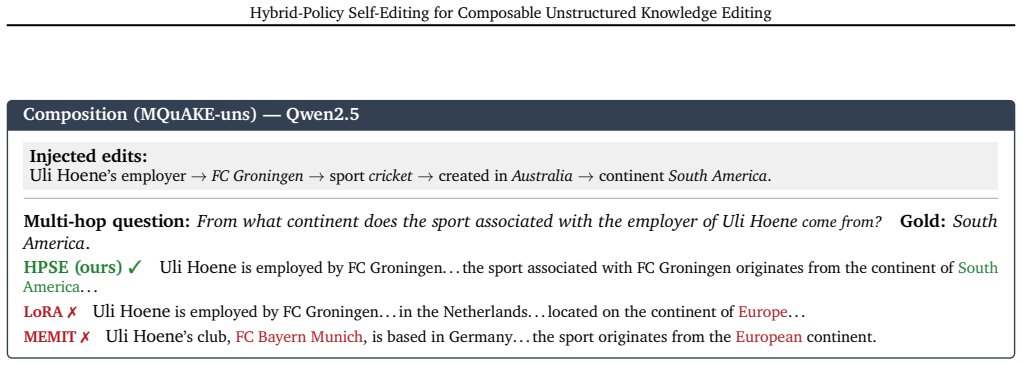
The central claim is that the gap between passively injected and usable knowledge is a coverage problem: because the new facts are novel, the pre-edited model's own rollouts rarely visit them, so pure on-policy self-distillation (OPSD) has almost no corrective signal to offer. HPSE closes this gap with a hybrid rollout policy that draws student tokens but switches to the privileged model's greedy token when the privileged–student gap exceeds $\tau$ and the privileged model's confidence exceeds $\kappa$; the student is then trained to match the privileged distribution on those prefixes. The paper proves that under its novelty assumptions the hybrid rollout visits every fact prefix, giving a fact-signal $S_{\pi_\rho} = \Omega(\ell)$, while OPSD's signal stays $O(1)$, so the advantage grows with the length of the new fact span. On the empirical side, HPSE is reported to improve composed recall by +2.3 points on average for FT-M and +9.9 points for LoRA, and to lift decomposed recall while preserving answer diversity and MMLU locality.
Load-bearing premise
The method assumes that the base model's in-context reading of the edit passage, $\pi^\star = \pi_0(\cdot \mid c, x)$, reliably produces the correct, stylistically compatible next token for every fact it injects, because there is no external verifier and the student will imitate whatever the privileged model emits.
Editorial extensions
If this is right
- Existing gradient-based KE editors such as FT-M and LoRA can gain composability without changing which parameters they update, because HPSE replaces only the training signal.
- Editing becomes more useful for downstream agents: injected facts can be queried atomically and chained into multi-hop answers, rather than requiring the original passage as a retrieval cue.
- The step-in gate self-terminates, so the intervention is a temporary curriculum rather than a permanent auxiliary mechanism.
- Under continual editing, the advantage persists as edits accumulate, with 29 of 32 tested editor–model–horizon settings improved.
- The theoretical analysis predicts the benefit grows with the length of the new fact span, which is exactly the unstructured-editing regime.
Reading between the lines
- Replace the max-probability confidence gate with an entropy-based or calibrated-uncertainty gate and the behavior should be similar, since the theory's $\kappa$ floor exists to keep the per-token signal bounded away from zero; this is a cheap ablation.
- Because HPSE is token-level and parameter-agnostic, it should transfer to representation-level editors and to non-text token spaces, which the authors list as future work; the coverage argument does not depend on a particular parameterization.
- The benchmarking protocol suggests that UKE evaluations should report diversity alongside decomposed recall, since a model that regurgitates the passage can otherwise masquerade as having decomposed knowledge.
- A stress test worth running is adversarial passages that make the privileged model confident but wrong; if HPSE amplifies such errors, the method inherits every systematic bias of in-context learning.
Signed reviews
Editorial analysis
A structured set of objections, weighed in public.
Referee Report
Summary. The paper introduces Hybrid-Policy Self-Editing (HPSE), a training-signal replacement for gradient-based knowledge editors in the unstructured knowledge editing (UKE) setting. HPSE defines a privileged teacher as the frozen base model with the edit passage in context, constructs hybrid rollouts that switch from the student's own tokens to the teacher's greedy token under a confidence-and-disagreement gate (Eqs. 2--3), and trains the student with a forward-KL distillation loss toward the teacher plus an NLL anchor (Eq. 4). The main empirical contribution is a two-benchmark composability evaluation (UnKEBench and MQuAKE-uns) showing consistent gains for FT-M and LoRA across Qwen2.5, Qwen3, Llama-3.1, and Gemma-2 in single-edit and continual-edit settings. Appendix A contains a formal signal-separation theorem under Assumptions A.1--A.3.
Significance. Strengths: the empirical evaluation is grounded in external gold-answer benchmarks (exact-match for MQuAKE-uns; expected-fact judge for UnKEBench), so the main empirical claim is not circular. The paper reports ablations, gate sensitivity, step-in dynamics, and continual-editing results, and provides a code repository. If the reported gains hold, HPSE is a practical plug-in that makes existing editors composability-aware without changing their parameterization. The main caveat is that the theoretical analysis covers the teacher's confident tokens, not independently verified gold facts; the significance of the method depends on the privileged model's in-context correctness, which the paper assumes but does not measure.
major comments (3)
- [Appendix A, Assumption A.1; Section 3.2, Eq. (3)] The gate in Eq. (3) injects the teacher's greedy token whenever the privileged model is confident, with no external verifier. Assumption A.1 defines the fact span as those same teacher tokens, y_star, and posits that they are the new-knowledge tokens the student lacks. The paper reports no measurement of how often the privileged model's confident tokens agree with the gold-answer facts on either benchmark (e.g., a per-token or per-question agreement rate), nor any analysis of cases where the base model reverts to prior knowledge or hallucinates a passage reading. Because the student is trained to imitate these tokens at exactly the step-in positions, the semantic claim that HPSE injects the intended knowledge is contingent on an unverified premise. The empirical gains suggest the teacher is often right on these datasets, but the paper should either supply this verification or explicitly qualify the central claim.
- [Section 3.3, Theorem 3.1; Appendix A.2] The informal theorem states that 'the hybrid signal is Omega(ell) while the OPSD signal is O(1)', but the signal is the KL divergence to the privileged model's distribution, and the fact span is the teacher's own greedy token sequence. The theorem is therefore a coverage statement about the teacher's confident continuation, not a statement about the gold facts. The manuscript's abstract and Section 4.2 use 'injects the knowledge' in ways that go beyond what the proof establishes. I request a revised theorem statement and interpretation that makes this conditional explicit, together with either an empirical link between teacher tokens and gold facts or a relaxation of the claim.
- [Section 4.3, Table 7 (MQuAKE-uns, Qwen3, T=10)] In this cell, HPSE improves Ind. from 2.0 to 5.1 but lowers Cmp. from 12.0 to 8.0 (-33.3%). The aggregate average remains within one point (7.0 vs. 6.5), so the paper's stated 'exceptions within one point on average' is technically correct, but the trade-off between individual and compositional recall in this cell is a direct counterexample to the general claim that HPSE improves composability. The paper should analyze this cell and state the conditions under which HPSE can hurt composition despite improving individual recall.
minor comments (4)
- [Appendix D.2, Table 8] The tau sweep shows Jnt. dropping from 75.0 (tau=2) to 69.6 (tau=4), a 5.4-point change on one metric; the 'robust' conclusion is based on the average varying within 2.2 points. Please report per-metric variability and discuss the practical choice of tau in light of this Jnt.-Dmp. trade-off.
- [Section 4.3, Figure 4] The continual-edit results are presented only as filled/outline bars, and the reader cannot see the variance or per-metric dispersion from the figure. Consider showing error bars or per-metric values in the main text for at least one setting, or moving the figure to a more readable format in an appendix.
- [Appendix C.2, Table 4] The gate calibration is described as 'inspecting the number of tokens they select on a few sample sequences', which is not sufficiently operationalized for replication. Please specify the target step-in rate or a concrete calibration procedure.
- [Section 5, Related Work] CODE (Li et al., 2026a) is a closely related on-policy self-distillation method adapted to knowledge editing; its exclusion from the experiments is reasonable given its dependence on an external frontier model for narrative synthesis, but this should be stated explicitly in the experiment section.
Circularity Check
Coverage-separation theorem restates the fact-span definition and Assumption A.1; the external benchmark results are not circular.
-
self definitional
[Appendix A.1–A.2, Assumption A.1 and Theorem A.1 (informal version: Section 3.3, Theorem 3.1)]
"At step t, define the teacher's greedy token by y⋆t ≜ arg max_v π⋆(v|x,y<t). We call a run of ℓ consecutive positions carrying the injected knowledge a fact span... At every fact prefix F_j, πθ(y⋆_{j+1}|F_j) ≤ ρ, π⋆(y⋆_{j+1}|F_j) > κ. Moreover, the edit is τ-detectable: ρ < κe^{−τ}. ... Hence the step-in fires at each fact token—a consequence, not an assumption."
The coverage separation is derived from the same inequalities that are put in by hand. Because y⋆ is defined as the argmax of π⋆, and Assumption A.1 already asserts at every fact prefix that π⋆(y⋆) > κ and πθ(y⋆) ≤ ρ < κe^{−τ}, the gate in Eq. (3) fires at every fact prefix by construction; c_j(πρ) = 1 in Theorem A.1 is a restatement of that assumption. The student-side bound c_j(πθ) ≤ ρ^j ≤ e^{−τj} is just the assumed per-prefix bound iterated. The Θ(ℓ)-vs-Θ(1) signal separation is therefore the input assumption rewritten in coverage notation, not an independent first-principles derivation of why HPSE should succeed. The fact span being defined as the teacher's own greedy tokens makes 'the hybrid visits every fact prefix' close to tautological.
full rationale
The main HPSE claim—that replacing the editing loss with a hybrid-rollout distillation improves decomposition and composition on UnKEBench and MQuAKE-uns—is evaluated against fixed external gold answers (FActScore, LLM-as-judge prompts, official MQuAKE matching), so that claim is not circular and is not forced by any fitted parameter. The step-in thresholds τ and κ are calibrated once and fixed, and the reported gains are against baselines under the same untargeted editing prompts. Self-citations to Liu et al. (2025a,b) and Wang et al. (2024a) are background or related-work citations, not load-bearing premises, and no uniqueness theorem is imported from the authors' prior work. The only respect in which the derivation is self-referential is the theoretical coverage result: the fact span is defined as the privileged teacher's greedy tokens, and Assumption A.1 already asserts at those tokens that the teacher is confident and the student is not; the gate then fires there by construction, so c_j(πρ)=1 and c_j(πθ)≤e^{−τj} are repackaged assumptions rather than an independent prediction. This localized step does not contaminate the empirical comparisons. A separate concern—that teacher confidence is not factuality—is a correctness risk, not a circularity, and is not scored here.
Assumptions & free parameters
free parameters (6)
- Step-in gap gate τ =
2.0
- Teacher confidence gate κ =
0.3
- NLL anchor weight λ =
1.0
- Outer rounds R =
5
- Inner steps M =
8
- Top-K for KL target =
16
assumptions (5)
- domain assumption Novel edit assumption: the student's probability of producing the fact tokens is at most ρ while the teacher's is above κ, with ρ < κ e^{-τ} (Assumption A.1).
- domain assumption Stationary student during each rollout (Assumption A.2).
- standard math Uniformly bounded per-token KL (Assumption A.3).
- domain assumption Context separation: fact prefixes differ from passage prefixes (Assumption A.4).
- domain assumption In-context learning reliability of the frozen base model.
Cite this review
Pith. "Pith review of Hybrid-Policy Self-Editing for Composable Unstructured Knowledge Editing." pith.science (2026). https://pith.science/paper/6IBJVPWO
@misc{pith2026260811660,
  author       = {Pith},
  title        = {Pith review of: Hybrid-Policy Self-Editing for Composable Unstructured Knowledge Editing},
  year         = {2026},
  howpublished = {\url{https://pith.science/paper/6IBJVPWO}},
  note         = {Machine review of arXiv:2608.11660}
}
read the original abstract
Large language models (LLMs) achieve remarkable performance across natural language tasks, yet they are trained on static corpora and their knowledge quickly becomes outdated in a fast-changing world. This motivates knowledge editing (KE), which updates specific knowledge in an LLM without changing unrelated others. Recent works move from structured knowledge triples toward unstructured KE (UKE), where the edit is a free-form passage that may state multiple facts at once. Nonetheless, existing editors inject such a passage yet fail to use it: the edited model can recall the passage, but can neither answer atomic questions about its facts nor compose them into multi-hop reasoning. We attribute this missing property, which we term composability, to editors' passive reliance on the fixed passage as the sole learning source. In response, we cast editing as a proactive self-distillation from a privileged in-context state of the same model, which requires no external supervision. We further reveal that due to the novelty of the injected knowledge, the pre-edited model's own rollouts rarely cover it, which limits the effectiveness of pure on-policy distillation. To close this gap, we propose HPSE, which builds a hybrid rollout that steps in to place missing facts onto the student's own trajectory precisely where its coverage fails, while staying on-policy elsewhere. We theoretically analyze HPSE's advantage over pure on-policy distillation, and empirically establish its plug-and-play improvements across four LLM backbones and two KE editors under various scenarios.
Figures


Figures from the paper (13 more)






Reference graph
Works this paper leans on
-
[1]
Locating and Editing Factual Associations in
Meng, Kevin and Bau, David and Andonian, Alex and Belinkov, Yonatan , booktitle =. Locating and Editing Factual Associations in
-
[2]
International Conference on Learning Representations (ICLR) , year =
Mass-Editing Memory in a Transformer , author =. International Conference on Learning Representations (ICLR) , year =
-
[3]
Fang, Junfeng and Jiang, Houcheng and Wang, Kun and Ma, Yunshan and Shi, Jie and Wang, Xiang and He, Xiangnan and Chua, Tat-Seng , booktitle =
-
[4]
Deng, Jingcheng and Pang, Liang and Shen, Huawei and Cheng, Xueqi , booktitle =
-
[5]
arXiv preprint arXiv:2502.05628 , year =
Edit Any Knowledge Encoded in Language Models , author =. arXiv preprint arXiv:2502.05628 , year =
-
[6]
and Luu, Anh T
Wu, Xiaobao and Pan, Liangming and Wang, William Y. and Luu, Anh T. , booktitle =
-
[7]
and Potts, Christopher and Chen, Danqi , booktitle =
Zhong, Zexuan and Wu, Zhengxuan and Manning, Christopher D. and Potts, Christopher and Chen, Danqi , booktitle =
-
[8]
arXiv preprint arXiv:2602.19043 , year =
Uncovering Context Reliance in Unstructured Knowledge Editing , author =. arXiv preprint arXiv:2602.19043 , year =
Show all 108 references
-
[9]
Min, Sewon and Krishna, Kalpesh and Lyu, Xinxi and Lewis, Mike and Yih, Wen-tau and Koh, Pang Wei and Iyyer, Mohit and Zettlemoyer, Luke and Hajishirzi, Hannaneh , booktitle =
-
[10]
International ACM SIGIR Conference on Research and Development in Information Retrieval (SIGIR) , year =
Texygen: A Benchmarking Platform for Text Generation Models , author =. International ACM SIGIR Conference on Research and Development in Information Retrieval (SIGIR) , year =
-
[11]
arXiv preprint arXiv:2412.15115 , year =
Qwen2.5 Technical Report , author =. arXiv preprint arXiv:2412.15115 , year =
-
[12]
arXiv preprint arXiv:2505.09388 , year =
Qwen3 Technical Report , author =. arXiv preprint arXiv:2505.09388 , year =
-
[13]
arXiv preprint arXiv:2407.21783 , year =
The Llama 3 Herd of Models , author =. arXiv preprint arXiv:2407.21783 , year =
-
[14]
arXiv preprint arXiv:2408.00118 , year =
Gemma 2: Improving Open Language Models at a Practical Size , author =. arXiv preprint arXiv:2408.00118 , year =
-
[15]
arXiv preprint arXiv:2401.01286 , year =
A Comprehensive Study of Knowledge Editing for Large Language Models , author =. arXiv preprint arXiv:2401.01286 , year =
-
[16]
Aging with
Hartvigsen, Thomas and Sankaranarayanan, Swami and Palangi, Hamid and Kim, Yoon and Ghassemi, Marzyeh , booktitle =. Aging with
-
[17]
Wang, Peng and Li, Zexi and Zhang, Ningyu and Xu, Ziwen and Yao, Yunzhi and Jiang, Yong and Xie, Pengjun and Huang, Fei and Chen, Huajun , booktitle =
-
[18]
International Conference on Learning Representations (ICLR) , year =
Unifying Distillation and Privileged Information , author =. International Conference on Learning Representations (ICLR) , year =
-
[19]
International Conference on Learning Representations (ICLR) , year =
In-Context Editing: Learning Knowledge from Self-Induced Distributions , author =. International Conference on Learning Representations (ICLR) , year =
-
[20]
arXiv preprint arXiv:2410.07819 , year =
Uncovering Overfitting in Large Language Model Editing , author =. arXiv preprint arXiv:2410.07819 , year =
-
[21]
Mitigating Heterogeneous Token Overfitting in
Tianci Liu and Ruirui Li and Zihan Dong and Hui Liu and Xianfeng Tang and Qingyu Yin and Linjun Zhang and Haoyu Wang and Jing Gao , booktitle=. Mitigating Heterogeneous Token Overfitting in
-
[22]
Zhang, Zihao and others , booktitle =
-
[23]
Transactions of the Association for Computational Linguistics (TACL) , year =
Evaluating the Ripple Effects of Knowledge Editing in Language Models , author =. Transactions of the Association for Computational Linguistics (TACL) , year =
-
[24]
Conference on Empirical Methods in Natural Language Processing (EMNLP) , year =
Can We Edit Factual Knowledge by In-Context Learning? , author =. Conference on Empirical Methods in Natural Language Processing (EMNLP) , year =
-
[25]
and Shen, Yelong and Wallis, Phillip and Allen-Zhu, Zeyuan and Li, Yuanzhi and Wang, Shean and Wang, Lu and Chen, Weizhu , booktitle =
Hu, Edward J. and Shen, Yelong and Wallis, Phillip and Allen-Zhu, Zeyuan and Li, Yuanzhi and Wang, Shean and Wang, Lu and Chen, Weizhu , booktitle =
-
[26]
Advances in Neural Information Processing Systems (NeurIPS) , year =
Attention is All You Need , author =. Advances in Neural Information Processing Systems (NeurIPS) , year =
-
[27]
Advances in Neural Information Processing Systems (NeurIPS) , year =
Language Models are Few-Shot Learners , author =. Advances in Neural Information Processing Systems (NeurIPS) , year =
-
[28]
Advances in Neural Information Processing Systems (NeurIPS) , year =
Training Language Models to Follow Instructions with Human Feedback , author =. Advances in Neural Information Processing Systems (NeurIPS) , year =
-
[29]
Sparks of Artificial General Intelligence: Early Experiments with
Bubeck, S. Sparks of Artificial General Intelligence: Early Experiments with. arXiv preprint arXiv:2303.12712 , year =
-
[30]
Advances in Neural Information Processing Systems (NeurIPS) , year =
A Neural Probabilistic Language Model , author =. Advances in Neural Information Processing Systems (NeurIPS) , year =
-
[31]
Neural Computation , volume =
Long Short-Term Memory , author =. Neural Computation , volume =
-
[32]
Advances in Neural Information Processing Systems (NeurIPS) , year =
Sequence to Sequence Learning with Neural Networks , author =. Advances in Neural Information Processing Systems (NeurIPS) , year =
-
[33]
Learning Phrase Representations using
Cho, Kyunghyun and van Merri. Learning Phrase Representations using. Conference on Empirical Methods in Natural Language Processing (EMNLP) , year =
-
[34]
arXiv preprint arXiv:2310.16218 , year =
Knowledge Editing for Large Language Models: A Survey , author =. arXiv preprint arXiv:2310.16218 , year =
-
[35]
arXiv preprint arXiv:1503.02531 , year =
Distilling the Knowledge in a Neural Network , author =. arXiv preprint arXiv:1503.02531 , year =
-
[36]
International Conference on Learning Representations (ICLR) , year =
On-Policy Distillation of Language Models: Learning from Self-Generated Mistakes , author =. International Conference on Learning Representations (ICLR) , year =
-
[37]
Gu, Yuxian and Dong, Li and Wei, Furu and Huang, Minlie , booktitle =
-
[38]
International Conference on Learning Representations (ICLR) , year =
Speculative Knowledge Distillation: Bridging the Teacher-Student Gap Through Interleaved Sampling , author =. International Conference on Learning Representations (ICLR) , year =
-
[39]
arXiv preprint arXiv:2602.12275 , year =
On-Policy Context Distillation for Language Models , author =. arXiv preprint arXiv:2602.12275 , year =
-
[40]
Ding, Ken , journal =
-
[41]
International Conference on Learning Representations (ICLR) , year =
Fast Model Editing at Scale , author =. International Conference on Learning Representations (ICLR) , year =
-
[42]
International Conference on Machine Learning (ICML) , year =
Memory-Based Model Editing at Scale , author =. International Conference on Machine Learning (ICML) , year =
-
[43]
Does Reinforcement Learning Really Incentivize Reasoning Capacity in
Yue, Yang and Chen, Zhiqi and Lu, Rui and Zhao, Andrew and Wang, Zhaokai and Song, Shiji and Huang, Gao , booktitle =. Does Reinforcement Learning Really Incentivize Reasoning Capacity in
-
[44]
Zian Su and Ziyang Huang and Kaiyuan Zhang and Xiangyu Zhang , booktitle=. \
-
[45]
The Thirteenth International Conference on Learning Representations , year=
Unlocking Efficient, Scalable, and Continual Knowledge Editing with Basis-Level Representation Fine-Tuning , author=. The Thirteenth International Conference on Learning Representations , year=
-
[46]
Shaochen Zhong and Yifan Lu and Lize Shao and Bhargav Bhushanam and Xiaocong Du and Yixin Wan and Yucheng Shi and Daochen Zha and Yiwei Wang and Ninghao Liu and Kaixiong Zhou and Shuai Xu and Kai-Wei Chang and Louis Feng and Vipin Chaudhary and Xia Hu , booktitle=
-
[47]
2025 , eprint=
Is Fine-Tuning an Effective Solution? Reassessing Knowledge Editing for Unstructured Data , author=. 2025 , eprint=
2025
-
[48]
The Fourteenth International Conference on Learning Representations , year=
Fine-tuning Done Right in Model Editing , author=. The Fourteenth International Conference on Learning Representations , year=
-
[49]
2023 , eprint=
Generative Pre-trained Transformer: A Comprehensive Review on Enabling Technologies, Potential Applications, Emerging Challenges, and Future Directions , author=. 2023 , eprint=
2023
-
[50]
Language Models are Unsupervised Multitask Learners , author=
-
[51]
The Mirage of Model Editing: Revisiting Evaluation in the Wild
Yang, Wanli and Sun, Fei and Tan, Jiajun and Ma, Xinyu and Cao, Qi and Yin, Dawei and Shen, Huawei and Cheng, Xueqi. The Mirage of Model Editing: Revisiting Evaluation in the Wild. Proceedings of the 63rd Annual Meeting of the Association for Computational Linguistics (Volume ...
2025
-
[52]
FABLE : Fine-grained Fact Anchoring for Unstructured Model Editing
Wang, Peng and Zhou, Biyu and Tang, Xuehai and Han, Jizhong and Hu, Songlin. FABLE : Fine-grained Fact Anchoring for Unstructured Model Editing. Findings of the A ssociation for C omputational L inguistics: ACL 2026. 2026
2026
-
[53]
2024 , eprint=
DeepEdit: Knowledge Editing as Decoding with Constraints , author=. 2024 , eprint=
2024
-
[54]
C a KE : Circuit-aware Editing Enables Generalizable Knowledge Learners
Yao, Yunzhi and Fang, Jizhan and Gu, Jia-Chen and Zhang, Ningyu and Deng, Shumin and Chen, Huajun and Peng, Nanyun. C a KE : Circuit-aware Editing Enables Generalizable Knowledge Learners. Proceedings of the 2025 Conference on Empirical Methods in Natural Language Processing. 2025
2025
-
[55]
S tep KE : Stepwise Knowledge Editing for Multi-Hop Question Answering
Lee, Jaewook and Jung, Dahyun and Lim, Heuiseok. S tep KE : Stepwise Knowledge Editing for Multi-Hop Question Answering. Findings of the Association for Computational Linguistics: EMNLP 2025. 2025
2025
-
[56]
2026 , eprint=
A Survey of On-Policy Distillation for Large Language Models , author=. 2026 , eprint=
2026
-
[57]
2026 , eprint=
Rethinking On-Policy Distillation of Large Language Models: Phenomenology, Mechanism, and Recipe , author=. 2026 , eprint=
2026
-
[58]
2026 , eprint=
Self-Distilled Reasoner: On-Policy Self-Distillation for Large Language Models , author=. 2026 , eprint=
2026
-
[59]
Forty-second International Conference on Machine Learning , year=
Reinforced Lifelong Editing for Language Models , author=. Forty-second International Conference on Machine Learning , year=
-
[60]
arXiv preprint arXiv:2402.11905 , year=
Learning to edit: Aligning llms with knowledge editing , author=. arXiv preprint arXiv:2402.11905 , year=
-
[61]
2024 , eprint=
RoseLoRA: Row and Column-wise Sparse Low-rank Adaptation of Pre-trained Language Model for Knowledge Editing and Fine-tuning , author=. 2024 , eprint=
2024
-
[62]
Proceedings of the AAAI Conference on Artificial Intelligence , volume=
Melo: Enhancing model editing with neuron-indexed dynamic lora , author=. Proceedings of the AAAI Conference on Artificial Intelligence , volume=
-
[63]
arXiv preprint arXiv:2404.03592 , year=
Reft: Representation finetuning for language models , author=. arXiv preprint arXiv:2404.03592 , year=
-
[64]
Advances in Neural Information Processing Systems , volume=
Locating and editing factual associations in GPT , author=. Advances in Neural Information Processing Systems , volume=
-
[65]
arXiv preprint arXiv:2210.07229 , year=
Mass-editing memory in a transformer , author=. arXiv preprint arXiv:2210.07229 , year=
-
[66]
knowledge editing in language models , author=
Does localization inform editing? surprising differences in causality-based localization vs. knowledge editing in language models , author=. Advances in Neural Information Processing Systems , volume=
-
[67]
arXiv preprint arXiv:2110.11309 , year=
Fast model editing at scale , author=. arXiv preprint arXiv:2110.11309 , year=
-
[68]
arXiv preprint arXiv:2401.17623 , year=
Neighboring perturbations of knowledge editing on large language models , author=. arXiv preprint arXiv:2401.17623 , year=
-
[69]
Transactions of the Association for Computational Linguistics , volume=
Evaluating the ripple effects of knowledge editing in language models , author=. Transactions of the Association for Computational Linguistics , volume=
-
[70]
arXiv preprint arXiv:2505.00661 , year=
On the generalization of language models from in-context learning and finetuning: a controlled study , author=. arXiv preprint arXiv:2505.00661 , year=
-
[71]
The Twelfth International Conference on Learning Representations , year=
Massive Editing for Large Language Models via Meta Learning , author=. The Twelfth International Conference on Learning Representations , year=
-
[72]
arXiv preprint arXiv:2402.16123 , year=
Instructedit: Instruction-based knowledge editing for large language models , author=. arXiv preprint arXiv:2402.16123 , year=
-
[73]
arXiv preprint arXiv:2402.13048 , year=
Stable knowledge editing in large language models , author=. arXiv preprint arXiv:2402.13048 , year=
-
[74]
2025 , eprint=
Lifelong Knowledge Editing for LLMs with Retrieval-Augmented Continuous Prompt Learning , author=. 2025 , eprint=
2025
-
[75]
arXiv preprint arXiv:2104.08164 , year=
Editing factual knowledge in language models , author=. arXiv preprint arXiv:2104.08164 , year=
-
[76]
Proceedings of the AAAI Conference on Artificial Intelligence , volume=
Pmet: Precise model editing in a transformer , author=. Proceedings of the AAAI Conference on Artificial Intelligence , volume=
-
[77]
Proceedings of the 2024 Conference on Empirical Methods in Natural Language Processing , pages=
Model editing harms general abilities of large language models: Regularization to the rescue , author=. Proceedings of the 2024 Conference on Empirical Methods in Natural Language Processing , pages=
2024
-
[78]
Findings of the Association for Computational Linguistics: EMNLP 2024 , pages=
A unified framework for model editing , author=. Findings of the Association for Computational Linguistics: EMNLP 2024 , pages=
2024
-
[79]
2025 , eprint=
Perturbation-Restrained Sequential Model Editing , author=. 2025 , eprint=
2025
-
[80]
2024 , eprint=
WilKE: Wise-Layer Knowledge Editor for Lifelong Knowledge Editing , author=. 2024 , eprint=
2024
-
[81]
Does Reinforcement Learning Really Incentivize Reasoning Capacity in
Yang Yue and Zhiqi Chen and Rui Lu and Andrew Zhao and Zhaokai Wang and Yang Yue and Shiji Song and Gao Huang , booktitle=. Does Reinforcement Learning Really Incentivize Reasoning Capacity in
-
[82]
Cognitive Behaviors that Enable Self-Improving Reasoners, or, Four Habits of Highly Effective
Kanishk Gandhi and Ayush K Chakravarthy and Anikait Singh and Nathan Lile and Noah Goodman , booktitle=. Cognitive Behaviors that Enable Self-Improving Reasoners, or, Four Habits of Highly Effective
-
[83]
Proceedings of the 2025 Conference on Empirical Methods in Natural Language Processing , pages=
Rewarding the unlikely: Lifting grpo beyond distribution sharpening , author=. Proceedings of the 2025 Conference on Empirical Methods in Natural Language Processing , pages=
2025
-
[84]
Kakade and Cengiz Pehlevan and Samy Jelassi and Eran Malach , booktitle=
Rosie Zhao and Alexandru Meterez and Sham M. Kakade and Cengiz Pehlevan and Samy Jelassi and Eran Malach , booktitle=. Echo Chamber:
-
[85]
The Surprising Effectiveness of Negative Reinforcement in
Xinyu Zhu and Mengzhou Xia and Zhepei Wei and Wei-Lin Chen and Danqi Chen and Yu Meng , booktitle=. The Surprising Effectiveness of Negative Reinforcement in
-
[86]
Thinking Machines Lab: Connectionism , year =
Kevin Lu and Thinking Machines Lab , title =. Thinking Machines Lab: Connectionism , year =
-
[87]
2026 , eprint=
DOPD: Dual On-policy Distillation , author=. 2026 , eprint=
2026
-
[88]
Forty-third International Conference on Machine Learning , year=
Entropy-Aware On-Policy Distillation of Language Models , author=. Forty-third International Conference on Machine Learning , year=
-
[89]
2026 , eprint=
Self-Distillation Enables Continual Learning , author=. 2026 , eprint=
2026
-
[90]
2026 , eprint=
Beyond GRPO and On-Policy Distillation: An Empirical Sparse-to-Dense Reward Principle for Language-Model Post-Training , author=. 2026 , eprint=
2026
-
[91]
arXiv preprint arXiv:1910.13461 , year=
Bart: Denoising sequence-to-sequence pre-training for natural language generation, translation, and comprehension , author=. arXiv preprint arXiv:1910.13461 , year=
1910 arXiv
-
[92]
arXiv preprint arXiv:1909.10705 , year=
Do massively pretrained language models make better storytellers? , author=. arXiv preprint arXiv:1909.10705 , year=
1909 arXiv
-
[93]
The Journal of Machine Learning Research , volume=
Exploring the limits of transfer learning with a unified text-to-text transformer , author=. The Journal of Machine Learning Research , volume=
-
[94]
ACM Computing Surveys , volume=
Survey of hallucination in natural language generation , author=. ACM Computing Surveys , volume=
-
[95]
arXiv preprint arXiv:2108.07258 , year=
On the opportunities and risks of foundation models , author=. arXiv preprint arXiv:2108.07258 , year=
-
[96]
arXiv preprint arXiv:2302.09419 , year=
A comprehensive survey on pretrained foundation models: A history from bert to chatgpt , author=. arXiv preprint arXiv:2302.09419 , year=
-
[97]
arXiv preprint arXiv:2301.00234 , year=
A survey for in-context learning , author=. arXiv preprint arXiv:2301.00234 , year=
-
[98]
Advances in neural information processing systems , volume=
Large language models are zero-shot reasoners , author=. Advances in neural information processing systems , volume=
-
[99]
arXiv preprint arXiv:2104.08696 , year=
Knowledge neurons in pretrained transformers , author=. arXiv preprint arXiv:2104.08696 , year=
-
[100]
Tianzhe Chu and Yuexiang Zhai and Jihan Yang and Shengbang Tong and Saining Xie and Dale Schuurmans and Quoc V Le and Sergey Levine and Yi Ma , booktitle=
-
[101]
Proceedings of the fourteenth international conference on artificial intelligence and statistics , pages=
A reduction of imitation learning and structured prediction to no-regret online learning , author=. Proceedings of the fourteenth international conference on artificial intelligence and statistics , pages=. 2011 , organization=
2011
-
[102]
2010 , publisher=
Efficient reductions for imitation learning , author=. 2010 , publisher=
2010
-
[103]
Advances in Neural Information Processing Systems , volume=
Toward the fundamental limits of imitation learning , author=. Advances in Neural Information Processing Systems , volume=
-
[104]
International Conference on Machine Learning , pages=
Of moments and matching: A game-theoretic framework for closing the imitation gap , author=. International Conference on Machine Learning , pages=. 2021 , organization=
2021
-
[105]
Proceedings of the Nineteenth International Conference on Machine Learning , pages=
Kakade, Sham and Langford, John , title=. Proceedings of the Nineteenth International Conference on Machine Learning , pages=. 2002 , isbn=
2002
-
[106]
arXiv preprint arXiv:2111.02080 , year=
An explanation of in-context learning as implicit bayesian inference , author=. arXiv preprint arXiv:2111.02080 , year=
-
[107]
1999 , publisher=
Elements of information theory , author=. 1999 , publisher=
1999
-
[108]
2026 , eprint=
From Fact Overwriting to Knowledge Evolution: Causal Editing via On-Policy Self-Distillation , author=. 2026 , eprint=
2026
Reviewed August 16, 2026 · model on record in the stance chip above.
Discussion (0). Continue with ORCID to comment.