Artificial Intelligence · arXiv:2608.11676 v2 · submitted 12 Aug 2026
XBridge: Entity-Grounded Latent Bridge for Heterogeneous LLM Communication
The paper says
“Heterogeneous multi-agent LLM systems, where agents are powered by different model families, can outperform homogeneous configurations by reducing redundant reasoning patterns.”
more of the abstract
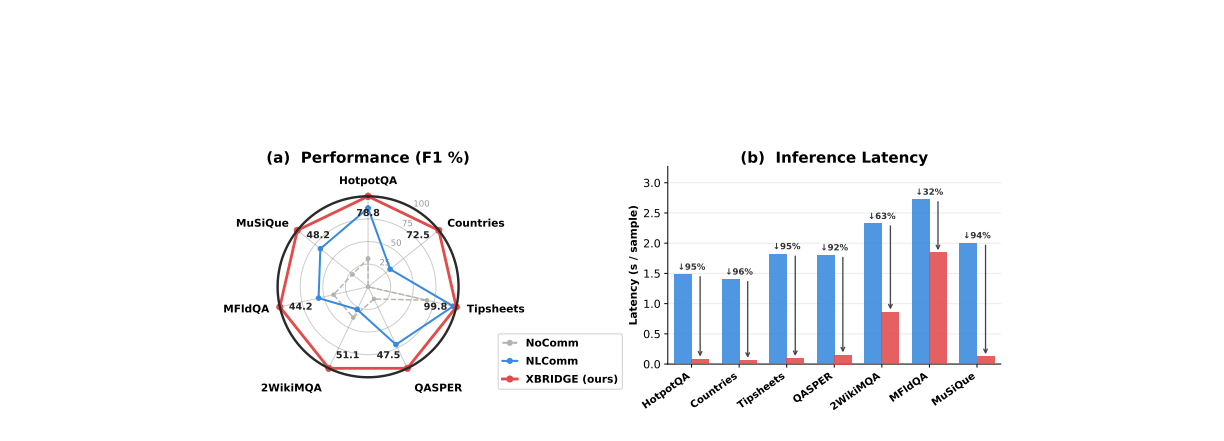
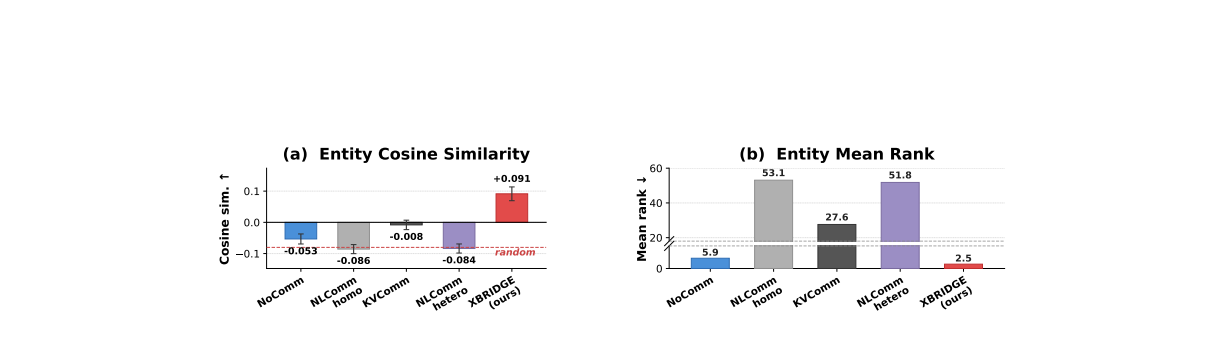
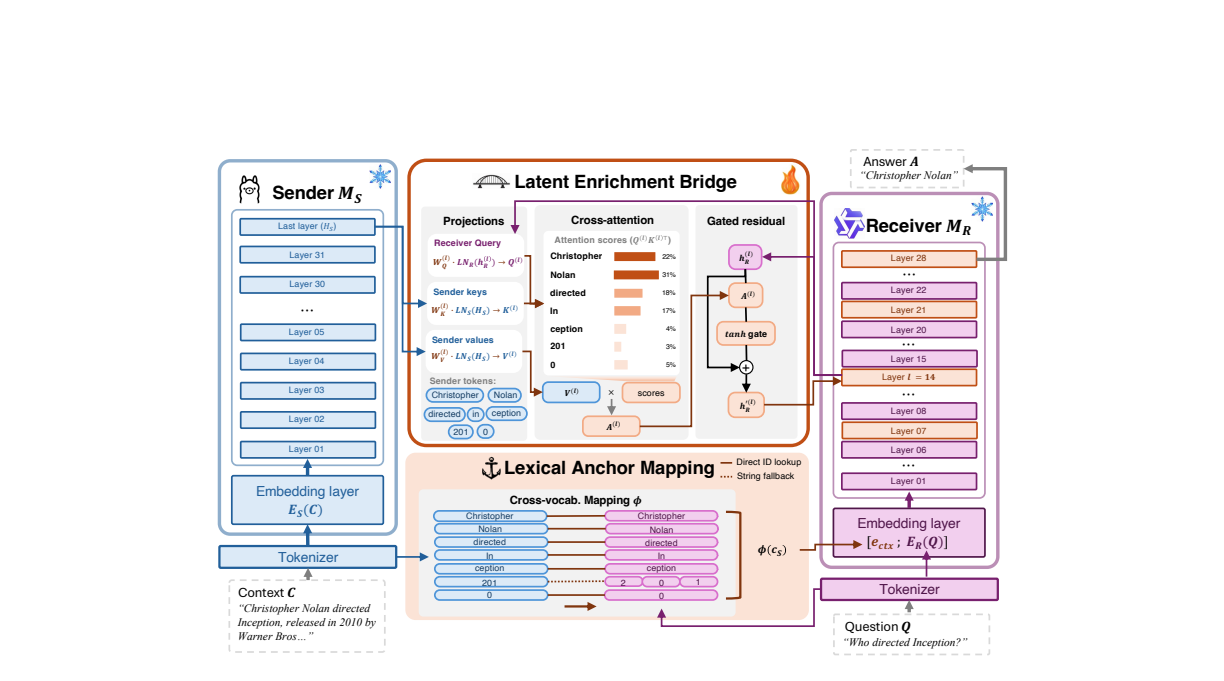
Yet existing communication protocols either operate through text, discarding the sender's internal representations, or require architectural homogeneity for latent-level transfer. We identify the entity grounding problem in cross-architecture communication: cross-attention bridges that transfer continuous representations across different LLM families suffer from rare-token compression collapse, where entity identity is lost in the continuous bottleneck (bridge-only F1 30%). We propose XBRIDGE, a decode-free communication protocol that addresses this through two mechanisms. Lexical Anchor Mapping (LAM) maps the sender's original context tokens to the receiver's vocabulary, providing discrete entity anchors. A Latent Enrichment Bridge (LEB) lets the receiver query the sender's hidden states for contextual enrichment. The entity anchors ground the bridge's contextual signals to specific entities through the receiver's own self-attention. Across three model families (Llama, Qwen, and Mistral), seven benchmarks, and both communication directions, XBRIDGE outperforms text-based communication on all seven tasks for each model pair while achieving 11x lower latency, and in a same-architecture setting it also exceeds a KV-sharing baseline on six of seven tasks. LEB requires only 264M trainable parameters (3.8% of the receiver), is trained on a small balanced sample set, and adds negligible inference overhead.
from the abstract
Pith says
Machine review · deepseek-v4-flash · 16 Aug 2026 · of version 1 of the paper; version 2 is newer · what was read was not recorded · not checked by a person
It can be wrong. Challenge this review or reply to it.
Holds up, with conditions. Useful engineering contribution with a real problem formulation, but the headline comparison is confounded and the tuning leaks HotpotQA; worth peer review after a fair text baseline is added. This line is wrong
4 major objections · 5 minor
How often objections from reviews like this one are right: not yet measured
Not checked: figures, code, what the references say.
The paper says, at §4.1, Table 1
The review did not quote this passage.
Pith says: Objection 1 of 4 · major
The headline comparison against NLComm is confounded by the amount of information each protocol sends. XBRIDGE transmits the full sender context through LAM, whereas the NLComm baseline sends a fixed 128-token summary generated by greedy decoding. The abstract's claim that XBRIDGE 'outperforms text-based communication on all seven tasks' is therefore not an apples-to-apples comparison of the communication protocol itself; the gains may partly reflect the difference between full-context access and fixed-length summarization.
more of objection 1
Please add a text-based baseline that transfers the full context (or otherwise matches the information budget), and report it in the same table format. The same-architecture comparison in Appendix C.1 partially addresses this for LEB's effect because LAM reduces to the identity mapping there, but it does not resolve the confound in the heterogeneous setting.
The paper says, at §3.2, Appendix A.1
The review did not quote this passage.
Pith says: Objection 2 of 4 · major
The claim that the LAM string fallback is 'lossless' is only surface-string losslessness. For Mistral→Qwen, 12.2% of tokens fall back and the dominant mismatch type is 'Words + proper nouns'; Table 7 shows the entity-bearing token 'Angeles' expanding to ['An','ge','les'].
more of objection 2
Section 3.4's grounding mechanism assumes LAM places entity mentions as discrete anchors, so a split anchor requires the receiver to re-associate the pieces through its own self-attention. No experiment measures entity fidelity specifically for fallback tokens. Please report entity-level accuracy or rank for direct-mapped versus fallback entities, or an equivalent test showing that the anchor channel remains intact for fallback tokens.
The paper says, at §4.4, Table 2
The review did not quote this passage.
Pith says: Objection 3 of 4 · major
The role-separation conclusion is based on a selected subset of the data. In conditions B and C, 58–59% of outputs mention neither the original nor the swapped entity; the paper then 'compares the original-versus-swapped direction among target-entity outputs,' which discards the majority of samples.
more of objection 3
The near-identical B and C counts are consistent with LAM controlling entity selection, but the high 'neither' rate also shows that the swapped LAM input often fails to produce the swapped entity. Please report the full conditional distribution including 'neither' and define the primary outcome in advance; for example, report the unconditional probability that the output mentions the swapped entity, and the probability conditional on mentioning either entity.
The paper says, at §4.3, Appendix B.1, Tables 3, 9, 10
The review did not quote this passage.
Pith says: Objection 4 of 4 · major
Several design choices—number of bridge modules, sender layer, gate initialization, and the balanced training-set composition—were selected by ablating on HotpotQA, which is also one of the seven evaluation benchmarks and part of the reported average. If HotpotQA is used as both the validation set and a final test task, the reported gains are partly the result of tuning on a test benchmark.
more of objection 4
Please either use a separate validation split (for example, a disjoint HotpotQA dev set or a held-out task) for all design decisions, or quantify the sensitivity of the conclusions to these choices.
5 minor objections
The paper says, at §4.5, Table 5
Pith says: minor objection 1 of 5
The latency comparison reports only local inference time, but XBRIDGE additionally transmits full hidden states and mapped context tokens. If communication happens over a network, please report message size and transfer latency, or explicitly state that the comparison is compute-only.
The paper says, at §4.1, Table 1
Pith says: minor objection 2 of 5
The main F1 tables report no variance or significance. With only 75–200 evaluation samples per task, please add bootstrap confidence intervals or standard errors, especially for small differences such as Tipsheets.
show 3 more
The paper says, at Eq. (5)
Pith says: minor objection 3 of 5
The entity-fidelity metric uses the first answer token as a diagnostic proxy for multi-token entities; since receiver-native tokenization can split entities (Table 7), state explicitly how split anchors are handled in this metric.
The paper says, at Appendix A.1
Pith says: minor objection 4 of 5
The word 'lossless' should be qualified as 'surface-string-lossless' to avoid implying token-level or entity-level preservation; the paper's own examples show one-to-many expansions.
The paper says, at Abstract
Pith says: minor objection 5 of 5
The '11x lower latency' claim should be scoped to the local inference setting; the paper does not report message-size or network-transfer costs.
What would settle it
On the Mistral→Qwen evaluation, split the 200 HotpotQA (and ideally all seven) samples into two strata: gold-answer entities whose sender tokens are direct-mapped vs. those whose sender tokens undergo string fallback. Compute F1 and Eq. 5 entity rank separately for the two strata; if fallback-stratum F1 is substantially below direct-stratum F1 (e.g., >10 pp), the losslessness claim fails at the entity level. As a second arm, replace fallback-mapped entity spans with the receiver's own tokenization of the same surface string and re-run; if F1 increases, the fallback segmentation itself is the cause.
from the skeptic's reading
How the review went
4 readings by deepseek-v4-flash · 16 Aug 2026
- Reader holds up, with conditions
- Skeptic agrees
- Editor wrote the verdict above
- Referee major revision: 4 major objections, 5 minor
Not run on this paper: the simulated authors' defence.
Pith did not check this review's objections against the paper.
The review in full
The review in brief, machine-written
Worth a look: a clean engineering paper on a real problem, with a headline comparison that is less clean than it looks. The entity grounding problem—continuous bridges that preserve context but lose rare-token identity across heterogeneous tokenizers—is a good articulation, and the dual-channel fix (LAM for discrete anchors, LEB for continuous enrichment) is simple and effective. The ablation logic is coherent, the role-separation experiment in Table 2 is a nice touch, and a 264M-parameter bridge trained on 587 samples in under ten minutes is a genuinely practical result. Code is linked.
The main soft spot is the comparison against text-based communication. LAM sends the full context; NLComm sends a fixed 128-token summary. That is not "outperforming text"—it is outperforming a heavily compressed summary. The paper even concedes the point in Section 4.2. A fair baseline would be a text protocol relaying the full context (or a much longer summary), and the absence of that baseline makes the "all seven tasks" claim weaker than advertised.
The second issue is tuning leakage. The architecture choices—four bridge modules, layer placements, gate initialization, sender layer—were selected by ablating on HotpotQA, which is also one of the seven reported evaluation tasks. So HotpotQA is effectively a development set. This is fixable: hold out a separate validation task and report all ablations on that held-out task.
A related gap: no existing continuous bridge is run as a baseline. The "bridge-only F1 ~30%" comes from their own LEB without LAM, not from C2C-style projections or a cross-attention bridge from prior work. The entity grounding problem would be more convincing if they showed a prior continuous method actually failing in this asymmetric setting.
The latency claim is based on HotpotQA's ~74-token contexts; 11x may not hold on the 6-7K-token tasks. That is a minor point.
One concern from our stress test—that string-fallback fragments entities like "Angeles" into ['An','ge','les']—does not, on reflection, land. That fragmentation is exactly what the receiver's own tokenizer would do to the surface string, and the receiver is pretrained to handle subword entity mentions. The fallback is "lossless" in the only sense that matters: the receiver sees its native tokenization of the context. The paper could be more careful about the word, but the mechanism does not depend on one-token-per-entity.
Bottom line: this deserves a serious referee. The core idea and results are worth engaging with, but the headline claims need better baselines and a cleaner train/test separation. I'd recommend peer review with a request for a text-full-context baseline and a re-run of the ablations on a held-out task.
The strongest objection
The central mechanism depends on LAM supplying receiver-native entity anchors. Appendix A.1 calls the string fallback "lossless," but the guarantee is only about surface string content. Table 6 gives Mistral→Qwen a 12.2% fallback rate whose dominant mismatch type is "Words + proper nouns"; Table 7 shows the entity-bearing token "Angeles" expanding to ['An','ge','les']. Section 3.4 asserts that LAM "places entity mentions ... as discrete embeddings" and that the receiver's queries "already encode which entities are present." A split token is not a single discrete embedding; the grounding claim requires the receiver's self-attention to re-associate the pieces into the entity, and no experiment in the paper validates this re-association. This is load-bearing because Section 4.3 shows that without LAM the bridge collapses to 30.3% F1 (HotpotQA, Llama→Qwen), i.e., LAM is the only channel that carries entity identity; if that channel fragments the very proper nouns it exists to preserve, the claimed entity fidelity (Eq. 5) is not guaranteed for the Mistral pair. The entity perturbation experiment (Table 2) shows LAM controls output entity, but it does not separate direct-mapped from fallback entities, so it cannot detect a fallback-specific failure.
Reader's weakest assumption and my most load-bearing concern coincide. The paper's headline claim is that XBridge solves the entity grounding problem; the mechanism is that LAM anchors discrete entities while LEB supplies context. The ablation makes LAM indispensable: removing it drops F1 from 78.8 to 30.3 (Table 3). Therefore if LAM's fallback path corrupts entity anchors, the central claim fails for a substantial fraction of Mistral→Qwen contexts. The paper's own definition of entity grounding (Section 2, Eq. 4) requires receiver-native lexical realization; fallback does produce receiver-native tokens, but it may split a single entity into multiple tokens, and the paper provides no evidence that the receiver re-associates them. This is a concrete, testable internal weakness, not a disagreement with consensus. I would not change the verdict: the reader's CONDITIONAL is appropriate, and the proposed stratification test would determine whether the concern lands. Secondary concerns (text-baseline confound, no continuous-bridge baseline, latency measured on short contexts) are real but less central to the mechanism; they were noted in the reader's rationale.
The referee's report
If the empirical claims hold, the paper makes a useful and timely contribution: it identifies a concrete failure mode (rare-token compression collapse) in continuous cross-architecture bridges and proposes a practical dual-channel remedy that preserves entity identity without requiring architectural homogeneity or autoregressive decoding. The design is clean, the bridge is lightweight (264M parameters, trained on 587 samples), and the same-architecture comparison in Appendix C.1 helps isolate the contribution of the latent channel. The paper also ships reproducible code and includes a thoughtful analysis of training-data composition. The main results are plausible, but the headline comparison is currently overclaimed because XBridge transmits the full context while the text baseline transmits a 128-token summary, and several supporting mechanistic analyses need tightening before the role-separation conclusions are fully supported.
Pith's reading of the paper (a machine's summary, not the authors')
This paper tries to establish that different LLM families can communicate at the latent level without giving up exact entity identity. It identifies a failure it calls the entity grounding problem: continuous-only bridges transfer context but lose rare names, numbers, and dates, dropping entity-level F1 to about 30%. XBRIDGE answers this with two channels: Lexical Anchor Mapping sends discrete receiver-vocabulary anchors for every sender token, and a Latent Enrichment Bridge lets the receiver query the sender's hidden states through cross-attention. Across three model families, seven benchmarks, and both communication directions, the paper reports that XBRIDGE beats text-based communication on every task while running about 11 times faster. If that holds, heterogeneous agents can collaborate at the representation level rather than through slower textual summaries.
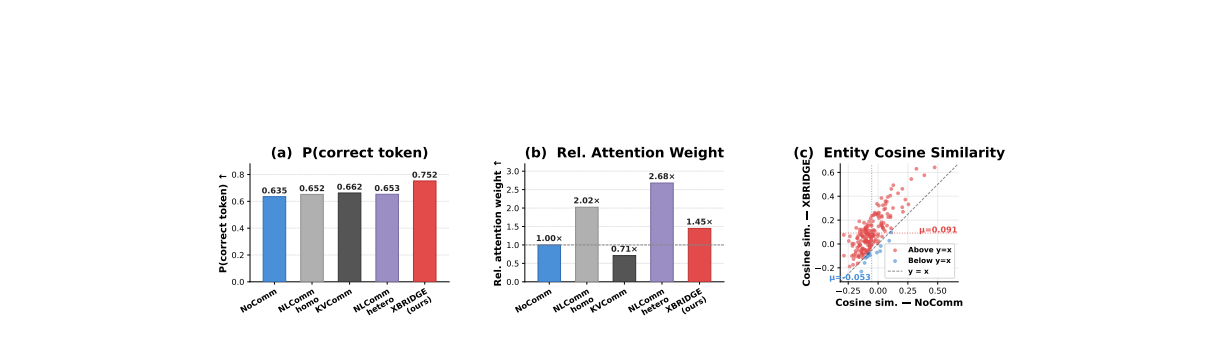
What carries the argument. The central machinery is the split of a message into a discrete anchor channel and a continuous enrichment channel. Lexical Anchor Mapping is a precomputed, training-free map from sender tokens to receiver tokens: tokens whose surface string exists in both vocabularies are transferred by ID lookup, and the rest are decoded to their surface string and re-tokenized with the receiver's tokenizer, giving receiver-native entity anchors. The Latent Enrichment Bridge inserts four gated cross-attention modules into the receiver at layers 6, 13, 20, and 27; each projects the receiver's own hidden state into a query and the sender's last-layer hidden states into keys and values, then adds the attention output through a tanh-gated residual. The grounding mechanism is that the lexical anchors propagate through the receiver's self-attention and shape the queries the bridge uses, so the bridge retrieves sender context about the entities the receiver already sees. The paper's perturbation experiment claims this gives clean role separation: swapping the anchors changes which entity is emitted, while swapping the enrichment changes only how the receiver reasons about it.
Core claim. XBRIDGE claims that heterogeneous LLM communication can preserve entity fidelity by decoupling which entities appear from how the receiver reasons about them. A continuous bridge alone suffers rare-token compression collapse: sender hidden states carry contextual semantics but the receiver cannot identify discrete entities such as names, numbers, or rare tokens, so bridge-only F1 sits near 30%. Lexical Anchor Mapping fixes this by mapping each sender context token into the receiver's vocabulary through direct ID lookup or string re-tokenization and prepending the resulting embeddings to the receiver's input. The Latent Enrichment Bridge then lets the receiver query the sender's last-layer hidden states with gated cross-attention, supplying contextual enrichment that the receiver's self-attention binds to those anchors. The paper reports that this dual-channel protocol outperforms text-based communication on all seven tasks for each of three model pairs, beats the full-context receiver baseline on average, exceeds a same-architecture KV-sharing baseline on six of seven tasks, and does so with 11x lower latency and only 264M trainable parameters.
The premise it rests on. The load-bearing premise is that Lexical Anchor Mapping's string-fallback re-tokenization is lossless at the entity level: for the Mistral-to-Qwen pair, where 12.2% of tokens fall back, a sender token like 'Angeles' becomes 'An', 'ge', 'les', and the whole method depends on the receiver's self-attention being able to reassemble those pieces into the correct entity.
If the paper is right (Pith's inferences, not the authors')
Heterogeneous agents can share full context with no autoregressive decoding, cutting per-sample latency from about 1.70 seconds to 0.15 seconds in the paper's measurements.
The same bridge design transfers across model families: with Llama, Qwen, and Mistral senders and Qwen or Llama receivers, XBRIDGE improves over text-based communication on every one of seven tasks in both communication directions.
In a same-architecture setting, the latent enrichment alone adds value beyond full-context reading, beating a KV-sharing baseline on six of seven tasks.
Independently trained bridges can be composed at inference time: two senders using separate bridges outperform a single-sender full-context baseline, suggesting the protocol scales to multi-sender collaboration.
The bridge trains on about 587 balanced samples in under ten minutes, so the method is cheap enough to instantiate per sender-receiver pair.
Editorial inference: if the discrete anchors are what supply entity fidelity, then any continuous-only bridge method, including KV-cache projection and hidden-state injection, could likely be upgraded by adding a lexical anchor channel rather than only fine-tuning the continuous transfer.
Editorial inference: the string-fallback expansion is testable in isolation; entity names that split into many receiver tokens should be exactly the cases where the grounding mechanism either succeeds or fails, so per-token-type analysis could predict which entity classes each model pair handles poorly.
Editorial inference: the paper's asymmetric setting, sender has context and receiver has question, matches retrieval-augmented generation and tool-use routing, so a decode-free grounded bridge may extend to those settings, though multi-turn exchanges would need a way to keep anchors and hidden states aligned across turns.
Editorial inference: because the anchor mapping is sender-size invariant, richer senders help only through the enrichment bridge, and the paper's 14B sender plateau suggests the bridge, not the sender, is the current bottleneck; scaling the small training set may unlock larger senders.
Check this review
Pith stored no record of this review's passes and took no fingerprint of it. Reviews made by code from 13 Nov 2026 on carry both.
How often reviews like this one are right
Reviews like this one: written by deepseek-v4-flash, where what was read was not recorded.
How often objections from reviews like this one are right: not yet measured
Reviews by people
This review was written by a machine. No person has reviewed this paper on Pith yet. A scientist listed on Pith can review it for a fee, and their review is published here whatever it concludes.
The paper
Abstract
Heterogeneous multi-agent LLM systems, where agents are powered by different model families, can outperform homogeneous configurations by reducing redundant reasoning patterns. Yet existing communication protocols either operate through text, discarding the sender's internal representations, or require architectural homogeneity for latent-level transfer. We identify the entity grounding problem in cross-architecture communication: cross-attention bridges that transfer continuous representations across different LLM families suffer from rare-token compression collapse, where entity identity is lost in the continuous bottleneck (bridge-only F1 30%). We propose XBRIDGE, a decode-free communication protocol that addresses this through two mechanisms. Lexical Anchor Mapping (LAM) maps the sender's original context tokens to the receiver's vocabulary, providing discrete entity anchors. A Latent Enrichment Bridge (LEB) lets the receiver query the sender's hidden states for contextual enrichment. The entity anchors ground the bridge's contextual signals to specific entities through the receiver's own self-attention. Across three model families (Llama, Qwen, and Mistral), seven benchmarks, and both communication directions, XBRIDGE outperforms text-based communication on all seven tasks for each model pair while achieving 11x lower latency, and in a same-architecture setting it also exceeds a KV-sharing baseline on six of seven tasks. LEB requires only 264M trainable parameters (3.8% of the receiver), is trained on a small balanced sample set, and adds negligible inference overhead.
The paper's own sentences, arranged, kept beside the review and separate from it. Each label is drawn from a closed vocabulary; the number beside it is the probability the classifier gave that label. No sentence in this record was written by a model.
abstract compiled · 2026-09-23
The authors' main claim, as the classifier picked it out 1.00
“Across three model families (Llama, Qwen, and Mistral), seven benchmarks, and both communication directions, XBRIDGE outperforms text-based communication on all seven tasks for each model pair while achieving 11x lower latency, and in a same-architecture setting it also exceeds a KV-sharing baseline on six of seven tasks.”
How the main claim is stated: asserted 1.00
What the abstract itself states, as probabilities: claims first 0.10 · states limitation 0.40 · human participants 0.03 · controlled comparison 0.96 · randomized assignment 0.02 · states quantitative result 0.99 · compares with prior results 0.98 · mentions code or data availability 0.03
The abstract, sentence by sentence
This table labels the abstract only (arXiv listing abstract v1). The number is the probability the classifier gave the label.
| Sentence | Role | The authors' own work | States the main conclusion | Strength |
|---|---|---|---|---|
| Heterogeneous multi-agent LLM systems, where agents are powered by different model families, can outperform homogeneous configurations by reducing redundant reasoning patterns. | background 1.00 | 0.12 | 0.06 | asserted 0.51 |
| Yet existing communication protocols either operate through text, discarding the sender's internal representations, or require architectural homogeneity for latent-level transfer. | gap 0.89 | 0.07 | 0.02 | asserted 1.00 |
| We identify the entity grounding problem in cross-architecture communication: cross-attention bridges that transfer continuous representations across different LLM families suffer from rare-token compression collapse, where entity identity is lost in the continuous bottleneck (bridge-only F1 ~30%). | gap 0.83 | 0.80 | 0.08 | asserted 1.00 |
| We propose XBRIDGE, a decode-free communication protocol that addresses this through two mechanisms. | contribution 0.95 | 0.82 | 0.06 | asserted 0.97 |
| Lexical Anchor Mapping (LAM) maps the sender's original context tokens to the receiver's vocabulary, providing discrete entity anchors. | method 0.93 | 0.81 | 0.04 | asserted 1.00 |
| A Latent Enrichment Bridge (LEB) lets the receiver query the sender's hidden states for contextual enrichment. | method 0.94 | 0.75 | 0.03 | asserted 1.00 |
| The entity anchors ground the bridge's contextual signals to specific entities through the receiver's own self-attention. | method 0.99 | 0.56 | 0.05 | asserted 1.00 |
| Across three model families (Llama, Qwen, and Mistral), seven benchmarks, and both communication directions, XBRIDGE outperforms text-based communication on all seven tasks for each model pair while achieving 11x lower latency, and in a same-architecture setting it also exceeds a KV-sharing baseline on six of seven tasks. | result 1.00 | 0.95 | 0.79 | asserted 1.00 |
| LEB requires only 264M trainable parameters (3.8% of the receiver), is trained on a small balanced sample set, and adds negligible inference overhead. | result 0.58 | 0.93 | 0.06 | asserted 1.00 |
What kind of paper the classifier reports this is: method or tool 1.00 · evidence from observation or experiment 0.98
What was examined, and what was not
Sources read
- arXiv listing abstract v1
Not examined
- full text
- figures and tables
- references and citing sentences
- relations to other papers
Levels run
- P abstract
Not run
- S sections
- T body sentences
- C citations
- R cross-paper relations
How the labels were made
Compiled by classifier-1.13.0 via TypeSafe API, question bank abstract-p1-20260923, 2026-09-23: 1 request, 7,041 input tokens.
Every quoted sentence on this record is the authors'. Every label is from Pith's closed vocabulary, with the probability shown beside it. This record as JSON
Figures (4)
Figures are the authors', reproduced from the paper.
Cited by 2 Pith papers
Reviewed papers on Pith that cite this one. The full citation record
How the literature uses it
What this paper does with the arXiv papers it cites
Challenges and discussion
Disagree with the review, or know something it missed? Leave a comment, or challenge this review formally: a challenge becomes a permanent entry in this paper's record, and its decision is published here.
Come back by email
A short list of the week's newly reviewed papers. Nothing is sent until you confirm from your inbox, and every email has a link that stops it. No account.
No comments yet.
Sign in to comment