REVIEW 3 major objections 6 minor 26 references
Structural Silence: When AI Infrastructure Fails Speakers of Underrepresented Languages
T0 review · 3 major / 6 minor · reviewed 2026-08-16 · deepseek-v4-flash
Pith's one-line read Structural barriers, not model quality, explain why AI serves Bengali speakers poorly.
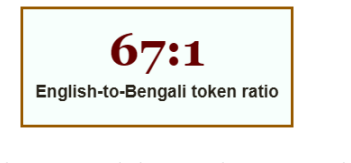
desk verdict A clear, well-referenced synthesis of why Bengali speakers are structurally underserved by AI infrastructure; the four-barrier framing is useful, but the headline 67:1 token ratio compares different corpora and the tokenization-to-performance link is asserted, not shown. read the letter →
The pith
A machine-rendered reading of the paper's core claim, the machinery that carries it, and where it could break.
The reading
What carries the argument
The mechanism that carries the argument is the compounding sequence of the four infrastructure layers, anchored by two quantitative measures: the $67{:}1$ training-token ratio and token fertility, defined as the average number of subword tokens required to represent one word or linguistic unit. Token fertility is the crucial converter: it turns the script difference between Latin-script English and Bengali's alphasyllabary script, with its diacritics (matras) and conjuncts (yuktakshar), into a computational penalty inside standard Byte Pair Encoding (BPE) and WordPiece tokenizers, so that even equal data volumes would not produce equal representational quality. The four failures are not independent; each one feeds the next, and the paper uses this cumulative structure to explain why Bengali performance lags across model families despite Bengali's inclusion in multilingual training sets.
What would settle it
Compute the English-to-Bengali token ratio inside a single corpus, such as within the Indic corpus the paper uses or within a matched web-crawl sample, and measure token fertility on aligned Bengali and English texts with the same tokenizer; if the within-corpus ratio falls far below $67{:}1$, or if fertility-adjusted Bengali tokens carry nearly the same per-token signal as English tokens, the quantitative core of the structural-silence argument would be contradicted.
Extended reading notes
Core claim
The paper's central claim is that the poor performance of general-purpose large language models on Bengali is not primarily a modeling shortcoming but the predictable output of what it calls structural silence: the accumulated weight of design decisions that never centered Bengali in AI infrastructure. It identifies four interlocking failures: a web presence gap (under 0.5% of web content for roughly 4% of the global population), a $67{:}1$ English-to-Bengali training-token deficit (Sangraha's $30$B Bengali allocation against Common Corpus's roughly $2$T English tokens), a tokenization penalty from Bengali's alphasyllabary script that raises token fertility under standard subword tokenizers, and a connectivity exclusion ($36.5\%$ rural versus $71.4\%$ urban individual internet penetration) that makes cloud-dependent tools functionally inaccessible to rural learners. Each failure compounds the others: less web presence means fewer tokens, fewer tokens plus higher token fertility means less usable representation, and cloud-based deployment assumes away the connectivity that would let users reach any web-scale model. The paper concludes that model performance gaps track training feasibility and resource allocation, and that offline-first, locally deployable AI is an equity-oriented infrastructure strategy rather than a degraded compromise.
Load-bearing premise
The argument's quantitative load rests on the $67{:}1$ English-to-Bengali token ratio, which compares Bengali's $30$ billion tokens in the Sangraha corpus with English's roughly $2$ trillion tokens in a different corpus, Common Corpus; if the true within-corpus ratio is much smaller, or if Bengali's higher token fertility is offset by other efficiencies, the claimed compounding deficit weakens.
Editorial extensions
If this is right
- If the structural-silence account is right, improving multilingual model performance on Bengali requires changing infrastructure such as web content, tokenizers, benchmarks, and deployment assumptions, not just scaling up one model.
- Equitable Bengali model performance will require substantially more than proportional training data, because the tokenization penalty means Bengali tokens carry less usable signal per token under standard subword tokenizers.
- Offline-first, locally deployed models, made feasible by quantization and parameter-efficient fine-tuning, should be treated and funded as an equity strategy rather than as a degraded fallback.
- Evaluation frameworks that test only high-connectivity cloud use validate tools that are inaccessible to rural learners, so benchmarks should include low-bandwidth and offline conditions.
- Dataset construction, benchmark creation, and evaluation protocols for underrepresented languages deserve recognition as primary research contributions, not as supporting labor.
Reading between the lines
- A testable extension the paper leaves implicit: recomputing the English-to-Bengali token ratio within a single aligned multilingual corpus would show whether the $67{:}1$ figure survives at the same order of magnitude, which would strengthen or qualify the compounding-deficit claim.
- The same four-failure diagnosis likely applies, with different magnitudes, to other large languages with Indic or African scripts, such as Hindi, Tamil, or Amharic, where web presence and tokenizer fit are similarly skewed; a comparative case study would test whether structural silence is a general mechanism.
- If the tokenization penalty is the binding constraint, then designing tokenizers that respect Bengali's orthographic units could reduce the data required for parity, effectively converting part of the $67{:}1$ deficit into a smaller gap; this is an intervention the paper motivates but does not test.
- Field studies that log actual learner usage of cloud-based versus offline AI tutors in rural Bangladesh would directly test whether offline-first design changes learning outcomes, since the paper's connectivity argument predicts a large access effect that survey statistics alone do not demonstrate.
Signed reviews
Editorial analysis
A structured set of objections, weighed in public.
Referee Report
Summary. The paper examines AI infrastructure barriers for Bengali speakers, identifying four interlocking failures: a web presence gap, a training token deficit, a tokenization penalty, and connectivity exclusion. It argues that uneven multilingual model performance reflects structural design decisions rather than isolated technical limitations, and it concludes that offline-first design and dataset construction should be treated as equity-oriented research contributions. The contribution is framed as an analytic synthesis rather than a new benchmark or system.
Significance. If the qualitative argument is accepted, the paper provides a useful integrative account of how disparities at different layers of AI infrastructure compound. Its strength lies in linking published benchmarks, infrastructure statistics, and cognitive load theory into a single explanatory narrative, and in honestly stating that it introduces no new empirical data. The paper also gives explicit recognition to dataset construction as primary research and to offline-first design as equity architecture. However, its only original quantitative contribution, the 67:1 token ratio, is based on a cross-corpus comparison that the authors themselves concede is illustrative, which limits the force of the quantitative indictment.
major comments (3)
- [Section 3.2 and Figure 2] The 67:1 training-token ratio is computed from two different corpora: the Bengali token allocation in Sangraha and the English token count in Common Corpus. Footnote 1 acknowledges this, but the abstract and the main text of Section 3.2 state the ratio as a quantitative fact ('The ratio ... is therefore approximately 67:1'). Because the headline claim of the paper rests on this ratio, the main text must either present the figure as an explicitly cross-corpus illustration or replace it with a same-corpus comparison from Sangraha or another single corpus; otherwise the 'cumulative and compounding' argument in Section 3.3 is built on an incomparable baseline.
- [Section 3.3] The tokenization-penalty argument asserts that Bengali text requires 'significantly more subword tokens' than English, but no fertility ratio or token-count data are reported; the only citation is to Shahriar and Barbosa (2024), and footnote 2 says exact ratios depend on tokenizer and corpus. The claim that the penalty compounds the data deficit and that 'equitable Bengali model performance ... requires ... substantially more data' is therefore unsupported by a quantitative estimate. Please provide a concrete fertility comparison (e.g., tokens per word or per sentence for the relevant tokenizer) or explicitly downgrade this from a quantitative compounding effect to a qualitative structural tendency.
- [Section 3.2] The sentence 'This ratio carries direct consequences for model performance' overstates the evidence: the cited evaluations (Kabir et al., 2024; Bhowmik et al., 2025) demonstrate that Bengali performance is lower, but they do not establish that the token ratio causes that gap, and the paper itself later describes the evidence as 'consistent with data-volume explanations.' Please rephrase to match the strength of the evidence, e.g., 'is associated with' or 'is consistent with,' to avoid a causal claim that the manuscript does not support.
minor comments (6)
- [Introduction] There is a typo in the Introduction where 'Bengali is a revealing case study' appears as 'Bengaliisarevealingcasestudyprecisely' without spaces; please fix.
- [Section 3.4] The cost dimension sentence has missing spaces: 'cost:The Daily Starreports' and 'The Business Standardreports' should be corrected.
- [Figures] Figure 1 and Figure 2 are not explicitly referenced in the running text; add 'see Figure 1' and 'see Figure 2' at the appropriate points.
- [References] Some references are incomplete, e.g., the IndicLLMSuite entry lists 'et al.' without a full author list, and the Sangraha corpus is cited via the IndicLLMSuite paper rather than a dedicated dataset description; please ensure the citation matches the resource name.
- [Section 2.2] The sentence 'The gaps correlated with tokenization efficiency and model scale in ways consistent with data-volume explanations' is vague; specify the correlation measure or report the actual values.
- [Abstract vs. Section 3.1] The abstract states 'roughly 285 million speakers' while Section 3.1 says 'approximately 242 million native speakers'; clarify which figure is used and why.
Circularity Check
No circularity: the paper is an analytic synthesis that makes no predictions and fits no parameters.
full rationale
This paper is a case-study synthesis that assembles externally sourced statistics and published benchmark results; it derives no new quantitative result from its own assumptions. The one original quantitative figure, the 67:1 English–Bengali training-token ratio, is explicitly flagged in Footnote 1 as illustrative and cross-corpus ('These are not the same corpus, and the comparison is intended to illustrate the order-of-magnitude disparity... rather than an exact within-corpus measurement'), so although it is a comparability limitation, it is not circular: the ratio is not the output of a fitted model or of the paper's own definitions. The four 'failures' are documented from independent sources (web-content shares, tokenizer-fertility studies, connectivity surveys), and the cognitive-load argument is imported from established external literature rather than being constructed to match the conclusion. No parameters are fitted, no quantity is renamed as a prediction, and no load-bearing claim rests on a self-citation or on an author-imported uniqueness theorem. The paper's contribution is explicitly diagnostic and explanatory, and its central claim about structural exclusion remains independently supported by the cited external evidence even if that evidence is debatable.
Assumptions & free parameters
assumptions (4)
- domain assumption Greater training data volumes generally produce better-performing models, and this relationship transfers across languages.
- domain assumption A language's share of web content is a valid proxy for its representation in AI training corpora.
- domain assumption Elevated token fertility for Bengali directly degrades model representation quality, so equal data volume would still leave a performance gap.
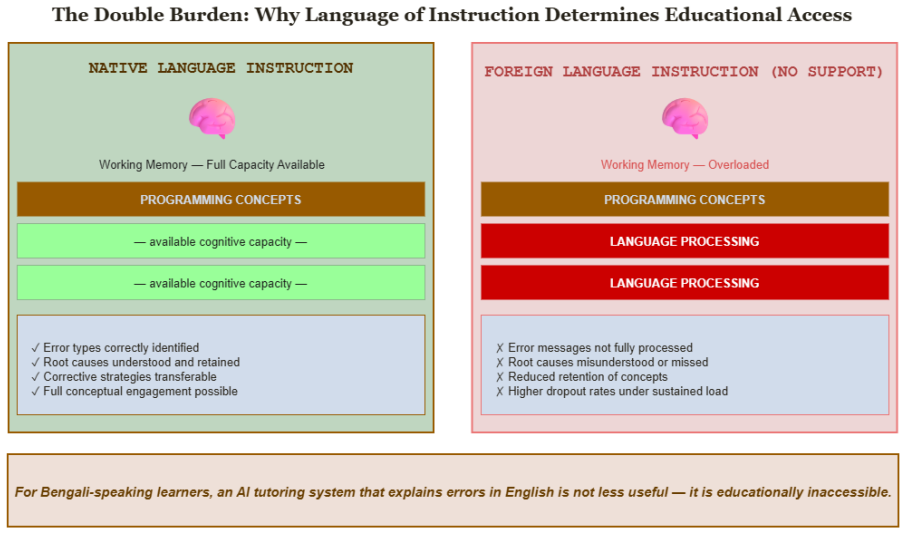
- domain assumption Cognitive Load Theory, validated in classroom studies, applies to AI-generated explanations for programming education.
Cite this review
Pith. "Pith review of Structural Silence: When AI Infrastructure Fails Speakers of Underrepresented Languages." pith.science (2026). https://pith.science/paper/6GNSEQ7K
@misc{pith2026260812278,
  author       = {Pith},
  title        = {Pith review of: Structural Silence: When AI Infrastructure Fails Speakers of Underrepresented Languages},
  year         = {2026},
  howpublished = {\url{https://pith.science/paper/6GNSEQ7K}},
  note         = {Machine review of arXiv:2608.12278}
}
read the original abstract
Artificial intelligence tools for education and language support are increasingly framed as scalable responses to access gaps in under-resourced communities. Yet the infrastructure underlying these tools, including training corpora, tokenization schemes, evaluation benchmarks, and deployment architectures, can systematically disadvantage speakers of underrepresented languages before a model is trained. This paper examines these structural barriers through Bengali, one of the world's most widely spoken languages, focusing on AI-assisted education in low-connectivity environments. We identify four interlocking failures: a severe web presence gap, with Bengali accounting for less than 0.5% of global web content despite representing nearly 4% of the global population; a 67:1 training-token deficit between English and Bengali in major multilingual corpora; a tokenization penalty associated with Bengali's alphasyllabary script that compounds the data deficit through higher token fertility; and connectivity exclusion, with individual internet penetration at 36.5% in rural areas compared with 71.4% in urban areas. These failures reflect longstanding resource-allocation decisions, institutional priorities, and design defaults that did not center underrepresented languages in mainstream AI development. We argue that dataset scarcity should be understood as a structural barrier rather than an isolated technical limitation, and that offline-first design should be treated as an equity-oriented infrastructure strategy. We conclude with directions for linguistics and AI research aimed at reducing these structural inequalities.
Figures


Figures from the paper (2 more)

Reference graph
Works this paper leans on
-
[1]
Sohel and Shahriyar, Rifat , booktitle =
Bhattacharjee, Abhik and Hasan, Tahmid and Islam, Wasi Ahmad and Mubasshir, Kazi Samin and Li, Yuan-Fang and Kang, Yong-Bin and Rahman, M. Sohel and Shahriyar, Rifat , booktitle =. 2022 , publisher =
work page 2022
-
[2]
Bhowmik, Shimanto and Dipto, Tawsif Tashwar and Islam, Md Sazzad and Hsu, Sheryl and Reasat, Tahsin , journal =. Evaluating. 2025 , url =
work page 2025
-
[3]
2025 , howpublished =
2025
-
[4]
arXiv preprint arXiv:2408.10441 , year =
Goldfish: Monolingual Language Models for 350 Languages , author =. arXiv preprint arXiv:2408.10441 , year =
-
[5]
Internet Shows Stark Rural-Urban Divide , author =. 2025 , month = jan, day =
work page 2025
-
[6]
Dettmers, Tim and Pagnoni, Artidoro and Holtzman, Ari and Zettlemoyer, Luke , journal =. 2023 , doi =
work page 2023
-
[7]
The Teacher's Dilemma: Balancing Trade-Offs in Programming Education for Emergent Bilingual Students
The Teacher's Dilemma: Balancing Trade-Offs in Programming Education for Emergent Bilingual Students , author =. arXiv preprint arXiv:2506.14147 , year =
-
[8]
What Are the Top 200 Most Spoken Languages? , author =. 2025 , howpublished =
work page 2025
Show all 26 references
-
[9]
Saiful and Mubasshir, Kazi and Li, Yuan-Fang and Kang, Yong-Bin and Rahman, M
Hasan, Tahmid and Bhattacharjee, Abhik and Islam, Md. Saiful and Mubasshir, Kazi and Li, Yuan-Fang and Kang, Yong-Bin and Rahman, M. Sohel and Shahriyar, Rifat , booktitle =. 2021 , publisher =
2021
-
[10]
and Shen, Yelong and Wallis, Phillip and Allen-Zhu, Zeyuan and Li, Yuanzhi and Wang, Shean and Wang, Lu and Chen, Weizhu , booktitle =
Hu, Edward J. and Shen, Yelong and Wallis, Phillip and Allen-Zhu, Zeyuan and Li, Yuanzhi and Wang, Shean and Wang, Lu and Chen, Weizhu , booktitle =. 2022 , url =
2022
-
[11]
2026 , url =
10 Most Spoken Languages in the World in 2026 , author =. 2026 , url =
2026
-
[12]
The State and Fate of Linguistic Diversity and Inclusion in the
Joshi, Pratik and Santy, Sebastin and Budhiraja, Amar and Bali, Kalika and Choudhury, Monojit , booktitle =. The State and Fate of Linguistic Diversity and Inclusion in the. 2020 , publisher =
2020
-
[13]
Saiful and Hoque, Enamul , booktitle =
Kabir, Mohsinul and Islam, Mohammed Saidul and Laskar, Md Tahmid Rahman and Nayeem, Mir Tafseer and Bari, M. Saiful and Hoque, Enamul , booktitle =. 2024 , url =
2024
-
[14]
2024 , publisher =
Khan, Mohammed Safiur Rahman and Madhani, Yash and Nilesh, Vinit and others , booktitle =. 2024 , publisher =
2024
-
[15]
Common Corpus: The Largest Collection of Ethical Data for
Langlais, Pierre-Jean and others , year =. Common Corpus: The Largest Collection of Ethical Data for
-
[16]
2024 , month = oct, day =
Cabinet Approves Conferring Status of Classical Language to. 2024 , month = oct, day =
2024
-
[17]
2024 , howpublished =
Reliably Exploring the Presence of Languages on the Internet , author =. 2024 , howpublished =. doi:10.32907/RO-139-5856605838 , url =
2024 doi
-
[18]
Mosiur and others , booktitle =
Raihan, Nafees and Jawad, Mohammad Abdullah and Rahman, Md. Mosiur and others , booktitle =. Overview of. 2025 , publisher =
2025
-
[19]
Bridging the Last Mile: Unpacking the Rural Digital Divide in
Rashed, Rayhan and Bhuyan, Muhammad Masroor Ali and others , booktitle =. Bridging the Last Mile: Unpacking the Rural Digital Divide in. 2025 , doi =
2025
-
[20]
Learning and Instruction , volume =
Learning Subject Content through a Foreign Language Should Not Ignore Human Cognitive Architecture: A Cognitive Load Theory Approach , author =. Learning and Instruction , volume =. 2017 , doi =
2017
-
[21]
Improving
Shahriar, Arif and Barbosa, Denilson , booktitle =. Improving. 2024 , url =
2024
-
[22]
Proceedings of the 49th
Does Native Language Play a Role in Learning a Programming Language? , author =. Proceedings of the 49th. 2018 , doi =
2018
-
[23]
2011 , doi =
Cognitive Load Theory , author =. 2011 , doi =
2011
-
[24]
2025 , month = apr, day =
52\. 2025 , month = apr, day =
2025
-
[25]
2026 , url =
International Mother Language Day , author =. 2026 , url =
2026
-
[26]
2026 , url =
Usage Statistics and Market Share of Content Languages for Websites, March 2026 , author =. 2026 , url =
2026
Reviewed August 16, 2026 · model on record in the stance chip above.
Discussion (0). Continue with ORCID to comment.