REVIEW 3 major objections 5 minor 38 references
From Local Mismatch to Global Impact: Optimizing Cache Reuse Policy for Efficient Diffusion
T0 review · 3 major / 5 minor · reviewed 2026-08-15 · deepseek-v4-flash
Pith's one-line read Cache reuse in diffusion models should be budgeted by each step's eventual impact on the final image, not by how similar neighboring residuals look, and GCache learns that positional weighting per model and wins at matched speedup.
desk verdict Worth a serious referee: the caching idea is sound, but the in-sample metric optimization in the evaluation is a real weakness that needs a held-out split. read the letter →
The pith
A machine-rendered reading of the paper's core claim, the machinery that carries it, and where it could break.
The reading
What carries the argument
The load-bearing object is the propagation exponent $w_{t_{i+1}} = \ln(h_{t_{i+1}} L_{\mathrm{out}}) + \sum_{j=1}^{i-1} h_{t_{j+1}} L_{t_{j+1}}$: a per-timestep scalar that converts a local residual error into its estimated contribution to the final deviation. It carries the whole argument because it is what makes the policy global — an early-step error accumulates a long sum of step-size–Lipschitz products and therefore receives a large exponential weight. Because the Lipschitz constants are unknown, the paper replaces the exponent with a Bernstein polynomial $w(t;s) = \sum_{\nu=0}^{d} s_\nu \binom{d}{\nu} t^\nu (1-t)^{d-\nu}$ and fits the coefficients $s$ by bilevel optimization: the inner level is a shortest-path dynamic program over the cost matrix $E_{i,j} = \|\delta_{t_i} - \delta_{t_j}\|_1 \, e^{w(t_j;s)}$ that selects exactly $K$ refresh points, and the outer level tunes $s$ with a Gaussian-process Bayesian search (LCB acquisition) against the LPIPS$+$SSIM objective on generated samples, using residual errors pre-computed on the full-computation trajectory so the search never re-runs the model.
What would settle it
Inject a perturbation of fixed magnitude into the feature maps at each denoising step of a held-out diffusion model, measure the resulting final-image distortion for every injection timestep (as in the paper's Figure 2), and compare that measured amplification profile with the weights GCache learns: if the learned exponent is uncorrelated with the measured profile — for example if a model shows flat or late-peaked sensitivity — the positional-amplification mechanism cannot be the source of the gains. A second decisive check is to rerun the bilevel search on a model with strong trajectory drift using the pre-computed error proxy versus errors re-measured on the actual cached trajectory; the two policies should be near-identical in quality if the proxy assumption holds, and diverge if it does not.
Extended reading notes
Core claim
The central claim is that global-impact weighting is the right objective for cache reuse policy, and that it can be made practical. Theorem 3.4 bounds the deviation of a cached trajectory from the baseline Euler trajectory by $\sum_{i=1}^{N-1} \|\epsilon^c_{t_{i+1}}\|_1 e^{w_{t_{i+1}}}$, with $w_{t_{i+1}} = \ln(h_{t_{i+1}} L_{\mathrm{out}}) + \sum_{j=1}^{i-1} h_{t_{j+1}} L_{t_{j+1}}$; because the accumulated sum of Lipschitz-weighted step sizes is larger for earlier steps, the bound says errors injected early in denoising are amplified more. Since the worst-case bound is too pessimistic for real diffusion models, GCache reparameterizes $w$ as a degree-3 Bernstein polynomial in the timestep and fits its coefficients by a bilevel search: an inner dynamic program chooses the $K$ refresh steps minimizing the weighted cost for a given exponent, and an outer Bayesian optimizer adjusts the coefficients against the LPIPS$+$SSIM loss of generated samples. The empirical claim is that this learned policy consistently outperforms local-similarity caching (ERTACache, TeaCache) at the same speedup across three video backbones and one image backbone, with no inference-time overhead beyond the policy itself.
Load-bearing premise
The load-bearing premise is that local residual errors measured on the unperturbed full-computation trajectory faithfully predict the errors that arise under cache reuse — a proxy the paper tests on only one model and concedes may fail under large trajectory shifts, with the bound's Lipschitz and approximation constants never measured.
Editorial extensions
If this is right
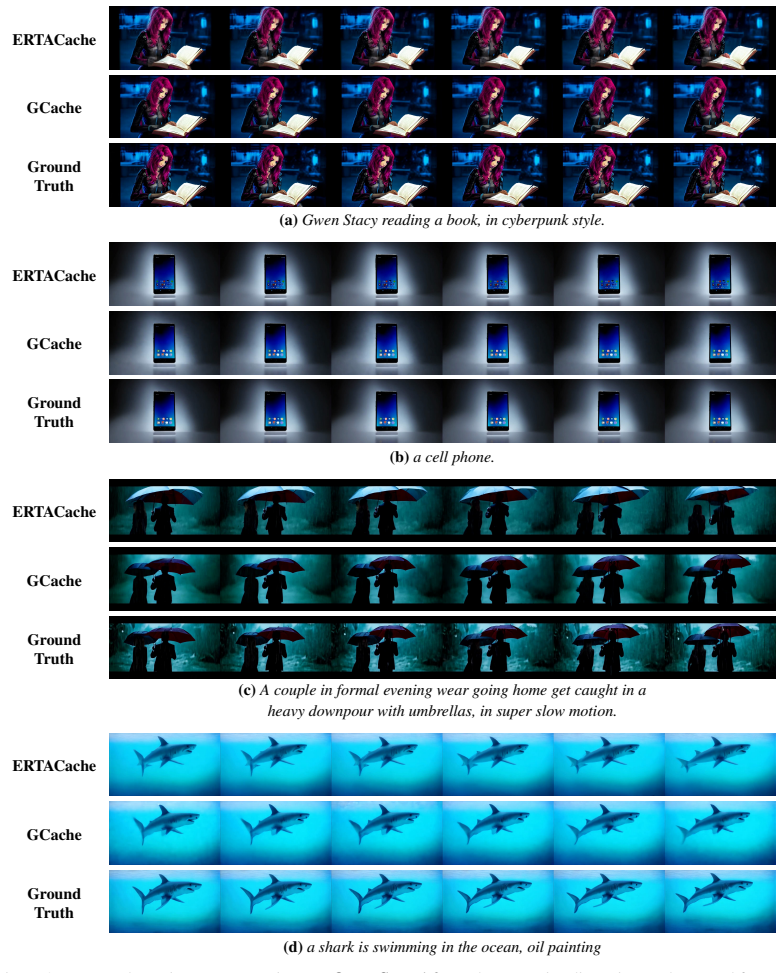
- At matched speedups, GCache outperforms local-similarity caching on every backbone tested — Open-Sora 1.2, CogVideoX-2B, Wan2.1-1.3B, and Flux-dev 1.0 — so the global-impact weighting, not the cache mechanism itself, is what fixes the bottleneck.
- The headline result stands without auxiliary machinery: on Wan2.1-1.3B at 2.17×, GCache cuts LPIPS from 0.1095 to 0.0316 and raises PSNR from 23.77 to 32.44 using only the reuse policy, while the local-heuristic baseline needs an error-rectification module to reach 0.1095.
- Learned policies transfer: a policy optimized on static prompts works on dynamic prompts, and a policy optimized at 1024×1024 transfers zero-shot to 512 and 256 resolutions without retuning.
- Per-model policy search is cheap — under a day on 4–8 GPUs — which makes treating cache policy as a per-model artifact practical rather than a fixed universal schedule.
- A pure optimized policy beats a worse policy plus error correction (Table 8), implying that policy quality and error correction act as substitutes rather than complements in this acceleration regime.
Reading between the lines
- If per-model fitting of the propagation weighting is the true source of the gains, the same bilevel scheme should transfer to other trajectory decisions — timestep skipping in few-step samplers, layer dropping, or attention pruning — wherever the cost of a local error depends on where along the trajectory it is made.
- The fitted Bernstein weights can be read as a per-model sensitivity curve for step-skipping; comparing these curves across architectures is a test of whether some models tolerate skipping late steps better than others, a prediction the paper itself does not make.
- The proxy-fidelity experiment validates pre-computed errors on one model only; evaluating GCache on a backbone that drifts strongly under cache reuse, against a variant that recomputes errors along the actual cached trajectory, would bound how much of the gain survives proxy failure.
- The paper fixes one policy per model; the natural next step its own limitation section gestures at is making the refresh schedule sample-adaptive, using the same weighting machinery with per-input error estimates.
Signed reviews
Editorial analysis
A structured set of objections, weighed in public.
Referee Report
Summary. The paper proposes Global-Impact Cache (GCache), a cache reuse policy for diffusion model inference. It provides a theoretical analysis of how local cache reuse errors propagate along the denoising trajectory (Theorems 3.2-3.4), and then reparameterizes the propagation exponent with a Bernstein polynomial and searches for the optimal policy via bilevel optimization: an inner dynamic program finds the reuse mask that minimizes a weighted sum of local errors for fixed parameters, and an outer Bayesian optimization adjusts the polynomial coefficients to minimize an empirical perceptual loss. Experiments on Open-Sora 1.2, CogVideoX-2B, Wan2.1-1.3B, and Flux-dev 1.0 report consistent improvements over cache-based baselines at matched speedups, with the largest gain on Wan2.1 (LPIPS 0.0316 vs 0.1095 at 2.17x).
Significance. If the empirical results are confirmed on held-out prompts, GCache would be a practical and theoretically motivated improvement over local-similarity cache policies. The paper's strengths include a clean formalization of error propagation (even though the constants are not measured), an efficient DP/BO pipeline, extensive experiments across four models, and an explicit empirical validation of the pre-computed error proxy on CogVideoX-2B. The main unresolved issue is whether the reported gains are an artifact of optimizing the evaluation metric on prompts sampled from the same benchmarks used for testing.
major comments (3)
- [§4.1, Appendix D.3, Eq. (18) and (25)] The outer objective L = LPIPS + (1 - SSIM) used for policy fitting is exactly the metric reported in Tables 1 and 2, and the 512 training prompts described in Appendix D.3 as 'randomly sampled from the corresponding dataset' are not stated to be disjoint from the 946 VBench prompts and 30K COCO prompts used for evaluation. The reported 'consistent outperformance' therefore may reflect in-sample optimization rather than a genuinely superior policy. Please document a train/test prompt split or re-run Tables 1 and 2 with policies fitted only on a disjoint prompt set; the appendix's cross-distribution results (Table 6) partially mitigate but do not address the same-benchmark overlap.
- [§3.3, Appendix D.3, Appendix E.4] The inner objective Eq. (19) uses the pre-computed error matrix E_{i,j} = ||δ_{t_i} - δ_{t_j}||_1 from the original full-step trajectory, whereas Theorem 3.4 bounds the deviation of a cached trajectory using local errors ε^c_{t_n} evaluated on the actual cached trajectory. The theorem therefore does not directly justify the proxy; the substitution is an additional assumption. The validation in Figure 6 covers only CogVideoX-2B with K=17, so the claim that GCache 'consistently outperforms' across Open-Sora, Wan2.1, and Flux-dev relies on an unvalidated transfer of this proxy assumption. Please provide per-backbone proxy validation or an upper bound on the drift-induced bias.
- [§3.3, Eq. (17), Appendix D.3] The paper never reports the fitted Bernstein coefficients s* nor the sensitivity of the final policy to the search range [0,10]^4. Since the theoretical constants in Eq. (13) are unmeasured, the Bernstein reparameterization is effectively a four-parameter empirical weighting. To establish that the theoretical form (exponential-in-timestep weighting) is the source of the improvement rather than the flexibility of any fitted step weighting, please report s* for each backbone and compare against a free per-step weight vector optimized to the same outer objective; this would clarify what the theory adds beyond an arbitrary learned scheduler.
minor comments (5)
- [§3.3, Eq. (17)] The binomial coefficient uses n where it should use the polynomial degree d; the expression should be \binom{d}{\nu}, not \binom{n}{\nu}.
- [Appendix A.1, Algorithm 1] Line 1 defines a cumulative propagated error (with a bar in the text), but the DP transition in line 6 uses E_{j,i} without a bar; the notation is inconsistent and should be clarified.
- [Appendix D.3] There is a typo in the sentence 'S = [s_1, s_2, ..., s_n]^T are reviously sampled parameters' — should be 'previously'.
- [Appendix F.2] The heading 'Vedio Generation' should read 'Video Generation'.
- [Abstract and §5] The phrase 'rigorous theoretical characterization' is too strong given that Assumption 3.1 is not empirically verified; consider softening to 'a theoretical characterization'.
Circularity Check
Evaluation metric equals the outer objective and calibration prompts are drawn from the same VBench/COCO pools, so the headline LPIPS/SSIM gains are partly in-sample.
-
fitted input called prediction
[Section 3.3 Eq. (18); Appendix A.3 Eq. (25); Appendix D.1; Appendix D.3]
"In the outer objective of the bilevel optimization framework (Equation (18)), we define the loss function L to evaluate the empirical generation quality. Specifically, we utilize a joint objective that combines ... LPIPS ... and SSIM: L = L_LPIPS + (1 − L_SSIM). ... We utilize a training set consisting of 512 prompts randomly sampled from the corresponding dataset. ... evaluate all methods using the official 946 prompts provided by VBench ... use the first 30K text prompts [of COCO]."
The reported headline metrics (LPIPS, SSIM, PSNR) in Tables 1–2 are the same quantities minimized by the outer objective: Appendix A.3 sets L = L_LPIPS + (1 − L_SSIM), and Eq. (18) minimizes L(m*(s)). The Bernstein coefficients s are therefore fitted to minimize the evaluation metric itself. Appendix D.3 samples the 512 calibration prompts from 'the corresponding dataset' — for video this is VBench, for image this is COCO — and Appendix D.1 evaluates on the official 946 VBench prompts and 30K COCO prompts, without stating that calibration prompts are excluded from those evaluation sets.
full rationale
The theoretical derivation is self-contained: Assumptions 3.1 and Theorems 3.2–3.4 form a genuine bound proved from stated Lipschitz/approximation conditions, and the Bernstein reparameterization is explicitly presented as a fitted correction to an overly conservative bound, not as a consequence of the theory. The inner DP policy search and the BO outer loop are algorithmically well-defined. The circular component is confined to the empirical evaluation: the outer objective minimized in Eq. (18) is the same LPIPS+SSIM joint loss reported in Tables 1–2, and the 512 calibration prompts are sampled from 'the corresponding dataset' with no stated exclusion from the 946 VBench / 30K COCO evaluation prompts. Thus the headline quality numbers are partly in-sample values of the optimized objective, so the claim of consistent outperformance over training-free baselines is not an independent prediction. The unmeasured constants in Assumption 3.1 are a correctness risk, not circularity; no self-citation chain, uniqueness import, or renamed known result is present.
Assumptions & free parameters
free parameters (3)
- Bernstein polynomial coefficients s =
Not stated numerically; bounded in [0,10], d=3, so 4 coefficients
- Budget K =
18, 11, 31, 17, 24, 16, 14, 10
- Polynomial degree d =
3
assumptions (3)
- domain assumption Assumption 3.1: v_theta is L_t-Lipschitz with L_t <= L, uniformly within eta of the true marginal velocity, and the ground-truth velocity has total time derivative bounded by M.
- domain assumption The local residual error on the original full-computation trajectory is a faithful proxy for the local error on the cache-reused trajectory.
- domain assumption LPIPS and SSIM measured against the unaccelerated model are adequate proxies for final generation quality.
Cite this review
Pith. "Pith review of From Local Mismatch to Global Impact: Optimizing Cache Reuse Policy for Efficient Diffusion." pith.science (2026). https://pith.science/paper/QQEL5GKZ
@misc{pith2026260813043,
  author       = {Pith},
  title        = {Pith review of: From Local Mismatch to Global Impact: Optimizing Cache Reuse Policy for Efficient Diffusion},
  year         = {2026},
  howpublished = {\url{https://pith.science/paper/QQEL5GKZ}},
  note         = {Machine review of arXiv:2608.13043}
}
read the original abstract
Diffusion models have achieved dominant performance in visual generation but suffer from substantial inference overhead. While cache-based acceleration has emerged as a promising solution, existing policies rely on local similarity heuristics, which we identify as being significantly misaligned with final generation quality. This discrepancy stems from the non-uniform propagation and accumulation of errors along the denoising trajectory. To address this, we propose Global-Impact Cache (GCache). We first establish a rigorous theoretical characterization of the error propagation upper bound. Recognizing that this bound can be overly conservative for complex, highly non-convex diffusion models, we further reparameterize the propagation exponent with a Bernstein form and reformulate cache policy search as a bilevel optimization problem. In detail, GCache identifies an optimal reuse policy in the inner objective while aligning the error-weighting function with generation quality loss in the outer objective. This framework effectively reconciles theoretical rigor with empirical performance, learning to prioritize computation where it most impacts visual fidelity. Extensive experiments demonstrate that GCache consistently outperforms prior caching strategies on both video and image generation. Notably, on the state-of-the-art Wan2.1 video diffusion model, GCache maintains a 2.17x speedup while significantly enhancing generation quality, reducing LPIPS from 0.1095 to 0.0316.
Figures


Figures from the paper (7 more)



Reference graph
Works this paper leans on
-
[1]
Denoising diffusion probabilistic models
Jonathan Ho, Ajay Jain, and Pieter Abbeel. Denoising diffusion probabilistic models. InAd- vances in Neural Information Processing Systems 33: Annual Conference on Neural Information Processing Systems 2020, NeurIPS 2020, December 6-12, 2020, virtual, 2020
work page 2020
-
[2]
Kingma, Abhishek Kumar, Stefano Ermon, and Ben Poole
Yang Song, Jascha Sohl-Dickstein, Diederik P. Kingma, Abhishek Kumar, Stefano Ermon, and Ben Poole. Score-based generative modeling through stochastic differential equations. In9th International Conference on Learning Representations, ICLR 2021, Virtual Event, Austria, May 3-7, 2021. OpenReview.net, 2021
2021
-
[3]
Diffusion models beat gans on image syn- thesis
Prafulla Dhariwal and Alexander Quinn Nichol. Diffusion models beat gans on image syn- thesis. In Marc’Aurelio Ranzato, Alina Beygelzimer, Yann N. Dauphin, Percy Liang, and Jennifer Wortman Vaughan, editors,Advances in Neural Information Processing Systems 34: Annual Conference on Neural Information Processing Systems 2021, NeurIPS 2021, December 6-14, 20...
work page 2021
-
[4]
Yaron Lipman, Ricky T. Q. Chen, Heli Ben-Hamu, Maximilian Nickel, and Matthew Le. Flow matching for generative modeling. InThe Eleventh International Conference on Learning Representations, ICLR 2023, Kigali, Rwanda, May 1-5, 2023. OpenReview.net, 2023
2023
-
[5]
High- resolution image synthesis with latent diffusion models
Robin Rombach, Andreas Blattmann, Dominik Lorenz, Patrick Esser, and Björn Ommer. High- resolution image synthesis with latent diffusion models. InIEEE/CVF Conference on Computer Vision and Pattern Recognition, CVPR 2022, New Orleans, LA, USA, June 18-24, 2022, pages 10674–10685. IEEE, 2022
2022
-
[6]
Chitwan Saharia, William Chan, Saurabh Saxena, Lala Li, Jay Whang, Emily L. Denton, Seyed Kamyar Seyed Ghasemipour, Raphael Gontijo Lopes, Burcu Karagol Ayan, Tim Salimans, Jonathan Ho, David J. Fleet, and Mohammad Norouzi. Photorealistic text-to-image diffusion models with deep language understanding. In Sanmi Koyejo, S. Mohamed, A. Agarwal, Danielle Bel...
work page 2022
-
[7]
Andreas Blattmann, Tim Dockhorn, Sumith Kulal, Daniel Mendelevitch, Maciej Kilian, Do- minik Lorenz, Yam Levi, Zion English, Vikram V oleti, Adam Letts, Varun Jampani, and Robin Rombach. Stable video diffusion: Scaling latent video diffusion models to large datasets.CoRR, abs/2311.15127, 2023
arXiv 2023
-
[8]
Videocrafter2: Overcoming data limitations for high-quality video diffusion models
Haoxin Chen, Yong Zhang, Xiaodong Cun, Menghan Xia, Xintao Wang, Chao Weng, and Ying Shan. Videocrafter2: Overcoming data limitations for high-quality video diffusion models. In IEEE/CVF Conference on Computer Vision and Pattern Recognition, CVPR 2024, Seattle, WA, USA, June 16-22, 2024, pages 7310–7320. IEEE, 2024. 10
work page 2024
Show all 38 references
-
[9]
PTQD: accurate post-training quantization for diffusion models
Yefei He, Luping Liu, Jing Liu, Weijia Wu, Hong Zhou, and Bohan Zhuang. PTQD: accurate post-training quantization for diffusion models. InAdvances in Neural Information Processing Systems 36: Annual Conference on Neural Information Processing Systems 2023, NeurIPS 2023, New Or...
2023
-
[10]
LD-Pruner: efficient pruning of latent diffusion models using task-agnostic insights
Thibault Castells, Hyoung-Kyu Song, Bo-Kyeong Kim, and Shinkook Choi. LD-Pruner: efficient pruning of latent diffusion models using task-agnostic insights. InProceedings of the IEEE/CVF Conference on Computer Vision and Pattern Recognition Workshops, CVPRW 2024, Seattle, WA, U...
2024
-
[11]
DPM-Solver: a fast ODE solver for diffusion probabilistic model sampling in around 10 steps
Cheng Lu, Yuhao Zhou, Fan Bao, Jianfei Chen, Chongxuan Li, and Jun Zhu. DPM-Solver: a fast ODE solver for diffusion probabilistic model sampling in around 10 steps. InAdvances in Neural Information Processing Systems 35: Annual Conference on Neural Information Processing Syste...
2022
-
[12]
Fast sampling of diffusion models with exponential integrator
Qinsheng Zhang and Yongxin Chen. Fast sampling of diffusion models with exponential integrator. InThe Eleventh International Conference on Learning Representations, ICLR 2023, Kigali, Rwanda, May 1-5, 2023, 2023
2023
-
[13]
UniPC: a unified predictor- corrector framework for fast sampling of diffusion models
Wenliang Zhao, Lujia Bai, Yongming Rao, Jie Zhou, and Jiwen Lu. UniPC: a unified predictor- corrector framework for fast sampling of diffusion models. InAdvances in Neural Information Processing Systems 36: Annual Conference on Neural Information Processing Systems 2023, NeurI...
2023
-
[14]
∆-dit: A training-free acceleration method tailored for diffusion transformers.CoRR, abs/2406.01125, 2024
Pengtao Chen, Mingzhu Shen, Peng Ye, Jianjian Cao, Chongjun Tu, Christos-Savvas Bouganis, Yiren Zhao, and Tao Chen. ∆-dit: A training-free acceleration method tailored for diffusion transformers.CoRR, abs/2406.01125, 2024
2024 arXiv
-
[15]
Timestep embedding tells: It’s time to cache for video diffusion model
Feng Liu, Shiwei Zhang, Xiaofeng Wang, Yujie Wei, Haonan Qiu, Yuzhong Zhao, Yingya Zhang, Qixiang Ye, and Fang Wan. Timestep embedding tells: It’s time to cache for video diffusion model. InIEEE/CVF Conference on Computer Vision and Pattern Recognition, CVPR 2025, Nashville, T...
2025
-
[16]
ERTACache: Error rectification and timesteps adjustment for efficient diffusion
Xurui Peng, Chenqian Yan, Hong Liu, Rui Ma, Fangmin Chen, XING WANG, Zhihua Wu, Songwei Liu, and Mingbao Lin. ERTACache: Error rectification and timesteps adjustment for efficient diffusion. InThe Fourteenth International Conference on Learning Representations, 2026
2026
-
[17]
FORA: fast-forward caching in diffusion transformer acceleration.CoRR, abs/2407.01425, 2024
Pratheba Selvaraju, Tianyu Ding, Tianyi Chen, Ilya Zharkov, and Luming Liang. FORA: fast-forward caching in diffusion transformer acceleration.CoRR, abs/2407.01425, 2024
2024 arXiv
-
[18]
Real-time video generation with pyramid attention broadcast
Xuanlei Zhao, Xiaolong Jin, Kai Wang, and Yang You. Real-time video generation with pyramid attention broadcast. InThe Thirteenth International Conference on Learning Representations, ICLR 2025, Singapore, April 24-28, 2025. OpenReview.net, 2025
2025
-
[19]
Scaling rectified flow transformers for high-resolution image synthesis
Patrick Esser, Sumith Kulal, Andreas Blattmann, Rahim Entezari, Jonas Müller, Harry Saini, Yam Levi, Dominik Lorenz, Axel Sauer, Frederic Boesel, Dustin Podell, Tim Dockhorn, Zion English, and Robin Rombach. Scaling rectified flow transformers for high-resolution image synthes...
2024
-
[20]
Gomez, Lukasz Kaiser, and Illia Polosukhin
Ashish Vaswani, Noam Shazeer, Niki Parmar, Jakob Uszkoreit, Llion Jones, Aidan N. Gomez, Lukasz Kaiser, and Illia Polosukhin. Attention is all you need. InAdvances in Neural Infor- mation Processing Systems 30: Annual Conference on Neural Information Processing Systems 2017, D...
2017
-
[21]
Improved analysis of score-based generative modeling: User-friendly bounds under minimal smoothness assumptions
Hongrui Chen, Holden Lee, and Jianfeng Lu. Improved analysis of score-based generative modeling: User-friendly bounds under minimal smoothness assumptions. InProceedings of the 40th International Conference on Machine Learning, ICML 2023, pages 4735–4763, 2023. 11
2023
-
[22]
Efros, Eli Shechtman, and Oliver Wang
Richard Zhang, Phillip Isola, Alexei A. Efros, Eli Shechtman, and Oliver Wang. The unrea- sonable effectiveness of deep features as a perceptual metric. In2018 IEEE Conference on Computer Vision and Pattern Recognition, CVPR 2018, Salt Lake City, UT, USA, June 18-22, 2018, pag...
2018
-
[23]
Kakade, and Matthias W
Niranjan Srinivas, Andreas Krause, Sham M. Kakade, and Matthias W. Seeger. Gaussian process optimization in the bandit setting: No regret and experimental design. InProceedings of the 27th International Conference on Machine Learning (ICML-10), June 21-24, 2010, Haifa, Israel,...
2010
-
[24]
Open-sora: Democratizing efficient video production for all
Zangwei Zheng, Xiangyu Peng, Tianji Yang, Chenhui Shen, Shenggui Li, Hongxin Liu, Yukun Zhou, Tianyi Li, and Yang You. Open-sora: Democratizing efficient video production for all. CoRR, abs/2412.20404, 2024
2024 arXiv
-
[25]
Cogvideox: Text-to-video diffusion models with an expert transformer
Zhuoyi Yang, Jiayan Teng, Wendi Zheng, Ming Ding, Shiyu Huang, Jiazheng Xu, Yuanming Yang, Wenyi Hong, Xiaohan Zhang, Guanyu Feng, Da Yin, Yuxuan Zhang, Weihan Wang, Yean Cheng, Bin Xu, Xiaotao Gu, Yuxiao Dong, and Jie Tang. Cogvideox: Text-to-video diffusion models with an ex...
2025
-
[26]
Wan: Open and advanced large-scale video generative models.CoRR, abs/2503.20314, 2025
Ang Wang, Baole Ai, Bin Wen, Chaojie Mao, Chen-Wei Xie, Di Chen, Feiwu Yu, Haiming Zhao, Jianxiao Yang, Jianyuan Zeng, Jiayu Wang, Jingfeng Zhang, Jingren Zhou, Jinkai Wang, Jixuan Chen, Kai Zhu, Kang Zhao, Keyu Yan, Lianghua Huang, Xiaofeng Meng, Ningyi Zhang, Pandeng Li, Pin...
2025 arXiv
-
[27]
Flux.https://github.com/black-forest-labs/flux, 2024
Black Forest Labs. Flux.https://github.com/black-forest-labs/flux, 2024
2024
-
[28]
Faster diffusion through temporal attention decomposition.Trans
Haozhe Liu, Wentian Zhang, Jinheng Xie, Francesco Faccio, Mengmeng Xu, Tao Xiang, Mike Zheng Shou, Juan-Manuel Pérez-Rúa, and Jürgen Schmidhuber. Faster diffusion through temporal attention decomposition.Trans. Mach. Learn. Res., 2025, 2025
2025
-
[29]
Model reveals what to cache: Profiling-based feature reuse for video diffusion models
Xuran Ma, Yexin Liu, Yaofu Liu, Xianfeng Wu, Mingzhe Zheng, Zihao Wang, Ser-Nam Lim, and Harry Yang. Model reveals what to cache: Profiling-based feature reuse for video diffusion models. InProceedings of the IEEE/CVF International Conference on Computer Vision (ICCV), pages 1...
2025
-
[30]
Zhengyao Lv, Chenyang Si, Junhao Song, Zhenyu Yang, Yu Qiao, Ziwei Liu, and Kwan-Yee K. Wong. Fastercache: Training-free video diffusion model acceleration with high quality. InThe Thirteenth International Conference on Learning Representations, ICLR 2025, Singapore, April 24-...
2025
-
[31]
Vbench: Comprehensive benchmark suite for video generative models
Ziqi Huang, Yinan He, Jiashuo Yu, Fan Zhang, Chenyang Si, Yuming Jiang, Yuanhan Zhang, Tianxing Wu, Qingyang Jin, Nattapol Chanpaisit, Yaohui Wang, Xinyuan Chen, Limin Wang, Dahua Lin, Yu Qiao, and Ziwei Liu. Vbench: Comprehensive benchmark suite for video generative models. I...
2024
-
[32]
Belongie, Lubomir Bourdev, Ross B
Tsung-Yi Lin, Michael Maire, Serge J. Belongie, Lubomir Bourdev, Ross B. Girshick, James Hays, Pietro Perona, Deva Ramanan, Piotr Dollár, and C. Lawrence Zitnick. Microsoft COCO: common objects in context. InComputer Vision - ECCV 2014 - 13th European Conference, Zürich, Switz...
2014
-
[33]
Large language diffusion models
Shen Nie, Fengqi Zhu, Zebin You, Xiaolu Zhang, Jingyang Ou, Jun Hu, JUN ZHOU, Yankai Lin, Ji-Rong Wen, and Chongxuan Li. Large language diffusion models. InThe Thirty-ninth Annual Conference on Neural Information Processing Systems, 2025. 12
2025
-
[34]
U-net: Convolutional networks for biomedical image segmentation
Olaf Ronneberger, Philipp Fischer, and Thomas Brox. U-net: Convolutional networks for biomedical image segmentation. In Nassir Navab, Joachim Hornegger, William M. Wells III, and Alejandro F. Frangi, editors,Medical Image Computing and Computer-Assisted Intervention - MICCAI 2...
2015
-
[35]
Scalable diffusion models with transformers
William Peebles and Saining Xie. Scalable diffusion models with transformers. InIEEE/CVF International Conference on Computer Vision, ICCV 2023, Paris, France, October 1-6, 2023, pages 4172–4182. IEEE, 2023
2023
-
[36]
Denoising diffusion implicit models
Jiaming Song, Chenlin Meng, and Stefano Ermon. Denoising diffusion implicit models. In9th International Conference on Learning Representations, ICLR 2021, Virtual Event, Austria, May 3-7, 2021. OpenReview.net, 2021
2021
-
[37]
semantic drift
Xingyi Yang, Daquan Zhou, Jiashi Feng, and Xinchao Wang. Diffusion probabilistic model made slim. InProceedings of the IEEE/CVF Conference on Computer Vision and Pattern Recognition, CVPR 2023, Vancouver, BC, Canada, June 18-22, 2023, pages 22552–22562, 2023. 13 Appendix Conte...
2023
-
[1024]
sawtooth
on lower resolutions (512 and 256) without re-tuning. GCache-fast consistently outperforms ERTACache across all scales, demonstrating its robustness to spatial resolution shifts. Resolution Method LPIPS↓SSIM↑PSNR↑ 1024 ERTACache 0.2658 0.7863 20.60 GCache-fast0.1825 0.8423 23....
Reviewed August 15, 2026 · model on record in the stance chip above.
Discussion (0). Continue with ORCID to comment.