REVIEW 2 major objections 6 minor 37 references
Keep, Customize, or Exit: Default Design and Token Pricing in LLM Reasoning Services
T0 review · 2 major / 6 minor · reviewed 2026-08-14 · deepseek-v4-flash
Pith's one-line read A default reasoning allocation only changes what an LLM user gets when that user values keeping the default; otherwise the implemented allocation is the user's own customized optimum.
desk verdict Solid Stackelberg analysis of default reasoning budgets; the theory is clean, the empirics are thin, but the paper deserves serious review. read the letter →
The pith
A machine-rendered reading of the paper's core claim, the machinery that carries it, and where it could break.
The reading
What carries the argument
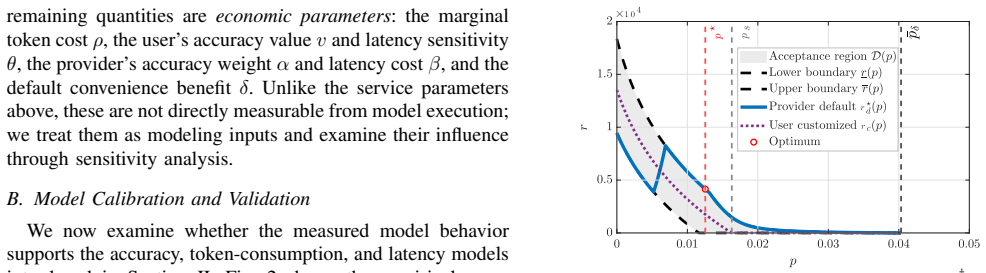
The argument is carried by the acceptance region $D(p)$, the set of default reasoning budgets the user will keep at a given price, defined by the default's utility clearing both the customization and participation thresholds. Strict concavity of the user's utility in the reasoning budget, coming from the exponential accuracy model $Q(r)=D+A(1-e^{-br})$ together with linear latency and billed-token models, makes $D(p)$ either empty or a compact interval, with endpoints given in closed form by the two real branches of the Lambert $W$ function. Inside that interval the provider's optimal default is fixed by a three-regime rule: take the largest accepted default when the net marginal revenue per token $\gamma(p)=p-\rho-\beta c$ is nonnegative, take the smallest when $\gamma(p)\leq -\alpha Ab$, and otherwise project the unconstrained optimum $\frac{1}{b}\log\left(-\frac{\alpha Ab}{\gamma(p)}\right)$ onto the interval. This collapses the provider's two-dimensional choice into a one-dimensional continuous maximization over prices, and the sign of the optimized value decides whether service is offered.
What would settle it
Measure accuracy at many fine-grained token budgets on a current reasoning model and check whether the accuracy-versus-budget curve is concave everywhere. If any dataset shows a flat region followed by a jump, the derived unique customized allocation and compact acceptance interval fail, and the optimal default would sit at the jump rather than at the Lambert $W$ boundary.
Extended reading notes
Core claim
On the paper's own terms, the discovery is that default design and token pricing in an LLM reasoning service are jointly tractable: the user's optimal customized reasoning allocation has a closed form, the acceptance region $D(p)$ is either empty or a compact interval whose endpoints are expressible through the Lambert $W$ function, and the provider's best default at a fixed price is described by a three-regime rule based on the net marginal revenue per token. A Stackelberg equilibrium exists, and the provider serves the user exactly when the optimized service value is nonnegative. The paper further establishes that the default has independent allocative power only when the convenience benefit $\delta$ is positive; at $\delta=0$ the acceptance region collapses to the singleton $\{r_c(p)\}$, so whatever default is shown, the implemented allocation is the user's customized optimum. With $\delta>0$ the provider can deliberately offer a default above the user's customized allocation and capture the convenience margin, and the gap between the two measures the extra reasoning the default induces.
Load-bearing premise
The whole closed-form analysis assumes that each extra reasoning token buys a smaller accuracy gain than the one before, smoothly and without plateaus or sudden jumps; if real reasoning models have accuracy curves with flat stretches or jumps, the unique customized allocation, the interval-shaped acceptance region, and the three-regime default rule need not hold.
Editorial extensions
If this is right
- A provider can compute the equilibrium price and default by maximizing a single continuous function of price, then serving only if that maximum is nonnegative.
- When the convenience benefit is zero, the default is allocationally inert: every accepted default implements the user's customized reasoning budget, although pricing still determines whether service is offered.
- With a positive convenience benefit, the provider can place the default above the user's customized budget and the gap measures the extra reasoning the default induces.
- The set of feasible prices is a compact interval that shrinks as price rises, closing at a unique maximum price where the default coincides with the customized allocation.
- The provider's equilibrium payoff is nondecreasing in the convenience benefit, and the equilibrium price can switch between co-optimal values without any discontinuity in the payoff.
Reading between the lines
- If real accuracy-token curves are non-concave with plateaus or jumps, the compact-interval acceptance region and the three-regime rule should fail in a specific way: the optimal default would sit at the edge of a plateau rather than at a Lambert $W$ boundary, which is directly testable with fine-grained budget sweeps.
- The convenience benefit $\delta$ is empirically identifiable: in a user study that presents the same allocation once as a default and once as a preselected customization value, the rate at which users keep the default encodes $\delta$, and the model predicts how that rate varies with the allocation's distance from the user's optimum.
- Because the provider extracts the convenience margin, the framework supplies a quantitative accounting for how much extra reasoning a default induces, which could inform welfare discussions about whether defaults steer users away from their independently chosen levels.
- The same leader-follower structure should transfer to other metered reasoning resources, such as search steps or ensemble size, whenever quality is a saturating function of the resource and users face a keep-or-customize choice.
Signed reviews
Editorial analysis
A structured set of objections, weighed in public.
Referee Report
Summary. This paper studies pricing and default design in an LLM reasoning service. The provider commits to a per-token price p and a default reasoning-token allocation r_d; a representative user then keeps the default, customizes the allocation, or exits. Under an exponential accuracy-budget model Q(r)=D+A(1-exp(-br)) with linear latency and billed-token models, the paper derives the user's unique customized allocation r_c(p) (Lemma 1), characterizes the set of accepted defaults as a compact interval whose Lambert-W endpoints are given in closed form (Lemma 2), solves the provider's fixed-price default selection in three regimes (Proposition 1), and proves existence of a Stackelberg equilibrium, with service offered iff the optimized service value is nonnegative (Theorem 1). It further shows that when the default convenience benefit delta=0, the acceptance region collapses to {r_c(p)}, so defaults have no independent allocative power. Experiments on Qwen3-8B and DeepSeek-R1-Distill-Llama-8B across five benchmarks fit the exponential accuracy model and illustrate equilibrium prices, defaults, and allocations under calibrated service parameters.
Significance. The theoretical core is sound and clean: the proofs of Lemma 1, Lemma 2, Proposition 1, and Theorem 1 are internally consistent, and the replication argument (customization outcomes can be reproduced by an accepted default) together with the Berge maximum-theorem continuity argument are well executed. The main qualitative insight—defaults matter only through a positive convenience benefit, and otherwise every service-providing outcome implements the user's customized allocation—is a useful and falsifiable statement for the design of configurable LLM services. The reduction of equilibrium computation to one-dimensional price optimization is a genuine convenience. The significance is currently limited by the empirical validation: the claim that experiments support the accuracy-token model rests on point fits without uncertainty quantification, so the practical applicability of the equilibrium rules is not yet established. If the empirical concerns are addressed, the paper would be a solid contribution to the emerging literature on test-time-compute economics.
major comments (2)
- [Section IV.A-B, Table II, Eq. (31)] The empirical support for Eq. (1) is not quantified. The fitted D, A, b in Table II are point estimates only; no standard errors, confidence intervals, R-squared, RMSE, residual plots, or cross-validation are reported. Since each empirical accuracy is computed from only three Bernoulli responses per question in Eq. (31), the noise in each point is substantial, and without uncertainty quantification or model criticism the statement that Fig. 2 supports the saturating accuracy-token model is not yet justified. This is a load-bearing gap because strict concavity of Q(r) is the foundation for the compact-interval acceptance region in Lemma 2 and for the three-regime default rule in Proposition 1. Please add inferential statistics for the fits and, if possible, release code/data or the per-allocation accuracy values used in the fitting.
- [Section III, Lemmas 1-2; Eq. (25)] The closed-form equilibrium rules are conditional on the specific exponential form in Eq. (1). The paper does not test robustness to non-concave or non-monotone accuracy-budget curves, which are plausible given the discrete, step-like behavior of LLM reasoning traces. If the true Q(r) is staircase-like or has local plateaus, the compact-interval acceptance region in Lemma 2 and the projection-based three-regime rule in Eq. (25) can fail. I am not asking for a proof for general Q, but the paper should either provide evidence that the exponential form adequately captures the measured data, which connects to the previous comment, or explicitly limit the practical claims to the calibrated exponential model rather than presenting them as empirical validation of the equilibrium rule.
minor comments (6)
- [Table I and Fig. 2] The model name 'DeepSeek-R1-Distill-8B' in Table I is inconsistent with 'DeepSeek-R1-Distill-Llama-8B' used in the text and Fig. 2; please standardize.
- [Section IV.A] The fitting procedure is not described: please specify the loss function, the optimizer, the set of allocation points used, and the number of points per model-benchmark pair.
- [Section IV.B] The statement that accuracy 'generally increases' and 'exhibits diminishing returns' is not a quantitative validation; please support it with the fit statistics requested above or soften the wording.
- [Section III.D] The tie-breaking robustness paragraph is informal; since Theorem 1 is stated conditional on the K > C > E rule, a precise statement of when the alternative tie-breaking gives the same value versus only a supremum would be helpful.
- [Eq. (31)] The notation \hat{y}_{i,j}(\ell) is used before being defined; please define it as the answer produced by the j-th sample for question i at allocation \ell.
- [Fig. 6] The discrete jump in p* and r_d* near b\delta = 0.88 is explained in the text as a switch between co-optimal equilibria, but the caption should also state this so the plot is not misread as a discontinuity in the equilibrium value.
Circularity Check
No material circularity; the equilibrium theorems are derived from explicit assumptions, and the only mildly definitional step is the δ=0 default-power claim.
-
self definitional
[Section III.B (Default Acceptance Region), paragraph after Lemma 2]
"if δ=0, then h(p)=B(p), and nonemptiness in (20) requires B(p)≥0. Since the value B(p) is attained uniquely at r c(p), we have D(p) ={r c(p)} when δ=0. Thus, without a default convenience benefit, the provider cannot induce any reasoning allocation other than the user’s customized optimum."
δ is defined in Section II as the default-specific convenience benefit and is the only utility term distinguishing keeping from customizing (U_K = u0 + δ, U_C = B(p)). The headline conclusion that defaults affect the implemented allocation only when δ>0 is therefore largely a restatement of the modeling choice that δ is the sole channel through which defaults enter utility, together with uniqueness of the customized maximizer. The interval and steering results for δ>0 are genuine derivations, and the central equilibrium existence and three-regime default rules do not reduce to this claim.
full rationale
The paper's derivation chain is self-contained given its explicit model assumptions. The accuracy model Q(r)=D+A(1-exp(-br)), linear latency t(r)=t0+cr, and linear token model T(r)=Tb+r are stated as assumptions, not derived from the conclusions. Lemma 1, Lemma 2, Proposition 1, and Theorem 1 follow from these assumptions through standard concave optimization and Lambert-W analysis; no step smuggles in the target result via definition or citation. The fitted parameters D, A, and b in Table II are calibration inputs for the numerical illustrations, not predictions of the theory, so the fitted-input-called-prediction pattern does not apply. The self-citations [22] and [24] appear only in related-work discussion and are not load-bearing for any theorem. The only mild definitional element is the claim that defaults have no independent allocative power when δ=0, which is essentially the definition of δ as the default-specific convenience benefit; this is more a modeling observation than a discovered result, but it does not undermine the main equilibrium characterization. The lack of error bars or goodness-of-fit statistics for the exponential fit is a correctness and validity concern, not a circularity concern.
Assumptions & free parameters
free parameters (5)
- D (baseline accuracy) =
Qwen3: 0, 0, 0.354, 0.276, 0.044; R1: 0.011, 0, 0.290, 0.067, 0.033 (Table II)
- A (maximum additional accuracy gain) =
Qwen3: 0.595, 0.737, 0.227, 0.677, 0.302; R1: 0.260, 0.309, 0.185, 0.822, 0.223 (Table II)
- b (accuracy saturation rate) =
Qwen3: 9.3e-5, 1.1e-4, 2.6e-4, 2.7e-3, 1.9e-4; R1: 1.9e-4, 2.5e-4, 2.1e-4, 3.0e-3, 1.4e-4 (Table II)
- Exogenous economic parameters (v, theta, rho, alpha, beta) =
baseline v=250, theta=5, rho=0.005, alpha=80, beta=5; Fig.4: v=70, theta=2, rho=0.05, alpha=30, beta=10
- delta (default convenience benefit) =
5 in baseline; varied as delta/B(0) in Fig.6
assumptions (6)
- domain assumption Accuracy follows Q(r)=D+A(1-exp(-br)) with D>=0, A>0, b>0, D+A<=1
- domain assumption Billed tokens and latency are linear: T(r)=Tb+r and t(r)=t0+c r
- domain assumption Complete information, representative user, monetary-equivalent utilities, and at most one task at a time
- ad hoc to paper Default convenience benefit delta>=0 is added to user utility only when keeping the default and also enters participation
- ad hoc to paper Tie-breaking rule K > C > E on indifference boundaries
- domain assumption Provider payoff is G(p,r)=(p-rho)T(r)+alpha Q(r)-beta t(r)
Cite this review
Pith. "Pith review of Keep, Customize, or Exit: Default Design and Token Pricing in LLM Reasoning Services." pith.science (2026). https://pith.science/paper/JXBDGKTP
@misc{pith2026260813315,
  author       = {Pith},
  title        = {Pith review of: Keep, Customize, or Exit: Default Design and Token Pricing in LLM Reasoning Services},
  year         = {2026},
  howpublished = {\url{https://pith.science/paper/JXBDGKTP}},
  note         = {Machine review of arXiv:2608.13315}
}
read the original abstract
We study a large language model (LLM) service in which a provider chooses a per-token price and a default reasoning-token allocation, while a user may accept the default, customize the allocation, or exit. Larger allocations can improve accuracy but increase token cost and latency. We model this interaction as a Stackelberg game and derive the user's unique optimal customized allocation in closed form. For any price, the acceptable defaults form either an empty set or a compact interval. We characterize the provider's optimal default through a three-regime rule, reduce equilibrium computation to a one-dimensional price optimization, and prove the existence of the equilibrium. We further show that defaults affect the implemented reasoning allocation only when users value the convenience of avoiding customization; otherwise, every service-providing outcome implements the user's optimal customized allocation. Experiments with two compact open-weight reasoning models on five mathematics and science benchmarks support the accuracy-token model and show how model and task characteristics determine equilibrium prices, defaults, and reasoning allocations.
Figures


Figures from the paper (4 more)


Reference graph
Works this paper leans on
-
[1]
Scaling LLM test-time compute optimally can be more effective than scaling parameters for reasoning,
C. V . Snell, J. Lee, K. Xu, and A. Kumar, “Scaling LLM test-time compute optimally can be more effective than scaling parameters for reasoning,” inThe Thirteenth International Conference on Learning Representations, 2025
2025
-
[2]
Inference scaling laws: An empirical analysis of compute-optimal inference for LLM problem- solving,
Y . Wu, Z. Sun, S. Li, S. Welleck, and Y . Yang, “Inference scaling laws: An empirical analysis of compute-optimal inference for LLM problem- solving,” inThe Thirteenth International Conference on Learning Rep- resentations, 2025
work page 2025
-
[3]
N. Muennighoff, Z. Yang, W. Shi, X. L. Li, L. Fei-Fei, H. Hajishirzi, L. Zettlemoyer, P. Liang, E. Cand `es, and T. Hashimoto, “s1: Simple test-time scaling,” inProceedings of the 2025 Conference on Empirical Methods in Natural Language Processing. Suzhou, China: Association for Computational Linguistics, Nov. 2025, pp. 20 275–20 321
work page 2025
-
[4]
Token-budget- aware LLM reasoning,
T. Han, Z. Wang, C. Fang, S. Zhao, S. Ma, and Z. Chen, “Token-budget- aware LLM reasoning,” inFindings of the Association for Computational Linguistics: ACL 2025. Vienna, Austria: Association for Computational Linguistics, Jul. 2025, pp. 24 842–24 855
work page 2025
-
[5]
Status quo bias in decision making,
W. Samuelson and R. Zeckhauser, “Status quo bias in decision making,” Journal of Risk and Uncertainty, vol. 1, no. 1, pp. 7–59, 1988
work page 1988
-
[6]
The power of suggestion: Inertia in 401(k) participation and savings behavior,
B. C. Madrian and D. F. Shea, “The power of suggestion: Inertia in 401(k) participation and savings behavior,”The Quarterly Journal of Economics, vol. 116, no. 4, pp. 1149–1187, 2001
work page 2001
-
[7]
Optimal defaults and active decisions,
G. D. Carroll, J. J. Choi, D. Laibson, B. C. Madrian, and A. Metrick, “Optimal defaults and active decisions,”The Quarterly Journal of Economics, vol. 124, no. 4, pp. 1639–1674, November 2009
work page 2009
-
[8]
MORES: Mobile Reasoning-as-a-Service via Distributed LLM Inference-Time Scaling
G. Liu, H. Du, and K. Huang, “MORES: mobile reasoning-as-a- service via distributed LLM inference-time scaling,”Available on arXiv:2607.08116, 2026
work page Pith review arXiv 2026
Show all 37 references
-
[9]
Self-consistency improves chain of thought reasoning in language models,
X. Wang, J. Wei, D. Schuurmans, Q. V . Le, E. H. Chi, S. Narang, A. Chowdhery, and D. Zhou, “Self-consistency improves chain of thought reasoning in language models,” inThe Eleventh International Conference on Learning Representations, 2023
2023
-
[10]
Chain-of-thought prompting elicits reasoning in large language models,
J. Wei, X. Wang, D. Schuurmans, M. Bosma, F. Xia, E. Chi, Q. V . Le, D. Zhouet al., “Chain-of-thought prompting elicits reasoning in large language models,”Advances in Neural Information Processing Systems, vol. 35, pp. 24 824–24 837, 2022
2022
-
[11]
Training verifiers to solve math word problems,
K. Cobbe, V . Kosaraju, M. Bavarian, M. Chen, H. Jun, L. Kaiser, M. Plappert, J. Tworek, J. Hilton, R. Nakanoet al., “Training verifiers to solve math word problems,”Available on arXiv:2110.14168, 2021
2021 arXiv
-
[12]
Let’s verify step by step,
H. Lightman, V . Kosaraju, Y . Burda, H. Edwards, B. Baker, T. Lee, J. Leike, J. Schulman, I. Sutskever, and K. Cobbe, “Let’s verify step by step,” inThe Twelfth International Conference on Learning Representations, 2024
2024
-
[13]
Tree of thoughts: Deliberate problem solving with large language models,
S. Yao, D. Yu, J. Zhao, I. Shafran, T. L. Griffiths, Y . Cao, and K. R. Narasimhan, “Tree of thoughts: Deliberate problem solving with large language models,” inThirty-seventh Conference on Neural Information Processing Systems, 2023
2023
-
[14]
Reasoning in token economies: Budget-aware evaluation of LLM rea- soning strategies,
J. Wang, S. Jain, D. Zhang, B. Ray, V . Kumar, and B. Athiwaratkun, “Reasoning in token economies: Budget-aware evaluation of LLM rea- soning strategies,” inProceedings of the 2024 Conference on Empirical Methods in Natural Language Processing. Miami, Florida, USA: Association...
2024
-
[15]
An empirical study of LLM reasoning ability under strict output length constraint,
Y . Sun, H. Wang, J. Li, J. Liu, X. Li, H. Wen, Y . Yuan, H. Zheng, Y . Liang, Y . Li, and Y . Liu, “An empirical study of LLM reasoning ability under strict output length constraint,” inProceedings of the 2025 Conference on Empirical Methods in Natural Language Processing. Su...
2025
-
[16]
Plan and budget: Effective and efficient test-time scaling on reasoning large language models,
J. Lin, X. Zeng, J. Zhu, S. Wang, J. Shun, J. Wu, and D. Zhou, “Plan and budget: Effective and efficient test-time scaling on reasoning large language models,” inThe Fourteenth International Conference on Learning Representations, 2026
2026
-
[17]
Budget-aware anytime reasoning with LLM-synthesized preference data,
X. Zhang, S. Ashrafi, A. Mirsaidova, A. H. Rezaeian, M. Ballesteros, L. Chilton, Z. Yu, and D. Roth, “Budget-aware anytime reasoning with LLM-synthesized preference data,” inFindings of the Association for Computational Linguistics: ACL 2026. San Diego, California, United Stat...
2026
-
[18]
FrugalGPT: How to use large language models while reducing cost and improving performance,
L. Chen, M. Zaharia, and J. Zou, “FrugalGPT: How to use large language models while reducing cost and improving performance,”Transactions on Machine Learning Research, 2024, featured Certification
2024
-
[19]
RouteLLM: Learning to route LLMs from preference data,
I. Ong, A. Almahairi, V . Wu, W.-L. Chiang, T. Wu, J. E. Gonzalez, M. W. Kadous, and I. Stoica, “RouteLLM: Learning to route LLMs from preference data,” inThe Thirteenth International Conference on Learning Representations, 2025
2025
-
[20]
Hybrid LLM: Cost-efficient and quality-aware query routing,
D. Ding, A. Mallick, C. Wang, R. Sim, S. Mukherjee, V . R ¨uhle, L. V . S. Lakshmanan, and A. H. Awadallah, “Hybrid LLM: Cost-efficient and quality-aware query routing,” inThe Twelfth International Conference on Learning Representations, 2024
2024
-
[21]
Graphrouter: A graph-based router for LLM selections,
T. Feng, Y . Shen, and J. You, “Graphrouter: A graph-based router for LLM selections,” inInternational Conference on Learning Representa- tions, Y . Yue, A. Garg, N. Peng, F. Sha, and R. Yu, Eds., vol. 2025, 2025, pp. 26 186–26 203
2025
-
[22]
Balancing information accuracy and response timeliness in networked LLMs,
Y . Turkmen, B. Buyukates, and M. Bastopcu, “Balancing information accuracy and response timeliness in networked LLMs,” inIEEE INFO- COM 2026 - IEEE Conference on Computer Communications, 2026, pp. 1–9
2026
-
[23]
MixLLM: Dynamic routing in mixed large language models,
X. Wang, Y . Liu, W. Cheng, X. Zhao, Z. Chen, W. Yu, Y . Fu, and H. Chen, “MixLLM: Dynamic routing in mixed large language models,” inProceedings of the 2025 Conference of the Nations of the Americas Chapter of the Association for Computational Linguistics: Human Language Tech...
2025
-
[24]
Don’t always pick the highest-performing model: An information theoretic view of LLM ensemble selection,
Y . Turkmen, B. Buyukates, and M. Bastopcu, “Don’t always pick the highest-performing model: An information theoretic view of LLM ensemble selection,”Available on arXiv:2602.08003, 2026
2026
-
[25]
Routerbench: A benchmark for multi- LLM routing system,
Q. J. Hu, J. Bieker, X. Li, N. Jiang, B. Keigwin, G. Ranganath, K. Keutzer, and S. K. Upadhyay, “Routerbench: A benchmark for multi- LLM routing system,” inAgentic Markets Workshop at ICML 2024, 2024
2024
-
[26]
Game-theoretic resource pricing and provisioning strategies in cloud systems,
V . Cardellini, V . D. Valerio, and F. L. Presti, “Game-theoretic resource pricing and provisioning strategies in cloud systems,”IEEE Transactions on Services Computing, vol. 13, no. 1, pp. 86–98, Jan 2020
2020
-
[27]
Dynamic trust enforcing pricing scheme for sensors-as-a-service in sensor-cloud in- frastructure,
A. Chakraborty, A. Mondal, A. Roy, and S. Misra, “Dynamic trust enforcing pricing scheme for sensors-as-a-service in sensor-cloud in- frastructure,”IEEE Transactions on Services Computing, vol. 14, no. 5, pp. 1345–1356, 2021
2021
-
[28]
A Stackelberg game-based robust optimization for user-side energy storage configuration and power pricing,
Y . Ding, Q. Xu, L. Hao, and Y . Xia, “A Stackelberg game-based robust optimization for user-side energy storage configuration and power pricing,”Energy, vol. 283, p. 128429, 2023
2023
-
[29]
Optimal service caching and pricing in edge computing: A Bayesian Gaussian process bandit approach,
F. T ¨ut¨unc¨uo˘glu and G. D ´an, “Optimal service caching and pricing in edge computing: A Bayesian Gaussian process bandit approach,”IEEE Transactions on Mobile Computing, vol. 23, no. 1, pp. 705–718, 2024
2024
-
[30]
An oversubscription and service pricing exploitation-based profit maximization framework for industry cloud resource management,
D. Saxena and A. K. Singh, “An oversubscription and service pricing exploitation-based profit maximization framework for industry cloud resource management,”IEEE Transactions on Services Computing, vol. 17, no. 5, pp. 2041–2053, 2024
2024
-
[31]
Lmaas: Exploring pricing strategy of large model as a service for communication,
P. Wu, Q. Liu, Y . Dong, Z. Wang, and F. Wang, “Lmaas: Exploring pricing strategy of large model as a service for communication,”IEEE Transactions on Mobile Computing, vol. 23, no. 12, pp. 12 748–12 760, 2024
2024
-
[32]
Pricing online LLM services with data- calibrated Stackelberg routing game,
Z. Guo, W. Bai, and J. Jin, “Pricing online LLM services with data- calibrated Stackelberg routing game,”Proceedings of the AAAI Confer- ence on Artificial Intelligence, vol. 40, no. 20, p. 17005–17013, Mar. 2026
2026
-
[33]
Test-time compute games,
A. A. Velasco, D. Rontogiannis, S. Tsirtsis, and M. Gomez-Rodriguez, “Test-time compute games,”Available on arXiv:2601.21839, 2026
2026 arXiv
-
[34]
Qwen3 technical report,
A. Yang, A. Li, B. Yang, B. Zhang, B. Hui, B. Zheng, B. Yu, C. Gao, C. Huang, C. Lvet al., “Qwen3 technical report,”Available on arXiv:2505.09388, 2025
2025 arXiv
-
[35]
Deepseek-r1 incentivizes reasoning in LLMs through reinforcement learning,
D. Guo, D. Yang, H. Zhang, J. Song, P. Wang, Q. Zhu, R. Xu, R. Zhang, S. Ma, X. Biet al., “Deepseek-r1 incentivizes reasoning in LLMs through reinforcement learning,”Nature, vol. 645, no. 8081, pp. 633– 638, September 2025
2025
-
[36]
GPQA: A graduate-level google-proof q&a benchmark,
D. Rein, B. L. Hou, A. C. Stickland, J. Petty, R. Y . Pang, J. Dirani, J. Michael, and S. R. Bowman, “GPQA: A graduate-level google-proof q&a benchmark,” inFirst Conference on Language Modeling, 2024
2024
-
[37]
Efficient memory management for large language model serving with pagedattention,
W. Kwon, Z. Li, S. Zhuang, Y . Sheng, L. Zheng, C. H. Yu, J. Gonzalez, H. Zhang, and I. Stoica, “Efficient memory management for large language model serving with pagedattention,” inProceedings of the 29th symposium on operating systems principles, 2023, pp. 611–626
2023
Reviewed August 14, 2026 · model on record in the stance chip above.
Discussion (0). Continue with ORCID to comment.