Information Retrieval · arXiv:2608.13956 v1 · submitted 14 Aug 2026 · 19 references
How retriever redundancy and diversity impact RAG effectiveness
The paper says
“In RAG, while the retriever typically ranks documents by their individual relevance to the query, the generator instead produces an answer based on the retrieved documents as a whole.”
more of the abstract
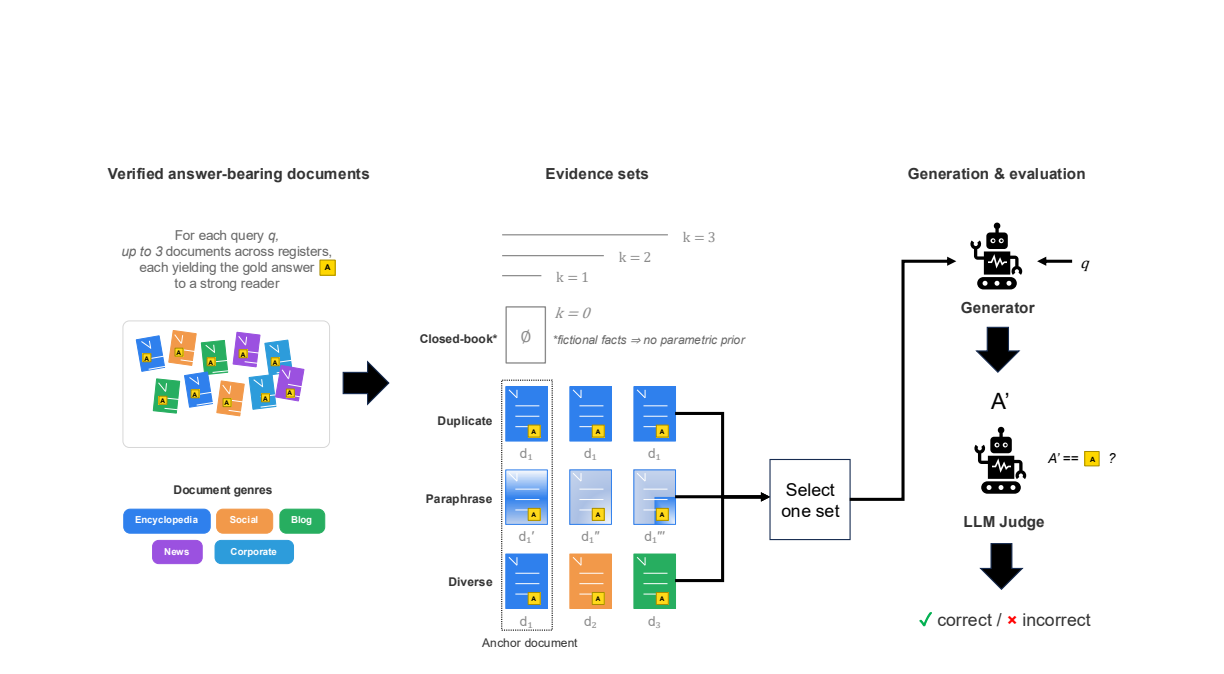
This paper investigates how redundancy and diversity from the retrieved document set impact the generator in terms of answer correctness. Previous work has provided a mix of findings: some showing that redundancy improves generation by reinforcing relevant information, others that LLM-based paraphrasing of the same content may be beneficial. Many of these studies did not control for confounding factors like whether the documents contained the exact answer or not, and if parametric knowledge plays a role. We conduct a carefully controlled experiment investigating three key scenarios of retrieved document sets: 1) Duplicate (exact copies of the same document), 2) Paraphrased (LLM rephrased versions of one document) and 3) Diverse (documents from different genres each containing relevant information in different forms). We control for which documents contain the answer in exact match or rephrased form. Evaluation is done with FictionalQA, a synthetic, fictional question-answer dataset that ensures the LLM generator prior knowledge cannot answer the question; the answer must come from retrieved documents. We show that duplicate redundancy and LLM paraphrasing does not significantly improve answer correctness. However, providing diverse documents is highly beneficial, improving answer correctness by 17%-47%. We further show this improvement is driven by diverse forms of document genre (news, blogs, etc.) alone and not a consequence of more relevant answer being available to generator. Our findings help to direct more attention to how new retrieval methods might improve RAG by catering to the generator preference for diversity in retrieval results.
from the abstract
Pith says
Machine review · deepseek-v4-flash · 27 Aug 2026 · what was read was not recorded · not checked by a person
It can be wrong. Challenge this review or reply to it.
Holds up, with conditions. A well-controlled study that convincingly shows diverse evidence sets help RAG short-form QA; the genre-alone mechanism is real but not fully isolated. This line is wrong
3 major objections · 4 minor
How often objections from reviews like this one are right: not yet measured
Not checked: figures, code, what the 19 references say.
The paper says, at Section 4.3, Table 6
The review did not quote this passage.
Pith says: Objection 1 of 3 · major
The claim that the diverse gain 'comes truly from their diversity in genre and not from having more or better relevant information' is not established by the design. The Diverse condition simultaneously varies genre, document identity, and (even after screening) the superficial form of the answer, while the Duplicate condition varies none of these.
more of objection 1
There is no same-genre distinct-document condition: comparing 'anchor + one other-genre verified document' against 'two verbatim copies' cannot separate the effect of genre mixing from the effect of simply having a second, independently worded verified document. The large per-genre differences in Table 6 (pooled correctness 0.532 for social vs 0.804 for encyclopedia) make this confound concrete: if a diverse gain is concentrated in pairs where a low-performing anchor is supplemented by a high-performing genre, the effect would be attributable to document ease rather than to diversity as such. I recommend adding a condition that holds genre constant while varying document identity, e.g., k distinct verified documents all from the same genre, and reporting whether the diverse condition still outperforms it.
The paper says, at Section 3.2, Table 2
The review did not quote this passage.
Pith says: Objection 2 of 3 · major
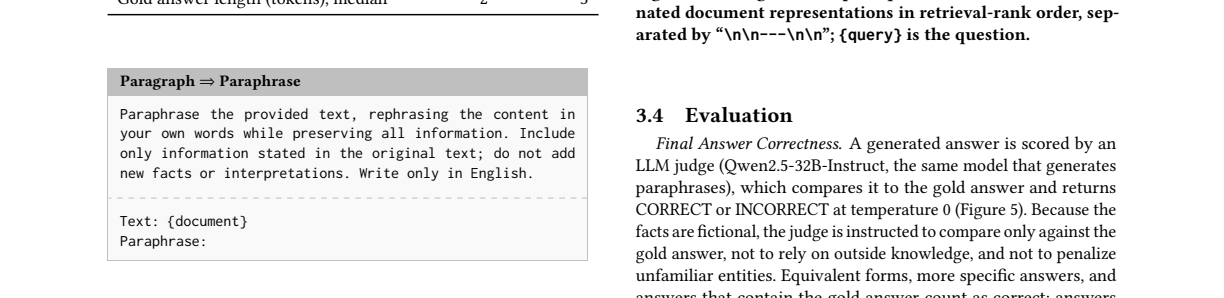
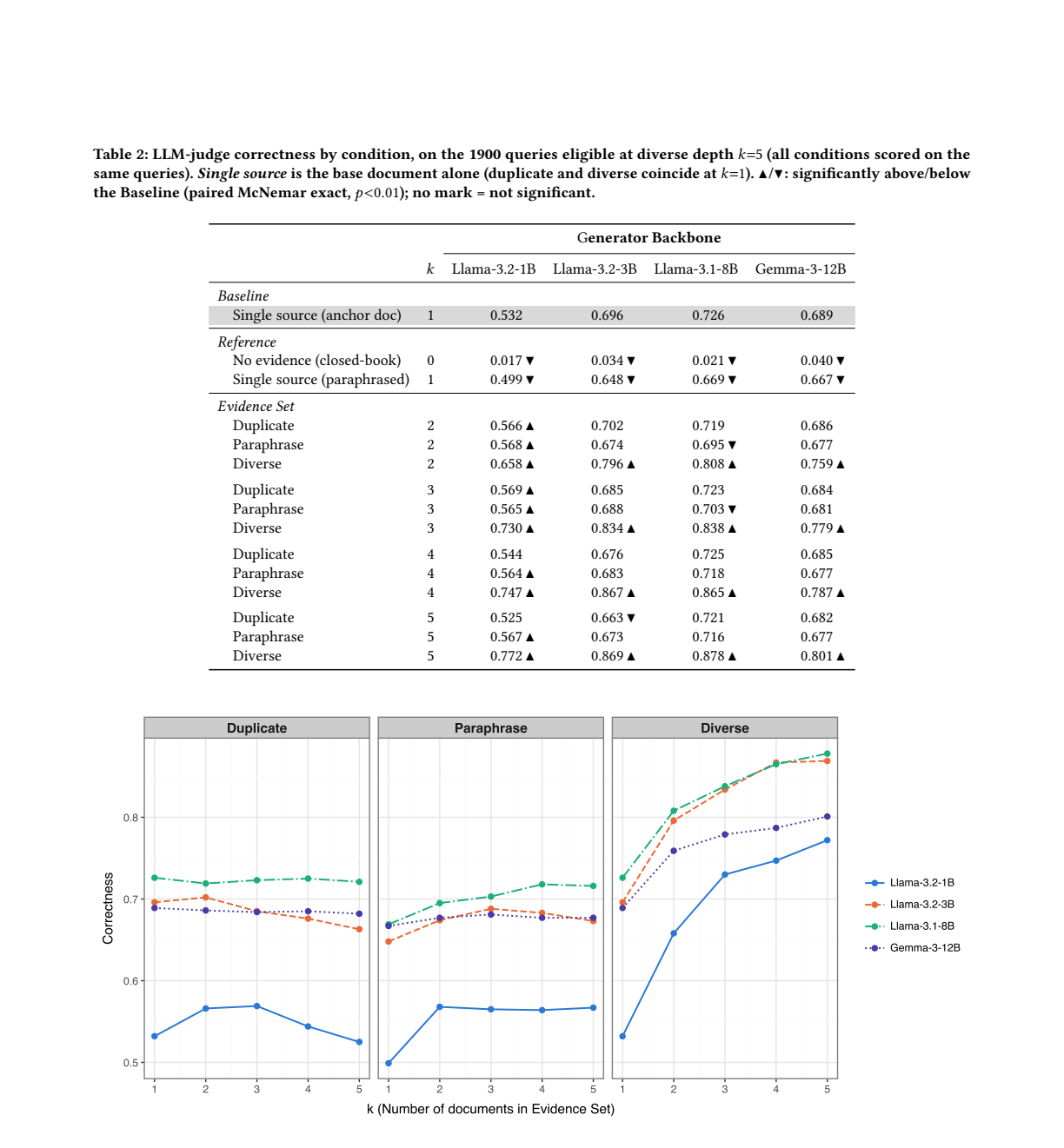
The paraphrase condition assumes that Qwen2.5-32B-Instruct rewordings preserve the answer-bearing content, but this is not verified. The paper itself notes that 'answer related content survives the paraphrase only if the model follows the instruction' (Section 3.2). The data suggest that paraphrases are in fact lossy: at k=1 the paraphrased single source is significantly below the anchor baseline for every generator (e.g., 0.669 vs 0.726 for Llama-3.1-8B and 0.499 vs 0.532 for Llama-3.2-1B in Table 2).
more of objection 2
If paraphrases sometimes drop or corrupt the answer, the null result for the paraphrase condition is confounded: it would reflect degraded input, not the absence of a beneficial repetition effect. The authors should verify that each paraphrase is answer-supporting (using the same GPT-4o verification procedure) or, failing that, report the paraphrase fidelity rate and re-run the analysis on only faithful paraphrases.
The paper says, at Section 4.3, Tables 4-5
The review did not quote this passage.
Pith says: Objection 3 of 3 · major
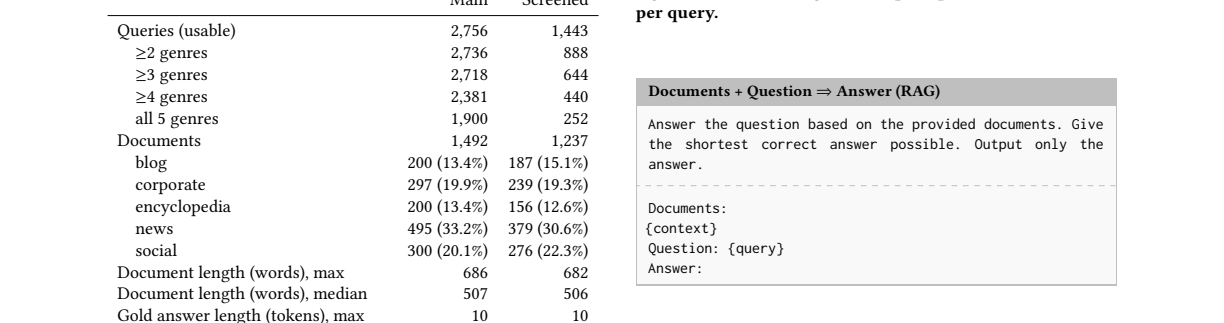
The screened-query analysis that underpins the 'genre alone' conclusion uses only 252 queries and only one generator (Llama-3.1-8B). The full 1,900-query result is shown for four generators, but the string-matching control is demonstrated for a small subset of one model.
more of objection 3
Given that the central claim about the mechanism rests on this subset, the paper should either run the screened analysis on all four generators, or justify why the 252-query subset is sufficient to make a cross-model claim. At minimum, confidence intervals or a power analysis for the 252-query contrasts would help assess whether the null results for Duplicate and Paraphrase are informative.
4 minor objections
The paper says, at Section 3.2
Pith says: minor objection 1 of 4
The sentence 'The results is our screened queryset' is ungrammatical and should be revised, for example to 'The resulting set is our screened queryset.'
The paper says, at Section 4.3
Pith says: minor objection 2 of 4
The word 'truely' should be 'truly'.
show 2 more
The paper says, at Table 5
Pith says: minor objection 3 of 4
The row labels 'Paraphrase over Duplicate (n=225)' are clear in context, but the caption could state explicitly that all other contrasts use the balanced 252-query set.
The paper says, at Abstract
Pith says: minor objection 4 of 4
The phrase 'documents from different genres each containing relevant information in different forms' is imprecise; 'different forms' is used to mean both different wording and different document type, and these are conflated throughout the paper.
What would settle it
Add a SameGenre condition to the released pipeline: for the same 1,900 main and 252 screened queries, build k=2..5 evidence sets from k distinct verified documents drawn from one genre (e.g., two different news articles). If SameGenre gains over Duplicate match Diverse-over-Duplicate, the mechanism is document distinctness/source independence, not genre. Additionally, stratify the existing Diverse-over-Duplicate contrast by anchor genre and by added document genre/ease; if gains occur only when the added genre has high single-document correctness (e.g., encyclopedia) and not for low-ease genres (social), the gain is document ease rather than genre diversity.
from the skeptic's reading
How the review went
4 readings by deepseek-v4-flash · 27 Aug 2026
- Reader holds up, with conditions
- Skeptic partly agrees
- Editor wrote the verdict above
- Referee major revision: 3 major objections, 4 minor
Not run on this paper: the simulated authors' defence.
Pith did not check this review's objections against the paper.
The review in full
The review in brief, machine-written
Vanja — quick take on arXiv:2608.13956. Worth reading. It isolates redundancy from content in short-form QA more cleanly than anything in the cited prior work, and the main result — diverse documents improve correctness by 17–47% while verbatim duplicates do not — looks solid. The FictionalQA setup kills parametric priors, the document verification is careful, and the screened queryset rules out the trivial explanation that diverse docs merely contain the exact answer string. Four generator sizes, consistent direction, code released. That is real work.
What is actually new: CUE-R and GroupQA had parametric-prior or knowledge-conflict confounds; Schuster et al. used synthetic entities but only under conflict and only duplicates. Here the same uncontested fact is presented as duplicate, paraphrase, or cross-genre documents, and the duplicate-vs-diverse contrast is clean. The diverse gain is monotonic in k and replicates on the screened set.
Soft spots, in proportion. First, the ‘genre alone’ claim in Section 4.3 is stronger than what was tested. The Diverse condition varies genre, document identity, and the lexical form of the answer simultaneously; there is no same-genre, distinct-document condition. So a skeptic can say the gain comes from having a second, independently worded document that is easier to extract from, not from genre mixing per se. Table 6 shows strong genre effects at k=1, but that does not establish that the k=2 gain is genre-driven. This is an addressable design gap rather than a fatal flaw — the main diverse-benefit conclusion survives.
Second, the paraphrase condition is undermined by unverified paraphrase fidelity. The k=1 paraphrase baseline is significantly below the anchor baseline for all models (0.669 vs 0.726 for the 8B), so the rewrites are probably lossy. That means ‘paraphrasing doesn’t help’ is not cleanly established; a lossy paraphrase could hide a real effect. They should verify paraphrases preserve the gold answer, or report the loss rate.
Third, minor: the paper says ‘truely’ and the abstract’s ‘genre alone’ wording overstates. Copyedits.
Overall: the central finding is new and likely correct; the mechanism claim needs tightening. The paper deserves a serious referee. I’d send it to review, with a request to either add a same-genre distinct-document control or soften the genre-alone claim, and to verify paraphrase fidelity.
The strongest objection
Section 4.3 concludes the diverse gain is 'driven by diverse forms of document genre alone', but the Diverse condition is not genre-only. At k=2 it presents the anchor plus one verified document from another genre, while Duplicate presents two verbatim copies; the two sets differ simultaneously in genre, document identity, and the lexical form of the answer. The screened queryset removes only exact/near answer strings (Section 3.2), not the semantic presence or extractability of the answer. Because every added document is verified answer-supporting, the gain could reflect a second, easier route to the answer rather than genre mixing. Table 6 shows strong single-document genre effects (pooled correctness 0.532 for social vs 0.804 for encyclopedia); if the diverse gain is concentrated in pairs where a low-ease anchor is supplemented by a high-ease document, the effect is document quality, not diversity. No same-genre distinct-document condition is run, so the paper's central mechanistic claim—that genre, not document identity or answer phrasing, drives the improvement—is untested.
The reader's weakest assumption was paraphrase fidelity, which is a real flaw in the paraphrase arm but does not threaten the clean Diverse-over-Duplicate comparison that supports the headline 'diverse documents improve correctness'. The more load-bearing issue for the paper's strongest claim is the second half of that claim: 'driven by diverse forms of document genre alone'. The experimental design never isolates genre from document identity or answer phrasing. The screened set handles only surface-level answer matches, and Table 6 demonstrates that single-document genre has a large effect on correctness, making it entirely possible that the diverse gain is the sum of adding an easier document rather than an emergent property of genre mixing. This concern does not overturn the diverse-benefit result, but it does invalidate the mechanism claim and the corresponding recommendation to diversify specifically by genre. The paper otherwise has strong controls: fictional corpus with near-zero closed-book accuracy, paired McNemar tests on the same queries, and a released code repository. The condition is addressable with a SameGenre control and a genre-stratified analysis, so the reader's CONDITIONAL verdict remains appropriate; I would not change it.
The referee's report
If the results hold, this is a useful contribution to the RAG literature: it provides a carefully controlled comparison of duplicate, paraphrased, and diverse evidence sets, with a credible non-parametric benchmark (FictionalQA), paired queries across conditions, a closed-book floor, and a screening procedure for exact/near answer strings. The paper also ships code and results, which supports reproducibility. The main headline—that diverse documents help substantially—is likely robust. However, the paper's central mechanistic claim, that the gain is driven by genre diversity alone, is not directly tested because the diverse condition conflates genre with document identity and answer phrasing. The paraphrase condition is also weakened by the lack of verification that paraphrases retain answer-bearing content. These issues are fixable with additional experiments, but they are load-bearing for the paper's conclusions as stated.
Pith's reading of the paper (a machine's summary, not the authors')
This paper asks what a retrieval-augmented generator gains from the retrieved document set as a whole, rather than from any single document. Using FictionalQA, a synthetic dataset of fictional facts that no model can answer from memory, the authors vary the number $k$ of answer-bearing documents and whether they are verbatim duplicates, LLM rewordings of one document, or independently written documents from different genres. They find that duplicates and paraphrases do not reliably improve answer correctness, while diverse documents improve correctness by 17% to 47% across models, with gains growing at larger $k$. The improvement survives even when every document is screened so the gold-answer string never appears, and single-document genre alone shifts correctness from about 0.37 to 0.85. The authors conclude that retrievers and rerankers should select for diverse, independently written sources rather than top-ranked passages that overlap in wording.
What carries the argument. The controlled evidence-set design is the central mechanism. For each query the answer-bearing content is held fixed while the number of documents $k$ (1–5) and the textual form of each recurrence vary: verbatim duplicate copies of an anchor document, independently LLM-reworded copies of that anchor, or one verified document from each of five genres. FictionalQA supplies fictional events so closed-book accuracy is near zero, which removes parametric memory as a confound; every document is verified to yield the gold answer when read alone by a strong reader; and an LLM judge scores the generator's answer against the gold. This lets any difference in correctness be attributed to redundancy or diversity of form, not to new content. The genre ablation further isolates document genre as a single factor by fixing $k=1$.
Core claim. The central claim is that in short-form question answering, the generator's correctness is driven by the diversity of the retrieved document set, not by redundancy. When the same answer-bearing document is supplied $k$ times verbatim, or as $k$ LLM-generated paraphrases, correctness stays essentially at the single-document baseline; but when the $k$ documents come from $k$ different genres, correctness rises monotonically with $k$, reaching gains of 17% to 47% (up to 24.7 percentage points over duplicate contexts at $k=5$) across four generators from 1B to 12B parameters. The paper further claims this gain is caused by diversity of document form alone: on a screened subset of 252 queries where no document contains the exact or near answer string, the diverse condition still beats the baseline by 0.139–0.230, while duplicates and paraphrases do not. A separate ablation shows the genre of a single answer-bearing document strongly changes correctness, with encyclopedic documents best and social-media documents worst, despite all being verified as answer-supporting. In the authors' terms, RAG retrieval should be rethought: instead of filling the context window with similar top-$k$ passages, retrievers should cater to the generator's preference for diverse evidence.
The premise it rests on. The experiment assumes that the LLM-generated paraphrases preserve the answer-bearing content, but paraphrases are not individually verified for answer support, and a single paraphrased document already yields lower correctness than the original document in every generator tested.
If the paper is right (Pith's inferences, not the authors')
Retrieval pipelines should optimize the whole retrieved set for cross-document diversity, such as genre or register spread, rather than only individual query relevance.
Duplicate or paraphrase-based augmentation is unlikely to improve short-form factual QA; adding an independently written source is a better use of the retrieval budget.
Diversity-aware reranking need not rely on detecting explicit answer strings, since the benefit persists when no document contains the exact answer.
Set-level or coverage-oriented selection becomes the relevant design target, because per-document relevance scores miss the collective property that drives generation.
Document genre is itself a ranking signal: the same fact from an encyclopedic source yields far higher correctness than from a social-media post, so source type should influence selection.
A natural testable extension would vary genre labels while holding wording fixed, e.g., rephrasing the same passage in different registers; if gains persist, form alone drives the effect, and if they vanish, semantic content differences across independently written documents are doing the work.
The effect may be smaller on real-world facts where the generator already holds parametric knowledge, since the closed-book floor here is near zero; on familiar topics, parametric priors could mask or alter the diversity benefit.
One mechanism consistent with the results is that diverse documents widen the lexical and structural coverage around the answer, giving the generator more surface cues; this predicts that diversity gains should shrink if diverse documents are lexically aligned.
For practitioners, a cheap proxy for diversity might be enforcing a genre or URL-domain quota in the retrieved set; the screened-set result suggests this could work even without requiring exact-answer overlap detection.
Check this review
Pith stored no record of this review's passes and took no fingerprint of it. Reviews made by code from 13 Nov 2026 on carry both.
How often reviews like this one are right
Reviews like this one: written by deepseek-v4-flash, where what was read was not recorded.
How often objections from reviews like this one are right: not yet measured
Reviews by people
This review was written by a machine. No person has reviewed this paper on Pith yet. A scientist listed on Pith can review it for a fee, and their review is published here whatever it concludes.
The paper
Abstract
In RAG, while the retriever typically ranks documents by their individual relevance to the query, the generator instead produces an answer based on the retrieved documents as a whole. This paper investigates how redundancy and diversity from the retrieved document set impact the generator in terms of answer correctness. Previous work has provided a mix of findings: some showing that redundancy improves generation by reinforcing relevant information, others that LLM-based paraphrasing of the same content may be beneficial. Many of these studies did not control for confounding factors like whether the documents contained the exact answer or not, and if parametric knowledge plays a role. We conduct a carefully controlled experiment investigating three key scenarios of retrieved document sets: 1) Duplicate (exact copies of the same document), 2) Paraphrased (LLM rephrased versions of one document) and 3) Diverse (documents from different genres each containing relevant information in different forms). We control for which documents contain the answer in exact match or rephrased form. Evaluation is done with FictionalQA, a synthetic, fictional question-answer dataset that ensures the LLM generator prior knowledge cannot answer the question; the answer must come from retrieved documents. We show that duplicate redundancy and LLM paraphrasing does not significantly improve answer correctness. However, providing diverse documents is highly beneficial, improving answer correctness by 17%-47%. We further show this improvement is driven by diverse forms of document genre (news, blogs, etc.) alone and not a consequence of more relevant answer being available to generator. Our findings help to direct more attention to how new retrieval methods might improve RAG by catering to the generator preference for diversity in retrieval results.
The paper's own sentences, arranged, kept beside the review and separate from it. Each label is drawn from a closed vocabulary; the number beside it is the probability the classifier gave that label. No sentence in this record was written by a model.
abstract compiled · 2026-09-23
The authors' main claim, as the classifier picked it out 0.98
“However, providing diverse documents is highly beneficial, improving answer correctness by 17%-47%.”
How the main claim is stated: asserted 1.00
What the abstract itself states, as probabilities: claims first 0.05 · states limitation 0.14 · human participants 0.03 · controlled comparison 0.72 · randomized assignment 0.04 · states quantitative result 0.99 · compares with prior results 0.88 · mentions code or data availability 0.03
The abstract, sentence by sentence
This table labels the abstract only (arXiv listing abstract v1). The number is the probability the classifier gave the label.
| Sentence | Role | The authors' own work | States the main conclusion | Strength |
|---|---|---|---|---|
| In RAG, while the retriever typically ranks documents by their individual relevance to the query, the generator instead produces an answer based on the retrieved documents as a whole. | background 1.00 | 0.06 | 0.02 | asserted 0.96 |
| This paper investigates how redundancy and diversity from the retrieved document set impact the generator in terms of answer correctness. | contribution 0.96 | 0.54 | 0.03 | asserted 0.81 |
| Previous work has provided a mix of findings: some showing that redundancy improves generation by reinforcing relevant information, others that LLM-based paraphrasing of the same content may be beneficial. | background 1.00 | 0.03 | 0.02 | asserted 0.85 |
| Many of these studies did not control for confounding factors like whether the documents contained the exact answer or not, and if parametric knowledge plays a role. | gap 0.98 | 0.07 | 0.02 | asserted 0.94 |
| We conduct a carefully controlled experiment investigating three key scenarios of retrieved document sets: 1) Duplicate (exact copies of the same document), 2) Paraphrased (LLM rephrased versions of one document) and 3) Diverse (documents from different genres each containing relevant information in different forms). | method 0.80 | 0.94 | 0.03 | asserted 0.96 |
| We control for which documents contain the answer in exact match or rephrased form. | method 0.98 | 0.94 | 0.02 | asserted 0.99 |
| Evaluation is done with FictionalQA, a synthetic, fictional question-answer dataset that ensures the LLM generator prior knowledge cannot answer the question; the answer must come from retrieved documents. | method 1.00 | 0.87 | 0.02 | asserted 0.98 |
| We show that duplicate redundancy and LLM paraphrasing does not significantly improve answer correctness. | result 1.00 | 0.96 | 0.16 | asserted 1.00 |
| However, providing diverse documents is highly beneficial, improving answer correctness by 17%-47%. | result 1.00 | 0.95 | 0.66 | asserted 1.00 |
| We further show this improvement is driven by diverse forms of document genre (news, blogs, etc.) alone and not a consequence of more relevant answer being available to generator. | result 0.56 | 0.96 | 0.22 | asserted 1.00 |
| Our findings help to direct more attention to how new retrieval methods might improve RAG by catering to the generator preference for diversity in retrieval results. | future work 0.73 | 0.53 | 0.10 | asserted 0.50 |
What kind of paper the classifier reports this is: empirical study 1.00 · evidence from observation or experiment 1.00
What was examined, and what was not
Sources read
- arXiv listing abstract v1
Not examined
- full text
- figures and tables
- references and citing sentences
- relations to other papers
Levels run
- P abstract
Not run
- S sections
- T body sentences
- C citations
- R cross-paper relations
How the labels were made
Compiled by classifier-1.13.0 via TypeSafe API, question bank abstract-p1-20260923, 2026-09-23: 1 request, 8,262 input tokens.
Every quoted sentence on this record is the authors'. Every label is from Pith's closed vocabulary, with the probability shown beside it. This record as JSON
Figures (6)
Figures are the authors', reproduced from the paper.
References (19)
- [1] Jaime Carbonell and Jade Goldstein. 1998. The Use of MMR, Diversity-Based Reranking for Reordering Documents and Producing Summaries. InProceedings of the 21st Annual International ACM SIGIR Conference on Research and Development in Information Retrieval. ACM, Melbourne Austra... on Pithdoi:10.1145/290941
- [2] Florin Cuconasu, Giovanni Trappolini, Federico Siciliano, Simone Filice, Cesare Campagnano, Yoelle Maarek, Nicola Tonellotto, and Fabrizio Silvestri. 2024. The Power of Noise: Redefining Retrieval for RAG Systems. InProceedings of the 47th International ACM SIGIR Conference on... on PitharXiv
- [3] Siddharth Jain and Venkat Narayan Vedam. 2026. CUE-R: Beyond the Fi- nal Answer in Retrieval-Augmented Generation.CoRRabs/2604.05467 (2026). arXiv:2604.05467 doi:10.48550/ARXIV.2604.05467 on PithPith's reviewarXivdoi:10.48550/arxiv.2604.05467
- [4] Jia-Huei Ju, Suzan Verberne, Maarten de Rijke, and Andrew Yates. 2025. Con- trolled Retrieval-augmented Context Evaluation for Long-form RAG. InFindings of the Association for Computational Linguistics: EMNLP 2025, Suzhou, China, November 4-9, 2025, Christos Christodoulopoulos... on Pithdoi:10.18653/v1/2025.findings-emnlp.1151
- [5] Jia-Huei Ju, Eugene Yang, Trevor Adriaanse, Suzan Verberne, and Andrew Yates on Pith
- [6] Vladimir Karpukhin, Barlas Oguz, Sewon Min, Patrick Lewis, Ledell Wu, Sergey Edunov, Danqi Chen, and Wen-tau Yih. 2020. Dense Passage Retrieval for Open- Domain Question Answering. InProceedings of the 2020 Conference on Empirical Methods in Natural Language Processing (EMNLP)... on Pithdoi:10.18653/v1/2020.emnlp-main.550
- [7] John Kirchenbauer, Natjanan Mongkolsupawan, Yuxin Wen, Tom Goldstein, and Daphne Ippolito. 2026. FictionalQA: A Dataset for Studying Memorization and Knowledge Acquisition. InThe Fourteenth International Conference on Learning Representations. https://openreview.net/forum?id=S... on Pith
- [8] Dahyun Lee, Yongrae Jo, Haeju Park, and Moontae Lee. 2025. Shifting from Ranking to Set Selection for Retrieval Augmented Generation. InProceedings of the 63rd Annual Meeting of the Association for Computational Linguistics (Volume 1: Long Papers), ACL 2025, Vienna, Austria, J... on Pithdoi:10.18653/v1/2025
- [9] Patrick Lewis, Ethan Perez, Aleksandra Piktus, Fabio Petroni, Vladimir Karpukhin, Naman Goyal, Heinrich Küttler, Mike Lewis, Wen-tau Yih, Tim Rocktäschel, Sebastian Riedel, and Douwe Kiela. 2020. Retrieval-Augmented Generation for Knowledge-Intensive NLP Tasks.Advances in neur... on Pith
- [10] Nelson F Liu, Kevin Lin, John Hewitt, Ashwin Paranjape, Michele Bevilacqua, Fabio Petroni, and Percy Liang. 2024. Lost in the Middle: How Language Models Use Long Contexts.Transactions of the Association for Computational Linguistics 12 (Feb. 2024), 157–173. doi:10.1162/tacl_a_00638 on Pithdoi:10.1162/tacl_a_00638
- [11] Atharv Naphade. 2026. Rational Synthesizers or Heuristic Followers? An- alyzing LLMs in RAG-based Question-Answering. InFindings of the Associ- ation for Computational Linguistics, ACL 2026, San Diego, California, United States, July 2-7, 2026, Maria Liakata, Viviane P. Moreir... on Pith
- [12] Saron Samuel, Alexander Martin, Eugene Yang, Andrew Yates, Dawn Lawrie, Ian Soboroff, Laura Dietz, and Benjamin Van Durme. 2026. Beyond Relevance: On the Relationship Between Retrieval and RAG Information Coverage. InProceedings of the 2026 International ACM SIGIR Conference o... on Pith
- [13] Saron Samuel, Andrew Yates, Dawn Lawrie, Ian Soboroff, Trevor Adriaanse, Benjamin Van Durme, and Eugene Yang. 2026. CoverageBench: Evaluating Information Coverage across Tasks and Domains. InProceedings of the 49th International ACM SIGIR Conference on Research and Development... on Pith
- [14] Rodrygo LT Santos, Craig Macdonald, and Iadh Ounis. 2012. On the role of novelty for search result diversification.Information retrieval15, 5 (2012), 478–502 on Pith
- [15] Rodrygo LT Santos, Craig Macdonald, and Iadh Ounis. 2015. Search Result Diversification.Foundations and Trends®in Information Retrieval9, 1 (2015), 1–90 on Pith
- [16] Jakob Schuster, Vagrant Gautam, and Katja Markert. 2026. Whose Facts Win? LLM Source Preferences under Knowledge Conflicts. arXiv:2601.03746 [cs.CL] doi:10.48550/arXiv.2601.03746 on PithPith's reviewarXivdoi:10.48550/arxiv.2601.03746
- [17] Alexander Wan, Eric Wallace, and Dan Klein. 2024. What Evidence Do Language Models Find Convincing?. InProceedings of the 62nd Annual Meeting of the Association for Computational Linguistics (Volume 1: Long Papers), ACL 2024, Bangkok, Thailand, August 11-16, 2024, Lun-Wei Ku, ... on Pith
- [18] Guido Zuccon, Leif Azzopardi, Dell Zhang, and Jun Wang. 2012. Top-k retrieval using facility location analysis. InEuropean Conference on Information Retrieval. Springer, 305–316. 9 on Pith
- [2026] Search for Coverage: Learning Coverage-Aware Retrieval with Augmented Sub-Question Answerability. InProceedings of the 49th International ACM SIGIR Conference on Research and Development in Information Retrieval. 723–733 on Pith
Cited by 1 Pith paper
Reviewed papers on Pith that cite this one. The full citation record
- Record Grouping Controls Evidence Weight in Language Models cs.CL · Sep 2026
Challenges and discussion
Disagree with the review, or know something it missed? Leave a comment, or challenge this review formally: a challenge becomes a permanent entry in this paper's record, and its decision is published here.
Come back by email
A short list of the week's newly reviewed papers. Nothing is sent until you confirm from your inbox, and every email has a link that stops it. No account.
No comments yet.
Sign in to comment