Computation and Language · arXiv:2609.08698 v1 · submitted 8 Sep 2026 · 17 references
Record Grouping Controls Evidence Weight in Language Models
The paper says
“Retrieved records are presentation units; a supplied partition determines which records enter a language model as one evidential contribution.”
more of the abstract
We characterize the invariant group-content state that removes within-group copies while retaining complementary canonical content, show that equal group counts can encode different evidence states, and derive a sharp content-aware partition-error bound. Given a supplied partition, our pre-generation representation deduplicates and aggregates content within groups and bounds each group's contribution. Across 104,402 trials and 6 public checkpoints, a central natural-text intervention finds that content-fixed false splits add 10.27-32.66 percentage points and false merges remove 9.13-31.79 points; a matched six-slot control retains the positive direction in all 16 cells. In a new 48-item controlled campaign panel, changing the supplied partition produces measurable, checkpoint-dependent decision shifts across all four models, and the balanced mirror design exposes substantial order interactions. Together, the theory and experiments establish the supplied partition as a controllable pre-generation representation variable and characterize its checkpoint-dependent behavioral effects.
from the abstract
Pith says
Machine review · deepseek-v4-flash · 9 Sep 2026 · what was read was not recorded · not checked by a person
It can be wrong. Challenge this review or reply to it.
Holds up. A careful, well-controlled demonstration that the supplied record partition causally shifts how much evidence LLMs weigh; the theory is modest but the empirical core is solid and the acknowledged limits are not load-bearing. This line is wrong
3 major objections · 4 minor
How often objections from reviews like this one are right: not yet measured
Not checked: figures, code, what the 17 references say.
The paper says, at Section 3.2, Eq. (2)
The review did not quote this passage.
Pith says: Objection 1 of 3 · major
The paper assumes the existence of a fixed canonicalizer z_ev that maps every record to a canonical evidence element. The operational canonicalizer used in experiments is exact-text deduplication, which satisfies this assumption for the tested scenarios. However, the theory's reliance on a fixed, domain-independent canonicalizer is not validated across diverse real-world settings (e.g., paraphrases or semantically equivalent but textually distinct records).
more of objection 1
The paper acknowledges the exact-recovery boundary (Proposition 6) but does not discuss how to construct or justify z_ev in practice. This limits the direct applicability of the representation guarantee outside exact-copy settings.
The paper says, at Section 3.3, Proposition 12
The review did not quote this passage.
Pith says: Objection 2 of 3 · major
The sharp content-aware bound in Proposition 12 involves a constant B that is an arbitrary upper bound on the aggregator's output norm. The paper does not instantiate B for any real model or downstream map, nor does it provide a method to estimate it.
more of objection 2
While the bound is mathematically correct, its practical utility for predicting decision stability (Corollary 13) is unclear without a concrete B. A brief discussion of how one might calibrate B in a given pipeline would strengthen the connection between theory and experiments.
The paper says, at Table 1 and Table 3
The review did not quote this passage.
Pith says: Objection 3 of 3 · major
The matched six-slot control (Table 3) shows positive point estimates in all 16 cells but only 12 of 16 ordinary 95% intervals lie entirely above zero (Bonferroni-adjusted: 11/16). The authors mention this but do not discuss potential sources of residual variation that could lead to intervals crossing zero (e.g., model-specific sensitivity to format, order interactions, or limited statistical power in certain cells). A short explanation would help readers interpret the strength of the matched control evidence.
4 minor objections
The paper says, at Abstract
Pith says: minor objection 1 of 4
The abstract states '104,402 trials and 6 public checkpoints' but Table 1 only lists 4 checkpoints; the other two checkpoints (Qwen3-14B-AWQ, Phi-4) appear in Appendix Tables 7. Consider mentioning the extended set explicitly to avoid confusion.
The paper says, at Section 4.2
Pith says: minor objection 2 of 4
The description of the matched six-slot control (Phase 11) is spread across multiple paragraphs. A single concise summary of what is controlled (six JSON slots, R1–R6, header/separator, tokenizer length, etc.) would improve readability. The reader may benefit from a pointer to Table 3 earlier in the text.
show 2 more
The paper says, at Figure 1 caption
Pith says: minor objection 3 of 4
The caption reads 'Retrieved records are presentation units and may share claim-relative evidence roots.' The phrase 'presentation units' is not defined in the caption. A brief definition or reference to Section 3.1 would help.
The paper says, at References
Pith says: minor objection 4 of 4
Some references include 'URL' fields that are broken across lines (e.g., Rahadi 2026). Ensure all URLs use a consistent formatting that renders correctly.
What would settle it
Re-run the core split/merge contrast (Table 1) on a third natural-text domain (e.g., medical Q&A with clinician-annotated evidence roots) using the same experimental protocol. If the sign and approximate magnitude of the effects replicate, cross-domain robustness is confirmed.
from the skeptic's reading
How the review went
4 readings by deepseek-v4-flash · 9 Sep 2026
- Reader holds up
- Skeptic agrees
- Editor wrote the verdict above
- Referee minor revision: 3 major objections, 4 minor
Not run on this paper: the simulated authors' defence.
Pith did not check this review's objections against the paper.
The review in full
The review in brief, machine-written
You should know two things up front. First, this paper's central empirical claim holds up: with the ordered evidence words fixed, splitting one supplied group into four records inflates the attack-side probability by 10–33 percentage points, and merging four supplied units into one record suppresses it by 9–32 points, across four checkpoints and two domains. The matched six-slot control is the right kind of check — same object count, headers, separators, byte length, and tokenizer input length — and the effect stays positive in 16/16 cells, though only 12 intervals exclude zero. Second, the theory is real but not deep. The quotient characterization, equal-count separation example, and Lipschitz-bound wrapper are clean and correctly stated, but they mostly formalize what a grouping representation should preserve; they do not predict the effect sizes or signs. The paper does not oversell them, which I appreciate.
The best parts are the experimental discipline. The split/merge contrasts are content-fixed. The six-slot control removes serialization confounds. The synthetic campaign panel exposes checkpoint-dependent reversals, including a striking order interaction on Qwen3-8B, and the paper reports that instability instead of averaging it away. The bootstrap resampling respects dependence components, and the Bonferroni sensitivity leaves all 16 split/merge effects with positive lower bounds. The reproduction statement is unusually concrete: stored outputs, exact verification counts, and a reported 5.33e-15 numerical difference.
Soft spots, in proportion. The canonicalizer z_ev is assumed rather than validated across domains; the paper acknowledges the text-only recovery boundary, and for the exact-text experiments the canonicalizer is just deduplication, so this is a limitation for the general framing, not a flaw in the measured effect. The theory-experiment link is loose: the formal representation is not actually instantiated in the tested pipelines, so the bounds do not explain the behavioral magnitudes. And the campaign panel uses carefully templated fictional products; it shows the phenomenon exists under controlled conditions, not that real coordinated campaigns behave this way. None of these undercut the central claim.
This paper is for people building RAG pipelines, studying evidence weighting, or worrying about search-engine optimization against answer engines. It deserves a serious referee: the empirical design is careful, the negative and reversal results are honestly reported, and the contribution is a genuinely new controlled variable rather than another frequency-effect anecdote. I would send it out and expect useful revision mostly around tightening the theory-empirics connection and broadening the canonicalizer discussion.
The strongest objection
The paper's central claim that record grouping causally controls evidence weight in language models is well-supported by a multi-contrast experimental design with rigorous controls. The content-fixed split/merge contrasts, matched six-slot serialization control, and controlled campaign panel collectively identify a causal effect of the supplied partition on model behavior. The theoretical characterization (quotient state, error bounds) is sound and does not affect the empirical identification. The acknowledged limitation about the canonicalizer z_ev is not load-bearing for the experimental results, which use exact-text deduplication as the operational canonicalizer. No inconsistent internal argument, missing control, or statistical flaw was found that would weaken the central claim.
The reader's verdict (ACCEPT) and weakest assumption (canonicalizer validity) are aligned with the stress-tester's assessment. The paper explicitly acknowledges the canonicalizer limitation (Proposition 6) and provides operational solutions for both the natural-text and controlled experiments. The internal validity of the causal claims is strong; external generalizability is tested through two natural domains and a controlled fictional panel, which supports the central argument. No additional load-bearing concern was identified that would change the verdict.
The referee's report
If the result holds, the paper identifies record grouping as a controllable pre-generation representation variable, with direct implications for retrieval-augmented language models, adversarial robustness, and evidence-weighting in systems exposed to coordinated content placement. The theoretical analysis (quotient state, invariance, sharp bounds) provides a principled framework that separates representation guarantees from behavioral responses. The experimental design is thorough: multiple natural-text domains, content-fixed split/merge contrasts, a matched six-slot control that equalizes object count and tokenizer length, and a controlled campaign panel that tests cross-genre same-root and independent-root partitions. The statistical analysis uses dependence-component bootstrapping and Bonferroni-adjusted intervals. The paper is likely to be influential in both the representation and adversarial-information communities.
Pith's reading of the paper (a machine's summary, not the authors')
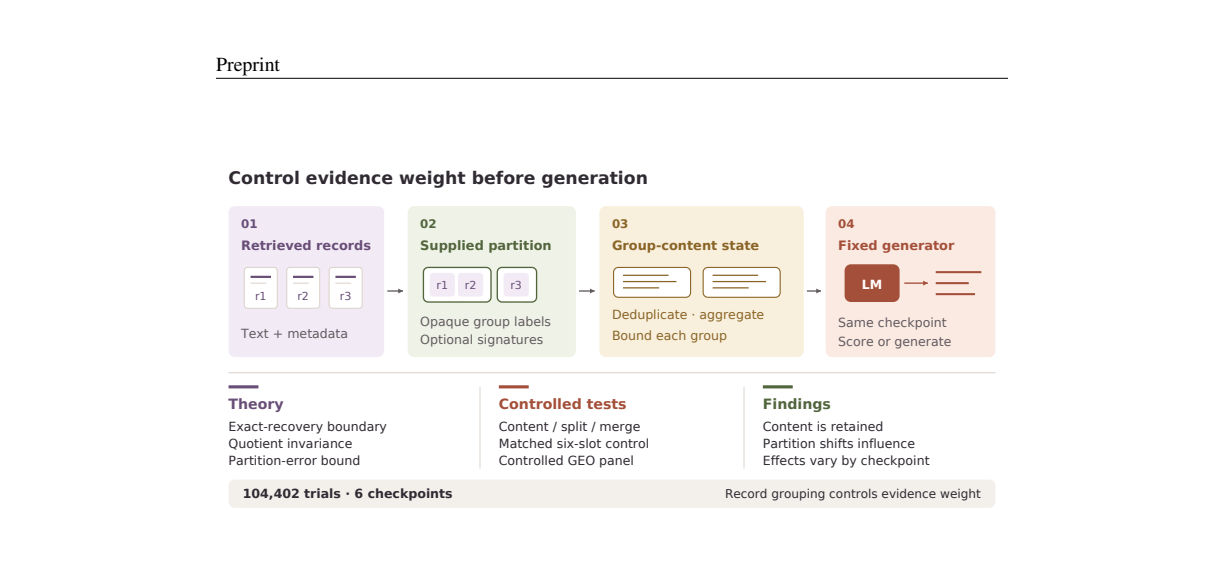
The paper establishes that the way retrieved records are grouped before a language model processes them is not a neutral packaging choice but a controllable determinant of how much influence the evidence exerts. The authors characterize an invariant group-content state that removes within-group duplicates while retaining complementary canonical content, and derive a sharp bound on how partition errors distort the evidence representation. Across over 100,000 experimental trials, content-fixed false splits (breaking one evidence unit into multiple records) inflate the manipulated side's likelihood by 10.27 to 32.66 percentage points, while false merges (combining distinct evidence units) suppress it by 9.13 to 31.79 points. A matched six-slot serialization control confirms the effect persists after equalizing record counts, headers, and tokenizer length, establishing the supplied partition as a controllable pre-generation variable with checkpoint-specific behavioral effects.
What carries the argument. The central object is the group-content state, defined as the quotient multiset of canonical evidence sets per group under opaque membership labels. This state removes within-group exact duplicates while retaining complementary canonical content, assigns one bounded contribution per group, and distinguishes partitions with equal group counts but different content combinations (Proposition 2). The representation is characterized by Theorem 1 (invariant and faithful recoding) and yields a sharp content-aware partition-error bound (Proposition 12) that converts upstream partition errors into a representation distortion bound, which in turn gates decision stability via a Lipschitz margin condition.
Core claim. The central claim is that a supplied partition over retrieved records—how records are grouped into evidence units before generation—directly controls the evidence weight a language model assigns, independently of the text content itself. The paper proves that the group-content state (a multiset of canonical content sets per group) is invariant under nuisance transformations and faithfully distinguishes all partition configurations that differ by which facts are combined in the same group. Experimentally, when the same ordered 160-word evidence stream is presented as one grouped record versus four separate records, the split increases the attack-side probability by up to 32.66 points, and merging four distinct evidence units into one record decreases it by up to 31.79 points, with all intervals positive. The matched six-slot control removes confounds from extra objects, headers, and token length, yet the effect direction remains positive in all 16 cells, establishing that evidence packaging itself is an active variable in retrieval-augmented generation.
The premise it rests on. The paper assumes the existence of a fixed canonicalizer z_ev that maps every record to a unique canonical evidence element, without validating that such a canonicalizer exists or is reliable outside controlled settings.
If the paper is right (Pith's inferences, not the authors')
Retrieval-augmented generation pipelines must treat record grouping as a design parameter that actively allocates evidence weight, not merely a presentational choice.
Coordinated content placement can exploit false splits to inflate influence or false merges to suppress counter-evidence, creating new adversarial vectors.
Checkpoint-specific responses to partition boundaries mean that system-level guarantees about evidence weighting require model-specific calibration.
The pre-generation grouping representation offers a principled way to implement evidence multiplicity control independently of model behavior, by deduplicating and bounding group-level contributions.
Equal-count separation implies that simple count-based metrics are insufficient to capture evidence weight; the combination of which facts share a group matters.
The paper implies that any automatic chunking or syndication of documents implicitly defines a partition affecting downstream LLM decisions, even if text is identical; information diversity should be measured at the evidence-root level, not the URL or chunk level.
Sign reversals in the controlled campaign panel (e.g., Mistral-7B showing negative same-root split effect) indicate partition effects interact with instruction tuning or architecture, motivating mechanism characterization.
The group-content representation could be used defensively: an oracle partition can enforce bounded contribution per independent evidence source, neutralizing copy-based influence manipulation without removing complementary information.
Future work could test the partition effect in multi-hop reasoning where evidence must be synthesized across groups, as the current setup uses claim-affirming framing.
Check this review
Pith stored no record of this review's passes and took no fingerprint of it. Reviews made by code from 13 Nov 2026 on carry both.
How often reviews like this one are right
Reviews like this one: written by deepseek-v4-flash, where what was read was not recorded.
How often objections from reviews like this one are right: not yet measured
Reviews by people
This review was written by a machine. No person has reviewed this paper on Pith yet. A scientist listed on Pith can review it for a fee, and their review is published here whatever it concludes.
The paper
Abstract
Retrieved records are presentation units; a supplied partition determines which records enter a language model as one evidential contribution. We characterize the invariant group-content state that removes within-group copies while retaining complementary canonical content, show that equal group counts can encode different evidence states, and derive a sharp content-aware partition-error bound. Given a supplied partition, our pre-generation representation deduplicates and aggregates content within groups and bounds each group's contribution. Across 104,402 trials and 6 public checkpoints, a central natural-text intervention finds that content-fixed false splits add 10.27-32.66 percentage points and false merges remove 9.13-31.79 points; a matched six-slot control retains the positive direction in all 16 cells. In a new 48-item controlled campaign panel, changing the supplied partition produces measurable, checkpoint-dependent decision shifts across all four models, and the balanced mirror design exposes substantial order interactions. Together, the theory and experiments establish the supplied partition as a controllable pre-generation representation variable and characterize its checkpoint-dependent behavioral effects.
The paper's own sentences, arranged, kept beside the review and separate from it. Each label is drawn from a closed vocabulary; the number beside it is the probability the classifier gave that label. No sentence in this record was written by a model.
abstract compiled · 2026-09-23
The authors' main claim, as the classifier picked it out 1.00
“Together, the theory and experiments establish the supplied partition as a controllable pre-generation representation variable and characterize its checkpoint-dependent behavioral effects.”
How the main claim is stated: asserted 1.00
What the abstract itself states, as probabilities: claims first 0.06 · states limitation 0.30 · human participants 0.08 · controlled comparison 0.94 · randomized assignment 0.07 · states quantitative result 0.98 · compares with prior results 0.46 · mentions code or data availability 0.03
The abstract, sentence by sentence
This table labels the abstract only (arXiv listing abstract v1). The number is the probability the classifier gave the label.
| Sentence | Role | The authors' own work | States the main conclusion | Strength |
|---|---|---|---|---|
| Retrieved records are presentation units; a supplied partition determines which records enter a language model as one evidential contribution. | background 0.92 | 0.10 | 0.09 | asserted 1.00 |
| We characterize the invariant group-content state that removes within-group copies while retaining complementary canonical content, show that equal group counts can encode different evidence states, and derive a sharp content-aware partition-error bound. | contribution 0.97 | 0.94 | 0.17 | asserted 1.00 |
| Given a supplied partition, our pre-generation representation deduplicates and aggregates content within groups and bounds each group's contribution. | method 0.88 | 0.86 | 0.08 | asserted 1.00 |
| Across 104,402 trials and 6 public checkpoints, a central natural-text intervention finds that content-fixed false splits add 10.27-32.66 percentage points and false merges remove 9.13-31.79 points; a matched six-slot control retains the positive direction in all 16 cells. | result 1.00 | 0.95 | 0.17 | asserted 1.00 |
| In a new 48-item controlled campaign panel, changing the supplied partition produces measurable, checkpoint-dependent decision shifts across all four models, and the balanced mirror design exposes substantial order interactions. | result 0.94 | 0.94 | 0.08 | asserted 1.00 |
| Together, the theory and experiments establish the supplied partition as a controllable pre-generation representation variable and characterize its checkpoint-dependent behavioral effects. | interpretation 0.64 | 0.90 | 0.87 | asserted 1.00 |
What kind of paper the classifier reports this is: empirical study 0.92 · evidence from observation or experiment 0.99
What was examined, and what was not
Sources read
- arXiv listing abstract v1
Not examined
- full text
- figures and tables
- references and citing sentences
- relations to other papers
Levels run
- P abstract
Not run
- S sections
- T body sentences
- C citations
- R cross-paper relations
How the labels were made
Compiled by classifier-1.13.0 via TypeSafe API, question bank abstract-p1-20260923, 2026-09-23: 1 request, 5,056 input tokens.
Every quoted sentence on this record is the authors'. Every label is from Pith's closed vocabulary, with the probability shown beside it. This record as JSON
Figures (5)



Figures are the authors', reproduced from the paper.
References (17)
- [3] doi: 10.1145/3637528.3671900. URLhttps://doi.org/10.1145/3637528.3671900. Sihao Chen, Daniel Khashabi, Wenpeng Yin, Chris Callison-Burch, and Dan Roth. Seeing things from a different angle: Discovering diverse perspectives about claims. InProceedings of the 2019 Conference of ... on PitharXiv
- [9] URLhttps://aclanthology.org/2024.lrec-main.1466/. Yuxuan Li, Xinwei Guo, Jiashi Gao, Guanhua Chen, Xiangyu Zhao, Jiaxin Zhang, Quanying Liu, Haiyan Wu, Xin Yao, and Xuetao Wei. LLMs trust humans more, that’s a problem! unveiling and mitigating the authority bias in retrieval-a... on Pith
- [11] URLhttps://arxiv.org/abs/2607.20827. 10 Preprint Shayne Longpre, Kartik Perisetla, Anthony Chen, Nikhil Ramesh, Chris DuBois, and Sameer Singh. Entity-based knowledge conflicts in question answering. InProceedings of the 2021 Conference on Empirical Methods in Natural Language... on PithPith's reviewarXiv
- [13] URL https://arxiv.org/ abs/2503.01743. Atharv Naphade. Rational synthesizers or heuristic followers? analyzing LLMs in RAG-based question-answering. InFindings of the Association for Computational Linguistics: ACL 2026, pp. 40293–40311, on PithPith's reviewarXiv
- [14] doi: 10.18653/v1/2026.findings-acl.2003. URL https: //aclanthology.org/2026.findings-acl.2003/. Irwan Rahadi. Counting copies as evidence: Confidence inflation from dependent evidence in retrieval-augmented generation (RAG), August on Pithdoi:10.18653/v1/2026.findings-acl.2003
- [15] URL https://doi.org/10.5281/ zenodo.21923648. Position paper and preprint. Nils Reimers and Iryna Gurevych. Sentence-BERT: Sentence embeddings using Siamese BERT- networks. InProceedings of the 2019 Conference on Empirical Methods in Natural Language Processing and the 9th Int... on Pith
- [17] URL https: //arxiv.org/abs/2608.13956. Jakob Schuster, Vagrant Gautam, and Katja Markert. Whose facts win? LLM source preferences under knowledge conflicts. InProceedings of the 64th Annual Meeting of the Association for Computational Linguistics (Volume 1: Long Papers), pp. 2... on PithPith's reviewarXiv
- [19] URL https://arxiv. org/abs/2607.26448. Kaiser Sun, Fan Bai, and Mark Dredze. Task matters: Knowledge requirements shape LLM responses to context–memory conflict. InFindings of the Association for Computational Lin- guistics: ACL 2026, pp. 4154–4176, on PithPith's reviewarXiv
- [21] URLhttps://arxiv.org/abs/2404.13208. Alexander Wan, Eric Wallace, and Dan Klein. What evidence do language models find convincing? InProceedings of the 62nd Annual Meeting of the Association for Computational Linguistics (Volume 1: Long Papers), pp. 7468–7484, on PithPith's reviewarXiv
- [23] URL https: //arxiv.org/abs/2505.09388. Zhonghao Zhan, Huichi Zhou, Zhenhao Li, Peiyuan Jing, Krinos Li, and Hamed Haddadi. How adversarial environments mislead agentic AI? InFindings of the Association for Computational Linguistics: ACL 2026, pp. 10264–10280, on PithPith's reviewarXiv
- [25] URL https://arxiv. org/abs/2407.13048. 11 Preprint Wenxuan Zhou, Sheng Zhang, Hoifung Poon, and Muhao Chen. Context-faithful prompting for large language models. InFindings of the Association for Computational Linguistics: EMNLP 2023, pp. 14544–14556, on PithPith's reviewarXiv
- [26] doi: 10.18653/v1/2023.findings-emnlp.968. URL https:// aclanthology.org/2023.findings-emnlp.968/. 12 Preprint A SUPPORTINGTWO-STAGEAUDITTHEORY A.1 FINITE-STATETWO-STAGEIDENTITY For itemi, let balanced directionSi∈{−1,+1} determine which abstract value wins the supplied- group ... on Pithdoi:10.18653/v1/2023.findings-emnlp.968
- [2019] doi: 10.18653/v1/N19-1053. URLhttps://aclanthology.org/N19-1053/. Yimeng Chen, Zhe Ren, Firas Laakom, Yu Li, Dandan Guo, and J ¨urgen Schmidhuber. How much can we trust LLM search agents? measuring endorsement vulnerability to web content manipulation.arXiv preprint arXiv:2606.16821, on PithPith's reviewarXiv
- [2023] URL https://arxiv. org/abs/2310.06825. Zhuoran Jin, Pengfei Cao, Yubo Chen, Kang Liu, Xiaojian Jiang, Jiexin Xu, Li Qiuxia, and Jun Zhao. Tug-of-war between knowledge: Exploring and resolving knowledge conflicts in retrieval- augmented language models. InProceedings of the 202... on PithPith's reviewarXiv
- [2024] URL https: //arxiv.org/abs/2412.08905. Pranjal Aggarwal, Vishvak Murahari, Tanmay Rajpurohit, Ashwin Kalyan, Karthik Narasimhan, and Ameet Deshpande. GEO: Generative engine optimization. InProceedings of the 30th ACM SIGKDD Conference on Knowledge Discovery and Data Mining, pp. 5–16, on PithPith's reviewarXiv
- [2025] URLhttps://arxiv.org/abs/2505.17762. Albert Q. Jiang et al. Mistral 7B.arXiv preprint arXiv:2310.06825, on PithPith's reviewarXiv
- [2026] doi: 10.48550/arXiv.2606.16821. URL https://arxiv.org/abs/2606.16821. Cheng-Han Chiang and Hung-yi Lee. Do metadata and appearance of the retrieved webpages affect LLM’s reasoning in retrieval-augmented generation? InProceedings of the 7th Black- boxNLP Workshop: Analyzing and... on PithPith's reviewarXivdoi:10.48550/arxiv.2606.16821
Cited by 1 Pith paper
Reviewed papers on Pith that cite this one. The full citation record
Challenges and discussion
Disagree with the review, or know something it missed? Leave a comment, or challenge this review formally: a challenge becomes a permanent entry in this paper's record, and its decision is published here.
Come back by email
A short list of the week's newly reviewed papers. Nothing is sent until you confirm from your inbox, and every email has a link that stops it. No account.
No comments yet.
Sign in to comment