Artificial Intelligence · arXiv:2611.27138 v1 · submitted 20 Nov 2026 · 51 references
Double counting in LLM evidence fusion: exact posteriors separate rule compliance from posterior gain
The paper says
“Language models fuse reports in retrieval, multi-agent consensus and agent memory, where treating shared-source reports as independent can double count evidence. A common remedy is an instruction to count each source once. Its value depends on the receiver's raw baseline.”
more of the abstract
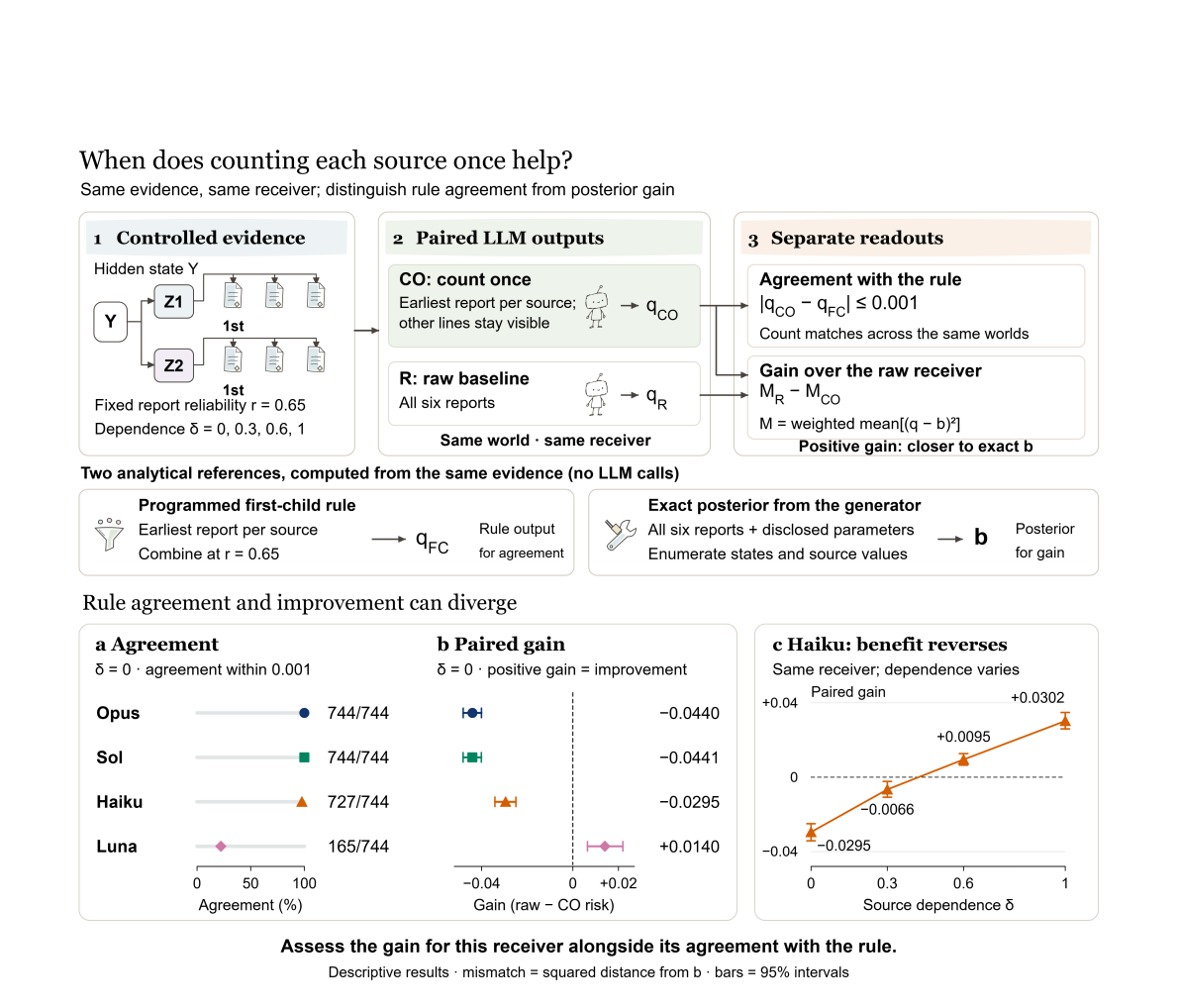
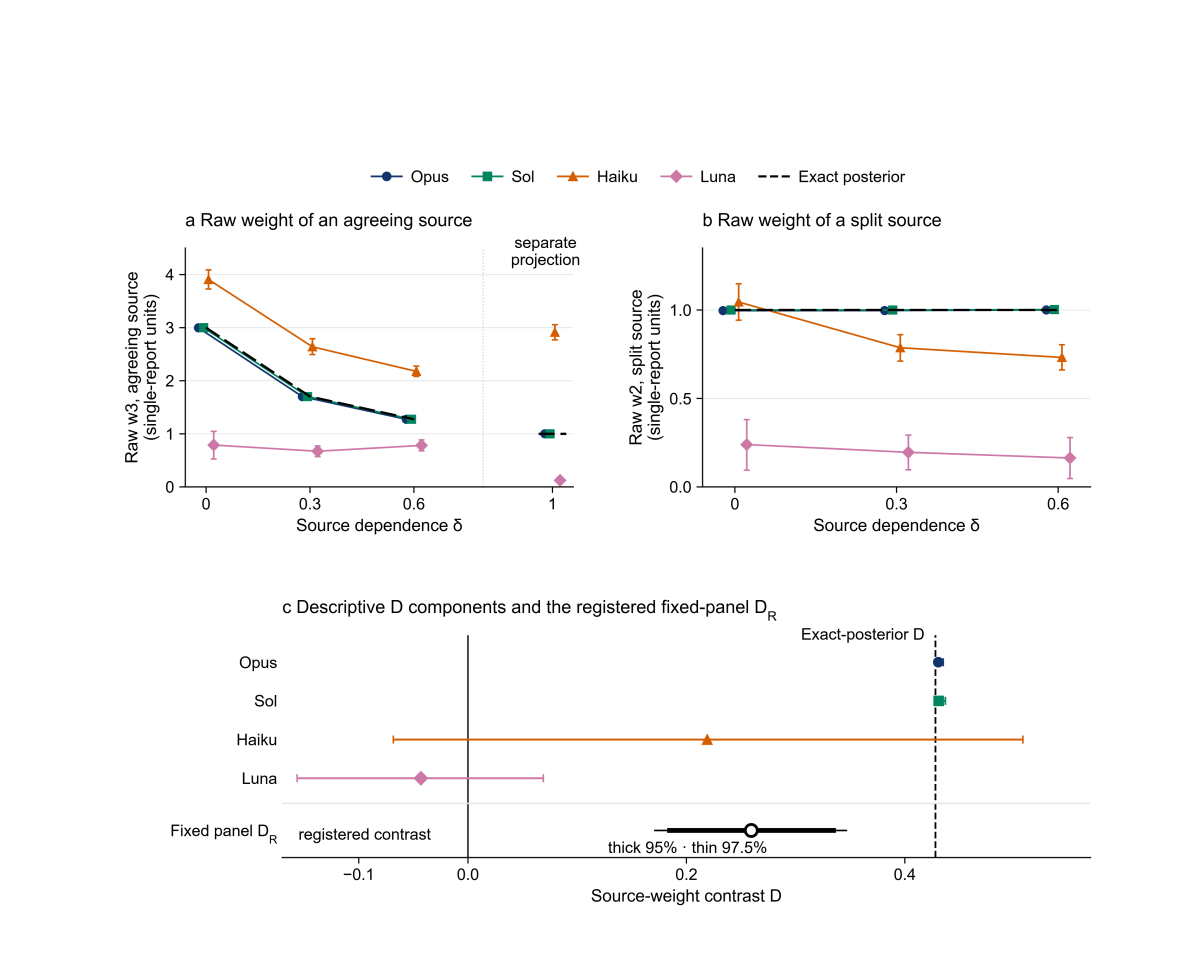
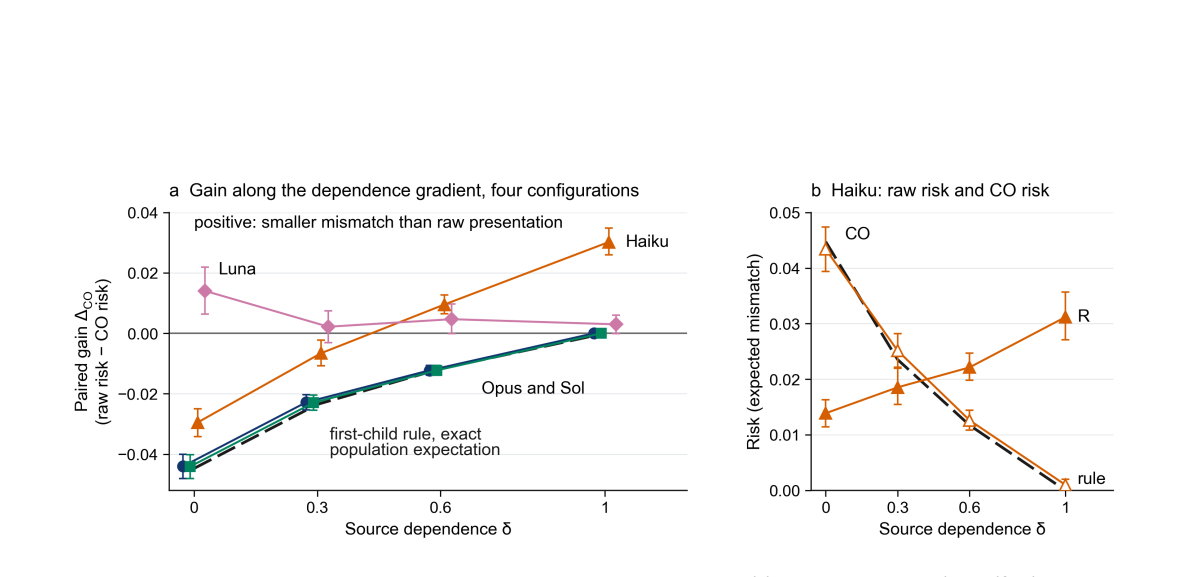
Pricing it needs an exact reference. We build the graded-dependence exact reference: binary worlds with single-report reliability 0.65 and four dependence levels, whose disclosed parameters give every world an exact posterior and every rule a target risk. The paired gain protocol scores raw and instructed answers of four configurations on 2,976 worlds. Agreement and gain separate in both directions. At δ = 0, claude-opus-5-5 and gpt-6.1-sol agreed with the rule within 0.001 in 744 of 744, and the instruction raised their posterior mismatch by 0.044; gpt-6-luna agreed in 165 of 744 and gained 0.0140 (95% interval 0.0064 to 0.0219); claude-haiku-5-5's gain moved from -0.0295 (δ = 0) to +0.0302 (δ = 1) (descriptive). The prespecified first-child endpoint contrast, gain at δ = 1 minus δ = 0, was 0.0342 (0.0303 to 0.0382). In the preregistered tests, the raw source-weight contrast was positive (0.259, 95% interval 0.182 to 0.337; Holm rejected zero) and the grouping endpoint difference was not detected (0.0004, -0.0023 to 0.0031). This interval excludes differences larger than 0.0031 in magnitude and lies within the registered precision bound of ±0.0046. The reference prices the rule before any model call. The paired gain, estimable as a Brier difference on labelled deployment items, decides adoption per receiver and prompt condition.
from the abstract
Pith says
Machine review · deepseek-v4-flash · 23 Nov 2026 · read the full text (178,904 characters) · not checked by a person
It can be wrong. Challenge this review or reply to it.
Holds up. Agreement with a count-once rule and the gain from it separate in both directions—the value of the instruction is set by the receiver it is given to. This line is wrong
5 minor
How often objections from reviews like this one are right: not yet measured
The paper, first character to last
The reviewer was given the whole text, 178,904 characters. Not checked: figures, code, what the 51 references say.
5 minor objections
The paper says, at Table 2 and Figures 1, 3, 4
Pith says: minor objection 1 of 5
The paper uses model nicknames (Opus, Sol, Haiku, Luna) that are defined in Table 2 but the mapping to full model identifiers (claude-opus-5-5, gpt-6.1-sol, etc.) is not repeated in later sections. Consider adding a brief reminder in the captions of Figures 1, 3, and 4, or in a footnote, to help readers who jump to those figures.
The paper says, at Section 3.1
Pith says: minor objection 2 of 5
Section 3.1 defines δ as the correlation between the correctness of two child reports of one source, but the formula for the flip probability e in terms of r and δ is relegated to Supplementary Section S1.1. Since δ is a central parameter, a brief statement of the relationship (e.g., the quadratic that determines e) in the main text would improve readability.
show 3 more
The paper says, at Abstract and Section 5
Pith says: minor objection 3 of 5
The registered precision bound of ±0.0046 for TG is introduced in Section 4.3 and used in the abstract and Section 5. It would be helpful to state explicitly that this bound is a planning target from the sample-size calculation, not a formal equivalence margin, to avoid misinterpretation.
The paper says, at Section 3.3
Pith says: minor objection 4 of 5
The paper uses many abbreviations (R, G, CO, DA, DR, TG, TCO, etc.). A consolidated list of abbreviations in the main text (perhaps after the introduction) would aid the reader.
The paper says, at Section S3.3
Pith says: minor objection 5 of 5
The calibration-support screen and scenario X04 (deviation D6) were built after the formal results were seen. The paper is transparent about this, but the confirmatory reading of DR and TG would be strengthened by a statement that the preregistered calibration scenarios already covered the observed composition, or by a discussion of how the post-hoc scenario affects the confirmatory status.
What would settle it
Re-run the confirmatory analysis of DR using only the two configurations (Opus and Sol) that fit the fixed projection model with small residuals, and compare the sign and significance to the four-configuration mean. If the positive DR is preserved, the conclusion about positive source-weight contrast is robust to model misspecification for the other two configurations.
from the skeptic's reading
How the review went
5 passes by deepseek-v4-flash · 23 Nov 2026
- Reader holds up
- Skeptic partly agrees
- Referee 5 minor
- Check against the paper
- Editor wrote the verdict above
Not run on this paper: the simulated authors' defence.
Pith checked this review's objections against the text of the paper it read.
The review in full
The review in brief, machine-written
This paper asks a practical question: when you tell an LLM to count each source of evidence once, does that help or hurt? The answer depends on the receiver. The authors build a graded-dependence exact reference—a binary generator with known parameters that gives every world an exact posterior and every rule a target risk—and pair it with a protocol that scores each receiver's raw and instructed answers on the same worlds. The central finding is that agreement with the rule and gain from it separate in both directions. Two configurations agreed with the rule in all 744 worlds at conditional independence and lost 0.044 in posterior accuracy. A third agreed in 165 of those worlds and gained 0.014. A fourth changed sign with dependence. The same instruction is worth a different amount to each receiver, and the amount depends on the receiver's raw baseline and its response to the instruction, not just on how often it matches the rule's output. The paper is transparent, preregistered, and backed by extensive robustness checks including bootstrap calibration, deviation sensitivity, and a calibration-support screen. The exact reference and paired gain protocol are new contributions. The soft spot is the fixed projection model (Eq. 4), which assumes that the logit of the reported probability is linear in the logit prior and the weighted counts of agreeing and split sources, with weights constant across the two middle dependence levels. The residuals are small for Opus and Sol but larger for Haiku and Luna, so the source-weight contrast D for those configurations is a projection coefficient rather than a structural parameter. The paper acknowledges this and interprets D accordingly. This is a minor limitation that does not undermine the central claim. The paper is for researchers working on evidence fusion in LLMs, retrieval-augmented generation, and multi-agent systems. It deserves a serious referee and should be sent to peer review.
The strongest objection
The paper's central claim—that agreement and gain separate in both directions—is supported by descriptive statistics and the paired gain protocol, not solely by the confirmatory test DR. The reader's weakest assumption concerns the fixed projection model (Eq. 4) used to define the source-weight contrast D. The paper acknowledges that for Haiku and Luna the projection residuals are larger (Table S3e) and interprets D as a fixed projection coefficient rather than a structural parameter. The confirmatory test DR is positive and robust to sensitivity analyses (ε = 10⁻⁶, complete cases, deviation envelopes). The separation claim itself does not depend on the projection model; it is demonstrated by the raw agreement counts and paired gain intervals in Fig. 1 and Table S4a. The paper is transparent about the descriptive status of the separation claim and the exploratory nature of conditions A and B. No critical flaw undermines the central argument.
The paper is well-executed, preregistered, and transparent about limitations. The fixed projection model is used for a confirmatory test that passes robustness checks, and the main claim about separation of agreement and gain is supported by direct empirical evidence. The reader's weakest assumption is acknowledged and does not invalidate the central findings. Therefore, the verdict should remain unchanged.
The referee's report
The paper provides a principled method to evaluate fusion instructions against an exact Bayesian reference, separating rule compliance from posterior gain. This is important for LLM evidence fusion in retrieval, multi-agent systems, and memory. The graded-dependence exact reference and paired gain protocol are reusable for other rules and receivers, and the empirical results demonstrate that agreement and gain separate in both directions, so the value of a count-once instruction is set by the receiver. The preregistered confirmatory tests and extensive robustness checks (bootstrap, calibration support, deviation sensitivity) strengthen the findings.
Pith's reading of the paper (a machine's summary, not the authors')
The paper tries to establish that the value of a count-once instruction for LLM evidence fusion depends on the receiver, not on how well the receiver's answers match the rule's output. It builds a graded-dependence exact reference—a binary generator with known reliability and dependence—that gives every report pattern an exact posterior and every fusion rule an exact target risk before any model call. Using this reference, the authors test four LLM configurations and find that agreement with the rule and gain from it separate in both directions: two configurations agreed perfectly with the rule but lost posterior accuracy, while a third gained despite low agreement. The preregistered confirmatory tests support the separation. The paired gain protocol, estimable as a Brier difference on labelled items, provides a practical way to decide whether to adopt an instruction for a given receiver.
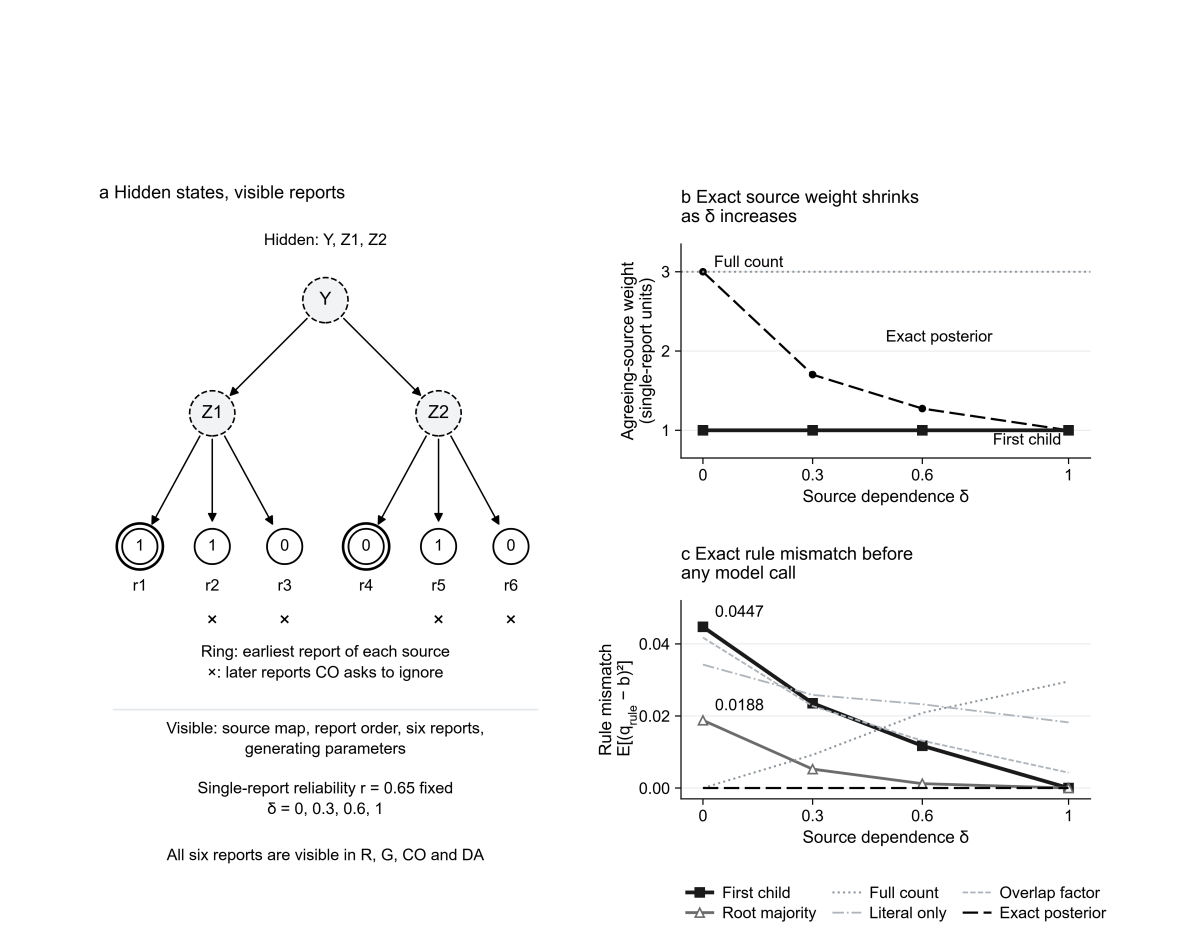
What carries the argument. The graded-dependence exact reference: a binary generator with hidden state Y, two sources Z1 and Z2 independent given Y, each emitting three child reports with fixed single-report reliability r = 0.65 and dependence δ ∈ {0, 0.3, 0.6, 1}. The disclosed parameters give every visible report pattern an exact posterior b and every fusion rule an exact target risk. The paired gain protocol compares raw (R) and instructed (CO) answers on the same worlds, scoring mismatch (q − b)² and computing ΔCO = E[(qR − b)² − (qCO − b)²]. The risk expansion Eq. (3) splits CO risk into the rule's target risk, the squared deviation from the rule, and a cross term, allowing interpretation of gain or loss.
Core claim. The paper claims that against an exact posterior, the value of a count-once instruction for LLM evidence fusion is set by the receiver it is given to, and that agreement with the rule's output and gain from it separate in both directions: full agreement can come with a loss, and near-zero agreement with a gain. The authors build a graded-dependence exact reference—binary worlds with fixed single-report reliability and four dependence levels—that gives every report pattern an exact posterior and every fusion rule an exact target risk before any model call. They test four closed-weight LLM configurations on 2,976 worlds and find that at conditional independence, two configurations agreed with the rule within 0.001 in all 744 worlds and lost 0.044 in posterior mismatch, while a third agreed in 165 of 744 worlds and gained 0.0140, and a fourth reversed from loss to gain as dependence rose. The preregistered confirmatory tests show a positive source-weight contrast (DR = 0.259, 95% interval 0.182 to 0.337; Holm rejected zero) and no detected grouping endpoint difference (TG = 0.0004, interval −0.0023 to 0.0031).
The premise it rests on. The fixed projection model (Eq. 4) assumes that the logit of the reported probability is linear in the logit prior and the weighted counts of agreeing and split sources, with weights w3 and w2 constant across the two middle dependence levels. This assumption is used to define the source-weight contrast D, the primary confirmatory quantity. The paper reports that the projection residuals are small for Opus and Sol but larger for Haiku and Luna (Table S3e), so D for those configurations is interpreted as a fixed projection coefficient rather than a structural parameter.
If the paper is right (Pith's inferences, not the authors')
Evaluating a count-once instruction requires measuring paired gain against an exact posterior, not just agreement with the rule's output.
The graded-dependence exact reference prices any fusion rule (first child, root majority, deduplication, overlap-factor discount) before any model call, enabling comparison of candidate rules.
On labelled deployment items, the Brier difference between raw and instructed arms estimates the paired gain without needing the exact posterior, supporting adoption decisions per receiver and prompt condition.
The protocol extends to other fusion operators (e.g., covariance intersection, cautious rule) and to settings with unknown dependence or imperfect source maps.
The separation implies that ranking receivers by agreement with a rule can reverse their ranking by actual gain, so deployment audits must run both arms.
Current benchmarks that measure only agreement with a fusion rule may mislead about instruction effectiveness; the paired gain protocol provides a more informative evaluation.
The protocol could be used to tune prompts per receiver: for a receiver with raw answers near the exact posterior, any rule with positive target risk harms; for one that over-counts, a count-once instruction may help even if agreement is low.
The graded-dependence exact reference could be extended to more complex dependence structures (e.g., three sources, asymmetric reliability, continuous reports) to price a wider class of fusion rules.
The separation result suggests that the common practice of using agreement as a proxy for fusion quality should be replaced by direct gain measurement in deployment audits.
Check this review
What was read
The passes were given all 178,904 characters of the text of the paper's PDF.
Fingerprint of that text (SHA-256): 3edabb0e9a81ba8cfb2201d98e97c4f9bc0b0ccc7bc62489987a5a2d0b99daf5
Pith does not keep that text. Rebuilt from the paper's source or PDF by the same code, it has this fingerprint if it is the same text. From a copy of Pith's code:
PYTHONPATH=. python scripts/review_input_check.py 2611.27138
The passes, in the order they ran
- Reader deepseek-v4-flash · medium effort · $0.0051 · instructions of the Reader, fingerprint f9ead7300382…
- Skeptic deepseek-v4-flash · medium effort · $0.0043 · instructions of the Skeptic, fingerprint 8f88c0f61488…
- Referee deepseek-v4-flash · medium effort · $0.0044 · instructions of the Referee, fingerprint a852d99aea0d…
- Editor deepseek-v4-flash · medium effort · $0.0042 · instructions of the Editor, fingerprint e7211f6a3d27…
- Circularity check deepseek-v4-flash · medium effort · $0.0042 · instructions of the Circularity check, fingerprint e9946e39d67b…
- Summary for the page deepseek-v4-flash · medium effort · temperature 0.2 · $0.0044 · instructions of the Summary for the page, fingerprint e4f56bf568e7…
The passes cost $0.027 in model calls together.
Version stamped on this review: pith-pipeline@v1.4.1-daily-deepseek-or-medium+deepseek/deepseek-v4-flash+p.505d180dcaef
Each link opens a pass's instructions as plain text, the exact bytes its fingerprint was taken over. Every stored set of instructions.
curl -s https://pith.science/methodology/prompts/f9ead730038216984cfb56d7cb34332bdf691828296a1de4245f3d6667d4bf56 | sha256sum
prints the fingerprint of the reader's instructions. The same works for every pass.
The receipt
The review's fingerprint was taken on 23 Nov 2026. The review you are reading still matches it.
Fingerprint of the review (SHA-256): f6c8b8fd1a03c2b479d86e3ac6f9c3ab8915408d13a75095c0b9cbf424ef0b3a
curl -s 'https://pith.science/api/v1/verdicts/2611.27138?form=canonical' | sha256sum
prints the fingerprint of the review as it stands now. The rule, in four steps.
A matching fingerprint shows the review has not changed since that date. It does not show that the review is right.
How often reviews like this one are right
Reviews like this one: written by deepseek-v4-flash, from the text of the paper's PDF.
How often objections from reviews like this one are right: not yet measured
Reviews by people
This review was written by a machine. No person has reviewed this paper on Pith yet. A scientist listed on Pith can review it for a fee, and their review is published here whatever it concludes.
The paper
Abstract
Language models fuse reports in retrieval, multi-agent consensus and agent memory, where treating shared-source reports as independent can double count evidence. A common remedy is an instruction to count each source once. Its value depends on the receiver's raw baseline. Pricing it needs an exact reference. We build the graded-dependence exact reference: binary worlds with single-report reliability 0.65 and four dependence levels, whose disclosed parameters give every world an exact posterior and every rule a target risk. The paired gain protocol scores raw and instructed answers of four configurations on 2,976 worlds. Agreement and gain separate in both directions. At δ = 0, claude-opus-5-5 and gpt-6.1-sol agreed with the rule within 0.001 in 744 of 744, and the instruction raised their posterior mismatch by 0.044; gpt-6-luna agreed in 165 of 744 and gained 0.0140 (95% interval 0.0064 to 0.0219); claude-haiku-5-5's gain moved from -0.0295 (δ = 0) to +0.0302 (δ = 1) (descriptive). The prespecified first-child endpoint contrast, gain at δ = 1 minus δ = 0, was 0.0342 (0.0303 to 0.0382). In the preregistered tests, the raw source-weight contrast was positive (0.259, 95% interval 0.182 to 0.337; Holm rejected zero) and the grouping endpoint difference was not detected (0.0004, -0.0023 to 0.0031). This interval excludes differences larger than 0.0031 in magnitude and lies within the registered precision bound of ±0.0046. The reference prices the rule before any model call. The paired gain, estimable as a Brier difference on labelled deployment items, decides adoption per receiver and prompt condition.
The paper's own sentences, arranged, kept beside the review and separate from it. Each label is drawn from a closed vocabulary; the number beside it is the probability the classifier gave that label. No sentence in this record was written by a model.
abstract compiled · 2026-11-23
The authors' main claim, as the classifier picked it out 0.88
“Agreement and gain separate in both directions.”
How the main claim is stated: asserted 1.00
What the abstract itself states, as probabilities: claims first 0.07 · states limitation 0.43 · human participants 0.05 · controlled comparison 0.94 · randomized assignment 0.06 · states quantitative result 0.99 · compares with prior results 0.83 · mentions code or data availability 0.05
The abstract, sentence by sentence
This table labels the abstract only (arXiv listing abstract v1). The number is the probability the classifier gave the label.
| Sentence | Role | The authors' own work | States the main conclusion | Strength |
|---|---|---|---|---|
| Language models fuse reports in retrieval, multi-agent consensus and agent memory, where treating shared-source reports as independent can double count evidence. | background 1.00 | 0.07 | 0.06 | asserted 0.93 |
| A common remedy is an instruction to count each source once. | background 1.00 | 0.05 | 0.02 | asserted 1.00 |
| Its value depends on the receiver's raw baseline. | background 0.59 | 0.13 | 0.06 | asserted 1.00 |
| Pricing it needs an exact reference. | gap 0.65 | 0.11 | 0.04 | asserted 0.99 |
| We build the graded-dependence exact reference: binary worlds with single-report reliability 0.65 and four dependence levels, whose disclosed parameters give every world an exact posterior and every rule a target risk. | method 0.82 | 0.94 | 0.05 | asserted 1.00 |
| The paired gain protocol scores raw and instructed answers of four configurations on 2,976 worlds. | method 0.97 | 0.95 | 0.04 | asserted 0.97 |
| Agreement and gain separate in both directions. | result 0.92 | 0.87 | 0.44 | asserted 1.00 |
| At $\delta$ = 0, claude-opus-5-5 and gpt-6.1-sol agreed with the rule within 0.001 in 744 of 744, and the instruction raised their posterior mismatch by 0.044; gpt-6-luna agreed in 165 of 744 and gained 0.0140 (95% interval 0.0064 to 0.0219); claude-haiku-5-5's gain moved from -0.0295 ($\delta$ = 0) to +0.0302 ($\delta$ = 1) (descriptive). | result 1.00 | 0.93 | 0.18 | asserted 1.00 |
| The prespecified first-child endpoint contrast, gain at $\delta$ = 1 minus $\delta$ = 0, was 0.0342 (0.0303 to 0.0382). | result 0.98 | 0.94 | 0.15 | asserted 1.00 |
| In the preregistered tests, the raw source-weight contrast was positive (0.259, 95% interval 0.182 to 0.337; Holm rejected zero) and the grouping endpoint difference was not detected (0.0004, -0.0023 to 0.0031). | result 1.00 | 0.94 | 0.18 | asserted 1.00 |
| This interval excludes differences larger than 0.0031 in magnitude and lies within the registered precision bound of $\pm$0.0046. | result 0.68 | 0.90 | 0.06 | asserted 1.00 |
| The reference prices the rule before any model call. | method 0.44 | 0.73 | 0.10 | asserted 1.00 |
| The paired gain, estimable as a Brier difference on labelled deployment items, decides adoption per receiver and prompt condition. | interpretation 0.64 | 0.48 | 0.37 | asserted 0.99 |
What kind of paper the classifier reports this is: method or tool 0.38 · evidence from simulation or computation 0.70
What was examined, and what was not
Sources read
- arXiv listing abstract v1
Not examined
- full text
- figures and tables
- references and citing sentences
- relations to other papers
Levels run
- P abstract
Not run
- S sections
- T body sentences
- C citations
- R cross-paper relations
How the labels were made
Compiled by classifier-1.13.0 via TypeSafe API, question bank abstract-p1-20260923, 2026-11-23: 1 request, 9,808 input tokens.
Every quoted sentence on this record is the authors'. Every label is from Pith's closed vocabulary, with the probability shown beside it. This record as JSON
Figures (4)
Figures are the authors', reproduced from the paper.
References (51)
- [1] B. Khaleghi, A. Khamis, F.O. Karray, S.N. Razavi, Multisensor data fusion: A review of the state-of-the-art, Inf. Fusion 14(1) (2013) 28–44. https://doi.org/10.1016/j.inffus.2011.08.001 on Pithdoi:10.1016/j.inffus.2011.08.001
- [2] Y. Bar-Shalom, L. Campo, The effect of the common process noise on the two-sensor fused- track covariance, IEEE Trans. Aerosp. Electron. Syst. AES-22(6) (1986) 803–805. https://doi.org/10.1109/TAES.1986.310815 on Pithdoi:10.1109/taes.1986.310815
- [3] R.T. Clemen, R.L. Winkler, Limits for the Precision and Value of Information from Dependent Sources, Oper. Res. 33(2) (1985) 427–442. https://doi.org/10.1287/opre.33.2.427 on Pithdoi:10.1287/opre.33.2.427
- [4] R.L. Winkler, Combining Probability Distributions from Dependent Information Sources, Manag. Sci. 27(4) (1981) 479–488. https://doi.org/10.1287/mnsc.27.4.479 on Pithdoi:10.1287/mnsc.27.4.479
- [5] S.J. Julier, J.K. Uhlmann, A non-divergent estimation algorithm in the presence of unknown correlations, in: Proceedings of the 1997 American Control Conference, vol. 4 (1997), pp. 2369–2373. https://doi.org/10.1109/ACC.1997.609105 on Pithdoi:10.1109/acc.1997.609105
- [6] T. Denœux, Conjunctive and disjunctive combination of belief functions induced by nondistinct bodies of evidence, Artif. Intell. 172(2–3) (2008) 234–264. https://doi.org/10.1016/j.artint.2007.05.008 on Pithdoi:10.1016/j.artint.2007.05.008
- [7] C.N. Taylor, A.N. Bishop, Homogeneous functionals and Bayesian data fusion with unknown correlation, Inf. Fusion 45 (2019) 179–189. https://doi.org/10.1016/j.inffus.2018.02.002 on Pithdoi:10.1016/j.inffus.2018.02.002
- [8] Y. Li, S. Yao, P. Zeng, D. Kong, S. Lin, C. Lin, X. Wang, M. Han, Memory Echo in Single- Agent Long-Term Memory: Lifecycle Evaluation and Provenance-Guided Mitigation, arXiv preprint arXiv:2610.17763 (v1, 2026-10-13), 2026. https://doi.org/10.48550/arXiv.2610.17763 on PithPith's reviewarXivdoi:10.48550/arxiv.2610.17763
- [9] M. Krishna, A. Harit, C. Xiao, Z. Sun, Recognizing Study Lineage Is Not Enough: Over- Crediting Same-Trial Evidence in LLM-Based Medical Verification, arXiv preprint arXiv:2610.23721 (v1, 2026-10-16), 2026. https://doi.org/10.48550/arXiv.2610.23721 on PithPith's reviewarXivdoi:10.48550/arxiv.2610.23721
- [10] M. Bara, Epistemic Sybil Resistance: Multiplying AI Agents Without Multiplying Evidence, arXiv preprint arXiv:2609.01873 (v1, 2026-09-01), 2026. https://doi.org/10.48550/arXiv.2609.01873 on PithPith's reviewarXivdoi:10.48550/arxiv.2609.01873
- [11] J. Gao, R. Li, T. Yu, L. Ren, B. Chen, Z. Wang, Copies or Sources? Measuring How LLM Aggregators Count Restated Evidence in Multi-Agent Systems, arXiv preprint arXiv:2610.06192 (v1, 2026-10-05), 2026. https://doi.org/10.48550/arXiv.2610.06192 on PithPith's reviewarXivdoi:10.48550/arxiv.2610.06192
- [12] Anonymous, When Repetition Becomes Evidence: Semantic Evidence Overcounting in Multi- Agent RAG, ICLR 2027 submission, OpenReview, https://openreview.net/forum?id=BRBuFtjx3u, accessed 2026-11-02 on Pith
- [13] Anonymous, Deliberation with Overlapping Evidence, ICLR 2027 submission, OpenReview, https://openreview.net/forum?id=kndCSUbmqN, accessed 2026-10-20 on Pith
- [14] Y. Eliaz, GullibleBench [software], version 1.1.0, released 2026-08-27, MIT licence, 2026. https://github.com/zozo123/GULI-SET; dataset zozo-ib/gulliblebench on Hugging Face, https://huggingface.co/datasets/zozo-ib/gulliblebench on Pith
- [15] R. Forsling, B. Noack, G. Hendeby, A quarter century of covariance intersection: Correlations still unknown?, IEEE Control Syst. Mag. 44(2) (2024) 81–105. https://doi.org/10.1109/MCS.2024.3358658. 28 on Pithdoi:10.1109/mcs.2024.3358658
- [16] M. Wang, H. Liu, H. Tang, M. Zhang, X. Shen, IFNet: Data-driven multisensor estimate fusion with unknown correlation in sensor measurement noises, Inf. Fusion 115 (2025) 102750. https://doi.org/10.1016/j.inffus.2024.102750 on Pithdoi:10.1016/j.inffus.2024.102750
- [17] X.L. Dong, L. Berti-Equille, D. Srivastava, Integrating conflicting data: the role of source dependence, Proc. VLDB Endow. 2(1) (2009) 550–561. https://doi.org/10.14778/1687627.1687690 on Pithdoi:10.14778/1687627.1687690
- [18] X. Yin, J. Han, P.S. Yu, Truth Discovery with Multiple Conflicting Information Providers on the Web, IEEE Trans. Knowl. Data Eng. 20(6) (2008) 796–808. https://doi.org/10.1109/TKDE.2007.190745 on Pithdoi:10.1109/tkde.2007.190745
- [19] Y. Li, J. Gao, C. Meng, Q. Li, L. Su, B. Zhao, W. Fan, J. Han, A Survey on Truth Discovery, ACM SIGKDD Explor. Newsl. 17(2) (2016) 1–16. https://doi.org/10.1145/2897350.2897352 on Pithdoi:10.1145/2897350.2897352
- [20] S. Destercke, D. Dubois, Idempotent conjunctive combination of belief functions: Extending the minimum rule of possibility theory, Inf. Sci. 181(18) (2011) 3925–3945. https://doi.org/10.1016/j.ins.2011.05.007 on Pithdoi:10.1016/j.ins.2011.05.007
show 31 more
- [21] M.E.G.V. Cattaneo, Belief functions combination without the assumption of independence of the information sources, Int. J. Approx. Reason. 52(3) (2011) 299–315. https://doi.org/10.1016/j.ijar.2010.10.006 on Pithdoi:10.1016/j.ijar.2010.10.006
- [22] H. Li, F. Nashashibi, M. Yang, Split covariance intersection filter: Theory and its application to vehicle localization, IEEE Trans. Intell. Transp. Syst. 14(4) (2013) 1860–1871. https://doi.org/10.1109/TITS.2013.2267800 on Pithdoi:10.1109/tits.2013.2267800
- [23] A. Kallel, S. Le Hégarat-Mascle, Combination of partially non-distinct beliefs: The cautious- adaptive rule, Int. J. Approx. Reason. 50(7) (2009) 1000–1021. https://doi.org/10.1016/j.ijar.2009.03.006 on Pithdoi:10.1016/j.ijar.2009.03.006
- [24] J. Xu, X. Li, Q. Song, S. Zhu, MoRE-RAG: Bayesian optimal fusion of multiple retrieval experts for retrieval-augmented generation, Neurocomputing 701 (2026) 134536. https://doi.org/10.1016/j.neucom.2026.134536 on Pithdoi:10.1016/j.neucom.2026.134536
- [25] Z. Wu, Split the Labor: Separating Evidence Interpretation from Decision Aggregation – A Design Principle, Its Failure Mode, and Two Instantiations, arXiv preprint arXiv:2608.14509 (v1, 2026-08-14), 2026. https://doi.org/10.48550/arXiv.2608.14509 on PithPith's reviewarXivdoi:10.48550/arxiv.2608.14509
- [26] G. Zhou, Y. Lu, Burden of proof: Calibrated evidential arbitration for asymmetric decision- level fusion in vision–language recognition, Inf. Fusion 139 (2027) 104860. https://doi.org/10.1016/j.inffus.2026.104860 on Pithdoi:10.1016/j.inffus.2026.104860
- [27] S. Kawada, M. Kellis, Evidence Integration in Large Language Models, arXiv preprint arXiv:2609.04290 (v1, 2026-09-03), 2026. https://doi.org/10.48550/arXiv.2609.04290 on PithPith's reviewarXivdoi:10.48550/arxiv.2609.04290
- [28] J. Zhang, K. Jiang, G. Lu, What Counts as Evidence? Epistemic Cue Utilization in Large Language Models, arXiv preprint arXiv:2610.12788 (v1, 2026-10-08), 2026. https://doi.org/10.48550/arXiv.2610.12788 on PithPith's reviewarXivdoi:10.48550/arxiv.2610.12788
- [29] Anonymous, Consensus Is Not Evidence: Evidence Lineage for Replication-Safe Multi-Agent Reasoning, ICLR 2027 submission, OpenReview, https://openreview.net/forum?id=x1YuqAY7xv, accessed 2026-10-22. 29 on Pith
- [30] T. Huang, E. Liu, J. Chong, E. Yin, W. Zhao, Provenance-Aware Belief Updating in Human- AI Feedback Loops, arXiv preprint arXiv:2610.13008 (v2, 2026-10-27), 2026. https://doi.org/10.48550/arXiv.2610.13008 on PithPith's reviewarXivdoi:10.48550/arxiv.2610.13008
- [31] Z. Liu, S. Zhou, H. Wang, Record Grouping Controls Evidence Weight in Language Models, arXiv preprint arXiv:2609.08698 (v1, 2026-09-08), 2026. https://doi.org/10.48550/arXiv.2609.08698 on PithPith's reviewarXivdoi:10.48550/arxiv.2609.08698
- [32] L. Qiu, F. Sha, K. Allen, Y. Kim, T. Linzen, S. van Steenkiste, Bayesian teaching enables probabilistic reasoning in large language models, Nat. Commun. 17 (2026) 1238. https://doi.org/10.1038/s41467-025-67998-6 on Pithdoi:10.1038/s41467-025-67998-6
- [33] A. Paruchuri, J. Garrison, S. Liao, J.B. Hernandez, J. Sunshine, T. Althoff, X. Liu, D. McDuff, What Are the Odds? Language Models Are Capable of Probabilistic Reasoning, in: Proceedings of the 2024 Conference on Empirical Methods in Natural Language Processing (2024), pp. 117... on Pithdoi:10.18653/v1/2024.emnlp-main.654
- [34] B. Enke, F. Zimmermann, Correlation Neglect in Belief Formation, Rev. Econ. Stud. 86(1) (2019) 313–332. https://doi.org/10.1093/restud/rdx081. First published online 2017-12-22 on Pithdoi:10.1093/restud/rdx081
- [35] P.M. DeMarzo, D. Vayanos, J. Zwiebel, Persuasion Bias, Social Influence, and Unidimensional Opinions, Q. J. Econ. 118(3) (2003) 909–968. https://doi.org/10.1162/00335530360698469 on Pithdoi:10.1162/00335530360698469
- [36] S.R. Yousif, R. Aboody, F.C. Keil, The Illusion of Consensus: A Failure to Distinguish Between True and False Consensus, Psychol. Sci. 30(8) (2019) 1195–1204. https://doi.org/10.1177/0956797619856844 on Pithdoi:10.1177/0956797619856844
- [37] J. Schuster, V. Gautam, K. Markert, Whose Facts Win? LLM Source Preferences under Knowledge Conflicts, in: Proceedings of the 64th Annual Meeting of the Association for Computational Linguistics (Volume 1: Long Papers) (2026), pp. 29430–29459; arXiv:2601.03746. https://doi.org... on PithPith's reviewarXiv
- [38] R. Xu, Z. Qi, Z. Guo, C. Wang, H. Wang, Y. Zhang, W. Xu, Knowledge Conflicts for LLMs: A Survey, in: Proceedings of the 2024 Conference on Empirical Methods in Natural Language Processing (2024), pp. 8541–8565. https://doi.org/10.18653/v1/2024.emnlp- main.486 on Pithdoi:10.18653/v1/2024.emnlp-
- [39] G. Brouillette, F. Kagabo, U. Faghihi, N. Ghazzali, Finding the Right Balance: Relevance and Diversity in LLM Retrieval, arXiv preprint arXiv:2610.09412 (v1, 2026-10-07), 2026. https://doi.org/10.48550/arXiv.2610.09412 on PithPith's reviewarXivdoi:10.48550/arxiv.2610.09412
- [40] X. Li, Y. Wang, C. Zhu, K. Xu, W. Yang, Z. Sun, P. Song, Y. Duan, T. Cai, A Benchmark and Diagnostic Study of Epistemic Admission in Shared Agent Memory, arXiv preprint arXiv:2609.30813 (v1, 2026-09-25), 2026. https://doi.org/10.48550/arXiv.2609.30813 on PithPith's reviewarXivdoi:10.48550/arxiv.2609.30813
- [41] N.H. Siboni, M. Springer, V. Rostami, Neuro-Inspired Inhibitory Message Passing for Accurate and Token-Efficient Multi-Agent Reasoning, arXiv preprint arXiv:2610.24718 (v1, 2026-10-17), 2026. https://doi.org/10.48550/arXiv.2610.24718 on PithPith's reviewarXivdoi:10.48550/arxiv.2610.24718
- [42] S. Barhoumi, I.K. Kallel, É. Bossé, B. Solaiman, An empirical survey-type analysis of uncertainty measures for the fusion of crisp and fuzzy bodies of evidence, Inf. Fusion 121 (2025) 103106. https://doi.org/10.1016/j.inffus.2025.103106. 30 on Pithdoi:10.1016/j.inffus.2025.103106
- [43] M. Xuanyuan, T. Yang, J. Fu, S. Zhao, Y. Wang, Insufficient task description can impair in- context learning: A study from information perspective, Inf. Fusion 120 (2025) 103116. https://doi.org/10.1016/j.inffus.2025.103116 on Pithdoi:10.1016/j.inffus.2025.103116
- [44] T. Gneiting, A.E. Raftery, Strictly Proper Scoring Rules, Prediction, and Estimation, J. Am. Stat. Assoc. 102(477) (2007) 359–378. https://doi.org/10.1198/016214506000001437 on Pithdoi:10.1198/016214506000001437
- [45] L. Chen, M. Zaharia, J. Zou, How Is ChatGPT's Behavior Changing Over Time?, Harv. Data Sci. Rev. 6(2) (2024). https://doi.org/10.1162/99608f92.5317da47 on Pithdoi:10.1162/99608f92.5317da47
- [46] S. Holm, A Simple Sequentially Rejective Multiple Test Procedure, Scand. J. Stat. 6(2) (1979) 65–70 on Pith
- [47] M. Sclar, Y. Choi, Y. Tsvetkov, A. Suhr, Quantifying Language Models' Sensitivity to Spurious Features in Prompt Design or: How I learned to start worrying about prompt formatting, in: The Twelfth International Conference on Learning Representations (ICLR on Pith
- [48] A.H. Murphy, Skill scores based on the mean square error and their relationships to the correlation coefficient, Mon. Weather Rev. 116(12) (1988) 2417–2424. https://doi.org/10.1175/1520-0493(1988)116<2417:SSBOTM>2.0.CO;2 on Pithdoi:10.1175/1520-0493(1988)116
- [49] Y. Bar-Shalom, X.R. Li, T. Kirubarajan, Estimation with Applications to Tracking and Navigation: Theory, Algorithms and Software, Wiley, New York, 2001. https://doi.org/10.1002/0471221279 on Pithdoi:10.1002/0471221279
- [50] E.M. Kim, A. Garg, K. Peng, N. Garg, Correlated errors in large language models, in: Proceedings of the 42nd International Conference on Machine Learning (ICML 2025), PMLR 267 (2025), pp. 30038–30066. https://proceedings.mlr.press/v267/kim25e.html. 1 Supplementary Material Dou... on Pith
- [2024] (2024). https://doi.org/10.48550/arXiv.2310.11324 on PithPith's reviewarXivdoi:10.48550/arxiv.2310.11324
Challenges and discussion
Disagree with the review, or know something it missed? Leave a comment, or challenge this review formally: a challenge becomes a permanent entry in this paper's record, and its decision is published here.
Come back by email
A short list of the week's newly reviewed papers. Nothing is sent until you confirm from your inbox, and every email has a link that stops it. No account.
No comments yet.
Sign in to comment