Artificial Intelligence · arXiv:2609.01873 v1 · submitted 1 Sep 2026 · 28 references
Epistemic Sybil Resistance: Multiplying AI Agents Without Multiplying Evidence
The paper says
“Multi-agent AI systems improve inference by spawning agents and synthesizing reports. But another agent is not another observation: apparently independent reports may descend from the same evidence, and genuinely independent evidence can produce nearly identical reports.”
more of the abstract
We formalize this as an epistemic Sybil problem. A report Z is an epistemic Sybil extension relative to reports R when I(Theta; Z | R) = 0. No report-only aggregator can generally distinguish replication from independent corroboration: identical reports can warrant different posteriors under unobserved ancestry. A Gaussian shared-root model shows common ancestry does not imply complete redundancy. Repeated extraction adds information toward a source-level ceiling, and correlated extraction errors, which a shared base model can induce among independent agents, lower that ceiling further. We test these predictions with more than 20,000 controlled LLM-agent report and extraction calls on synthetic evidentiary documents. Holding one evidence root fixed while report multiplicity rises from 1 to 32 collapses naive posterior coverage from 0.940 to 0.263. Holding report count fixed while evidence-root multiplicity rises from 1 to 16 closes the gap, and the aggregators are statistically indistinguishable at k = 16. The agent's replicate extraction errors are correlated (gamma_cal = 0.719, estimated out of sample), and a correlated-extraction aggregator restores calibration accordingly. A controlled manipulation isolates representation similarity from evidential ancestry. It changes a report-space deduplication mechanism's mean inferred cluster count by 1.425 (95% CI [1.363, 1.485]), whereas a fourfold change in true ancestry changes it by only 0.040 ([-0.045, 0.120]). Collective inference should therefore track evidential ancestry and dependence, not agent or report multiplicity or similarity.
from the abstract
Pith says
Machine review · deepseek-v4-flash · 9 Sep 2026 · what was read was not recorded · not checked by a person
It can be wrong. Challenge this review or reply to it.
Holds up. A well-executed formalization of an important problem with open-eyed experiments; deserves serious review. This line is wrong
1 major objection · 7 minor
How often objections from reviews like this one are right: not yet measured
Not checked: figures, code, what the 28 references say.
The paper says, at Section 8.4
The review did not quote this passage.
Pith says: Objection 1 of 1 · major
The correlated-extraction analysis is labeled as exploratory, and the paper is transparent about its post-hoc status. However, the central confirmatory results (Grids A and B) do not depend on this refinement; they already show that the simple shared-root model improves calibration and that naive aggregation fails dramatically.
more of objection 1
The correlated-extraction correction further improves coverage to near-nominal levels, which is compelling. Nevertheless, the paper should explicitly state (or reiterate) that this exploratory analysis was not pre-registered and that its parameters, though estimated on a disjoint calibration split, were chosen after observing the failure of the independent-extraction specification. The text already does this, but a clearer separation between confirmatory and exploratory interpretations would strengthen the paper.
7 minor objections
The paper says, at Abstract
Pith says: minor objection 1 of 7
“The agent's replicate extraction errors are correlated” could be rephrased as “The agents' replicate extraction errors are correlated” for clarity, though the current phrasing is acceptable.
The paper says, at Section 2.1
Pith says: minor objection 2 of 7
The reference to “McLaughlin, Evans, and Krishnamurthy, 2003” should be checked: the author name appears to be “McLaughlin” in the citation but the reference list spells “McLaughlin” (which is likely correct). Please ensure consistency.
show 5 more
The paper says, at Section 5.2
Pith says: minor objection 3 of 7
In the sentence “Defining meff = m / [1 + ρ(m−1)] , the classical survey-sampling design effect (Kish, 1965) applied here to a likelihood rather than a variance of a sample mean”, it would be helpful to explicitly note that this holds exactly only under the Gaussian equicorrelation model, as the next corollary does.
The paper says, at Section 8.5
Pith says: minor objection 4 of 7
The description of the 2×2 design's representation manipulation is clear but could benefit from a schematic figure or a table summarizing the four cells (A, B, C, D) with their ancestry and representation conditions. The current text and Figure 8 are helpful, but a concise table would improve readability.
The paper says, at Section 10 (Limitations)
Pith says: minor objection 5 of 7
The paper lists seven limitations. The first bullet states “conditional mutual information is defined relative to a probability distribution. In many real inference problems the joint distribution is unknown.” This is an important caveat; consider adding a brief remark that the empirical section side-steps this by using the same generative model for the experiments as for the aggregators’ assumed structure.
The paper says, at Figure 1
Pith says: minor objection 6 of 7
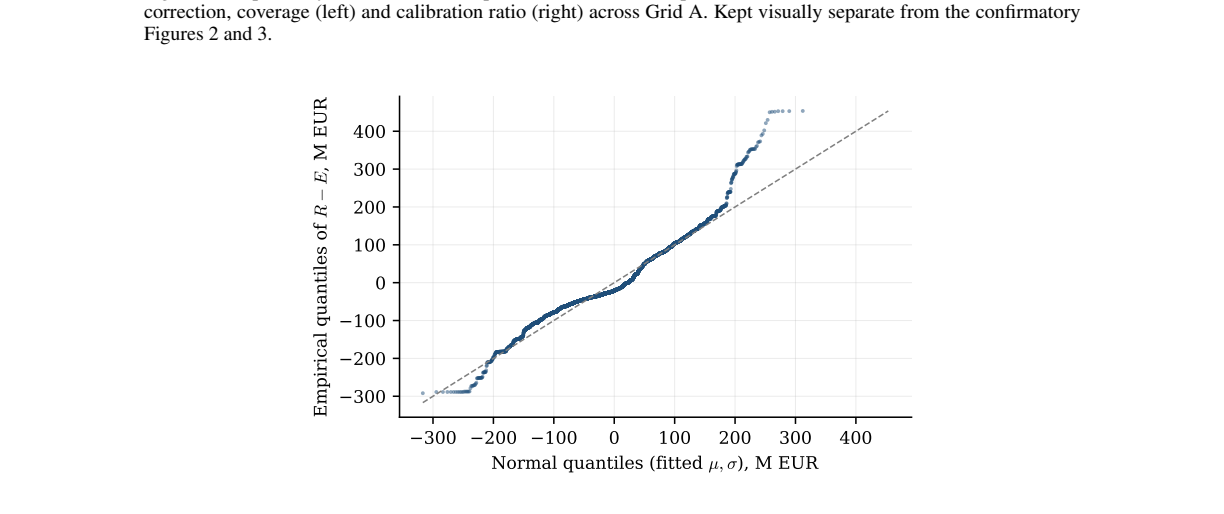
The y-axis label reads “Calibration ratio C = RMSE/posterior s.d.” but in the simulation the posterior is the correct dependence-aware Bayes; the figure duplicates the simulation data (Section 7) where the label is accurate. For consistency with the main empirical figures (Figures 2 and 6), consider renaming “posterior s.d.” to “reported posterior s.d.” if space permits.
The paper says, at References
Pith says: minor objection 7 of 7
The entry for “Kong, Y., and Schoenebeck, G. (2019)” uses a capital “I” in “An Information Theoretic Framework”; please ensure proper capitalization throughout the reference list.
What would settle it
Re-run the confirmatory Grid A experiment (report multiplicity, k=1) using a different LLM family (e.g., GPT-4o-mini) with explicit temperature control for independent replicate draws. If the naive coverage collapse is qualitatively similar (e.g., below 0.5 at n=32) and the provenance-aware aggregator stays within 0.85–0.95, the temporal and model-specific scope of the empirical support is broadened. If the collapse is much weaker, the information-saturation mechanism may be model-specific, but the formal theory would remain intact—the test would refine the scope, not refute the core claim.
from the skeptic's reading
How the review went
4 readings by deepseek-v4-flash · 9 Sep 2026
- Reader holds up
- Skeptic agrees
- Editor wrote the verdict above
- Referee minor revision: 1 major objection, 7 minor
Not run on this paper: the simulated authors' defence.
Pith did not check this review's objections against the paper.
The review in full
The review in brief, machine-written
Here's the short version: this paper formalizes the epistemic Sybil problem for multi-agent AI, proves a clean non-identifiability result, derives information ceilings under shared roots, and tests key predictions with a careful empirical design. It's a solid contribution that deserves a serious referee.
What's actually new: The definition of epistemic Sybil extension via conditional mutual information is the right formal target. Theorem 1 (report-only non-identifiability) is simple but important, and the paper correctly frames it as an information-barrier result, not a proof that similarity is useless. The Gaussian shared-root model gives a closed-form effective-sample-size discount that connects directly to the survey-sampling design effect, and the correlated-extraction extension shows how shared base models lower the ceiling further. The empirical design is notably rigorous: confirmatory grids with frozen designs, calibration splits, out-of-sample validation for the correlated-extraction correction, and a 2×2 manipulation that cleanly separates representation similarity from evidential ancestry. The result that a deduplication mechanism tracks representation far more than ancestry (+1.425 vs +0.040) is strong operational evidence for the non-identifiability theorem.
Soft spots: The empirical scope is narrow—synthetic quarterly-revenue memos, one small LLM (Haiku-class), single task family. The Gaussian model is acknowledged to be stylized, though the out-of-sample validation suggests it captures a real regularity in this setting. The non-identifiability proof uses a minimal binary model; in practice the gap may be larger or smaller depending on the report space. The paper is candid about all of this. The mechanism-design problems (truthful provenance, privacy) are left open, which is appropriate for this paper.
Who should read it: Anyone building multi-agent systems that aggregate reports, especially those relying on report-count or similarity-based deduplication. The paper makes a clean case that you need to track evidential ancestry and dependence structure, not just report multiplicity.
My recommendation: send to review. The central claims are well-supported, the empirical tests are controlled, and the limitations are honestly stated. I would bring this to our reading group and would cite it.
The strongest objection
The paper's central claims are internally consistent, well-supported by formal derivations, and checked with controlled experiments. The report-only non-identifiability (Theorem 1) is correctly established for the minimal model class and does not depend on empirical generalizability. The shared-root information ceiling (Proposition 2) and its correlated-extraction extension (Section 5.3) are derived from a Gaussian model that the paper itself acknowledges is stylized; the empirical tests show that even when the Gaussian assumption is violated (heavy tails, excess kurtosis 2.35), the qualitative predictions hold: naive aggregation collapses coverage from 0.940 to 0.263, the gap closes under genuine independence (k=16), and the correlated-extraction correction restores near-nominal coverage out of sample. The strongest claim—that multiplying reports without multiplying evidence leads to overconfidence—is directly observed. The weakest assumption (generalizability from synthetic memos and one LLM) is a scope limitation, not a logical flaw. No internal contradiction or unsupported leap undermines the central argument.
The reader correctly identified generalizability as the weakest assumption, and I see no overlooked flaw. The theoretical contributions (definitions, non-identifiability, no-minting, ceiling results) are logically sound and independent of the empirical section. The empirical study is carefully designed, with frozen design protocols, a calibration split, and exploratory extensions clearly labeled. The residual mismatch between the Gaussian aggregator and actual heavy-tailed extraction noise is acknowledged and does not favor any particular aggregator. The paper's central findings—that report multiplicity without evidence multiplicity induces overconfidence, that this gap closes when ancestry becomes independent, and that representation similarity does not reliably indicate ancestry—are each supported by clean experiments with proper controls. Accepting the paper as an advance does not require accepting that the Gaussian model is universally applicable; the conceptual framework and negative result (Theorem 1) stand on their own. Therefore, no change to the verdict is warranted.
The referee's report
This paper makes a timely and well-executed contribution to the collective-inference literature, particularly for multi-agent AI systems where report generation is cheap. The information-theoretic definition of epistemic Sybil extensions is clean, the report-only non-identifiability result is important and correctly established, and the Gaussian shared-root model provides a tractable benchmark with closed-form effective-sample-size corrections. The empirical design is rigorous: confirmatory grids with frozen specifications, calibration splits disjoint from evaluation, and a controlled stress test that separates representation from ancestry. The results demonstrate concretely that report multiplicity and report similarity are not reliable proxies for evidential multiplicity, and they highlight the need for provenance information and dependence-aware aggregation. The paper is transparent about its limitations (single task family, one small model, stylized Gaussian assumptions). If these results generalize, they would have significant implications for orchestrating LLM-based agents and for building reliable collective inference systems.
Pith's reading of the paper (a machine's summary, not the authors')
The paper defines an epistemic Sybil extension as any AI-generated report Z such that I(Θ; Z|R) = 0 relative to already-admitted reports R — it contributes no marginal information about the latent state Θ. It proves that under a report-only interface, no aggregation rule can distinguish between exact replication and genuinely independent corroboration from the same observable output (Theorem 1), so surface similarity cannot identify evidential ancestry. A Gaussian shared-root model shows that repeated extraction from one evidence root adds information only toward a finite ceiling, and the ceiling is lower when extraction errors are correlated across agents sharing a base model. More than 20,000 LLM calls on synthetic documents confirm these predictions: naive coverage collapses from 0.940 to 0.263 when report count rises from 1 to 32 at fixed ancestry, while provenance-aware aggregation stays calibrated. A controlled design reveals that a report-space deduplication mechanism tracks representation similarity (+1.425 cluster count effect) far more than true ancestry (+0.040).
What carries the argument. The central object is the conditional mutual information I(Θ; Z|R) as the criterion for an epistemic Sybil extension. The Gaussian shared-root model with equicorrelated extraction errors provides closed-form expressions for the effective sample size $m_{\text{eff}} = m/[1+\rho(m-1)]$ and the information ceiling $\lim_{m\to\infty} J_m = 1/(\sigma^2+\gamma\nu^2)$. This model supplies the quantitative predictions tested empirically.
Core claim. The central claim is that the conditional mutual information I(Θ; Z|R) = 0 operationalizes when an additional report carries no new evidence, and that no report-only aggregator can universally identify this condition because the same observable profile can arise from clone or independent structures requiring different Bayes updates. Further, information from descendants of fixed evidence is bounded by a source-level ceiling 1/σ² (or lower with correlated extraction errors), so report multiplicity alone cannot mint information. Empirically, naive independence-assuming aggregation becomes severely overconfident as report count grows at fixed ancestry, and this overconfidence disappears exactly when ancestry becomes genuinely independent.
The premise it rests on. The Gaussian shared-root model with equicorrelated extraction errors captures the information accumulation behavior of real LLM agents only approximately, and the empirical results come from a single small model on synthetic quarterly-revenue memos; generalizability to natural language and other models is not established.
If the paper is right (Pith's inferences, not the authors')
Aggregation systems should track evidential ancestry and dependence structure, not report count or agent identity.
A report-space deduplication mechanism that relies on representation similarity alone can be misled by cosmetic rendering changes while missing true ancestry differences.
Even when ancestry is known, the statistical dependence of extraction errors (e.g., from a shared base model) must be modeled to avoid overconfidence — a simple shared-root correction is insufficient if replicate errors are correlated.
The effective-sample-size discount $\kappa_m = 1/[1+\rho(m-1)]$ is exact for Gaussian equicorrelation and provides a parameterized correction that can be estimated from calibration data.
The no-minting principle (data-processing inequality) implies that no sequence of reports derived from a single evidence root can collectively exceed the information in that root, providing a fundamental bound on what repeated agent calls can achieve.
If these results generalize, multi-agent orchestration frameworks that spawn many reasoning paths from one retrieved document risk systematic overconfidence unless they explicitly model shared ancestry and extraction correlation.
The epistemic Sybil definition may extend beyond AI reports to any sequence of testimonial or sensor reports where ancestry can be hidden — the formal framework is not limited to LLMs.
The failure of representation similarity to track ancestry suggests that defenses based on semantic deduplication (e.g., embedding clustering) are insufficient without provenance metadata, and that cryptographic or attested ancestry interfaces may be necessary for reliable collective inference in adversarial settings.
The paper's Gaussian model offers a tractable approximation but residual heavy tails in real extraction errors (excess kurtosis 2.35) indicate that Gaussian likelihood models are misspecified in the tails, motivating future work on robust or non-parametric dependence-aware aggregation.
Check this review
Pith stored no record of this review's passes and took no fingerprint of it. Reviews made by code from 13 Nov 2026 on carry both.
How often reviews like this one are right
Reviews like this one: written by deepseek-v4-flash, where what was read was not recorded.
How often objections from reviews like this one are right: not yet measured
Reviews by people
This review was written by a machine. No person has reviewed this paper on Pith yet. A scientist listed on Pith can review it for a fee, and their review is published here whatever it concludes.
The paper
Abstract
Multi-agent AI systems improve inference by spawning agents and synthesizing reports. But another agent is not another observation: apparently independent reports may descend from the same evidence, and genuinely independent evidence can produce nearly identical reports. We formalize this as an epistemic Sybil problem. A report Z is an epistemic Sybil extension relative to reports R when I(Theta; Z | R) = 0. No report-only aggregator can generally distinguish replication from independent corroboration: identical reports can warrant different posteriors under unobserved ancestry. A Gaussian shared-root model shows common ancestry does not imply complete redundancy. Repeated extraction adds information toward a source-level ceiling, and correlated extraction errors, which a shared base model can induce among independent agents, lower that ceiling further. We test these predictions with more than 20,000 controlled LLM-agent report and extraction calls on synthetic evidentiary documents. Holding one evidence root fixed while report multiplicity rises from 1 to 32 collapses naive posterior coverage from 0.940 to 0.263. Holding report count fixed while evidence-root multiplicity rises from 1 to 16 closes the gap, and the aggregators are statistically indistinguishable at k = 16. The agent's replicate extraction errors are correlated (gamma_cal = 0.719, estimated out of sample), and a correlated-extraction aggregator restores calibration accordingly. A controlled manipulation isolates representation similarity from evidential ancestry. It changes a report-space deduplication mechanism's mean inferred cluster count by 1.425 (95% CI [1.363, 1.485]), whereas a fourfold change in true ancestry changes it by only 0.040 ([-0.045, 0.120]). Collective inference should therefore track evidential ancestry and dependence, not agent or report multiplicity or similarity.
The paper's own sentences, arranged, kept beside the review and separate from it. Each label is drawn from a closed vocabulary; the number beside it is the probability the classifier gave that label. No sentence in this record was written by a model.
abstract compiled · 2026-09-23
The authors' main claim, as the classifier picked it out 1.00
“Collective inference should therefore track evidential ancestry and dependence, not agent or report multiplicity or similarity.”
How the main claim is stated: asserted 0.86
What the abstract itself states, as probabilities: claims first 0.05 · states limitation 0.49 · human participants 0.04 · controlled comparison 0.82 · randomized assignment 0.07 · states quantitative result 0.99 · compares with prior results 0.69 · mentions code or data availability 0.03
The abstract, sentence by sentence
This table labels the abstract only (arXiv listing abstract v1). The number is the probability the classifier gave the label.
| Sentence | Role | The authors' own work | States the main conclusion | Strength |
|---|---|---|---|---|
| Multi-agent AI systems improve inference by spawning agents and synthesizing reports. | background 1.00 | 0.08 | 0.02 | asserted 1.00 |
| But another agent is not another observation: apparently independent reports may descend from the same evidence, and genuinely independent evidence can produce nearly identical reports. | background 0.66 | 0.09 | 0.14 | hedged possibility 0.65 |
| We formalize this as an epistemic Sybil problem. | contribution 0.93 | 0.86 | 0.04 | asserted 0.97 |
| A report Z is an epistemic Sybil extension relative to reports R when I(Theta; Z | R) = 0. | contribution 0.74 | 0.65 | 0.06 | asserted 0.99 |
| No report-only aggregator can generally distinguish replication from independent corroboration: identical reports can warrant different posteriors under unobserved ancestry. | result 0.43 | 0.46 | 0.33 | asserted 1.00 |
| A Gaussian shared-root model shows common ancestry does not imply complete redundancy. | result 0.47 | 0.76 | 0.04 | asserted 1.00 |
| Repeated extraction adds information toward a source-level ceiling, and correlated extraction errors, which a shared base model can induce among independent agents, lower that ceiling further. | result 0.56 | 0.57 | 0.06 | asserted 0.99 |
| We test these predictions with more than 20,000 controlled LLM-agent report and extraction calls on synthetic evidentiary documents. | method 0.94 | 0.96 | 0.02 | asserted 1.00 |
| Holding one evidence root fixed while report multiplicity rises from 1 to 32 collapses naive posterior coverage from 0.940 to 0.263. | result 1.00 | 0.95 | 0.07 | asserted 1.00 |
| Holding report count fixed while evidence-root multiplicity rises from 1 to 16 closes the gap, and the aggregators are statistically indistinguishable at k = 16. | result 1.00 | 0.94 | 0.10 | asserted 1.00 |
| The agent's replicate extraction errors are correlated (gamma_cal = 0.719, estimated out of sample), and a correlated-extraction aggregator restores calibration accordingly. | result 0.99 | 0.93 | 0.07 | asserted 1.00 |
| A controlled manipulation isolates representation similarity from evidential ancestry. | method 0.91 | 0.88 | 0.03 | asserted 0.96 |
| It changes a report-space deduplication mechanism's mean inferred cluster count by 1.425 (95% CI [1.363, 1.485]), whereas a fourfold change in true ancestry changes it by only 0.040 ([-0.045, 0.120]). | result 1.00 | 0.95 | 0.05 | asserted 1.00 |
| Collective inference should therefore track evidential ancestry and dependence, not agent or report multiplicity or similarity. | interpretation 0.98 | 0.30 | 0.92 | asserted 0.86 |
What kind of paper the classifier reports this is: empirical study 0.40 · evidence from observation or experiment 0.64
What was examined, and what was not
Sources read
- arXiv listing abstract v1
Not examined
- full text
- figures and tables
- references and citing sentences
- relations to other papers
Levels run
- P abstract
Not run
- S sections
- T body sentences
- C citations
- R cross-paper relations
How the labels were made
Compiled by classifier-1.13.0 via TypeSafe API, question bank abstract-p1-20260923, 2026-09-23: 1 request, 10,263 input tokens.
Every quoted sentence on this record is the authors'. Every label is from Pith's closed vocabulary, with the probability shown beside it. This record as JSON
Figures (13)




Figures are the authors', reproduced from the paper.
References (28)
- [1] Berriaud, D., and Wattenhofer, R. (2026). Breaking the Illusion of Artificial Consensus: Clone-Robust Weighting for Arbitrary Metric Spaces. arXiv:2602.24024 on PithPith's reviewarXiv
- [2] Blackwell, D. (1953). Equivalent comparisons of experiments. Annals of Mathematical Statistics, 24(2), 265–272 on Pith
- [3] Bovens, L., and Hartmann, S. (2002). Bayesian Networks and the Problem of Unreliable Instruments. Philosophy of Science, 69(1), 29–72 on Pith
- [4] Burnat, F. A. D., and Davidson, B. I. (2026). Quotient Semivalues for False-Name-Resistant Data Attribution. arXiv:2605.07663 on PithPith's reviewarXiv
- [5] Cheney, J., Ahmed, A., and Acar, U. A. (2011). Provenance as dependency analysis.Mathematical Structures in Computer Science, 21(6), 1301–1337. https://doi.org/10.1017/S0960129511000211 on Pithdoi:10.1017/s0960129511000211
- [6] Clemen, R. T., and Winkler, R. L. (1999). Combining probability distributions from experts in risk analysis. Risk Analysis, 19(2), 187–203 on Pith
- [7] Clemen, R. T., and Winkler, R. L. (2007). Aggregating probability distributions. In W. Edwards, R. F. Miles Jr., and D. von Winterfeldt (Eds.), Advances in Decision Analysis. Cambridge University Press. Das Sarma, A., Dong, X. L., and Halevy, A. (2011). Data Integration with D... on Pith
- [8] DeMarzo, P. M., Vayanos, D., and Zwiebel, J. (2003). Persuasion bias, social influence, and unidimensional opinions. Quarterly Journal of Economics, 118(3), 909–968 on Pith
- [9] Dietrich, F., and List, C. (2004). A model of jury decisions where all jurors have the same evidence. Synthese, 142(2), 175–202. https://doi.org/10.1007/s11229-004-1276-z on Pithdoi:10.1007/s11229-004-1276-z
- [10] Douceur, J. R. (2002). The Sybil attack. In Peer-to-Peer Systems, IPTPS 2002, Lecture Notes in Computer Science 2429, 251–260 on Pith
- [11] Enke, B., and Zimmermann, F. (2019). Correlation neglect in belief formation. Review of Economic Studies, 86(1), 313–332 on Pith
- [12] Golub, B., and Jackson, M. O. (2010). Naïve learning in social networks and the wisdom of crowds. American Economic Journal: Microeconomics, 2(1), 112–149. 22 Epistemic Sybil Resistance: Multiplying AI Agents Without Multiplying EvidenceA PREPRINT on Pith
- [13] Julier, S. J., and Uhlmann, J. K. (1997). A non-divergent estimation algorithm in the presence of unknown correlations. Proceedings of the American Control Conference, 2369–2373 on Pith
- [14] Kish, L. (1965). Survey Sampling. Wiley on Pith
- [15] Kong, Y ., and Schoenebeck, G. (2019). An Information Theoretic Framework for Designing Information Elicitation Mechanisms That Reward Truth-telling.ACM Transactions on Economics and Computation, 7(1), Article 2, 1–33. https://doi.org/10.1145/3296670 on Pithdoi:10.1145/3296670
- [16] Kuncheva, L. I., Whitaker, C. J., Shipp, C. A., and Duin, R. P. W. (2003). Limits on the Majority V ote Accuracy in Classifier Fusion. Pattern Analysis and Applications, 6(1), 22–31 on Pith
- [17] Lee, D., and Kim, J. (2026). A Failure-Mode Benchmark for Polymorphic Sybil Poisoning in RAG. arXiv:2607.03739 on PithPith's reviewarXiv
- [18] Louck, Y . (2026). Securing LLM-Agent Long-Term Memory Against Poisoning: Non-Malleable, Origin-Bound Authority with Machine-Checked Guarantees. arXiv:2606.24322 on PithPith's reviewarXiv
- [19] McLaughlin, S. P., Evans, R. J., and Krishnamurthy, V . (2003). Data incest removal in a survivable estimation fusion architecture. Proceedings of the Sixth International Conference of Information Fusion on Pith
- [20] Olsson, E. J. (2002). Corroborating Testimony, Probability and Surprise. British Journal for the Philosophy of Science, 53(2), 273–288 on Pith
show 8 more
- [21] Pedroso, L., Batista, P., and Heemels, W. P. M. H. (2026). Overlapping Covariance Intersection: Fusion with Partial Structural Knowledge of Correlation from Multiple Sources. arXiv:2603.16768 on PithPith's reviewarXiv
- [22] Ramchurn, S. D., Huynh, T. D., Wu, F., Ikuno, Y ., Flann, J., Moreau, L., Fischer, J. E., Jiang, W., Rodden, T., Simpson, E., Reece, S., Roberts, S., and Jennings, N. R. (2016). A Disaster Response System based on Human-Agent Collectives. Journal of Artificial Intelligence Res... on Pith
- [23] Sherman, J., and Morrison, W. J. (1950). Adjustment of an Inverse Matrix Corresponding to a Change in One Element of a Given Matrix. The Annals of Mathematical Statistics, 21(1), 124–127. https://doi.org/10.1214/aoms/1177729893 on PitharXiv
- [24] Williams, P. L., and Beer, R. D. (2010). Nonnegative Decomposition of Multivariate Information. arXiv:1004.2515 on PithPith's reviewarXiv
- [25] Winkler, R. L. (1981). Combining probability distributions from dependent information sources. Management Science, 27(4), 479–488 on Pith
- [26] Wu, Z. (2026). Split the Labor: Separating Evidence Interpretation from Decision Aggregation. arXiv:2608.14509 on PithPith's reviewarXiv
- [27] Xu, H. (2026). Mesh Inference: A Formal Model of Collective Inference Without a Center. arXiv:2606.19537 on PithPith's reviewarXiv
- [28] Yan, C., Yue, Z., Zhao, F., Lin, E., Jia, L., Tong, H., Lyu, M., Sun, C., and Zeng, Y . (2026). When Truth Is Distributed: Misinformation Derails Collective Fact Recovery in LLM-Based Multi-Agent Systems. arXiv:2608.03421. 23 on PithPith's reviewarXiv
Cited by 4 Pith papers
Reviewed papers on Pith that cite this one. OpenAlex reports about 7 citations worldwide. The full citation record
- Neuro-Inspired Inhibitory Message Passing for Accurate and Token-Efficient Multi-Agent Reasoning cs.AI · Oct 2026
- Engineering Reliable Commit Gates for Agentic AI: Cost-Aware Verification Portfolios under Common-Mode Data Failures cs.SE · Sep 2026
- Double counting in LLM evidence fusion: exact posteriors separate rule compliance from posterior gain cs.AI · Nov 2026
- Copies or Sources? Measuring How LLM Aggregators Count Restated Evidence in Multi-Agent Systems cs.AI · Oct 2026
Challenges and discussion
Disagree with the review, or know something it missed? Leave a comment, or challenge this review formally: a challenge becomes a permanent entry in this paper's record, and its decision is published here.
Come back by email
A short list of the week's newly reviewed papers. Nothing is sent until you confirm from your inbox, and every email has a link that stops it. No account.
No comments yet.
Sign in to comment