Artificial Intelligence · arXiv:2610.06192 v1 · submitted 5 Oct 2026 · 68 references
Copies or Sources? Measuring How LLM Aggregators Count Restated Evidence in Multi-Agent Systems
The paper says
“Multi-agent systems built on large language models (LLMs) restate observations as a matter of course: relays forward them, shared boards repeat them and discussion rounds echo them. An aggregator that pools such messages should count sources, not statements.”
more of the abstract
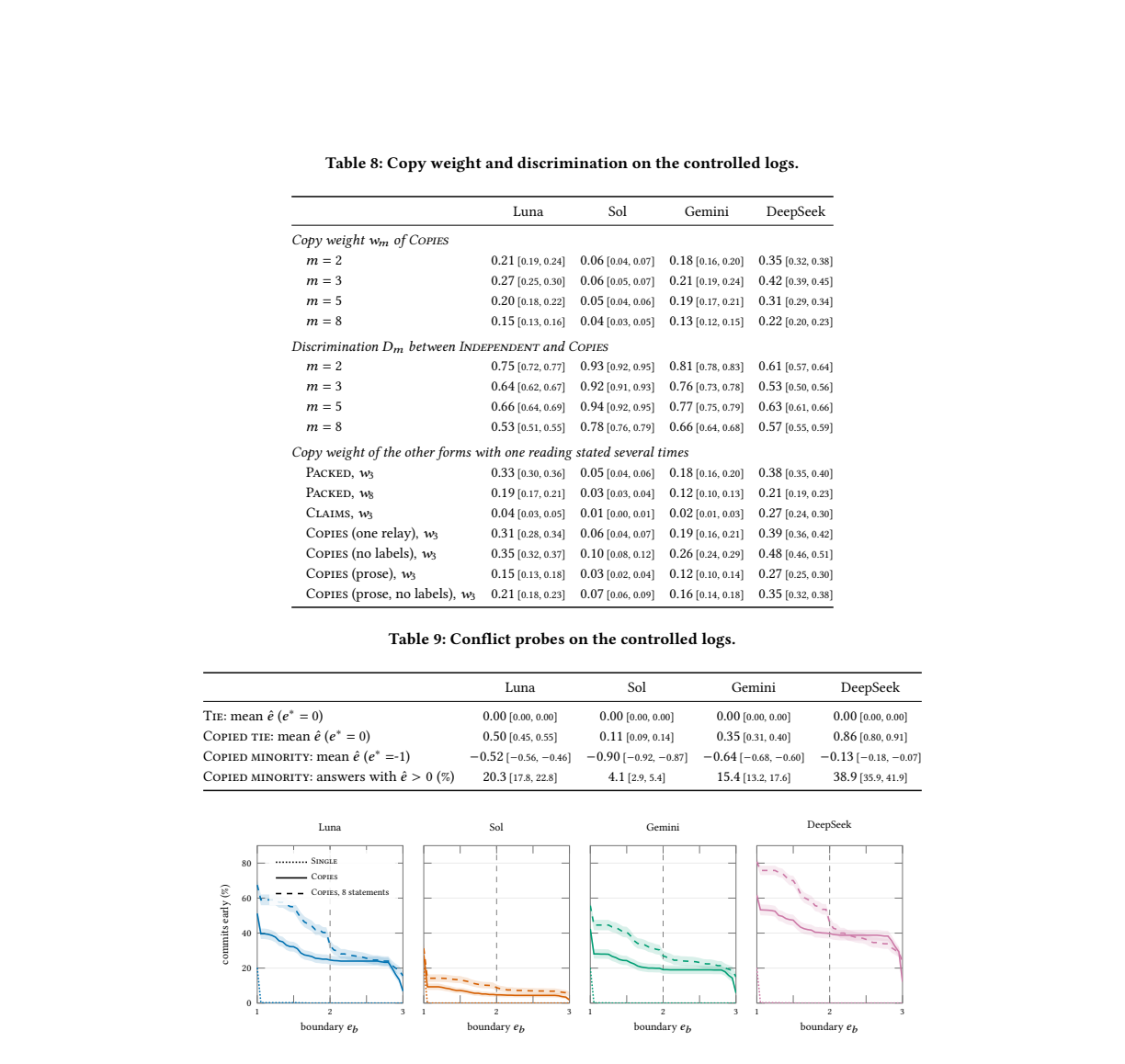
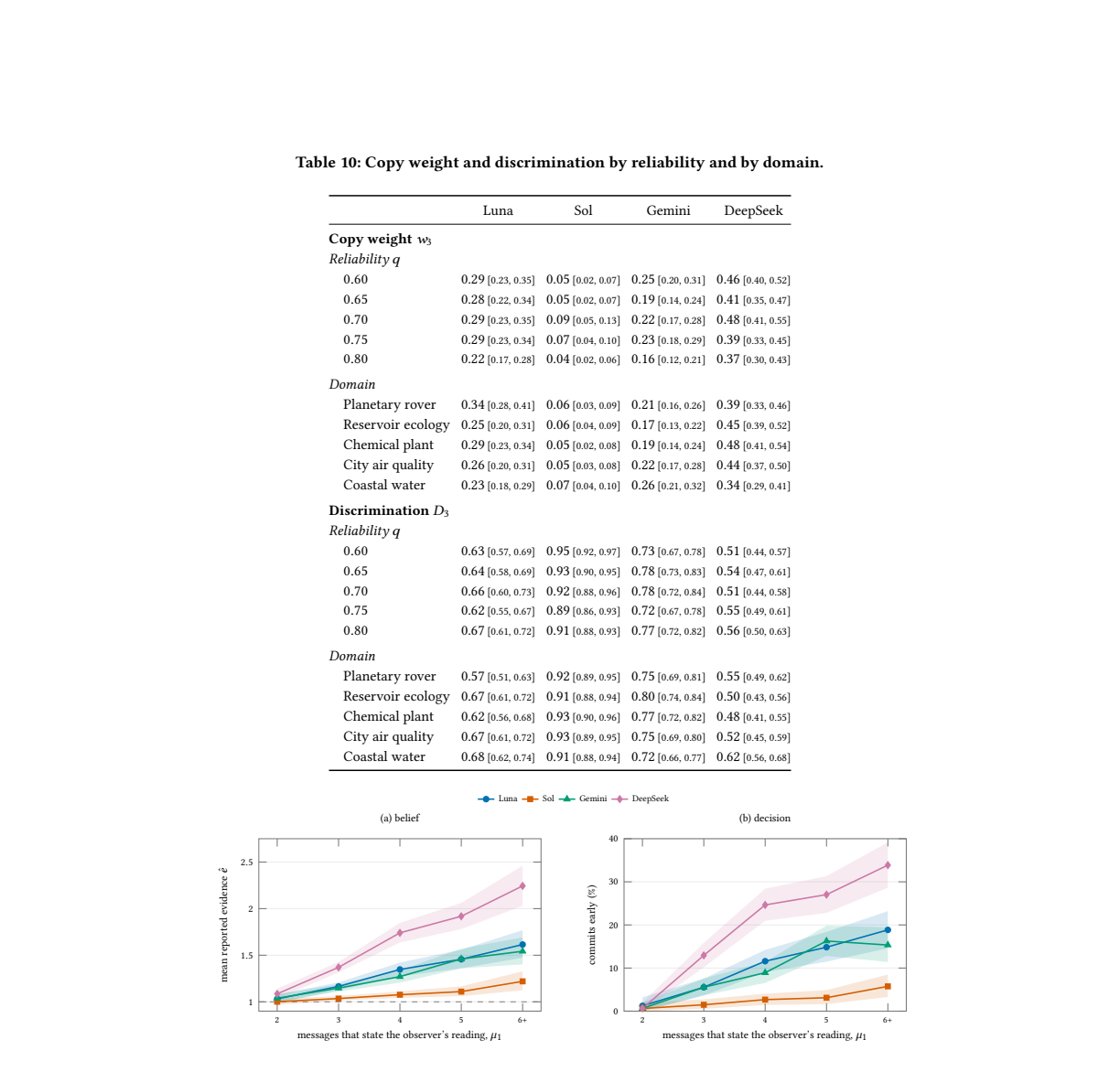
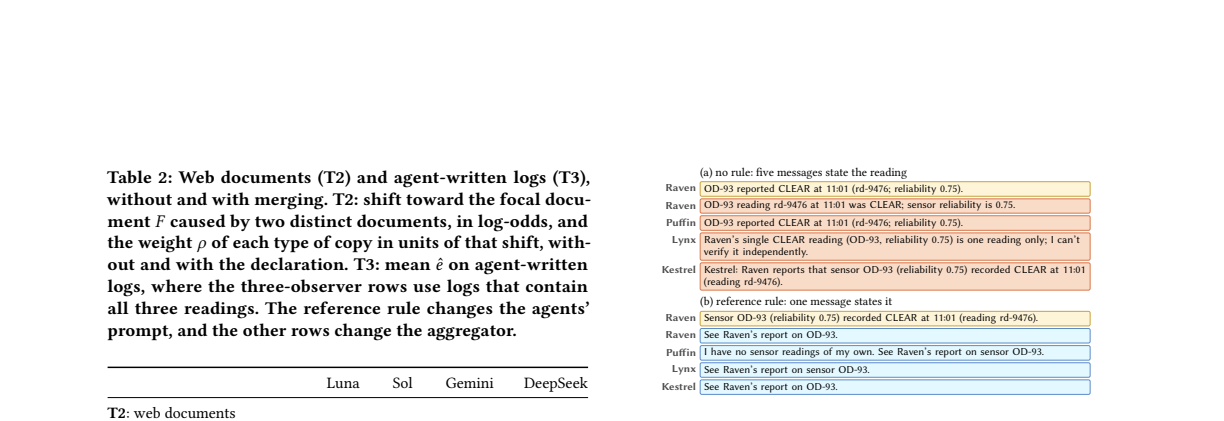
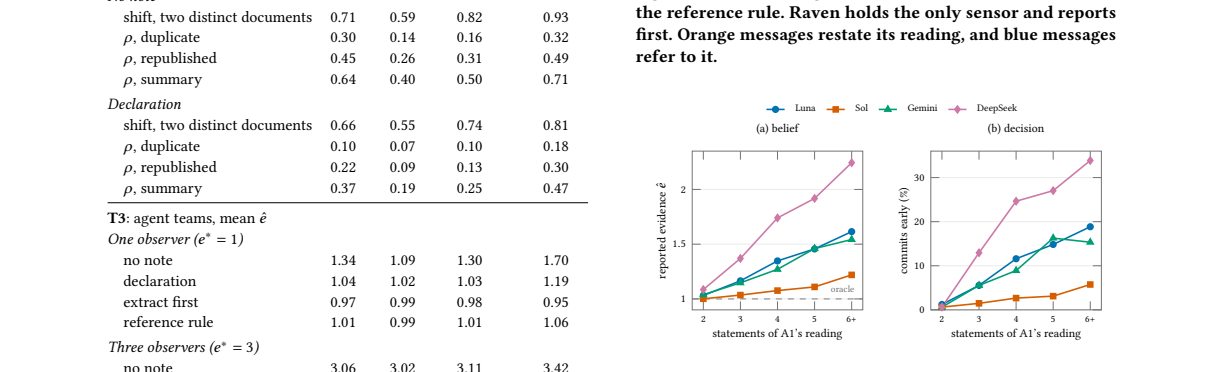
We convert a reported probability into units of independent readings, which assigns every restatement a copy weight, 0 for an aggregator that counts sources and 1 for one that counts every statement, and yields the implied decision under any cost structure. Three testbeds hold the evidence fixed and vary how it is restated: message logs with an exact Bayesian oracle, web documents with appended copies, and logs written by LLM agent teams under four communication protocols. Across four models from three providers, a forwarded copy counts for 0.06 to 0.42 of a new reading, mostly because some replies count every statement. On 5% to 40% of logs that state one reading three times, the reported belief implies an early commitment that the oracle never makes. The models that count copies least and most on controlled logs do so on web copies and agent-written logs as well. A one-paragraph declaration of what a copy contributes brings the copy weight on controlled logs to 0.08 or less. A rule that has agents refer to readings instead of restating them cuts belief-implied early commitment from 11.2% to 1.1% and preserves genuine corroboration.
from the abstract
Pith says
Machine review · deepseek-v4-flash · 6 Oct 2026 · what was read was not recorded · not checked by a person
It can be wrong. Challenge this review or reply to it.
The passes disagreed. Reader: holds up. Skeptic: holds up only with conditions. Referee: minor revision.
Careful, unusually well-controlled measurement of how LLM aggregators count restated copies; the qualitative finding survives on calibration-free evidence, but the headline numbers and the missing data release need attention at review. This line is wrong
1 major objection · 5 minor
How often objections from reviews like this one are right: not yet measured
Not checked: figures, code, what the 68 references say.
The paper says, at Section 2.2, Eq. (2); Sections 4.1 and 4.3; Table 11
The review did not quote this passage.
Pith says: Objection 1 of 1 · major
The quantitative headline, w3 = 0.06–0.42 (Section 4.1), depends on reading each reported probability as a Bayesian posterior over independent readings of known reliability q, via Eq. (2). That premise is well validated where copies are absent: Single gives e ≈ 1.00, and the Independent dose series gives 1.96–1.99, 2.83–2.96 and 4.47–4.94 against e* = 2, 3 and 5 (Table 7), so the scale is anchored at multiple intermediate levels, not just the endpoints.
more of objection 1
The manuscript does not, however, test whether the restatement manipulation itself distorts the probability-reporting channel, and Section 6 cites [56] for calibration error in verbalized probabilities. The conflict probes (Section 4.1) and the emitted-action channel (Table 17) support the existence and decision-relevance of over-counting without Eq. (2), so the qualitative claim is not at risk; the exposure is confined to the magnitude. Table 11 bounds that exposure for the headline m = 3 conditions: only 5.1–19.3% of replies fall strictly between the one-reading and three-reading posteriors, and the two modes sit at posteriors whose verbalization the Independent conditions show to be accurate. Re-anchoring the intermediate band by as much as ±0.5 readings would move w3 by at most about 0.05, and more realistic distortions by a few hundredths, so the 0.06–0.42 range is unlikely to be dominated by a reporting artifact. I recommend adding a short sensitivity analysis (recomputing w3 with intermediate reports re-anchored to the Independent-condition calibration curve, or a calibration plot for the Copies condition) and, in the abstract and Section 7, stating that the reading-scale magnitudes conjoin evidence weighting with the probability-reporting channel. As a related clarification: because the logit transform is monotone, all Wilcoxon, McNemar and Page tests in Table 31 are invariant to the conversion of Eq. (2); the calibration concern affects magnitudes and boundary-crossing rates only.
5 minor objections
The paper says, at Supplement (Appendices A–G)
Pith says: minor objection 1 of 5
The manuscript ships no code or data repository; the appendix publishes prompts, item-generation rules, and the full test tables, which is helpful, but the 1,000 T1 items, the 500 T2 items, and the 8,000 T3 transcripts with annotations would need to be released for the replicate-sample results (Table 13) and the annotation-agreement check (Section D.2) to be independently verifiable.
The paper says, at Main-text and appendix figure numbering
Pith says: minor objection 2 of 5
Figure numbers collide between the main text and the appendix: the appendix's own Figure 3 ('early commitment by restatement count', Section F.3) is easily confused with the main text's Figure 3 (boundary curves, Section 4.4); renumber the appendix figures.
show 3 more
The paper says, at Section 2.3
Pith says: minor objection 3 of 5
The convention that a report exactly at the boundary counts as a query appears only in Section E of the appendix; move that sentence to Section 2.3, where early commitment is first defined.
The paper says, at Section 3, Models and analysis
Pith says: minor objection 4 of 5
The sentence claiming that every pre-specified contrast behind the claims is significant after Holm correction should be scoped to confirmatory families, since Table 31 contains secondary contrasts that remain non-significant after correction (for example, Placebo: delivery versus no note on Copies for Luna, p = 0.299), and those contrasts do not support any headline claim.
The paper says, at Abstract and Section 4.3
Pith says: minor objection 5 of 5
The abstract's 'mostly because some replies count every statement' is established for three statements; at eight statements the full-counting share falls to 1–6% and intermediate reports dominate (Table 11), so the abstract sentence should carry the dose qualification or point to Section 4.3's discussion of the spread.
What would settle it
Run the T1 action channel on the paired Single, Copies, and Independent forms at several cost levels c (equivalently, several boundaries e_b) for each model, preserving the same r per q and the oracle decision rule. Recover the posterior implied by each model's emitted COMMIT/QUERY choices from the thresholds at which behavior switches, convert it to evidence in readings, and compute an action-based copy weight w_action = (e_implied(Copies) − e_implied(Single))/(m − 1). Compare w_action with the belief-based w3 from Eq. (3). If w_action differs from w3 by more than the bootstrap interval width, or if the Sol/DeepSeek ordering flips, Eq. (2) is measuring a probability-reporting distortion and the headline range should be reported as decision-contingent rather than as a stable copy weight.
from the skeptic's reading
How the review went
4 readings by deepseek-v4-flash · 6 Oct 2026
- Reader holds up
- Skeptic agrees: says it holds up only with conditions The quantified copy-weight range rests on Eq. (2)'s uncalibrated log-odds mapping; endpoint checks do not rule out content-dependent miscalibration of intermediate reports, so the 0.06–0.42 numbers may be partly a probability-reporting artifact.
- Editor wrote the verdict above
- Referee minor revision: 1 major objection, 5 minor
Not run on this paper: the simulated authors' defence.
Pith did not check this review's objections against the paper.
The review in full
The review in brief, machine-written
Read it. This is about as carefully controlled an empirical measurement of the "copy counted as source" failure as I've seen. The new thing is the unit: converting reported probabilities into readings against an exact Bayesian oracle, which separates a model-specific copy weight from the protocol-determined restatement count. That decomposition is genuinely useful, and the design does the work — paired same-item contrasts, pre-specified test families with Holm correction, null controls (Pointers, Padding) equivalent within 0.10 readings, replicate samples, and placebos that isolate content from length and position. They state Assumption 1 and then test its two predictions instead of using it to define results; the reference rule and hierarchy results confirm it from both sides. The full-counting mixture analysis (4–35% of reports carry 71–84% of the excess) is honest and explains why a mean below the boundary still produces early commitment.
The stress-test is right about Eq. (2). The 0.06–0.42 copy weights come from treating every reported probability as a Bayesian posterior via the log-odds mapping, the paper validates only the endpoints, and it itself cites [56] on calibration error in verbalized probabilities. So the precision of the headline numbers is partly hostage to probability-reporting artifacts. But the stress-test overreaches when it implies the central claim falls with Eq. (2). The conflict probes (Copied tie, Copied minority) read over-counting from the direction of the answer rather than its magnitude, and the action channel shows copies add 6–35 points of commitment matching the belief-implied rates within 6 points. Those carry the qualitative conclusion — copies move decisions — without relying on the mapping. The early-commitment percentages share the Eq. (2) caveat.
The bigger practical gap is that no code or data repository is shipped, and the four models are proprietary systems a reviewer can't call. The appendix gives complete prompts (Section G is genuinely thorough), but for a measurement paper whose value is the numbers, that's a lot of surface for transcription error. A calibration pass on intermediate reports and a repo would close most of the distance.
The self-citations are not load-bearing; [1] is a legitimately contrasting benchmark. The Sol-based annotation with a 240-message human check at 98.8% is fine.
Who gets value: anyone building aggregators over relayed, shared-board, or discussion logs, and methods people who want a model of pre-registered behavioral testing against a closed-form oracle. Send it to review — it deserves referee time, with the calibration and data-release points on the revision list.
The strongest objection
The central quantitative claim—w3 = 0.06 to 0.42, and 5–40% early commitment—is computed from Eq. (2), e = a logit(p_hat)/L, which treats every reported probability as a Bayesian posterior over readings of reliability q, and from Eq. (3), w_m = (mean e − 1)/(m − 1). The paper validates the endpoints (Single ≈ 1.00, Independent ≈ 2.83–2.96) but never calibrates intermediate reports, and it cites [56] showing that LLM verbalized probabilities carry calibration error. If restatement induces a content-dependent distortion of the probability-reporting channel, then w3 and the Section 4.3 full-counting shares are a mixture of copy counting and miscalibration. The paired controls (Pointers, Padding) exclude length and record-count confounds, and the conflict probes and the action-channel results in Table 17 support the qualitative conclusion that copies move decisions without relying on Eq. (2). The load-bearing weak point is therefore the precise quantification that the abstract and Section 7 state: a copy counts for 0.06–0.42 of a new reading. The paper does not itself supply a check that this number reflects evidence weighting rather than verbalization artifact.
I agree with the reader that the weakest load-bearing premise is the log-odds mapping of reported probabilities to independent readings. The paper is otherwise unusually strong: the testbeds are paired so that restatement is the only intended difference, the null controls (Pointers, Padding, Trace) rule out generic length or record-count effects, the conflict probes do not depend on calibration, the action channel corroborates the decision-level conclusion without using Eq. (2), and replicate samples bound sampling noise. The concern is not that the phenomenon is false; it is that the precise headline numbers, including the copy-weight range in the abstract and Section 7, could be materially shifted by content-dependent miscalibration of verbalized probabilities. Because the readers and the paper's own Section 2.2 define the unit through Eq. (2), a multi-cost decision-elicitation check would settle whether the reported probabilities correspond to the evidence weights used in choices. The absence of a public code or data release makes this check non-trivial for an independent reviewer, but that is a reproducibility limitation rather than an additional technical flaw.
The referee's report
If the results hold, the paper converts a known failure mode — restatement swaying LLM answers — into a decision-relevant measurement that separates model behavior (copy weight) from protocol behavior (restatement count), and it tests two interventions that remove most of the inflation. The empirical apparatus is a strength. Every contrast is paired on the same items; the T1 oracle is exact; test families were pre-specified with Holm correction within family and model, and Table 31 reports adjusted p-values and bootstrap intervals for every contrast; null controls (Pointers, Padding) are judged equivalent only within tight ±0.10-reading bounds (Table 32); replicate samples bound condition-mean drift to at most 0.07 readings (Table 13); the emitted-action channel (Table 17) corroborates the belief-implied early-commitment numbers without relying on Eq. (2); and the conflict probes establish over-counting from the direction of the answer, again without the reading scale. The measurement has no fitted free parameters, and Assumption 1 is stated with testable predictions that Sections 4.2 and 5.2 check rather than being used to define the results.
Pith's reading of the paper (a machine's summary, not the authors')
This paper establishes that when LLM-based multi-agent systems echo an observation — a relay forwarding it, a board repeating it, a discussion round restating it — the component that pools the messages counts the restatements as partial new evidence, even when provenance is labelled in the text. To make the effect measurable it converts each reported probability into units of independent readings, $\hat{e} = a\,\mathrm{logit}(\hat{p})/L$, and reads off a copy weight $w$: an aggregator that counts sources gives copies weight 0, one that counts every statement gives them weight 1. Across four models from three providers, a forwarded copy counts for 0.06 to 0.42 of a new reading, and on 5% to 40% of logs that state one reading three times, the reported belief crosses a commit boundary that the oracle never crosses. The weight comes mostly from a minority of replies that count every statement in full, so a mean belief below the boundary can conceal beliefs far above it. A one-paragraph declaration at the aggregator and a reference rule in the protocol each remove most of the inflation, bringing the copy weight to 0.08 or less and cutting belief-implied early commitment from 11.2% to 1.1%.
What carries the argument. The measure is Eq. (2): a reported probability $\hat{p}$ is converted into evidence in readings by $\hat{e} = a\,\mathrm{logit}(\hat{p})/L$, where $L = \log(q/(1-q))$ is the known log-likelihood ratio of a reading of reliability $q$ and $a$ is the direction of the primary reading. One reading stated any number of times has oracle evidence $e^* = 1$, and $m$ agreeing independent readings have $e^* = m$, so the copy weight of a log stating one reading $m$ times is $w_m = (\bar{e}-1)/(m-1)$, with $w_m=0$ for a source-counting aggregator and $w_m=1$ for one that counts every statement; a companion discrimination $D_m$ compares $m$ independent readings with one reading stated $m$ times. Because the weight is read from the belief before any threshold is applied, the same reports give the implied decision under every cost structure through the commit boundary $e_b = \mathrm{logit}(r-c/2)/L$. Two further ingredients separate the contributors: the copy weight belongs to the model, while the restatement count $S$ is fixed by the protocol, and under the copy-count sufficiency assumption the protocol affects decisions only through $S$, so a protocol that states each reading once leaves the copy weight nothing to act on.
Core claim. The paper's central claim is that a copy carries a model-specific fraction of the weight of a source, enough to move decisions that the evidence does not support. On controlled logs, two forwarded copies raise the reported evidence from one reading to 1.12–1.84 readings, giving copy weights $w_3$ of 0.06, 0.21, 0.27 and 0.42 for the four models, while three genuinely independent readings in the same format give 2.83–2.96 readings. The weight follows how often a value is written, not how many records carry it: references and placeholder padding leave the belief at one reading, while a single packed record that repeats the value three times behaves like three separate records. Most of the weight comes from occasional full counting — replies that take every statement as a new reading — which is why the same log can sit at the one-reading posterior in one reply and at the three-reading posterior in another. The same ordering of models (Sol counting copies least, DeepSeek most) holds on web documents and on agent-written logs, and merging copies before the decision, either by a declaration or by a protocol rule that has agents refer to readings instead of restating them, removes most of the inflation while preserving genuine corroboration near three readings.
The premise it rests on. The load-bearing premise is that a reported probability can be read as a Bayesian posterior on a scale where each independent reading has a known reliability $L$; if the verbalized probabilities the models emit carry content-dependent miscalibration at intermediate values, the computed copy weights and early-commitment rates are partly calibration artifacts rather than pure copy counting.
If the paper is right (Pith's inferences, not the authors')
A multi-agent aggregator that pools messages without acting on provenance systematically fabricates corroboration: one observation restated can cross the commit boundary as if several independent observers had confirmed it, so decision loops (a rover manoeuvre, a verification verdict, a consensus answer) can commit on evidence the log does not contain.
The copy weight is a stable, model-specific quantity: the models that count copies least and most on controlled logs count them the same way on web documents and on agent-written logs, so the ranking transfers across testbeds.
The protocol, not the model, sets how many copies exist: relay chains and discussion rounds restate close to their bounds, and a reference rule that makes agents cite a reading instead of restating it cuts belief-implied early commitment from 11.2% to 1.1% while preserving genuine corroboration near three readings.
A single declarative sentence at the aggregator — naming which records are copies and that they add no evidence — brings the copy weight on controlled logs to 0.08 or less and roughly halves the effect of web duplicates, but it works only for copies the aggregator can recognise in the text, so summaries keep a residual weight of 0.19 to 0.47 of a distinct document.
Because the paper shows the weight arises from discrete full-counting replies rather than a uniform discount — the same log draws the one-reading posterior in one reply and full counting in another — interventions that stabilise which mode the model is in could reduce the weight more than generic reasoning-effort increases, which the paper shows are already effective.
The measure needs only reported probabilities on paired logs, so it reads as an inexpensive audit for agent platforms: run a single-observer relay on a fixed item, compare the reported belief to the one-reading posterior, and flag any system whose implied copy weight exceeds a budget.
The web finding that the further a copy departs from its original the more it counts suggests paraphrase distance is a second axis of copy weight: surface-similarity deduplication would remove the lightest-weight copies (exact duplicates) while leaving the heaviest (summaries) in place.
Check this review
Pith stored no record of this review's passes and took no fingerprint of it. Reviews made by code from 13 Nov 2026 on carry both.
How often reviews like this one are right
Reviews like this one: written by deepseek-v4-flash, where what was read was not recorded.
How often objections from reviews like this one are right: not yet measured
Reviews by people
This review was written by a machine. No person has reviewed this paper on Pith yet. A scientist listed on Pith can review it for a fee, and their review is published here whatever it concludes.
The paper
Abstract
Multi-agent systems built on large language models (LLMs) restate observations as a matter of course: relays forward them, shared boards repeat them and discussion rounds echo them. An aggregator that pools such messages should count sources, not statements. We convert a reported probability into units of independent readings, which assigns every restatement a copy weight, 0 for an aggregator that counts sources and 1 for one that counts every statement, and yields the implied decision under any cost structure. Three testbeds hold the evidence fixed and vary how it is restated: message logs with an exact Bayesian oracle, web documents with appended copies, and logs written by LLM agent teams under four communication protocols. Across four models from three providers, a forwarded copy counts for 0.06 to 0.42 of a new reading, mostly because some replies count every statement. On 5% to 40% of logs that state one reading three times, the reported belief implies an early commitment that the oracle never makes. The models that count copies least and most on controlled logs do so on web copies and agent-written logs as well. A one-paragraph declaration of what a copy contributes brings the copy weight on controlled logs to 0.08 or less. A rule that has agents refer to readings instead of restating them cuts belief-implied early commitment from 11.2% to 1.1% and preserves genuine corroboration.
The paper's own sentences, arranged, kept beside the review and separate from it. Each label is drawn from a closed vocabulary; the number beside it is the probability the classifier gave that label. No sentence in this record was written by a model.
abstract compiled · 2026-10-06
The authors' main claim, as the classifier picked it out 0.71
“An aggregator that pools such messages should count sources, not statements.”
How the main claim is stated: asserted 1.00
What the abstract itself states, as probabilities: claims first 0.04 · states limitation 0.23 · human participants 0.06 · controlled comparison 0.65 · randomized assignment 0.04 · states quantitative result 0.99 · compares with prior results 0.68 · mentions code or data availability 0.03
The abstract, sentence by sentence
This table labels the abstract only (arXiv listing abstract v1). The number is the probability the classifier gave the label.
| Sentence | Role | The authors' own work | States the main conclusion | Strength |
|---|---|---|---|---|
| Multi-agent systems built on large language models (LLMs) restate observations as a matter of course: relays forward them, shared boards repeat them and discussion rounds echo them. | background 1.00 | 0.06 | 0.02 | asserted 1.00 |
| An aggregator that pools such messages should count sources, not statements. | interpretation 0.31 | 0.10 | 0.64 | asserted 1.00 |
| We convert a reported probability into units of independent readings, which assigns every restatement a copy weight, 0 for an aggregator that counts sources and 1 for one that counts every statement, and yields the implied decision under any cost structure. | method 0.84 | 0.87 | 0.18 | asserted 0.99 |
| Three testbeds hold the evidence fixed and vary how it is restated: message logs with an exact Bayesian oracle, web documents with appended copies, and logs written by LLM agent teams under four communication protocols. | method 0.97 | 0.91 | 0.03 | asserted 0.94 |
| Across four models from three providers, a forwarded copy counts for 0.06 to 0.42 of a new reading, mostly because some replies count every statement. | result 1.00 | 0.94 | 0.18 | asserted 1.00 |
| On 5% to 40% of logs that state one reading three times, the reported belief implies an early commitment that the oracle never makes. | result 1.00 | 0.92 | 0.08 | asserted 1.00 |
| The models that count copies least and most on controlled logs do so on web copies and agent-written logs as well. | result 1.00 | 0.92 | 0.10 | asserted 1.00 |
| A one-paragraph declaration of what a copy contributes brings the copy weight on controlled logs to 0.08 or less. | result 0.92 | 0.87 | 0.13 | asserted 1.00 |
| A rule that has agents refer to readings instead of restating them cuts belief-implied early commitment from 11.2% to 1.1% and preserves genuine corroboration. | result 0.85 | 0.87 | 0.39 | asserted 1.00 |
What kind of paper the classifier reports this is: empirical study 0.81 · evidence from observation or experiment 0.68
What was examined, and what was not
Sources read
- arXiv listing abstract v1
Not examined
- full text
- figures and tables
- references and citing sentences
- relations to other papers
Levels run
- P abstract
Not run
- S sections
- T body sentences
- C citations
- R cross-paper relations
How the labels were made
Compiled by classifier-1.13.0 via TypeSafe API, question bank abstract-p1-20260923, 2026-10-06: 1 request, 6,997 input tokens.
Every quoted sentence on this record is the authors'. Every label is from Pith's closed vocabulary, with the probability shown beside it. This record as JSON
Figures (5)

Figures are the authors', reproduced from the paper.
References (68)
- [56] Katherine Tian, Eric Mitchell, Allan Zhou, Archit Sharma, Rafael Rafailov, Huaxiu Yao, Chelsea Finn, and Christopher D. Manning. 2023. Just Ask for Calibration: Strategies for Eliciting Calibrated Confidence Scores from Language Models Fine-Tuned with Human Feedback. InProceed... on Pith
- [1] 2026. GullibleBench: A Causal Benchmark for Manufactured Consensus. GitHub repository, https://github.com/zozo123/GULI-SET. Version 1.1.0 on Pith
- [2] Amro Abbas, Kushal Tirumala, Dániel Simig, Surya Ganguli, and Ari S. Morcos on Pith
- [3] Marc Bara. 2026. Epistemic Sybil Resistance: Multiplying AI Agents Without Multiplying Evidence. arXiv:2609.01873 on PithPith's reviewarXiv
- [4] Andrei Z. Broder. 1997. On the Resemblance and Containment of Documents. In Proceedings of Compression and Complexity of Sequences. IEEE, 21–29 on Pith
- [5] Mert Cemri, Melissa Z. Pan, Shuyi Yang, Lakshya A. Agrawal, Bhavya Chopra, Rishabh Tiwari, Kurt Keutzer, Aditya Parameswaran, Dan Klein, Kannan Ram- chandran, Matei Zaharia, Joseph E. Gonzalez, and Ion Stoica. 2025. Why Do Multi-Agent LLM Systems Fail?. InAdvances in Neural In... on Pith
- [6] Justin Chih-Yao Chen, Swarnadeep Saha, and Mohit Bansal. 2024. ReConcile: Round-Table Conference Improves Reasoning via Consensus among Diverse LLMs. InProceedings of the 62nd Annual Meeting of the Association for Computa- tional Linguistics. 7066–7085 on Pith
- [7] Hanjun Cho and Jay-Yoon Lee. 2026. RARE: Redundancy-Aware Retrieval Evalu- ation Framework for High-Similarity Corpora. InProceedings of the 64th Annual Meeting of the Association for Computational Linguistics. 20160–20185 on Pith
- [8] Hyeong Kyu Choi, Xiaojin Zhu, and Sharon Li. 2025. Debate or Vote: Which Yields Better Decisions in Multi-Agent Large Language Models?. InAdvances in Neural Information Processing Systems, Vol. 38 on Pith
- [9] Min Choi, Keonwoo Kim, Sungwon Chae, and Sangyeob Baek. 2025. An Empirical Study of Group Conformity in Multi-Agent Systems. InFindings of the Association for Computational Linguistics: ACL 2025. 5123–5139 on Pith
- [10] Chengxiao Dai. 2026. When Consensus Is Not Correctness: Diversity Collapse and Manufactured Overconfidence in Multi-Agent LLM Debate. InKDD Workshop on Evaluation and Trustworthiness of Agentic AI on Pith
- [11] Alice Dechêne, Christoph Stahl, Jochim Hansen, and Michaela Wänke. 2010. The Truth About the Truth: A Meta-Analytic Review of the Truth Effect.Personality and Social Psychology Review14, 2 (2010), 238–257 on Pith
- [12] Morris H. DeGroot. 1974. Reaching a Consensus.J. Amer. Statist. Assoc.69, 345 (1974), 118–121 on Pith
- [13] Peter M. DeMarzo, Dimitri Vayanos, and Jeffrey Zwiebel. 2003. Persuasion Bias, Social Influence, and Unidimensional Opinions.The Quarterly Journal of Economics118, 3 (2003), 909–968 on Pith
- [14] Franz Dietrich and Kai Spiekermann. 2013. Independent Opinions? On the Causal Foundations of Belief Formation and Jury Theorems.Mind122, 487 (2013), 655–685 on Pith
- [15] Yilun Du, Shuang Li, Antonio Torralba, Joshua B. Tenenbaum, and Igor Mor- datch. 2024. Improving Factuality and Reasoning in Language Models through Multiagent Debate. InProceedings of the 41st International Conference on Machine Learning (PMLR, Vol. 235). 11733–11763 on Pith
- [16] Benjamin Enke and Florian Zimmermann. 2019. Correlation Neglect in Belief Formation.The Review of Economic Studies86, 1 (2019), 313–332 on Pith
- [17] Andrew Estornell and Yang Liu. 2024. Multi-LLM Debate: Framework, Principals, and Interventions. InAdvances in Neural Information Processing Systems, Vol. 37 on Pith
- [18] Patricia Everaere, Sébastien Konieczny, and Pierre Marquis. 2015. Belief Merging versus Judgment Aggregation. InProceedings of the 14th International Conference on Autonomous Agents and Multiagent Systems. 999–1007 on Pith
- [19] Erik Eyster and Matthew Rabin. 2010. Naïve Herding in Rich-Information Settings.American Economic Journal: Microeconomics2, 4 (2010), 221–243 on Pith
show 48 more
- [20] Jianxin Gao, Beini Hu, Runze Li, Wanli Peng, Ruohan Lei, Jinyuan Zhang, Linna Deng, Tianyi Yu, and Zining Wang. 2026. MirrorCraft: Paired Evaluation under Hidden Rule Changes in Minecraft. arXiv:2607.29218 on PithPith's reviewarXiv
- [21] Jianxin Gao, Tianyi Yu, Linna Deng, Runze Li, and Zining Wang. 2026. Testing Interchangeability in LLM Agent Teams. arXiv:2609.05279 on PithPith's reviewarXiv
- [22] Matt Gardner, Yoav Artzi, Victoria Basmov, Jonathan Berant, Ben Bogin, Si- hao Chen, Pradeep Dasigi, Dheeru Dua, Yanai Elazar, Ananth Gottumukkala, Nitish Gupta, Hannaneh Hajishirzi, Gabriel Ilharco, Daniel Khashabi, Kevin Lin, Jiangming Liu, Nelson F. Liu, Phoebe Mulcaire, Qi... on Pith
- [23] Christian Genest and James V. Zidek. 1986. Combining Probability Distributions: A Critique and an Annotated Bibliography.Statist. Sci.1, 1 (1986), 114–135 on Pith
- [24] Benjamin Golub and Matthew O. Jackson. 2010. Naïve Learning in Social Net- works and the Wisdom of Crowds.American Economic Journal: Microeconomics 2, 1 (2010), 112–149 on Pith
- [25] Todd J. Green, Grigoris Karvounarakis, and Val Tannen. 2007. Provenance Semirings. InProceedings of the 26th ACM SIGMOD-SIGACT-SIGART Symposium on Principles of Database Systems. 31–40 on Pith
- [26] Ritwik Gupta, Rodolfo Corona, Jiaxin Ge, Eric Wang, Dan Klein, Trevor Darrell, and David M. Chan. 2025. Enough Coin Flips Can Make LLMs Act Bayesian. InProceedings of the 63rd Annual Meeting of the Association for Computational Linguistics. 7634–7655 on Pith
- [27] Lynn Hasher, David Goldstein, and Thomas Toppino. 1977. Frequency and the Conference of Referential Validity.Journal of Verbal Learning and Verbal Behavior 16, 1 (1977), 107–112 on Pith
- [28] Sture Holm. 1979. A Simple Sequentially Rejective Multiple Test Procedure. Scandinavian Journal of Statistics6, 2 (1979), 65–70 on Pith
- [29] Sirui Hong, Mingchen Zhuge, Jonathan Chen, Xiawu Zheng, Yuheng Cheng, Ceyao Zhang, Jinlin Wang, Zili Wang, Steven Ka Shing Yau, Zijuan Lin, Liyang Zhou, Chenyu Ran, Lingfeng Xiao, Chenglin Wu, and Jürgen Schmidhuber. 2024. MetaGPT: Meta Programming for a Multi-Agent Collaborat... on Pith
- [30] Jen-Tse Huang, Jiaxu Zhou, Tailin Jin, Xuhui Zhou, Zixi Chen, Wenxuan Wang, Youliang Yuan, Michael Lyu, and Maarten Sap. 2025. On the Resilience of LLM- Based Multi-Agent Collaboration with Faulty Agents. InProceedings of the 42nd International Conference on Machine Learning (... on Pith
- [31] Adit Jain and Vikram Krishnamurthy. 2025. Interacting Large Language Model Agents: Bayesian Social Learning Based Interpretable Models.IEEE Access13 (2025), 25465–25504 on Pith
- [32] Simon J. Julier and Jeffrey K. Uhlmann. 1997. A Non-Divergent Estimation Algo- rithm in the Presence of Unknown Correlations. InProceedings of the American Control Conference, Vol. 4. 2369–2373 on Pith
- [33] Lars Benedikt Kaesberg, Jonas Becker, Jan Philip Wahle, Terry Ruas, and Bela Gipp. 2025. Voting or Consensus? Decision-Making in Multi-Agent Debate. In Findings of the Association for Computational Linguistics: ACL 2025. 11640–11671 on Pith
- [34] Guneet Kohli. 2026. Nine Judges, Two Effective Votes: Correlated Errors Under- mine LLM Evaluation Panels. arXiv:2605.29800 on PithPith's reviewarXiv
- [35] Sébastien Konieczny and Ramón Pino Pérez. 2002. Merging Information under Constraints: A Logical Framework.Journal of Logic and Computation12, 5 (2002), 773–808 on Pith
- [36] Vikram Krishnamurthy and William Hoiles. 2014. Online Reputation and Polling Systems: Data Incest, Social Learning, and Revealed Preferences.IEEE Transac- tions on Computational Social Systems1, 3 (2014), 164–179 on Pith
- [37] Murathan Kurfalı and Robert Östling. 2025. Conflicting Needles in a Haystack: How LLMs Behave When Faced with Contradictory Information. InProceedings of the 2025 Conference on Empirical Methods in Natural Language Processing. 34361–34376 on Pith
- [38] Krishna K. Ladha. 1992. The Condorcet Jury Theorem, Free Speech, and Corre- lated Votes.American Journal of Political Science36, 3 (1992), 617–634 on Pith
- [39] Katherine Lee, Daphne Ippolito, Andrew Nystrom, Chiyuan Zhang, Douglas Eck, Chris Callison-Burch, and Nicholas Carlini. 2022. Deduplicating Training Data Makes Language Models Better. InProceedings of the 60th Annual Meeting of the Association for Computational Linguistics. 8424–8445 on Pith
- [40] Guohao Li, Hasan Abed Al Kader Hammoud, Hani Itani, Dmitrii Khizbullin, and Bernard Ghanem. 2023. CAMEL: Communicative Agents for “Mind” Exploration of Large Language Model Society. InAdvances in Neural Information Processing Systems, Vol. 36 on Pith
- [41] Yuxuan Li, Aoi Naito, and Hirokazu Shirado. 2025. Systematic Failures in Collective Reasoning under Distributed Information in Multi-Agent LLMs. arXiv:2505.11556 on PithPith's reviewarXiv
- [42] Junchi Liao. 2026. Auditing Provenance Sensitivity in LLM Agent Action Selec- tion. arXiv:2607.20827 on PithPith's reviewarXiv
- [43] Chenchen Lin, Wenhao Yuan, Xuehe Wang, and Edith Cheuk Han Ngai. 2026. Beyond Memory Majority: Latent-Source Reasoning for Multi-Agent Memory Arbitration. arXiv:2608.19701 on PithPith's reviewarXiv
- [44] Tongxuan Liu, Xingyu Wang, Weizhe Huang, Wenjiang Xu, Yuting Zeng, Lei Jiang, Hailong Yang, and Jing Li. 2026. GroupDebate: Enhancing the Efficiency of Multi-Agent Debate Using Group Discussion. InProceedings of the 25th Inter- national Conference on Autonomous Agents and Mult... on Pith
- [45] Evan Miller. 2024. Adding Error Bars to Evals: A Statistical Approach to Language Model Evaluations. arXiv:2411.00640 on PithPith's reviewarXiv
- [46] Atharv Naphade. 2026. Rational Synthesizers or Heuristic Followers? Analyzing LLMs in RAG-Based Question-Answering. InFindings of the Association for Computational Linguistics: ACL 2026. 40293–40311 on Pith
- [47] H. Penny Nii. 1986. The Blackboard Model of Problem Solving and the Evolution of Blackboard Architectures.AI Magazine7, 2 (1986), 38–53 on Pith
- [48] Ellis Batten Page. 1963. Ordered Hypotheses for Multiple Treatments: A Signifi- cance Test for Linear Ranks.J. Amer. Statist. Assoc.58, 301 (1963), 216–230 on Pith
- [49] Joon Sung Park, Joseph O’Brien, Carrie Jun Cai, Meredith Ringel Morris, Percy Liang, and Michael S. Bernstein. 2023. Generative Agents: Interactive Simulacra of Human Behavior. InProceedings of the 36th Annual ACM Symposium on User Interface Software and Technology on Pith
- [50] Siyue Ren, Wanli Fu, Xinkun Zou, Chen Shen, Yi Cai, Chen Chu, Zhen Wang, and Shuyue Hu. 2026. Reputation as a Solution to Cooperation Collapse in LLM- based MASs. InProceedings of the 25th International Conference on Autonomous Agents and Multiagent Systems. 9 on Pith
- [51] Marco Tulio Ribeiro, Tongshuang Wu, Carlos Guestrin, and Sameer Singh. 2020. Beyond Accuracy: Behavioral Testing of NLP Models with CheckList. InProceed- ings of the 58th Annual Meeting of the Association for Computational Linguistics. 4902–4912 on Pith
- [52] Jakob Schuster, Vagrant Gautam, and Katja Markert. 2026. Whose Facts Win? LLM Source Preferences under Knowledge Conflicts. InProceedings of the 64th Annual Meeting of the Association for Computational Linguistics (Volume 1: Long Papers). 29430–29459 on Pith
- [53] Xu Shen, Yixin Liu, Yiwei Dai, Yili Wang, Rui Miao, Yue Tan, Shirui Pan, and Xin Wang. 2025. Understanding the Information Propagation Effects of Communica- tion Topologies in LLM-based Multi-Agent Systems. InProceedings of the 2025 Conference on Empirical Methods in Natural L... on Pith
- [54] Freda Shi, Xinyun Chen, Kanishka Misra, Nathan Scales, David Dohan, Ed H. Chi, Nathanael Schärli, and Denny Zhou. 2023. Large Language Models Can Be Easily Distracted by Irrelevant Context. InProceedings of the 40th International Conference on Machine Learning (PMLR, Vol. 202)... on Pith
- [55] Andries Petrus Smit, Nathan Grinsztajn, Paul Duckworth, Thomas D. Barrett, and Arnu Pretorius. 2024. Should We Be Going MAD? A Look at Multi-Agent Debate Strategies for LLMs. InProceedings of the 41st International Conference on Machine Learning (PMLR, Vol. 235). 45883–45905 on Pith
- [57] Pat Verga, Sebastian Hofstätter, Sophia Althammer, Yixuan Su, Aleksandra Piktus, Arkady Arkhangorodsky, Minjie Xu, Naomi White, and Patrick Lewis. 2024. Replacing Judges with Juries: Evaluating LLM Generations with a Panel of Diverse Models. arXiv:2404.18796 on PithPith's reviewarXiv
- [58] Alexander Wan, Eric Wallace, and Dan Klein. 2024. What Evidence Do Language Models Find Convincing?. InProceedings of the 62nd Annual Meeting of the Asso- ciation for Computational Linguistics. Association for Computational Linguistics, Bangkok, Thailand, 7468–7484 on Pith
- [59] Han Wang, Archiki Prasad, Elias Stengel-Eskin, and Mohit Bansal. 2025. Retrieval- Augmented Generation with Conflicting Evidence. InSecond Conference on Lan- guage Modeling on Pith
- [60] Sikun Wang, Yixi Zhou, Lei Fan, and Fan Zhang. 2026. GraphEcho: Structural Redundancy and Evidence Provenance in LLM Graph Agents. arXiv:2609.17695 on PithPith's reviewarXiv
- [61] Yiqi Wang, Zihao Yan, Jiaqi Zhang, Zhangkai Wu, Mingkai Zheng, Zequn Sun, Yanming Zhu, and Taotao Cai. 2026. MAP-Graph: Provenance-Aware Shared Memory for Multi-Agent Workflows. arXiv:2608.10509 on PithPith's reviewarXiv
- [62] Zhiyuan Weng, Guikun Chen, and Wenguan Wang. 2025. Do as We Do, Not as You Think: The Conformity of Large Language Models. InThe Thirteenth International Conference on Learning Representations on Pith
- [63] Robert L. Winkler. 1981. Combining Probability Distributions from Dependent Information Sources.Management Science27, 4 (1981), 479–488 on Pith
- [64] Kevin Wu, Eric Wu, and James Zou. 2024. ClashEval: Quantifying the Tug-of-War between an LLM’s Internal Prior and External Evidence. InAdvances in Neural Information Processing Systems (Datasets and Benchmarks Track), Vol. 37 on Pith
- [65] Zhelun Wu. 2026. Split the Labor: Separating Evidence Interpretation from Decision Aggregation. arXiv:2608.14509 on PithPith's reviewarXiv
- [66] Jian Xie, Kai Zhang, Jiangjie Chen, Renze Lou, and Yu Su. 2024. Adaptive Chameleon or Stubborn Sloth: Revealing the Behavior of Large Language Models in Knowledge Conflicts. InThe Twelfth International Conference on Learning Representations on Pith
- [67] Chenfei Yan, Zeyang Yue, Feifei Zhao, Erliang Lin, Lu Jia, Haibo Tong, Mingyang Lyu, Chengyi Sun, and Yi Zeng. 2026. When Truth Is Distributed: Misinfor- mation Derails Collective Fact Recovery in LLM-Based Multi-Agent Systems. arXiv:2608.03421 10 A Overview Table 1 lists ever... on PithPith's reviewarXiv
- [2023] SemDeDup: Data-Efficient Learning at Web-Scale Through Semantic Deduplication. arXiv:2303.09540 on PithPith's reviewarXiv
Cited by 3 Pith papers
Reviewed papers on Pith that cite this one. The full citation record
- Multimodal LLMs Know the Game but Assume the Real World cs.CL · Nov 2026
- Neuro-Inspired Inhibitory Message Passing for Accurate and Token-Efficient Multi-Agent Reasoning cs.AI · Oct 2026
- Double counting in LLM evidence fusion: exact posteriors separate rule compliance from posterior gain cs.AI · Nov 2026
Challenges and discussion
Disagree with the review, or know something it missed? Leave a comment, or challenge this review formally: a challenge becomes a permanent entry in this paper's record, and its decision is published here.
Come back by email
A short list of the week's newly reviewed papers. Nothing is sent until you confirm from your inbox, and every email has a link that stops it. No account.
No comments yet.
Sign in to comment