Artificial Intelligence · arXiv:2609.05279 v1 · submitted 4 Sep 2026 · 33 references
Testing Interchangeability in LLM Agent Teams
The paper says
“Production multi-agent systems replace agents constantly, on the assumption that an agent filling a role is interchangeable with any other agent that can do the job. We test that assumption.”
more of the abstract
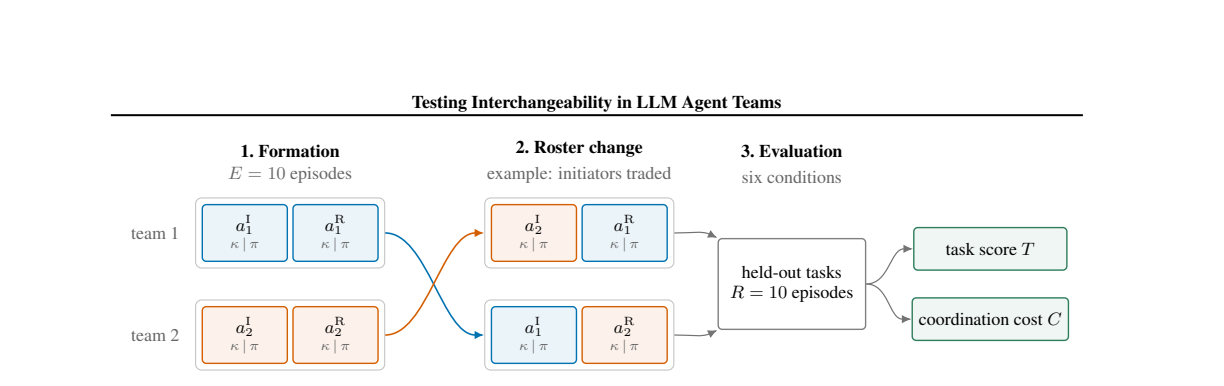
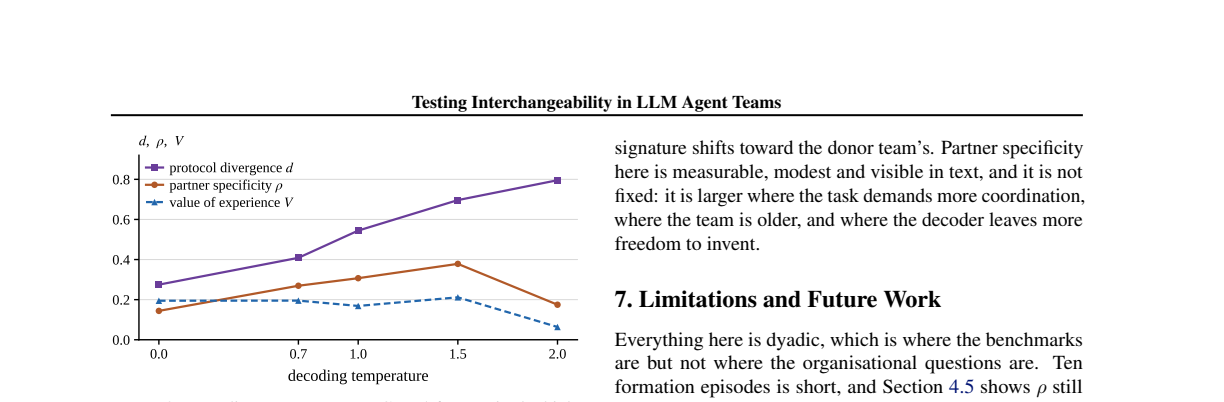
Eight teams per setting are formed independently from one base model on the same tasks, each agent keeping a private notebook across ten formation episodes; we then trade role-matched agents between teams and measure what changes on held-out tasks. Against a placebo that reproduces the disruption of a roster change without changing who occupies the seat, a swap costs little in task score but raises the communication a team spends per unit of progress by 16 to 63 percent, and in Hanabi a swapped agent is more expensive than an inexperienced one, consistent with interference from conventions learned with its former partner. In Collab-Overcooked, when the agent that sets the agenda is replaced, most of the extra communication comes from the agent that stayed. Three ablations, over base models, decoding temperature and formation length, move the swap penalty alongside one other quantity: how far independently formed teams drift apart. Greedy decoding lowers both; doubling a team's history raises both. In these settings, agents are more fungible in task outcome than in coordination efficiency, with larger swap effects after longer formation histories.
from the abstract
Pith says
Machine review · deepseek-v4-flash · 8 Sep 2026 · what was read was not recorded · not checked by a person
It can be wrong. Challenge this review or reply to it.
Holds up. Solid empirical paper: the swap test with placebo is a clean diagnostic, and the finding that coordination cost is more sensitive than task score is practically useful. This line is wrong
3 major objections · 7 minor
How often objections from reviews like this one are right: not yet measured
Not checked: figures, code, what the 33 references say.
The paper says, at §4.1, Table 2, Table 6
The review did not quote this passage.
Pith says: Objection 1 of 3 · major
The paper reports bootstrap intervals for the main settings' ρ values (0.14–0.21, 0.24–0.30, 0.41–0.47) but does not provide similar intervals for the ablation results in Table 6 or for ρ_C (the coordination-cost ratio). The ablations rely on only 3 swap pairs (6 teams) per configuration, and the claims about ordering (e.g., temperature 0.0 vs. 0.7, model rank) would be strengthened by explicit confidence intervals for ρ and V.
more of objection 1
Without them, the reader cannot assess whether the observed differences are within sampling noise. The paper should supply bootstrap intervals (or an equivalent uncertainty quantification) for every ratio it interprets, or at least state the spread explicitly for each cell.
The paper says, at §3.2, §7 (Limitations)
The review did not quote this passage.
Pith says: Objection 2 of 3 · major
The notebook-based decomposition (W, Σ) is used to argue that the swap penalty is localized in the partner notes, but the paper acknowledges that deleting a section also shortens context and that agents may file partner-specific material under task notes.
more of objection 2
The authors state that 'W and Σ would be cleaner against length-matched and neutral-text controls, which we did not run.' This is an honest limitation, but it means the localisation claims (e.g., 'W/Π = 0.81 in the high-coupling setting') are not as clean as the presentation suggests. The authors should either add such controls or add a stronger caveat that the notebook split is an approximation and that the observed W/Π and Σ values may partially reflect context-length effects.
The paper says, at Table 2, §4.2
The review did not quote this passage.
Pith says: Objection 3 of 3 · major
The claim that 'in Hanabi a swapped agent is more expensive than an inexperienced one' relies on ρ_C = 1.11. No confidence interval is given for ρ_C, and the bootstrap procedure is described only for the score-based metrics. Given that the sample size is 4 swap pairs, and that the coordination cost ratio is a quotient of two differences, the uncertainty around ρ_C = 1.11 could be large.
more of objection 3
The paper should compute and report a bootstrap interval for ρ_C, or at least state whether the value is significantly above 1.0. The same applies to the ρ_C values in the other settings (0.45, 0.72).
7 minor objections
The paper says, at §3.3, Table 2
Pith says: minor objection 1 of 7
The notation ρ_C is introduced in the text but the table header uses 'ρ C' without a clear subscript. Use a consistent notation (e.g., ρ_C or ρ^C) and define it explicitly in the caption.
The paper says, at §4.1, Figure 2
Pith says: minor objection 2 of 7
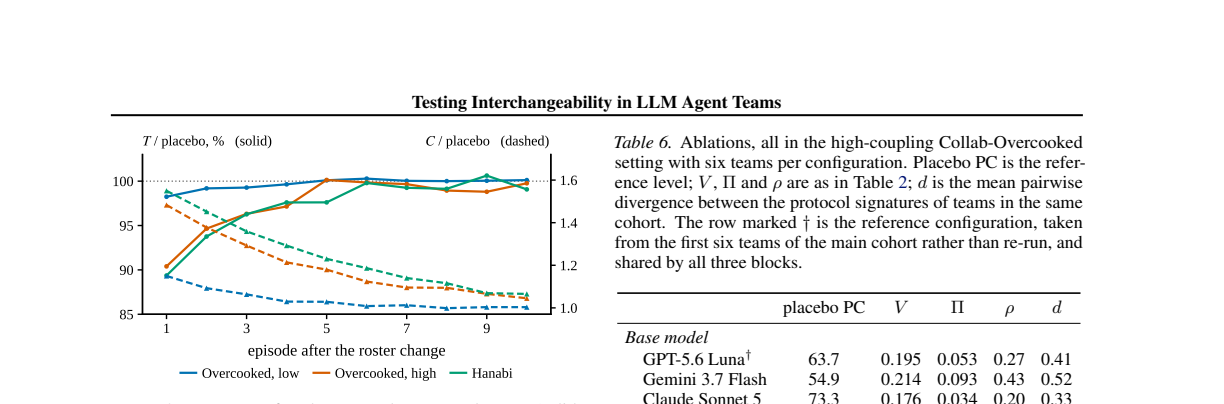
The figure uses solid lines for task score and dashed lines for coordination cost, but the lines are not directly labelled. The caption says 'solid, left axis' and 'dashed, right axis', which is helpful but could be improved by adding direct annotations or a legend inside the figure.
show 5 more
The paper says, at §4.2, Table 3
Pith says: minor objection 3 of 7
The four categories of extra messages sum to 99% for the low-coupling setting (33+25+23+18=99). Either round the numbers or add a note that the sum is 99 due to rounding. The same applies to the high-coupling row (100% is fine).
The paper says, at §4.1, 'Protocol signatures'
Pith says: minor objection 4 of 7
The extraction rules for protocol signatures are described as 'rule-based and automatic', but the description is brief. It would be helpful to add a few sentences about how the hand-off templates, field order, aliases, and Hanabi hint–action mapping are extracted, and whether the rules are publicly available. This would improve reproducibility.
The paper says, at §4.5, 'Ablations'
Pith says: minor objection 5 of 7
The ablation table (Table 6) does not show the number of swap pairs (3, since teams are 6). The reader must infer that there are 3 pairs. State this explicitly in the caption or the text. Also, the reference row (†) is 'taken from the first six teams of the main cohort'—clarify that these six teams are a subset of the eight, and whether the swap pairs are the same three pairs.
The paper says, at §7 (Limitations)
Pith says: minor objection 6 of 7
The limitations section is thorough, but it does not mention the small sample size as a limitation for the ablation comparisons. The ablations use 6 teams (3 pairs), which is even smaller than the main study. Add a brief note that the ablation results are exploratory and that the confidence intervals around the reported ρ values are correspondingly wide.
The paper says, at §4.2, 'What the extra messages are'
Pith says: minor objection 7 of 7
The coding of extra messages is described qualitatively. It would be useful to state how many messages were coded and whether the coding was done by a single author or with inter-rater reliability. This is a minor point, but it affects the reader's confidence in the categorization.
What would settle it
Replicate the high-coupling Collab-Overcooked experiment with 16 teams (8 swap pairs) instead of 8, holding all other settings (GPT-5.6 Luna, temperature 0.7, E=10) fixed. If the swap penalty in coordination cost remains in the range +40–60% with tighter 95% bootstrap intervals, the primary claim is robust to small-sample concerns.
from the skeptic's reading
How the review went
4 readings by deepseek-v4-flash · 8 Sep 2026
- Reader holds up
- Skeptic disagrees
- Editor wrote the verdict above
- Referee minor revision: 3 major objections, 7 minor
Not run on this paper: the simulated authors' defence.
Pith did not check this review's objections against the paper.
The review in full
The review in brief, machine-written
The main thing to know about this paper is that it gives production teams a cheap diagnostic (the swap test) and a clear result: rotating agents costs little in task score but raises coordination cost by 16–63%, and that gap widens with coupling, temperature, and team age. The placebo control is the key design choice—without it, the disruption of any roster change would be conflated with the identity of the person. The decomposition into ρ (partner-specific residue) is sensible, and the ablations (model, temperature, formation length) are informative even if the sample is small.
What the paper does well: the experimental design is careful. The six-condition fork avoids order effects. The metrics (task score and coordination cost) are separated, and the recovery curves show that cost recovers more slowly than score—a practical point for anyone monitoring agent teams. The limitations section is honest about the small sample (4 swap pairs), the approximate notebook split, and the observational coupling gradient. The protocol signature analysis and the seat-targeted swaps add texture.
Soft spots: the sample is genuinely small—bootstrap intervals on ρ are coarse, and the ordering of settings is plausible but not tight. The notebook split is approximate: deleting a section also shortens context, and agents may file partner-specific material under task notes. The coupling gradient is observational (task complexity rises with coupling), so the paper cannot separate coupling from difficulty. The ρ–d correlation is exploratory (8 points, 4 from one manipulation). None of these undermine the central qualitative finding, but they limit precision.
Who this is for: system designers deploying LLM agent teams, and researchers studying multi-agent coordination. The paper is a solid empirical contribution that deserves a serious referee. I would accept it with minor revisions—perhaps a request for a larger cohort or a length-matched control for the notebook deletion, but neither is load-bearing.
Recommendation: send to peer review. The paper is honest, the design is sound, and the results are actionable.
The strongest objection
The paper's central claim—that swapping role-matched agents between teams costs little in task score but raises coordination cost (16–63%), and that this effect reflects partner-specific conventions—is supported by a well-designed placebo-controlled swap design. The main evidence (the swap vs. placebo comparison) does not depend on the notebook-split approximation, since the split is used only for subsidiary analyses (Amnesia, Swap-cleared) that localise the residue but are not required for the primary conclusion. The acknowledged small sample (4 independent swap pairs per setting) is mitigated by consistent replication across three benchmarks and across ablations; the reported bootstrap intervals, though coarse, support the ordering of effects. The paper's own limitations discussion (Section 7) identifies the notebook-split precision and small sample honestly, and neither undermines the robustness of the qualitative finding that swaps impair coordination efficiency more than task outcome. I therefore find no load-bearing concern that would change the verdict.
The reader identified the notebook-split approximation (κ/π) as the weakest assumption. While this is a genuine limitation for the localisation analyses (W/Π, Σ), the central swap-vs-placebo comparison that establishes the headline effect does not rely on that split. The swap condition simply exchanges notebooks; the placebo controls for roster-change disruption. The quantitative decomposition (ρ) uses only placebo, swap, and naive conditions, which are unaffected by how agents organise their notes. Thus, even if agents frequently mis-file partner-specific material under task notes, the measured swap penalty still captures the cost of replacing an agent with an equally experienced stranger—the paper's core result. The reader's concern, while valid, is therefore not load-bearing for the primary claim. I therefore disagree that it is the most critical weak point. The stress-test reveals no fundamental flaw; the paper's evidence supports its conclusions within its stated scope. The verdict should remain ACCEPT (UNCHANGED).
The referee's report
The paper addresses a timely and practical question: can LLM agents filling a role be freely swapped without performance loss? The design is rigorous, combining a placebo control, multiple benchmarks (Collab-Overcooked low and high coupling, Hanabi), and a decomposition of team history into portability and partner-specific components. The main finding—that task score is largely unaffected while coordination cost rises substantially—is a valuable insight for deploying multi-agent systems, where dashboards often track only success rate. The swap test itself is a reusable diagnostic. The ablations (model, temperature, formation length) provide preliminary evidence that partner specificity correlates with protocol divergence, suggesting that the effect is not an artifact of a single setting. The paper is likely to influence both research and engineering of LLM-based multi-agent teams.
Pith's reading of the paper (a machine's summary, not the authors')
The paper tests whether agent replacement in multi-agent LLM systems is truly interchangeable, as commonly assumed in production deployments. It introduces a swap test with a placebo control to separate generic task experience from partner-specific knowledge. Across three coordination benchmarks (Collab-Overcooked variants and Hanabi), swapping role-matched agents leaves task scores nearly unchanged but raises coordination cost—messages per unit of progress—by 16 to 63 percent. In Hanabi, a swapped agent is more expensive than an inexperienced one. The findings imply that monitoring only task success can mask coordination inefficiencies after roster changes.
What carries the argument. A swap test with a placebo control, where role-matched agents from independently formed teams trade places, and a partitioned notebook that splits learned knowledge into task notes (kappa) and partner notes (pi). The ratio ρ = Π/V quantifies the share of experience that is partner-specific, and the same ratio on coordination cost (ρ_C) reveals a larger effect than on task score.
Core claim. LLM agent teams that form together develop partner-specific conventions stored in private notebooks, and these conventions are largely invisible to task-score metrics but costly in communication efficiency. The partner-specific residue is modest: it stays below half the value of generic experience in most settings. It grows with task coupling, team age, and decoding temperature. The penalty concentrates in the initiating seat, and the additional communication is predominantly emitted by the agent that stayed.
The premise it rests on. The paper assumes that the split between task notes (κ) and partner notes (π) cleanly separates partner-specific knowledge, but agents may file partner-specific information under task notes, and deleting a section also shortens the context, making the localization approximate.
If the paper is right (Pith's inferences, not the authors')
Production multi-agent systems that measure only task success will miss coordination inefficiencies after agent swaps; a swap test is a lightweight complement to competence checks.
Clearing partner-specific notes (pi) from an arriving agent reduces the swap penalty, suggesting a simple intervention for reducing coordination cost.
The swap penalty grows with team history (formation length), so long-lived teams may require more careful handover procedures.
Greedy decoding reduces both team drift and swap penalty, offering a cheap lever to improve interchangeability without task score loss.
The study implies that transactive memory—knowledge about who knows what—arises naturally in LLM agent teams even with short histories, echoing human team dynamics.
If the swap penalty scales with number of agents (beyond dyads), larger teams may need coordination mechanisms beyond notebook partitioning to remain interchangeable.
The correlation between protocol divergence d and penalty ρ suggests that measuring inter-team alignment could predict swap costs, enabling proactive roster planning.
Check this review
Pith stored no record of this review's passes and took no fingerprint of it. Reviews made by code from 13 Nov 2026 on carry both.
How often reviews like this one are right
Reviews like this one: written by deepseek-v4-flash, where what was read was not recorded.
How often objections from reviews like this one are right: not yet measured
Reviews by people
This review was written by a machine. No person has reviewed this paper on Pith yet. A scientist listed on Pith can review it for a fee, and their review is published here whatever it concludes.
The paper
Abstract
Production multi-agent systems replace agents constantly, on the assumption that an agent filling a role is interchangeable with any other agent that can do the job. We test that assumption. Eight teams per setting are formed independently from one base model on the same tasks, each agent keeping a private notebook across ten formation episodes; we then trade role-matched agents between teams and measure what changes on held-out tasks. Against a placebo that reproduces the disruption of a roster change without changing who occupies the seat, a swap costs little in task score but raises the communication a team spends per unit of progress by 16 to 63 percent, and in Hanabi a swapped agent is more expensive than an inexperienced one, consistent with interference from conventions learned with its former partner. In Collab-Overcooked, when the agent that sets the agenda is replaced, most of the extra communication comes from the agent that stayed. Three ablations, over base models, decoding temperature and formation length, move the swap penalty alongside one other quantity: how far independently formed teams drift apart. Greedy decoding lowers both; doubling a team's history raises both. In these settings, agents are more fungible in task outcome than in coordination efficiency, with larger swap effects after longer formation histories.
The paper's own sentences, arranged, kept beside the review and separate from it. Each label is drawn from a closed vocabulary; the number beside it is the probability the classifier gave that label. No sentence in this record was written by a model.
abstract compiled · 2026-09-23
The authors' main claim, as the classifier picked it out 1.00
“In these settings, agents are more fungible in task outcome than in coordination efficiency, with larger swap effects after longer formation histories.”
How the main claim is stated: asserted 1.00
What the abstract itself states, as probabilities: claims first 0.04 · states limitation 0.42 · human participants 0.04 · controlled comparison 0.97 · randomized assignment 0.14 · states quantitative result 0.98 · compares with prior results 0.90 · mentions code or data availability 0.03
The abstract, sentence by sentence
This table labels the abstract only (arXiv listing abstract v1). The number is the probability the classifier gave the label.
| Sentence | Role | The authors' own work | States the main conclusion | Strength |
|---|---|---|---|---|
| Production multi-agent systems replace agents constantly, on the assumption that an agent filling a role is interchangeable with any other agent that can do the job. We test that assumption. | background 0.82 | 0.21 | 0.05 | asserted 0.99 |
| Eight teams per setting are formed independently from one base model on the same tasks, each agent keeping a private notebook across ten formation episodes; we then trade role-matched agents between teams and measure what changes on held-out tasks. | method 0.99 | 0.95 | 0.03 | asserted 0.90 |
| Against a placebo that reproduces the disruption of a roster change without changing who occupies the seat, a swap costs little in task score but raises the communication a team spends per unit of progress by 16 to 63 percent, and in Hanabi a swapped agent is more expensive than an inexperienced one, consistent with interference from conventions learned with its former partner. | result 1.00 | 0.96 | 0.31 | asserted 0.86 |
| In Collab-Overcooked, when the agent that sets the agenda is replaced, most of the extra communication comes from the agent that stayed. | result 1.00 | 0.94 | 0.06 | asserted 1.00 |
| Three ablations, over base models, decoding temperature and formation length, move the swap penalty alongside one other quantity: how far independently formed teams drift apart. | result 0.55 | 0.95 | 0.07 | asserted 1.00 |
| Greedy decoding lowers both; doubling a team's history raises both. | result 1.00 | 0.93 | 0.06 | asserted 1.00 |
| In these settings, agents are more fungible in task outcome than in coordination efficiency, with larger swap effects after longer formation histories. | interpretation 0.86 | 0.94 | 0.86 | asserted 1.00 |
What kind of paper the classifier reports this is: empirical study 0.98 · evidence from observation or experiment 0.96
What was examined, and what was not
Sources read
- arXiv listing abstract v1
Not examined
- full text
- figures and tables
- references and citing sentences
- relations to other papers
Levels run
- P abstract
Not run
- S sections
- T body sentences
- C citations
- R cross-paper relations
How the labels were made
Compiled by classifier-1.13.0 via TypeSafe API, question bank abstract-p1-20260923, 2026-09-23: 1 request, 5,687 input tokens.
Every quoted sentence on this record is the authors'. Every label is from Pith's closed vocabulary, with the probability shown beside it. This record as JSON
Figures (3)
Figures are the authors', reproduced from the paper.
References (33)
- [1] Agashe, S., Fan, Y., Reyna, A., and Wang, X. E. LLM-Coordination : Evaluating and analyzing multi-agent coordination abilities in large language models. In Findings of the Association for Computational Linguistics: NAACL 2025, pp.\ 8053--8072, 2025 on Pith
- [2] Ashery, A. F., Aiello, L. M., and Baronchelli, A. Emergent social conventions and collective bias in LLM populations. Science Advances, 11 0 (20): 0 eadu9368, 2025 on Pith
- [3] Bard, N., Foerster, J. N., Chandar, S., Burch, N., Lanctot, M., Song, H. F., Parisotto, E., Dumoulin, V., Moitra, S., Hughes, E., Dunning, I., Mourad, S., Larochelle, H., Bellemare, M. G., and Bowling, M. The Hanabi challenge: A new frontier for AI research. Artificial Intelli... on Pith
- [4] Carroll, M., Shah, R., Ho, M. K., Griffiths, T. L., Seshia, S. A., Abbeel, P., and Dragan, A. On the utility of learning about humans for human- AI coordination. In Advances in Neural Information Processing Systems (NeurIPS), 2019 on Pith
- [5] Cemri, M., Pan, M. Z., Yang, S., Agrawal, L. A., Chopra, B., Tiwari, R., Keutzer, K., Parameswaran, A., Klein, D., Ramchandran, K., Zaharia, M., Gonzalez, J. E., and Stoica, I. Why do multi-agent LLM systems fail? In Advances in Neural Information Processing Systems (NeurIPS),... on Pith
- [6] Chen, H., Song, X., Jin, J., Ren, P., and Zhang, L.-J. Toward an organizational science of multi-agent LLM systems: Decoupling who, how, and which algorithm. arXiv preprint arXiv:2607.25446, 2026 on PithPith's reviewarXiv
- [7] Clark, H. H. and Wilkes-Gibbs, D. Referring as a collaborative process. Cognition, 22 0 (1): 0 1--39, 1986 on Pith
- [8] Espinosa, J. A., Slaughter, S. A., Kraut, R. E., and Herbsleb, J. D. Familiarity, complexity, and team performance in geographically distributed software development. Organization Science, 18 0 (4): 0 613--630, 2007 on Pith
- [9] Goel, H., Ellendula, A. S., Tadiparthi, V., Moradi Pari, E., Nourkhiz Mahjoub, H., and Chinchali, S. P. Bayesian partner modelling enables adaptive replanning for LLM coordination. arXiv preprint arXiv:2608.18490, 2026 on PithPith's reviewarXiv
- [10] Hong, S., Zhuge, M., Chen, J., Zheng, X., Cheng, Y., Wang, J., Zhang, C., Wang, Z., Yau, S. K. S., Lin, Z., Zhou, L., Ran, C., Xiao, L., Wu, C., and Schmidhuber, J. MetaGPT : Meta programming for a multi-agent collaborative framework. In International Conference on Learning Re... on Pith
- [11] Hu, H., Lerer, A., Peysakhovich, A., and Foerster, J. ``other-play'' for zero-shot coordination. In Proceedings of the 37th International Conference on Machine Learning (ICML), pp.\ 4399--4410, 2020 on Pith
- [12] Hu, H., Lerer, A., Cui, B., Pineau, J., and Foerster, J. Off-belief learning. In Proceedings of the 38th International Conference on Machine Learning (ICML), pp.\ 4369--4379, 2021 on Pith
- [13] Huckman, R. S., Staats, B. R., and Upton, D. M. Team familiarity, role experience, and performance: Evidence from Indian software services. Management Science, 55 0 (1): 0 85--100, 2009 on Pith
- [14] Ko, T.-W. and Geiping, J. Attractor states emerge in multi-turn LLM conversations. arXiv preprint arXiv:2606.30571, 2026 on PithPith's reviewarXiv
- [15] Lewis, D. Convention: A Philosophical Study. Harvard University Press, Cambridge, MA, 1969 on Pith
- [16] Lewis, K. Measuring transactive memory systems in the field: Scale development and validation. Journal of Applied Psychology, 88 0 (4): 0 587--604, 2003 on Pith
- [17] Mirsky, R., Carlucho, I., Rahman, A., Fosong, E., Macke, W., Sridharan, M., Stone, P., and Albrecht, S. V. A survey of ad hoc teamwork research. In Proceedings of the 19th European Conference on Multi-Agent Systems (EUMAS), pp.\ 275--293, 2022 on Pith
- [18] Park, J. S., O'Brien, J. C., Cai, C. J., Morris, M. R., Liang, P., and Bernstein, M. S. Generative agents: Interactive simulacra of human behavior. In Proceedings of the 36th Annual ACM Symposium on User Interface Software and Technology (UIST), 2023 on Pith
- [19] Qian, C., Liu, W., Liu, H., Chen, N., Dang, Y., Li, J., Yang, C., Chen, W., Su, Y., Cong, X., Xu, J., Li, D., Liu, Z., and Sun, M. ChatDev : Communicative agents for software development. In Proceedings of the 62nd Annual Meeting of the Association for Computational Linguistic... on Pith
- [20] Ramesh, M., Jayakumar, K., Ramkumar, A., Thodima, P., Rege, A., and Vlatakis-Gkaragkounis, E.-V. Sparks of cooperative reasoning: LLM s as strategic Hanabi agents. In Proceedings of the 43rd International Conference on Machine Learning (ICML), 2026 on Pith
show 13 more
- [21] Reagans, R., Argote, L., and Brooks, D. Individual experience and experience working together: Predicting learning rates from knowing who knows what and knowing how to work together. Management Science, 51 0 (6): 0 869--881, 2005 on Pith
- [22] Riedl, C. Emergent coordination in multi-agent language models. In International Conference on Learning Representations (ICLR), 2026 on Pith
- [23] Shih, A., Sawhney, A., Kondic, J., Ermon, S., and Sadigh, D. On the critical role of conventions in adaptive human- AI collaboration. In International Conference on Learning Representations (ICLR), 2021 on Pith
- [24] Stone, P., Kaminka, G. A., Kraus, S., and Rosenschein, J. S. Ad hoc autonomous agent teams: Collaboration without pre-coordination. In Proceedings of the 24th AAAI Conference on Artificial Intelligence (AAAI), pp.\ 1504--1509, 2010 on Pith
- [25] Strouse, D., McKee, K. R., Botvinick, M., Hughes, E., and Everett, R. Collaborating with humans without human data. In Advances in Neural Information Processing Systems (NeurIPS), 2021 on Pith
- [26] Sun, H., Zhang, S., Niu, L., Ren, L., Xu, H., Fu, H., Zhao, F., Yuan, C., and Wang, X. Collab-Overcooked : Benchmarking and evaluating large language models as collaborative agents. In Proceedings of the 2025 Conference on Empirical Methods in Natural Language Processing (EMNL... on Pith
- [27] Treutlein, J., Dennis, M., Oesterheld, C., and Foerster, J. A new formalism, method and open issues for zero-shot coordination. In Proceedings of the 38th International Conference on Machine Learning (ICML), pp.\ 10413--10423, 2021 on Pith
- [28] Wang, P.-Y. A., Mishra, C., \"O zy \"u rek, A., Rubio-Fern \'a ndez, P., and Ghaleb, E. Aligned but not partner-specific: Distinguishing how multimodal LLM agents succeed in reference games without human-like conventions. arXiv preprint arXiv:2606.08081, 2026 on PithPith's reviewarXiv
- [29] Weckbecker, M., M \"u ller, J., Hagag, B., and Mulet, M. Thought virus: Viral misalignment via subliminal prompting in multi-agent systems. arXiv preprint arXiv:2603.00131, 2026 on PitharXiv
- [30] Wegner, D. M. Transactive memory: A contemporary analysis of the group mind. In Theories of Group Behavior, pp.\ 185--208. Springer, 1987 on Pith
- [31] Wu, Q., Bansal, G., Zhang, J., Wu, Y., Li, B., Zhu, E., Jiang, L., Zhang, X., Zhang, S., Liu, J., Awadallah, A. H., White, R. W., Burger, D., and Wang, C. AutoGen : Enabling next-gen LLM applications via multi-agent conversations. In Conference on Language Modeling (COLM), 2024 on Pith
- [32] Xu, W., Liang, Z., Mei, K., Gao, H., Tan, J., and Zhang, Y. A-mem: Agentic memory for LLM agents. arXiv preprint arXiv:2502.12110, 2025 on PithPith's reviewarXiv
- [33] Zhu, K., Du, H., Hong, Z., Yang, X., Guo, S., Wang, Z., Wang, Z., Qian, C., Tang, X., Ji, H., and You, J. MultiAgentBench : Evaluating the collaboration and competition of LLM agents. In Proceedings of the 63rd Annual Meeting of the Association for Computational Linguistics (A... on Pith
Cited by 2 Pith papers
Reviewed papers on Pith that cite this one. The full citation record
Challenges and discussion
Disagree with the review, or know something it missed? Leave a comment, or challenge this review formally: a challenge becomes a permanent entry in this paper's record, and its decision is published here.
Come back by email
A short list of the week's newly reviewed papers. Nothing is sent until you confirm from your inbox, and every email has a link that stops it. No account.
No comments yet.
Sign in to comment