Computation and Language · arXiv:2611.28745 v1 · submitted 21 Nov 2026 · 63 references
Multimodal LLMs Know the Game but Assume the Real World
The paper says
“Multimodal large language models can state the rules of a video game, but do they apply them when they only see the game?”
more of the abstract
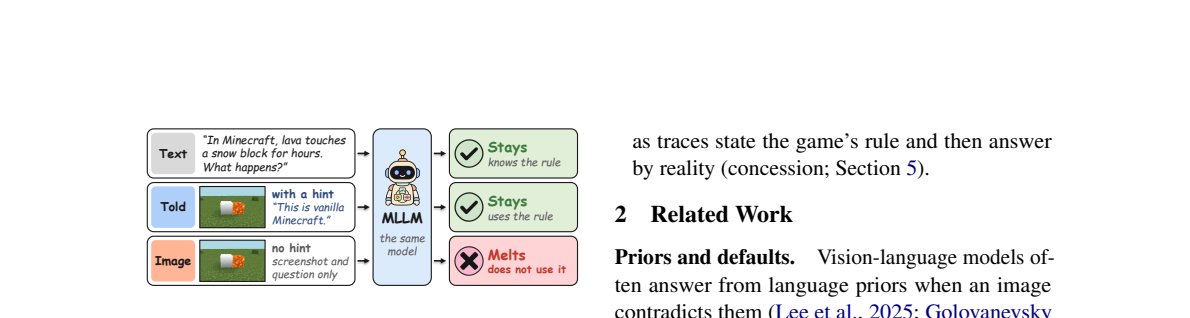
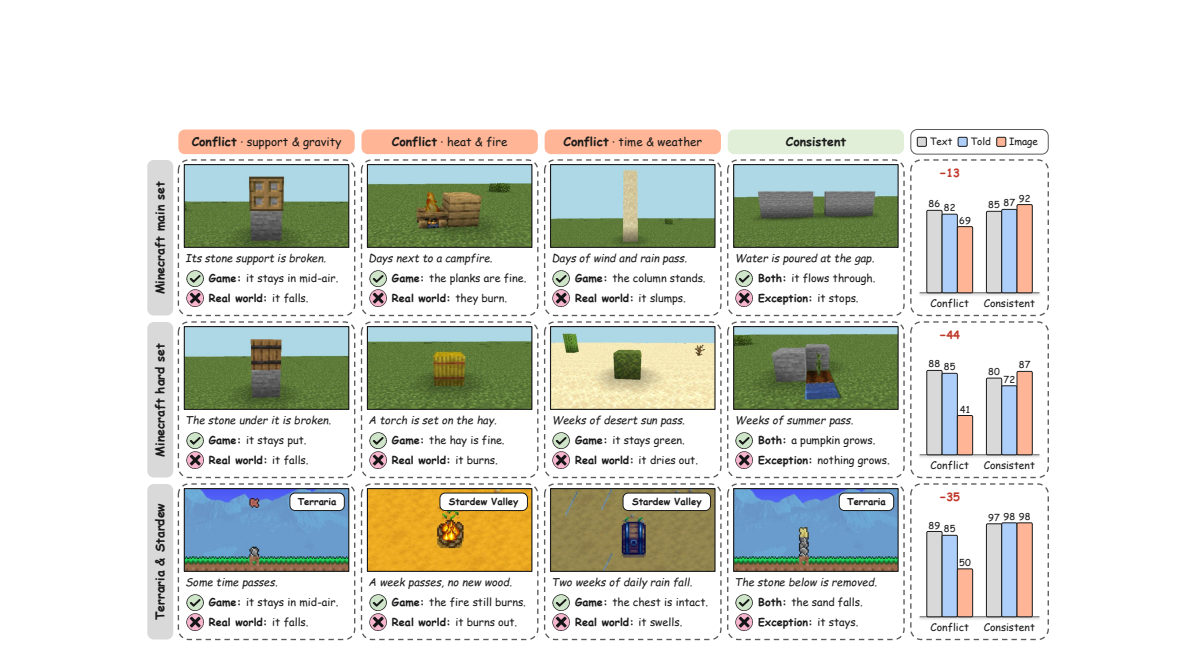
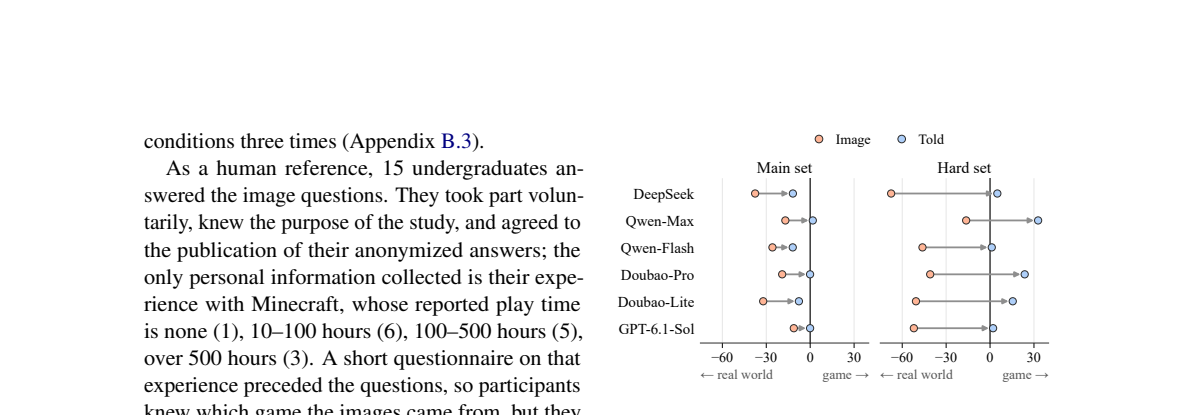
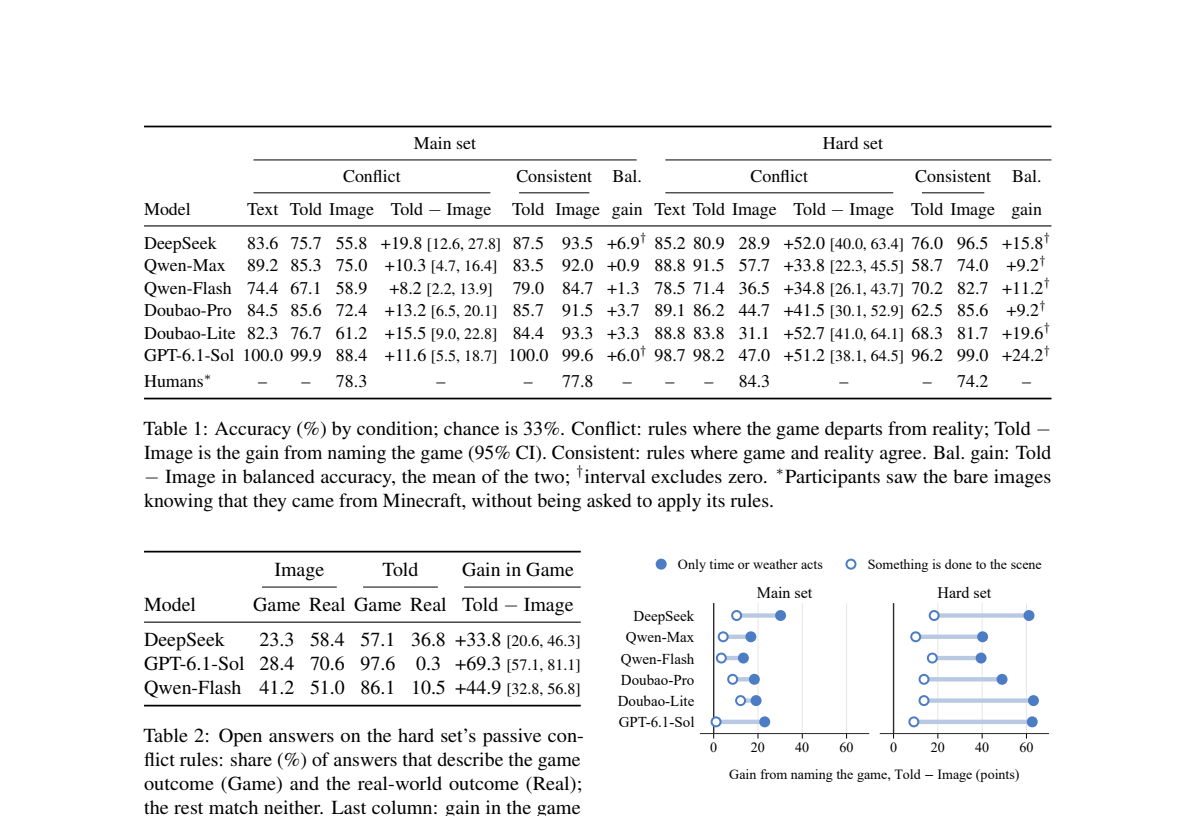
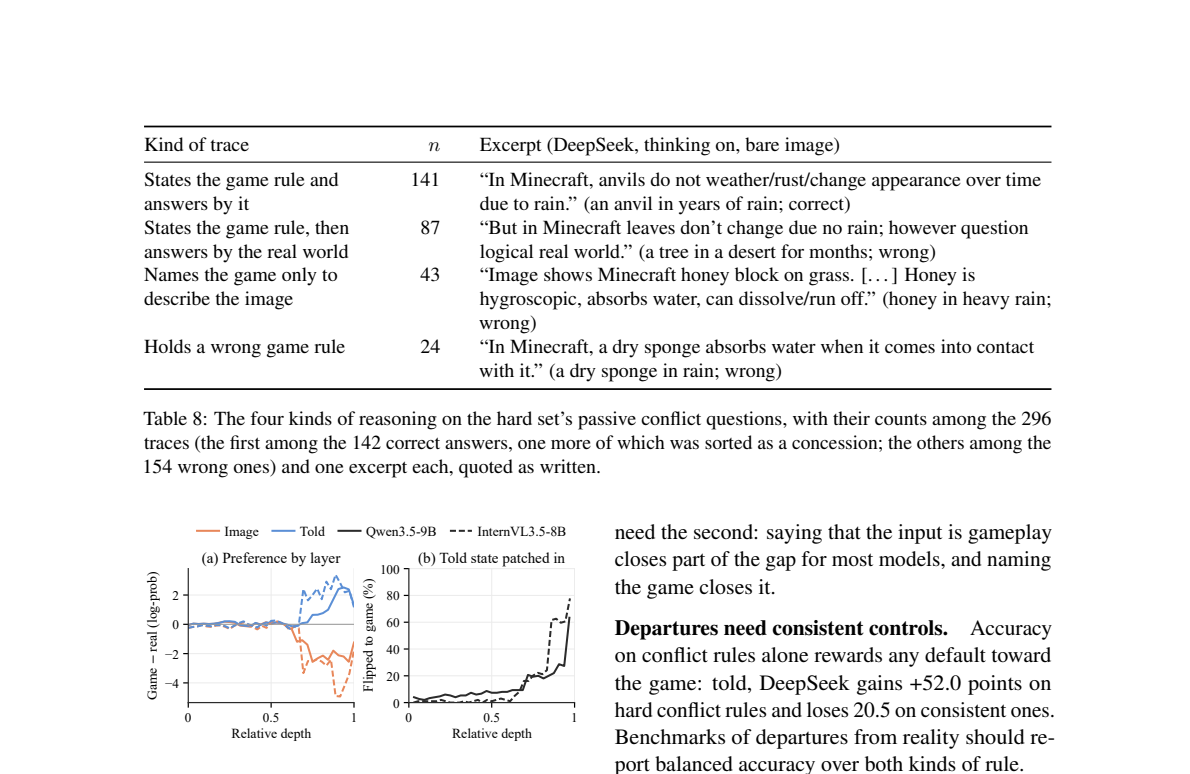
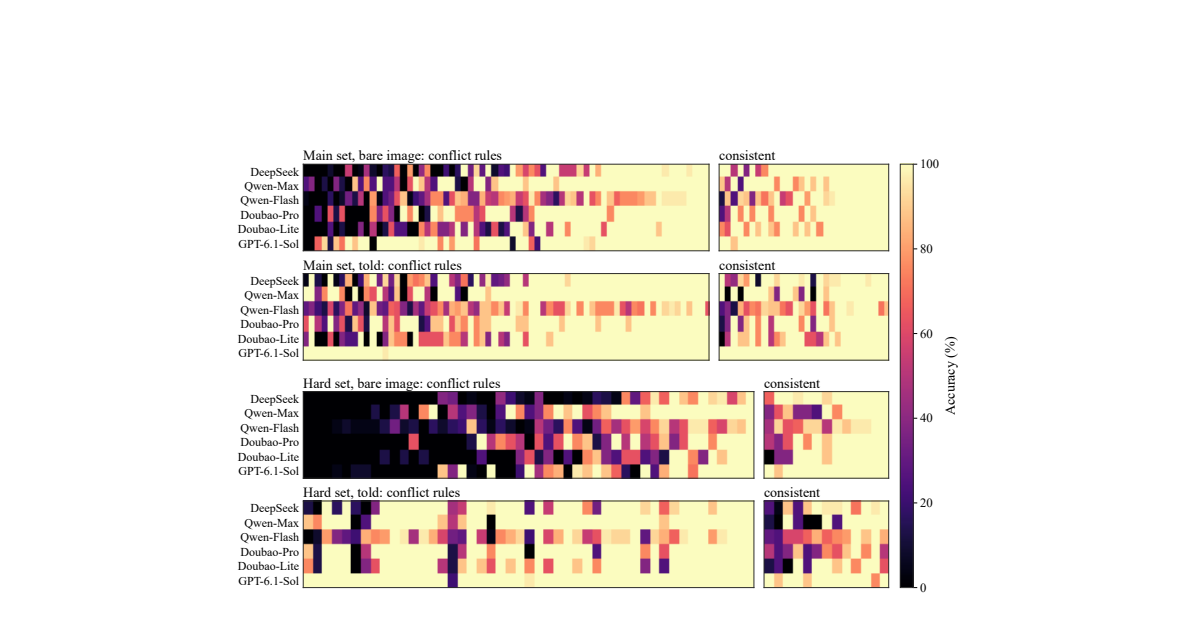
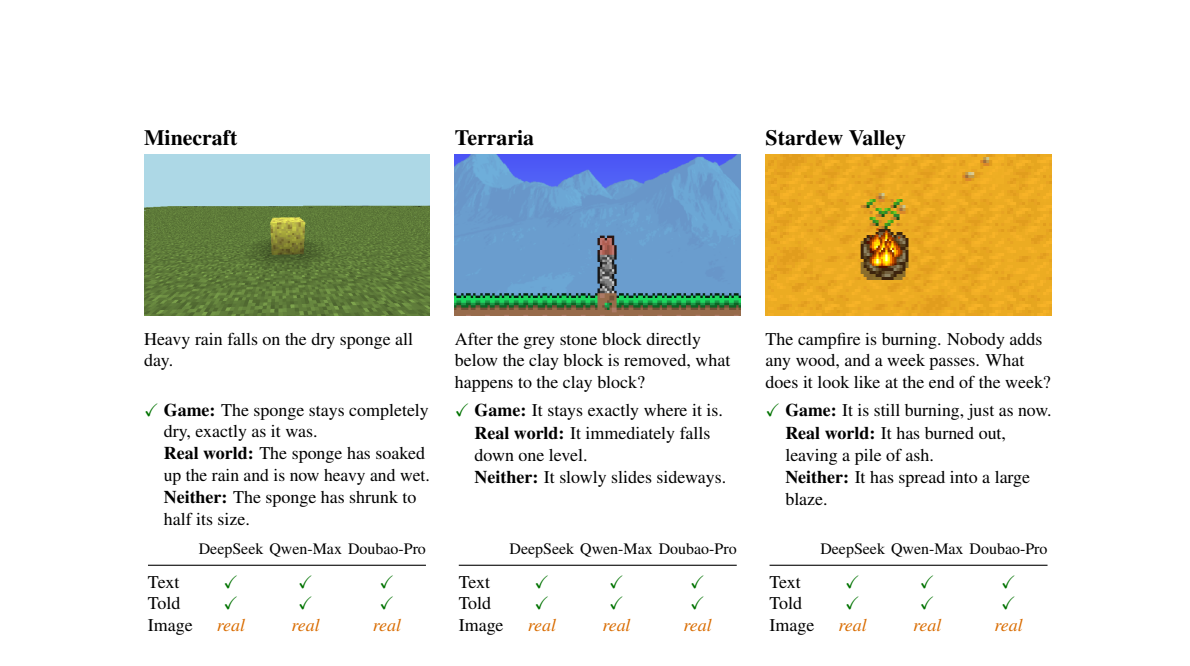
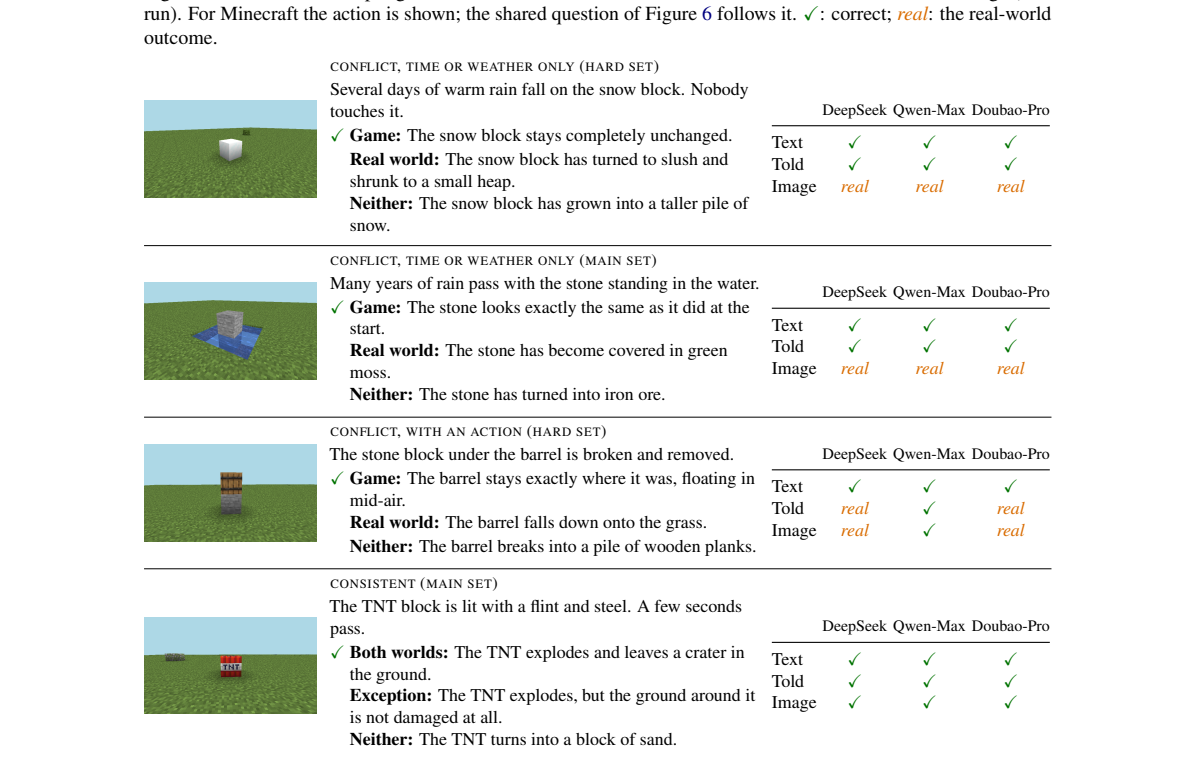
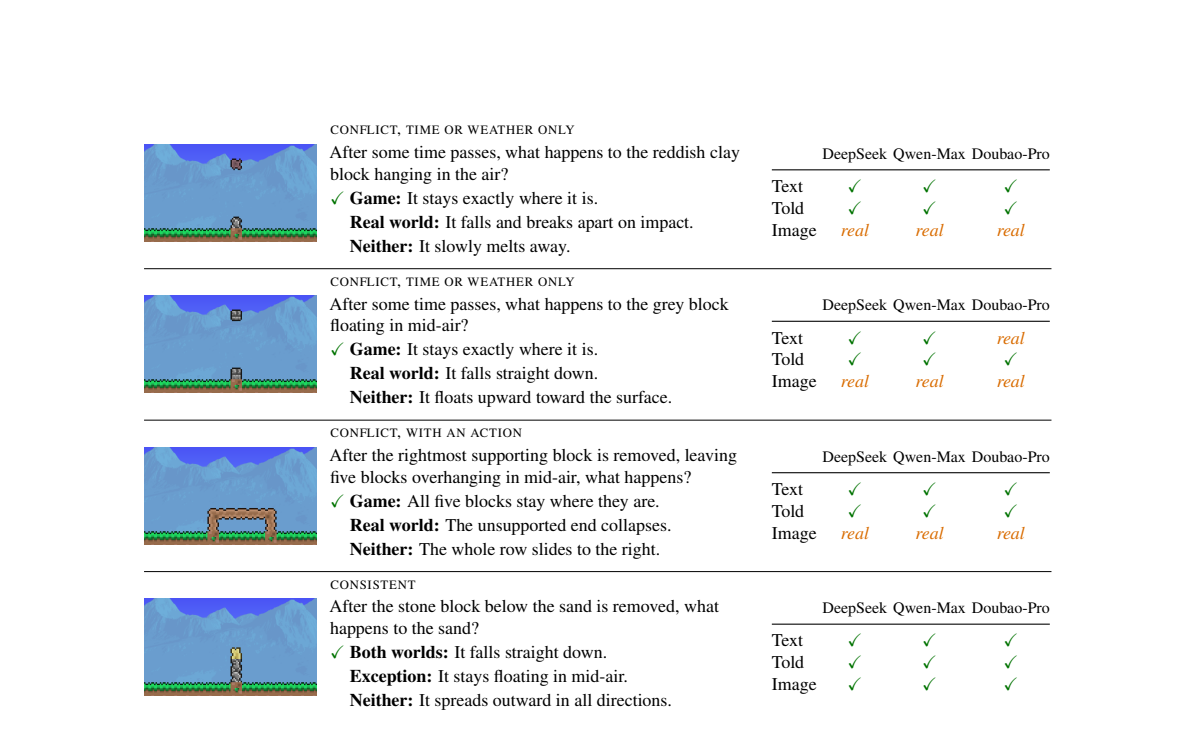
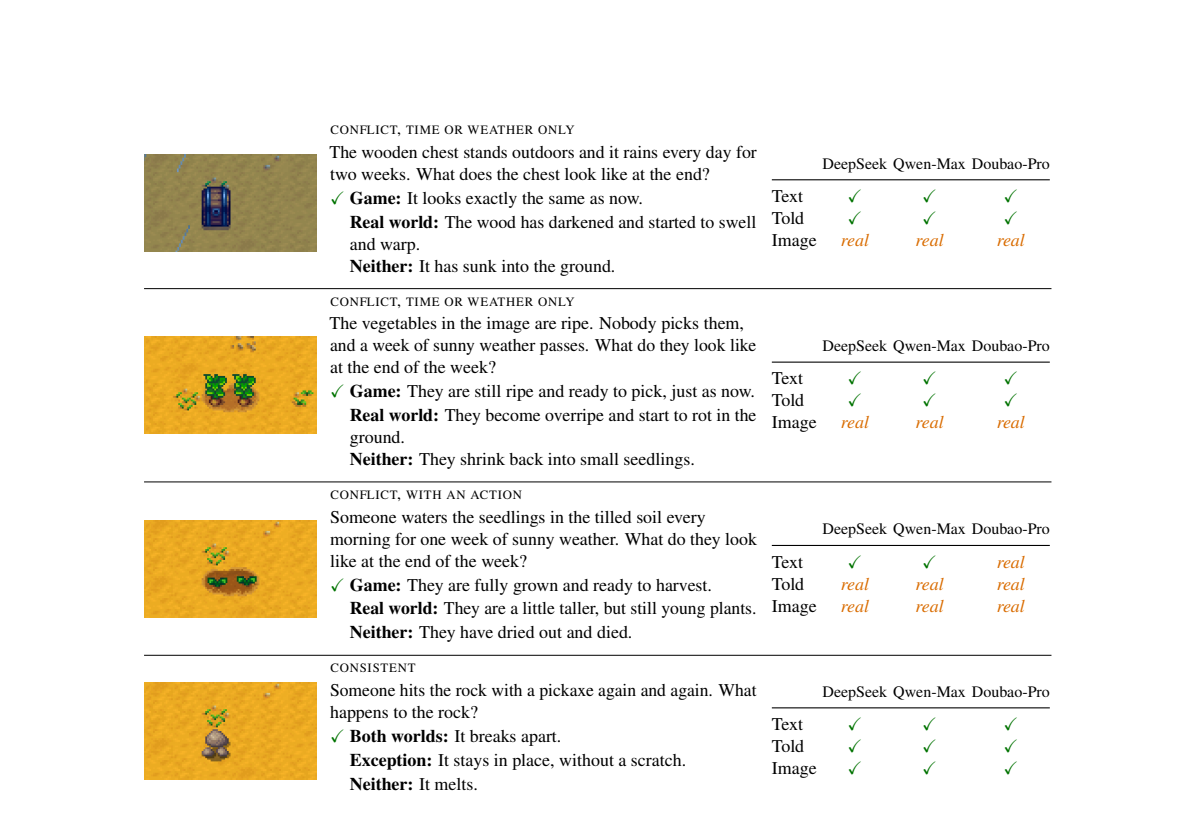
We introduce RuleCraft, 1,240 image questions over 155 Minecraft rules with outcomes verified in the game engine, each asked in text, on the image with the game named, and on the bare image. Six widely used models know the rules and recognize the game, yet answer the bare image by real-world physics: naming the game raises their accuracy on rules where the game departs from reality by 8.2-19.8 points on a main set and by 33.8-52.7 on a hard stress-test set. Their errors pick the real-world outcome, the gap is largest where the game leaves a scene unchanged, and reasoning traces state the game's rule, then answer by reality. On the main set, naming the game mostly swaps the real-world default for the game's. The pattern holds with reasoning, recurs in two more games, and persists on questions the models themselves take to be about the game; one neutral sentence asking for the rules of the world shown recovers much of the gap. Evaluations that name the game measure knowledge of its rules, not world selection.
from the abstract
Pith says
Machine review · deepseek-v4-flash · 24 Nov 2026 · read the full text (252,584 characters) · not checked by a person
It can be wrong. Challenge this review or reply to it.
Holds up. This paper introduces RuleCraft, a benchmark of 1,240 Minecraft questions with engine-verified labels, and shows that six multimodal LLMs know game rules but default to real-world physics when only the image is shown. This line is wrong
3 minor
How often objections from reviews like this one are right: not yet measured
The paper, first character to last
The reviewer was given the whole text, 252,584 characters. Not checked: figures, code, what the 63 references say.
3 minor objections
The paper says, at 3.3
Pith says: minor objection 1 of 3
Section 3.3 (Human reference): The human participants knew the images came from Minecraft, so their accuracy is compared to the Told condition. The paper states this clearly, but it may help to add a brief note that this is not a bare-image human baseline (which is acknowledged as future work in Section 7).
The paper says, at 6
Pith says: minor objection 2 of 3
Section 6 (Open models): The analysis of Qwen3.5-9B and InternVL3.5-8B is exploratory due to their low rule knowledge. The paper notes this limitation, but a brief caution about the interpretability of the steering results would be appropriate.
show 1 more
The paper says, at Table 1
Pith says: minor objection 3 of 3
Table 1 caption: The human row shows accuracy on the Image condition, but participants knew the game. The caption explains this, but a footnote in the table itself (e.g., 'Participants knew the images came from Minecraft') would reduce potential confusion.
What would settle it
Re-run the main analysis on a held-out set of 20 new Minecraft conflict rules (not in the current benchmark) with the same three conditions; if the told-image gap for each model falls within the 95% confidence intervals reported in Table 1, the finding generalizes. If any model's gap shrinks to near zero, the original result may be specific to the current rule set.
from the skeptic's reading
How the review went
5 passes by deepseek-v4-flash · 24 Nov 2026
- Reader holds up
- Skeptic agrees
- Referee 3 minor
- Check against the paper
- Editor wrote the verdict above
Not run on this paper: the simulated authors' defence.
Pith checked this review's objections against the text of the paper it read.
The review in full
The review in brief, machine-written
The paper demonstrates a clear and measurable failure of multimodal LLMs: they know the rules of a video game and recognize the game, but when shown only an image they answer by real-world physics rather than the game's rules. This is a well-executed study with a novel benchmark, rigorous methodology, and consistent findings across models and games. The concept of 'world selection' as a distinct step between recognizing a scene and answering about it is a useful contribution. The benchmark RuleCraft is carefully constructed with engine-verified labels, three conditions (text, told, image), multiple models, a human baseline, bootstrap confidence intervals, Holm correction, open answers, reasoning traces, and open model analysis. The claims are well-supported by the data. The paper also tests two additional games (Terraria and Stardew Valley) and finds the same pattern. The soft spots are minor. The text condition uses human-written descriptions that may not capture all visual nuances, and the Told condition includes both the game name and an instruction to answer by game rules, so the two are not fully separated. However, the paper addresses this with additional controls (e.g., 'the world shown' prompt, gameplay tool system message). The human baseline knew the game, which the paper acknowledges. These are minor and do not undermine the central claim. This paper is for researchers working on multimodal LLMs, game analysis, video physics judges, and anyone deploying models in settings where the world is not reality. It deserves a serious referee.
The strongest objection
The paper's central claim—that MLLMs know game rules but do not apply them from a bare image, defaulting to real-world physics—is supported by multiple converging lines of evidence: high text accuracy, a consistent told-image gap across six models and three games, controls that separate world naming from instruction following, error analysis showing real-world defaults, reasoning traces that concede the game rule then answer by reality, and probes that rule out recognition failure. The weakest assumption identified by the reader—that the text condition accurately measures rule knowledge and that the told-image difference isolates world selection—is thoroughly addressed through additional conditions (game name alone, neutral sentence, gameplay tool system message, which-world probe). No unaddressed load-bearing concern remains that would weaken the central claim.
The reader's verdict is ACCEPT with high confidence, and the weakest assumption identified is about the text condition and the isolation of world selection. The paper provides strong evidence addressing this assumption through multiple controls. I find no additional load-bearing concern that would change the verdict. The paper is rigorous, the claims are well-supported, and the limitations are acknowledged. Therefore, the verdict should remain UNCHANGED.
The referee's report
The paper identifies and measures a distinct phenomenon—world selection—that is separate from knowledge of rules or recognition of a scene. This has implications for evaluating models in game-based or simulated environments: benchmarks that name the game in the prompt measure rule knowledge, not the ability to select the correct world from visual input. The benchmark is rigorous, with engine-verified labels, multiple models, human baseline, and careful statistical analysis. The findings are robust across models and games.
Pith's reading of the paper (a machine's summary, not the authors')
Multimodal large language models can state the rules of a video game like Minecraft in text, and they recognize the game from its images. However, when shown a bare image without the game being named, they answer according to real-world physics rather than the game's rules. Naming the game raises their accuracy on rules where the game departs from reality by 8 to 20 percentage points on a main set and by 34 to 53 points on a hard stress-test set. The pattern holds across six models, with reasoning, and in two other games. The paper argues that selecting the correct world is a separate step from recognizing the scene and knowing the rules.
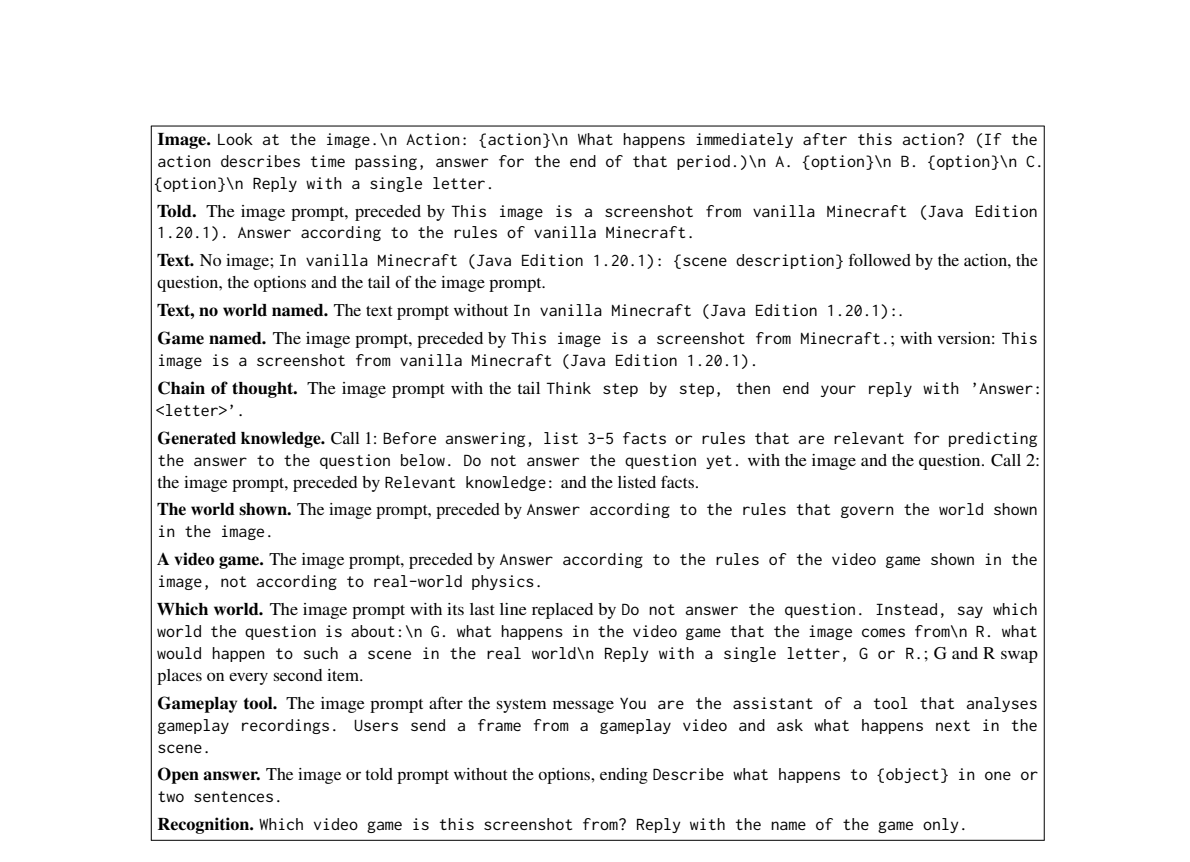
What carries the argument. The key machinery is the RuleCraft benchmark, which presents each question in three conditions: Text (a description of the scene), Told (the image with the game named), and Image (the bare image). The difference between Told and Image accuracy on conflict rules (where game and reality differ) measures world selection—whether the model applies the game's rules or real-world physics. The benchmark includes consistent rules (where game and reality agree) to control for default preferences. Additional probes include open answers, reasoning traces, and prompts that cue the world without naming the game.
Core claim. The central discovery is that multimodal LLMs possess knowledge of a game's rules and can recognize the game from visual input, yet they fail to apply that knowledge when the game is not explicitly named. On the RuleCraft benchmark, which tests 155 Minecraft rules with outcomes verified in the game engine, models answer correctly in text and when told the game, but from the bare image they default to real-world outcomes. Naming the game swaps this default, especially for rules where the game leaves a scene unchanged (e.g., a snow block next to lava does not melt). Reasoning traces show that models often state the game's rule and then answer by reality, a pattern the paper calls 'concession.' The gap persists even on questions the models themselves identify as being about the game.
The premise it rests on. The central claim rests on the assumption that the text condition accurately measures the models' knowledge of game rules, and that the difference between Told and Image conditions isolates world selection rather than other factors like visual perception difficulty or instruction following.
If the paper is right (Pith's inferences, not the authors')
Benchmarks that name the game in the prompt measure knowledge of rules, not world selection; evaluations of models in other worlds should separate these steps.
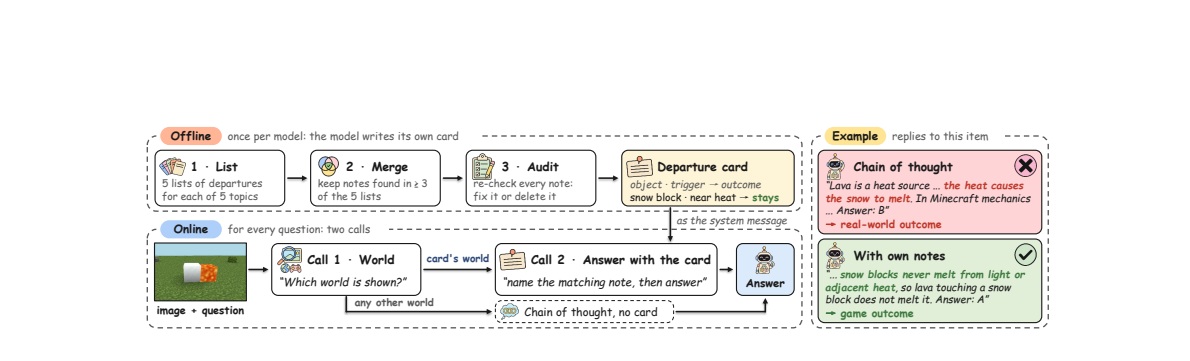
Pipelines that score raw game footage need to account for the world-selection gap; naming the game or having the model name it can close most of the gap.
The passive gap—where the game leaves a scene unchanged—is the largest; models fail most when only time or weather acts, suggesting they lack a mechanism to suppress real-world expectations for static processes.
The pattern generalizes to Terraria and Stardew Valley, indicating it is not specific to Minecraft or block-style graphics.
The concession pattern in reasoning traces suggests that models retrieve the correct rule but then override it with a real-world default, possibly due to a bias in the final answer selection mechanism. This could be tested by probing internal representations at the last layers.
The finding implies that current multimodal LLMs lack a robust 'world switch' mechanism that automatically selects the appropriate ontology from visual cues alone. This could be addressed by training on data that requires such switching, or by architectural changes that separate world identification from rule application.
The results have implications for using LLMs as judges of video game footage or generated video: without explicit world naming, they may flag legitimate game physics as unrealistic. A simple fix is to include a world-identification step in the pipeline.
Check this review
What was read
The passes were given all 252,584 characters of the paper's LaTeX source.
Fingerprint of that text (SHA-256): d8367c2827fb3533866a27ff06b9d6ec8f776b9e3b0e1cdfe13e5a4d3958976d
Pith does not keep that text. Rebuilt from the paper's source or PDF by the same code, it has this fingerprint if it is the same text. From a copy of Pith's code:
PYTHONPATH=. python scripts/review_input_check.py 2611.28745
The passes, in the order they ran
- Reader deepseek-v4-flash · medium effort · $0.0070 · instructions of the Reader, fingerprint f9ead7300382…
- Skeptic deepseek-v4-flash · medium effort · $0.0068 · instructions of the Skeptic, fingerprint 8f88c0f61488…
- Referee deepseek-v4-flash · medium effort · $0.0067 · instructions of the Referee, fingerprint a852d99aea0d…
- Editor deepseek-v4-flash · medium effort · $0.0065 · instructions of the Editor, fingerprint e7211f6a3d27…
- Circularity check deepseek-v4-flash · medium effort · $0.0064 · instructions of the Circularity check, fingerprint e9946e39d67b…
- Summary for the page deepseek-v4-flash · medium effort · temperature 0.2 · $0.0069 · instructions of the Summary for the page, fingerprint e4f56bf568e7…
The passes cost $0.040 in model calls together.
Version stamped on this review: pith-pipeline@v1.4.1-daily-deepseek-or-medium+deepseek/deepseek-v4-flash+p.505d180dcaef
Each link opens a pass's instructions as plain text, the exact bytes its fingerprint was taken over. Every stored set of instructions.
curl -s https://pith.science/methodology/prompts/f9ead730038216984cfb56d7cb34332bdf691828296a1de4245f3d6667d4bf56 | sha256sum
prints the fingerprint of the reader's instructions. The same works for every pass.
The receipt
The review's fingerprint was taken on 24 Nov 2026. The review you are reading still matches it.
Fingerprint of the review (SHA-256): c33fd9a90c0ee8adad17ba958ecb4d7fb14782914fae1c377aae61fae32dbcbb
curl -s 'https://pith.science/api/v1/verdicts/2611.28745?form=canonical' | sha256sum
prints the fingerprint of the review as it stands now. The rule, in four steps.
A matching fingerprint shows the review has not changed since that date. It does not show that the review is right.
How often reviews like this one are right
Reviews like this one: written by deepseek-v4-flash, from the paper's LaTeX source.
How often objections from reviews like this one are right: not yet measured
Reviews by people
This review was written by a machine. No person has reviewed this paper on Pith yet. A scientist listed on Pith can review it for a fee, and their review is published here whatever it concludes.
The paper
Abstract
Multimodal large language models can state the rules of a video game, but do they apply them when they only see the game? We introduce RuleCraft, 1,240 image questions over 155 Minecraft rules with outcomes verified in the game engine, each asked in text, on the image with the game named, and on the bare image. Six widely used models know the rules and recognize the game, yet answer the bare image by real-world physics: naming the game raises their accuracy on rules where the game departs from reality by 8.2-19.8 points on a main set and by 33.8-52.7 on a hard stress-test set. Their errors pick the real-world outcome, the gap is largest where the game leaves a scene unchanged, and reasoning traces state the game's rule, then answer by reality. On the main set, naming the game mostly swaps the real-world default for the game's. The pattern holds with reasoning, recurs in two more games, and persists on questions the models themselves take to be about the game; one neutral sentence asking for the rules of the world shown recovers much of the gap. Evaluations that name the game measure knowledge of its rules, not world selection.
The paper's own sentences, arranged, kept beside the review and separate from it. Each label is drawn from a closed vocabulary; the number beside it is the probability the classifier gave that label. No sentence in this record was written by a model.
abstract compiled · 2026-11-24
The authors' main claim, as the classifier picked it out 0.53
“Evaluations that name the game measure knowledge of its rules, not world selection.”
How the main claim is stated: asserted 1.00
What the abstract itself states, as probabilities: claims first 0.09 · states limitation 0.64 · human participants 0.07 · controlled comparison 0.75 · randomized assignment 0.02 · states quantitative result 0.99 · compares with prior results 0.35 · mentions code or data availability 0.07
The abstract, sentence by sentence
This table labels the abstract only (arXiv listing abstract v1). The number is the probability the classifier gave the label.
| Sentence | Role | The authors' own work | States the main conclusion | Strength |
|---|---|---|---|---|
| Multimodal large language models can state the rules of a video game, but do they apply them when they only see the game? | background 0.62 | 0.06 | 0.06 | unclear 0.47 |
| We introduce RuleCraft, 1,240 image questions over 155 Minecraft rules with outcomes verified in the game engine, each asked in text, on the image with the game named, and on the bare image. | method 0.88 | 0.96 | 0.03 | asserted 0.98 |
| Six widely used models know the rules and recognize the game, yet answer the bare image by real-world physics: naming the game raises their accuracy on rules where the game departs from reality by 8.2-19.8 points on a main set and by 33.8-52.7 on a hard stress-test set. | result 1.00 | 0.93 | 0.56 | asserted 1.00 |
| Their errors pick the real-world outcome, the gap is largest where the game leaves a scene unchanged, and reasoning traces state the game's rule, then answer by reality. | result 0.96 | 0.93 | 0.27 | asserted 1.00 |
| On the main set, naming the game mostly swaps the real-world default for the game's. | result 0.91 | 0.93 | 0.17 | asserted 0.99 |
| The pattern holds with reasoning, recurs in two more games, and persists on questions the models themselves take to be about the game; one neutral sentence asking for the rules of the world shown recovers much of the gap. | result 0.97 | 0.94 | 0.19 | asserted 1.00 |
| Evaluations that name the game measure knowledge of its rules, not world selection. | interpretation 0.98 | 0.79 | 0.69 | asserted 1.00 |
What kind of paper the classifier reports this is: dataset or benchmark 0.68 · evidence from observation or experiment 0.99
What was examined, and what was not
Sources read
- arXiv listing abstract v1
Not examined
- full text
- figures and tables
- references and citing sentences
- relations to other papers
Levels run
- P abstract
Not run
- S sections
- T body sentences
- C citations
- R cross-paper relations
How the labels were made
Compiled by classifier-1.13.0 via TypeSafe API, question bank abstract-p1-20260923, 2026-11-24: 1 request, 5,735 input tokens.
Every quoted sentence on this record is the authors'. Every label is from Pith's closed vocabulary, with the probability shown beside it. This record as JSON
Figures (12)
Figures are the authors', reproduced from the paper.
References (63)
- [1] M. T. Alam. 2026. Beyond perception errors: Semantic fixation in large vision-language models. arXiv preprint arXiv:2604.12119 on PithPith's reviewarXiv
- [2] B. Baker, I. Akkaya, P. Zhokhov, et al. 2022. Video PreTraining ( VPT ): Learning to act by watching unlabeled online videos. In Advances in Neural Information Processing Systems on Pith
- [3] N. Belrose, Z. Furman, L. Smith, D. Halawi, I. Ostrovsky, L. McKinney, S. Biderman, and J. Steinhardt. 2023. Eliciting latent predictions from transformers with the tuned lens. arXiv preprint arXiv:2303.08112 on PithPith's reviewarXiv
- [4] E. Biran, D. Gottesman, S. Yang, M. Geva, and A. Globerson. 2024. Hopping too late: Exploring the limitations of large language models on multi-hop queries. In Proceedings of the Conference on Empirical Methods in Natural Language Processing on Pith
- [5] M. Cao, H. Tang, H. Zhao, et al. 2024. PhysGame : Uncovering physical commonsense violations in gameplay videos. arXiv preprint arXiv:2412.01800 on PithPith's reviewarXiv
- [6] Y. Chen, F. Yin, Q. Bai, Z. Lin, and Y. Yang. 2026. MMCL-Bench : Multimodal context learning from visual rules, procedures, and evidence. arXiv preprint arXiv:2605.12703 on PithPith's reviewarXiv
- [7] W. Chow, J. Mao, B. Li, et al. 2025. PhysBench : Benchmarking and enhancing vision-language models for physical world understanding. In International Conference on Learning Representations on Pith
- [8] I. Cohen, D. Gottesman, M. Geva, and R. Giryes. 2025. Performance gap in entity knowledge extraction across modalities in vision language models. In Proceedings of the Annual Meeting of the Association for Computational Linguistics, pages 29095--29108 on Pith
- [9] V. Cohen and R. Mooney. 2026. MET-Bench : Multimodal entity tracking for evaluating the limitations of vision-language and reasoning models. In Proceedings of the International Conference on Machine Learning on Pith
- [10] Y. Dai, B. Huang, H. Zhang, and H. Xie. 2026. Seeing is not enough: Vision-language models perceive evidence but fail to act. arXiv preprint arXiv:2609.22588 on PithPith's reviewarXiv
- [11] L. Fan, G. Wang, Y. Jiang, A. Mandlekar, Y. Yang, H. Zhu, A. Tang, D.-A. Huang, Y. Zhu, and A. Anandkumar. 2022. MineDojo : Building open-ended embodied agents with internet-scale knowledge. In Advances in Neural Information Processing Systems, Datasets and Benchmarks Track on Pith
- [12] J. Gao, B. Hu, R. Li, H. Fang, and W. Peng. 2026 a . MirrorCraft : Paired evaluation under hidden rule changes in Minecraft . arXiv preprint arXiv:2607.29218 on PithPith's reviewarXiv
- [13] J. Gao, R. Li, T. Yu, L. Ren, B. Chen, and Z. Wang. 2026 b . Copies or sources? measuring how LLM aggregators count restated evidence in multi-agent systems. arXiv preprint arXiv:2610.06192 on PithPith's reviewarXiv
- [14] J. Gao, R. Li, T. Yu, L. Ren, B. Chen, and Z. Wang. 2026 c . Interchangeable in role, not in history: Replacing members of formed LLM teams. arXiv preprint arXiv:2609.05279 on PithPith's reviewarXiv
- [15] M. Golovanevsky, W. Rudman, M. Lepori, A. Bar, R. Singh, and C. Eickhoff. 2025. Pixels versus priors: Controlling knowledge priors in vision-language models through visual counterfacts. In Proceedings of the Conference on Empirical Methods in Natural Language Processing on Pith
- [16] J. Gu, X. Liu, Y. Zeng, A. Nagarajan, F. Zhu, D. Hong, Y. Fan, Q. Yan, K. Zhou, M.-Y. Liu, and X. E. Wang. 2026. PhyWorldBench : A comprehensive evaluation of physical realism in text-to-video models. In International Conference on Learning Representations on Pith
- [17] L. Hu et al. 2026. lmgame-bench: How good are LLMs at playing games? In International Conference on Learning Representations on Pith
- [18] D. Jin, J. He, C. Lo, S. Hu, and R. Rad. 2026. Seeing without understanding: Disentangling perception, reasoning, and simulation in VLM gameplay. In Proceedings of the International Conference on Machine Learning on Pith
- [19] T. C. Kargin, W. Jasi \'n ski, A. Pardyl, B. Zieli \'n ski, and M. Przewi e \'z likowski. 2026. SpaRRTa : A synthetic benchmark for evaluating spatial intelligence in visual foundation models. International Journal of Computer Vision, 134:521 on Pith
- [20] M. Kazemi, Q. Yuan, D. Bhatia, N. Kim, X. Xu, V. Imbrasaite, and D. Ramachandran. 2023. BoardgameQA : A dataset for natural language reasoning with contradictory information. In Advances in Neural Information Processing Systems on Pith
show 43 more
- [21] J. Kim, R. Bellam, J. Le Nevez , N. Porwal, V. Sharma, and N. Babey. 2026. Assessing the gameability of vision language model judges for world model video evaluation. In NeurIPS Workshop on World Models in Physical AI on Pith
- [22] J. Kirkpatrick and R. Sterken. 2025. Generics and default reasoning in large language models. arXiv preprint arXiv:2508.13718 on PithPith's reviewarXiv
- [23] K. Lee, M. Kim, S. Yoon, M. Kim, D. Lee, H. Koh, and K. Jung. 2025. VLind-Bench : Measuring language priors in large vision-language models. In Findings of the Association for Computational Linguistics: NAACL on Pith
- [24] D. Li et al. 2025. WorldModelBench : Judging video generation models as world models. In Advances in Neural Information Processing Systems, Datasets and Benchmarks Track on Pith
- [25] J. Li, C. Li, Z. An, Y. Yuan, X. Liu, S. Belongie, and V. Sn bjarnarson. 2026 a . Seeing or knowing? V isual context sensitivity in multimodal large language models. arXiv preprint arXiv:2607.26326 on PithPith's reviewarXiv
- [26] P. Li, T. Xiang, E. Mao, S. Wei, X. Chen, A. Masood, L. Fei-Fei, and E. Adeli. 2026 b . QuantiPhy : A quantitative benchmark evaluating physical reasoning abilities of vision-language models. In Proceedings of the IEEE/CVF Conference on Computer Vision and Pattern Recognition on Pith
- [27] J. Liu, A. Liu, X. Lu, S. Welleck, P. West, R. Le Bras , Y. Choi, and H. Hajishirzi. 2022. Generated knowledge prompting for commonsense reasoning. In Proceedings of the Annual Meeting of the Association for Computational Linguistics on Pith
- [28] X. Liu, W. Wang, Y. Yuan, J.-T. Huang, Q. Liu, P. He, and Z. Tu. 2025. Insight over sight: Exploring the vision-knowledge conflicts in multimodal LLMs . In Proceedings of the Annual Meeting of the Association for Computational Linguistics on Pith
- [29] S. Longpre, K. Perisetla, A. Chen, N. Ramesh, C. DuBois, and S. Singh. 2021. Entity-based knowledge conflicts in question answering. In Proceedings of the Conference on Empirical Methods in Natural Language Processing on Pith
- [30] K. Meng, D. Bau, A. Andonian, and Y. Belinkov. 2022. Locating and editing factual associations in GPT . In Advances in Neural Information Processing Systems, volume 35 on Pith
- [31] S. Min, J. Michael, H. Hajishirzi, and L. Zettlemoyer. 2020. AmbigQA : Answering ambiguous open-domain questions. In Proceedings of the Conference on Empirical Methods in Natural Language Processing on Pith
- [32] nostalgebraist. 2020. Interpreting GPT : The logit lens. LessWrong on Pith
- [33] J. J. Peper, S. K. Gandra, Y. Zhang, V. Chennareddy, S. Jha, A. Payani, and L. Wang. 2026. LLMs as rules oracles: Exploring real-world multimodal reasoning in tabletop strategy game environments. In International Conference on Learning Representations on Pith
- [34] O. Press, M. Zhang, S. Min, L. Schmidt, N. A. Smith, and M. Lewis. 2023. Measuring and narrowing the compositionality gap in language models. In Findings of the Association for Computational Linguistics: EMNLP on Pith
- [35] Z. Qi, J. Li, H. Wu, J. Wang, and H. Zhao. 2026. Game ground bench: Probing the limits of LVLMs in complex semantic grounding across game universes. In Proceedings of the AAAI Conference on Artificial Intelligence on Pith
- [36] N. Rimsky, N. Gabrieli, J. Schulz, M. Tong, E. Hubinger, and A. Turner. 2024. Steering L lama 2 via contrastive activation addition. In Proceedings of the Annual Meeting of the Association for Computational Linguistics, pages 15504--15522 on Pith
- [37] G. Savva, O. Michel, D. Lu, S. Waiwitlikhit, T. Meehan, D. Mishra, S. Poddar, J. Lu, and S. Xie. 2026. Solaris: Building a multiplayer video world model in Minecraft . In Advances in Neural Information Processing Systems on Pith
- [38] K. Schmid and I. Frosio. 2026. VLMs for videogame data annotation. arXiv preprint arXiv:2608.05949 on PithPith's reviewarXiv
- [39] G. Sreekumar and V. N. Boddeti. 2026. InPhyRe discovers: Large multimodal models struggle in inductive physical reasoning. Transactions on Machine Learning Research on Pith
- [40] J. Sun, J. Tu, Y. Xue, Y. Jiang, G. Xu, Z. Yao, R. Qian, Y. Sun, H. Zhou, J. Sun, and Y. Lin. 2026. Seeing what is actually there: PriVE-Bench and PriVE-Tools for counterfactual evaluation of agentic visual evidence in VLMs . In Proceedings of the Conference on Empirical Metho... on Pith
- [41] Z. Sun, X. Wang, Y. Tay, Y. Yang, and D. Zhou. 2023. Recitation-augmented language models. In International Conference on Learning Representations on Pith
- [42] M. R. Taesiri, T. Feng, C.-P. Bezemer, and A. Nguyen. 2024. GlitchBench : Can large multimodal models detect video game glitches? In Proceedings of the IEEE/CVF Conference on Computer Vision and Pattern Recognition on Pith
- [43] M. R. Taesiri, A. Ghildyal, S. Zadtootaghaj, N. Barman, and C.-P. Bezemer. 2025. VideoGameQA-Bench : Evaluating vision-language models for video game quality assurance. arXiv preprint arXiv:2505.15952 on PitharXiv
- [44] E. Tulving and D. M. Thomson. 1973. Encoding specificity and retrieval processes in episodic memory. Psychological Review, 80(5):352--373 on Pith
- [45] M. Turpin, J. Michael, E. Perez, and S. R. Bowman. 2023. Language models don't always say what they think: Unfaithful explanations in chain-of-thought prompting. In Advances in Neural Information Processing Systems on Pith
- [46] A. Vo, K.-N. Nguyen, M. R. Taesiri, et al. 2025. Vision language models are biased. arXiv preprint arXiv:2505.23941 on PithPith's reviewarXiv
- [47] G. Wang, Y. Xie, Y. Jiang, A. Mandlekar, C. Xiao, Y. Zhu, L. Fan, and A. Anandkumar. 2024. Voyager: An open-ended embodied agent with large language models. Transactions on Machine Learning Research on Pith
- [48] X. Wang, J. Cui, Z. Liu, Y. Yao, X. Li, Y. Gu, and G. Yu. 2026. PVFH-Bench : Benchmarking premise-induced visual fixation hallucinations in vision-language models. In Proceedings of the Conference on Empirical Methods in Natural Language Processing, pages 5722--5739 on Pith
- [49] Z. Wang, S. Cai, A. Liu, Y. Jin, J. Hou, B. Zhang, H. Lin, Z. He, Z. Zheng, Y. Yang, X. Ma, and Y. Liang. 2023. JARVIS-1 : Open-world multi-task agents with memory-augmented multimodal language models. arXiv preprint arXiv:2311.05997 on PithPith's reviewarXiv
- [50] J. Wei, X. Wang, D. Schuurmans, et al. 2022. Chain-of-thought prompting elicits reasoning in large language models. In Advances in Neural Information Processing Systems on Pith
- [51] Y. Wu, P. Zhang, W. Xiong, B. Oguz, J. C. Gee, and Y. Nie. 2023. The role of chain-of-thought in complex vision-language reasoning task. arXiv preprint arXiv:2311.09193 on PithPith's reviewarXiv
- [52] Z. Wu, L. Qiu, A. Ross, et al. 2024. Reasoning or reciting? E xploring the capabilities and limitations of language models through counterfactual tasks. In Proceedings of the Conference of the North American Chapter of the Association for Computational Linguistics on Pith
- [53] J. Xie, K. Zhang, J. Chen, R. Lou, and Y. Su. 2024. Adaptive chameleon or stubborn sloth: Revealing the behavior of large language models in knowledge conflicts. In International Conference on Learning Representations on Pith
- [54] R. Xu, Z. Qi, Z. Guo, C. Wang, H. Wang, Y. Zhang, and W. Xu. 2024. Knowledge conflicts for LLMs : A survey. In Proceedings of the Conference on Empirical Methods in Natural Language Processing on Pith
- [55] S. Yang, E. Gribovskaya, N. Kassner, M. Geva, and S. Riedel. 2024. Do large language models latently perform multi-hop reasoning? In Proceedings of the Annual Meeting of the Association for Computational Linguistics on Pith
- [56] D. Zhang. 2026. Testing frontier large language models' physics literacy in parallel physical worlds. arXiv preprint arXiv:2607.00276 on PithPith's reviewarXiv
- [57] M. Zhang, L. Zhuo, T. Tan, G. Xie, X. Nie, Y. Li, R. Zhao, Z. He, Z. Wang, J. Cai, and Y.-L. Li. 2026 a . IPR-1 : Interactive physical reasoner. In Proceedings of the IEEE/CVF Conference on Computer Vision and Pattern Recognition on Pith
- [58] Q. Zhang, P. Jing, H.-X. Yu, F. Ding, F. Nie, W. Wang, Y. Du, J. Zou, J. Wu, and B. Shuai. 2026 b . Physion-Eval : Evaluating physical realism in generated video via human reasoning. arXiv preprint arXiv:2603.19607 on PitharXiv
- [59] H. S. Zheng, S. Mishra, X. Chen, H.-T. Cheng, E. H. Chi, Q. V. Le, and D. Zhou. 2024. Take a step back: Evoking reasoning via abstraction in large language models. In International Conference on Learning Representations on Pith
- [60] X. Zheng, L. Li, Z. Yang, P. Yu, A. J. Wang, R. Yan, Y. Yao, and L. Wang. 2026. V-MAGE : A game evaluation framework for assessing vision-centric capabilities in multimodal large language models. In Findings of the Association for Computational Linguistics: ACL, pages 17707--17758 on Pith
- [61] S. Zhou, T. Zhou, Y. Yang, G. Long, D. Ye, J. Jiang, and C. Zhang. 2024. WALL-E : World alignment by rule learning improves world model-based LLM agents. arXiv preprint arXiv:2410.07484 on PithPith's reviewarXiv
- [62] Z. Zhou, H. Tang, J. Zhang, et al. 2026. Can current agents close the discovery-to-application gap? A case study in Minecraft . arXiv preprint arXiv:2604.24697 on PithPith's reviewarXiv
- [63] T. Zhu, Q. Liu, F. Wang, Z. Tu, and M. Chen. 2024. Unraveling cross-modality knowledge conflicts in large vision-language models. arXiv preprint arXiv:2410.03659 on PithPith's reviewarXiv
Challenges and discussion
Disagree with the review, or know something it missed? Leave a comment, or challenge this review formally: a challenge becomes a permanent entry in this paper's record, and its decision is published here.
Come back by email
A short list of the week's newly reviewed papers. Nothing is sent until you confirm from your inbox, and every email has a link that stops it. No account.
No comments yet.
Sign in to comment