Artificial Intelligence · arXiv:2608.05949 v1 · submitted 6 Aug 2026 · 15 references
VLMs for Videogame Data Annotation
The paper says
“Vision Language Models (VLMs) and Artificial Intelligence (AI) agents have revolutionized how engineers approach complex problems in real-world applications.”
more of the abstract
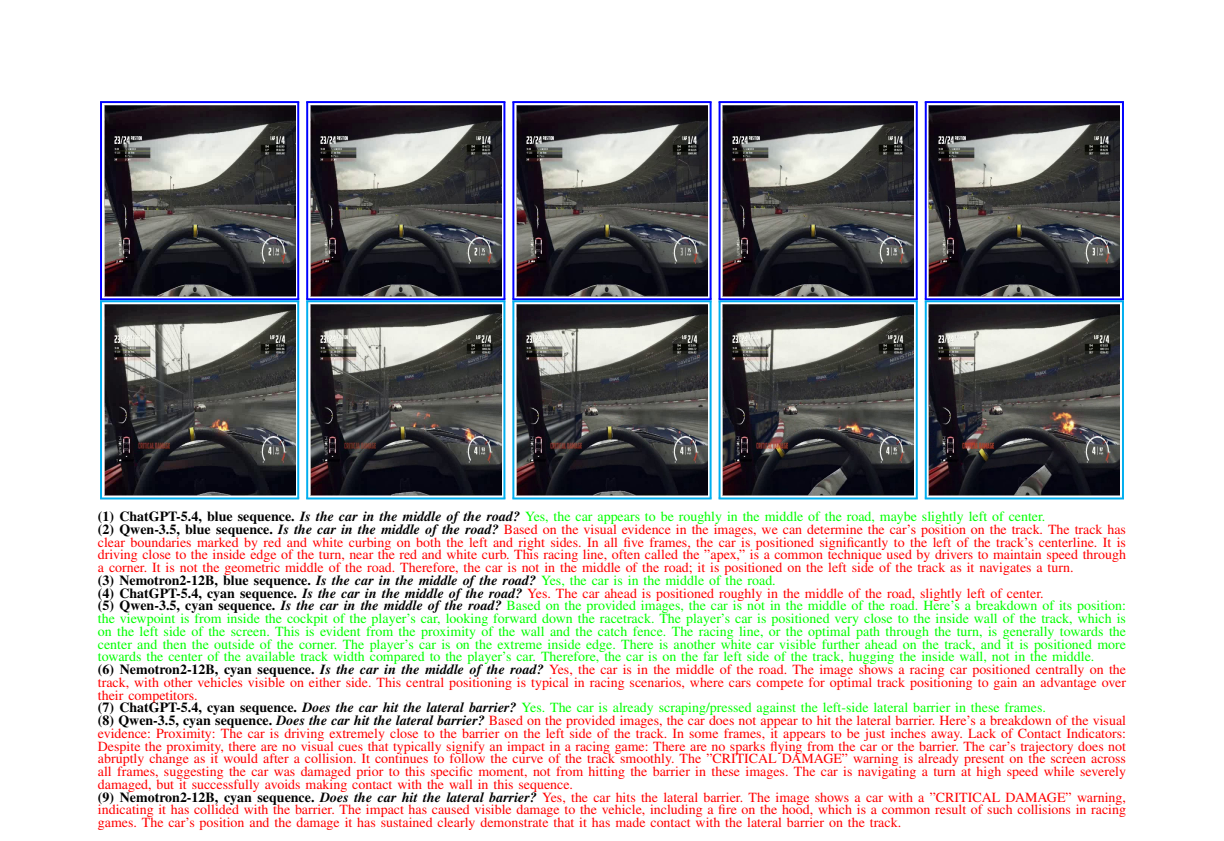
Their adoption in video games is on the other hand limited by the extreme variability of the synthetic scenarios and their poor compliance with real-world physics. Here we investigate the use of VLMs for annotating video game frame sequences with reward signals, a task with several potential applications including, among others, conditioned training and offline reinforcement learning. We show that VLMs often struggle to answer basic questions on racing video games (although we observed a similar behavior on other game genres) and discuss countermeasures such as VLM output mixing and prompt optimization. We also show how input sequence length, resolution, and question batching affect the annotation quality and its token consumption.
from the abstract
Pith says
Machine review · deepseek-v4-flash · 7 Aug 2026 · what was read was not recorded · not checked by a person
It can be wrong. Challenge this review or reply to it.
Holds up, with conditions. Useful empirical recipe, but the central RAM improvement claim is not established because all metrics come from the same validation set used for fitting, with no held-out test. This line is wrong
3 major objections · 5 minor
How often objections from reviews like this one are right: not yet measured
Not checked: figures, code, what the 15 references say.
The paper says, at Section IV, 'Testing dataset', and Section III, 'Reward Annotation Model'
The review did not quote this passage.
Pith says: Objection 1 of 3 · major
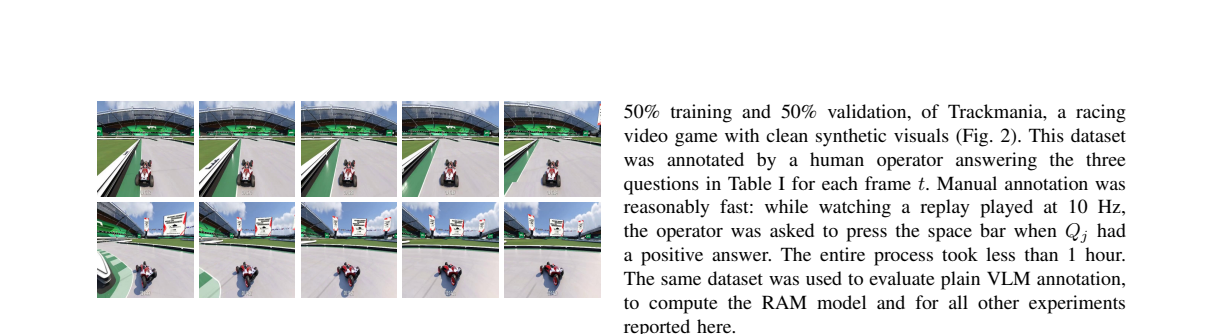
The central claim that RAM 'shows significant improvements ... for any VLM considered' rests on metrics computed on the same validation split used to select RAM. The text states that the T=5500 Trackmania frames are split 50/50 into training and validation, that 'the same dataset was used to evaluate plain VLM annotation, to compute the RAM model and for all …
more of objection 1
… other experiments,' and Section III states RAM is optimized with RMSProp for 10000 iterations, 'returning the RAM model with the best validation.' MIPROv2 prompt optimization also uses this same human-annotated dataset. Consequently, Tables II-IV report selection-on-validation results with no held-out test set, so the magnitude and even the sign of the RAM improvement on new frames is unknown. The authors should add a held-out test set that is fixed before any RAM fitting, early stopping, or prompt tuning, and report all final numbers there.
The paper says, at Section IV, 'Wreckfest' and Table V
The review did not quote this passage.
Pith says: Objection 2 of 3 · major
The claim that RAM 'consistently improves' annotation is contradicted by Table V itself: ChatGPT-5.4 Forward F1 drops from 89.4 (plain) to 83.1 (RAM). Similar small regressions appear in Trackmania (Kimi-k2.5 Barrier F1 drops from 60.5 in Table II to 57.6 in Table III; ChatGPT-5.4 Forward drops from 93.3 to 93.1).
more of objection 2
Moreover, no dataset size, annotation protocol, train/validation split, or RAM fitting procedure is given for Wreckfest. The Wreckfest results therefore cannot be assessed, and as reported they directly undermine the 'any VLM' and 'consistently' wording. The authors should either report complete Wreckfest evaluation details or restrict the claim to the setup that supports it.
The paper says, at Throughout Sections III and IV
The review did not quote this passage.
Pith says: Objection 3 of 3 · major
No measure of uncertainty or statistical significance is reported. The reference set is a single annotator's labels on 5500 Trackmania frames, split once into 2750 training and 2750 validation frames. Without confidence intervals, bootstrap estimates, or multiple annotators/runs, the word 'significant' in Section IV is unsupported even on the reported validation set.
more of objection 3
This is compounded by the evaluation-bias issue raised in the first major comment. Please add per-cell uncertainty (for example, confidence intervals via bootstrap over frames, or multiple annotators) or downgrade the language to a descriptive claim.
5 minor objections
The paper says, at Section IV, 'Plain annotation'
Pith says: minor objection 1 of 5
The sentence 'For three ChatGTP-5.4, Qwen3.5 and Nemotron2, the same Table also shows the metrics when the model VLMs' appears truncated and should be revised; note also the 'ChatGTP' typo.
This objection may describe the copy Pith gave the reviewer, not the paper.
The paper says, at Section III, Eqs. (3)-(5)
Pith says: minor objection 2 of 5
TP_j, FP_j, and FN_j are called true/false positive and negative rates, but with the continuous RAM output a_RAM they are soft counts or weighted sums; please clarify the definitions.
show 3 more
The paper says, at Table II
Pith says: minor objection 3 of 5
Several cells report '—' for rho (for example, Nemotron2-12B on Q2); a footnote should state that Pearson correlation is undefined or omitted when the VLM output is constant.
The paper says, at Section IV, Table IV
Pith says: minor objection 4 of 5
The table does not state the resolution and data split used for the MIPROv2 experiments; since MIPROv2 uses the same human-annotated dataset, the reader needs to know whether these are validation-set numbers and how they compare with Tables II and III.
The paper says, at Section III, 'Reward Annotation Model'
Pith says: minor objection 5 of 5
The statement that 'the L2 loss (or F-beta for beta != 1) generally achieve worse results' is given without quantitative support; please provide an appendix table or cite a specific figure.
What would settle it
Re-run the Trackmania evaluation with a three-way split: 40% train, 20% validation, 40% test, keeping contiguous frame windows together. Fit RAM on train; use validation only to select the iteration count and to tune MIPROv2 prompts (or freeze prompts before seeing validation); then evaluate plain VLM and RAM once on the test split. Report per-question ΔF1 = F1_RAM - F1_plain with 95% bootstrap CIs clustered by frame sequence. If every claimed cell has a positive ΔF1 whose CI excludes zero, the core claim survives; if deltas are mixed or shrink below noise, the claim must be revised to 'RAM improves on average for most VLMs,' and Wreckfest must be re-run under the same protocol with a described annotation reference set.
from the skeptic's reading
How the review went
4 readings by deepseek-v4-flash · 7 Aug 2026
- Reader holds up, with conditions
- Skeptic partly agrees
- Editor wrote the verdict above
- Referee major revision: 3 major objections, 5 minor
Not run on this paper: the simulated authors' defence.
Pith did not check this review's objections against the paper.
The review in full
The review in brief, machine-written
The paper is a practical empirical study of using VLMs to annotate racing-game frames with reward labels, and it introduces RAM, a simple linear mix of VLM outputs with weights learned on a small human-annotated reference set. That idea is plausible and easy to replicate, and the systematic comparison of resolution, sequence length, batching, and prompt optimization is genuinely useful for anyone building annotation pipelines. The token-efficiency analysis is also practical. The paper is honest about some limitations: it explicitly says the reference set is small and single-annotator, and it notes commercial constraints of some VLMs.
But the central claim — that RAM significantly improves F1 over plain VLM output for any VLM considered — is not supported by the reported evaluation. Section IV says the same dataset was used to evaluate plain annotation, to compute the RAM model, and for all other experiments. RAM is optimized with RMSProp over 10000 iterations, returning the model with the best validation. MIPROv2 prompt optimization also uses the same human-annotated dataset. So every reported F1 number is a best-on-validation result, with no held-out test set. That selection-on-evaluation bias can inflate F1 and makes the improvement uninterpretable.
The contradiction is visible in the paper's own tables. On Wreckfest, ChatGPT-5.4 Forward F1 drops from 89.4 to 83.1 under RAM. On Trackmania, Kimi-k2.5 Barrier drops from 60.5 to 57.6, and ChatGPT-5.4 Forward drops from 93.3 to 93.1. No confidence intervals or significance tests appear anywhere. The Wreckfest annotation protocol is not described at all, which makes those numbers hard to audit.
These are fixable issues, not conceptual ones. A proper held-out split, per-cell uncertainty, and a significance test would likely settle whether RAM generalizes. As is, the paper is a useful design-space exploration but not a reliable demonstration of its headline result. The authors deserve credit for stating the small-reference-set limitation, but they missed the validation-contamination problem, which is the more important threat to their claim.
This paper is for researchers building VLM-based game annotation systems; they will find the practical comparisons worthwhile, but they should treat the RAM improvement as provisional. The method is plausible and the problem is relevant, so I think it deserves a serious referee despite the flaw. The right call is to send it to review with a clear request for a held-out test set and corrected statistical reporting — then the empirical contribution could become solid.
The strongest objection
Central claim requires Table III (and Table V) F1 values to reflect RAM's generalization, i.e., metrics on frames not used for fitting RAM weights, selecting iterations, or tuning prompts. The paper does not provide such a set. Section IV says the T=5500 Trackmania frames are split 50/50 into training and validation, and 'The same dataset was used to evaluate plain VLM annotation, to compute the RAM model and for all other experiments.' Section III says RAM is optimized with RMSProp for 10000 iterations, 'returning the RAM model with the best validation.' Thus the reported RAM numbers are the best epoch on the validation split, with no separate test split described. MIPROv2 prompt optimization also uses 'the same human-annotated dataset used to learn RAM,' so the plain baseline can be tuned on the evaluation set too. This selection-on-evaluation bias can inflate F1 and makes 'significant improvements' uninterpretable. Independently, the claim is internally contradicted by the displayed numbers: Wreckfest Table V shows ChatGPT-5.4 Forward F1 dropping from 89.4 to 83.1; Trackmania Table III vs. II shows Kimi-k2.5 Barrier F1 dropping from 60.5 to 57.6 and ChatGPT-5.4 Forward dropping from 93.3 to 93.1. No confidence intervals or significance tests are reported anywhere. Without a truly held-out test set and per-cell uncertainty, the central claim does not follow.
The paper's construction is simple and plausible: Eq. (1) is a low-capacity linear mix of VLM outputs, and the RAM equations are mathematically coherent. The first-order threat is not the small number of parameters but the evaluation protocol. Section III explicitly performs 10000 RMSProp iterations and returns the model with the best validation; Section IV then reports metrics on the 50% validation split while also using the same dataset for prompt optimization. This means the reported improvements are not measured on data that is cleanly out-of-sample, so their magnitude cannot be trusted. The reader's concern about a small single-annotator dataset is valid, but the more precise issue is selection on the evaluation set: even a large dataset would not fix the absence of a separate test split. Additionally, the paper's own tables contradict the strongest phrasing of the claim. Wreckfest Table V shows ChatGPT-5.4 Forward F1 decreasing from 89.4 to 83.1 under RAM, and Trackmania Table III versus Table II shows Kimi-k2.5 Barrier F1 decreasing from 60.5 to 57.6 and ChatGPT-5.4 Forward F1 decreasing from 93.3 to 93.1. Some differences are small and all lack error bars, so 'significant improvements for any VLM considered' overstates the evidence even before the leakage issue. I would keep the reader's conditional verdict but make the conditions explicit: a held-out test split, clustered bootstrap intervals, and a weakened conclusion for Wreckfest. This is a resolvable empirical concern, not a fundamental flaw in the proposed model.
The referee's report
If the central claim survives a clean evaluation, the paper would make a modest but useful contribution: a simple, computationally cheap linear aggregation of off-the-shelf VLM outputs that raises annotation quality on dense reward tasks, including sparse events, plus a practical analysis of token costs. The paper deserves credit for reporting precision, recall, F1, and correlation simultaneously, for including token counts, and for comparing with Snorkel baselines; these choices make the cost-quality tradeoff interpretable. The authors also state a limitation in Section V. However, the current evaluation design does not support the generality of the claim, and the Wreckfest results contain internal counterexamples. The contribution is therefore conditional on a methodologically cleaner validation.
Pith's reading of the paper (a machine's summary, not the authors')
Reward signals for training game agents are usually hand-annotated frame by frame. This paper asks whether vision-language models can produce those per-frame rewards automatically, and finds that a single VLM's answers are frequently wrong on racing-game questions such as whether the car is mid-road or hitting a barrier. The core proposal is the Reward Annotation Model (RAM), a linear combination of VLM probability outputs, which the paper reports lifts the balanced precision–recall score (F1) over plain annotation for every VLM tested, on both Trackmania and Wreckfest. The paper also traces how resolution, input sequence length, question batching, and automatic prompt optimization change both accuracy and token cost. If the result holds, a VLM ensemble with a small supervised linear correction could become a practical ingredient for offline reinforcement learning and conditioned agent training.
What carries the argument. The central mechanism is the Reward Annotation Model (RAM), the linear combination $a^{RAM}_j(t)=\sum_{k=1}^{N}w_{k,j}a^{VLM}_k(t)+b_j$ learned independently for each reward question $Q_j$ from a small human-annotated reference set. The weights are fit by minimizing an L2 loss or, preferably, by maximizing a soft $F_\beta$ score (with $\beta=1$ reported), which makes training robust to heavily imbalanced questions such as barrier hits. RAM's work is to exploit correlations between the reward questions — a car that is off-center is more likely to be near a barrier — so the linear mix cancels individual VLM mistakes and compresses the gap between different models. Around it, the pipeline uses a fixed premise prompt, five-frame sequences at 20 Hz with one-frame overlap, and interpolation of the resulting probabilities into a dense reward signal.
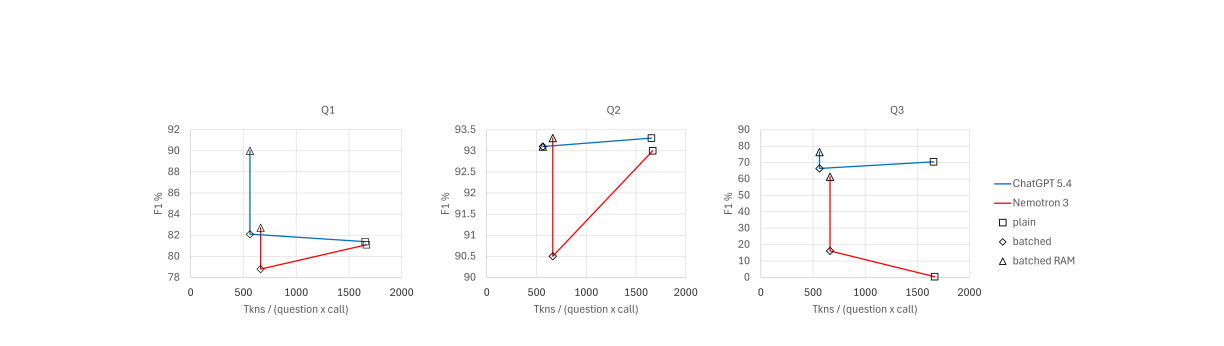
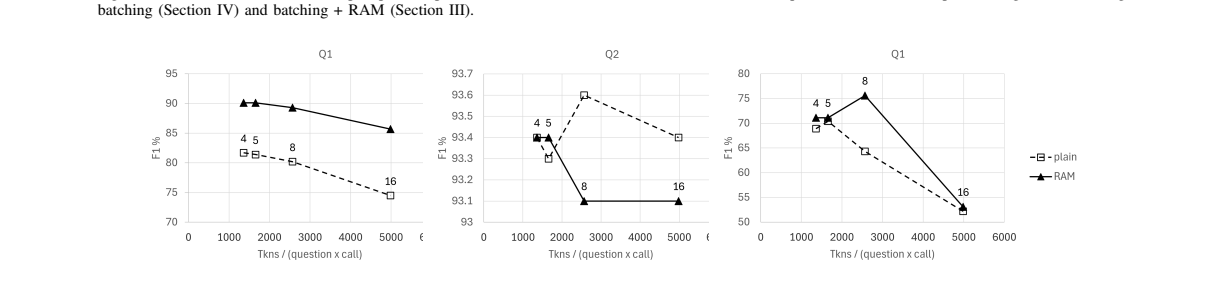
Core claim. The central discovery is the Reward Annotation Model (RAM): given several VLMs answering the same per-frame reward questions with confidence scores in 0–100, a linear combination of those scores, with weights learned independently per question on a small human-annotated reference set, produces annotations that are more accurate than any single VLM's plain output. RAM is defined by $a^{RAM}_j(t) = \sum_{k=1}^{N} w_{k,j}\,a^{VLM}_k(t) + b_j$, and the weights are fit by minimizing an L2 loss or, with better results, by maximizing a soft $F_\beta$ score (using $\beta=1$ in the reported results). On Trackmania, RAM raises F1 on the sparse 'hitting the lateral barrier' question from 70.4 (plain output of the strongest single VLM) to 76.2, and on the 'middle of the road' question from 81.4 to 89.9; a mix of three VLMs reaches 90.4 on the first question, beating all single models. RAM also narrows the gap between strong and weak VLMs, and it outperforms majority-vote and learned-label aggregators, which collapse on the imbalanced question. The paper further shows that longer input sequences and question batching tend to hurt plain F1, while applying RAM to batched questions restores much of the loss, and that automatic prompt optimization helps some questions and hurts others.
The premise it rests on. The results rest on a single human-annotated reference set of 5500 Trackmania frames produced by one operator, and the same data are used to fit RAM, tune prompts, and compute every reported metric, so the claimed gains might not survive a different track, a different annotator, or a held-out game as clean as Trackmania.
If the paper is right (Pith's inferences, not the authors')
A single linear correction layer lets weaker, cheaper VLMs approach the annotation quality of the best proprietary model, making reward annotation feasible when the strongest model's terms of service forbid downstream AI training.
Applying RAM to batched multi-question prompts regains most of the F1 lost by batching while keeping the token savings, so annotation cost and quality need not trade off as sharply as plain prompting suggests.
Because RAM improves the sparse 'barrier hit' question the most, the method is directly useful for dense reward signals where rare events matter, such as collision-based penalties in offline reinforcement learning.
Automatic prompt optimization does not reliably help: on some questions it improves plain F1 but worsens RAM F1, so per-question and per-model tuning decisions are needed rather than a single optimized prompt.
Beyond the paper's two racing games, the same linear-mixing recipe could be tested on other annotation tasks where reward questions are correlated, such as safety-critical driving logs or robotic manipulation episodes; if the correlation structure is similar, RAM-style aggregation may beat plain VLM labelling without any prompt tuning.
Because RAM learns per-question weights from only a few thousand frames, an active-learning loop that selects which frames a human labels could reduce the reference-set cost further — the paper's 5500 frames may already be more than needed.
A generative weak-supervision model and RAM are complementary rather than mutually exclusive: a label model could supply the linear combination without labels, and RAM's supervised fit could then correct residual bias, though the paper only compares the two on one dataset.
The Wreckfest results, where the same questions yield much lower F1 than Trackmania, suggest the method's gain may be largest when visual complexity is moderate; a stress test on a third game with a first-person view and heavy occlusion would clarify where the approach stops paying off.
Check this review
Pith stored no record of this review's passes and took no fingerprint of it. Reviews made by code from 13 Nov 2026 on carry both.
How often reviews like this one are right
Reviews like this one: written by deepseek-v4-flash, where what was read was not recorded.
How often objections from reviews like this one are right: not yet measured
Reviews by people
This review was written by a machine. No person has reviewed this paper on Pith yet. A scientist listed on Pith can review it for a fee, and their review is published here whatever it concludes.
The paper
Abstract
Vision Language Models (VLMs) and Artificial Intelligence (AI) agents have revolutionized how engineers approach complex problems in real-world applications. Their adoption in video games is on the other hand limited by the extreme variability of the synthetic scenarios and their poor compliance with real-world physics. Here we investigate the use of VLMs for annotating video game frame sequences with reward signals, a task with several potential applications including, among others, conditioned training and offline reinforcement learning. We show that VLMs often struggle to answer basic questions on racing video games (although we observed a similar behavior on other game genres) and discuss countermeasures such as VLM output mixing and prompt optimization. We also show how input sequence length, resolution, and question batching affect the annotation quality and its token consumption.
The paper's own sentences, arranged, kept beside the review and separate from it. Each label is drawn from a closed vocabulary; the number beside it is the probability the classifier gave that label. No sentence in this record was written by a model.
abstract compiled · 2026-09-23
The authors' main claim, as the classifier picked it out 1.00
“We show that VLMs often struggle to answer basic questions on racing video games (although we observed a similar behavior on other game genres) and discuss countermeasures such as VLM output mixing and prompt optimization.”
How the main claim is stated: asserted 0.95
What the abstract itself states, as probabilities: claims first 0.04 · states limitation 0.87 · human participants 0.04 · controlled comparison 0.10 · randomized assignment 0.02 · states quantitative result 0.05 · compares with prior results 0.14 · mentions code or data availability 0.03
The abstract, sentence by sentence
This table labels the abstract only (arXiv listing abstract v1). The number is the probability the classifier gave the label.
| Sentence | Role | The authors' own work | States the main conclusion | Strength |
|---|---|---|---|---|
| Vision Language Models (VLMs) and Artificial Intelligence (AI) agents have revolutionized how engineers approach complex problems in real-world applications. | background 1.00 | 0.04 | 0.02 | asserted 1.00 |
| Their adoption in video games is on the other hand limited by the extreme variability of the synthetic scenarios and their poor compliance with real-world physics. | background 0.78 | 0.09 | 0.04 | asserted 1.00 |
| Here we investigate the use of VLMs for annotating video game frame sequences with reward signals, a task with several potential applications including, among others, conditioned training and offline reinforcement learning. | contribution 1.00 | 0.66 | 0.07 | asserted 0.62 |
| We show that VLMs often struggle to answer basic questions on racing video games (although we observed a similar behavior on other game genres) and discuss countermeasures such as VLM output mixing and prompt optimization. | result 0.95 | 0.95 | 0.43 | asserted 0.95 |
| We also show how input sequence length, resolution, and question batching affect the annotation quality and its token consumption. | result 0.71 | 0.93 | 0.08 | asserted 1.00 |
What kind of paper the classifier reports this is: empirical study 1.00 · evidence from observation or experiment 0.99
What was examined, and what was not
Sources read
- arXiv listing abstract v1
Not examined
- full text
- figures and tables
- references and citing sentences
- relations to other papers
Levels run
- P abstract
Not run
- S sections
- T body sentences
- C citations
- R cross-paper relations
How the labels were made
Compiled by classifier-1.13.0 via TypeSafe API, question bank abstract-p1-20260923, 2026-09-23: 1 request, 4,291 input tokens.
Every quoted sentence on this record is the authors'. Every label is from Pith's closed vocabulary, with the probability shown beside it. This record as JSON
Figures (4)
Figures are the authors', reproduced from the paper.
References (15)
- [1] An Y . et al. Qwen3.5-omni technical report.ArXiv, 2026 on Pith
- [2] Bolton A. et al. Sima 2: A generalist embodied agent for virtual worlds. ArXiv, 2025 on Pith
- [3] Durst D. et al. Learning to move like professional counter-strike players. InSCA, 2024 on Pith
- [4] Kim H. J. et al. Meganno+: A human-llm collaborative annotation system.ArXiv, 2024 on Pith
- [5] Klissarov M. et al. Motif: Intrinsic motivation from artificial intelligence feedback. InICLR, 2024 on Pith
- [6] Ma Y . J. et al. Eureka: Human-level reward design via coding large language models.ArXiv, 2023 on Pith
- [7] Opsahl-Ong K. et al. Optimizing instructions and demonstrations for multi-stage language model programs. InEMNLP, 2024 on Pith
- [8] Ratner A. J. et al. Snorkel: Rapid training data creation with weak supervision. InVLDB Endowment, 2017 on Pith
- [9] Reed S. et al. A generalist agent.ArXiv, 2022 on Pith
- [10] Salewski L. et al. Gala: A zero-shot gaming language-action model for player guidance captioning.IEEE TOG [accepted, unpublished], 2026 on Pith
- [11] Wang G. et al. V oyager: An open-ended embodied agent with large language models.IEEE TMLR, 2024 on Pith
- [12] Zheng Q. et al. Ai-generated game commentary: A survey and a datasheet repository. 2025 on Pith
- [13] Schmid K. and Frosio I. Training a conditioned video game agent on a VLM-annotated dataset.ArXiv, 2026 on Pith
- [14] OpenAI. ChatGPT. https://openai.com/chatgpt, 2026 on Pith
- [15] Richard S. Sutton and Andrew G. Barto.Reinforcement Learning: An Introduction. 2018 on Pith
Cited by 1 Pith paper
Reviewed papers on Pith that cite this one. The full citation record
- Multimodal LLMs Know the Game but Assume the Real World cs.CL · Nov 2026
Challenges and discussion
Disagree with the review, or know something it missed? Leave a comment, or challenge this review formally: a challenge becomes a permanent entry in this paper's record, and its decision is published here.
Come back by email
A short list of the week's newly reviewed papers. Nothing is sent until you confirm from your inbox, and every email has a link that stops it. No account.
No comments yet.
Sign in to comment