Artificial Intelligence · arXiv:2609.17695 v1 · submitted 15 Sep 2026 · 3 references
GraphEcho: Structural Redundancy and Evidence Provenance in LLM Graph Agents
The paper says
“A large language model (LLM) agent can follow more graph paths without acquiring more independent evidence. GraphEcho tests whether agents mistake these repeated encounters for additional corroboration.”
more of the abstract
The benchmark varies path counts and evidential origins while holding evidence content fixed, and evaluates both judgments and active exploration. Controlled synthetic experiments reveal model-dependent judgment shifts, but redundant supporting paths increase the share of repeated walks across all evaluated frozen agents. Provenance-aware post-training (PAPT) reduces revisits and improves synthetic accuracy, yet covers fewer distinct sources. On scientific claims, it continues to reduce repetition while accuracy declines. These findings expose a gap between efficient exploration and effective evidence use: an agent can learn to stop repeating itself while overlooking information it needs. GraphEcho provides a controlled way to evaluate both what graph agents conclude and whether their exploration reaches distinct evidential sources.
from the abstract
Pith says
Machine review · deepseek-v4-flash · 17 Sep 2026 · what was read was not recorded · not checked by a person
It can be wrong. Challenge this review or reply to it.
Holds up. Solid empirical paper on an important failure mode in graph RAG; the controlled design and honest treatment of tradeoffs make it worth engaging. This line is wrong
3 minor
How often objections from reviews like this one are right: not yet measured
Not checked: figures, code, what the 3 references say.
3 minor objections
The paper says, at Table 2
Pith says: minor objection 1 of 3
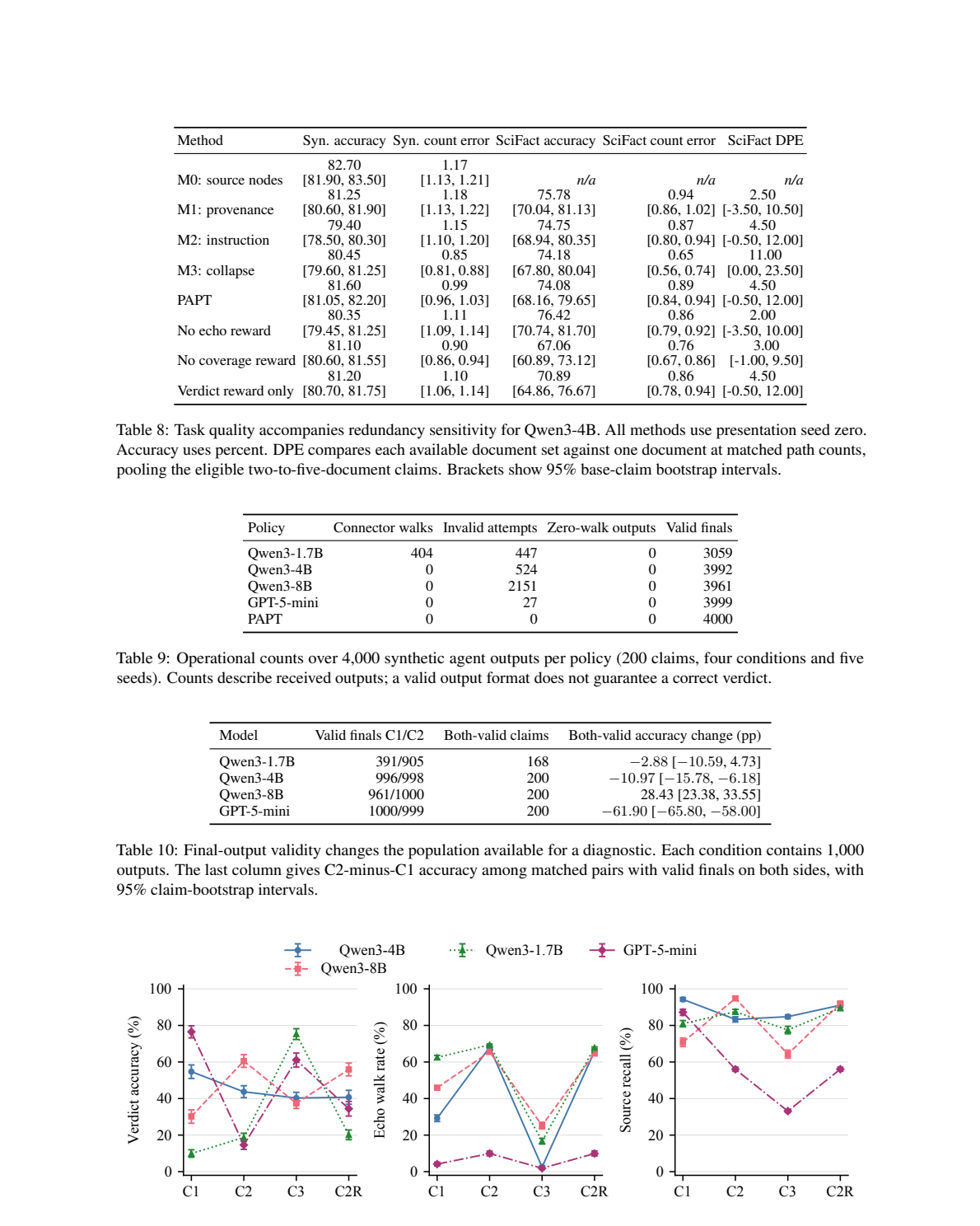
The confidence interval for Qwen3-4B count inflation is reported as [-1.00, -1.00], implying zero variance. Please clarify whether this is a consequence of the model's deterministic output (greedy decoding) or a computational artifact; if the point estimate is exactly -1 for all 200 claims, state this explicitly.
The paper says, at Section 4.3, Eq. (3) and surrounding text
Pith says: minor objection 2 of 3
The definition of the count reward uses Δ and U; the sentence describing Δ is a bit compressed. Expanding it slightly (e.g., Δ = |predicted_support_count - gold_support_count| + |predicted_refute_count - gold_refute_count|) would improve readability.
show 1 more
The paper says, at Figure 2
Pith says: minor objection 3 of 3
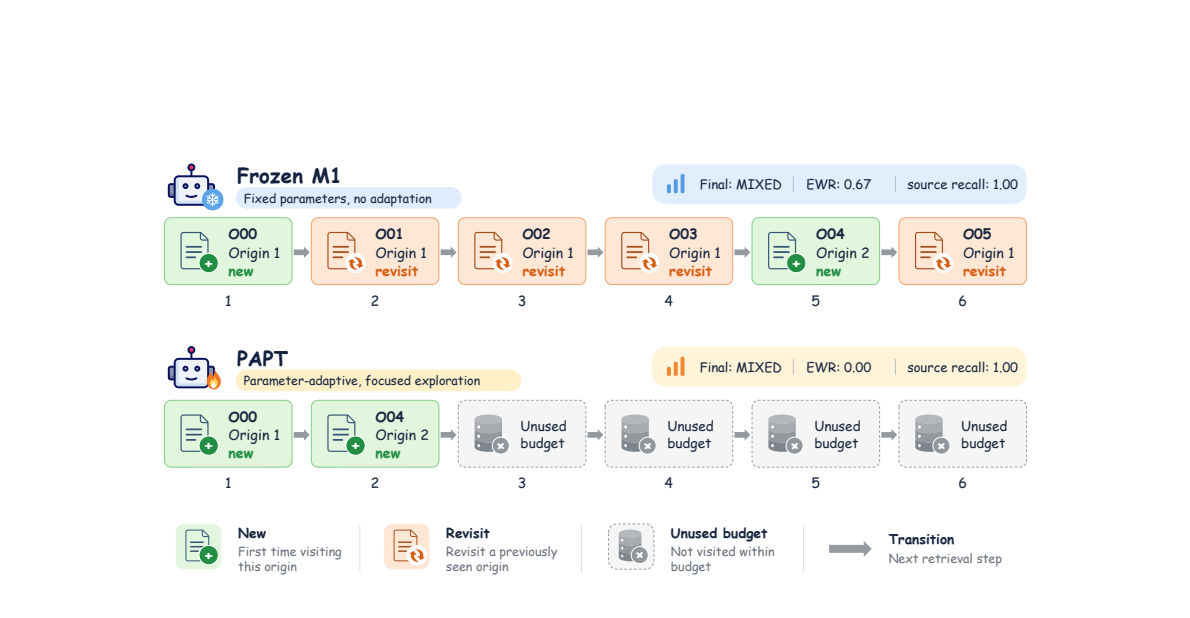
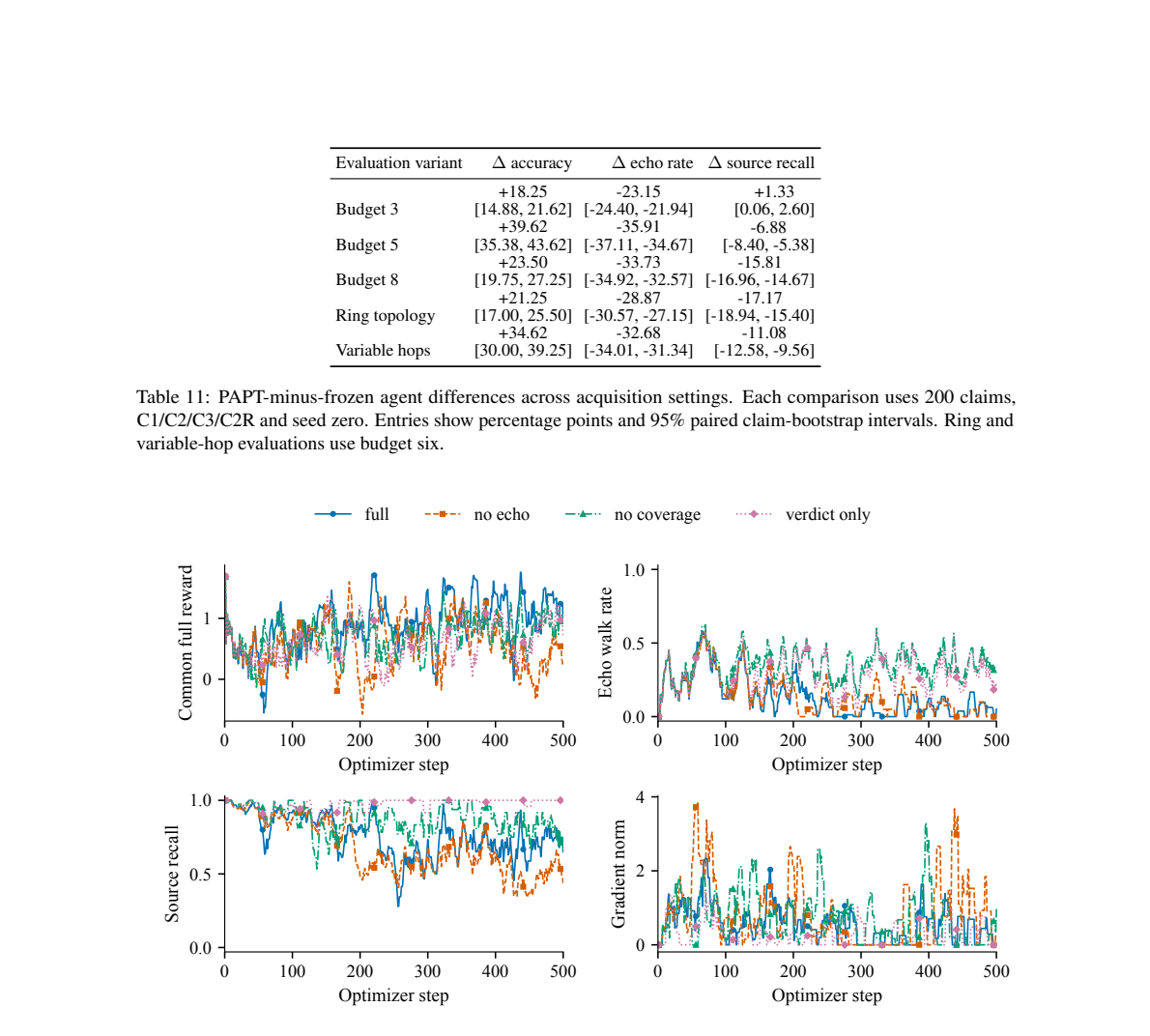
The figure effectively contrasts the frozen and PAPT trajectories. Consider adding the policy name (Frozen M1, PAPT) directly into the figure panel titles or a more prominent caption to make the comparison self-contained.
What would settle it
Train PAPT with an additional random seed (e.g., 123) and recompute Table 5 reward ablations using the same 500 training instances and the same development selection criterion. If the qualitative tradeoffs (synthetic accuracy gain, echo rate reduction, and source recall loss relative to frozen Qwen3-4B) are not reproduced, the conclusions depend on a single training run and the reported intervals understate the uncertainty.
from the skeptic's reading
How the review went
4 readings by deepseek-v4-flash · 17 Sep 2026
- Reader holds up
- Skeptic agrees
- Editor wrote the verdict above
- Referee accept: 3 minor
Not run on this paper: the simulated authors' defence.
Pith did not check this review's objections against the paper.
The review in full
The review in brief, machine-written
The paper delivers what it promises: a cleanly separated test of whether LLM graph agents mistake path multiplicity for evidentiary multiplicity. The central finding—that redundant supporting paths increase echo walk rates across all four frozen models—is well-supported, and the PAPT training tradeoff (reduced echoes but lower coverage and transfer accuracy) is honestly documented. The controlled synthetic benchmark (path lengths matched, evidence wording fixed, representation types held constant) is the main contribution, and it is a good one. The sensitivity checks (ring topology, variable hops, multiple budgets) strengthen confidence that the qualitative patterns are not artifacts of one graph construction. Credit where due: the paper does not oversell. It reports model-dependent judgment shifts, heterogeneous accuracy changes, and the clear tradeoff that better exploration efficiency does not guarantee better evidence use. The limitations section is unusually direct about the single training seed, the equal-weight evidence assumption, and the synthetic nature of the benchmark. The soft spots are real but not load-bearing. The single training seed is the most notable gap, and the authors flag it. The SciFact transfer test is limited to one-document rationales, which constrains what can be claimed about multi-source acquisition in real science. The synthetic graph topologies are deliberately simple, and whether the echo pattern holds in organic, sparser or denser graphs with variable evidence strength is an open question. But these are invitations for follow-up, not flaws that undermine the paper's internal logic. The paper is for researchers working on graph retrieval, evidence-aware exploration, or RAG reliability. A serious referee should engage with it. The experiments are reproducible in principle, the claims are bounded, and the benchmark can be reused. I would take it to a reading group focused on LLM agents. I would cite it if my work touched on redundant retrieval or exploration tradeoffs.
The strongest objection
After close reading, the paper's central argument—that redundant supporting paths increase echo walk rates across frozen agents, and that PAPT trades repeated acquisition against coverage and transfer accuracy—is well-supported by the evidence. The controlled synthetic design matches evidence wording and path templates, and the sensitivity checks (ring topology, variable hops, multiple budgets) show that the tradeoff extends beyond the primary setup. The limitations are explicitly discussed: single training seed, equal-weight evidence labels, and the SciFact gold-rationale setting. No internal inconsistency or missing control undermines the main findings. The weakest assumption, as the reader noted, is the representativeness of the synthetic graph topologies, but the paper provides enough sensitivity analysis to retain confidence in the qualitative patterns. I do not identify a single load-bearing concern that would change the verdict.
The reader identified representativeness of synthetic graphs as the weakest assumption. I agree that it is the weakest link, but the paper partially addresses it through sensitivity analyses (ring topology, variable hops, multiple budgets) which show consistent tradeoffs. The limited training seed is a more actionable concern, but the paper acknowledges it and the claim-bootstrap intervals already condition on the fitted policy. The overall evidence still supports the central claims, and no revision of the ACCEPT verdict is warranted.
The referee's report
The paper makes a clear, well-executed contribution by isolating a specific failure mode—confusing structural redundancy with independent corroboration—that is relevant to the growing use of graph-structured retrieval in LLM agents. The experimental design is careful: it controls evidence content, path length, and source strength, and it measures both static judgments and active exploration. The introduction of echo walk rate as a metric and the sensitivity analysis (ring topology, variable hops, multiple budgets) strengthen the conclusions. The limitations (single training seed, equal-weight evidence, synthetic graph topology) are transparently discussed. If the result stands, it provides a necessary behavioral benchmark for evaluating whether agents actually acquire distinct evidence rather than repeat what they have already seen.
Pith's reading of the paper (a machine's summary, not the authors')
The paper asks whether LLM agents treat multiple graph paths that lead to the same underlying evidence as independent corroboration. Through controlled synthetic graphs, the authors show that redundant supporting paths consistently increase the fraction of repeated visits to the same origin—a measure they call the echo walk rate—across all four frozen agents tested. Training with a provenance-aware reward (PAPT) reduces these repeats and improves synthetic accuracy, but simultaneously decreases the number of distinct sources reached and hurts accuracy on real scientific claims from SciFact. The central insight is that an agent can learn to stop repeating itself while still overlooking important evidence, revealing a gap between efficient exploration and effective evidence acquisition that a single accuracy metric alone cannot capture.
What carries the argument. The central object is the 'echo walk rate' (EWR), the proportion of walk actions that revisit an already-seen evidential origin. The paper builds on a controlled synthetic benchmark (GraphEcho-Syn) that isolates path count from provenance count by holding evidence wording and relation templates constant while varying the number of distinct origins. The training intervention PAPT uses a multi-component reward combining verdict accuracy, provenance counting, coverage, echo penalty, and cost. Together these mechanisms enable measuring both what agents conclude and whether their exploration reaches distinct sources.
Core claim. The paper's core discovery is that structural graph redundancy—multiple paths sharing one evidential origin—causes LLM agents to repeatedly re-acquire the same evidence (echo walks) rather than seeking new sources, and this effect is consistent across model sizes (Qwen3-1.7B, 4B, 8B) and an API model (GPT-5-mini). Furthermore, while provenance-aware post-training (PAPT) can reduce echo walks and improve accuracy on synthetic benchmarks (by 41.5 percentage points over frozen Qwen3-4B), it simultaneously reduces source recall, lowers count accuracy, and hurts transfer accuracy on scientific claims (by 3.6 points on SciFact), exposing a fundamental tradeoff between exploration efficiency and evidence coverage that simple inference-time controls (e.g., collapsing equivalent paths) can partly circumvent.
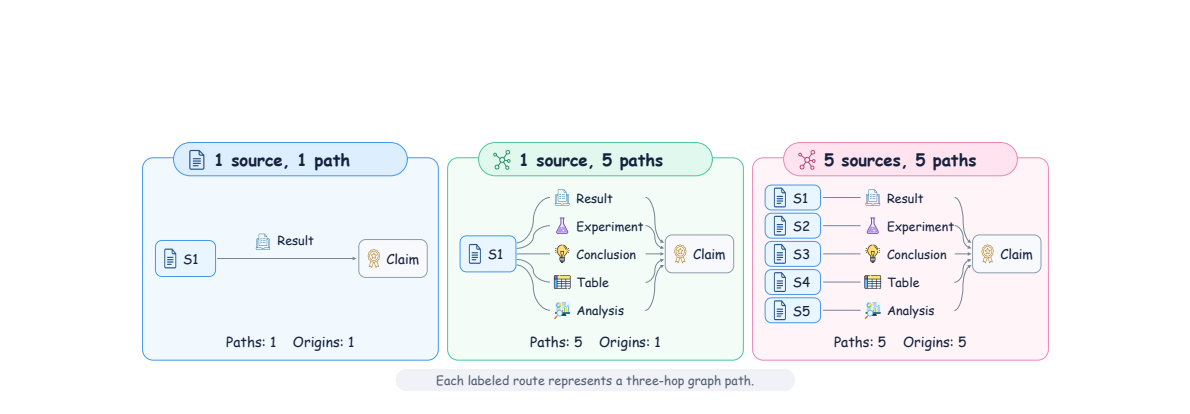
The premise it rests on. The controlled synthetic experiments assume that five representation types (result, experiment, conclusion, table, analysis) and three-hop paths capture how real graph retrieval systems surface redundant evidence; if real graph topologies or content formats differ, the measured echo walk rates and PAPT tradeoffs may not transfer.
If the paper is right (Pith's inferences, not the authors')
Graph retrieval systems that do not track provenance risk inflating agent confidence because structural repeats may be mistaken for independent corroboration, affecting claim verification in applications like scientific fact-checking.
Training rewards that penalize revisits without explicitly rewarding source diversity can produce agents that stop early and miss critical evidence, as shown by PAPT's lower source recall and SciFact accuracy.
Evaluation of graph agents should report both accuracy and acquisition measures (echo walk rate, source recall, walk efficiency) because accuracy alone can mask exploration failures—some frozen agents maintained accuracy while increasing echo walks.
Simple inference-time controls such as collapsing equivalent paths (M3) may offer a more robust and cheaper alternative to learned policies, as M3 eliminated redundant-path sensitivity while preserving source sensitivity and achieved comparable SciFact accuracy to PAPT without the recall cost.
Future work on multi-source scientific graphs must design benchmarks that annotate shared datasets and experiments across papers to test whether agents recognize common empirical origins across documents.
If real-world graph databases (e.g., biomedical knowledge graphs built from multiple extraction pipelines) exhibit similar structural redundancy, then current evaluation practices that only measure answer accuracy may overestimate the true evidence diversity used by deployed agents, potentially leading to overconfident predictions in high-stakes domains.
The finding that PAPT reduces source recall on SciFact raises the possibility that optimizing for echo-avoidance alone could harm performance on tasks requiring broad evidence gathering, such as systematic reviews or literature mining. A testable extension would be to run the same agents on a benchmark that explicitly rewards coverage of distinct experiments across papers.
The paper's controlled synthetic setup uses a single path length (3 hops) and five representation types; extending to variable hop counts or heterogeneous graph topologies in follow-up work could reveal whether the echo effect generalizes or is an artifact of this specific construction. An editorial reader could propose re-running the agent experiments on real citation graphs where papers share da
Check this review
Pith stored no record of this review's passes and took no fingerprint of it. Reviews made by code from 13 Nov 2026 on carry both.
How often reviews like this one are right
Reviews like this one: written by deepseek-v4-flash, where what was read was not recorded.
How often objections from reviews like this one are right: not yet measured
Reviews by people
This review was written by a machine. No person has reviewed this paper on Pith yet. A scientist listed on Pith can review it for a fee, and their review is published here whatever it concludes.
The paper
Abstract
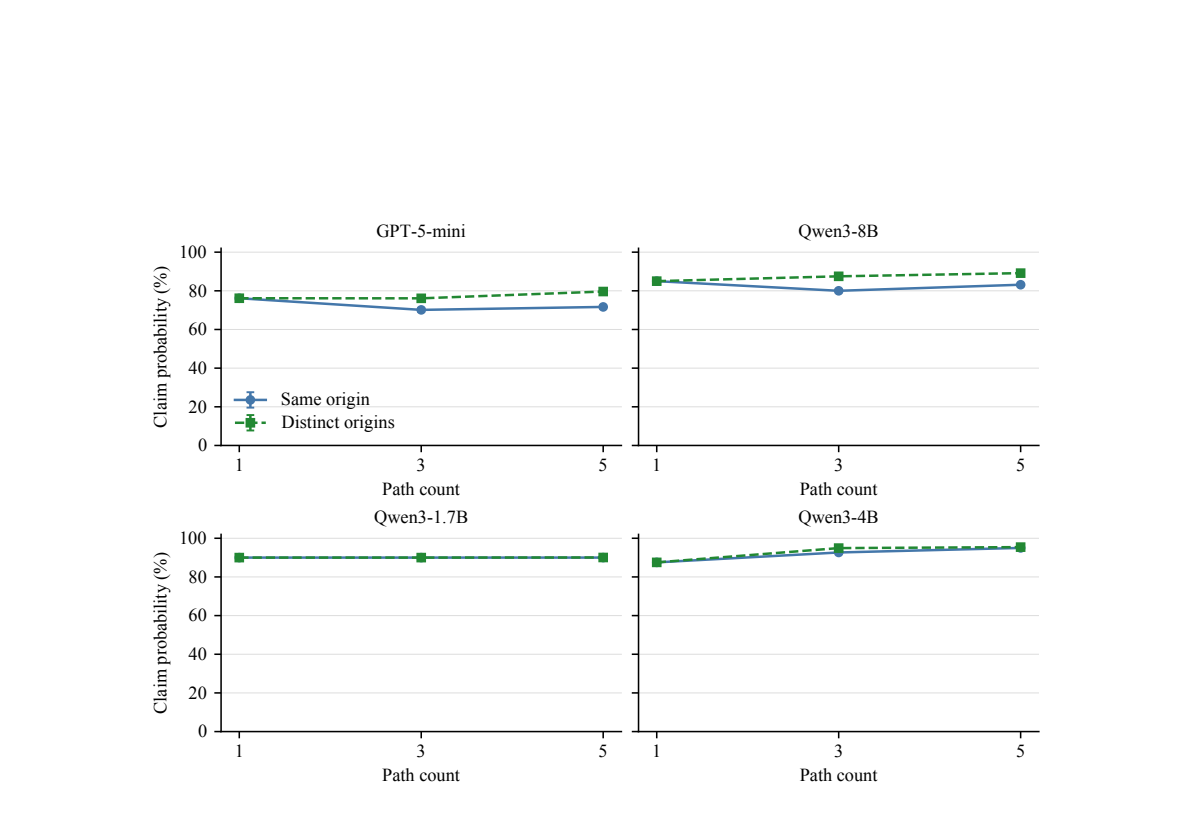
A large language model (LLM) agent can follow more graph paths without acquiring more independent evidence. GraphEcho tests whether agents mistake these repeated encounters for additional corroboration. The benchmark varies path counts and evidential origins while holding evidence content fixed, and evaluates both judgments and active exploration. Controlled synthetic experiments reveal model-dependent judgment shifts, but redundant supporting paths increase the share of repeated walks across all evaluated frozen agents. Provenance-aware post-training (PAPT) reduces revisits and improves synthetic accuracy, yet covers fewer distinct sources. On scientific claims, it continues to reduce repetition while accuracy declines. These findings expose a gap between efficient exploration and effective evidence use: an agent can learn to stop repeating itself while overlooking information it needs. GraphEcho provides a controlled way to evaluate both what graph agents conclude and whether their exploration reaches distinct evidential sources.
The paper's own sentences, arranged, kept beside the review and separate from it. Each label is drawn from a closed vocabulary; the number beside it is the probability the classifier gave that label. No sentence in this record was written by a model.
abstract compiled · 2026-09-23
The authors' main claim, as the classifier picked it out 0.99
“These findings expose a gap between efficient exploration and effective evidence use: an agent can learn to stop repeating itself while overlooking information it needs.”
How the main claim is stated: asserted 0.98
What the abstract itself states, as probabilities: claims first 0.06 · states limitation 0.71 · human participants 0.03 · controlled comparison 0.59 · randomized assignment 0.03 · states quantitative result 0.08 · compares with prior results 0.75 · mentions code or data availability 0.03
The abstract, sentence by sentence
This table labels the abstract only (arXiv listing abstract v1). The number is the probability the classifier gave the label.
| Sentence | Role | The authors' own work | States the main conclusion | Strength |
|---|---|---|---|---|
| A large language model (LLM) agent can follow more graph paths without acquiring more independent evidence. | background 0.89 | 0.23 | 0.25 | asserted 0.75 |
| GraphEcho tests whether agents mistake these repeated encounters for additional corroboration. | contribution 0.94 | 0.72 | 0.04 | asserted 0.69 |
| The benchmark varies path counts and evidential origins while holding evidence content fixed, and evaluates both judgments and active exploration. | method 0.99 | 0.90 | 0.04 | asserted 0.97 |
| Controlled synthetic experiments reveal model-dependent judgment shifts, but redundant supporting paths increase the share of repeated walks across all evaluated frozen agents. | result 1.00 | 0.93 | 0.18 | asserted 1.00 |
| Provenance-aware post-training (PAPT) reduces revisits and improves synthetic accuracy, yet covers fewer distinct sources. | result 0.98 | 0.83 | 0.10 | asserted 1.00 |
| On scientific claims, it continues to reduce repetition while accuracy declines. | result 0.99 | 0.86 | 0.12 | asserted 1.00 |
| These findings expose a gap between efficient exploration and effective evidence use: an agent can learn to stop repeating itself while overlooking information it needs. | interpretation 1.00 | 0.83 | 0.76 | asserted 0.98 |
| GraphEcho provides a controlled way to evaluate both what graph agents conclude and whether their exploration reaches distinct evidential sources. | contribution 0.99 | 0.78 | 0.17 | asserted 1.00 |
What kind of paper the classifier reports this is: dataset or benchmark 0.94 · evidence from observation or experiment 0.83
What was examined, and what was not
Sources read
- arXiv listing abstract v1
Not examined
- full text
- figures and tables
- references and citing sentences
- relations to other papers
Levels run
- P abstract
Not run
- S sections
- T body sentences
- C citations
- R cross-paper relations
How the labels were made
Compiled by classifier-1.13.0 via TypeSafe API, question bank abstract-p1-20260923, 2026-09-23: 1 request, 6,070 input tokens.
Every quoted sentence on this record is the authors'. Every label is from Pith's closed vocabulary, with the probability shown beside it. This record as JSON
Figures (5)
Figures are the authors', reproduced from the paper.
References (3)
- [32] Training samples actions with temperature 0.7 and top-p 0.9. Training uses a zero Kullback– Leibler (KL) coefficient and gradient clipping at norm one. Checkpoint selection compares the poli- cies at training steps 450, 475, and 500. Each candidate receives the same 400-instan... on Pith
- [2022] Rich knowledge sources bring complex knowl- edge conflicts: Recalibrating models to reflect con- flicting evidence. InProceedings of the 2022 Confer- ence on Empirical Methods in Natural Language Processing, EMNLP ’22, pages 2292–2307, Abu Dhabi, United Arab Emirates. Associat... on PithPith's reviewarXiv
- [2023] Enabling large language models to generate text with citations. InProceedings of the 2023 Con- ference on Empirical Methods in Natural Language Processing, EMNLP ’23, pages 6465–6488, Singa- pore. Association for Computational Linguistics. Bernal Jiménez Gutiérrez, Yiheng Shu,... on PithPith's reviewarXiv
Cited by 2 Pith papers
Reviewed papers on Pith that cite this one. The full citation record
Challenges and discussion
Disagree with the review, or know something it missed? Leave a comment, or challenge this review formally: a challenge becomes a permanent entry in this paper's record, and its decision is published here.
Come back by email
A short list of the week's newly reviewed papers. Nothing is sent until you confirm from your inbox, and every email has a link that stops it. No account.
No comments yet.
Sign in to comment