Information Retrieval · arXiv:2611.20034 v1 · submitted 15 Nov 2026 · 54 references
EchoSpec: Training Search Agents to Weigh Evidence Above Echoes
The paper says
“Search agents trained with reinforcement learning decide what to retrieve, when to search again, and when to answer. In real corpora, one claim is copied and paraphrased across many pages while the primary source settling a question appears once.”
more of the abstract
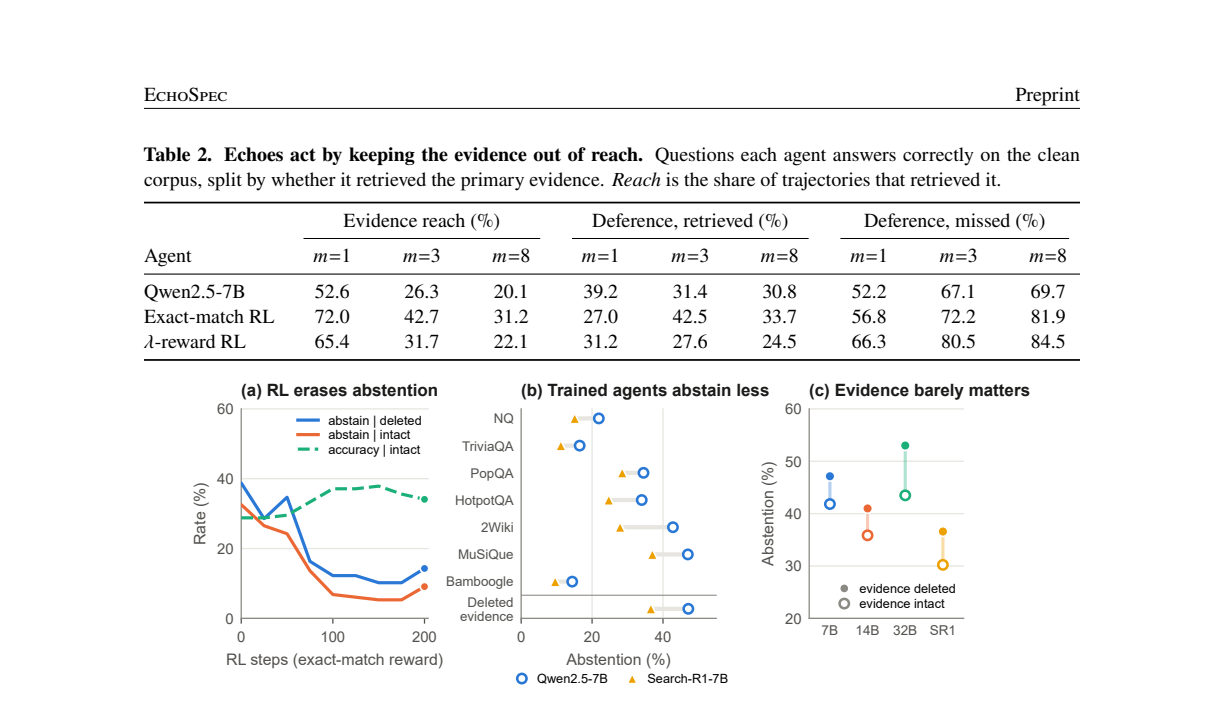
We show that reinforcement-learned search agents grant echoes the credence of independent sources and lose their ability to abstain. Across five base models from 3B to 32B and seven released RL agents on multi-hop Wikipedia questions with primary evidence intact, eight paraphrased false-claim echoes overturn 58-73% of previously correct answers, while exact-match RL drives deleted-evidence abstention below 15%. Conditioning on retrieval localizes the failure to evidence acquisition: once primary evidence enters context, agents overrule eight echoes as reliably as one, whereas echoes fill top ranks and halt search early, so larger budgets, forced search turns, or passive passage filtering alone fail to recover displaced evidence. We introduce EchoSpec, specifying reliability across five corpus transformations with known target answers and training in two stages. Verification warm-start teaches multi-hop bridge-entity recovery past echoes, after which group RL optimizes an evidence-gated λ-reward with an outcome-independent acquisition bonus and scale-preserving advantages retaining the optimal rule λ/(1 + λ). Across Qwen2.5-3B, Qwen2.5-7B, and Llama-3.1-8B backbones on nine evaluation suites, EchoSpec cuts eight-echo deference by 30-44 points on Qwen2.5-7B down to 29-31%, nearly quadruples eight-echo reach to 26-27% with zero-shot transfer to unseen BGE and BM25 retrievers, and raises standalone QA precision to 47-55%. Code is publicly available at https://github.com/unihsy/EchoSpec.
from the abstract
Pith says
Machine review · deepseek-v4-flash · 17 Nov 2026 · read the full text (103,472 characters) · not checked by a person
It can be wrong. Challenge this review or reply to it.
Holds up, with conditions. EchoSpec shows that RL-trained search agents mistake repeated claims for corroboration and lose the ability to abstain, and introduces a two-stage training method that substantially fixes both problems on Wikipedia-scale benchmarks. This line is wrong
no objections raised
How often objections from reviews like this one are right: not yet measured
The paper, first character to last
The reviewer was given the whole text, 103,472 characters. Not checked: figures, code, what the 54 references say.
What would settle it
A live web search experiment with the same EchoSpec-trained agents on real queries where a false claim is widely syndicated (e.g., a hoax news story) and the primary source is a single authoritative page: if the agent defers to the echo majority or fails to abstain when the primary source is deleted, the central claim that EchoSpec generalizes beyond controlled Wikipedia worlds would be contradicted.
from Pith's summary of the paper
How the review went
5 passes by deepseek-v4-flash · 17 Nov 2026
- Reader holds up, with conditions
- Skeptic concern not confirmed: listed as an open question
- Referee no objections raised
- Check against the paper kept 0 of 1 objection
- Editor wrote the verdict above
Not run on this paper: the simulated authors' defence.
Pith's passes raised 1 objection. A check against the paper's text kept 0 and left 1 as a question.
The review in full
The review in brief, machine-written
This paper identifies a real vulnerability in RL-trained search agents: when a false claim appears in many paraphrased copies across a corpus, the agent treats the copies as independent evidence, stops searching early, and answers incorrectly. The authors also show that standard exact-match rewards erase the agent's ability to abstain when evidence is missing. Both findings are clearly demonstrated through controlled corpus transformations on multi-hop Wikipedia questions.
The main contribution is EchoSpec, a two-stage training method. Stage 1 uses guided trajectory synthesis to teach the agent to search past early echoes and verify claims against primary evidence. Stage 2 uses a carefully designed reward that prices wrong answers and includes an acquisition bonus for retrieving evidence, with a modification to standard advantage normalization that preserves the reward's abstention threshold. The empirical evaluation is extensive: multiple backbones (3B to 8B), seven released RL agents, five defenses, nine evaluation suites, and zero-shot transfer to unseen retrievers. The gains are large and consistent.
The soft spots are worth noting. The evaluation is on a fixed Wikipedia corpus with a controlled retriever; the authors acknowledge that live web search adds dynamic rankings and adversarial content not tested here. The training relies on multi-hop questions with known primary evidence passages, which limits direct applicability to open-ended search. Several key tables are included via \input commands from external files, so the numerical results cannot be verified from the manuscript alone. Some cited works are from 2026 and may not be peer-reviewed.
This paper is for researchers working on search agents, retrieval-augmented generation, and robustness of RL-trained systems. It deserves a serious referee. The core claims are well-supported by the controlled experiments described in the text, and the method is practical. The missing table data should be provided before final acceptance.
The stress test's concern
Not confirmed. Pith could not check this concern against the text of the paper it was given; it is listed as an open question, not a finding.
The referee's report
If the results hold, the paper identifies a significant vulnerability in RL-trained search agents and proposes a practical mitigation. The controlled audit and the proposed method are well-motivated. The evaluation is extensive, covering multiple backbones, baselines, and ablations.
Pith's reading of the paper (a machine's summary, not the authors')
The authors show that search agents trained with reinforcement learning on standard QA corpora systematically treat paraphrased copies of a false claim as independent corroboration, overturning 58–73% of previously correct answers when eight such echoes are present. They trace the failure to premature search termination: echoes fill the top retrieval ranks and halt the search before primary evidence is reached. The same training erodes the agent's ability to abstain when evidence is missing, because binary exact-match rewards price wrong guesses and refusals identically. The paper introduces EchoSpec, a two-stage training method that first teaches multi-hop verification past echoes via guided trajectory synthesis, then optimizes a reward that prices wrong answers with a tunable parameter λ and includes an evidence-acquisition bonus that does not distort the optimal abstention threshold. Across three backbone models and nine evaluation suites, EchoSpec cuts eight-echo deference from 58–73% down to 29–31%, nearly quadruples the rate at which primary evidence is retrieved under echoes, and raises QA precision to 47–55%.
What carries the argument. The central mechanism is the λ-calibrated reward function (Eq. 1) together with the scale-preserving advantage estimation that avoids standard GRPO's std-normalization, which the paper proves erases λ from the objective. The reward assigns +1 for grounded correct answers or correct abstention, 0 for abstention on answerable worlds, and -λ for wrong answers. The acquisition bonus β_acq·φ(D) depends only on the retrieved set D, not the answer, so it cancels from the answering-vs-abstaining decision and leaves the threshold λ/(1+λ) intact. The verification warm-start (Stage 1) uses chain-guided trajectory synthesis to produce demonstrations of multi-hop bridge-entity recovery past Turn-1 echoes, which are then distilled via LoRA SFT.
Core claim. The paper establishes that the vulnerability of RL-trained search agents to echo-chamber effects is not a failure of evidence evaluation once evidence is in context, but a failure of evidence acquisition: echoes cause the agent to stop searching early. It further shows that standard outcome-reward RL (exact match) systematically removes abstention behavior because the reward function treats wrong guesses and refusals identically, creating a threshold of zero for answering. The paper then demonstrates that both problems can be addressed simultaneously by (i) a warm-start that seeds multi-hop verification trajectories past echoes, and (ii) a λ-calibrated group RL objective with an evidence-acquisition bonus and scale-preserving advantages that preserve the optimal answering threshold λ/(1+λ).
The premise it rests on. The training and evaluation rely on a controlled Wikipedia corpus (wiki-18) with a fixed retriever (e5-base-v2) and multi-hop questions where primary evidence passages and bridge entities are known in advance; the paper acknowledges that live web search introduces dynamic rankings, SEO manipulation, and compromised sources not tested here.
If the paper is right (Pith's inferences, not the authors')
If the paper's analysis is correct, any RL-trained search agent trained with binary outcome rewards on clean corpora will be vulnerable to echo-chamber effects and will lose abstention capability, regardless of model scale.
The λ-calibrated reward framework provides a principled way to control the precision-coverage tradeoff in search agents via a single parameter with a known closed-form threshold.
The finding that evidence acquisition (not evaluation) is the bottleneck suggests that defenses operating on already-retrieved passages (filtering, debate, provenance gating) cannot fully address echo-chamber effects; the search policy itself must be changed.
The zero-shot transfer to unseen retrievers (BGE, BM25) suggests that EchoSpec learns a retriever-agnostic verification strategy rather than overfitting to a specific embedding space.
The paper's controlled corpus transformations (Inject, Consistent, Dup, Rewrite, Delete) could serve as a general benchmark for evaluating search agent robustness to misinformation and missing evidence, beyond the specific echo-chamber setting.
The result that standard advantage normalization erases the risk penalty λ from the objective (Proposition 2) is a general critique of GRPO-style training for any task where calibrated risk aversion is desired, not just search.
The paper's evidence that model scale (7B vs 32B) does not reduce echo deference suggests that scaling alone will not solve this class of failure; targeted training interventions are necessary.
The abstention calibration results (EchoSpec abstains on items where baselines err at 78–80% error rate) suggest that the λ-reward framework could be applied to other selective prediction settings beyond search agents.
Check this review
What was read
The passes were given all 103,472 characters of the paper's LaTeX source.
Fingerprint of that text (SHA-256): 7af83c08f621dedfe37014aa09211ced3fb9f08b91f7701dd4096326f2a79502
Pith does not keep that text. Rebuilt from the paper's source or PDF by the same code, it has this fingerprint if it is the same text. From a copy of Pith's code:
PYTHONPATH=. python scripts/review_input_check.py 2611.20034
The passes, in the order they ran
- Reader deepseek-v4-flash · medium effort · $0.0041 · instructions of the Reader, fingerprint f9ead7300382…
- Skeptic deepseek-v4-flash · medium effort · $0.0034 · instructions of the Skeptic, fingerprint 8f88c0f61488…
- Referee deepseek-v4-flash · medium effort · $0.0034 · instructions of the Referee, fingerprint a852d99aea0d…
- Check against the paper deepseek-v4-flash · medium effort · $0.0050 · instructions of the Check against the paper, fingerprint 6c7a6883d551…
- Editor deepseek-v4-flash · medium effort · $0.0034 · instructions of the Editor, fingerprint e7211f6a3d27…
- Circularity check deepseek-v4-flash · medium effort · $0.0033 · instructions of the Circularity check, fingerprint e9946e39d67b…
- Summary for the page deepseek-v4-flash · medium effort · temperature 0.2 · $0.0037 · instructions of the Summary for the page, fingerprint e4f56bf568e7…
The passes cost $0.026 in model calls together.
Version stamped on this review: pith-pipeline@v1.4.1-daily-deepseek-or-medium+deepseek/deepseek-v4-flash+p.d60f54226f00
Each link opens a pass's instructions as plain text, the exact bytes its fingerprint was taken over. Every stored set of instructions.
curl -s https://pith.science/methodology/prompts/f9ead730038216984cfb56d7cb34332bdf691828296a1de4245f3d6667d4bf56 | sha256sum
prints the fingerprint of the reader's instructions. The same works for every pass.
The receipt
The review's fingerprint was taken on 17 Nov 2026. The review you are reading still matches it.
Fingerprint of the review (SHA-256): 0f2ab6cdd83444b8ab1bb6dd63a6848e686001d377e4bd4673e29044f20ef258
curl -s 'https://pith.science/api/v1/verdicts/2611.20034?form=canonical' | sha256sum
prints the fingerprint of the review as it stands now. The rule, in four steps.
A matching fingerprint shows the review has not changed since that date. It does not show that the review is right.
How often reviews like this one are right
Reviews like this one: written by deepseek-v4-flash, from the paper's LaTeX source.
How often objections from reviews like this one are right: not yet measured
Reviews by people
This review was written by a machine. No person has reviewed this paper on Pith yet. A scientist listed on Pith can review it for a fee, and their review is published here whatever it concludes.
The paper
Abstract
Search agents trained with reinforcement learning decide what to retrieve, when to search again, and when to answer. In real corpora, one claim is copied and paraphrased across many pages while the primary source settling a question appears once. We show that reinforcement-learned search agents grant echoes the credence of independent sources and lose their ability to abstain. Across five base models from 3B to 32B and seven released RL agents on multi-hop Wikipedia questions with primary evidence intact, eight paraphrased false-claim echoes overturn 58-73% of previously correct answers, while exact-match RL drives deleted-evidence abstention below 15%. Conditioning on retrieval localizes the failure to evidence acquisition: once primary evidence enters context, agents overrule eight echoes as reliably as one, whereas echoes fill top ranks and halt search early, so larger budgets, forced search turns, or passive passage filtering alone fail to recover displaced evidence. We introduce EchoSpec, specifying reliability across five corpus transformations with known target answers and training in two stages. Verification warm-start teaches multi-hop bridge-entity recovery past echoes, after which group RL optimizes an evidence-gated λ-reward with an outcome-independent acquisition bonus and scale-preserving advantages retaining the optimal rule λ/(1 + λ). Across Qwen2.5-3B, Qwen2.5-7B, and Llama-3.1-8B backbones on nine evaluation suites, EchoSpec cuts eight-echo deference by 30-44 points on Qwen2.5-7B down to 29-31%, nearly quadruples eight-echo reach to 26-27% with zero-shot transfer to unseen BGE and BM25 retrievers, and raises standalone QA precision to 47-55%. Code is publicly available at https://github.com/unihsy/EchoSpec.
The paper's own sentences, arranged, kept beside the review and separate from it. Each label is drawn from a closed vocabulary; the number beside it is the probability the classifier gave that label. No sentence in this record was written by a model.
abstract compiled · 2026-11-17
The authors' main claim, as the classifier picked it out 0.87
“We show that reinforcement-learned search agents grant echoes the credence of independent sources and lose their ability to abstain.”
How the main claim is stated: asserted 1.00
What the abstract itself states, as probabilities: claims first 0.06 · states limitation 0.27 · human participants 0.03 · controlled comparison 0.88 · randomized assignment 0.03 · states quantitative result 0.99 · compares with prior results 0.95 · mentions code or data availability 0.98
The abstract, sentence by sentence
This table labels the abstract only (arXiv listing abstract v1). The number is the probability the classifier gave the label.
| Sentence | Role | The authors' own work | States the main conclusion | Strength |
|---|---|---|---|---|
| Search agents trained with reinforcement learning decide what to retrieve, when to search again, and when to answer. | background 1.00 | 0.07 | 0.02 | asserted 0.99 |
| In real corpora, one claim is copied and paraphrased across many pages while the primary source settling a question appears once. | background 1.00 | 0.09 | 0.03 | asserted 1.00 |
| We show that reinforcement-learned search agents grant echoes the credence of independent sources and lose their ability to abstain. | result 0.94 | 0.88 | 0.79 | asserted 1.00 |
| Across five base models from 3B to 32B and seven released RL agents on multi-hop Wikipedia questions with primary evidence intact, eight paraphrased false-claim echoes overturn 58-73% of previously correct answers, while exact-match RL drives deleted-evidence abstention below 15%. | result 1.00 | 0.94 | 0.34 | asserted 1.00 |
| Conditioning on retrieval localizes the failure to evidence acquisition: once primary evidence enters context, agents overrule eight echoes as reliably as one, whereas echoes fill top ranks and halt search early, so larger budgets, forced search turns, or passive passage filtering alone fail to recover displaced evidence. | result 0.67 | 0.92 | 0.17 | asserted 1.00 |
| We introduce EchoSpec, specifying reliability across five corpus transformations with known target answers and training in two stages. | contribution 0.72 | 0.94 | 0.05 | asserted 0.96 |
| Verification warm-start teaches multi-hop bridge-entity recovery past echoes, after which group RL optimizes an evidence-gated $\lambda$-reward with an outcome-independent acquisition bonus and scale-preserving advantages retaining the optimal rule $\lambda/(1+\lambda)$. | method 0.99 | 0.93 | 0.07 | asserted 0.97 |
| Across Qwen2.5-3B, Qwen2.5-7B, and Llama-3.1-8B backbones on nine evaluation suites, EchoSpec cuts eight-echo deference by 30-44 points on Qwen2.5-7B down to 29-31%, nearly quadruples eight-echo reach to 26-27% with zero-shot transfer to unseen BGE and BM25 retrievers, and raises standalone QA precision to 47-55%. | result 1.00 | 0.96 | 0.27 | asserted 1.00 |
| Code is publicly available at https://github.com/unihsy/EchoSpec. | contribution 0.88 | 0.48 | 0.02 | asserted 0.90 |
What kind of paper the classifier reports this is: method or tool 0.99 · evidence from observation or experiment 0.97
What was examined, and what was not
Sources read
- arXiv listing abstract v1
Not examined
- full text
- figures and tables
- references and citing sentences
- relations to other papers
Levels run
- P abstract
Not run
- S sections
- T body sentences
- C citations
- R cross-paper relations
How the labels were made
Compiled by classifier-1.13.0 via TypeSafe API, question bank abstract-p1-20260923, 2026-11-17: 1 request, 7,289 input tokens.
Every quoted sentence on this record is the authors'. Every label is from Pith's closed vocabulary, with the probability shown beside it. This record as JSON
Figures (5)




Figures are the authors', reproduced from the paper.
References (54)
- [1] MarahAbdin,JyotiAneja,HarkiratBehl,SébastienBubeck,RonenEldan,SuriyaGunasekar,Michael Harrison, Russell J. Hewett, Mojan Javaheripi, Piero Kauffmann, James R. Lee, Yin Tat Lee, Yuanzhi Li, Weishung Liu, Caio C. T. Mendes, Anh Nguyen, Eric Price, Gustavo de Rosa, Olli Saarikivi... on PithPith's reviewarXiv
- [2] Martin Arjovsky, Léon Bottou, Ishaan Gulrajani, and David Lopez-Paz. Invariant risk minimization. arXiv preprint arXiv:1907.02893, 2019 on PithPith's reviewarXiv
- [3] Akari Asai, Zeqiu Wu, Yizhong Wang, Avirup Sil, and Hannaneh Hajishirzi. Self-RAG: Learning to retrieve, generate, and critique through self-reflection. InInternational Conference on Learning Representations, 2024 on Pith
- [4] Mingyang Chen, Linzhuang Sun, Tianpeng Li, Haoze Sun, Yijie Zhou, Chenzheng Zhu, Haofen Wang, Jeff Z. Pan, Wen Zhang, Huajun Chen, Fan Yang, Zenan Zhou, and Weipeng Chen. ReSearch: LearningtoreasonwithsearchforLLMsviareinforcementlearning.InAdvancesinNeuralInformation Processi... on Pith
- [5] Yujia Chen, Yuhui Wang, Junzhe Wang, Shihan Dou, Di Liang, Yujiong Shen, Yuhao Zhou, Zhiheng Xi, Ming Zhang, Senjie Jin, Jiayi Chen, Dingwei Zhu, Yajie Yang, Yuan Hua, Chenyao Lu, Tao Gui, QiZhang,andXuanjingHuang. QREF:Improvingdeepsearchagentsbyaligningsearchwithreasoning vi... on PithPith's reviewarXiv
- [6] Ran El-Yaniv and Yair Wiener. On the foundations of noise-free selective classification.Journal of Machine Learning Research, 11:1605–1641, 2010 on Pith
- [7] LisaK.Fazio,NadiaM.Brashier,B.KeithPayne,andElizabethJ.Marsh. Knowledgedoesnotprotect against illusory truth.Journal of Experimental Psychology: General, 144(5):993–1002, 2015 on Pith
- [8] Shangbin Feng, Weijia Shi, Yike Wang, Wenxuan Ding, Vidhisha Balachandran, and Yulia Tsvetkov. Don’thallucinate,abstain: IdentifyingLLMknowledgegapsviamulti-LLMcollaboration. InProceed- ings of ACL, 2024 on Pith
- [9] Yonatan Geifman and Ran El-Yaniv. Selective classification for deep neural networks. InAdvances in Neural Information Processing Systems, 2017 on Pith
- [10] RobertGeirhos,Jörn-HenrikJacobsen,ClaudioMichaelis,RichardZemel,WielandBrendel,Matthias Bethge, and Felix A. Wichmann. Shortcut learning in deep neural networks.Nature Machine Intelli- gence, 2020 on Pith
- [11] Aaron Grattafiori, Abhimanyu Dubey, Abhinav Jauhri, Abhinav Pandey, Abhishek Kadian, Ahmad Al-Dahle, Aiesha Letman, Akhil Mathur, Alan Schelten, Alex Vaughan, and Llama Team, AI @ Meta. The Llama 3 herd of models.arXiv preprint arXiv:2407.21783, 2024 on PithPith's reviewarXiv
- [12] Lynn Hasher, David Goldstein, and Thomas Toppino. Frequency and the conference of referential validity.Journal of Verbal Learning and Verbal Behavior, 16(1):107–112, 1977 on Pith
- [13] Xanh Ho, Anh-Khoa Duong Nguyen, Saku Sugawara, and Akiko Aizawa. Constructing a multi-hop QA dataset for comprehensive evaluation of reasoning steps. InProceedings of COLING, 2020. 10 EchoSpec Preprint on Pith
- [14] Edward J. Hu, Yelong Shen, Phillip Wallis, Zeyuan Allen-Zhu, Yuanzhi Li, Shean Wang, Lu Wang, andWeizhuChen. LoRA:Low-rankadaptationoflargelanguagemodels. InInternationalConference on Learning Representations, 2022 on Pith
- [15] Bowen Jin, Hansi Zeng, Zhenrui Yue, Jinsung Yoon, Sercan Arik, Dong Wang, Hamed Zamani, and Jiawei Han. Search-R1: Training LLMs to reason and leverage search engines with reinforcement learning.arXiv preprint arXiv:2503.09516, 2025 on PithPith's reviewarXiv
- [16] Mandar Joshi, Eunsol Choi, Daniel S. Weld, and Luke Zettlemoyer. TriviaQA: A large scale distantly supervised challenge dataset for reading comprehension. InProceedings of ACL, 2017 on Pith
- [17] Saurav Kadavath, Tom Conerly, Amanda Askell, Tom Henighan, Dawn Drain, Ethan Perez, Nicholas Schiefer, Zac Hatfield-Dodds, Nova DasSarma, Eli Tran-Johnson, Scott Johnston, Sheer El-Showk, Andy Jones, Nelson Elhage, Tristan Hume, Anna Chen, Yuntao Bai, Sam Bowman, Stanislav For... on PithPith's reviewarXiv
- [18] Adam Tauman Kalai, Ofir Nachum, Santosh S. Vempala, and Edwin Zhang. Why language models hallucinate.arXiv preprint arXiv:2509.04664, 2025 on PithPith's reviewarXiv
- [19] Amita Kamath, Robin Jia, and Percy Liang. Selective question answering under domain shift. In Proceedings of ACL, 2020 on Pith
- [20] VladimirKarpukhin,BarlasOğuz,SewonMin,PatrickLewis,LedellWu,SergeyEdunov,DanqiChen, and Wen-tau Yih. Dense passage retrieval for open-domain question answering. InProceedings of EMNLP, 2020 on Pith
show 34 more
- [21] DivyanshKaushik,EduardHovy,andZacharyLipton. Learningthedifferencethatmakesadifference withcounterfactually-augmenteddata. InInternationalConferenceonLearningRepresentations,2020 on Pith
- [22] Tom Kwiatkowski, Jennimaria Palomaki, Olivia Redfield, Michael Collins, Ankur Parikh, Chris Al- berti, Danielle Epstein, Illia Polosukhin, Jacob Devlin, Kenton Lee, Kristina Toutanova, Llion Jones, Matthew Kelcey, Ming-Wei Chang, Andrew M. Dai, Jakob Uszkoreit, Quoc Le, and Sl... on Pith
- [23] Shayne Longpre, Kartik Perisetla, Anthony Chen, Nikhil Ramesh, Chris DuBois, and Sameer Singh. Entity-based knowledge conflicts in question answering. InProceedings of EMNLP, 2021 on Pith
- [24] Alex Mallen, Akari Asai, Victor Zhong, Rajarshi Das, Daniel Khashabi, and Hannaneh Hajishirzi. When not to trust language models: Investigating effectiveness of parametric and non-parametric memories. InProceedings of ACL, 2023 on Pith
- [25] Jun Nie, Zhiqin Yang, Zhenheng Tang, Yonggang Zhang, Xiaowen Chu, Xinmei Tian, and Bo Han. DRNOISE: Benchmarking deep research agents in misleading evidence environments.arXiv preprint arXiv:2607.17291, 2026 on PithPith's reviewarXiv
- [26] YikangPan,LiangmingPan,WenhuChen,PreslavNakov,Min-YenKan,andWilliamYangWang. On the risk of misinformation pollution with large language models. InFindings of EMNLP, 2023. 11 EchoSpec Preprint on Pith
- [27] Ofir Press, Muru Zhang, Sewon Min, Ludwig Schmidt, Noah A. Smith, and Mike Lewis. Measuring and narrowing the compositionality gap in language models. InFindings of EMNLP, 2023 on Pith
- [28] Stephen Robertson and Hugo Zaragoza. The probabilistic relevance framework: BM25 and beyond. Foundations and Trends in Information Retrieval, 3(4):333–389, 2009 on Pith
- [29] ZhihongShao,PeiyiWang,QihaoZhu,RunxinXu,JunxiaoSong,XiaoBi,HaoweiZhang,Mingchuan Zhang,Y.K.Li,Y.Wu,andDayaGuo. DeepSeekMath: Pushingthelimitsofmathematicalreasoning in open language models.arXiv preprint arXiv:2402.03300, 2024 on PithPith's reviewarXiv
- [30] Yaorui Shi, Sihang Li, Chang Wu, Zhiyuan Liu, Junfeng Fang, Hengxing Cai, An Zhang, and Xiang Wang. Search and refine during think: Facilitating knowledge refinement for improved retrieval- augmented reasoning. InAdvances in Neural Information Processing Systems, 2025 on Pith
- [31] Huatong Song, Jinhao Jiang, Yingqian Min, Jie Chen, Zhipeng Chen, Wayne Xin Zhao, Lei Fang, and Ji-Rong Wen. R1-Searcher: Incentivizing the search capability in LLMs via reinforcement learning. arXiv preprint arXiv:2503.05592, 2025 on PithPith's reviewarXiv
- [32] LinxinSong,TaiweiShi,andJieyuZhao.Thehallucinationtaxofreinforcementfinetuning.InFindings of the Association for Computational Linguistics: EMNLP 2025, pages 2105–2120, 2025 on Pith
- [33] HaoSun,ZileQiao,JiayanGuo,XuanboFan,YingyanHou,YongJiang,PengjunXie,YanZhang,Fei Huang, and Jingren Zhou. ZeroSearch: Incentivize the search capability of LLMs without searching. arXiv preprint arXiv:2505.04588, 2025 on PithPith's reviewarXiv
- [34] Harsh Trivedi, Niranjan Balasubramanian, Tushar Khot, and Ashish Sabharwal. MuSiQue: Multihop questions via single-hop question composition.Transactions of the Association for Computational Linguistics, 2022 on Pith
- [35] Harsh Trivedi, Niranjan Balasubramanian, Tushar Khot, and Ashish Sabharwal. Interleaving retrieval with chain-of-thought reasoning for knowledge-intensive multi-step questions. InProceedings of ACL, 2023 on Pith
- [36] Han Wang, Archiki Prasad, Elias Stengel-Eskin, and Mohit Bansal. Retrieval-augmented generation with conflicting evidence.arXiv preprint arXiv:2504.13079, 2025 on PithPith's reviewarXiv
- [37] Liang Wang, Nan Yang, Xiaolong Huang, Binxing Jiao, Linjun Yang, Daxin Jiang, Rangan Ma- jumder,andFuruWei. Textembeddingsbyweakly-supervisedcontrastivepre-training.arXivpreprint arXiv:2212.03533, 2022 on PithPith's reviewarXiv
- [38] Sikun Wang, Yixi Zhou, Lei Fan, and Fan Zhang. GraphEcho: Structural redundancy and evidence provenance in LLM graph agents.arXiv preprint arXiv:2609.17695, 2026 on PithPith's reviewarXiv
- [39] BingbingWen,JihanYao,ShangbinFeng,ChenjunXu,YuliaTsvetkov,BillHowe,andLucyLuWang. Know your limits: A survey of abstention in large language models.Transactions of the Association for Computational Linguistics, 13, 2025 on Pith
- [40] KevinWu,EricWu,andJamesZou. ClashEval: Quantifyingthetug-of-warbetweenanLLM’sinternal prior and external evidence. InNeurIPS Datasets and Benchmarks Track, 2024 on Pith
- [41] Chong Xiang, Tong Wu, Zexuan Zhong, David Wagner, Danqi Chen, and Prateek Mittal. Certifiably robust RAG against retrieval corruption.arXiv preprint arXiv:2405.15556, 2024. 12 EchoSpec Preprint on PitharXiv
- [42] Shitao Xiao, Zheng Liu, Peitian Zhang, Niklas Muennighoff, Defu Lian, and Jian-Yun Nie. C-Pack: Packed resources for general chinese embeddings. InProceedings of SIGIR, 2024 on Pith
- [43] Jian Xie, Kai Zhang, Jiangjie Chen, Renze Lou, and Yu Su. Adaptive chameleon or stubborn sloth: Revealing the behavior of large language models in knowledge conflicts. InInternational Conference on Learning Representations, 2024 on Pith
- [44] Rongwu Xu, Zehan Qi, Zhijiang Guo, Cunxiang Wang, Hongru Wang, Yue Zhang, and Wei Xu. Knowledge conflicts for LLMs: A survey. InProceedings of EMNLP, 2024 on Pith
- [45] Shi-Qi Yan, Jia-Chen Gu, Yun Zhu, and Zhen-Hua Ling. Corrective retrieval augmented generation. arXiv preprint arXiv:2401.15884, 2024 on PithPith's reviewarXiv
- [46] AnYang, AnfengLi, BaosongYang, BeichenZhang, BinyuanHui, BoZheng, BowenYu, ChangGao, Chengen Huang, Chenxu Lv, Chujie Zheng, Dayiheng Liu, Fan Zhou, Fei Huang, Feng Hu, Hao Ge, HaoranWei,HuanLin,JialongTang,JianYang,JianhongTu,JianweiZhang,JianxinYang,JiaxiYang, Jing Zhou, Jin... on PithPith's reviewarXiv
- [47] AnYang,BaosongYang,BeichenZhang,BinyuanHui,BoZheng,BowenYu,ChengyuanLi,Dayiheng Liu, Fei Huang, Haoran Wei, Huan Lin, Jian Yang, Jianhong Tu, Jianwei Zhang, Jianxin Yang, Jiaxi Yang, Jingren Zhou, Junyang Lin, Kai Dang, Keming Lu, Keqin Bao, Kexin Yang, Le Yu, Mei Li, Mingfeng... on PithPith's reviewarXiv
- [48] ZhilinYang,PengQi,SaizhengZhang,YoshuaBengio,WilliamW.Cohen,RuslanSalakhutdinov,and Christopher D. Manning. HotpotQA: A dataset for diverse, explainable multi-hop question answering. InProceedings of EMNLP, 2018 on Pith
- [49] Fengji Zhang, Tianyu Fan, Yuxiang Zheng, Xinyao Niu, Chengen Huang, Jacky Keung, and Bei Chen. To answer or to abstain: Mitigating search-agent hallucinations via abstention-aware reinforcement learning.arXiv preprint arXiv:2607.10738, 2026 on PithPith's reviewarXiv
- [50] HanningZhang,ShizheDiao,YongLin,YiR.Fung,QingLian,XingyaoWang,YangyiChen,HengJi, and Tong Zhang. R-Tuning: Instructing large language models to say “I don’t know”. InProceedings of NAACL, 2024 on Pith
- [51] Yuxiang Zheng, Dayuan Fu, Xiangkun Hu, Xiaojie Cai, Lyumanshan Ye, Pengrui Lu, and Pengfei Liu. DeepResearcher: Scaling deep research via reinforcement learning in real-world environments. InProceedings of EMNLP, 2025 on Pith
- [52] HuichiZhou,Kin-HeiLee,ZhonghaoZhan,YueChen,ZhenhaoLi,ZhaoyangWang,HamedHaddadi, and Emine Yilmaz. TrustRAG: Enhancing robustness and trustworthiness in retrieval-augmented generation.arXiv preprint arXiv:2501.00879, 2025. 13 EchoSpec Preprint on PithPith's reviewarXiv
- [53] Ruihua Zhou, Hao Huang, Yijie Zheng, Jiatang Luo, Yunpeng Li, Yuling Liu, and Dan Du. Evidence laundering: Deepresearchagentsmistakecorrelatedsourcesforindependentevidence. InProceedings of the 2026 Conference on Empirical Methods in Natural Language Processing, pages 11682–11... on Pith
- [54] Wei Zou, Runpeng Geng, Binghui Wang, and Jinyuan Jia. PoisonedRAG: Knowledge corruption attacks to retrieval-augmented generation of large language models. InUSENIX Security Symposium, 2025. 14 EchoSpec Preprint Table5. HyperparametersforEchoSpecStage1warm-startsynthesisandSFT... on Pith
Challenges and discussion
Disagree with the review, or know something it missed? Leave a comment, or challenge this review formally: a challenge becomes a permanent entry in this paper's record, and its decision is published here.
Come back by email
A short list of the week's newly reviewed papers. Nothing is sent until you confirm from your inbox, and every email has a link that stops it. No account.
No comments yet.
Sign in to comment