Software Engineering · arXiv:2609.10969 v1 · submitted 10 Sep 2026 · 21 references
Engineering Reliable Commit Gates for Agentic AI: Cost-Aware Verification Portfolios under Common-Mode Data Failures
The paper says
“Agentic systems commit state-changing actions, but additional verifiers can inherit the same upstream fault. We present VP-CONTROL, a runtime-assurance design and deterministic benchmark for cost-aware commit gates. Its 48 task templates yield 2,880 scenarios across six fault regimes.”
more of the abstract
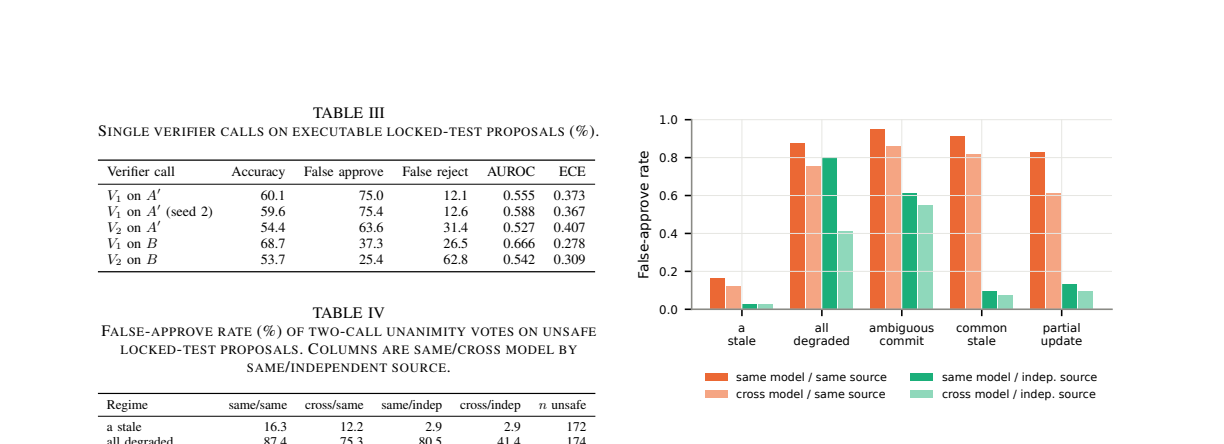
A fixed-call 2 x 2 experiment separates verifier-model diversity from evidence-source diversity. On frozen proposals from two local actor families, a cross-model vote over shared evidence approves 62.9% of unsafe proposals, versus 22.9% with an independent source. The source effect is 40.9 percentage points, compared with 11.3 for model diversity. A portfolio controller selects verification plans using only deployment-observable metadata. Approximate cluster-adjusted calibration at a nominal 5% per-task target yields 1.9% unsafe execution and 38.2% automated safe coverage on the locked test. Matched-budget portfolios also improve on fixed verification policies. Transfer remains conditional: unseen fault families yield 16-26% risk, and a FinQA check fails to reproduce the source effect with the tested small verifiers. A preregistered live HTTP/SQLite study tests concurrent writes and lost responses. After-check races defeat verifier-only gates; transactional partial guards prevent only covered failures, while a full atomic guard records no unsafe effects across 216 episodes. Idempotent request identifiers prevent duplicate effects after lost responses. The results motivate explicit evidence lineage, cost-aware selection, and commit-time enforcement, while exposing the limits of approximate calibration and local-tool generalization.
from the abstract
Pith says
Machine review · deepseek-v4-flash · 11 Sep 2026 · what was read was not recorded · not checked by a person
It can be wrong. Challenge this review or reply to it.
Holds up, with conditions. A careful benchmark on commit-gate design isolates evidence lineage from model diversity, but the headline source-effect ordering is partly baked into the synthetic construction and fails external replication. This line is wrong
2 major objections · 8 minor
How often objections from reviews like this one are right: not yet measured
Not checked: figures, code, what the 21 references say.
The paper says, at Section V-A, Table IV
The review did not quote this passage.
Pith says: Objection 1 of 2 · major
The load-bearing claim of a 40.9 pp source effect versus 11.3 pp model effect is estimated from a synthetic world in which source B 'independently lags with probability 0.10' and the six fault regimes contribute equal scenario counts. No sensitivity analysis varies either the degree of B's independence (e.g., the probability of correlated lag) or the regime mixture weights.
more of objection 1
The all-degraded regime in Table IV already shows a reversed ordering (model effect ~25.6 pp vs source effect ~20.4 pp), and the FinQA check (Section VI-C) and live arm (Section VI-D) fail to replicate a statistically significant source advantage. The central comparative claim is therefore an artifact of the specific parametrization, not a robust ordering. The authors should add explicit sensitivity analyses (sweeping B's lag probability from 0 to 1, varying regime prevalence) and discuss the range over which the ordering holds.
The paper says, at Section VI-D, Table IX
The review did not quote this passage.
Pith says: Objection 2 of 2 · major
The preregistered primary comparison L1 (shared-cache vote vs independent-read vote) yields a difference of +0.037 with a Holm-adjusted p = 0.2667, which is not statistically significant at the 0.05 level. The paper correctly notes this but still interprets the live arm as supportive of the source-effect ordering because 'Phi-4-mini rejects almost every migration proposal regardless of source.'
more of objection 2
This explanation implies that the non-significance is due to verifier incompetence on one task family, yet the inference in the text remains that the live arm 'supports an enforcement boundary rather than a second demonstration of portfolio risk superiority.' The authors should either present a power analysis for the twelve-contract design or more clearly separate the evidence-boundary finding from the source-effect ordering claim.
8 minor objections
The paper says, at Abstract
Pith says: minor objection 1 of 8
The phrase 'A fixed-call 2 x 2 experiment' should be 'A fixed-call 2×2 factorial experiment' for clarity.
The paper says, at Section III-A
Pith says: minor objection 2 of 8
The three evidence views (A, A', B) are described in prose; a small summary table listing their lineage, exposure, and typical staleness assumption would aid comprehension.
show 6 more
The paper says, at Table I
Pith says: minor objection 3 of 8
The 'Limit on the supported claim' column entry for 'Separate failure domains' says 'Lineage is supplied; independent sources can still lag or share an unmodeled fault.' This is vague; please specify what the intended limit is (e.g., 'no guarantee that the independent source has a truly independent failure path').
The paper says, at Section V-A
Pith says: minor objection 4 of 8
The description 'source health and schema signals are noisy' lacks quantitative detail; please specify the noise distributions or signal-to-noise ratio ranges used.
The paper says, at Section VI-C, Table VIII
Pith says: minor objection 5 of 8
The FinQA row shows that the independent source gives a higher unsafe rate (18.4%) than the same-source check (12.8%), reversing the main effect. A brief explanation of why this reversal occurs (e.g., verifier incompetence on financial tables, different error pattern) would help the reader.
The paper says, at General
Pith says: minor objection 6 of 8
Several acronyms (LTT, CORA, TTL) are used without expansion in the abstract; consider defining them at first use in each major section.
The paper says, at Figure 1
Pith says: minor objection 7 of 8
The legend uses 'indep.' while the text uses 'independent'; be consistent.
The paper says, at References
Pith says: minor objection 8 of 8
Several references (e.g., [4], [5], [7], [8]) are arXiv preprints without year or venue; consider adding the arXiv identifier and year in a consistent format.
What would settle it
Re-run the frozen RQ1 2x2 analysis on the cached verifier records with (a) regime weights reweighted to deployment-like mixtures, including an all-degraded-heavy mixture, and (b) B's lag probability swept from 0.10 to 0.25 and 0.50, plus a correlated-lag condition in which B shares the A/A' upstream in 30% of common-stale worlds. Recompute the paired source and model effects with template-cluster CIs for each setting. If under any plausible weighting or partial-correlation setting the source effect no longer exceeds the model effect, the 'four times' headline should be restated as a property of the benchmark's independence parametrization rather than of evidence plumbing generally.
from the skeptic's reading
How the review went
4 readings by deepseek-v4-flash · 11 Sep 2026
- Reader holds up, with conditions
- Skeptic agrees
- Editor wrote the verdict above
- Referee major revision: 2 major objections, 8 minor
Not run on this paper: the simulated authors' defence.
Pith did not check this review's objections against the paper.
The review in full
The review in brief, machine-written
This is the most internally valid study of agent commit gates I've seen. The 2x2 factorial on identical frozen proposals, separating model identity from evidence lineage, is a clean measurement. The auditing (hidden-field scans, recomputation with zero mismatches), preregistration with logged deviations, rule-based replication arm, and public full-trace artifact set a high bar. The paper also honestly reports where its claims break: the FinQA check reverses the source effect, the live arm's primary comparison isn't significant after correction, and the all-degraded regime flips the ordering. That frankness earns credit.
The soft spot is that the main quantitative claim—the 40.9-point source advantage over 11.3-point model effect—is partly a design artifact. The synthetic world defines B to have an independent failure path (p=0.10 lag) and mixes six fault regimes uniformly. The stress-test note is right: under all-degraded, the model effect is larger (25.6 vs 20.4). The pooled advantage comes from regimes where common-mode failures matter, which is exactly where it should show up, but the uniform regime mix and B's fixed independence level are not stress-tested. The paper scopes the claim to "the stated fault model," but in practice a reader might overgeneralize. The approximate cluster-adjusted calibration is also not a formal guarantee—the 1.9% observed risk is empirical, not a bound.
That said, the paper is a serious empirical contribution. It demonstrates that evidence lineage is often more important than model diversity, that the ordering depends on failure modes, and that commit-time enforcement (atomic guards) is needed even with good evidence. For a reader building production commit gates, this paper offers a useful framework and honest boundaries.
I would encourage a referee to accept with revisions that add sensitivity analysis on B's independence level and regime prevalence, and tighten the calibration language. The core experiments are reproducible and the negative results are valuable.
The strongest objection
The central quantitative claim is the paired source effect of -0.409 versus the model effect of -0.113 (Section VI-A), generalized as 'evidence plumbing, not LLM family.' This effect is estimated on a synthetic population in which B 'independently lags with probability 0.10' (Section V-A) and the six fault regimes contribute equal scenario counts. No sensitivity analysis varies the degree of B's independence, correlated lag, or regime prevalence. That matters because Table IV already shows the ordering is regime-dependent: in the all-degraded regime, computing the same paired contrasts gives a model effect of (87.4-75.3 + 80.5-41.4)/2 = 25.6 percentage points versus a source effect of (87.4-80.5 + 75.3-41.4)/2 = 20.4 points, so model diversity is the larger lever when all sources degrade. The pooled 40.9-point source advantage is therefore an artifact of the benchmark's uniform mixture over regimes and of B's designated fresh failure path. The external checks reinforce the concern: in the FinQA check, the source effect reverses (17% vs 20% approval, Section VI-C), and in the live arm the primary source comparison is not significant after Holm correction (p=0.2667, Section VI-D). The paper honestly labels these limits, and the claim is scoped to 'the stated fault model'; nonetheless, the reader's strongest claim, as an engineering statement about buying independent sources versus adding verifier models, depends on an untested parametrization of independence and an untested regime distribution.
The reader's weakest assumption already identifies the synthetic construction of B's independent failure path and the failed external/live replications. My stress-test pass sharpens that concern with a concrete internal observation: in the all-degraded row of Table IV, the same paired contrasts reverse, so the pooled 40.9-point source effect is a function of the uniform regime mix and the fixed B lag probability. This is not an internal inconsistency; the paper repeatedly scopes its claims to the stated fault model and explicitly reports the external negative results, the live non-significance, and the all-degraded limit. The concern is therefore about the strength and portability of the engineering inference, not about the integrity of the measurements. A sensitivity sweep over B's independence and regime weighting would determine whether the ordering survives plausible deviations from the benchmark's parametrization. Since the paper already reaches CONDITIONAL rather than ACCEPT, and since the authors' own hedges largely anticipate this concern, the appropriate adjustment is to keep the CONDITIONAL verdict rather than escalate to rejection. The concrete test should be part of the revised artifact or a follow-up before the claim is used as a general engineering rule.
The referee's report
If the ordering result (source diversity > model diversity) generalizes, it has direct engineering implications: agent commit gates should prioritize acquiring independent evidence sources over ensembling additional verifiers, and platforms should propagate lineage metadata to enable informed selection. The paper's methodological rigor (frozen proposals, preregistration, static and dynamic audits, a 900-entry recomputation audit with zero mismatches, cluster-bootstrap confidence intervals) sets a high bar for reproducibility in this area. However, the generality is constrained by the synthetic fault model, the small set of models (4B–9B quantized), the local live setup, and the failure of the FinQA check and live primary comparison to replicate the source effect at conventional significance. The significance for practice is therefore conditional on the deployment having verifiers that can interpret the independent evidence and on the independent source having a genuine independent failure path.
Pith's reading of the paper (a machine's summary, not the authors')
This paper argues that the engineering principle 'add another verifier model' is incomplete for agentic AI commit gates, because additional models share the same upstream evidence lineage and thus inherit the same stale or faulty data. Through a deterministic benchmark of 2,880 scenarios and a live HTTP/SQLite study, the authors establish that switching to an independent evidence source reduces false approval of unsafe proposals roughly four times more than switching to a different verifier model. They also propose a cost-aware portfolio controller that uses deployment-observable metadata to select verification plans, achieving 1.9% unsafe execution at a nominal 5% risk target on the locked test. However, the benefits are conditional: the source effect relies on the independent source having a genuinely independent failure path, and it reverses when the verifier cannot competently interpret the independent evidence, as shown by a FinQA check.
What carries the argument. The central machinery is a deterministic 2×2 factorial experiment on frozen proposals that independently varies verifier model (same or different) and evidence source (shared lineage A′ or independent snapshot B), with a fixed budget of two calls per scenario. The portfolio controller builds on this by enumerating 37 small decision trees over five mechanism families (same-model re-check, cross-model re-check, independent read, transactional guard, and human deferral) and selects one per observable context bucket using a Lagrangian that balances cost, coverage, and a smoothed unsafe-commit rate. Calibration uses a fixed-sequence learn-then-test procedure with an approximate design-effect-adjusted Wilson bound to choose a risk price λ, though the paper explicitly notes that this is not a finite-sample guarantee.
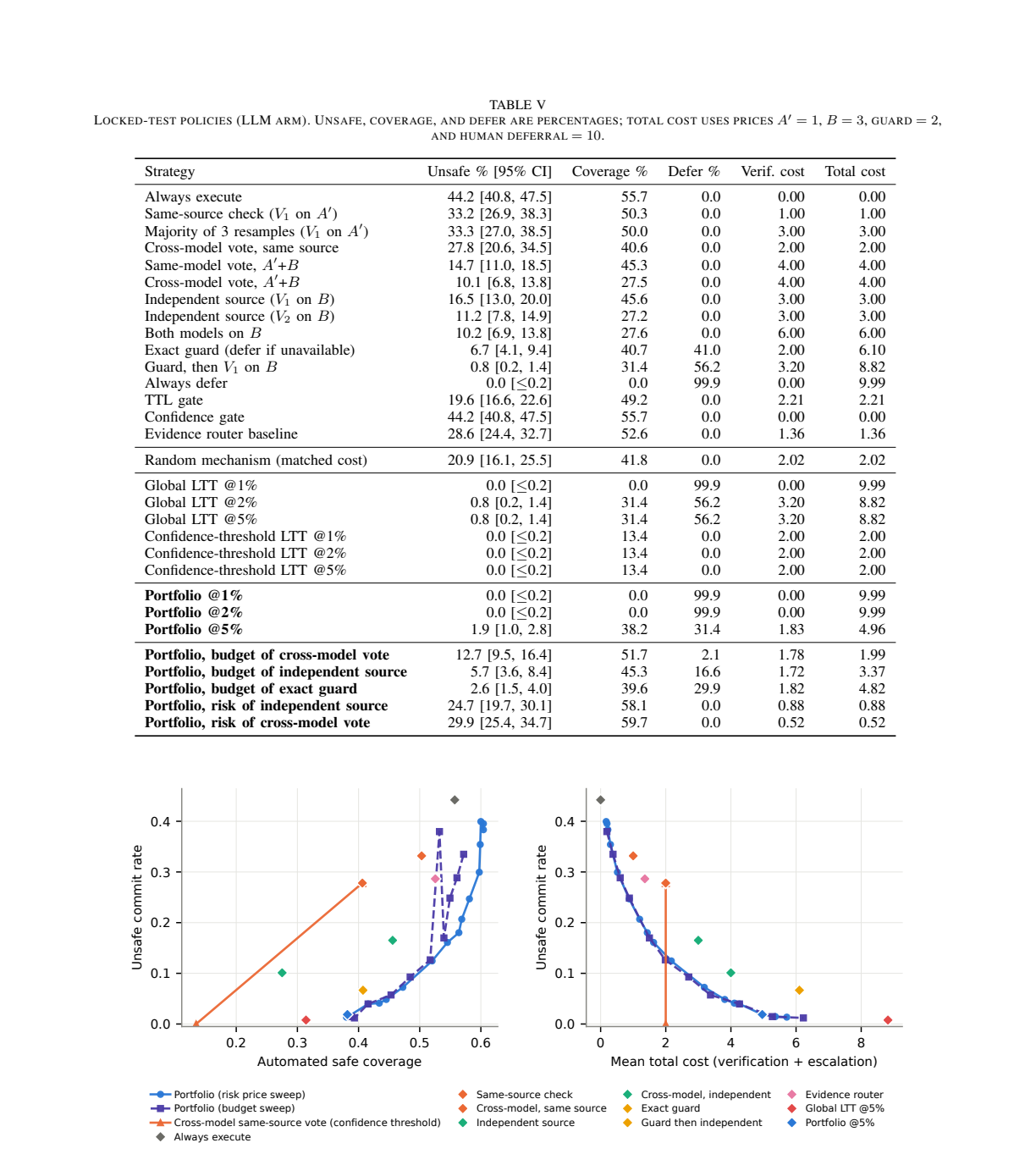
Core claim. In a fixed-call 2×2 factorial experiment that isolates verifier-model diversity from evidence-source diversity, a cross-model vote over shared evidence approves 62.9% of unsafe proposals, whereas the same vote over an independent source approves only 22.9%. The paired source effect at fixed model is –0.409 [–0.479, –0.331], compared with –0.113 [–0.215, –0.038] for the model effect at fixed source. This ordering is replicated in a rule-based arm that removes LLM-specific error correlations, confirming that the dominant lever is evidence lineage rather than model family. The portfolio controller, calibrated with approximate cluster-adjusted Wilson bounds, achieves 1.9% unsafe execution (95% CI 1.0–2.8%) and 38.2% safe automated coverage on the locked test at a nominal 5% target, and matched-budget portfolios improve over fixed verification policies. However, these results are conditional: unseen fault families break calibration (16–26% realised risk), the FinQA check reverses the source effect with small verifiers, and the live arm shows that after-check races defeat verifier-only gates while full atomic guards record no unsafe effects across 216 episodes.
The premise it rests on. The benchmark assumes that source B lags independently with probability 0.10 and that source health and schema signals are noisy but not systematically correlated with A; in real deployments, a nominally independent source may share a cache tier, a database replica, a common extraction pipeline, or a single network path, collapsing the 40.9-point source effect.
If the paper is right (Pith's inferences, not the authors')
Agent commit gates should prioritize independent evidence sources over additional verifier models, because common-mode data failures make extra votes ineffective.
A cost-aware portfolio that selects among heterogeneous mechanisms (verifier, guard, deferral) can improve the risk–cost trade-off relative to fixed policies, especially when budgets are tight.
Full atomic guards that re-read the entire safety predicate inside the write transaction outperform any pre-action verification scheme under concurrent writes, making them the preferred mechanism when the predicate is expressible in the database.
Calibration outcomes do not transfer across unseen fault families or tool deployments; achieving a nominal risk target requires recurring calibration data from the target population.
The paper implies that current multi-verifier architectures (e.g., LLM-as-a-judge cascades) may be overengineered on model diversity while underinvesting in evidence independence, suggesting a simpler architectural rule: ensure at least one read from a fault-independent data path.
Because the FinQA check failed to reproduce the source effect, the value of independent evidence is contingent on the verifier being competent for that evidence modality; engineering guidelines should couple evidence-source acquisition with verifier training or fine-tuning on that source's format.
The live-arm result that the full atomic guard dominates all verifier-based policies hints that, for tool-integrated agents, the more cost-effective path may be to move verification logic into the target system's transaction layer rather than buying more models.
Check this review
Pith stored no record of this review's passes and took no fingerprint of it. Reviews made by code from 13 Nov 2026 on carry both.
How often reviews like this one are right
Reviews like this one: written by deepseek-v4-flash, where what was read was not recorded.
How often objections from reviews like this one are right: not yet measured
Reviews by people
This review was written by a machine. No person has reviewed this paper on Pith yet. A scientist listed on Pith can review it for a fee, and their review is published here whatever it concludes.
The paper
Abstract
Agentic systems commit state-changing actions, but additional verifiers can inherit the same upstream fault. We present VP-CONTROL, a runtime-assurance design and deterministic benchmark for cost-aware commit gates. Its 48 task templates yield 2,880 scenarios across six fault regimes. A fixed-call 2 x 2 experiment separates verifier-model diversity from evidence-source diversity. On frozen proposals from two local actor families, a cross-model vote over shared evidence approves 62.9% of unsafe proposals, versus 22.9% with an independent source. The source effect is 40.9 percentage points, compared with 11.3 for model diversity. A portfolio controller selects verification plans using only deployment-observable metadata. Approximate cluster-adjusted calibration at a nominal 5% per-task target yields 1.9% unsafe execution and 38.2% automated safe coverage on the locked test. Matched-budget portfolios also improve on fixed verification policies. Transfer remains conditional: unseen fault families yield 16-26% risk, and a FinQA check fails to reproduce the source effect with the tested small verifiers. A preregistered live HTTP/SQLite study tests concurrent writes and lost responses. After-check races defeat verifier-only gates; transactional partial guards prevent only covered failures, while a full atomic guard records no unsafe effects across 216 episodes. Idempotent request identifiers prevent duplicate effects after lost responses. The results motivate explicit evidence lineage, cost-aware selection, and commit-time enforcement, while exposing the limits of approximate calibration and local-tool generalization.
The paper's own sentences, arranged, kept beside the review and separate from it. Each label is drawn from a closed vocabulary; the number beside it is the probability the classifier gave that label. No sentence in this record was written by a model.
abstract compiled · 2026-09-23
The authors' main claim, as the classifier picked it out 0.99
“The results motivate explicit evidence lineage, cost-aware selection, and commit-time enforcement, while exposing the limits of approximate calibration and local-tool generalization.”
How the main claim is stated: asserted 0.69
What the abstract itself states, as probabilities: claims first 0.06 · states limitation 0.98 · human participants 0.05 · controlled comparison 0.92 · randomized assignment 0.05 · states quantitative result 0.99 · compares with prior results 0.90 · mentions code or data availability 0.06
The abstract, sentence by sentence
This table labels the abstract only (arXiv listing abstract v1). The number is the probability the classifier gave the label.
| Sentence | Role | The authors' own work | States the main conclusion | Strength |
|---|---|---|---|---|
| Agentic systems commit state-changing actions, but additional verifiers can inherit the same upstream fault. | background 0.93 | 0.08 | 0.05 | asserted 0.95 |
| We present VP-CONTROL, a runtime-assurance design and deterministic benchmark for cost-aware commit gates. | contribution 1.00 | 0.93 | 0.07 | asserted 1.00 |
| Its 48 task templates yield 2,880 scenarios across six fault regimes. | method 0.92 | 0.89 | 0.03 | asserted 1.00 |
| A fixed-call 2 x 2 experiment separates verifier-model diversity from evidence-source diversity. | method 0.99 | 0.92 | 0.03 | asserted 0.99 |
| On frozen proposals from two local actor families, a cross-model vote over shared evidence approves 62.9% of unsafe proposals, versus 22.9% with an independent source. | result 1.00 | 0.93 | 0.23 | asserted 1.00 |
| The source effect is 40.9 percentage points, compared with 11.3 for model diversity. | result 0.96 | 0.93 | 0.17 | asserted 1.00 |
| A portfolio controller selects verification plans using only deployment-observable metadata. | method 0.88 | 0.81 | 0.06 | asserted 1.00 |
| Approximate cluster-adjusted calibration at a nominal 5% per-task target yields 1.9% unsafe execution and 38.2% automated safe coverage on the locked test. | result 1.00 | 0.94 | 0.14 | asserted 1.00 |
| Matched-budget portfolios also improve on fixed verification policies. | result 1.00 | 0.90 | 0.08 | asserted 1.00 |
| Transfer remains conditional: unseen fault families yield 16-26% risk, and a FinQA check fails to reproduce the source effect with the tested small verifiers. | limitation 0.97 | 0.92 | 0.12 | asserted 0.96 |
| A preregistered live HTTP/SQLite study tests concurrent writes and lost responses. | method 0.67 | 0.92 | 0.03 | asserted 0.94 |
| After-check races defeat verifier-only gates; transactional partial guards prevent only covered failures, while a full atomic guard records no unsafe effects across 216 episodes. | result 0.99 | 0.94 | 0.14 | asserted 1.00 |
| Idempotent request identifiers prevent duplicate effects after lost responses. | result 0.52 | 0.72 | 0.04 | asserted 1.00 |
| The results motivate explicit evidence lineage, cost-aware selection, and commit-time enforcement, while exposing the limits of approximate calibration and local-tool generalization. | interpretation 0.99 | 0.70 | 0.80 | asserted 0.69 |
What kind of paper the classifier reports this is: method or tool 0.85 · evidence from observation or experiment 0.98
What was examined, and what was not
Sources read
- arXiv listing abstract v1
Not examined
- full text
- figures and tables
- references and citing sentences
- relations to other papers
Levels run
- P abstract
Not run
- S sections
- T body sentences
- C citations
- R cross-paper relations
How the labels were made
Compiled by classifier-1.13.0 via TypeSafe API, question bank abstract-p1-20260923, 2026-09-23: 1 request, 10,010 input tokens.
Every quoted sentence on this record is the authors'. Every label is from Pith's closed vocabulary, with the probability shown beside it. This record as JSON
Figures (2)
Figures are the authors', reproduced from the paper.
References (21)
- [1] D. Liu, K. Upadhyay, V . Chhetri, A. B. Siddique, and U. Farooq, “A large-scale study on the development and issues of multi-agent AI systems,” in2025 IEEE International Conference on Big Data (BigData), 2025, pp. 7785–7792 on Pith
- [2] M. Becattini, R. Verdecchia, and E. Vicario, “An accountability-based architectural tactic for agent cooperation in LLM-based multi-agent sys- tems,” in2025 IEEE International Conference on Big Data (BigData), 2025, pp. 7761–7769 on Pith
- [3] A. Kaplunovich, “Plan-execute-generate-judge: A self verifying multi agent LLM framework for complex NoSQL querying,” in2025 IEEE International Conference on Big Data (BigData), 2025, pp. 7775–7784 on Pith
- [4] S. Lifshitz, S. A. McIlraith, and Y . Du, “Multi-agent verification: Scaling test-time compute with multiple verifiers,”arXiv preprint arXiv:2502.20379, 2025 on PithPith's reviewarXiv
- [5] J. Kwok, S. Li, P. Atreya, Y . Liu, Y . Jiang, C. Finn, M. Pavone, I. Stoica, and A. Mirhoseini, “LLM-as-a-verifier: A general-purpose verification framework,”arXiv preprint arXiv:2607.05391, 2026 on PithPith's reviewarXiv
- [6] J. Han, “Partially correlated verifier cascades in LLM harnesses: Con- cave log-odds, polynomial reliability, and blind-spot ceilings,”arXiv preprint arXiv:2607.13918, 2026 on PithPith's reviewarXiv
- [7] M. Bara, “Epistemic Sybil resistance: Multiplying AI agents without multiplying evidence,”arXiv preprint arXiv:2609.01873, 2026 on PithPith's reviewarXiv
- [8] A. Alvarez, S. Rajan, A. Genuardi, O. Wirjadi, S. Mugel, and R. Or ´us, “ProvenanceGuard: Source-aware factuality verification for MCP-based LLM agents,”arXiv preprint arXiv:2606.18037, 2026 on PithPith's reviewarXiv
- [9] Y . Xue, K. Greenewald, Y . Mroueh, and B. Mirzasoleiman, “Verify when uncertain: Beyond self-consistency in black box hallucination detection,” arXiv preprint arXiv:2502.15845, 2025 on PithPith's reviewarXiv
- [10] M. Wu, H. Yang, O. Ben-Porat, and Y . Ziser, “When knowledge is not free: Cost-aware evidence selection in retrieval-augmented generation,” arXiv preprint arXiv:2606.02245, 2026 on PithPith's reviewarXiv
- [11] Y . Ro, H. Qiu, ´I. Goiri, R. Fonseca, R. Bianchini, A. Akella, Z. Wang, M. Erez, and E. Choukse, “Sherlock: Reliable and efficient agentic workflow execution,”arXiv preprint arXiv:2511.00330, 2025 on PitharXiv
- [12] A. N. Angelopoulos, S. Bates, E. J. Cand `es, M. I. Jordan, and L. Lei, “Learn then test: Calibrating predictive algorithms to achieve risk control,”arXiv preprint arXiv:2110.01052, 2021 on PithPith's reviewarXiv
- [13] A. N. Angelopoulos, S. Bates, A. Fisch, L. Lei, and T. Schuster, “Conformal risk control,”arXiv preprint arXiv:2208.02814, 2022 on PithPith's reviewarXiv
- [14] Y . Feng, J. Du, Q. Wang, Z. Ma, Q. Niu, Y . Matsuo, L. Feng, and L. Yu, “CORA: Conformal risk-controlled agents for safeguarded mobile GUI automation,”arXiv preprint arXiv:2604.09155, 2026 on PithPith's reviewarXiv
- [15] M. Akewar and R. Ranjan, “SafeCommit: Certifying when memory- grounded agents may safely act,”arXiv preprint arXiv:2608.04289, 2026 on PithPith's reviewarXiv
- [16] Y . Liu, X. Peng, J. Cao, X. Wang, S. Deng, J. Chen, J. Yin, and X. Zhang, “ToolGate: Contract-grounded and verified tool execution for LLMs,” inFindings of the Association for Computational Linguistics: ACL 2026, 2026, pp. 9653–9684. [Online]. Available: https://aclanthology.... on Pith
- [17] Y . Tian, Z. Shi, Y . Zhou, and B. Zhao, “Beyond function calling: Benchmarking tool-using agents under tool-environment unreliability,” arXiv preprint arXiv:2606.25819, 2026 on PithPith's reviewarXiv
- [18] D. Zhu, X. Ma, Y . Shen, X. Li, Y . Zhao, S. Wang, L. Yan, and D. Yin, “When tools fail: Benchmarking dynamic replanning and anomaly recovery in LLM agents,”arXiv preprint arXiv:2606.05806, 2026 on PithPith's reviewarXiv
- [19] A. Gonuguntla, “The replay gap: Static evaluation of model switching in LLM agents scores the wrong world,” inProceedings of the Conference on Language Modeling (COLM 2026), 2026. [Online]. Available: https://arxiv.org/abs/2608.08239 on PithPith's reviewarXiv
- [20] Z. Chen, W. Chen, C. Smiley, S. Shah, I. Borova, D. Langdon, R. Moussa, M. Beane, T.-H. Huang, B. Routledge, and W. Y . Wang, “FinQA: A dataset of numerical reasoning over financial data,” in Proceedings of the 2021 Conference on Empirical Methods in Natural Language Processin... on Pith
show 1 more
- [21] Y . Tang, T. Li, E. Li, C. J. Maddison, H. Dong, and Y . Ruan, “LM agents may fail to act on their own risk knowledge,”arXiv preprint arXiv:2508.13465, 2025 on PithPith's reviewarXiv
Cited by 1 Pith paper
Reviewed papers on Pith that cite this one. The full citation record
Challenges and discussion
Disagree with the review, or know something it missed? Leave a comment, or challenge this review formally: a challenge becomes a permanent entry in this paper's record, and its decision is published here.
Come back by email
A short list of the week's newly reviewed papers. Nothing is sent until you confirm from your inbox, and every email has a link that stops it. No account.
No comments yet.
Sign in to comment