Artificial Intelligence · arXiv:2610.13008 v2 · submitted 9 Oct 2026
Provenance-Aware Belief Updating in Human-AI Feedback Loops
The paper says
“In repeated human-AI interaction, a single observation can be quoted, summarized, and returned to a model as multiple reports, making repetition look like independent corroboration.”
more of the abstract
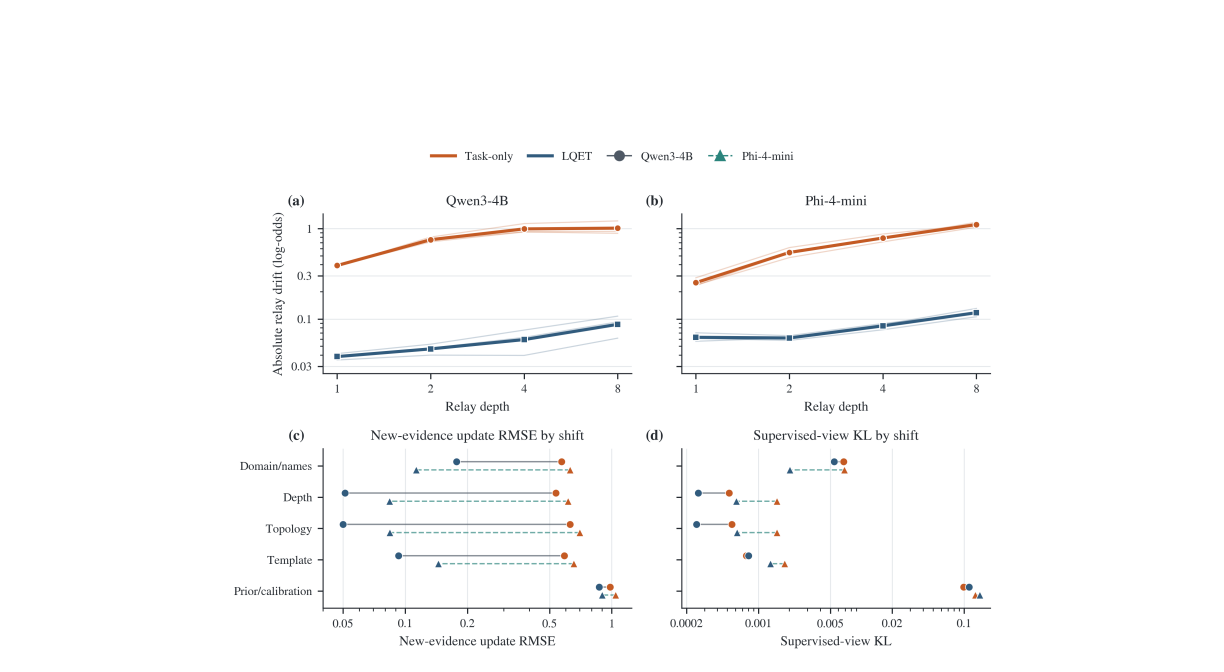
We study whether language models can use supplied report lineage to update according to evidence provenance rather than report count. We introduce Latent Quotient Evidence Training (LQET), a relational objective that combines sparse Bayesian supervision with constraints that encourage stable predictions when reports add no new evidence and consistent updates to the same new evidence across relay histories. On a controlled binary benchmark, LQET reduces new-evidence update RMSE by 41-44% and log-odds drift after eight relay steps by 89-91% relative to task-only training across Qwen3-4B and Phi-4-mini, with three paired training seeds per backbone. The gains extend to a closed-loop simulation in which model confidence controls how many relayed reports re-enter the model's context in later rounds. By grounding belief updates in supplied provenance, LQET offers a route toward dynamic human-AI systems in which influence follows new evidence, not the number of times the same evidence returns.
from the abstract
Pith says
Machine review · deepseek-v4-flash · 12 Oct 2026 · of version 1 of the paper; version 2 is newer · what was read was not recorded · not checked by a person
It can be wrong. Challenge this review or reply to it.
The passes disagreed. Reader: holds up. Skeptic: agrees with the reader. Referee: major revision.
Solid controlled study of a real problem, with honest limitations; the view-count confound is acknowledged and the core result stands. This line is wrong
2 major objections · 7 minor
How often objections from reviews like this one are right: not yet measured
Not checked: figures, code, what the references say.
The paper says, at §3, §4, §7
The review did not quote this passage.
A classifier read this sentence of the paper as acknowledging the concern (probability 0.82):
“Because adding update consistency also adds the composition views, this comparison estimates their combined contribution rather than isolating the loss term alone. 20”
Pith says: Objection 1 of 2 · major
The view-count confound between LQET (13 training views) and the task-only baseline (7 training views) is acknowledged in §7 but not fully resolved. The component analysis in §5.4 and Appendix G compares Pair-invariance (11 views) and No-order (13 views), but Pair-invariance already includes invariance losses, so the incremental benefit of the update-consistency and order terms is not separated from the effect of adding the two extra views (c11 and crev11).
more of objection 1
Moreover, there is no baseline that trains on all 13 matched views using only pointwise cross-entropy (task-only objective). Without this control, it is unclear how much of the reported improvement is due to the relational constraints versus simply seeing more varied prompts during training. The authors should either add such a baseline or provide a principled argument—supported by the component analysis—that the relational objective, rather than the increased view count, is the driving force.
The paper says, at §5.4, Table 12
The review did not quote this passage.
A classifier read this sentence of the paper as acknowledging the concern (probability 0.90):
“Because adding update consistency also adds the composition views, this comparison estimates their combined contribution rather than isolating the loss term alone. 20”
Pith says: Objection 2 of 2 · major
In the component analysis, the comparison between No-order and Pair-invariance confounds the addition of update-consistency losses with the addition of two new views (c11 and crev11). The paper acknowledges this in Appendix G (last sentence of the section) but still interprets the comparison as estimating the contribution of update-consistency supervision.
more of objection 2
The authors should clarify what specific conclusion can be drawn from this comparison and consider an ablation that adds the composition views without the update-consistency loss to isolate the effect of the loss term.
7 minor objections
The paper says, at Abstract
Pith says: minor objection 1 of 7
The abstract states 'LQET reduces new-evidence update RMSE by 41-44% and log-odds drift after eight relay steps by 89-91%.' It would be helpful to specify that these are mean reductions over three seeds, averaged across OOD shifts.
The paper says, at §2, Eq. (5)
Pith says: minor objection 2 of 7
The derivation of the Bayesian target is sound, but the notation ℓ_y(T) as 'log posterior log-probability up to an additive normalizing constant' could be clarified: ℓ_y(T) is the log prior plus log marginal likelihood for Y=y, which equals the posterior log-probability up to a constant that cancels in the log-odds. Consider rephrasing to avoid confusion.
show 5 more
The paper says, at §3, Eq. (10)
Pith says: minor objection 3 of 7
The Huber penalty is defined with δ=0.25, but the motivation for this specific value is not provided. Was it chosen based on prior work or a small pilot? A brief justification would be helpful.
The paper says, at §4, 'Primary endpoints' paragraph
Pith says: minor objection 4 of 7
The sentence 'Each backbone-level point estimate is the arithmetic mean of its three seed-level estimates; for RMSE, the square root is taken within each seed before averaging.' This is clear, but the reader might wonder why the mean of RMSEs (rather than a pooled RMSE) is chosen. Please add a brief rationale.
The paper says, at Table 1
Pith says: minor objection 5 of 7
The 95% bootstrap interval for Phi-4-mini supervised-view KL includes zero (lower bound -0.00002). The text says 'the prespecified +0.02-nat non-inferiority margin' is satisfied, which is true, but the interval crossing zero is a minor nuance that could be mentioned.
The paper says, at Appendix E, §E.2
Pith says: minor objection 6 of 7
In the copy-versus-new comparison, the zero-intercept regression slope is used. It would be helpful to report the correlation or the R^2 of the predicted vs. true changes to give a fuller picture of the relationship.
The paper says, at General
Pith says: minor objection 7 of 7
The paper is generally well-written, but some figure captions (e.g., Figure 2) are dense. Consider adding panel-specific descriptions in the caption for clarity.
What would settle it
Train a task-only baseline (pointwise cross-entropy only) on all 13 matched views, assigning targets to all views: invariance views (h10, h11, matched-copy, irrelevant) receive the same target as h00; composition views (c11, crev11) receive their exact Bayesian targets; others as in the original task-only set. Compare update RMSE, depth-8 relay drift, and supervised-view KL on the static IID and controlled-shift sets (800 families) and recursive-relay set (200 families). Use the same hyperparameters, seeds, and optimization schedule as the original LQET run. If the task-only-13-view baseline achieves RMSE and drift within, say, 20% of LQET's values, then the relational constraint is not the primary driver and the advantage is largely due to increased view exposure.
from the skeptic's reading
How the review went
4 readings by deepseek-v4-flash · 12 Oct 2026
- Reader holds up
- Skeptic partly agrees
- Editor wrote the verdict above
- Referee major revision: 2 major objections, 7 minor
Not run on this paper: the simulated authors' defence.
Pith did not check this review's objections against the paper.
The review in full
The review in brief, machine-written
This paper does two things well. First, it formalizes a clean idea—provenance equivalence classes and the relational constraints that follow from them—and grounds it in exact Bayesian targets under a natural source-reliability model. Second, it runs a thorough controlled evaluation across two backbones, three seeds, multiple OOD shifts, and a closed-loop simulation, with bootstrap inference and a prespecified non-inferiority margin. The reported gains (41-44% RMSE reduction, 89-91% drift reduction) are consistent and the component analysis shows the relational objective is doing real work beyond just added views.
The stress-test concern—that LQET trains on nearly twice as many views as task-only (13 vs 7), so part of the improvement could come from more data rather than the relational constraints—is valid. But the authors state this limitation plainly in Section 7: 'Comparisons match training families and optimizer updates but differ in transcript-view exposure, so the reported gains characterize the complete training protocol.' They do not claim otherwise. The component analysis partially addresses the question by comparing variants with matched view counts (No-order vs Full LQET both use 13 views), though the main comparison to task-only remains confounded. Adding a task-only baseline on all 13 views would clarify the increment, but the paper is honest about what it does and does not show.
The central soft spot is scope: supplied provenance, binary classification, small (4B) backbones, and synthetic data. Real-world provenance is messy and often absent. The authors flag this. Within their stated boundaries the results are reproducible and the math is sound. The only concerning numerical sign is the small KL increase on the prior/calibration shift (about +0.013 nats), which they note as a remaining challenge.
Who this is for: researchers working on training-time debiasing of LLMs against repetition/feedback loops, especially those who want a formally grounded baseline to compare against. The paper is methodologically serious and deserves peer review. I would cite it if I worked on this subproblem and would bring it to a reading group focused on AI safety or reliability.
The strongest objection
The paper compares LQET (13 training views) against task-only (7 training views) with identical optimizer-update counts. LQET processes nearly twice as many prompts per batch (13 vs 7), so the reported gains (41-44% RMSE reduction, 89-91% drift reduction) characterize the complete training protocol, as the authors acknowledge in §7. The component analysis compares Pair-invariance (11 views) and No-order (13 views), but Pair-invariance already includes invariance losses, so the incremental benefit of the relational objective (update consistency and order) is not separated from the effect of added views. No baseline trains on all 13 matched views using only pointwise cross-entropy. Therefore, it is unclear how much of the improvement is due to the relational constraints versus simply seeing more varied prompts during training. If a task-only model exposed to all 13 views achieved similar gains, the central claim that the relational objective is the driving force would be weakened.
The paper acknowledges the exposure difference as a limitation but does not quantify its contribution. The reader's weakest assumption focused on real-world provenance supply, which is a scope condition well-recognized. The internal training confound, however, is a methodological concern for the controlled claim that LQET's relational objective produces the gains. My proposed concrete test directly addresses this confound. If the test shows that view-exposure alone accounts for most of the improvement, the central claim about the relational objective would need qualification. Given the paper's honest reporting and the component analysis showing non-trivial gains from relational losses, I do not think the verdict should change, but confidence might be lowered slightly. Hence UNCHANGED is appropriate.
The referee's report
If the results are robust, the paper makes a useful contribution to the problem of data incest in repeated human-AI interaction. The formalization of provenance equivalence classes and the relational training objective are well-motivated, and the experimental design (exact Bayesian targets, multiple backbones, paired seeds, OOD shifts, bootstrap inference) is rigorous within the controlled setting. The selective invariance result (matched copy-versus-new control) convincingly shows that the model is not simply suppressing all updates. The closed-loop simulation connects static relational properties to dynamic feedback amplification, which is a step toward practical relevance. The main significance is in demonstrating that explicit provenance information can be used by language models to avoid double-counting evidence, with implications for trustworthy AI systems.
Pith's reading of the paper (a machine's summary, not the authors')
This paper addresses a problem in repeated human-AI interaction: a single observation can be quoted, summarized, and returned to a model multiple times, making repetition look like independent corroboration. The authors propose Latent Quotient Evidence Training (LQET), a relational learning objective that uses supplied report lineage to enforce two behaviors: predictions should not change when a report merely relays existing evidence, and the update from genuinely new evidence should be consistent regardless of the relay history. On a controlled binary benchmark, LQET reduces new-evidence update RMSE by 41–44% and log-odds drift after eight relay steps by 89–91% across two 4B-class backbones. A closed-loop simulation shows that these static gains translate to reduced feedback amplification when model confidence controls how many inherited reports re-enter context. If the approach generalizes, it offers a route toward dynamic human-AI systems in which influence follows new evidence, not the number of times the same evidence returns.
What carries the argument. Latent Quotient Evidence Training (LQET) is the central mechanism: a loss function that enforces provenance invariance and update consistency over matched transcript families. It uses the exact Bayesian log-odds target derived from a Beta-Bernoulli source-reliability model, computed from the supplied parent-report links and calibration records. The objective combines pointwise cross-entropy on seven supervised views with four Huber-penalized invariance residuals (e.g., base vs. relay, matched-copy vs. base) and three update-consistency residuals (e.g., update from base to new root vs. update from relayed context to same new root). The loss weights are fixed: 1:4:2:1 for task, invariance, update, and order components.
Core claim. Language models can learn to distinguish repeated evidence from genuinely new observations when provided with explicit report lineage, and to update beliefs accordingly. LQET formulates this as a relational training problem: it combines sparse pointwise supervision with four invariance constraints (ensuring relayed reports leave predictions unchanged) and three new-evidence update-consistency constraints (ensuring the same new evidence produces the same update across different relay histories). On Qwen3-4B and Phi-4-mini, LQET improves update accuracy and stability across three seeds and multiple distribution shifts, while supervised-view KL remains within a prespecified non-inferiority margin. Tightly matched controls show the model becomes selectively less sensitive to declared relays while retaining its response to declared new observations.
The premise it rests on. The method assumes that explicit parent-report links are supplied and accurate, and that the Bayesian source-reliability model (Beta-Bernoulli with conditional independence) correctly captures uncertainty; in practice, provenance may be incomplete, unreliable, or unavailable.
If the paper is right (Pith's inferences, not the authors')
In controlled binary settings, LQET-trained models can ignore repeated evidence and focus updates on genuinely new observations, reducing feedback-loop amplification.
The approach provides a concrete training recipe for dynamic human-AI systems where influence should track new evidence rather than report count.
The invariance and update-consistency constraints serve as a form of self-consistency regularization, potentially applicable to other settings with explicit dependency structure.
The closed-loop simulation shows that reducing sensitivity to inherited reports also reduces how many such reports return, creating a virtuous cycle.
If the method generalizes to naturalistic tasks and larger models, it could help mitigate overconfidence and echo-chamber effects in iterated human-AI interaction.
The reliance on supplied accurate parent-report links is a strong assumption; future work could combine LQET with provenance inference methods to handle incomplete or noisy lineage.
The paper's matched controls suggest that LQET learns to use provenance rather than surface features like author or outcome; this implies the model is sensitive to the declared derivation graph in the prompt.
The approach could be combined with calibration or martingale-based consistency objectives to further improve belief stability under distribution shift.
Testing on larger models (e.g., 70B parameters) and on open-ended generation tasks would clarify whether the relational constraints scale and transfer beyond forced-choice binary probes.
Check this review
Pith stored no record of this review's passes and took no fingerprint of it. Reviews made by code from 13 Nov 2026 on carry both.
How often reviews like this one are right
Reviews like this one: written by deepseek-v4-flash, where what was read was not recorded.
How often objections from reviews like this one are right: not yet measured
Reviews by people
This review was written by a machine. No person has reviewed this paper on Pith yet. A scientist listed on Pith can review it for a fee, and their review is published here whatever it concludes.
The paper
Abstract
In repeated human-AI interaction, a single observation can be quoted, summarized, and returned to a model as multiple reports, making repetition look like independent corroboration. We study whether language models can use supplied report lineage to update according to evidence provenance rather than report count. We introduce Latent Quotient Evidence Training (LQET), a relational objective that combines sparse Bayesian supervision with constraints that encourage stable predictions when reports add no new evidence and consistent updates to the same new evidence across relay histories. On a controlled binary benchmark, LQET reduces new-evidence update RMSE by 41-44% and log-odds drift after eight relay steps by 89-91% relative to task-only training across Qwen3-4B and Phi-4-mini, with three paired training seeds per backbone. The gains extend to a closed-loop simulation in which model confidence controls how many relayed reports re-enter the model's context in later rounds. By grounding belief updates in supplied provenance, LQET offers a route toward dynamic human-AI systems in which influence follows new evidence, not the number of times the same evidence returns.
The paper's own sentences, arranged, kept beside the review and separate from it. Each label is drawn from a closed vocabulary; the number beside it is the probability the classifier gave that label. No sentence in this record was written by a model.
abstract compiled · 2026-10-12
The authors' main claim, as the classifier picked it out 1.00
“By grounding belief updates in supplied provenance, LQET offers a route toward dynamic human-AI systems in which influence follows new evidence, not the number of times the same evidence returns.”
How the main claim is stated: hedged possibility 0.86
What the abstract itself states, as probabilities: claims first 0.05 · states limitation 0.12 · human participants 0.15 · controlled comparison 0.94 · randomized assignment 0.04 · states quantitative result 0.99 · compares with prior results 0.93 · mentions code or data availability 0.03
The abstract, sentence by sentence
This table labels the abstract only (arXiv listing abstract v1). The number is the probability the classifier gave the label.
| Sentence | Role | The authors' own work | States the main conclusion | Strength |
|---|---|---|---|---|
| In repeated human-AI interaction, a single observation can be quoted, summarized, and returned to a model as multiple reports, making repetition look like independent corroboration. | background 1.00 | 0.09 | 0.04 | asserted 0.93 |
| We study whether language models can use supplied report lineage to update according to evidence provenance rather than report count. | contribution 0.81 | 0.34 | 0.05 | unclear 0.60 |
| We introduce Latent Quotient Evidence Training (LQET), a relational objective that combines sparse Bayesian supervision with constraints that encourage stable predictions when reports add no new evidence and consistent updates to the same new evidence across relay histories. | method 0.84 | 0.92 | 0.07 | asserted 0.98 |
| On a controlled binary benchmark, LQET reduces new-evidence update RMSE by 41-44% and log-odds drift after eight relay steps by 89-91% relative to task-only training across Qwen3-4B and Phi-4-mini, with three paired training seeds per backbone. | result 1.00 | 0.97 | 0.16 | asserted 1.00 |
| The gains extend to a closed-loop simulation in which model confidence controls how many relayed reports re-enter the model's context in later rounds. | result 0.89 | 0.89 | 0.08 | asserted 0.98 |
| By grounding belief updates in supplied provenance, LQET offers a route toward dynamic human-AI systems in which influence follows new evidence, not the number of times the same evidence returns. | interpretation 0.99 | 0.29 | 0.87 | hedged possibility 0.86 |
What kind of paper the classifier reports this is: method or tool 1.00 · evidence from observation or experiment 0.57
What was examined, and what was not
Sources read
- arXiv listing abstract v1
Not examined
- full text
- figures and tables
- references and citing sentences
- relations to other papers
Levels run
- P abstract
Not run
- S sections
- T body sentences
- C citations
- R cross-paper relations
How the labels were made
Compiled by classifier-1.13.0 via TypeSafe API, question bank abstract-p1-20260923, 2026-10-12: 1 request, 5,088 input tokens.
Every quoted sentence on this record is the authors'. Every label is from Pith's closed vocabulary, with the probability shown beside it. This record as JSON
Figures (4)



Figures are the authors', reproduced from the paper.
Cited by 1 Pith paper
Reviewed papers on Pith that cite this one. The full citation record
Challenges and discussion
Disagree with the review, or know something it missed? Leave a comment, or challenge this review formally: a challenge becomes a permanent entry in this paper's record, and its decision is published here.
Come back by email
A short list of the week's newly reviewed papers. Nothing is sent until you confirm from your inbox, and every email has a link that stops it. No account.
No comments yet.
Sign in to comment