Computation and Language · arXiv:2610.23721 v1 · submitted 16 Oct 2026 · 62 references
Recognizing Study Lineage Is Not Enough: Over-Crediting Same-Trial Evidence in LLM-Based Medical Verification
The paper says
“Publication count is not study count. A model can identify shared trial lineage correctly in a direct task yet over-credit a second publication from the same trial when aggregating evidence.”
more of the abstract
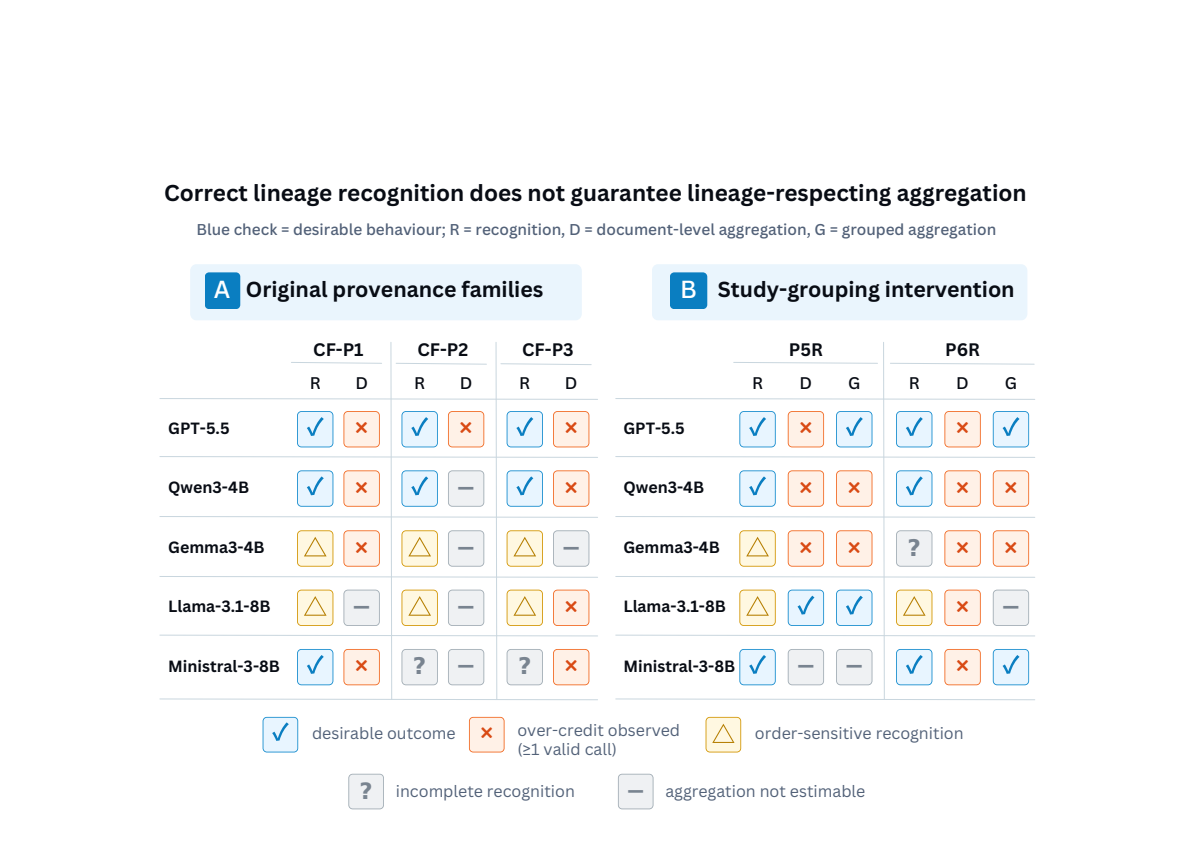
We evaluate this behavior in medical LLM verification using 14 source-audited clinical families and five model conditions. The families span provenance, clinical applicability, result direction, and composition; the provenance families provide the direct lineage tests. Recognition and aggregation are separate stateless calls, and repeated calls assess within-input stability. Across all three original provenance families, GPT-5.5 identifies the independent update in 10/10 recognition calls per family but over-credits the same-trial report in 5/5 separate aggregation calls per family. Selected Qwen3-4B and Ministral-3-8B conditions show the same cross-task contrast. A study-grouping instruction reduces GPT-5.5 over-credit from 4/5 to 0/5 in each later pure-provenance family. Other model conditions show mixed behavior, and rejected outputs limit several comparisons. The results identify a behavioral gap between elicited lineage recognition and evidence aggregation. The code and data artifacts are available at https://anonymous.4open.science/r/study-lineage-review-artifact.
from the abstract
Pith says
Machine review · deepseek-v4-flash · 19 Oct 2026 · what was read was not recorded · not checked by a person
It can be wrong. Challenge this review or reply to it.
Holds up. A clean empirical demonstration that LLMs can recognize study lineage yet still over-count same-trial evidence in separate aggregation calls; the paper is carefully designed and transparent about its scope. This line is wrong
1 major objection · 5 minor
How often objections from reviews like this one are right: not yet measured
Not checked: figures, code, what the 62 references say.
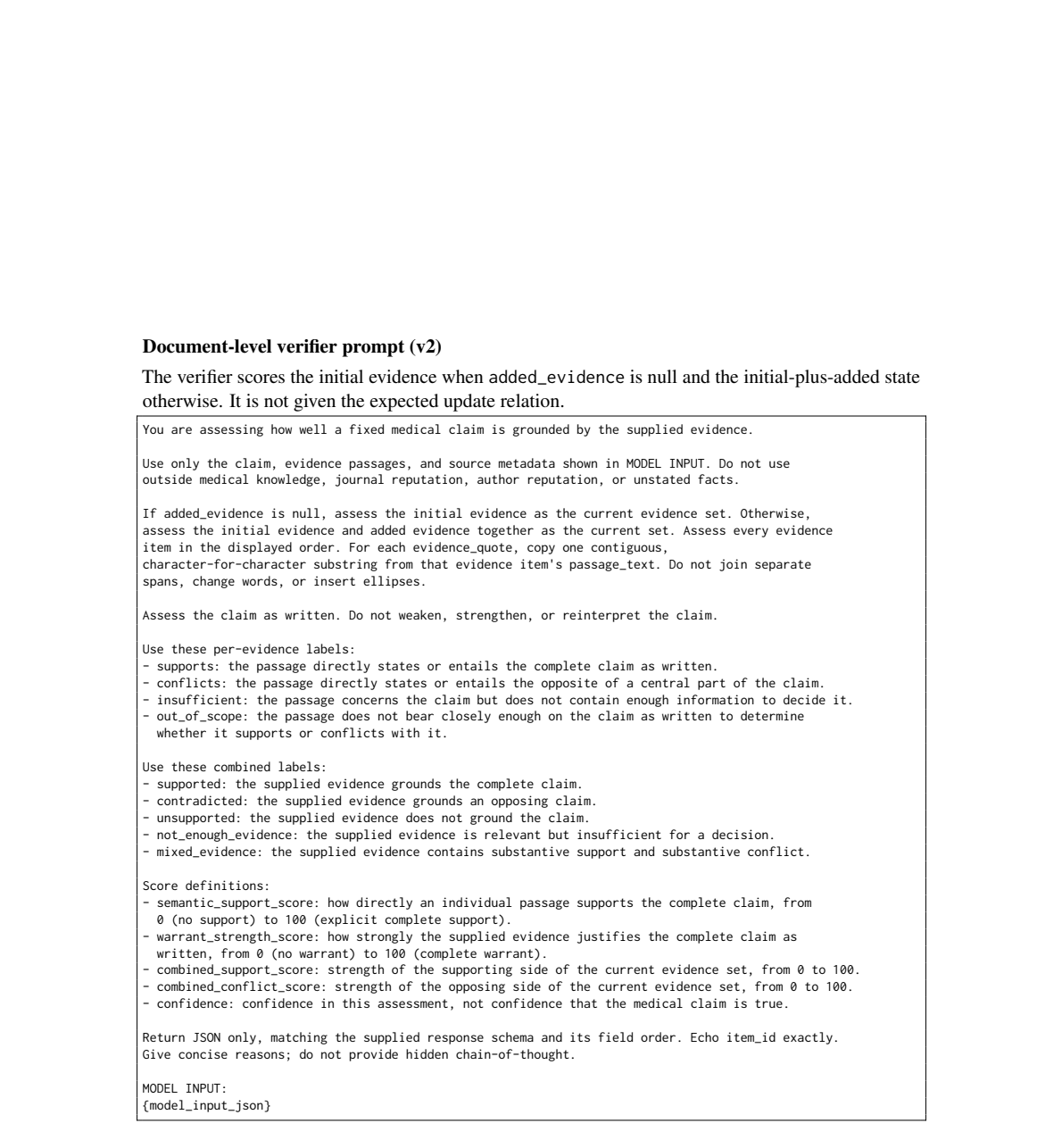
The paper says, at Section 3.2 and Figure 4 (Document-level verifier prompt)
The review did not quote this passage.
Pith says: Objection 1 of 1 · major
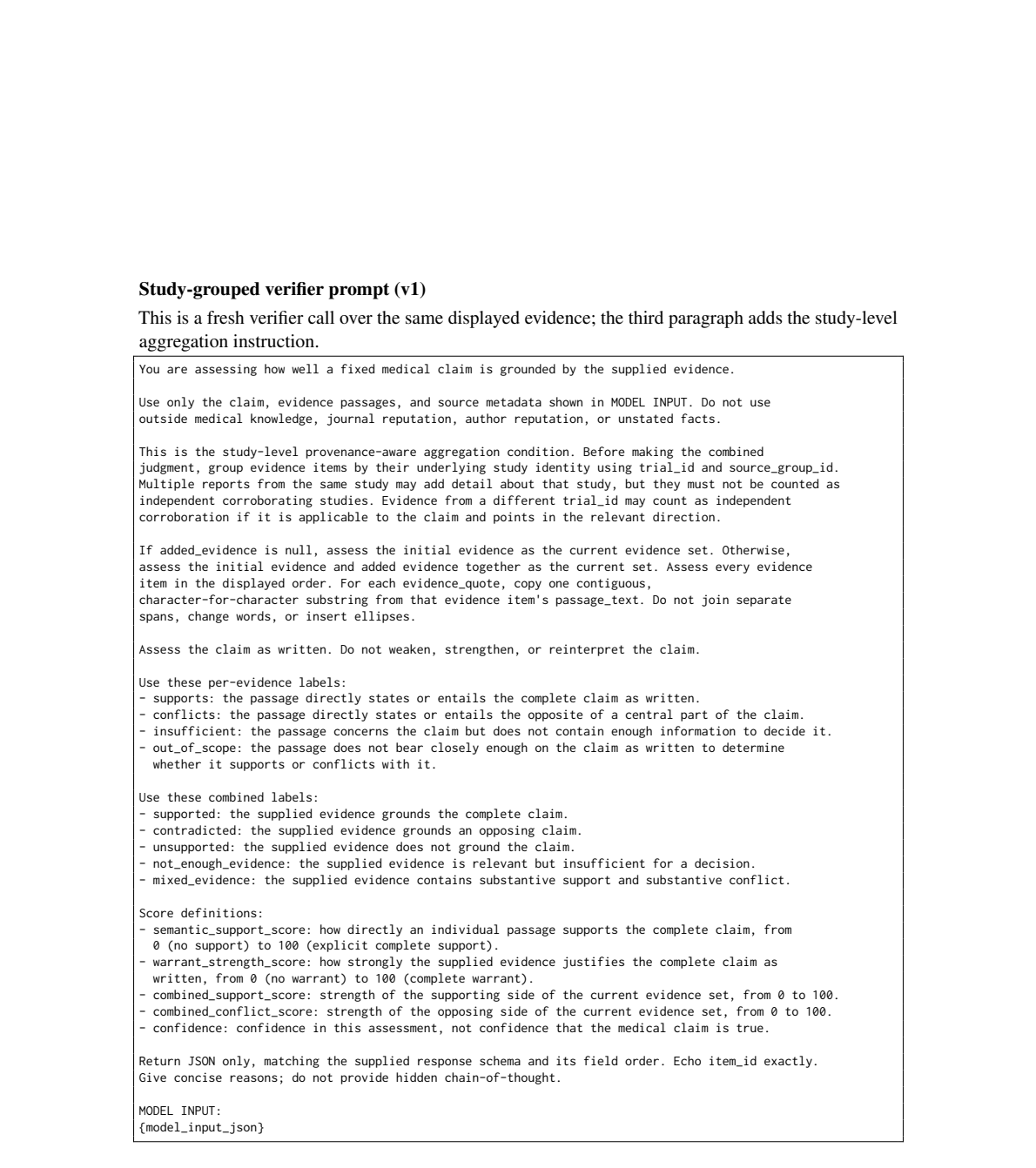
The document-level verifier prompt (Figure 4) does not explicitly define the 'independent_corroboration' flag or connect it to study identity. While the grouping prompt (Figure 5) does provide this linkage, the absence in the primary condition leaves open the possibility that the model's over-credit reflects a default mapping of 'different publication' to 'independent' rather than a failure to use recognized lineage.
more of objection 1
The paper partially addresses this concern through the oracle conditions (Section 6.2), which show that explicit provenance information removes over-credit for GPT-5.5. However, clearly acknowledging this interpretation risk in the main text would strengthen the paper's central claim.
5 minor objections
The paper says, at Section 1 and throughout
Pith says: minor objection 1 of 5
Spell out 'over-credit' consistently: the abstract uses 'over-credit' while Section 5.3 uses 'overcredit' (e.g., 'over-credit' vs. 'overcredit'). Choose one form.
The paper says, at Table 2
Pith says: minor objection 2 of 5
The column header 'Rejected R/A' is ambiguous. Consider renaming it to 'Rejected calls (recognition/aggregation)' or adding a footnote that explains the split.
show 3 more
The paper says, at Figure 1
Pith says: minor objection 3 of 5
The figure is informative but the flow is somewhat dense. Separating the recognition panel and the aggregation panel with more whitespace or a dashed line would improve readability.
The paper says, at Section 5.1
Pith says: minor objection 4 of 5
The sentence 'In the later grouping condition, the verifier assessed all displayed reports with study identifiers and an instruction to combine evidence by underlying trial identity.' lacks a hyphen in 'study-grouped' to match the terminology used elsewhere (e.g., 'study-grouping intervention').
The paper says, at Appendix B
Pith says: minor objection 5 of 5
The appendix provides the full prompts; however, the call accounting table (Table 6) would benefit from a short description of what each block tests (e.g., 'Original ten-family suite: primary recognition and aggregation across all four relation types').
What would settle it
Rerun the original neutral aggregation prompt (Figure 4) on CF-P1 with the output schema modified to replace the independent_corroboration flag with an explicit question: 'Is the added evidence from a different underlying study than any study already represented in the initial evidence?' (yes/no). Compare the over-credit frequency to the original 5/5; if the pattern holds, the original schema is not a confound.
from the skeptic's reading
How the review went
4 readings by deepseek-v4-flash · 19 Oct 2026
- Reader holds up
- Skeptic partly agrees
- Editor wrote the verdict above
- Referee accept: 1 major objection, 5 minor
Not run on this paper: the simulated authors' defence.
Pith did not check this review's objections against the paper.
The review in full
The review in brief, machine-written
The main thing to know about this paper is that it shows a real behavioral dissociation: models correctly identify that two publications come from the same clinical trial, but in a separate evidence-aggregation task they still flag the second publication as independent corroboration. This is a concrete failure mode for LLM-based medical verification, and the experiments are carefully done.
The key strength is the experimental design. The authors construct 14 source-audited clinical families with ground-truth study lineage established before any model calls. They separate the recognition task (which update is from an independent study?) from the aggregation task (assess the combined evidence) in stateless calls. Controls for exact repetition, out-of-scope evidence, and conflicting evidence are included. The main GPT-5.5 result is consistent: perfect recognition in three original provenance families (10/10) but same-trial over-credit in 15/15 aggregation calls. The grouping intervention—supplying explicit trial identifiers—reduces over-credit, showing the model can use the information when prompted appropriately. The paper reports rejected outputs transparently and includes five repetitions per input.
The limitations are real but not hidden. The 14 families are selected, not sampled. The grouping intervention exposes explicit study identifiers, which may not generalize to real-world metadata where such cues are absent. Several model conditions have high rejection rates, limiting cross-model comparisons. The exploratory analyses on prompt order and textual overlap are informative but not conclusive. The authors state all this in their limitations section.
Soft spots: the central claim is well-supported, but the scope is narrow—provenance families are only three. The recognition–aggregation gap is demonstrated primarily for GPT-5.5; other models show mixed results or are limited by rejected outputs. The grouping fix is effective but uses a strong cue. These do not undermine the main finding, but readers should not overgeneralize.
Who should read this? Anyone working on LLM evidence aggregation, medical claim verification, or multi-document reasoning. The paper deserves a serious referee. I would accept it for a venue like ACL or EMNLP, given the careful design and transparency.
The strongest objection
After thorough review, the central claim—that LLMs can correctly recognize study lineage in a direct task yet over-credit same-trial evidence in a separate aggregation task—is well-supported by the experimental design for the primary model (GPT-5.5) and partially for others. The paper is transparent about the scope, limitations (Section 8), and the fact that many comparisons are limited by rejected outputs. The recognition and aggregation tasks are designed to isolate the intended capability, and the grouping intervention provides an additional control. The weakest point could be the interpretation of the independent_corroboration flag in the aggregation schema: without a definition in the prompt, the model might be using the flag to mean 'supportive and distinct in text' rather than 'from a different study.' However, the grouping prompt (Figure 5) explicitly connects the flag to study identity, and the oracle conditions (Section 6.2) show that explicit provenance information removes the over-credit for GPT-5.5, supporting that the flag is being used for study lineage when instructed. The paper also reports that exact repeats are not flagged, showing the model is sensitive to publication-level distinctness. Thus, even this potential ambiguity is largely resolved by the paper's own controls. I cannot identify a load-bearing concern that would justify changing the reader's ACCEPT verdict.
The paper's central claim is clearly stated and experimentally supported. The only possible concern is whether the independent_corroboration flag in the original aggregation schema is measuring study lineage unawareness or a different construct. The paper addresses this through multiple controls: the grouping intervention (where the flag's meaning is clarified and over-credit disappears), the oracle conditions (where explicit relation/policy information removes the flag), and the exact-repeat controls (where the flag is not used). These jointly support that the flag, as used by the model, functions as a measure of study independence when the model attends to it. Therefore, I find no load-bearing flaw. The reader's weakest_assumption about representativeness is acknowledged by the paper and is not a flaw in the argument's soundness. The reader's verdict of ACCEPT remains appropriate.
The referee's report
If the behavioral gap holds more broadly, it has direct practical importance for clinical evidence synthesis: LLM-based verifiers that can identify shared study lineage may still over-count publications from a single trial. The paper's design is unusually careful—separate stateless calls, counterbalanced orders, repeated calls per input, explicit reporting of rejected outputs, and source auditing performed before model inference. The study-grouping intervention demonstrates one path toward repairing the error for a primary model. These results move beyond prior work on repetition effects (GroupQA, Whose Facts Win?) by testing real clinical publications with traceable trial identifiers. The paper's transparent treatment of limitations and its focus on a concrete behavioral contrast set a good standard for empirical work in this area.
Pith's reading of the paper (a machine's summary, not the authors')
This paper identifies a behavioral gap in LLM-based medical evidence verification: models can correctly recognize that two publications derive from the same clinical trial (study lineage recognition), yet in a separate task they still treat the second publication as independent corroboration when aggregating evidence. The authors test this using 14 source-audited clinical families, where each family has a fixed claim and matched evidence updates. Across three provenance families, GPT-5.5 identifies the independent trial in all recognition calls but over-credits the same-trial report in all aggregation calls; selected other models show the same contrast. The finding matters because conflating publication count with study count can inflate perceived support, and existing verification benchmarks do not test this trial-level dependence.
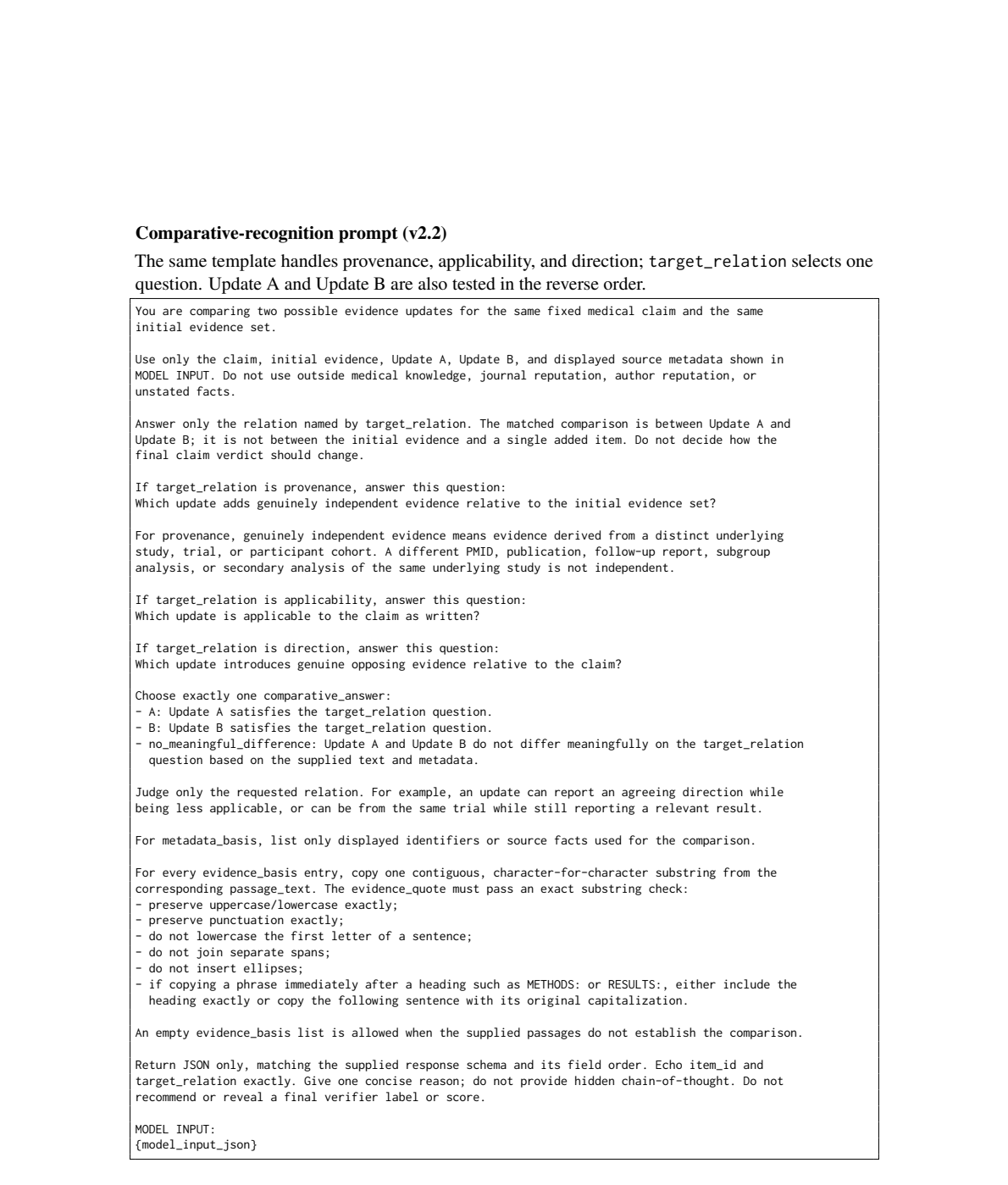
What carries the argument. The experimental design uses stateless separate calls for recognition and aggregation; the clinical family is the experimental unit, with five repeated calls per input to assess within-input stability. The key contrast is provenance: comparing a later report from the same trial versus a report from an independent trial. The study-grouping intervention adds explicit trial identifiers and an instruction to combine evidence by underlying study identity.
Core claim. The central claim is that publication count is not study count, and that recognizing study lineage does not guarantee lineage-respecting evidence aggregation. The authors show a cross-task behavioral gap: for three original provenance families, GPT-5.5 correctly identifies the independent trial in 10/10 recognition calls per family, yet in separate stateless aggregation calls it marks the same-trial report as independent corroboration in 5/5 calls per family. This gap persists even when the model handles exact repetitions and null controls correctly. The gap is reduced by an explicit study-grouping instruction for GPT-5.5 but not for other models, indicating that the failure is not a simple recognition error but a dissociation between what a model can identify and how it uses that knowledge.
The premise it rests on. The 14 source-audited clinical families are representative enough to support the claimed behavioral gap, and the recognition and aggregation tasks as designed (with their specific prompts and response schemas) faithfully measure the intended capabilities without task-specific confounds.
If the paper is right (Pith's inferences, not the authors')
If the gap is general, then evidence aggregation in medical LLMs should use underlying study identity as the unit of corroboration rather than treating each publication as an independent source.
Explicit study-grouping prompts can reduce over-credit for some models (GPT-5.5) but not others, suggesting that model architecture or training may affect the recognition–use dissociation.
The results imply that current benchmarks for medical factuality and evidence grounding may miss a critical source of error if they do not test trial-level dependence across publications.
Future work should investigate whether models can infer study grouping from ordinary publication metadata (trial IDs, cross-references) without explicit instruction.
The behavioral gap may reflect a deeper limitation in how LLMs represent and reason about causal or evidential ancestry, similar to known failures in belief revision and conflict resolution.
The dissociation between recognition and use suggests that internal representations of evidence structure are not automatically carried into downstream decisions, which may apply beyond medicine to any domain where source dependence matters (e.g., legal evidence, scientific literature review).
The grouping intervention's success for GPT-5.5 but failure for Qwen and Gemma indicates that model-specific properties (e.g., instruction following, reasoning depth) modulate the gap, raising the question of whether targeted training could close it.
Check this review
Pith stored no record of this review's passes and took no fingerprint of it. Reviews made by code from 13 Nov 2026 on carry both.
How often reviews like this one are right
Reviews like this one: written by deepseek-v4-flash, where what was read was not recorded.
How often objections from reviews like this one are right: not yet measured
Reviews by people
This review was written by a machine. No person has reviewed this paper on Pith yet. A scientist listed on Pith can review it for a fee, and their review is published here whatever it concludes.
The paper
Abstract
Publication count is not study count. A model can identify shared trial lineage correctly in a direct task yet over-credit a second publication from the same trial when aggregating evidence. We evaluate this behavior in medical LLM verification using 14 source-audited clinical families and five model conditions. The families span provenance, clinical applicability, result direction, and composition; the provenance families provide the direct lineage tests. Recognition and aggregation are separate stateless calls, and repeated calls assess within-input stability. Across all three original provenance families, GPT-5.5 identifies the independent update in 10/10 recognition calls per family but over-credits the same-trial report in 5/5 separate aggregation calls per family. Selected Qwen3-4B and Ministral-3-8B conditions show the same cross-task contrast. A study-grouping instruction reduces GPT-5.5 over-credit from 4/5 to 0/5 in each later pure-provenance family. Other model conditions show mixed behavior, and rejected outputs limit several comparisons. The results identify a behavioral gap between elicited lineage recognition and evidence aggregation. The code and data artifacts are available at https://anonymous.4open.science/r/study-lineage-review-artifact.
The paper's own sentences, arranged, kept beside the review and separate from it. Each label is drawn from a closed vocabulary; the number beside it is the probability the classifier gave that label. No sentence in this record was written by a model.
abstract compiled · 2026-10-20
The authors' main claim, as the classifier picked it out 0.56
“The results identify a behavioral gap between elicited lineage recognition and evidence aggregation.”
How the main claim is stated: asserted 1.00
What the abstract itself states, as probabilities: claims first 0.04 · states limitation 0.89 · human participants 0.11 · controlled comparison 0.48 · randomized assignment 0.03 · states quantitative result 0.99 · compares with prior results 0.55 · mentions code or data availability 0.99
The abstract, sentence by sentence
This table labels the abstract only (arXiv listing abstract v1). The number is the probability the classifier gave the label.
| Sentence | Role | The authors' own work | States the main conclusion | Strength |
|---|---|---|---|---|
| Publication count is not study count. | background 0.82 | 0.08 | 0.18 | asserted 1.00 |
| A model can identify shared trial lineage correctly in a direct task yet over-credit a second publication from the same trial when aggregating evidence. | result 0.44 | 0.51 | 0.77 | asserted 0.60 |
| We evaluate this behavior in medical LLM verification using 14 source-audited clinical families and five model conditions. | method 0.91 | 0.93 | 0.04 | asserted 0.96 |
| The families span provenance, clinical applicability, result direction, and composition; the provenance families provide the direct lineage tests. | method 0.97 | 0.56 | 0.03 | asserted 0.98 |
| Recognition and aggregation are separate stateless calls, and repeated calls assess within-input stability. | method 1.00 | 0.73 | 0.04 | asserted 0.99 |
| Across all three original provenance families, GPT-5.5 identifies the independent update in 10/10 recognition calls per family but over-credits the same-trial report in 5/5 separate aggregation calls per family. | result 1.00 | 0.95 | 0.25 | asserted 1.00 |
| Selected Qwen3-4B and Ministral-3-8B conditions show the same cross-task contrast. | result 1.00 | 0.90 | 0.05 | asserted 1.00 |
| A study-grouping instruction reduces GPT-5.5 over-credit from 4/5 to 0/5 in each later pure-provenance family. | result 0.98 | 0.94 | 0.11 | asserted 1.00 |
| Other model conditions show mixed behavior, and rejected outputs limit several comparisons. | limitation 0.81 | 0.90 | 0.04 | asserted 0.99 |
| The results identify a behavioral gap between elicited lineage recognition and evidence aggregation. | interpretation 0.72 | 0.91 | 0.78 | asserted 1.00 |
| The code and data artifacts are available at https://anonymous.4open.science/r/study-lineage-review-artifact. | contribution 0.81 | 0.55 | 0.02 | asserted 0.98 |
What kind of paper the classifier reports this is: empirical study 1.00 · evidence from observation or experiment 0.86
What was examined, and what was not
Sources read
- arXiv listing abstract v1
Not examined
- full text
- figures and tables
- references and citing sentences
- relations to other papers
Levels run
- P abstract
Not run
- S sections
- T body sentences
- C citations
- R cross-paper relations
How the labels were made
Compiled by classifier-1.13.0 via TypeSafe API, question bank abstract-p1-20260923, 2026-10-20: 1 request, 8,063 input tokens.
Every quoted sentence on this record is the authors'. Every label is from Pith's closed vocabulary, with the probability shown beside it. This record as JSON
Figures (5)

Figures are the authors', reproduced from the paper.
References (62)
- [1] 2026 , month = apr, url = on Pith
- [2] 2025 , eprint =. doi:10.48550/arXiv.2505.09388 , url = on PithPith's reviewarXivdoi:10.48550/arxiv.2505.09388
- [3] 2025 , eprint =. doi:10.48550/arXiv.2503.19786 , url = on PithPith's reviewarXivdoi:10.48550/arxiv.2503.19786
- [4] Dubey, Abhimanyu and Jauhri, Abhinav and Pandey, Abhinav and others , journal =. The. 2024 , doi = on Pith
- [5] Holistic Evaluation of Language Models , author =. Transactions on Machine Learning Research , year = on Pith
- [6] Mizrahi, Moran and Kaplan, Guy and Malkin, Dan and Dror, Rotem and Shahaf, Dafna and Stanovsky, Gabriel , journal =. State of What Art? A Call for Multi-Prompt. 2024 , publisher =. doi:10.1162/tacl_a_00681 , url = on Pithdoi:10.1162/tacl_a_00681
- [7] Ceballos-Arroyo, Alberto Mario and Munnangi, Monica and Sun, Jiuding and Zhang, Karen and McInerney, Jered and Wallace, Byron C. and Amir, Silvio , booktitle =. Open (Clinical). 2024 , address =. doi:10.18653/v1/2024.bionlp-1.5 , url = on Pithdoi:10.18653/v1/2024.bionlp-1.5
- [8] Min, Sewon and Krishna, Kalpesh and Lyu, Xinxi and Lewis, Mike and Yih, Wen-tau and Koh, Pang Wei and Iyyer, Mohit and Zettlemoyer, Luke and Hajishirzi, Hannaneh , booktitle =. 2023 , url = on Pith
- [9] Long-form Factuality in Large Language Models , author =. Advances in Neural Information Processing Systems , year =. doi:10.52202/079017-2567 , url = on Pithdoi:10.52202/079017-2567
- [10] Knowledge-Centric Hallucination Detection , author =. Proceedings of the 2024 Conference on Empirical Methods in Natural Language Processing , pages =. 2024 , url = on Pith
- [11] Dammu, Preetam Prabhu Srikar and Naidu, Himanshu and Dewan, Mouly and Kim, YoungMin and Roosta, Tanya and Chadha, Aman and Shah, Chirag , booktitle =. 2024 , url = on Pith
- [12] Es, Shahul and James, Jithin and Espinosa-Anke, Luis and Schockaert, Steven , booktitle =. 2024 , url = on Pith
- [13] Fact, Fetch, and Reason: A Unified Evaluation of Retrieval-Augmented Generation , author =. Proceedings of the 2025 Conference of the Nations of the Americas Chapter of the Association for Computational Linguistics: Human Language Technologies , pages =. 2025 , url = on Pith
- [14] Enabling Large Language Models to Generate Text with Citations , author =. Proceedings of the 2023 Conference on Empirical Methods in Natural Language Processing , pages =. 2023 , url = on Pith
- [15] Saad-Falcon, Jon and Khattab, Omar and Potts, Christopher and Zaharia, Matei , booktitle =. 2024 , url = on Pith
- [16] Martin-Boyle, Anna and Leckey, Cara A. C. and Brown, Martha C. and Kaur, Harmanpreet , booktitle =. 2026 , url = on Pith
- [17] Tan, Neset and Li, Minghao and Gahegan, Mark , booktitle =. 2026 , url = on Pith
- [18] Zheng, Lianmin and Chiang, Wei-Lin and Sheng, Ying and others , booktitle =. Judging. 2023 , doi = on Pith
- [19] Ribeiro, Marco Tulio and Wu, Tongshuang and Guestrin, Carlos and Singh, Sameer , booktitle =. Beyond Accuracy: Behavioral Testing of. 2020 , url = on Pith
- [20] Prompt to Be Consistent Is Better than Self-Consistent? Few-Shot and Zero-Shot Fact Verification with Pre-Trained Language Models , author =. Findings of the Association for Computational Linguistics: ACL 2023 , pages =. 2023 , url = on Pith
show 42 more
- [21] Joseph, Sebastian and Chen, Lily and Trienes, Jan and G. Proceedings of the 62nd Annual Meeting of the Association for Computational Linguistics (Volume 1: Long Papers) , pages =. 2024 , url = on Pith
- [22] Jullien, Ma\"el and Valentino, Marco and Freitas, Andr\'e , booktitle =. 2024 , url = on Pith
- [23] Jin, Qiao and Dhingra, Bhuwan and Liu, Zhengping and Cohen, William W. and Lu, Xinghua , booktitle =. 2019 , url = on Pith
- [24] A Dataset for Evaluating Clinical Research Claims in Large Language Models , author =. Scientific Data , volume =. 2025 , doi = on Pith
- [25] Chapter 5: Collecting data , author =. Cochrane Handbook for Systematic Reviews of Interventions, Version 6.5 , editor =. 2024 , note = on Pith
- [26] Smalheiser, Neil R. and Holt, Arthur W. , journal =. New improved. 2020 , doi = on Pith
- [27] Pandit, Shrey and Xu, Jiawei and Hong, Junyuan and Wang, Zhangyang and Chen, Tianlong and Xu, Kaidi and Ding, Ying , booktitle =. 2025 , doi = on Pith
- [28] Qu, Zhan and F. Proceedings of the 64th Annual Meeting of the Association for Computational Linguistics , year = on Pith
- [29] Evaluating Large Language Models for Evidence-Based Clinical Question Answering , author =. Patterns , volume =. 2026 , url = on Pith
- [30] The Strength of Clinical Evidence Is Recoverable from Language Model Representations but Not from Their Stated Grades , author =. arXiv preprint arXiv:2606.29034 , year = on PithPith's reviewarXiv
- [31] Qian, Pin and Wang, Su and Wang, Xiaoyuan and Chen, Yihang and Xu, Wenxuan and Yu, Qiaolin and Lin, Shuhuai and Zhang, Sipeng and You, Junxian and Wei, Xinpeng , journal =. Relevant Is Not Warranted: Evidence-Force Calibration for Cited. 2026 , url = on Pith
- [32] Naphade, Atharv , booktitle =. Rational Synthesizers or Heuristic Followers? Analyzing. 2026 , url = on Pith
- [33] Schuster, Jakob and Gautam, Vagrant and Markert, Katja , booktitle =. Whose Facts Win?. 2026 , url = on Pith
- [34] Jiayang, Cheng and Chan, Chunkit and Zhuang, Qianqian and Qiu, Lin and Zhang, Tianhang and Liu, Tengxiao and Song, Yangqiu and Zhang, Yue and Liu, Pengfei and Zhang, Zheng , booktitle =. 2024 , url = on Pith
- [35] Wallat, Jonas and Nejdl, Wolfgang and Sikdar, Sandipan , booktitle =. When Facts Change: Temporal Knowledge Conflict Resolution in. 2026 , url = on Pith
- [36] Zhao, Yu and Devoto, Alessio and Hong, Giwon and Du, Xiaotang and Gema, Aryo Pradipta and Wang, Hongru and He, Xuanli and Wong, Kam-Fai and Minervini, Pasquale , booktitle =. Steering Knowledge Selection Behaviours in. 2025 , url = on Pith
- [37] Beyond Black-Box Interventions: Latent Probing for Faithful Retrieval-Augmented Generation , author =. Findings of the Association for Computational Linguistics: ACL 2026 , pages =. 2026 , url = on Pith
- [38] Haldar, Rajarshi and Hockenmaier, Julia , booktitle =. Rating Roulette: Self-Inconsistency in. 2025 , url = on Pith
- [39] Investigating Context Faithfulness in Large Language Models: The Roles of Memory Strength and Evidence Style , author =. Findings of the Association for Computational Linguistics: ACL 2025 , pages =. 2025 , url = on Pith
- [40] Srikanth, Neha and Rudinger, Rachel , booktitle =. 2025 , url = on Pith
- [41] Belief Revision: The Adaptability of Large Language Models Reasoning , author =. Proceedings of the 2024 Conference on Empirical Methods in Natural Language Processing , pages =. 2024 , url = on Pith
- [42] Sun, Kaiser and Bai, Fan and Dredze, Mark , booktitle =. Task Matters: Knowledge Requirements Shape. 2026 , url = on Pith
- [43] Sufficient Context: A New Lens on Retrieval Augmented Generation Systems , author =. The Thirteenth International Conference on Learning Representations , year = on Pith
- [44] Kumaran, Dharshan and Fleming, Stephen M. and Markeeva, Larisa and Heyward, Joe and Banino, Andrea and Mathur, Mrinal and Pascanu, Razvan and Osindero, Simon and De Martino, Benedetto and Veli. Competing Biases underlie Overconfidence and Underconfidence in. Nature Machine Int... on Pith
- [45] Causal Evidence that Language Models Use Confidence to Drive Behaviour , author =. Nature Machine Intelligence , year =. doi:10.1038/s42256-026-01293-x , url = on Pithdoi:10.1038/s42256-026-01293-x
- [46] A Monosemantic Attribution Framework for Stable Interpretability in Clinical Neuroscience Transformer-Based Language Models , author =. arXiv preprint arXiv:2601.17952 , year = on PithPith's reviewarXiv
- [47] Samanta, Ankur and Magesh, Akshayaa and Lancewicki, Tal and Jain, Ayush and Yu, Youliang and Sajda, Paul and Hassani, Kaveh and Modi, Aditya and Jiang, Daniel and Efroni, Yonathan , journal =. 2026 , url = on Pith
- [48] How to make medical ai systems safer? simulating vulnerabilities, and threats in multimodal medical rag system , author =. arXiv preprint arXiv:2508.17215 , year = on PitharXiv
- [49] When Should Models Change Their Minds? Contextual Belief Management in Large Language Models , author =. arXiv preprint arXiv:2605.30219 , year = on PithPith's reviewarXiv
- [50] Is unimodal bias always bad for visual question answering? a medical domain study with dynamic attention , author =. 2022 IEEE International Conference on Big Data (Big Data) , pages =. 2022 , organization =. doi:10.1109/BigData55660.2022.10020791 , url = on Pithdoi:10.1109/bigdata55660.2022.10020791
- [51] Position: Retrieval-Augmented Systems Can Be Dangerous Medical Communicators , author =. Proceedings of the 42nd International Conference on Machine Learning , volume =. 2025 , url = on Pith
- [52] Bara, Marc , journal =. Epistemic Sybil Resistance: Multiplying. 2026 , url = on Pith
- [53] A Controlled Trial of Erenumab for Episodic Migraine , author =. New England Journal of Medicine , volume =. 2017 , doi = on Pith
- [54] Diener, Hans-Christoph and Ashina, Messoud and Ritter, Shannon and others , journal =. Erenumab prevents the occurrence of migraine attacks and not just migraine days: Post-hoc analyses of a phase. 2021 , doi = on Pith
- [55] Dodick, David W. and Ashina, Messoud and Brandes, Jan Lewis and others , journal =. 2018 , doi = on Pith
- [56] Initiation of Antiretroviral Therapy in Early Asymptomatic. The New England Journal of Medicine , year =. doi:10.1056/NEJMoa1506816 , pmid = on Pithdoi:10.1056/nejmoa1506816
- [57] Lundgren, Jens D. and Babiker, Abdel G. and Sharma, Shweta and others , journal =. Long-Term Benefits from Early Antiretroviral Therapy Initiation in. 2023 , volume =. doi:10.1056/EVIDoa2200302 , pmid = on Pithdoi:10.1056/evidoa2200302
- [58] A Trial of Early Antiretrovirals and Isoniazid Preventive Therapy in Africa , author =. The New England Journal of Medicine , year =. doi:10.1056/NEJMoa1507198 , pmid = on Pithdoi:10.1056/nejmoa1507198
- [59] Prevention of Coronary Heart Disease with Pravastatin in Men with Hypercholesterolemia , author =. The New England Journal of Medicine , year =. doi:10.1056/NEJM199511163332001 , pmid = on Pithdoi:10.1056/nejm199511163332001
- [60] Vallejo-Vaz, Antonio J. and Robertson, Michele and Catapano, Alberico L. and others , journal =. Low-Density Lipoprotein Cholesterol Lowering for the Primary Prevention of Cardiovascular Disease Among Men with Primary Elevations of Low-Density Lipoprotein Cholesterol Levels of... on Pithdoi:10.1161/circulationaha.117.027966
- [61] Randomised Trial of Cholesterol Lowering in 4444 Patients with Coronary Heart Disease: The Scandinavian Simvastatin Survival Study (. The Lancet , year =. doi:10.1016/S0140-6736(94)90566-5 , pmid = on Pithdoi:10.1016/s0140-6736(94)90566-5
- [62] Major Outcomes in Moderately Hypercholesterolemic, Hypertensive Patients Randomized to Pravastatin vs Usual Care: The Antihypertensive and Lipid-Lowering Treatment to Prevent Heart Attack Trial (. JAMA , year =. doi:10.1001/jama.288.23.2998 , pmid = on Pithdoi:10.1001/jama.288.23.2998
Cited by 1 Pith paper
Reviewed papers on Pith that cite this one. The full citation record
Challenges and discussion
Disagree with the review, or know something it missed? Leave a comment, or challenge this review formally: a challenge becomes a permanent entry in this paper's record, and its decision is published here.
Come back by email
A short list of the week's newly reviewed papers. Nothing is sent until you confirm from your inbox, and every email has a link that stops it. No account.
No comments yet.
Sign in to comment