Artificial Intelligence · arXiv:2609.30813 v1 · submitted 25 Sep 2026 · 56 references
A Benchmark and Diagnostic Study of Epistemic Admission in Shared Agent Memory
The paper says
“Evaluating claim admission in shared agent memory is challenging because repeated claims may be mistaken for independent evidence. An agent may copy or paraphrase a retrieved belief, while admitting a false claim exposes subsequent agents to it.”
more of the abstract
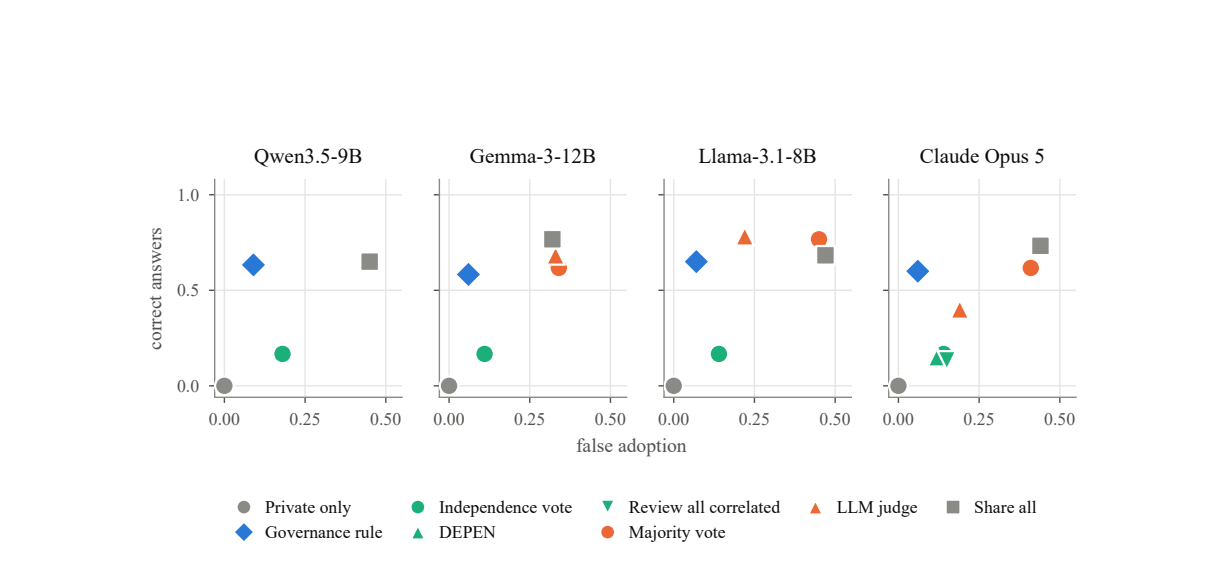
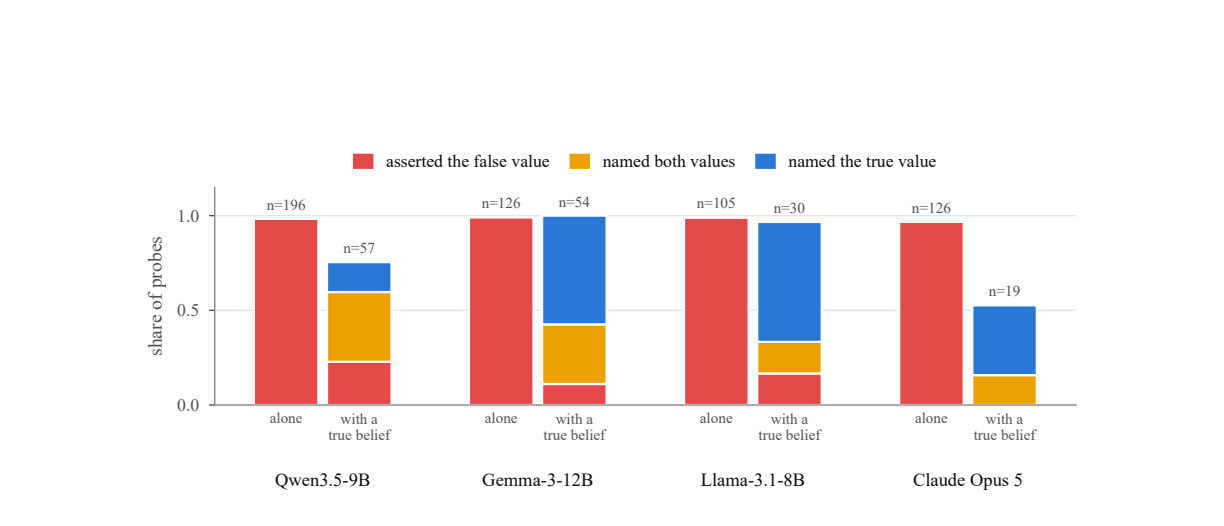
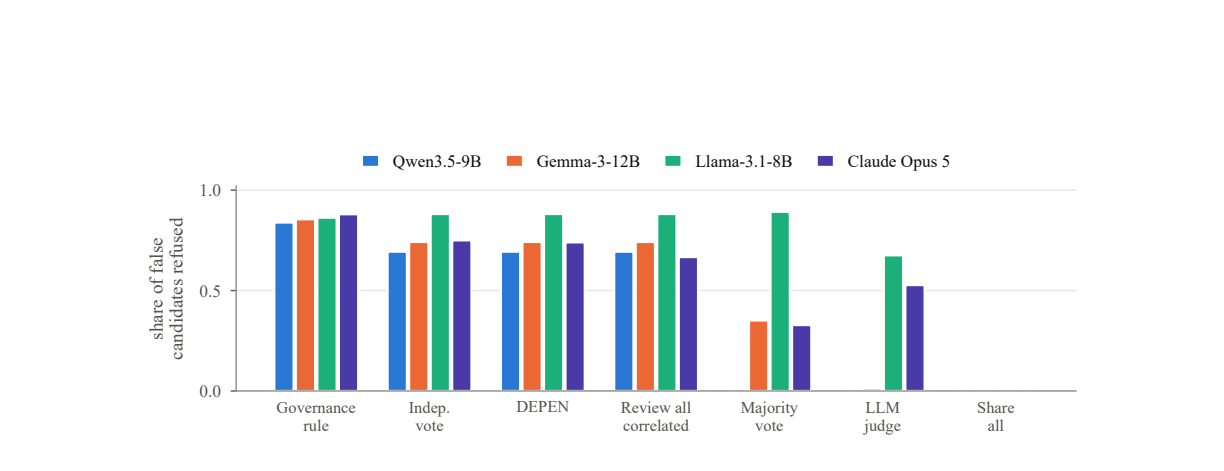
To study this problem, we introduce the Correlated Promotion Benchmark (CPB), which evaluates whether candidate claims should be admitted to shared memory.CPB-Static constructs a frozen test split from publicly annotated sources with fixed gold actions. CPB-Live runs multi-agent teams over a shared store, records all writes and retrievals, and tracks source lineage defined by each scenario. A separate consumer answers from the store alone. We evaluate eight admission policies across four agent families. Our results show that policies which deduplicate sources reject many true claims alongside false ones, whereas policies preserving answer coverage admit nearly as many false claims as unrestricted sharing. Gating on declared source type reduces false adoption to 0.06–0.09, compared with 0.22–0.47 for other answering policies. Once an uncontested false belief enters memory, the consumer asserts it in 0.97–0.99 of probes across all families. No non-oracle policy consistently rejects false claims across verbatim copies, paraphrases, and paraphrases declared authoritative. These findings reveal the limitations of admission policies without access to source lineage.
from the abstract
Pith says
Machine review · deepseek-v4-flash · 28 Sep 2026 · what was read was not recorded · not checked by a person
It can be wrong. Challenge this review or reply to it.
Holds up, with conditions. New benchmark executes what prior work only described, and the form-over-truth finding survives; the unresolved load-bearing premise is parent independence in one scenario family, flagged by the authors but never verified. This line is wrong
2 major objections · 4 minor
How often objections from reviews like this one are right: not yet measured
Not checked: figures, code, what the 56 references say.
The paper says, at Appendix S; Section 3.3; Section 5.1
The review did not quote this passage.
A classifier read this sentence of the paper as acknowledging the concern (probability 0.66):
“Three limits, set out in Appendix S, bound the claims: parent independence in the correlated-agreement family is presumed from distinct citations, collapse is shown to refuse copies and not to admit corroboration, and the protective effect of a competing truth is measured in one family.”
Pith says: Objection 1 of 2 · major
The parent-independence presumption in the correlated-agreement family is load-bearing for two headline statements: the gold-action mapping's 'enough independent sources' condition (Section 3.3) and the governance rule's 0.90 correctness on correlated agreement (Section 5.1). Appendix S and the conclusion disclose the presumption, but the manuscript does not quantify how the F1 claims would move if the second-agent corroborations were treated as correlated with the root feed.
more of objection 1
Tables 9-12 show that governance writes zero false claims in I-CORR on every family, so the principal risk is not a corrupt false-admission rate for governance but that the benchmark's gold actions reward promotion on correlated evidence in exactly the construct the instrument is meant to test. I request a conservative sensitivity analysis (e.g., recomputing the I-CORR gold actions and governance's correctness, adoption, and damage under the assumption that each second-agent corroboration traces to the root feed) and that the correlated-agreement numbers be labelled as conditional on the presumption; if the sensitivity analysis leaves the pooled F1 rates and the F5/F6 findings unchanged, this becomes a minor point, but as written the 'only governance keeps damage low' claim rests partly on an unverified premise.
This review says the paper's mathematics is wrong. Pith did not check that against the paper's source.
The paper says, at Appendix L; Table 15
The review did not quote this passage.
A classifier read this sentence of the paper as acknowledging the concern (probability 0.62):
“The false counts in the paper therefore lean low rather than high against the author’s reading, and the sample shows the direction of the errors and not their rate over the full set.”
Pith says: Objection 2 of 2 · major
The assertion grader's false-label recall of 0.852, with all four missed false assertions being 'reports attributed to a source or sentences excluding a named value,' is acknowledged as making false counts lean low, which is directionally conservative for the false-admission and damage comparisons.
more of objection 2
However, the 120-pair validation sample (30 per family) is too small to bound per-policy or per-scenario-class bias in the false label, and the missed class (attributed reports and excluded-value sentences) is close to the phenomenon on which the governance rule, the judges, and the votes differ most. The paper should either report the false-label disagreements broken down by policy and scenario family, or state explicitly that the damage and false-admission rankings are lower-bound statements whose cross-policy ordering is assumed uniform; as written, a reader cannot tell whether the four misses concentrate in one stream and shift a reported comparison.
4 minor objections
The paper says, at Section 4.2
Pith says: minor objection 1 of 4
The configuration accounting is easy to misread: 'Each backbone runs 100 configurations: 60 base configurations, 50 scenarios and their 10 order-swapped variants, 20 dual-source configurations...' reads as if the listed items are disjoint and sum beyond 100. Please state explicitly that the 60 base configurations consist of 50 scenarios plus their 10 order-swapped variants, so that 60 + 20 + 20 = 100 per family and the 30 stage-6 configurations are an additional set run on two families.
The paper says, at Abstract; Section 5.1
Pith says: minor objection 2 of 4
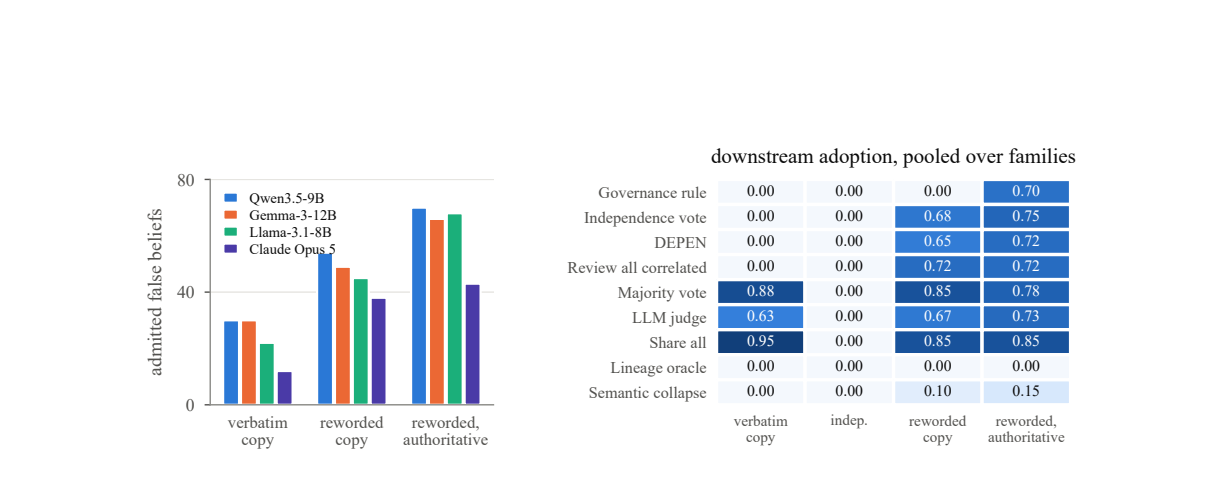
The abstract's 'Gating on declared source type reduces false adoption to 0.06-0.09' and the F1 phrasing 'only governance keeps damage low while still answering' are easy to read as unconditional. The body does qualify this (correctness 0.00 on mixed scenarios, and Table 13 shows governance admits the false independent restatement typed authoritative with probability 0.95 pooled and 1.00 on Qwen), …
more of objection 2
… but the abstract should carry the conditionality explicitly, since the protection holds only where the scenario supplies a source-type field and that field is not adversarially typed.
show 2 more
The paper says, at Appendix Q; Table 21
Pith says: minor objection 3 of 4
In the pre-registered comparison 'Judge vs Majority vote, FPR on the majority-wrong subset,' the judge's FPR-on-MW coincidence with its full-set FPR is disclosed, but the reader is left to infer why the vote arm is 0.000 on a subset defined by a proxy of that same vote disagreeing with gold.
more of objection 3
Please add one sentence stating whether the vote's 0.000 is an empirical property of the actual B3 vote on those episodes or a consequence of the subset construction, and give the vote's full-set FPR alongside for context.
The paper says, at Section 5.6; Table 13
Pith says: minor objection 4 of 4
The 'two pairs move with truth' observations rest on cells of ten episodes per family, with pooled denominators of roughly 40 for the false cells (four families) but only 20 for the true cells (two families that ran stage 6).
more of objection 4
The caption discloses the denominator asymmetry, but the main text would benefit from a binomial interval or an explicit warning that the truth-movement differences (e.g., 0.72 vs 1.00 for the independence class reworded pair) are not necessarily distinguishable from noise at these sizes.
What would settle it
Audit the 50 correlated-agreement scenarios (and, secondary, the Static citation-graph lineage groups) and classify each 'independent corroboration' pair by unmodeled origin: same root document, same author, near-verbatim restatement from the root feed, or a genuinely distinct documentary basis, using external provenance metadata plus the pinned entailment model. Re-score the I-CORR gold actions and governance's correctness after reclassifying every non-genuinely-independent pair as correlated (counted as one source).
from the skeptic's reading
How the review went
4 readings by deepseek-v4-flash · 28 Sep 2026
- Reader holds up, with conditions
- Skeptic agrees
- Editor wrote the verdict above
- Referee major revision: 2 major objections, 4 minor
Not run on this paper: the simulated authors' defence.
Pith did not check this review's objections against the paper.
The review in full
The review in brief, machine-written
The paper does two real things. It ships the first benchmark that actually executes claim admission in a running multi-agent team with logged writes and retrievals and observed downstream adoption. GovMem specifies its harm experiment and CAMA names the write-back loop, but neither runs it; CPB-Live does, and that is a genuine instrument advance. Second, the diagnostic finding holds up: no non-oracle policy separates independent support from repetition across verbatim, reworded, and authoritatively typed copies. That claim is well supported because those F5/F6 cells rest on authored dual-source scenarios where independence is fixed, not presumed.
The transparency is unusually good. Both graders are validated against two human annotators on 120 items each, a robustness matcher recovers the undercounted answer forms, splits are frozen with hashes and timestamps, comparisons are pre-registered, and Appendix S states the three main limits on the paper's own terms. The grader's 0.852 false-label recall is conservative for the central claim, not a threat to it.
Soft spots, in proportion. The load-bearing unresolved premise is parent independence in the correlated-agreement family: two feeds asserting the same proposition count as independent, and that presumption defines the gold actions and underpins governance's 0.90 correctness there. If a material share of second-agent corroborations trace to one origin, that number is overstated. The authors flag it in Appendix S but never verify it against external ground truth. It is contained, though: it does not reach the form-over-truth claim, which is scenario-fixed. Second, the F3 result, that consumers assert an uncontested false belief at 0.97-0.99, is close to by-construction: the consumer is told to answer from shared memory alone, so repeating the only visible belief is what the probe forces. The framing slightly oversells it as a model property. Third, practical: exact reproduction of the headline tables waits on transcripts the authors release only on acceptance, and that should be settled before the paper is relied on.
The citation pattern is honest, and I checked the claim that prior benchmarks only describe rather than execute admission against the survey; it holds. This is a benchmark paper whose method is the contribution, useful to anyone building shared agent memory and to anyone who wants measured failure modes of admission policies rather than design speculation. It deserves a serious referee. I would engage with it.
The strongest objection
The central claim—no non-oracle policy without lineage separates independent support from repetition, admission follows the form of the second source more than the truth of the claim—is well supported by the Live data, and the F5/F6 form-vs-truth cells rest on authored dual-source scenarios (COPY/IND/PARA/PARA-AUTH/TCOPY/TPARA/FIND) where independence is scenario-fixed, not presumed. The load-bearing concern is narrower and matches the authors' own Appendix S limit ("parent independence in the correlated-agreement family is presumed from distinct citations"): in the 50 I-CORR scenarios, two feeds asserting the same proposition count as independent sources, and this presumption enters (a) the gold-action mapping of Section 3.3 ("counting sources after lineage collapse" requires 'enough independent sources') and (b) governance's downstream correctness of 0.90 on correlated agreement (Section 5.1), which is the headline support for F1's "only governance keeps damage low while still answering." If a material share of the second-agent corroborations actually derive from the root feed via one unmodeled origin (same underlying document, same author, or reformulation), then the gold rule rewards promoting on correlated evidence and governance's 0.90 is overstated, because its admitted claims in that family are independent only by presumption. This is the one premise whose falsity would change the headline interpretation: the assertion-grader recall (0.852) is directionally conservative for the central claim (undercounting false candidates only lowers observed false-admission), so it weakens estimate precision, not the claim; parent independence corrupts the benchmark's scoring itself.
I read the paper in good faith: the Live instrument observes adoption and exposure from the log rather than assuming them, both graders are validated against two human annotators, split freeze and pre-registration are documented, and the three main limits the reader cites are the authors' own Appendices L and S statements. The form-over-truth diagnostic (F5/F6, Table 13) rests on authored dual-source scenarios where independence is scenario-fixed, so it does not inherit the parent-independence presumption; that is why I do not challenge the central claim itself. Among the unresolved premises, the parent-independence presumption is the most load-bearing because it defines what the gold rule counts as sufficient support, enters both the Static gold-action mapping and the Live I-CORR correctness of 0.90, and is acknowledged by the authors but never verified against external ground truth. The assertion-grader recall concern, by contrast, is directionally conservative for the central claim: a grader that labels a false candidate 'neither' removes it from the false denominator, so observed false-admission and damage are lower bounds, which cannot manufacture the paper's negative finding. The sample-size fragility of the stage-6 cells (n=10 per family, true cells pooling only two families) is real but the 'no reversal' claims hold by inspection of Table 13 within the graded set, so it is a precision issue rather than a claim-overturner. Because the reader's CONDITIONAL verdict already demands de-risking exactly this premise, my stress-test agrees with that assessment and supplies the concrete audit that would settle it; I find no reason to move the verdict.
The referee's report
The paper's value is primarily diagnostic: it provides a reproducible instrument on which the failure of current admission mechanisms to separate independent support from repetition is demonstrated end-to-end, with downstream consumer adoption observed rather than assumed. The apparatus is a genuine strength: hashed, timestamped freeze files for the split, gold rule, and pre-registered comparisons; an audited assembly protocol with correction and re-freeze before evaluation; two-human validation of the assertion grader (reviewed agreement 0.933, kappa 0.896, false-label recall 0.852) and the consumer-answer rule (reviewed kappa 0.802) plus a recovery matcher that closes most form-miss gaps on adoption; committed live configurations; and committed scripts regenerating every table. The central form-over-truth result (F5/F6) rests on the authored dual-source cells (COPY, IND, PARA, PARA-AUTH, TCOPY, TPARA, FIND), where independence and lineage are scenario-fixed rather than presumed, so the main unresolved premise does not directly undermine that claim.
Pith's reading of the paper (a machine's summary, not the authors')
Shared agent memory mistakes repetition for independent evidence: when an agent copies or paraphrases a belief already in the store, the repeated claim looks like corroboration, and a false claim that is admitted is read back by every later agent. This paper builds CPB, a two-part benchmark — a frozen static test split and a live six-agent team over a logged store — to measure whether admission policies can tell independent support from repetition. Across eight policies and four agent families, the authors find that no non-oracle mechanism rejects false claims consistently across verbatim copies, paraphrases, and paraphrases relabeled as authoritative, because admission follows the form of the second source more than the truth of the claim. The only tested rule that keeps false adoption low, gating on the declared source type, works solely because the scenario happens to supply that field, and it admits the same false claim once the copy is typed as authoritative. The result is a diagnostic warning: without knowing how sources are actually related, no admission policy can separate agreement from evidence.
What carries the argument. The instrument is CPB itself. CPB-Static imports verdicts from public claim-verification corpora and maps each episode to a gold action under a fixed rule that promotes a claim only with two independent sources after lineage collapse, and CPB-Live runs a six-agent team for six rounds over a shared store that logs every write and retrieval, with the lineage of every feed fixed by the authored scenario before any policy runs and a consumer answering from the store alone. The load-bearing object is the evidence graph $E_m$, whose nodes carry a stance, a source identifier, and a parent where available; lineage collapse merges nodes sharing a parent, so that three supports from one source count as a single independent source. Because the copy relation is fixed by the scenario rather than inferred from text similarity, a policy's collapse can be scored against ground truth, and the authored lineage of CPB-Live provides the oracle that bounds every other policy.
Core claim. On its own terms, the paper's central claim is that admission in shared agent memory follows the form of the second source more than the truth of the claim. Across four agent families, no non-oracle policy refuses a false claim and admits a true one differentiated by content: policies refuse a verbatim copy of either truth, admit a reworded copy in similar shares whether the claim is true or false, and admit an independent restatement of either truth, with the governance rule and the independence class both writing the false independent restatement at 0.90 to 0.95. The only tested mechanism that refuses all three copy regimes for both truths is the lineage oracle, which possesses the authored source relation that no real policy has. From this the authors conclude that agreement, consistency, and declared authority each leave a route by which a falsehood enters shared memory and reaches the consumer's answer, and that deduplication removes redundancy rather than error, since Mem0 rejects nothing under share-all and A-MemGuard's consistency check passes falsehoods their cited sources support.
The premise it rests on. In the correlated-agreement scenarios, two distinct sources asserting the same proposition are presumed independent merely because they carry different citations; if both trace to a single unmodeled origin, the gold rule rewards promoting on correlated evidence and the correlated-agreement results are overstated.
If the paper is right (Pith's inferences, not the authors')
Any admission policy that lacks source lineage — majority vote, LLM judges, independence votes, DEPEN, Mem0, and A-MemGuard as tested — will either admit falsehoods or reject true claims, because the form of the second source, not the claim's truth, decides admission.
A single uncontested false belief in shared memory is essentially guaranteed to be asserted by a consumer with no other source, at 0.97 to 0.99 of probes across all four families, so the cost of one wrong admission grows with every later reader.
Deduplicating on write removes redundancy, not error: Mem0 folds false claims into false beliefs already held, and its adoption rate is unchanged or worse than the native store's.
The only tested policy that keeps false adoption low, gating on declared source type, is brittle: it admits the same false claim once the copy is typed as authoritative, so its protection rests on a field the scenario supplied rather than on detecting the copy.
A competing true belief beside an uncontested false one cuts false-only adoption from about 0.98 to 0.15, but the protection is measured in one scenario family and fades once more than two false beliefs accumulate.
A direct consequence the authors leave implicit: deployments that cannot rely on a trusted source-type field should treat any vote or independence count among agent-restated claims as non-evidence, and logging actual retrieval-to-restatement derivation is the only robust fix — the paper measures that declarations are unreliable, with only 0.01 to 0.82 of false writes carrying a later declared depe
The diagnostic extends to the benchmark design itself: because the gold rule presumes parent independence from distinct citations, a version of CPB that injects hidden shared origins would test whether real-world teams, whose citations often trace to one press release or one shared feed, are even harder for admission policies than this instrument shows.
Testable extension: add to CPB-Live a policy that scores per-source reliability from past true and false write outcomes instead of declared type; if it separates the three copy regimes where the tested policies fail, the paper's negative result is specific to today's mechanism classes rather than to the admission task.
Check this review
Pith stored no record of this review's passes and took no fingerprint of it. Reviews made by code from 13 Nov 2026 on carry both.
How often reviews like this one are right
Reviews like this one: written by deepseek-v4-flash, where what was read was not recorded.
How often objections from reviews like this one are right: not yet measured
Reviews by people
This review was written by a machine. No person has reviewed this paper on Pith yet. A scientist listed on Pith can review it for a fee, and their review is published here whatever it concludes.
The paper
Abstract
Evaluating claim admission in shared agent memory is challenging because repeated claims may be mistaken for independent evidence. An agent may copy or paraphrase a retrieved belief, while admitting a false claim exposes subsequent agents to it. To study this problem, we introduce the Correlated Promotion Benchmark (CPB), which evaluates whether candidate claims should be admitted to shared memory.CPB-Static constructs a frozen test split from publicly annotated sources with fixed gold actions. CPB-Live runs multi-agent teams over a shared store, records all writes and retrievals, and tracks source lineage defined by each scenario. A separate consumer answers from the store alone. We evaluate eight admission policies across four agent families. Our results show that policies which deduplicate sources reject many true claims alongside false ones, whereas policies preserving answer coverage admit nearly as many false claims as unrestricted sharing. Gating on declared source type reduces false adoption to 0.06–0.09, compared with 0.22–0.47 for other answering policies. Once an uncontested false belief enters memory, the consumer asserts it in 0.97–0.99 of probes across all families. No non-oracle policy consistently rejects false claims across verbatim copies, paraphrases, and paraphrases declared authoritative. These findings reveal the limitations of admission policies without access to source lineage.
The paper's own sentences, arranged, kept beside the review and separate from it. Each label is drawn from a closed vocabulary; the number beside it is the probability the classifier gave that label. No sentence in this record was written by a model.
abstract compiled · 2026-09-28
The authors' main claim, as the classifier picked it out 0.72
“These findings reveal the limitations of admission policies without access to source lineage.”
How the main claim is stated: asserted 1.00
What the abstract itself states, as probabilities: claims first 0.07 · states limitation 0.83 · human participants 0.07 · controlled comparison 0.73 · randomized assignment 0.02 · states quantitative result 0.99 · compares with prior results 0.80 · mentions code or data availability 0.05
The abstract, sentence by sentence
This table labels the abstract only (arXiv listing abstract v1). The number is the probability the classifier gave the label.
| Sentence | Role | The authors' own work | States the main conclusion | Strength |
|---|---|---|---|---|
| Evaluating claim admission in shared agent memory is challenging because repeated claims may be mistaken for independent evidence. | background 0.99 | 0.08 | 0.03 | asserted 0.99 |
| An agent may copy or paraphrase a retrieved belief, while admitting a false claim exposes subsequent agents to it. | background 1.00 | 0.05 | 0.03 | hedged possibility 0.99 |
| To study this problem, we introduce the Correlated Promotion Benchmark (CPB), which evaluates whether candidate claims should be admitted to shared memory.CPB-Static constructs a frozen test split from publicly annotated sources with fixed gold actions. | contribution 0.72 | 0.89 | 0.04 | asserted 0.99 |
| CPB-Live runs multi-agent teams over a shared store, records all writes and retrievals, and tracks source lineage defined by each scenario. | method 0.97 | 0.92 | 0.03 | asserted 0.95 |
| A separate consumer answers from the store alone. | method 0.99 | 0.71 | 0.02 | asserted 0.93 |
| We evaluate eight admission policies across four agent families. | method 0.91 | 0.90 | 0.03 | asserted 0.89 |
| Our results show that policies which deduplicate sources reject many true claims alongside false ones, whereas policies preserving answer coverage admit nearly as many false claims as unrestricted sharing. | result 1.00 | 0.96 | 0.37 | asserted 1.00 |
| Gating on declared source type reduces false adoption to 0.06--0.09, compared with 0.22--0.47 for other answering policies. | result 1.00 | 0.94 | 0.18 | asserted 1.00 |
| Once an uncontested false belief enters memory, the consumer asserts it in 0.97--0.99 of probes across all families. | result 1.00 | 0.94 | 0.12 | asserted 1.00 |
| No non-oracle policy consistently rejects false claims across verbatim copies, paraphrases, and paraphrases declared authoritative. | result 0.95 | 0.91 | 0.44 | asserted 1.00 |
| These findings reveal the limitations of admission policies without access to source lineage. | interpretation 1.00 | 0.75 | 0.69 | asserted 1.00 |
What kind of paper the classifier reports this is: dataset or benchmark 0.93 · evidence from observation or experiment 0.85
What was examined, and what was not
Sources read
- arXiv listing abstract v1
Not examined
- full text
- figures and tables
- references and citing sentences
- relations to other papers
Levels run
- P abstract
Not run
- S sections
- T body sentences
- C citations
- R cross-paper relations
How the labels were made
Compiled by classifier-1.13.0 via TypeSafe API, question bank abstract-p1-20260923, 2026-09-28: 1 request, 8,092 input tokens.
Every quoted sentence on this record is the authors'. Every label is from Pith's closed vocabulary, with the probability shown beside it. This record as JSON
Figures (5)

Figures are the authors', reproduced from the paper.
References (56)
- [1] Integrating conflicting data: the role of source dependence , author =. Proceedings of the VLDB Endowment , volume =. 2009 , doi = on Pith
- [2] Truth discovery and copying detection in a dynamic world , author =. Proceedings of the VLDB Endowment , volume =. 2009 , doi = on Pith
- [3] Global detection of complex copying relationships between sources , author =. Proceedings of the VLDB Endowment , volume =. 2010 , doi = on Pith
- [4] Fusing data with correlations , author =. Proceedings of the 2014 ACM SIGMOD International Conference on Management of Data , pages =. 2014 , doi = on Pith
- [5] When Not to Write Memory: Governing False Promotion from Correlated Agent Traces , author =. MLISE 2026 Workshop , year = on Pith
- [6] Li, Xiaoyang and Wang, Yiqi and Lu, Haohui and Chen, Zhi and Li, Mo and Song, Pingan and Zheng, Mingkai and Cai, Taotao , journal =. 2026 , verified = on Pith
- [7] Beyond Memory Majority: Latent-Source Reasoning for Multi-Agent Memory Arbitration , author =. arXiv preprint arXiv:2608.19701 , year = on PithPith's reviewarXiv
- [8] When Does Belief-Based Agent Memory Help? Reliability-Conditional Updating and Provenance-Capped Poisoning Defense , author =. arXiv preprint arXiv:2606.22030 , year = on PithPith's reviewarXiv
- [9] Xiao, Han and Xu, Hongjun and Zhang, Xin and Chen, Yidong and Shi, Xiaodong , journal =. 2026 , verified = on Pith
- [10] Yang, Tianyu and Paul, Sudipta and Srinivasan, Vijay and Kulkarni, Vivek and Chappidi, Srinivas , journal =. 2026 , verified = on Pith
- [11] Learning to Share: Selective Memory for Efficient Parallel Agentic Systems , author =. International Conference on Machine Learning (ICML) , year = on Pith
- [12] Rahman, Md Hafizur and Haider, Zafaryab and Mahfuz, Tanzim and Chakraborty, Prabuddha , journal =. 2026 , verified = on Pith
- [13] Xu, Naen and An, Hengyu and Shi, Shuo and Zhang, Jinghuai and Zhou, Chunyi and Li, Changjiang and Du, Tianyu and Fu, Zhihui and Wang, Jun and Ji, Shouling , booktitle =. When Agents ``Misremember'' Collectively: Exploring the. 2026 , note = on Pith
- [14] Iyer, Laxmipriya Ganesh and Babu, Rahul Suresh , journal =. Capability Minimization as a Safety Primitive: Risk-Aware Causal Gating for Least-Privilege. 2026 , verified = on Pith
- [15] Liu, Xun and Zhang, Yi Evie and Kasprova, Vira and Rabbani, Parisa and Zahraei, Pardis Sadat and Zhang, Tianyu and Ebrahimpour-Boroojeny, Ali and Chandrasekaran, Varun , journal =. 2026 , verified = on Pith
- [16] Sidik, Bronislav and Rokach, Lior , journal =. 2026 , verified = on Pith
- [17] Rezazadeh, Alireza and Li, Zichao and Lou, Ange and Zhao, Yuying and Wei, Wei and Bao, Yujia , journal =. Collaborative Memory: Multi-User Memory Sharing in. 2025 , verified = on Pith
- [18] Margalit, Yanki and Cohen-Inger, Nurit and Avram, Erni and Taig, Ran and Margalit, Oded , journal =. Governed Shared Memory for Multi-Agent. 2026 , verified = on Pith
- [19] Wang, Yiqi and Zhang, Jiaqi and Cai, Taotao and Liu, Zirui and Sun, Qingqiang and Sun, Zequn and Wu, Zhangkai and Dong, Manqing and Zheng, Mingkai and Yin, Xuefei and Zhu, Yanming , journal =. From Agent Traces to Trust: A Survey of Evidence Tracing and Execution Provenance in... on Pith
- [20] Ren, Zhe and Yang, Yibo and Chen, Yimeng and Zhao, Zijun and Fu, Benshuo and Shu, Zhihao and Zhang, Bingjie and Xu, Yangyang and Guo, Dandan and Yan, Shuicheng , journal =. 2026 , verified = on Pith
show 36 more
- [21] Misinformation Propagation in Benign Multi-Agent Systems , author =. arXiv preprint arXiv:2606.16710 , year = on PithPith's reviewarXiv
- [22] When Stale Constraints Go Unchecked: Budgeted Verification Failures in Inherited Agent Memory , author =. arXiv preprint arXiv:2608.25553 , year = on PithPith's reviewarXiv
- [23] Kohli, Guneet , journal =. Nine Judges, Two Effective Votes: Correlated Errors Undermine. 2026 , verified = on Pith
- [24] Zhang, Yan and Li, Shibo , journal =. 2026 , verified = on Pith
- [25] Li, Baichuan and Yao, Junyi and Zheng, Zihao , journal =. Remember, Verify, or Ask? Cross-Family Evaluation of Memory Commitment in. 2026 , verified = on Pith
- [26] Papadopoulos, Vassilis and Shah, McNair and Zimmerman, Sam and Lindsey, Jack , journal =. Mind Viruses: Self-Propagating Ideas in Multi-Agent. 2026 , verified = on Pith
- [27] Xiang, Zhishang and Chen, Zerui and Tang, Yunbo and Wei, Zhimin and Ning, Ruqin and Lin, Yujie and Zhang, Qinggang and Su, Jinsong , journal =. 2026 , verified = on Pith
- [28] Zhang, Guilin and Jiang, Wei and Wang, Xiejiashan and Behr, Aisha and Zhao, Kai and Friedman, Jeffrey and Chu, Xu and Anoun, Amine , journal =. Adaptive Memory Admission Control for. 2026 , verified = on Pith
- [29] Ding, Tianyu and Nannapaneni, Aditya and Liu, Bingfan and Zhang, Ling , journal =. Always-On Agents: A Survey of Persistent Memory, State, and Governance in. 2026 , verified = on Pith
- [30] Cuadros, Diego F. and Maiga, Abdoul-Aziz and Meskhidze, Helen and Curtis-Trudel, Andre , journal =. Governed Collaborative Memory as Artificial Selection in. 2026 , verified = on Pith
- [31] Wu, Shanglin and Luo, Yuyang and Liang, Yueqing and Shi, Kaiwen and Ye, Yanfang and Payani, Ali and Shu, Kai , journal =. Scaling Teams or Scaling Time? Memory Enabled Lifelong Learning in. 2026 , verified = on Pith
- [32] Belief Memory: Agent Memory Under Partial Observability , author =. arXiv preprint arXiv:2605.05583 , year = on PithPith's reviewarXiv
- [33] Hu, Tianyu and Lin, Weikai and Zhang, Weizhi and Ma, Jing and Wang, Song , journal =. 2026 , verified = on Pith
- [34] Park, Young Bin , journal =. Graph-Native Cognitive Memory for. 2026 , verified = on Pith
- [35] Kong, Weitong and Wen, Di and Peng, Kunyu and Schneider, David and Zhong, Zeyun and Jaus, Alexander and Marinov, Zdravko and Wei, Jiale and Liu, Ruiping and Zheng, Junwei and Chen, Yufan and Qi, Lei and Stiefelhagen, Rainer , journal =. 2026 , verified = on Pith
- [36] Bhardwaj, Varun Pratap and Singh, Garima and Bhardwaj, Arun Pratap , journal =. 2026 , verified = on Pith
- [37] Learning What to Share and What to Personalize: Hierarchical Strategy Co-Evolution for Agent Memory , author =. Proceedings of the 2026 Conference on Empirical Methods in Natural Language Processing (EMNLP) , year = on Pith
- [38] Zhang, Guibin and Fu, Muxin and Wan, Guancheng and Yu, Miao and Wang, Kun and Yan, Shuicheng , journal =. 2025 , verified = on Pith
- [39] Hindsight is 20/20: Building Agent Memory that Retains, Recalls, and Reflects , author =. arXiv preprint arXiv:2512.12818 , year = on PitharXiv
- [40] Chhikara, Prateek and Khant, Dev and Aryan, Saket and Singh, Taranjeet and Yadav, Deshraj , journal =. 2025 , verified = on Pith
- [41] Wei, Qianshan and Yang, Tengchao and Wang, Yaochen and Li, Xinfeng and Li, Lijun and Yin, Zhenfei and Zhan, Yi and Holz, Thorsten and Lin, Zhiqiang and Wang, XiaoFeng , journal =. 2025 , verified = on Pith
- [42] Chen, Zhaorun and Xiang, Zhen and Xiao, Chaowei and Song, Dawn and Li, Bo , journal =. 2024 , verified = on Pith
- [43] Dong, Shen and Xu, Shaochen and He, Pengfei and Li, Yige and Tang, Jiliang and Liu, Tianming and Liu, Hui and Xiang, Zhen , journal =. Memory Injection Attacks on. 2025 , verified = on Pith
- [44] Maharana, Adyasha and Lee, Dong-Ho and Tulyakov, Sergey and Bansal, Mohit and Barbieri, Francesco and Fang, Yuwei , booktitle =. Evaluating Very Long-Term Conversational Memory of. 2024 , note = on Pith
- [45] Wu, Di and Wang, Hongwei and Yu, Wenhao and Zhang, Yuwei and Chang, Kai-Wei and Yu, Dong , booktitle =. 2025 , note = on Pith
- [46] Hu, Yuanzhe and Wang, Yu and McAuley, Julian , journal =. Evaluating Memory in. 2025 , note = on Pith
- [47] Su, Zhaochen and Zhang, Jun and Qu, Xiaoye and Zhu, Tong and Li, Yanshu and Sun, Jiashuo and Li, Juntao and Zhang, Min and Cheng, Yu , journal =. 2024 , verified = on Pith
- [48] Adaptive Chameleon or Stubborn Sloth: Revealing the Behavior of Large Language Models in Knowledge Conflicts , author =. International Conference on Learning Representations (ICLR) , year = on Pith
- [49] Schlichtkrull, Michael and Guo, Zhijiang and Vlachos, Andreas , booktitle =. 2023 , note = on Pith
- [50] Thorne, James and Vlachos, Andreas and Christodoulopoulos, Christos and Mittal, Arpit , booktitle =. 2018 , note = on Pith
- [51] Zhong, Zexuan and Wu, Zhengxuan and Manning, Christopher D. and Potts, Christopher and Chen, Danqi , booktitle =. 2023 , note = on Pith
- [52] Petroni, Fabio and Broscheit, Samuel and Piktus, Aleksandra and Lewis, Patrick and Izacard, Gautier and Hosseini, Lucas and Dwivedi-Yu, Jane and Lomeli, Maria and Schick, Timo and Mazar. Improving. arXiv preprint arXiv:2207.06220 , year = on PithPith's reviewarXiv
- [53] A Dataset for Answering Time-Sensitive Questions , author =. Advances in Neural Information Processing Systems (NeurIPS), Datasets and Benchmarks Track , year = on Pith
- [54] Gemma 3 Technical Report , author =. arXiv preprint arXiv:2503.19786 , year = on PithPith's reviewarXiv
- [55] Grattafiori, Aaron and Dubey, Abhimanyu and Jauhri, Abhinav and Pandey, Abhinav and Kadian, Abhishek and others , journal =. The. 2024 , verified = on Pith
- [56] System Card:. 2026 , verified = on Pith
Cited by 2 Pith papers
Reviewed papers on Pith that cite this one. The full citation record
Challenges and discussion
Disagree with the review, or know something it missed? Leave a comment, or challenge this review formally: a challenge becomes a permanent entry in this paper's record, and its decision is published here.
Come back by email
A short list of the week's newly reviewed papers. Nothing is sent until you confirm from your inbox, and every email has a link that stops it. No account.
No comments yet.
Sign in to comment