Computer Vision and Pattern Recognition · arXiv:2610.19611 v1 · submitted 14 Oct 2026 · 44 references
What Breaks in Multi-Image Schema Application? Factorial Oracle Interventions Reveal an Instance-Information Bottleneck
The paper says
“Modern vision-language models can accept multi-image contexts, but aggregate accuracy rarely reveals where a multi-image reasoning pipeline fails.”
more of the abstract
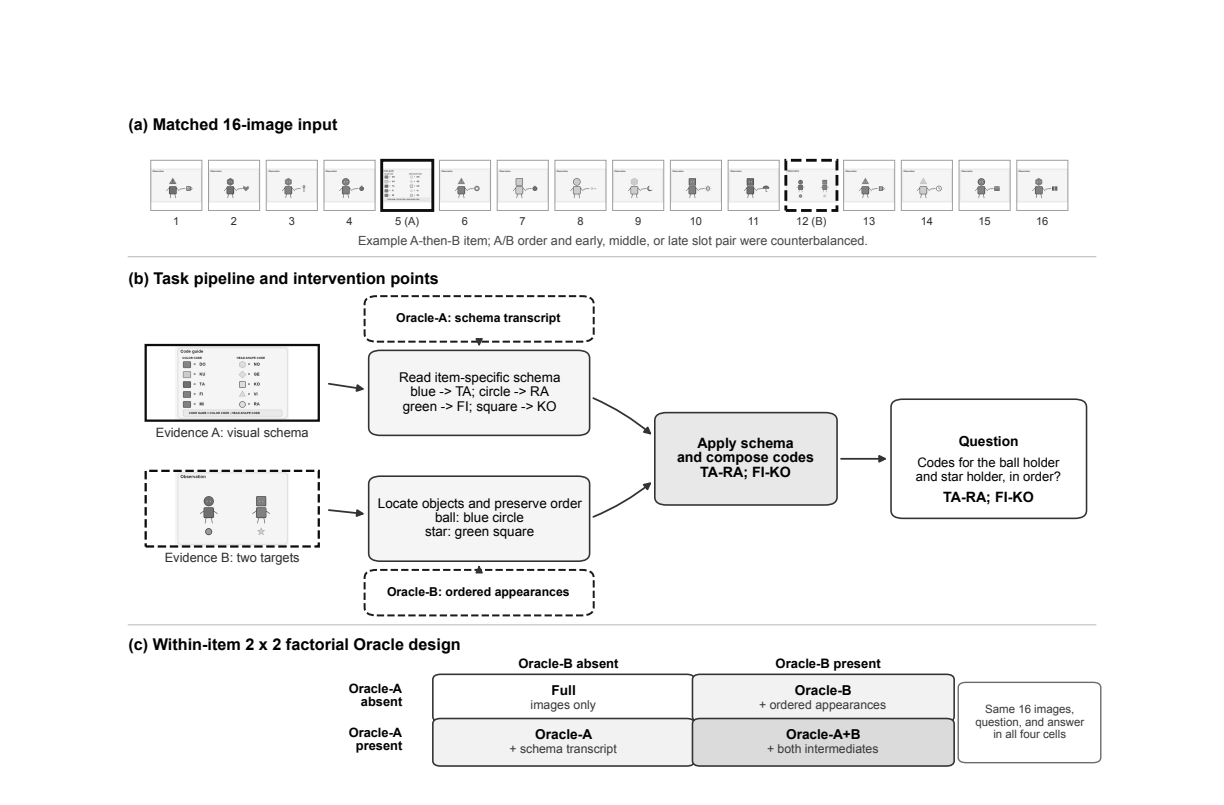
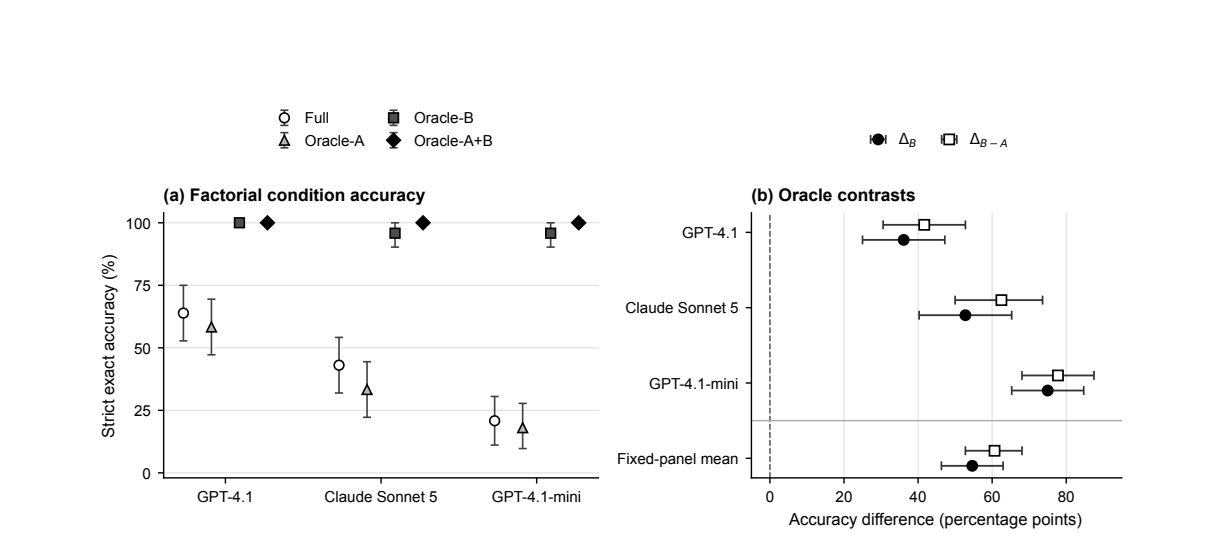
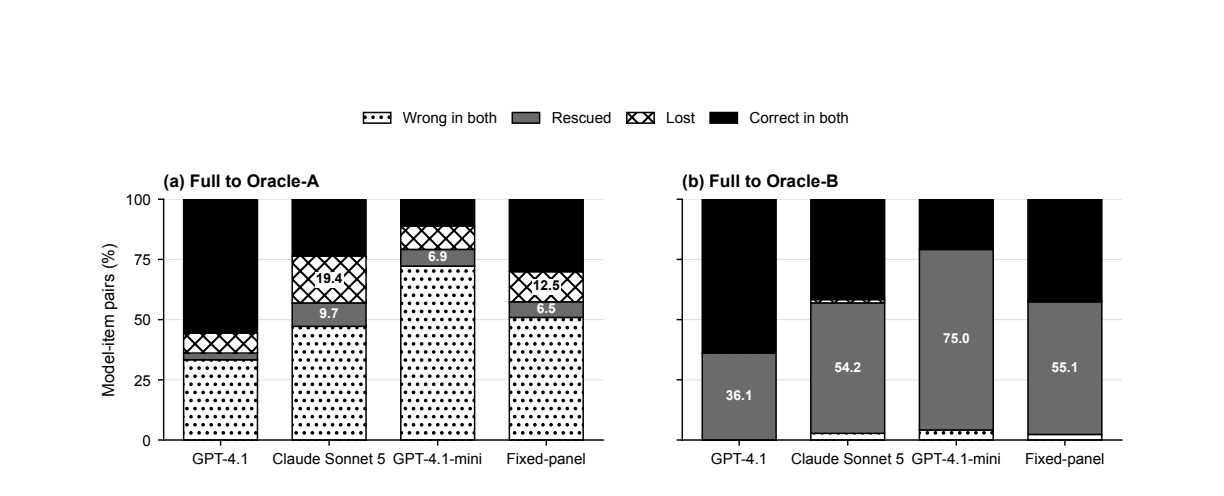
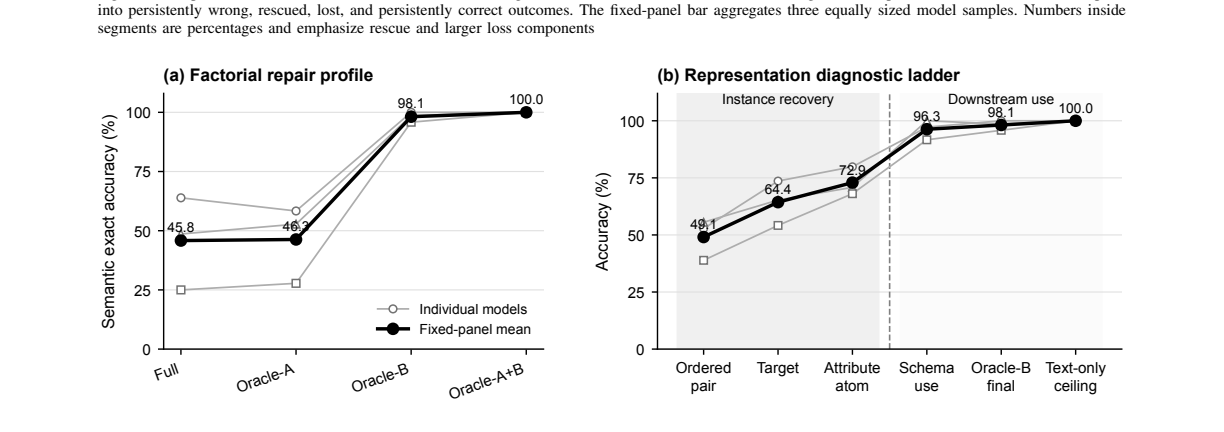
We study a controlled schema-application task in which a model must locate two target characters in a 16-image sequence, identify their visual attributes, consult an item-specific visual codebook, and compose two ordered nonce code names. We introduce a within-item 2-by-2 factorial Oracle design: Oracle-A supplies a verified textual schema, Oracle-B supplies a verified ordered target-appearance representation, and both interventions retain the original images and final question. Across 72 new items and 1,188 analyzed model responses, Oracle-B increased strict exact accuracy by 54.6 percentage points (95% confidence interval: 46.3 to 63.0) and outperformed Oracle-A by 60.6 points (Holm-adjusted p-value no greater than .0002). An auxiliary retrieval diagnostic reached only 49.1% ordered-appearance accuracy even after removing code-name generation. Providing both Oracle sources yielded 100% accuracy across all models. These results localize the dominant recoverable deficit to upstream ordered instance recovery rather than primarily to downstream schema use and composition.
from the abstract
Pith says
Machine review · deepseek-v4-flash · 15 Oct 2026 · what was read was not recorded · not checked by a person
It can be wrong. Challenge this review or reply to it.
Holds up. Clean diagnostic design with a clear asymmetric result; the recency/brevity confound is honestly flagged and real, but the contribution stands. This line is wrong
1 major objection · 5 minor
How often objections from reviews like this one are right: not yet measured
Not checked: figures, code, what the 44 references say.
The paper says, at Section VII (Limitations), sentences b226–227
The review did not quote this passage.
A classifier read this sentence of the paper as acknowledging the concern (probability 0.92):
“The Oracle treatments also arrive as text immediately before the question, so their effects combine semantic correction with textual accessibility and recency.”
Pith says: Objection 1 of 1 · major
The paper acknowledges that Oracle-B text is shorter and arrives immediately before the question, meaning its measured effect combines semantic correction with textual accessibility and recency. This confound is especially relevant for the 60.6 pp asymmetry between Oracle-B and Oracle-A.
more of objection 1
The auxiliary Retrieval-B diagnostic (no text, 49.1% ordered-appearance accuracy) partly mitigates the concern by showing that instance recovery fails even without any Oracle text, but the main factorial contrast (Delta_B-A) remains unadjusted. I recommend adding a brief discussion that (i) states explicitly that the magnitude of the asymmetry may be partially inflated by format/recency, and (ii) uses the Retrieval-B results to bound how much of the Oracle-B effect must be informational rather than recency-driven. This is a local issue and does not undermine the central claim, but it would strengthen the manuscript's precision.
5 minor objections
The paper says, at Abstract and Section V
Pith says: minor objection 1 of 5
The 100% accuracy in Oracle-A+B is a strong sanity check; consider noting explicitly that this sets a ceiling showing that downstream composition is not a limiting step, which is already implied but could be highlighted.
The paper says, at Table V and Table VI
Pith says: minor objection 2 of 5
The negative Oracle-A rescue under strict exact accuracy (e.g., -5.6 pp for GPT-4.1) is driven by instruction-following failures; the semantic analysis (Table VI) shows a small positive effect. The paper discusses this, but moving the semantic sensitivity discussion earlier (e.g., right after Table V) would clarify that the strict Oracle-A drop is a formatting artifact, not a substantive degradation.
show 3 more
The paper says, at Figure 3 caption
Pith says: minor objection 3 of 5
The fixed-panel bar is described as aggregating three equally sized model samples; it would be helpful to state explicitly that this is an equal-weighted mean of the model-specific percentages displayed in the individual bars.
The paper says, at Section IV, Statistical Analysis
Pith says: minor objection 4 of 5
The panel estimand is defined as an equal-weighted average of three models. Since the models differ substantially in unassisted accuracy, the panel mean could be supplemented with a brief note about sensitivity to model selection (the paper already reports model-specific contrasts, so this is minor).
The paper says, at References
Pith says: minor objection 5 of 5
A few entries (e.g., [19], [20]) include DOIs or URLs; consider ensuring consistent formatting (e.g., volume/pages for proceedings papers) according to journal style.
What would settle it
Add a control condition: in the Full (A0B0) condition, insert an irrelevant but matched-length short text (e.g., 'The weather is sunny and the birds are singing. Remember to answer in the correct format.') immediately before the question. If strict accuracy increases significantly above the Full baseline, recency/brevity is a confound. If accuracy remains unchanged (<5 pp), the Oracle-B effect is primarily informational.
from the skeptic's reading
How the review went
4 readings by deepseek-v4-flash · 15 Oct 2026
- Reader holds up
- Skeptic agrees
- Editor wrote the verdict above
- Referee minor revision: 1 major objection, 5 minor
Not run on this paper: the simulated authors' defence.
Pith did not check this review's objections against the paper.
The review in full
The review in brief, machine-written
This paper delivers what it promises: a rigorous within-item factorial Oracle design that localizes the dominant recoverable deficit in a controlled multi-image schema-application task. The headline result—Oracle-B (ordered target appearances) rescues 54.6 points of strict accuracy while Oracle-A (schema transcript) barely moves the needle—is new and clean. The methodological contribution (matched 2×2, item-cluster bootstrap, sign-flip tests) is solid; the authors don't overclaim. The three-model replication, the Retrieval-B diagnostics, and the semantic robustness check all converge. The 100% joint-Oracle ceiling confirms the bottleneck is upstream, not in downstream composition.
The main soft spot is exactly the one the paper flags (b226–227): Oracle-B arrives as two short answer-relevant sentences right before the question, while Oracle-A is a long schema transcript. The 60.6-point gap between them may partly reflect recency and brevity, not purely informational content. The authors acknowledge this and call for a future control. That's honest, but it does mean the central contrast is not fully deconfounded. I'd estimate the core finding survives—ordered instance recovery is harder than schema use—but the exact magnitude is uncertain. Additional minor concerns: synthetic images only, small proprietary model panel, and the 16-image context is fixed. All are acknowledged and bounded.
Who gets value from this paper? Any researcher working on multi-image VLMs, especially on diagnostic evaluation or intermediate representations. It's a case study in how to design failure-localization experiments, even if the specific task is narrow.
Recommendation: send to peer review. The experimental protocol is tight enough to deserve serious scrutiny, and the result—even with the format confound—is a useful empirical finding that will prompt follow-up work. I would not cite it directly for my own work, but I'd read it and assign it in a reading group.
The strongest objection
The factorial design compares Oracle-A (schema transcript, ~10 lines of text) with Oracle-B (two short template sentences, ~30 words) arriving immediately before the question (b226). Both are semantic corrections, but Oracle-B is drastically shorter and more answer-relevant. The central claim—that the dominant recoverable deficit is ordered instance recovery—rests on the 60.6 pp gap between Oracle-B and Oracle-A. If recency and brevity amplify Oracle-B’s measured effect, the informational content difference would be smaller than reported. The paper acknowledges the confound (b226–227) but does not test it; the auxiliary Retrieval-B diagnostic partly mitigates this by showing low appearance accuracy without text, but the main contrast remains unadjusted. A matched control for non-informative short text or delayed Oracle-B placement would settle whether the gap is purely informational or partly recency-driven.
The reader's weakest_assumption identified the recency/text confound for Oracle treatments. I agree this is the most load-bearing concern: it directly afffects interpretation of the primary contrast (∆_{B−A}). The paper's own limitation statement (b226–227) signals awareness, and the auxiliary Retrieval-B diagnostic provides converging evidence that the bottleneck exists even without text. The concrete test would cleanly separate recency from content. However, the paper's claim is well-supported by the within-item design, semantic robustness checks, and converging diagnostics; even if recency inflates the gap, the central finding that instance-information is more critical than schema knowledge holds. Therefore the verdict remains ACCEPT as the reader concluded.
The referee's report
The paper makes a strong methodological contribution by proposing a within-item factorial Oracle design that independently and jointly repairs two candidate intermediate representations while preserving the full visual context and question. This design turns aggregate accuracy into a repair test, providing a principled way to localize failures in multi-image reasoning pipelines. The empirical result—consistent across three proprietary models and robust to semantic-only scoring—provides clear evidence that in this controlled task, the bottleneck is in extracting ordered target appearances from the image sequence, not in applying the schema or composing code names. The auxiliary Retrieval-B diagnostic converges with the main result, and the 100% joint-Oracle ceiling confirms that downstream operations are not limiting. This diagnostic approach is valuable for guiding future model improvements and for structuring failure analysis in multimodal systems. The paper is honest about its limitations and appropriately scoped.
Pith's reading of the paper (a machine's summary, not the authors')
This paper aims to locate the precise point of failure in vision-language models performing a multi-image schema-application task. The authors design a within-item 2x2 factorial Oracle experiment where, for each item, they independently supply either a verified textual schema (Oracle-A) or verified ordered target appearances (Oracle-B), while holding the original 16 images and final question fixed. Across three commercial models and 1,188 responses, Oracle-B raised strict accuracy by 54.6 percentage points, whereas Oracle-A barely changed semantic accuracy. An auxiliary retrieval diagnostic shows that the models recover the complete ordered appearances on only 49.1% of trials. The paper argues that the dominant recoverable deficit is not in composing or applying the schema, but in extracting the ordered visual facts from the image sequence.
What carries the argument. The within-item 2x2 factorial Oracle design, which independently supplies a verified schema transcript (Oracle-A) or verified ordered target appearances (Oracle-B) while preserving the original 16-image context and final question. This design estimates the independent and joint repair effects of two candidate intermediate representations, turning aggregate accuracy into a diagnostic test of where a recoverable deficit sits.
Core claim. The paper establishes that, in a controlled multi-image task where a model must locate two target characters, identify their visual attributes, read an item-specific visual codebook, and compose two ordered code names, the dominant recoverable failure is upstream ordered instance recovery rather than downstream schema use or composition. Verified ordered target appearances (Oracle-B) increased strict exact accuracy by 54.6 points (95% CI: 46.3–63.0) across the fixed model panel and exceeded the effect of a verified schema transcript by 60.6 points (Holm-adjusted p ≤ .0002). Providing both sources yielded 100% accuracy for all models. An auxiliary diagnostic found that ordered appearance retrieval alone reached only 49.1% accuracy, while schema use, once appearances were given, exceeded 91.7% semantic accuracy. The pattern held across three models and survived semantic-only scoring.
The premise it rests on. The Oracle treatments are presented as text immediately before the question, so their effects combine semantic correction with textual accessibility and recency; the paper does not fully isolate these components.
If the paper is right (Pith's inferences, not the authors')
Improving visual retrieval, external grounding, or intermediate-state verification may be more effective than adding symbolic reasoning scaffolds for multi-image tasks.
The factorial Oracle method can be generalized to other multi-image or long-context scenarios to locate recoverable deficits at predefined intermediate boundaries.
When both ordered instance information and the schema are available, the downstream lookup, composition, and ordering steps work perfectly (100% accuracy across models).
The asymmetry in rescue effects (Oracle-B > Oracle-A) is robust across evidence positions and orders, suggesting the bottleneck is not an artifact of layout.
All three tested models show the same qualitative pattern, implying the bottleneck is widespread among current commercial VLMs.
The bottleneck may grow more severe with longer sequences or more distractors, as the 16-image setting already shows only 49.1% retrieval accuracy; scaling the context length could test this.
The Oracle-B effect likely conflates semantic correction with textual accessibility and recency, as the paper acknowledges; a future experiment with delayed or mismatched text controls could separate these components.
A finer-grained intervention set (supplying object locations, individual attributes, or unordered appearances) could pinpoint which subprocess within instance recovery—localization, binding, or order preservation—dominates the error.
The finding suggests that current VLMs lack robust mechanisms for selectively attending to and binding multimodal evidence across a sequence, pointing toward the need for explicit attention or memory structures for multi-image contexts.
Check this review
Pith stored no record of this review's passes and took no fingerprint of it. Reviews made by code from 13 Nov 2026 on carry both.
How often reviews like this one are right
Reviews like this one: written by deepseek-v4-flash, where what was read was not recorded.
How often objections from reviews like this one are right: not yet measured
Reviews by people
This review was written by a machine. No person has reviewed this paper on Pith yet. A scientist listed on Pith can review it for a fee, and their review is published here whatever it concludes.
The paper
Abstract
Modern vision-language models can accept multi-image contexts, but aggregate accuracy rarely reveals where a multi-image reasoning pipeline fails. We study a controlled schema-application task in which a model must locate two target characters in a 16-image sequence, identify their visual attributes, consult an item-specific visual codebook, and compose two ordered nonce code names. We introduce a within-item 2-by-2 factorial Oracle design: Oracle-A supplies a verified textual schema, Oracle-B supplies a verified ordered target-appearance representation, and both interventions retain the original images and final question. Across 72 new items and 1,188 analyzed model responses, Oracle-B increased strict exact accuracy by 54.6 percentage points (95% confidence interval: 46.3 to 63.0) and outperformed Oracle-A by 60.6 points (Holm-adjusted p-value no greater than .0002). An auxiliary retrieval diagnostic reached only 49.1% ordered-appearance accuracy even after removing code-name generation. Providing both Oracle sources yielded 100% accuracy across all models. These results localize the dominant recoverable deficit to upstream ordered instance recovery rather than primarily to downstream schema use and composition.
The paper's own sentences, arranged, kept beside the review and separate from it. Each label is drawn from a closed vocabulary; the number beside it is the probability the classifier gave that label. No sentence in this record was written by a model.
abstract compiled · 2026-10-15
The authors' main claim, as the classifier picked it out 1.00
“These results localize the dominant recoverable deficit to upstream ordered instance recovery rather than primarily to downstream schema use and composition.”
How the main claim is stated: asserted 0.98
What the abstract itself states, as probabilities: claims first 0.07 · states limitation 0.36 · human participants 0.04 · controlled comparison 0.83 · randomized assignment 0.04 · states quantitative result 0.99 · compares with prior results 0.85 · mentions code or data availability 0.03
The abstract, sentence by sentence
This table labels the abstract only (arXiv listing abstract v1). The number is the probability the classifier gave the label.
| Sentence | Role | The authors' own work | States the main conclusion | Strength |
|---|---|---|---|---|
| Modern vision-language models can accept multi-image contexts, but aggregate accuracy rarely reveals where a multi-image reasoning pipeline fails. | background 0.55 | 0.10 | 0.03 | asserted 0.99 |
| We study a controlled schema-application task in which a model must locate two target characters in a 16-image sequence, identify their visual attributes, consult an item-specific visual codebook, and compose two ordered nonce code names. | method 0.66 | 0.79 | 0.02 | asserted 0.94 |
| We introduce a within-item 2-by-2 factorial Oracle design: Oracle-A supplies a verified textual schema, Oracle-B supplies a verified ordered target-appearance representation, and both interventions retain the original images and final question. | method 0.91 | 0.93 | 0.03 | asserted 0.98 |
| Across 72 new items and 1,188 analyzed model responses, Oracle-B increased strict exact accuracy by 54.6 percentage points (95% confidence interval: 46.3 to 63.0) and outperformed Oracle-A by 60.6 points (Holm-adjusted p-value no greater than .0002). | result 1.00 | 0.97 | 0.24 | asserted 1.00 |
| An auxiliary retrieval diagnostic reached only 49.1% ordered-appearance accuracy even after removing code-name generation. | result 1.00 | 0.92 | 0.04 | asserted 1.00 |
| Providing both Oracle sources yielded 100% accuracy across all models. | result 1.00 | 0.93 | 0.10 | asserted 1.00 |
| These results localize the dominant recoverable deficit to upstream ordered instance recovery rather than primarily to downstream schema use and composition. | interpretation 1.00 | 0.93 | 0.92 | asserted 0.98 |
What kind of paper the classifier reports this is: empirical study 0.96 · evidence from observation or experiment 0.99
What was examined, and what was not
Sources read
- arXiv listing abstract v1
Not examined
- full text
- figures and tables
- references and citing sentences
- relations to other papers
Levels run
- P abstract
Not run
- S sections
- T body sentences
- C citations
- R cross-paper relations
How the labels were made
Compiled by classifier-1.13.0 via TypeSafe API, question bank abstract-p1-20260923, 2026-10-15: 1 request, 5,759 input tokens.
Every quoted sentence on this record is the authors'. Every label is from Pith's closed vocabulary, with the probability shown beside it. This record as JSON
Figures (4)
Figures are the authors', reproduced from the paper.
References (44)
- [1] X. Yueet al., “MMMU: A massive multi-discipline multimodal under- standing and reasoning benchmark for expert AGI,” inProc. IEEE/CVF Conf. Computer Vision and Pattern Recognition, 2024, pp. 9556–9567 on Pith
- [2] B. Zhao, Y . Zong, L. Zhang, and T. Hospedales, “Benchmarking multi-image understanding in vision and language models: Percep- tion, knowledge, reasoning, and multi-hop reasoning,”arXiv preprint arXiv:2406.12742, 2024 on PithPith's reviewarXiv
- [3] F. Wanget al., “MuirBench: A comprehensive benchmark for robust multi-image understanding,” inProc. 13th Int. Conf. Learning Repre- sentations, 2025 on Pith
- [4] D. Jiang, X. He, H. Zeng, C. Wei, M. Ku, Q. Liu, and W. Chen, “MANTIS: Interleaved multi-image instruction tuning,”Transactions on Machine Learning Research, 2024 on Pith
- [5] N. F. Liu, K. Lin, J. Hewitt, A. Paranjape, M. Bevilacqua, F. Petroni, and P. Liang, “Lost in the middle: How language models use long contexts,” Transactions of the Association for Computational Linguistics, vol. 12, pp. 157–173, 2024 on Pith
- [6] H. Wang, H. Shi, S. Tan, W. Qin, W. Wang, T. Zhang, A. Nambi, T. Ganu, and H. Wang, “Multimodal needle in a haystack: Benchmarking long-context capability of multimodal large language models,” inProc. 2025 Conf. Nations of the Americas Chapter of the Association for Computatio... on Pith
- [7] W. Wanget al., “Needle in a multimodal haystack,”arXiv preprint arXiv:2406.07230, 2024 on PithPith's reviewarXiv
- [8] T.-H. Wu, G. Biamby, J. Quenum, R. Gupta, J. E. Gonzalez, T. Darrell, and D. M. Chan, “Visual Haystacks: A vision-centric needle-in-a- haystack benchmark,” inProc. 13th Int. Conf. Learning Representations, 2025 on Pith
- [9] X. Chen, R. A. Chi, X. Wang, and D. Zhou, “Premise order matters in reasoning with large language models,” inProc. 41st Int. Conf. Machine Learning, vol. 235, 2024, pp. 6596–6620 on Pith
- [10] G. Wardle and T. Susnjak, “Image first or text first? Optimising the sequencing of modalities in large language model prompting and reasoning tasks,”arXiv preprint arXiv:2410.03062, 2024 on PithPith's reviewarXiv
- [11] S.-L. Wei, Y .-L. Liao, H.-H. Huang, and H.-H. Chen, “Do multimodal LLMs understand order? Measuring the fragility of multimodal reason- ing under input order perturbations,” inProc. 15th Language Resources and Evaluation Conf., 2026, pp. 9118–9128 on Pith
- [12] D. Kukreja, K. Sah, K. Goyal, M. Mohania, and V . Goyal, “DISSECT: Diagnosing where vision ends and language priors begin in scientific VLMs,”arXiv preprint arXiv:2604.06250, 2026 on PithPith's reviewarXiv
- [13] J. Leeet al., “Perceptual Taxonomy: Evaluating and guiding hier- archical scene reasoning in vision-language models,”arXiv preprint arXiv:2511.19526, 2025 on PitharXiv
- [14] O. Sharif, E. Hossain, N. Singh, and P. Ng, “Disentangling perception and reasoning in multimodal LLMs via reward design,”arXiv preprint arXiv:2601.00215, 2026 on PithPith's reviewarXiv
- [15] Z. Khan, V . Kumar B G, S. Schulter, M. Chandraker, and Y . Fu, “Exploring question decomposition for zero-shot VQA,” inAdvances in Neural Information Processing Systems, vol. 36, 2023 on Pith
- [16] Y . Jiang and F. Ferraro, “SCRIBE: Structured mid-level supervision for tool-using language models,”arXiv preprint arXiv:2601.03555, 2026 on PithPith's reviewarXiv
- [17] Y . Jiang, D. Li, and F. Ferraro, “DRP: Distilled reasoning pruning with mathematical skill-aware step decomposition for efficient large reasoning models,” inFindings of the Association for Computational Linguistics: ACL 2026, 2026, pp. 4020–4039 on Pith
- [18] Y . Jiang and F. Ferraro, “Beyond Math: Stories as a testbed for memorization-constrained reasoning in LLMs,” inProc. 19th Conf. European Chapter of the Association for Computational Linguistics, 2026, pp. 5590–5607 on Pith
- [19] S. Li, “Root cause analysis of failure in molecular biology workflows,” Ph.D. dissertation, Dept. Electrical and Computer Engineering, Uni- versity of Washington, Seattle, W A, USA, 2022. [Online]. Available: https://hdl.handle.net/1773/49344 on Pith
- [20] Z. Ye, L. Zhang, S. Zhou, Y . Yu, Y . Shi, J. Xuan, S. Dong, G. Tong, M. Zhang, and B. Li, “OSEF: One-step evidence fusion for cross-video scene procedure planning,”arXiv preprint arXiv:2607.29401, 2026 on PithPith's reviewarXiv
show 24 more
- [21] Y . Huang, M. Zhang, H. Lei, C. Ji, J. Wang, and H. Zhu, “CE-Agent: A cloud-edge collaborative agent framework with dynamic offloading and synergistic distillation,”Journal of Cloud Computing, 2026, doi: 10.1186/s13677-026-00984-5 on Pithdoi:10.1186/s13677-026-00984-5
- [22] S. Xiong, O. Gungordu, J. C. Kerce, and F. Fekri, “Adaptive infor- mation control for search-augmented LLM reasoning,”arXiv preprint arXiv:2602.01672, 2026 on PithPith's reviewarXiv
- [23] F. Han, H. Cui, L. Guo, Z. Wang, and Z. Lyu, “Read before you think: Mitigating LLM comprehension failures with step-by-step reading,” inProc. IEEE Int. Conf. Acoustics, Speech and Signal Processing (ICASSP), 2026, doi: 10.1109/ICASSP55912.2026.11464691 on Pithdoi:10.1109/icassp55912.2026.11464691
- [24] Y . Zhang, X. Wang, M. Hu, and Z. Zhang, “Bridging dual knowl- edge graphs for multi-hop question answering in construction safety,” Automation in Construction, vol. 183, Art. no. 106794, 2026, doi: 10.1016/j.autcon.2026.106794 on Pithdoi:10.1016/j.autcon.2026.106794
- [25] W. Duan, Y . Yu, J. He, and Y . Shi, “Adaptive context length optimization with low-frequency truncation for multi-agent reinforcement learning,” inAdvances in Neural Information Processing Systems, vol. 38, 2025, pp. 108340–108371 on Pith
- [26] X. Han, Y . Xiao, C. Wu, and T. Zhang, “How early is early enough? Design-dependent observation-window sufficiency in subscription churn prediction,”arXiv preprint arXiv:2607.00473, 2026 on PithPith's reviewarXiv
- [27] X. Han and C. Wu, “Validation-stage combinatorial fusion anal- ysis for imbalanced credit-card fraud detection,”arXiv preprint arXiv:2606.10393, 2026 on PithPith's reviewarXiv
- [28] X. Han, J. Liu, M. Zheng, Z. Zhang, and C. Wu, “Interpretable vs. learned encoders for high-cardinality fraud detection,”arXiv preprint arXiv:2607.00477, 2026 on PithPith's reviewarXiv
- [29] X. Han, Y . Xiao, Z. Zhang, and M. Zheng, “Interpretable factor decom- position for decision intelligence in large-scale financial markets: Evi- dence from China’s A-share market,”arXiv preprint arXiv:2606.12843, 2026 on PithPith's reviewarXiv
- [30] X. Han and Y . Xiao, “Decomposing firm-level crisis responses from incomplete market signals: Evidence from China’s IT sector during COVID-19,”arXiv preprint arXiv:2606.10297, 2026 on PithPith's reviewarXiv
- [31] X. Han, “Explainable machine learning for broadband adoption dis- parities: Tract-level prediction and SHAP-based factor profiling,”arXiv preprint arXiv:2608.29110, 2026 on PithPith's reviewarXiv
- [32] X. Han, Z. Zhang, X. Zhao, J. Lei, M. Zheng, and Y . Wang, “Support thresholds, not algorithms, limit rare-association recovery in co-purchase networks,”arXiv preprint arXiv:2609.20171, 2026 on PithPith's reviewarXiv
- [33] W. Duan, Z. Gao, J. He, and J. Xian, “Bayesian critique-tune-based reinforcement learning with adaptive pressure for multi-intersection traffic signal control,”IEEE Trans. Intell. Transp. Syst., vol. 26, no. 10, pp. 14968–14983, 2025, doi: 10.1109/TITS.2025.3581858 on Pithdoi:10.1109/tits.2025.3581858
- [34] W. Duan, Z. Gao, J. Xian, and Y . Shi, “MA VEN-T: Reinforced het- erogeneous distillation for real-time multi-agent trajectory prediction,” arXiv preprint arXiv:2604.10169, 2026 on PithPith's reviewarXiv
- [35] Y . Gao, Y . Lu, Z. Zhang, J. Nie, S. Yu, and Q. Xuan, “DSPC: Dual-stage progressive compression framework for efficient long- context reasoning,” inProc. IEEE Int. Conf. Acoustics, Speech and Signal Processing (ICASSP), 2026, pp. 19387–19391, doi: 10.1109/ICASSP55912.2026.11460600 on Pithdoi:10.1109/icassp55912.2026.11460600
- [36] Y . Lou, H. Hu, Y . Jiang, Z. Zhang, L. Wang, J. Liu, J. Ge, and X. Tao, “RACER: Reinforced agent collaboration for explainable reasoning on knowledge graphs,”arXiv preprint arXiv:2608.29263, 2026 on PithPith's reviewarXiv
- [37] Y . Lou, H. Hu, S. Ma, Z. Zhang, L. Wang, J. Ge, and X. Tao, “DRF: LLM-agent dynamic reputation filtering framework,” inNeural Information Processing, Singapore: Springer Nature, 2026, pp. 127–141, doi: 10.1007/978-981-95-4384-7_10 on Pithdoi:10.1007/978-981-95-4384-7_10
- [38] Y . Wanget al., “When does execution provenance help agent memory retrieval?”arXiv preprint arXiv:2609.25913, 2026 on PithPith's reviewarXiv
- [39] Y . Wanget al., “From agent traces to trust: A survey of evidence tracing and execution provenance in LLM agents,”arXiv preprint arXiv:2606.04990, 2026 on PithPith's reviewarXiv
- [40] Y . Wanget al., “IndustrialVLA-Bench: A traceable multi-axis evaluation of open robot policy models,”arXiv preprint arXiv:2609.25562, 2026 on PithPith's reviewarXiv
- [41] C. Yuet al., “From faulty memories to corrected actions: Dependency- guided rollback repair for memory-augmented agents,”arXiv preprint arXiv:2608.10502, 2026 on PithPith's reviewarXiv
- [42] L. Jin, L. Hu, B. Shen, H. Cai, and Y . Xin, “Same question, different answer? Measuring and mitigating prompt privilege for equitable AI access,”arXiv preprint arXiv:2608.08942, 2026 on PithPith's reviewarXiv
- [43] Y . Leiet al., “Sheet as token: A graph-enhanced representation for multi- sheet spreadsheet understanding,”arXiv preprint arXiv:2605.05811, 2026 on PithPith's reviewarXiv
- [44] X. Liet al., “A benchmark and diagnostic study of epistemic admission in shared agent memory,”arXiv preprint arXiv:2609.30813, 2026 on PithPith's reviewarXiv
Challenges and discussion
Disagree with the review, or know something it missed? Leave a comment, or challenge this review formally: a challenge becomes a permanent entry in this paper's record, and its decision is published here.
Come back by email
A short list of the week's newly reviewed papers. Nothing is sent until you confirm from your inbox, and every email has a link that stops it. No account.
No comments yet.
Sign in to comment