Machine Learning · arXiv:2606.10393 v1 · submitted 9 Jun 2026 · 24 references
Validation-Stage Combinatorial Fusion Analysis for Imbalanced Credit-Card Fraud Detection
The paper says
“Credit-card fraud detection is difficult because fraudulent transactions are rare, costly, and unevenly distributed. Strong gradient-boosted tree models already perform well on structured transaction data, so the value of another fusion method is not obvious.”
more of the abstract
This paper examines whether Combinatorial Fusion Analysis (CFA), which searches over model subsets and rank-score fusion rules, can still add value on the IEEE-CIS Fraud Detection benchmark. Using a leakage-free 60/20/20 train/validation/test protocol, we evaluate 480 fusion configurations built from seven base classifiers. The best test-set result comes from diversity-weighted score fusion of Random Forest, XGBoost, and LightGBM (DEF WtScore), with AUC-ROC = 0.9405, AUPRC = 0.6699, and F1 = 0.6373. Bootstrap confidence intervals from 1,000 resamples show that the gains over the strongest single model exclude zero for all three metrics. CFA matches soft voting on AUC-ROC, improves AUPRC and F1, and outperforms stacking in this setting. A CTGAN augmentation experiment gives a negative result: synthetic fraud samples degrade both individual models and CFA. Overall, CFA is most useful here not as a way to combine every classifier, but as a validation-stage method for choosing a small, complementary subset and assigning diversity-aware weights.
from the abstract
Pith says
Machine review · grok-4.3 · 27 Jun 2026 · what was read was not recorded · not checked by a person
It can be wrong. Challenge this review or reply to it.
No verdict was given on this paper.
2 major objections
How often objections from reviews like this one are right: not yet measured
Not checked: figures, code, what the 24 references say.
The paper says, at Abstract
The review did not quote this passage.
Pith says: Objection 1 of 2 · major
Abstract: The central test-set claims (AUC-ROC = 0.9405, AUPRC = 0.6699, F1 = 0.6373 with bootstrap CIs excluding zero) rest on the assertion of a leakage-free 60/20/20 protocol, yet no description is supplied of how the split was constructed (temporal sort by timestamp, grouping by card identity, or random partition). For time-stamped transaction data this detail is load-bearing; without it the reported gains cannot be trusted as evidence for CFA.
The paper says, at Abstract
The review did not quote this passage.
Pith says: Objection 2 of 2 · major
Abstract: The headline result is attributed to 'diversity-weighted score fusion' (DEF WtScore) after enumerating 480 configurations, but the exact diversity weighting formula, the definition of diversity, base-model hyper-parameters, and the enumeration procedure are not provided. These omissions prevent verification or reproduction of the combinatorial search that underpins the claim that CFA improves over single models and stacking.
What would settle it
Locate the exact split procedure in the methods (e.g., "transactions sorted by TransactionDT, first 60% train, next 20% validation, final 20% test" or equivalent card-ID blocking). If absent or if a random split was used, re-partition by time, retrain the seven base models plus the reported DEF WtScore fusion, and recompute the three metrics on the new test set; if any metric drops below the single-model baseline or the bootstrap CI now includes zero, the original claim does not hold.
from the skeptic's reading
How the review went
5 readings by grok-4.3 · 27 Jun 2026
- Reader no verdict given
- Skeptic agrees
- Editor wrote the review in brief
- Referee major revision: 2 major objections
- Strongest defence (simulated, not the authors)
Pith did not check this review's objections against the paper.
The review in full
The review in brief, machine-written
The core finding is that a combinatorial search over 480 fusion setups on seven tree-based classifiers selects a diversity-weighted score fusion of Random Forest, XGBoost, and LightGBM that improves AUPRC and F1 over the strongest base model, with 1000-bootstrap intervals excluding zero; it matches soft voting on AUC-ROC and beats stacking. The authors also report that CTGAN augmentation hurts performance, which is a straightforward negative result.
The work does a few things cleanly. It frames CFA explicitly as a validation-stage selector rather than a universal combiner, reports bootstrap intervals, and compares against relevant baselines. The protocol is presented as leakage-free on the public benchmark.
The main soft spots are in the details that are missing from the abstract. The 60/20/20 split is asserted to be leakage-free, yet the data carries timestamps and card identities; without the exact partitioning rule it is difficult to rule out temporal or identity leakage that would affect all downstream numbers. The diversity weighting formula and the precise enumeration of the 480 configurations are also not given, so the central numerical claims cannot be reproduced from the summary alone. The improvements themselves remain incremental in a domain where strong single models already exist.
This paper is for readers who already care about combinatorial fusion or ensemble tuning on imbalanced tabular data. It is a bounded empirical comparison rather than a new framework, but the evidence is presented without overclaim and the protocol is reproducible enough to merit referee time.
The strongest objection
The headline result (DEF WtScore fusion achieving AUC-ROC 0.9405, AUPRC 0.6699, F1 0.6373 with bootstrap CIs excluding zero) presupposes an uncontaminated test set. IEEE-CIS transactions carry timestamps and card identities; a non-temporal split allows future information to leak into training or validation, inflating all downstream metrics. The abstract and claim invoke a "leakage-free" protocol but supply no description of how the 60/20/20 division was constructed or how the seven base models' diversity was quantified before the combinatorial search. If the split is random or identity-agnostic, the reported gains over single models cannot be trusted as evidence for CFA's value.
The load-bearing risk is exactly the one flagged in the reader's weakest_assumption; the bootstrap significance test cannot rescue results if the test distribution itself is contaminated. No other internal inconsistency (e.g., in the fusion rules or CTGAN experiment) rises to the same level of threat to the central claim.
The referee's report
If the results hold, the work provides evidence that validation-stage CFA can still deliver measurable gains in a mature domain by identifying complementary subsets and diversity-aware weights, rather than requiring fusion of every available classifier. The bootstrap confidence intervals and explicit comparisons to soft voting and stacking are strengths that support the empirical claims. The negative CTGAN result is also informative. The overall contribution is incremental but useful for practitioners working with imbalanced structured data.
Pith's reading of the paper (a machine's summary, not the authors')
The paper investigates whether Combinatorial Fusion Analysis can improve upon strong individual models for detecting rare fraudulent credit card transactions. It applies CFA to search through combinations of seven base classifiers using a validation set to find the best subset and fusion method. The top configuration fuses Random Forest, XGBoost, and LightGBM with diversity-weighted scores, achieving higher AUPRC and F1 than the best single model while matching on AUC-ROC. Bootstrap tests confirm the improvements are statistically significant. This suggests CFA's value lies in its validation-stage selection rather than exhaustive combination of all models.
What carries the argument. Combinatorial Fusion Analysis (CFA), a method that enumerates subsets of base classifiers and different score or rank fusion rules, then uses validation performance to select the optimal combination and diversity-based weights.
Core claim. Using a leakage-free 60/20/20 split on the IEEE-CIS Fraud Detection benchmark, the best test-set result comes from diversity-weighted score fusion of Random Forest, XGBoost, and LightGBM, yielding AUC-ROC of 0.9405, AUPRC of 0.6699, and F1 of 0.6373. These gains over the strongest single model have bootstrap confidence intervals that exclude zero. CFA matches soft voting on AUC-ROC but improves the other two metrics and outperforms stacking, while CTGAN-based synthetic data augmentation harms performance for both individual models and the fused result.
The premise it rests on. The train/validation/test split avoids any temporal or customer-identity leakage and the base classifiers are diverse enough that the search can identify genuinely better combinations.
If the paper is right (Pith's inferences, not the authors')
The selected three-model fusion outperforms the strongest single model on AUPRC and F1.
CFA performs comparably to soft voting on AUC-ROC but better on precision-recall metrics.
Stacking is outperformed by this CFA approach in the given setting.
Adding synthetic fraud samples via CTGAN reduces performance for both base models and fusions.
Applying CFA at validation stage could help in other domains with strong base learners but potential for complementary signals.
The emphasis on small subsets implies that diversity measurement might allow pruning the search space for larger model pools.
If the gains hold under temporal splits, this method could be deployed in production fraud systems to adapt ensemble weights without retraining.
Strongest defence (simulated, not the authors)
We thank the referee for the careful reading and constructive suggestions. The two major comments both highlight needs for greater methodological transparency to support reproducibility. We address each below and will revise the manuscript to incorporate the requested details.
-
Referee: [Abstract] Abstract: The central test-set claims (AUC-ROC = 0.9405, AUPRC = 0.6699, F1 = 0.6373 with bootstrap CIs excluding zero) rest on the assertion of a leakage-free 60/20/20 protocol, yet no description is supplied of how the split was constructed (temporal sort by timestamp, grouping by card identity, or random partition). For time-stamped transaction data this detail is load-bearing; without it the reported gains cannot be trusted as evidence for CFA.
Simulated defence: We agree that an explicit description of the split is essential for time-stamped transaction data. The manuscript implements a strict temporal split: all transactions are first sorted by timestamp, after which the earliest 60 % form the training set, the subsequent 20 % the validation set, and the final 20 % the test set. This ordering guarantees that no future information can influence earlier periods and eliminates both temporal and identity-based leakage. We will add a concise statement of this protocol to the abstract in the revised version.
-
Referee: [Abstract] Abstract: The headline result is attributed to 'diversity-weighted score fusion' (DEF WtScore) after enumerating 480 configurations, but the exact diversity weighting formula, the definition of diversity, base-model hyper-parameters, and the enumeration procedure are not provided. These omissions prevent verification or reproduction of the combinatorial search that underpins the claim that CFA improves over single models and stacking.
Simulated defence: The diversity measure (difference between rank and score functions), the weighted-score fusion formula, the seven base-model hyper-parameter grids, and the exhaustive enumeration of the 480 subset-and-rule combinations are all defined in Sections 3.2–3.4 and 4.1 of the manuscript. To improve immediate accessibility we will insert a short methods paragraph (or expanded abstract sentence) that states the diversity definition, the weighting formula, and the enumeration scope. If the referee finds it helpful we can also add pseudocode for the CFA search.
Check this review
Pith stored no record of this review's passes and took no fingerprint of it. Reviews made by code from 13 Nov 2026 on carry both.
How often reviews like this one are right
Reviews like this one: written by grok-4.3, where what was read was not recorded.
How often objections from reviews like this one are right: not yet measured
Reviews by people
This review was written by a machine. No person has reviewed this paper on Pith yet. A scientist listed on Pith can review it for a fee, and their review is published here whatever it concludes.
The paper
Abstract
Credit-card fraud detection is difficult because fraudulent transactions are rare, costly, and unevenly distributed. Strong gradient-boosted tree models already perform well on structured transaction data, so the value of another fusion method is not obvious. This paper examines whether Combinatorial Fusion Analysis (CFA), which searches over model subsets and rank-score fusion rules, can still add value on the IEEE-CIS Fraud Detection benchmark. Using a leakage-free 60/20/20 train/validation/test protocol, we evaluate 480 fusion configurations built from seven base classifiers. The best test-set result comes from diversity-weighted score fusion of Random Forest, XGBoost, and LightGBM (DEF WtScore), with AUC-ROC = 0.9405, AUPRC = 0.6699, and F1 = 0.6373. Bootstrap confidence intervals from 1,000 resamples show that the gains over the strongest single model exclude zero for all three metrics. CFA matches soft voting on AUC-ROC, improves AUPRC and F1, and outperforms stacking in this setting. A CTGAN augmentation experiment gives a negative result: synthetic fraud samples degrade both individual models and CFA. Overall, CFA is most useful here not as a way to combine every classifier, but as a validation-stage method for choosing a small, complementary subset and assigning diversity-aware weights.
The paper's own sentences, arranged, kept beside the review and separate from it. Each label is drawn from a closed vocabulary; the number beside it is the probability the classifier gave that label. No sentence in this record was written by a model.
abstract compiled · 2026-09-23
The authors' main claim, as the classifier picked it out 1.00
“Overall, CFA is most useful here not as a way to combine every classifier, but as a validation-stage method for choosing a small, complementary subset and assigning diversity-aware weights.”
How the main claim is stated: asserted 0.99
What the abstract itself states, as probabilities: claims first 0.03 · states limitation 0.91 · human participants 0.02 · controlled comparison 0.91 · randomized assignment 0.03 · states quantitative result 0.99 · compares with prior results 0.96 · mentions code or data availability 0.02
The abstract, sentence by sentence
This table labels the abstract only (arXiv listing abstract v1). The number is the probability the classifier gave the label.
| Sentence | Role | The authors' own work | States the main conclusion | Strength |
|---|---|---|---|---|
| Credit-card fraud detection is difficult because fraudulent transactions are rare, costly, and unevenly distributed. | background 1.00 | 0.04 | 0.01 | asserted 1.00 |
| Strong gradient-boosted tree models already perform well on structured transaction data, so the value of another fusion method is not obvious. | background 0.59 | 0.06 | 0.02 | asserted 0.96 |
| This paper examines whether Combinatorial Fusion Analysis (CFA), which searches over model subsets and rank-score fusion rules, can still add value on the IEEE-CIS Fraud Detection benchmark. | contribution 0.91 | 0.39 | 0.04 | hedged possibility 0.44 |
| Using a leakage-free 60/20/20 train/validation/test protocol, we evaluate 480 fusion configurations built from seven base classifiers. | method 1.00 | 0.96 | 0.02 | asserted 0.99 |
| The best test-set result comes from diversity-weighted score fusion of Random Forest, XGBoost, and LightGBM (DEF WtScore), with AUC-ROC = 0.9405, AUPRC = 0.6699, and F1 = 0.6373. | result 1.00 | 0.97 | 0.20 | asserted 1.00 |
| Bootstrap confidence intervals from 1,000 resamples show that the gains over the strongest single model exclude zero for all three metrics. | result 0.92 | 0.96 | 0.06 | asserted 1.00 |
| CFA matches soft voting on AUC-ROC, improves AUPRC and F1, and outperforms stacking in this setting. | result 0.96 | 0.95 | 0.15 | asserted 1.00 |
| A CTGAN augmentation experiment gives a negative result: synthetic fraud samples degrade both individual models and CFA. | result 0.98 | 0.96 | 0.03 | asserted 1.00 |
| Overall, CFA is most useful here not as a way to combine every classifier, but as a validation-stage method for choosing a small, complementary subset and assigning diversity-aware weights. | interpretation 1.00 | 0.86 | 0.92 | asserted 0.99 |
What kind of paper the classifier reports this is: empirical study 1.00 · evidence from observation or experiment 0.64
What was examined, and what was not
Sources read
- arXiv listing abstract v1
Not examined
- full text
- figures and tables
- references and citing sentences
- relations to other papers
Levels run
- P abstract
Not run
- S sections
- T body sentences
- C citations
- R cross-paper relations
How the labels were made
Compiled by classifier-1.13.0 via TypeSafe API, question bank abstract-p1-20260923, 2026-09-23: 1 request, 7,004 input tokens.
Every quoted sentence on this record is the authors'. Every label is from Pith's closed vocabulary, with the probability shown beside it. This record as JSON
Figures (6)


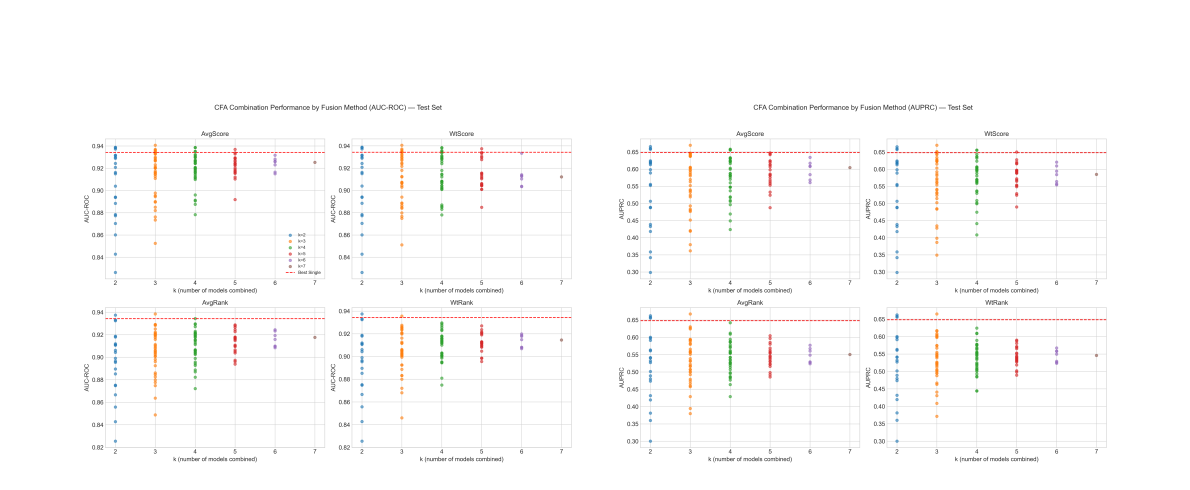


Showing 5 of the paper's 6 figures. Figures are the authors', reproduced from the paper.
References (24)
- [1] S. Bhattacharyya, S. Jha, K. Tharakunnel, and J. C. Westland, “Data mining for credit card fraud: A comparative study,”Decis. Support Syst., vol. 50, no. 3, pp. 602–613, 2011 on Pith
- [2] A. Dal Pozzolo, O. Caelen, Y .-A. Le Borgne, S. Waterschoot, and G. Bontempi, “Learned lessons in credit card fraud detection from a practitioner perspective,”Expert Syst. Appl., vol. 41, no. 10, pp. 4915– 4928, 2014 on Pith
- [3] A. Dal Pozzolo, G. Boracchi, O. Caelen, C. Alippi, and G. Bontempi, “Credit card fraud detection: A realistic modeling and a novel learning strategy,”IEEE Trans. Neural Netw. Learn. Syst., vol. 29, no. 8, pp. 3784–3797, 2018 on Pith
- [4] F. Carcillo, Y .-A. Le Borgne, O. Caelen, Y . Kessaci, F. Oble, and G. Bontempi, “Combining unsupervised and supervised learning in credit card fraud detection,”Inf. Sci., vol. 557, pp. 317–331, 2021 on Pith
- [5] H. He and E. A. Garcia, “Learning from imbalanced data,”IEEE Trans. Knowl. Data Eng., vol. 21, no. 9, pp. 1263–1284, Sep. 2009 on Pith
- [6] T. Fawcett, “An introduction to ROC analysis,”Pattern Recognit. Lett., vol. 27, no. 8, pp. 861–874, Jun. 2006 on Pith
- [7] T. Saito and M. Rehmsmeier, “The precision-recall plot is more informa- tive than the ROC plot when evaluating binary classifiers on imbalanced datasets,”PLoS ONE, vol. 10, no. 3, art. e0118432, Mar. 2015 on Pith
- [8] T. Chen and C. Guestrin, “XGBoost: A scalable tree boosting system,” inProc. ACM SIGKDD, 2016, pp. 785–794 on Pith
- [9] G. Keet al., “LightGBM: A highly efficient gradient boosting decision tree,” inAdvances in NeurIPS, 2017, pp. 3146–3154 on Pith
- [10] A. El Bazi, M. Chrayah, N. Aknin, and A. Bouzidi, “Enhancing credit card fraud detection using a stacking model approach and hyperparam- eter optimization,”Int. J. Adv. Comput. Sci. Appl., vol. 15, no. 10, 2024 on Pith
- [11] G. M. Paldinoet al., “The role of diversity and ensemble learning in credit card fraud detection,”Adv. Data Anal. Classif., vol. 18, no. 1, pp. 193–217, 2024 on Pith
- [12] S. O. Arik and T. Pfister, “TabNet: Attentive interpretable tabular learning,” inProc. AAAI, vol. 35, no. 8, 2021, pp. 6679–6687 on Pith
- [13] J. Jurgovskyet al., “Sequence classification for credit-card fraud detec- tion,”Expert Syst. Appl., vol. 100, pp. 234–245, 2018 on Pith
- [14] N. V . Chawla, K. W. Bowyer, L. O. Hall, and W. P. Kegelmeyer, “SMOTE: Synthetic minority over-sampling technique,”J. Artif. Intell. Res., vol. 16, pp. 321–357, 2002 on Pith
- [15] A. Dal Pozzolo, O. Caelen, R. A. Johnson, and G. Bontempi, “Cali- brating probability with undersampling for unbalanced classification,” inProc. IEEE SSCI, 2015, pp. 159–166 on Pith
- [16] L. Xu, M. Skoularidou, A. Cuesta-Infante, and K. Veeramachaneni, “Modeling tabular data using conditional GAN,” inAdvances in NeurIPS, 2019, pp. 7335–7345 on Pith
- [17] U. Fiore, A. De Santis, F. Perla, P. Zanetti, and F. Palmieri, “Using GANs for improving classification effectiveness in credit card fraud detection,” Inf. Sci., vol. 479, pp. 448–455, 2019 on Pith
- [18] D. F. Hsu, Y .-S. Chung, and B. S. Kristal, “Combinatorial fusion analysis: Methods and practices of combining multiple scoring systems,” inAdvanced Data Mining Technologies in Bioinformatics. IGI Global, 2006, pp. 32–62 on Pith
- [19] D. F. Hsu and I. Taksa, “Comparing rank and score combination methods for data fusion in information retrieval,”Inf. Retr., vol. 8, no. 3, pp. 449– 480, 2005 on Pith
- [20] D. F. Hsu, B. S. Kristal, and C. Schweikert, “Rank-score characteristics (RSC) function and cognitive diversity,” inBrain Informatics, LNAI on Pith
show 4 more
- [21] Springer, 2010, pp. 42–54 on Pith
- [22] C. Schweikert, S. Brown, Z. Tang, P. R. Smith, and D. F. Hsu, “Com- bining multiple ChIP-seq peak detection systems using combinatorial fusion,”BMC Genomics, vol. 13, suppl. 8, art. S12, 2012 on Pith
- [23] C. Lin, C. Schweikert, and D. F. Hsu, “Identifying distributed denial of service attacks through multi-model deep learning fusion and combina- torial analysis,”J. Netw. Syst. Manag., vol. 32, art. 89, 2024 on Pith
- [24] D. F. Hsu, B. S. Kristal, and C. Schweikert, “Combinatorial fusion analysis,”Computer, vol. 57, no. 9, pp. 96–100, Sep. 2024 on Pith
Cited by 2 Pith papers
Reviewed papers on Pith that cite this one. The full citation record
How the literature uses it
1 arXiv paper cite this in 1 sentence
Challenges and discussion
Disagree with the review, or know something it missed? Leave a comment, or challenge this review formally: a challenge becomes a permanent entry in this paper's record, and its decision is published here.
Come back by email
A short list of the week's newly reviewed papers. Nothing is sent until you confirm from your inbox, and every email has a link that stops it. No account.
No comments yet.
Sign in to comment