Artificial Intelligence · arXiv:2608.29263 v1 · submitted 29 Aug 2026 · 34 references
RACER: Reinforced Agent Collaboration for Explainable Reasoning on Knowledge Graphs
The paper says
“Large Language Models (LLMs) often suffer from hallucination and struggle with complex reasoning tasks requiring multi-hop domain knowledge.”
more of the abstract
While integrating Knowledge Graphs (KGs) provides a structured and verifiable information source, current KG-enhanced LLM paradigms usually rely on single-agent path extraction and fixed prompting, lacking adaptability and facing huge search spaces. To address these challenges, we propose RACER, a Reinforced Agent Collaboration framework for Explainable Reasoning on knowledge graphs. RACER employs a semantic-aware action pruning and teacher-guided reinforcement learning mechanism to efficiently extract high-quality reasoning pathways from large-scale KGs. Furthermore, to mitigate single-path generation pitfalls, we introduce a cross-task accumulated shared memory graph paired with an attention-driven multi-path knowledge refinement module. Finally, RACER orchestrates these components through a four-role multi-agent collaboration system (GraphAgent, TemplateAgent, AnswerAgent, and CriticAgent) to dynamically refine prompts and evaluate answers. Extensive experiments on CommonsenseQA and OpenBookQA datasets demonstrate that RACER significantly outperforms state-of-the-art KG-enhanced LLM baselines with an average improvement of 5%, offering robust and highly interpretable reasoning capabilities.
from the abstract
Pith says
Machine review · deepseek-v4-flash · 9 Sep 2026 · what was read was not recorded · not checked by a person
It can be wrong. Challenge this review or reply to it.
Holds up, with conditions. The 5% improvement claim is not supported by the paper's own Table 2; the framework is architecturally interesting but the empirical overclaim is load-bearing. This line is wrong
5 major objections · 6 minor
How often objections from reviews like this one are right: not yet measured
Not checked: figures, code, what the 34 references say.
The paper says, at Abstract, Section 5, Table 2
The review did not quote this passage.
Pith says: Objection 1 of 5 · major
The abstract and conclusion claim an average improvement of about 5% over state-of-the-art KG-enhanced LLM baselines, but Table 2 does not support this. Against the strongest KG-enhanced baseline KnowGPT, RACER (GPT-4) improves by 2.9 points on CommonsenseQA (84.7 vs. 81.8) and 0.8 points on OpenBookQA (93.2 vs. 92.4), for an average absolute gain of 1.85 points.
more of objection 1
Even as a relative gain, the average is (2.9/81.8 + 0.8/92.4)/2 ≈ 2.2%, not 5%. The only comparison in Table 2 that approaches 5% is RACER (GPT-5) versus zero-shot GPT-5, which is not a KG-enhanced baseline. Please state precisely which comparison yields the 5% figure, or correct the abstract and conclusion to report the actual average improvement.
The paper says, at Section 4.1, Table 2
The review did not quote this passage.
Pith says: Objection 2 of 5 · major
The backbone LLM used for each KG-prompting baseline is not specified. RACER is evaluated with GPT-4, GPT-5, Qwen3, GLM4.7, and Gemini 3, but it is unclear whether KnowGPT, CoK, RoG, and Mindmap use the same backbones or weaker ones. If the baselines were run with older or smaller models while RACER uses GPT-5/Gemini 3, the reported gains would conflate the framework's contribution with the base LLM's capability.
more of objection 2
Please report the exact backbone for every baseline and rerun at least the strongest baseline(s) on the same backbone as the corresponding RACER variant.
The paper says, at Section 3.1, Eq. (2)
The review did not quote this passage.
Pith says: Objection 3 of 5 · major
The teacher guidance mechanism assumes that BFS shortest paths in the knowledge graph are good approximations of optimal reasoning trajectories. For commonsense reasoning, the shortest path in ConceptNet is not necessarily the most semantically relevant chain, and mixing the teacher with probability p_teacher biases the policy toward short but possibly incorrect paths.
more of objection 3
The paper does not report p_teacher, the distribution of teacher path lengths, or any analysis of path quality versus path length. Please provide an ablation over p_teacher (e.g., 0.0, 0.5, 0.9) and compare against alternative teachers based on semantic similarity rather than BFS distance, so that the choice of teacher is empirically justified.
The paper says, at Section 3.2, Eq. (11)
The review did not quote this passage.
Pith says: Objection 4 of 5 · major
The query-path cross-attention formula appears dimensionally inconsistent. If q is a d-dimensional vector, then (1_k ⊗ q) has dimension kd (or k×d), while H^(L) is k×d; multiplying (1_k ⊗ q) by (H^(L))^T does not yield a vector that can then be multiplied by 1_d as written.
more of objection 4
Several terms in the displayed equations also rely on unspecified conventions for row versus column vectors. Please give the correct formulation with explicit dimensions and clarify how the attention weights in Eq. (11) are actually computed in the implementation.
The paper says, at Sections 4.2, 4.3, Tables 2 and 3
The review did not quote this passage.
Pith says: Objection 5 of 5 · major
No statistical significance measures are reported. The OpenBookQA gains over KnowGPT (93.2 vs. 92.4) and most ablation gaps are at or below 1–2 points with no standard deviations, confidence intervals, number of seeds, or per-run results. Given the stochasticity of LLM prompting and RL training, the claim that RACER 'significantly outperforms' baselines is not established by the reported single-point estimates. Please report multiple runs with variance measures and specify whether differences are significant.
6 minor objections
The paper says, at Section 3.2, Eq. (7)
Pith says: minor objection 1 of 6
Equation (7) as typeset appears to be missing fraction separators: the expression 'succ(e) + 1 freq(e) + 2' should presumably be (succ(e)+1)/(freq(e)+2), and the rejection term should be a separate fraction. Please make the formula unambiguous.
The paper says, at Section 3.1, Eq. (5)
Pith says: minor objection 2 of 6
The text after Eq. (5) mentions tuning λ_step, but no λ_step appears in Eq. (5) or in the definition of r_step; this is confusing and should be corrected.
show 4 more
The paper says, at Section 4.1
Pith says: minor objection 3 of 6
Several important hyperparameters are not specified, including the top-K action count in semantic pruning, the temperature τ, the number of candidate paths N, the number of attention layers L, and whether p_teacher is annealed during training. These details are needed for reproducibility.
The paper says, at Section 2.1
Pith says: minor objection 4 of 6
The heading 'Retrieually-Augmented Generation for LLMs' contains a typo and should read 'Retrieval-Augmented Generation for LLMs'.
The paper says, at Section 4.3, Table 3
Pith says: minor objection 5 of 6
The ablation table reports only accuracy values; adding standard deviations and indicating statistically significant drops over repeated runs would make the component analysis more convincing.
The paper says, at Section 4.1 and Abstract
Pith says: minor objection 6 of 6
The paper states 'approximately 5%' in the conclusion but 'an average improvement of 5%' in the abstract; once the correct comparison is identified, the wording should be made consistent and precise.
What would settle it
Recompute the average absolute (or relative) improvement of RACER (GPT-4) over the best KG-enhanced baseline (KnowGPT) on CommonsenseQA and OpenBookQA, using the numbers from Table 2. Verify the backbone LLM used for KnowGPT and other KG prompting baselines; if they use GPT-3.5 while RACER uses GPT-4, re-evaluate with a controlled comparison (e.g., RACER using GPT-3.5 vs. KnowGPT using GPT-3.5). If the average absolute improvement is ≤2% or not statistically significant (e.g., via McNemar's test on paired predictions, assuming access to per-question results), then the abstract's 5% claim is unsupported.
from the skeptic's reading
How the review went
4 readings by deepseek-v4-flash · 9 Sep 2026
- Reader holds up, with conditions
- Skeptic partly agrees
- Editor wrote the verdict above
- Referee major revision: 5 major objections, 6 minor
Not run on this paper: the simulated authors' defence.
Pith did not check this review's objections against the paper.
The review in full
The review in brief, machine-written
The core architecture is the most interesting thing here. The combination of RL-based path search with semantic pruning, a shared memory graph that tracks edge statistics across tasks, and a four-role multi-agent loop (GraphAgent, TemplateAgent, AnswerAgent, CriticAgent) is genuinely novel. No prior work puts all those pieces together. The ablation study shows each component contributes, which lends credibility to the design choices.
The problem is the central empirical claim. The abstract says "average improvement of 5% over state-of-the-art KG-enhanced LLM baselines." But Table 2 tells a different story. On CommonsenseQA, RACER (GPT-4) gets 84.7% vs. KnowGPT at 81.8% — that is 2.9% absolute. On OpenBookQA, it is 93.2% vs. 92.4% — 0.8%. The average across those two is 1.85%, not 5%. To get near 5% you have to compare RACER (GPT-5) against zero-shot GPT-5, which contradicts the abstract's wording. That is not a minor framing issue; it is a misrepresentation of the headline result.
Missing code and missing statistical significance measures (no standard deviations, no confidence intervals) further weaken empirical confidence. The teacher-guidance step (mimicking BFS shortest paths) introduces mild circularity, as the reader notes, but that is a minor concern compared to the overclaim.
The paper also does not specify which backbone LLM powers each baseline (KnowGPT, CoK, etc.), so it is hard to rule out that baselines use weaker models while RACER uses GPT-4/5, making comparisons inequitable.
Who should read this? Researchers working on multi-agent KG reasoning will find the architectural ideas worth considering, but they should treat the performance numbers as provisional until verified.
Recommendation: The paper should go to peer review. The framework is novel and well-motivated, but it needs major revision: the authors must release code and data, report variance, and correct the overclaim. If those fixes come, the work could be a solid contribution. As it stands, the headline does not match the evidence.
The strongest objection
The central claim in the abstract and conclusion is that RACER achieves an average improvement of 5% over state-of-the-art KG-enhanced LLM baselines. However, Table 2 shows that the best KG-enhanced baseline on CommonsenseQA is KnowGPT at 81.8%, while RACER (GPT-4) achieves 84.7%, an absolute gain of 2.9%. On OpenBookQA, KnowGPT achieves 92.4% and RACER (GPT-4) achieves 93.2%, a gain of 0.8%. The average absolute gain across both datasets is therefore (2.9% + 0.8%) / 2 = 1.85%, far below the claimed 5%. If the claim refers to relative improvement, the average relative gain is (3.5% + 0.9%) / 2 ≈ 2.2%, still not 5%. The discrepancy is not explained; the only way to approach 5% is to compare RACER (GPT-5) against a zero-shot GPT-5 baseline (about 7% gain), but the abstract explicitly states 'KG-enhanced LLM baselines,' not zero-shot LLMs. Furthermore, the paper does not specify which backbone LLM is used for each KG prompting baseline (KnowGPT, CoK, RoG, Mindmap), raising concern that baselines may use weaker LLMs (e.g., GPT-3.5) while RACER variants use GPT-4 or GPT-5, making the comparison inequitable. The missing statistical significance measures (standard deviations, confidence intervals) and the absence of released code and data prevent independent verification. This overclaim is load-bearing because if the true gain is only ~2% and potentially not statistically significant, the paper's headline contribution collapses to a modest incremental improvement, undermining its claimed strong superiority.
The reader's verdict is CONDITIONAL with moderate confidence, correctly identifying the overclaim in the rationale and the teacher guidance assumption as a weakness. However, the reader formally recorded the weakest_assumption as the teacher guidance (BFS shortest paths). While that is a reasonable methodological concern, the most load-bearing weakness for the paper's central claim is the inflated 5% improvement statistic, which directly contradicts Table 2. If the improvement is only ~2% and not statistically significant, the paper's main selling point is falsified. The teacher guidance assumption is secondary because the ablation shows it helps performance; even if it is suboptimal, it does not negate the current results. The overclaim, by contrast, is a misrepresentation of the presented evidence. My concrete test would settle this discrepancy. I kept the verdict as UNCHANGED because the reader already called for clarification and data release, which would address this concern. The stress-test reinforces the need for those conditions rather than suggesting a different verdict.
The referee's report
The framework is modular and plausibly useful: the shared memory graph, the multi-path refinement module, and the agent-based feedback loop are sensible engineering ideas that could be extended to other KG-grounded QA settings. The multi-backbone evaluation in Table 2 is a useful attempt at demonstrating generality, and Table 3 provides a clean five-way ablation of the main components. However, the headline claim of a 5% average improvement over KG-enhanced baselines is not supported by the numbers in Table 2, and the experimental comparison has unresolved fairness and significance issues. As written, the paper's contribution is a modest incremental gain rather than the claimed large improvement.
Pith's reading of the paper (a machine's summary, not the authors')
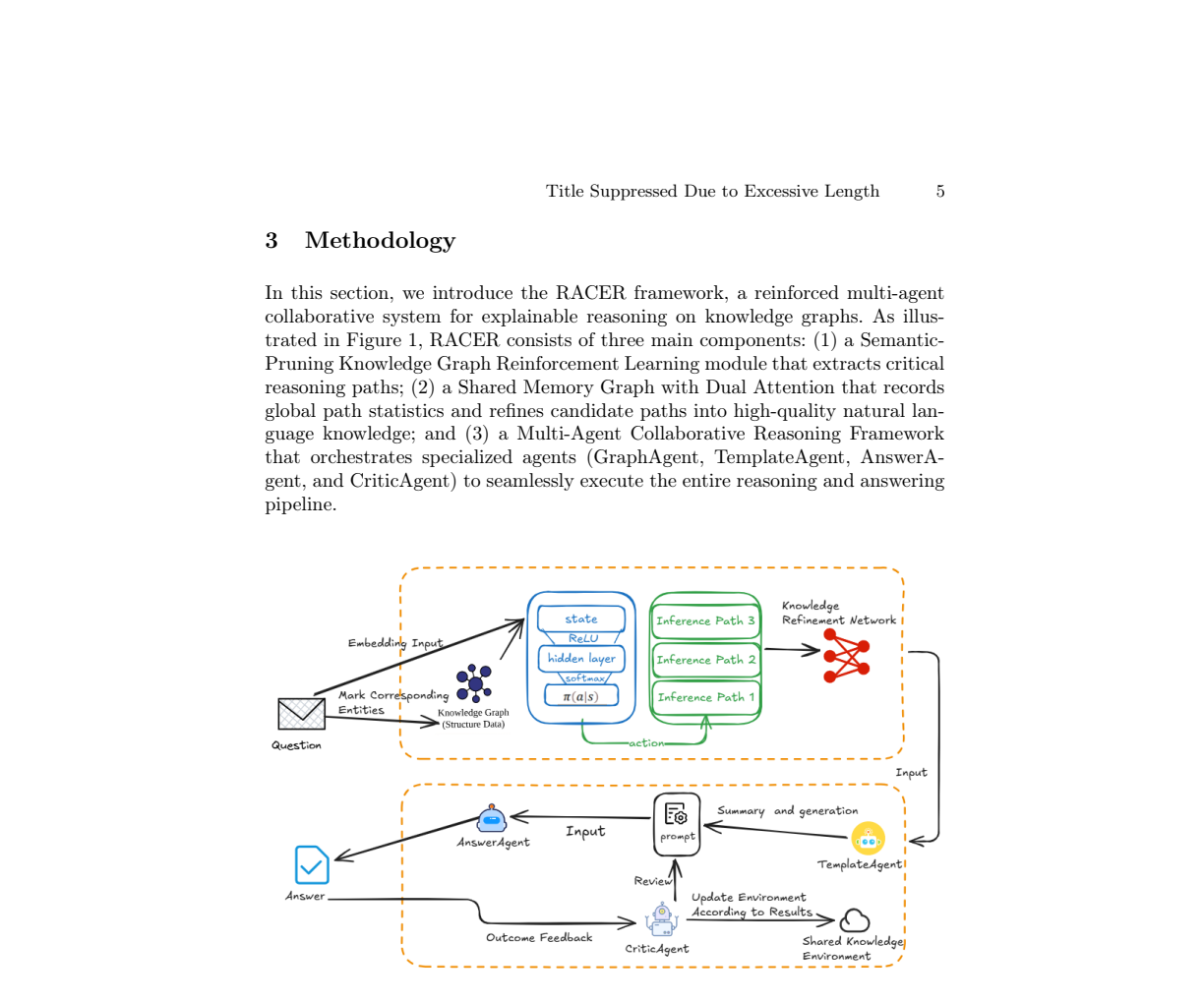
The paper sets out to show that the weak point in grounding large language models with knowledge graphs is not usually the model but the hunt for the right reasoning paths, and that this hunt can be learned rather than hardcoded. RACER trains a reinforcement-learning policy, pruned by semantic similarity to the question and answer choices, to walk multi-hop chains over the ConceptNet graph; a shared memory graph records which edges have historically led to success or failure, and a dual-attention network picks the most useful subset of candidate paths. Those paths are turned into plain-language knowledge snippets and fed to a four-role agent team, path searcher, template writer, answerer, and critic, whose feedback loop re-searches when the critic is unsure. On CommonsenseQA and OpenBookQA the paper reports an average gain of about 5 percent over state-of-the-art KG-enhanced LLM baselines, with ablations attributing the largest losses to removing semantic pruning and teacher guidance. The payoff, if the claims hold, is that LLM accuracy and verifiability improve together without retraining the underlying model.
What carries the argument. The argument is carried by four interacting components. Semantic action pruning scores each candidate step as $score(n_i, r_i) = \alpha\, sim(r_i,q) + \beta\, sim(n_i,q) + \gamma\, sim(n_i,g)$ with $\alpha+\beta+\gamma = 1$, keeping only the top-$K$ actions and collapsing the search space. Teacher-guided training mixes a BFS-shortest-path policy $T(a|s_t)$ with the learned policy $\pi_{RL}(a|s_t)$ under probability $p_{teacher}$, and the total reward is $R = r_{step} + r_{rel} + r_{goal} + r_{reach}$, where $r_{goal} = \lambda_{goal}(sim(v_{t+1},g) - sim(v_t,g))$ pushes the walk monotonically toward the target answer in embedding space. The shared memory graph stores per-edge statistics $\{succ(e), fail(e), reject(e)\}$ and re-ranks candidate actions by the edge quality score $score(e) = (succ(e)+1)/(freq(e)+2) - \gamma\, reject(e)/total(e)$, carrying information across questions and across failed attempts. The dual-attention refinement network applies multi-head self-attention across candidate paths and then query-path cross-attention with a learnable importance scorer to select the top-$k'$ paths, which the TemplateAgent renders as three to six sentences of background knowledge. The CriticAgent closes the loop: on an UNSURE decision it asks the GraphAgent to explore alternative branches, failed edges are penalized in memory to prevent repeats, and the collaboration is capped at three turns.
Core claim. The central claim is that knowledge-graph reasoning for LLMs should be treated as a learnable path-search problem embedded in a collaborative agent loop, not as fixed retrieval or handcrafted templates. RACER formulates the ideal supporting subgraph as the set of query-relevant reasoning chains, notes that extracting it is NP-hard, and replaces exhaustive search with a policy that prunes actions by composite semantic similarity (relation-to-query, node-to-query, node-to-target) and is trained by mixing teacher trajectories, which are BFS shortest paths, with reinforcement learning under a reward that penalizes wandering, rewards relation-query relevance, gives dense goal-proximity feedback, and pays a bonus on reaching the target. To escape single-path local optima, the framework generates multiple candidate paths with temperature sampling, ranks them through a dual-attention network that models both cross-path complementarity and query alignment, and distills the top subset into natural-language knowledge. A four-role multi-agent system, made up of the GraphAgent, TemplateAgent, AnswerAgent, and CriticAgent, executes the pipeline end to end: the critic returns ACCEPT or UNSURE with a confidence score, and on UNSURE it triggers re-exploration of alternative branches while failed edges are penalized in the memory graph. The paper reports that this design outperforms state-of-the-art KG-enhanced LLM baselines by an average of about 5 percent on CommonsenseQA and OpenBookQA, with the strongest results reaching 88.2 percent on CommonsenseQA and 98.0 percent on OpenBookQA with a GPT-5 backbone.
The premise it rests on. Teacher guidance treats the BFS shortest path in the knowledge graph as the optimal reasoning trajectory, so the trained policy is biased toward short chains even when the correct commonsense answer runs along a longer or less direct route.
If the paper is right (Pith's inferences, not the authors')
Accuracy on KG-grounded multiple-choice QA improves without fine-tuning the underlying LLM: RACER lifts every backbone it is tested on (GPT-4, GPT-5, Qwen, GLM, Gemini 3), so the paper attributes the gain to the search-and-collaboration layer rather than to model scale.
Answers become verifiable: each final answer is supported by explicit multi-hop knowledge-graph paths rendered as natural-language snippets, so a wrong answer can be traced back to the chain that produced it.
The framework can self-correct within a bounded budget: when the critic is unsure, the GraphAgent re-searches alternative branches and the memory graph suppresses edges that have already failed, with a maximum of three collaboration turns.
Path-search quality is the dominant lever: ablations show that removing semantic pruning costs the most accuracy (−4.6/−3.7 points), followed by removing teacher guidance (−3.2/−2.4), indicating that efficient path extraction matters more than the downstream prompt format.
Experience accumulates across tasks: the shared memory graph records edge success, failure, and rejection statistics globally, so paths found for earlier questions statistically inform later ones instead of each question being searched from scratch.
Because the teacher signal is defined as the BFS shortest path, a natural stress test is a set of questions whose correct answer requires a chain strictly longer than the shortest path; showing that the policy can override the teacher there would strengthen the claim that semantic relevance, not brevity, drives path choice.
The core modules look task-agnostic, so the same search-memory-refine pipeline could plausibly be ported to other knowledge-graph-grounded generation tasks, such as open-ended explanation or claim verification, where edge-level statistics and the critic loop do not depend on multiple-choice format.
The selection score mixes query relevance with cross-path complementarity, which implies a crisp ablation: removing the highest-attention pairs among the selected paths should change downstream accuracy measurably if complementarity is genuinely doing work.
The roughly additive ablation losses suggest that the next gains may come from a stronger critic rather than more path diversity, since a critic that verified answers against the graph itself could make the re-search loop more selective.
Check this review
Pith stored no record of this review's passes and took no fingerprint of it. Reviews made by code from 13 Nov 2026 on carry both.
How often reviews like this one are right
Reviews like this one: written by deepseek-v4-flash, where what was read was not recorded.
How often objections from reviews like this one are right: not yet measured
Reviews by people
This review was written by a machine. No person has reviewed this paper on Pith yet. A scientist listed on Pith can review it for a fee, and their review is published here whatever it concludes.
The paper
Abstract
Large Language Models (LLMs) often suffer from hallucination and struggle with complex reasoning tasks requiring multi-hop domain knowledge. While integrating Knowledge Graphs (KGs) provides a structured and verifiable information source, current KG-enhanced LLM paradigms usually rely on single-agent path extraction and fixed prompting, lacking adaptability and facing huge search spaces. To address these challenges, we propose RACER, a Reinforced Agent Collaboration framework for Explainable Reasoning on knowledge graphs. RACER employs a semantic-aware action pruning and teacher-guided reinforcement learning mechanism to efficiently extract high-quality reasoning pathways from large-scale KGs. Furthermore, to mitigate single-path generation pitfalls, we introduce a cross-task accumulated shared memory graph paired with an attention-driven multi-path knowledge refinement module. Finally, RACER orchestrates these components through a four-role multi-agent collaboration system (GraphAgent, TemplateAgent, AnswerAgent, and CriticAgent) to dynamically refine prompts and evaluate answers. Extensive experiments on CommonsenseQA and OpenBookQA datasets demonstrate that RACER significantly outperforms state-of-the-art KG-enhanced LLM baselines with an average improvement of 5%, offering robust and highly interpretable reasoning capabilities.
The paper's own sentences, arranged, kept beside the review and separate from it. Each label is drawn from a closed vocabulary; the number beside it is the probability the classifier gave that label. No sentence in this record was written by a model.
abstract compiled · 2026-09-23
The authors' main claim, as the classifier picked it out 1.00
“Extensive experiments on CommonsenseQA and OpenBookQA datasets demonstrate that RACER significantly outperforms state-of-the-art KG-enhanced LLM baselines with an average improvement of 5\%, offering robust and highly interpretable reasoning capabilities.”
How the main claim is stated: asserted 1.00
What the abstract itself states, as probabilities: claims first 0.06 · states limitation 0.08 · human participants 0.03 · controlled comparison 0.89 · randomized assignment 0.02 · states quantitative result 0.99 · compares with prior results 0.98 · mentions code or data availability 0.02
The abstract, sentence by sentence
This table labels the abstract only (arXiv listing abstract v1). The number is the probability the classifier gave the label.
| Sentence | Role | The authors' own work | States the main conclusion | Strength |
|---|---|---|---|---|
| Large Language Models (LLMs) often suffer from hallucination and struggle with complex reasoning tasks requiring multi-hop domain knowledge. | background 1.00 | 0.05 | 0.02 | asserted 0.94 |
| While integrating Knowledge Graphs (KGs) provides a structured and verifiable information source, current KG-enhanced LLM paradigms usually rely on single-agent path extraction and fixed prompting, lacking adaptability and facing huge search spaces. | gap 0.86 | 0.05 | 0.02 | asserted 1.00 |
| To address these challenges, we propose RACER, a Reinforced Agent Collaboration framework for Explainable Reasoning on knowledge graphs. | contribution 1.00 | 0.72 | 0.06 | asserted 0.98 |
| RACER employs a semantic-aware action pruning and teacher-guided reinforcement learning mechanism to efficiently extract high-quality reasoning pathways from large-scale KGs. | method 0.97 | 0.84 | 0.04 | asserted 1.00 |
| Furthermore, to mitigate single-path generation pitfalls, we introduce a cross-task accumulated shared memory graph paired with an attention-driven multi-path knowledge refinement module. | method 0.71 | 0.90 | 0.03 | asserted 0.99 |
| Finally, RACER orchestrates these components through a four-role multi-agent collaboration system (GraphAgent, TemplateAgent, AnswerAgent, and CriticAgent) to dynamically refine prompts and evaluate answers. | method 0.97 | 0.88 | 0.04 | asserted 1.00 |
| Extensive experiments on CommonsenseQA and OpenBookQA datasets demonstrate that RACER significantly outperforms state-of-the-art KG-enhanced LLM baselines with an average improvement of 5\%, offering robust and highly interpretable reasoning capabilities. | result 1.00 | 0.96 | 0.87 | asserted 1.00 |
What kind of paper the classifier reports this is: method or tool 1.00 · evidence from observation or experiment 1.00
What was examined, and what was not
Sources read
- arXiv listing abstract v1
Not examined
- full text
- figures and tables
- references and citing sentences
- relations to other papers
Levels run
- P abstract
Not run
- S sections
- T body sentences
- C citations
- R cross-paper relations
How the labels were made
Compiled by classifier-1.13.0 via TypeSafe API, question bank abstract-p1-20260923, 2026-09-23: 1 request, 5,740 input tokens.
Every quoted sentence on this record is the authors'. Every label is from Pith's closed vocabulary, with the probability shown beside it. This record as JSON
Figures (1)
Figures are the authors', reproduced from the paper.
References (34)
- [1] Anthropic: The claude 3 model family: Opus, sonnet, haiku (2024) on Pith
- [2] Devlin,J.,Chang,M.W.,Lee,K.,Toutanova,K.:Bert:Pre-trainingofdeepbidirec- tional transformers for language understanding. arXiv preprint arXiv:1810.04805 (2018) on PithPith's reviewarXiv
- [3] Dong, J., et al.: Clr-bench: Evaluating large language models in college-level rea- soning (2024) on Pith
- [4] Dong, J., et al.: Modality-aware integration with large language models for knowledge-based visual question answering (2024) on Pith
- [5] Edge, D., Trinh, H., Cheng, N., Bradley, J., Chao, A., Mody, A., Ward, S., Larson, C.: From local to global: A graph rag approach to query-focused summarization. arXiv preprint arXiv:2404.16130 (2024) on PithPith's reviewarXiv
- [6] Feng, Y., Chen, X., Lin, B.Y., Wang, P., Yan, J., Ren, X.: Scalable multi-hop relational reasoning for knowledge-aware question answering. In: EMNLP (2020) on Pith
- [7] Guan, X., et al.: Mitigating large language model hallucinations via autonomous knowledge graph-based retrofitting. AAAI (2024) on Pith
- [8] Hong, S., et al.: Metagpt: Meta programming for a multi-agent collaborative frame- work. In: ICLR (2024) on Pith
- [9] Hu, L., et al.: A survey of knowledge enhanced pre-trained language models. IEEE TKDE (2023) on Pith
- [10] Kung, T.H., et al.: Performance of chatgpt on usmle: Potential for ai-assisted med- ical education. PLoS digital health (2023) on Pith
- [11] Lewis, P., et al.: Retrieval-augmented generation for knowledge-intensive nlp tasks. NeurIPS (2020) on Pith
- [12] Li, H., et al.: A survey on retrieval-augmented text generation. arXiv (2022) on Pith
- [13] Liu, P., et al.: Pre-train, prompt, and predict: A systematic survey of prompting methods in nlp. ACM Computing Surveys (2023) on Pith
- [14] Liu, W., et al.: K-bert: Enabling language representation with knowledge graph. AAAI (2020) on Pith
- [15] Liu, Y., Ott, M., Goyal, N., Du, J., Mandar, J., Chen, D., Levy, O., Lewis, M., Zettlemoyer, L., Stoyanov, V.: Roberta: A robustly optimized bert pretraining approach. arXiv preprint arXiv:1907.11692 (2019) Title Suppressed Due to Excessive Length 15 on PithPith's reviewarXiv
- [16] Luo, L., Li, Y.F., Haffari, G., Pan, S.: Reasoning on graphs: Faithful and inter- pretable large language model reasoning. arXiv preprint arXiv:2310.01061 (2023) on PithPith's reviewarXiv
- [17] Mihaylov, T., Clark, P., Khot, T., Sabharwal, A.: Can a suit of armor conduct electricity? a new dataset for open book question answering. In: EMNLP (2018) on Pith
- [18] Minaee, S., et al.: Large language models: A survey. arXiv (2024) on Pith
- [19] OpenAI: Gpt-4 technical report (2023) on Pith
- [20] Ouyang, L., et al.: Training language models to follow instructions with human feedback. NeurIPS (2022) on Pith
show 14 more
- [21] Pan, S., et al.: Unifying large language models and knowledge graphs: A roadmap. IEEE TKDE (2024) on Pith
- [22] Peters,M.E.,etal.:Knowledgeenhancedcontextualwordrepresentations.EMNLP (2019) on Pith
- [23] Qian, C., et al.: Communicative agents for software development. arXiv preprint arXiv:2307.07924 (2023) on PithPith's reviewarXiv
- [24] Speer, R., Chin, J., Havasi, C.: Conceptnet 5.5: An open multilingual graph of general knowledge. In: AAAI (2017) on Pith
- [25] Sun, Y., et al.: Ernie: Enhanced representation through knowledge integration. arXiv (2019) on Pith
- [26] Sun, Y., Shi, Q., Qi, L., Zhang, Y.: Jointlk: Joint reasoning with language models and knowledge graphs for commonsense question answering. In: ACL (2022) on Pith
- [27] Talmor, A., Herzig, J., Lourie, N., Berant, J.: Commonsenseqa: A question answer- ing challenge targeting commonsense knowledge. arXiv preprint arXiv:1811.00937 (2018) on PithPith's reviewarXiv
- [28] Wang,X.,Jiang,Z.,Bach,B.,etal.:Chain-of-knowledge:Groundinglargelanguage models via dynamic knowledge adapting over heterogeneous sources. In: ICLR (2024) on Pith
- [29] Wen, Y., Wang, Z., Sun, J.: Mindmap: Knowledge graph prompting sparks graph of thoughts in large language models. arXiv preprint arXiv:2308.09729 (2023) on PithPith's reviewarXiv
- [30] Wu, Q., et al.: Autogen: Enabling next-gen llm applications via multi-agent con- versation. arXiv preprint arXiv:2308.08155 (2023) on PithPith's reviewarXiv
- [31] Yang, L., et al.: Give us the facts: Enhancing large language models with knowledge graphs. arXiv (2024) on Pith
- [32] Yasunaga, M., Ren, H., Bosselut, A., Liang, P., Leskovec, J.: Qa-gnn: Reasoning with language models and knowledge graphs for question answering. In: NAACL (2021) on Pith
- [33] Zhang, Q., Dong, J., Chen, H., Zha, D., Yu, Z., Huang, X.: Knowgpt: Knowledge graph based prompting for large language models. In: NeurIPS (2024) on Pith
- [34] Zhang, X., Bosselut, A., Yasunaga, M., Ren, H., Liang, P., Leskovec, J.: Greaselm: Graph reasoning enhanced language models. In: ICLR (2022) on Pith
Cited by 1 Pith paper
Reviewed papers on Pith that cite this one. The full citation record
How the literature uses it
What this paper does with the arXiv papers it cites
What it cites · 5 sentences without a confident label
Uses data or values from 1 paper
-
We select CommonsenseQA [ref] and OpenBookQA [ref] as benchmarks.
CommonsenseQA: A Question Answering Challenge Targeting Commonsense Knowledge · Experimental Setup · 0.92
Compares with 4 papers
-
We carefully select baselines from four categories: * LM + Fine-tuning: BERT-base, BERT-large [ref] , RoBERTa-large [ref] * KG-enhanced LM: MHGRN [ref] , QA-GNN [ref] , JointLK [ref] , GreaseLM [ref] * LLM + Zero-shot: GPT-3.5 [ref] , GPT-4 [ref] , GPT-5, Qwen, GLM, Gemini 3 * LLM + KG Prompting: KnowGPT [ref] , CoK [ref] , RoG [ref] , Mindmap [ref]
BERT: Pre-training of Deep Bidirectional Transformers for Language Understanding · Experimental Setup · 0.92
-
We carefully select baselines from four categories: * LM + Fine-tuning: BERT-base, BERT-large [ref] , RoBERTa-large [ref] * KG-enhanced LM: MHGRN [ref] , QA-GNN [ref] , JointLK [ref] , GreaseLM [ref] * LLM + Zero-shot: GPT-3.5 [ref] , GPT-4 [ref] , GPT-5, Qwen, GLM, Gemini 3 * LLM + KG Prompting: KnowGPT [ref] , CoK [ref] , RoG [ref] , Mindmap [ref]
RoBERTa: A Robustly Optimized BERT Pretraining Approach · Experimental Setup · 0.92
-
We carefully select baselines from four categories: * LM + Fine-tuning: BERT-base, BERT-large [ref] , RoBERTa-large [ref] * KG-enhanced LM: MHGRN [ref] , QA-GNN [ref] , JointLK [ref] , GreaseLM [ref] * LLM + Zero-shot: GPT-3.5 [ref] , GPT-4 [ref] , GPT-5, Qwen, GLM, Gemini 3 * LLM + KG Prompting: KnowGPT [ref] , CoK [ref] , RoG [ref] , Mindmap [ref]
MindMap: Knowledge Graph Prompting Sparks Graph of Thoughts in Large Language Models · Experimental Setup · 0.92
Challenges and discussion
Disagree with the review, or know something it missed? Leave a comment, or challenge this review formally: a challenge becomes a permanent entry in this paper's record, and its decision is published here.
Come back by email
A short list of the week's newly reviewed papers. Nothing is sent until you confirm from your inbox, and every email has a link that stops it. No account.
No comments yet.
Sign in to comment