Strongly Correlated Electrons · arXiv:2608.18267 v2 · submitted 18 Aug 2026 · 121 references
Finite-temperature Green's function cluster expansion from thermofield doubles: Breakdown of the polaron picture
The paper says
“We introduce a method, numerically exact in principle, for computing the momentum- and frequency-resolved single-particle Green's function of a polaron at finite temperature.”
more of the abstract
The method, which we refer to as the finite-temperature Green's function cluster expansion, combines two ingredients: the generalized Green's function cluster expansion, a numerically exact extension of the momentum average family of methods that solves the polaron problem at zero temperature through a hierarchy of equations of motion for restricted phonon cloud configurations; and the thermofield double formalism, which maps the thermal trace onto a pure-state expectation value over a doubled Hilbert space. The resulting equations of motion have the same algebraic structure as those of the multi-boson zero-temperature theory, with the temperature entering through a Bogoliubov-type mixing angle that controls the coupling to a set of fictitious bath bosons. We implement the method in our open-source software package and benchmark it on the one-dimensional Holstein polaron, computing spectral functions, dispersions, lifetimes, and effective masses across coupling regimes and temperatures up to T/Ω ∼ 1. Where finite-temperature density matrix renormalization group results are available, we find quantitative agreement at affordable computational cost. The method recovers momentum-resolved spectra directly in frequency space, with no time evolution or analytic continuation. We also discuss the practical costs of the approach. In particular, since the doubled phonon Hilbert space has a non-trivial configuration structure in which real and fictitious clouds compete, convergence in the corresponding cloud parameters requires care.
from the abstract
Pith says
Machine review · deepseek-v4-flash · 27 Aug 2026 · what was read was not recorded · not checked by a person
It can be wrong. Challenge this review or reply to it.
Holds up, with conditions. A genuinely useful finite-temperature polaron method with clean derivation and quantitative low-T benchmarks, but the title-level 'breakdown' claim rests on small-Ω calculations whose convergence is least controlled and should be treated as suggestive, not established. This line is wrong
3 major objections · 4 minor
How often objections from reviews like this one are right: not yet measured
Not checked: figures, code, what the 121 references say.
The paper says, at §V E and Fig. 9; Eq. (15)
The review did not quote this passage.
Pith says: Objection 1 of 3 · major
The central claim that the polaron picture breaks down at small Ω rests on the two-peak line shape at λ = 1, Ω = 0.5, T/Ω ≤ 0.30. No convergence scan in (M, N, M_t, N_t) is shown for these parameters, and no independent finite-temperature benchmark is provided in this regime.
more of objection 1
This matters because fictitious phonons enter the free propagator with negative energy (Eq. (15)), so the truncated theory is not variational; the paper itself states in Sec. VI that 'the full spectrum—and quantities derived from the line shape, like lifetimes—is considerably more sensitive' to the cloud cutoffs. A two-peak structure is exactly such a line-shape feature, and a finite set of negative-energy fictitious configurations could hybridize with the polaron spuriously. The authors should show that the splitting survives systematic enlargement of the four cloud parameters and match it against an independent method (e.g., finite-T DMRG) before claiming a breakdown of the quasiparticle picture.
This objection may describe the copy Pith gave the reviewer, not the paper.
The paper says, at §IV B and Fig. 3
The review did not quote this passage.
Pith says: Objection 2 of 3 · major
The convergence study is incomplete at the highest temperature: at T/Ω = 1 the curves do not fully collapse, and the paper only states that the polaron peak position and width remain stable. Since the same cloud cutoffs MN-M_tN_t = 39-35 are used for all reported observables, including the line-shape-sensitive lifetimes and the high-temperature spectral functions of Fig. 5, the truncation error at T/Ω = 1 is unquantified.
more of objection 2
The abstract and conclusion describe the method as 'numerically exact in principle' and the results as semi-quantitative up to T/Ω~1; this is too strong without either a demonstration that the reported line-shape features converge or an explicit restriction of the quantitative claims to T/Ω ≲ 0.4.
The paper says, at §II C and abstract
The review did not quote this passage.
Pith says: Objection 3 of 3 · major
The statement 'numerically exact in principle' is asserted rather than demonstrated. The untruncated hierarchy is exact by construction, but no argument is given that the four-parameter truncation converges for the parameter space considered, and Sec. VI correctly notes that no variational bound exists. The manuscript should either prove convergence (or provide a controlled extrapolation procedure) or explicitly state that exactness refers only to the untruncated hierarchy, with the truncation error being an uncontrolled approximation in practice.
4 minor objections
The paper says, at Fig. 3 caption
Pith says: minor objection 1 of 4
The labels '29-35', '37-35', etc. use the shorthand MN-M_tN_t, but the caption never defines that M and N are the real-cloud extent and phonon number while M_t and N_t are the fictitious-cloud counterparts; please spell this out explicitly in the caption.
The paper says, at Sec. VI and Ref. 31
Pith says: minor objection 2 of 4
Reference [31] is cited as 'Forthcoming' to support the claim that Γ(k)−η is η-independent at small η; please replace this with a published article or a stable arXiv identifier so the statement can be verified.
show 2 more
The paper says, at Fig. 9
Pith says: minor objection 3 of 4
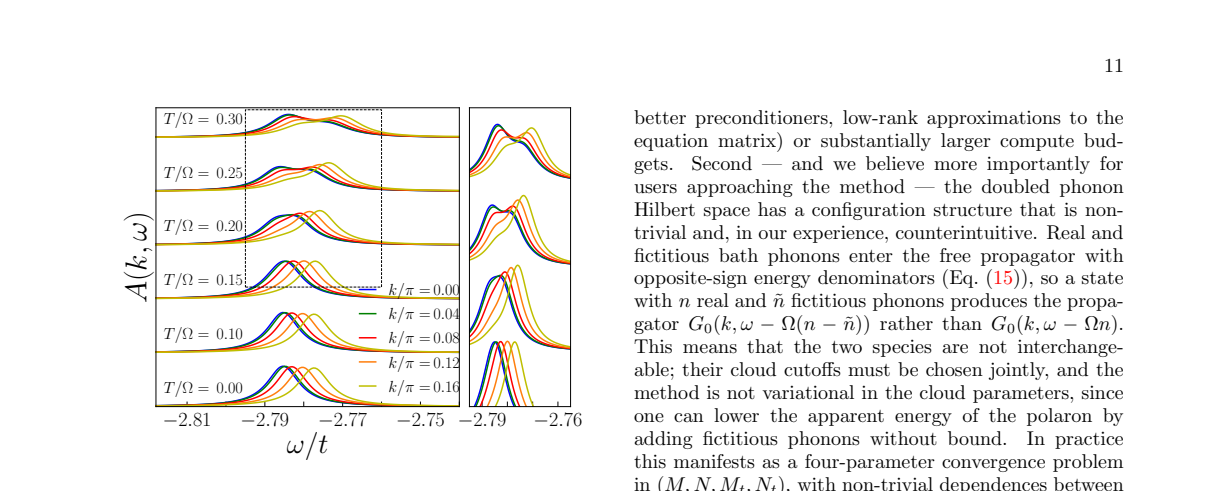
In the zoom panel, the frequency axis has no tick labels, making the magnitude of the peak splitting difficult to assess; add a scale.
The paper says, at Eqs. (7) and (11)
Pith says: minor objection 4 of 4
The notation |0̄⟩ is used for both the thermal TFD state |0̄(β)⟩ in Eq. (7) and the product vacuum |0⟩⊗|̃0⟩ in Eq. (11); although the text clarifies the latter, the double use is easy to confuse and a distinct symbol (e.g., |vac⟩) would improve readability.
What would settle it
Recompute the Fig. 9 line shape at λ=1, Ω=0.5, k/π=0 and k/π=0.16, T/Ω=0.30, with systematically enlarged cutoffs, e.g. (M,N,Mt,Nt) = (3,11,3,7), (5,13,5,9), and also with the finite-T DMRG purification setup of Appendix A at the same parameters. Accept the two-peak structure as physical only if it persists, with converged peak positions and weights, across these cutoffs and is reproduced by DMRG at comparable resolution; if the second maximum shifts, weakens, or disappears under this check, the Sec. V E breakdown claim should be retracted or reclassified as a truncation artifact.
from the skeptic's reading
How the review went
4 readings by deepseek-v4-flash · 27 Aug 2026
- Reader holds up, with conditions
- Skeptic agrees
- Editor wrote the verdict above
- Referee major revision: 3 major objections, 4 minor
Not run on this paper: the simulated authors' defence.
Pith did not check this review's objections against the paper.
The review in full
The review in brief, machine-written
The short version: this is a real methodological contribution. Combining GGCE with the thermofield double to get A(k,ω) directly on the real-frequency axis, without analytic continuation, is new and structurally clean. The derivation of the thermal Hamiltonian is straightforward, the temperature enters via a Bogoliubov angle, and the low- to intermediate-temperature benchmarks against finite-T DMRG are genuinely quantitative at T/Ω up to about 0.4. The code is open source, no parameters are fitted to benchmarks, and the authors include their own DMRG cross-checks. That is solid, reproducible work, and for polaron problems this should be useful.
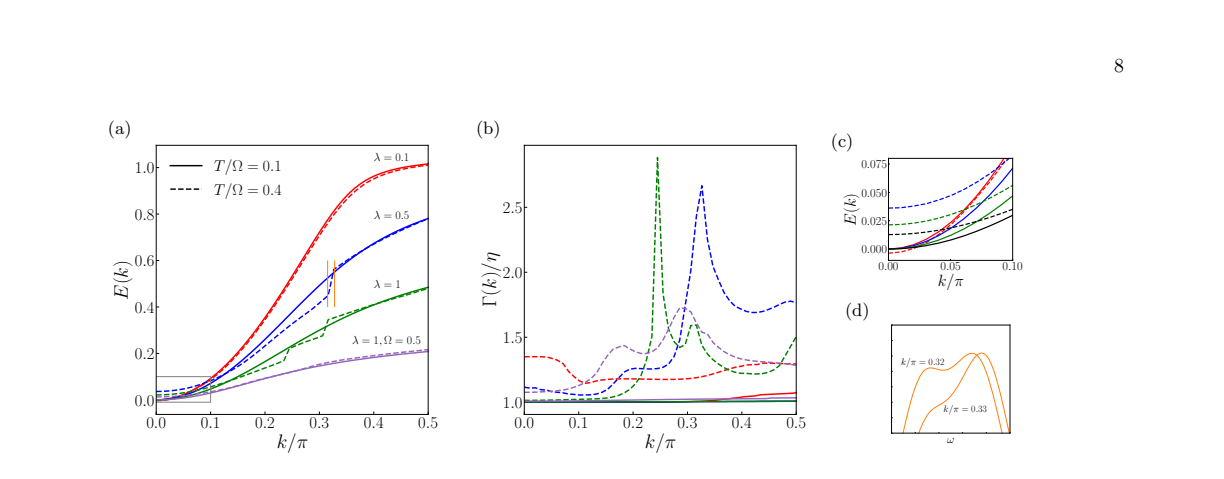
Where I part company with the title: “Breakdown of the polaron picture” is presented as the main physical conclusion, but it rests on Fig. 9 at λ=1, Ω=0.5, where exactly the method’s control is weakest. From Eq. (15), adding a fictitious phonon lowers the free-propagator energy by Ω, so the doubled cloud is not variational and the hierarchy truncation is a four-parameter problem. The convergence scan in Fig. 3 at Ω=1 shows only partial collapse at T/Ω=1, and no equivalent scan is shown for Ω=0.5. The two-peak structure in Fig. 9 could in principle be a truncation artifact of a discrete fictitious-phonon continuum hybridizing with the polaron. No independent DMRG or other benchmark is provided in that regime. The authors are candid about the non-variationality and the semi-quantitative nature of some results, which I appreciate, but the title overstates what is currently demonstrated.
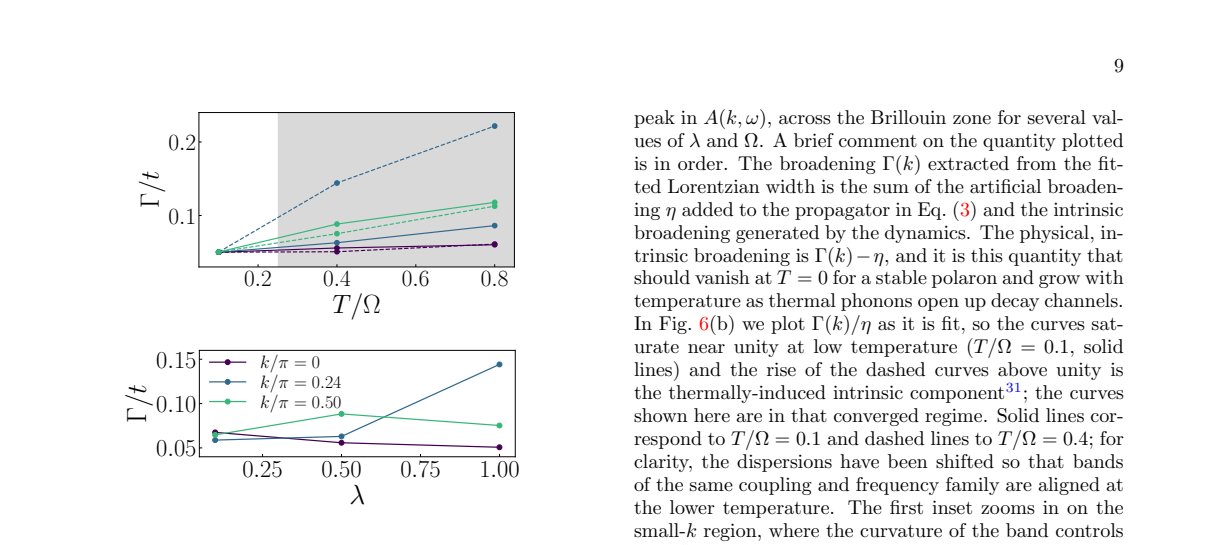
That said, this is not a fatal flaw. The method itself is well derived, the benchmarks where available are convincing, and the small-Ω regime is the natural place to push next. The fix is straightforward: a systematic convergence scan in (M, N, Mt, Nt) at Ω=0.5, showing the two-peak feature persists, plus ideally an independent comparison. The authors also note that lifetimes are more cutoff-sensitive than peak positions, so the specific broadening claims in the shaded high-T regions should be treated cautiously.
Who is this for? Anyone working on finite-temperature polaron physics, organic semiconductors, or ARPES-type spectral calculations. It deserves a serious referee, not a desk reject; the referee should focus on convergence control and the title's proportionality. I would cite it if I worked in this area, and I'd bring it to a reading group.
My recommendation: send to peer review, ask for the small-Ω convergence scan, and encourage the authors to temper the title until the breakdown claim has independent support.
The strongest objection
The central physical claim—breakdown of the single-quasiparticle/polaron picture at small Ω—is presented in Sec. V E and Fig. 9 for λ=1, Ω=0.5, T/Ω up to 0.30. This is the regime in which the method's practical exactness is weakest. From Eq. (15), a configuration with n real and ñ fictitious phonons enters the free propagator as G0(k, ω − Ω(n − ñ)); increasing ñ lowers the diagonal energy without bound. The paper itself states (Sec. VI) that the method is not variational, that convergence is a four-parameter problem, and that the full spectrum—lifetimes in particular—is considerably more sensitive to the cloud cutoffs than the polaron peak. Fig. 3 shows only partial collapse even at T/Ω=1 for Ω=1, and no equivalent convergence scan is shown at Ω=0.5. The two-peak structure in Fig. 9 is therefore exactly the kind of line-shape feature that a finite fictitious-cloud cutoff (M,N,Mt,Nt)=(3,9,3,5) could create artificially: the thermal-satellite 'continuum' is represented by a finite set of discrete negative-energy configurations, and its hybridization with the polaron could be a truncation artifact. No independent finite-T DMRG or other method is benchmarked in this regime; the authors' own DMRG data at T/Ω=1 and Ω=1 is only semi-quantitative. Until the splitting is shown to survive systematic enlargement of the cloud parameters and an independent comparison, the title-level 'breakdown' conclusion is unsupported.
I found the formal TFD-to-GGCE mapping internally consistent and the low-temperature benchmarks credible: the T→0 limit correctly returns GGCE, the θ(β) rotation in Eqs. (14)–(16) is standard, and the DMRG agreement at T/Ω=0.1 and 0.4 is a genuine strength. The reader's weakest assumption—practical convergence of the four-parameter non-variational truncation—is the right one, and I sharpen it by pointing at the precise regime where it bites: Sec. V E and Fig. 9, where the title claim lives and where no convergence scan or independent benchmark is provided. Because the fictitious phonons enter with negative energy (Eq. 15), the truncated space has a spurious hard boundary in ñ, and line-shape features such as the reported two-peak structure are precisely what such a boundary can produce. The authors themselves flag this sensitivity in Sec. VI, so the concern is not an external standard but their own stated limitation. A targeted convergence sweep plus one independent DMRG line cut at Ω=0.5, T/Ω=0.30 would settle it. Since the reader already returned CONDITIONAL with the same underlying concern, my stress-test does not change the verdict; it only makes the required condition concrete.
The referee's report
If the method's practical convergence is established, TGCE would be a valuable addition to the finite-temperature polaron toolbox: it returns A(k,ω) directly in frequency space without time evolution or analytic continuation, it is implemented in an open-source package, and it is not fitted to the benchmarks. The TFD-based derivation of the thermal Hamiltonian is clean, the agreement with independent DMRG data at T/Ω = 0.1 and 0.4 is quantitative, and the presentation of practical costs (matrix scaling, solver backends, sparsity) is useful. However, the headline physical claim—the breakdown of the polaron picture at small Ω—is not yet supported, because the regime in which it is made is precisely the regime where the non-variational fictitious-cloud truncation is least controlled and for which no independent benchmark or convergence scan is provided. The method's exactness is claimed 'in principle,' but no convergence proof or error bound is given for the truncated hierarchy.
Pith's reading of the paper (a machine's summary, not the authors')
The paper introduces TGCE, a method for computing the momentum- and frequency-resolved single-particle Green's function of a polaron at finite temperature, which is numerically exact in principle. It works by mapping the thermal trace onto a pure state in a doubled Hilbert space via the thermofield double formalism, so temperature enters through a squeezed mixing angle rather than through imaginary-time sampling. The method returns $A(k,\omega)$ directly at any momentum and frequency, with no time evolution and no analytic continuation. On the one-dimensional Holstein model it quantitatively matches finite-temperature DMRG benchmarks where those exist, and it exposes a regime at small phonon frequency and intermediate temperature where the polaron peak splits and the single-quasiparticle description fails. If correct, this gives a practical direct-frequency route to finite-temperature polaron physics in materials with soft lattice modes.
What carries the argument. The central object is the temperature-dependent thermal Hamiltonian $\bar{H}(\beta)=K+\Omega\sum_i(b_i^\dagger b_i-\tilde b_i^\dagger\tilde b_i)+\cosh\theta(\beta)\,V+\sinh\theta(\beta)\,\tilde V$, obtained by squeezing $H-\tilde{H}_{\rm vib}$ with $e^{-iG(\beta)}$, where $\theta(\beta)=\operatorname{arctanh}(e^{-\beta\Omega/2})$ and $\tilde V$ is the same electron-phonon interaction acting on fictitious bath phonons. This makes the finite-temperature problem algebraically identical to a zero-temperature two-boson cluster expansion, with temperature entering only through the two coefficients $\cosh\theta$ and $\sinh\theta$, and with fictitious phonons entering the free propagator at negative energy, $G_0(k,\omega-\Omega(n-\tilde n))$. The cloud-truncation hierarchy caps the real and fictitious cloud sizes $(M,N,M_t,N_t)$ and supplies the equations of motion whose solution is $G(k,\omega;\beta)=\langle 0|c_k[\omega-\bar{H}(\beta)+i\eta]^{-1}c_k^\dagger|0\rangle$.
Core claim. The central claim is that the finite-temperature polaron problem can be solved by combining the generalized Green's function cluster expansion with the thermofield double, producing a hierarchy of exact equations of motion for clouds built from both real and fictitious phonon species. Truncating the hierarchy at finite cloud sizes yields a sparse linear system whose solution is the Green's function, and the paper shows that modest cutoffs reproduce finite-temperature DMRG spectra quantitatively for the Holstein model at couplings up to $\lambda=1$ and temperatures up to $T/\Omega\approx 0.4$, and semi-quantitatively up to $T/\Omega=1$. The same calculation reveals that at small phonon frequency and elevated temperature the polaron spectral peak splits into two comparable maxima, which the paper interprets as hybridization with the thermal-satellite continuum and as a breakdown of the Lorentzian-broadened quasiparticle description. This multi-peak structure is presented as a genuine feature of the computed spectrum rather than an artifact of analytic continuation.
The premise it rests on. The practical exactness of the results rests on the assumption that a modestly truncated expansion of the doubled phonon cloud converges quickly enough at the temperatures studied; the paper itself shows this is only partially the case at $T/\Omega=1$.
If the paper is right (Pith's inferences, not the authors')
TGCE yields $A(k,\omega)$ at arbitrary momentum and frequency without time propagation or analytic continuation, so the entire real-frequency spectrum is obtained directly.
On the one-dimensional Holstein model, the method matches finite-temperature DMRG quantitatively for couplings up to $\lambda=1$ at $T/\Omega\leq 0.4$, and semi-quantitatively at $T/\Omega=1$.
The method predicts that at small phonon frequency and intermediate temperature, thermal dressing splits the polaron peak into two comparable maxima, so a single Lorentzian-broadened polaron is no longer a valid description.
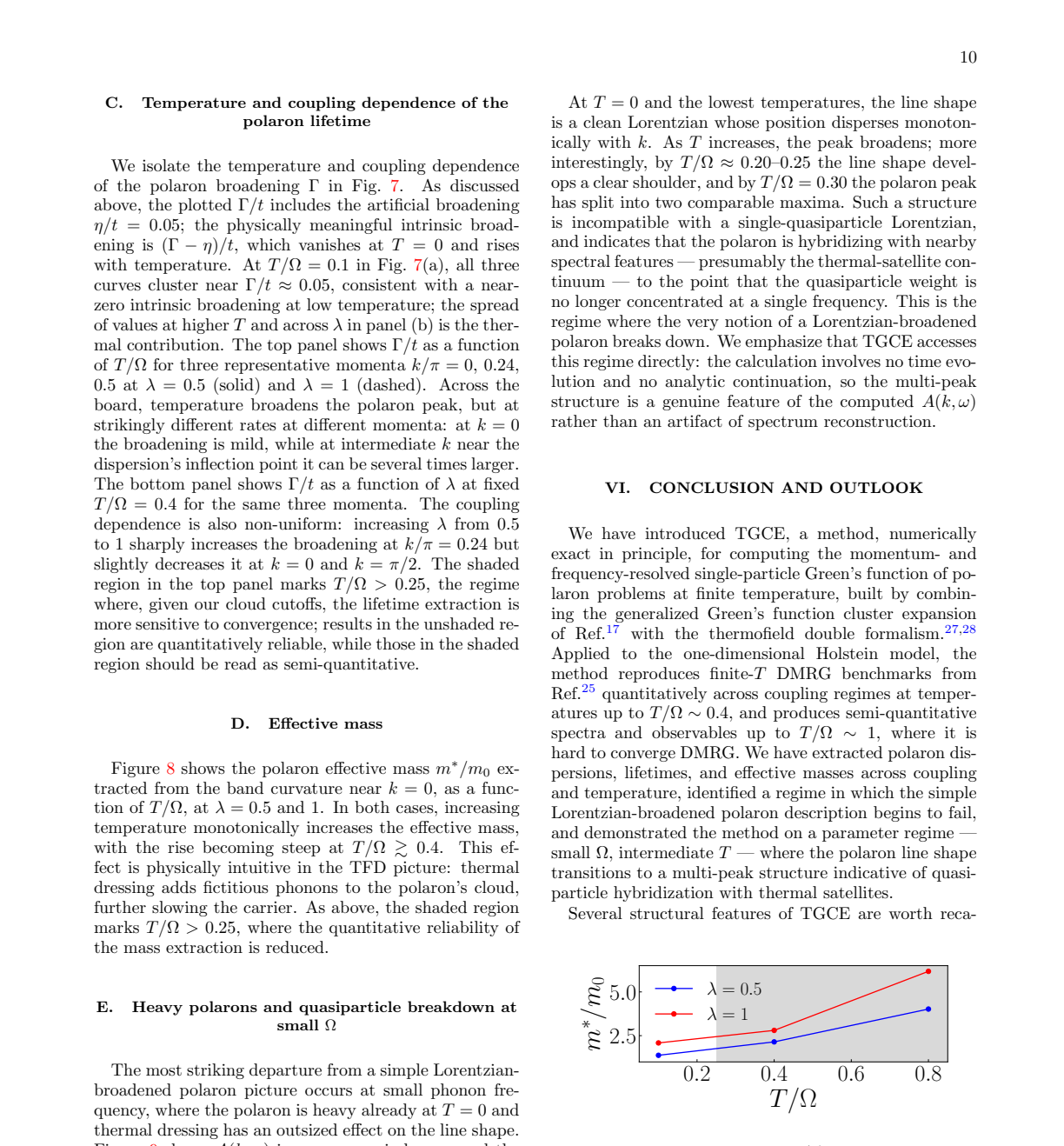
Polaron effective mass and inverse lifetime grow monotonically with temperature, with the broadening strongly momentum-dependent near the dispersion's inflection points.
Because temperature enters only as two scalar coefficients, extensions to higher dimensions and to Peierls or mixed couplings require only a model registration and numerical evaluation of the free propagator.
A natural test of the breakdown claim is to track the two spectral maxima as $\Omega\to 0$ at fixed $T/\Omega$: if the splitting tracks the thermal-phonon continuum edge, it should scale with $\Omega$, and the crossing temperature should be a function of $T/\Omega$ alone.
The direct real-frequency output makes TGCE a candidate benchmark for analytic-continuation methods and for approximate finite-temperature self-energies, since it provides spectra without the usual ill-conditioned inverse step.
The four-parameter convergence structure suggests an adaptive truncation rule: stop adding fictitious-cloud states when the polaron peak position and weight stop changing, rather than fixing cutoffs a priori.
The factorized initial state that makes the thermofield double exact for one carrier will fail for bipolaron response functions, so multi-carrier extensions will need a different purification or hybridization with diagrammatic Monte Carlo.
Check this review
Pith stored no record of this review's passes and took no fingerprint of it. Reviews made by code from 13 Nov 2026 on carry both.
How often reviews like this one are right
Reviews like this one: written by deepseek-v4-flash, where what was read was not recorded.
How often objections from reviews like this one are right: not yet measured
Reviews by people
This review was written by a machine. No person has reviewed this paper on Pith yet. A scientist listed on Pith can review it for a fee, and their review is published here whatever it concludes.
The paper
Abstract
We introduce a method, numerically exact in principle, for computing the momentum- and frequency-resolved single-particle Green's function of a polaron at finite temperature. The method, which we refer to as the finite-temperature Green's function cluster expansion, combines two ingredients: the generalized Green's function cluster expansion, a numerically exact extension of the momentum average family of methods that solves the polaron problem at zero temperature through a hierarchy of equations of motion for restricted phonon cloud configurations; and the thermofield double formalism, which maps the thermal trace onto a pure-state expectation value over a doubled Hilbert space. The resulting equations of motion have the same algebraic structure as those of the multi-boson zero-temperature theory, with the temperature entering through a Bogoliubov-type mixing angle that controls the coupling to a set of fictitious bath bosons. We implement the method in our open-source software package and benchmark it on the one-dimensional Holstein polaron, computing spectral functions, dispersions, lifetimes, and effective masses across coupling regimes and temperatures up to T/Ω ∼ 1. Where finite-temperature density matrix renormalization group results are available, we find quantitative agreement at affordable computational cost. The method recovers momentum-resolved spectra directly in frequency space, with no time evolution or analytic continuation. We also discuss the practical costs of the approach. In particular, since the doubled phonon Hilbert space has a non-trivial configuration structure in which real and fictitious clouds compete, convergence in the corresponding cloud parameters requires care.
The paper's own sentences, arranged, kept beside the review and separate from it. Each label is drawn from a closed vocabulary; the number beside it is the probability the classifier gave that label. No sentence in this record was written by a model.
abstract compiled · 2026-09-23
The authors' main claim, as the classifier picked it out 0.53
“Where finite-temperature density matrix renormalization group results are available, we find quantitative agreement at affordable computational cost.”
How the main claim is stated: asserted 1.00
What the abstract itself states, as probabilities: claims first 0.08 · states limitation 0.95 · human participants 0.01 · controlled comparison 0.21 · randomized assignment 0.01 · states quantitative result 0.64 · compares with prior results 0.95 · mentions code or data availability 0.92
The abstract, sentence by sentence
This table labels the abstract only (arXiv listing abstract v2). The number is the probability the classifier gave the label.
| Sentence | Role | The authors' own work | States the main conclusion | Strength |
|---|---|---|---|---|
| We introduce a method, numerically exact in principle, for computing the momentum- and frequency-resolved single-particle Green's function of a polaron at finite temperature. | contribution 0.98 | 0.93 | 0.11 | asserted 1.00 |
| The method, which we refer to as the finite-temperature Green's function cluster expansion, combines two ingredients: the generalized Green's function cluster expansion, a numerically exact extension of the momentum average family of methods that solves the polaron problem at zero temperature through a hierarchy of equations of motion for restricted phonon cloud configurations; and the thermofield double formalism, which maps the thermal trace onto a pure-state expectation value over a doubled Hilbert space. | method 0.95 | 0.63 | 0.06 | asserted 1.00 |
| The resulting equations of motion have the same algebraic structure as those of the multi-boson zero-temperature theory, with the temperature entering through a Bogoliubov-type mixing angle that controls the coupling to a set of fictitious bath bosons. | method 0.99 | 0.76 | 0.07 | asserted 1.00 |
| We implement the method in our open-source software package and benchmark it on the one-dimensional Holstein polaron, computing spectral functions, dispersions, lifetimes, and effective masses across coupling regimes and temperatures up to $T/\Omega \sim 1$. | method 0.43 | 0.97 | 0.09 | asserted 1.00 |
| Where finite-temperature density matrix renormalization group results are available, we find quantitative agreement at affordable computational cost. | result 1.00 | 0.96 | 0.09 | asserted 1.00 |
| The method recovers momentum-resolved spectra directly in frequency space, with no time evolution or analytic continuation. | contribution 0.40 | 0.89 | 0.11 | asserted 1.00 |
| We also discuss the practical costs of the approach. | limitation 0.78 | 0.64 | 0.02 | unclear 0.71 |
| In particular, since the doubled phonon Hilbert space has a non-trivial configuration structure in which real and fictitious clouds compete, convergence in the corresponding cloud parameters requires care. | limitation 1.00 | 0.66 | 0.06 | asserted 0.89 |
What kind of paper the classifier reports this is: method or tool 1.00 · evidence from simulation or computation 1.00
What was examined, and what was not
Sources read
- arXiv listing abstract v2
Not examined
- full text
- figures and tables
- references and citing sentences
- relations to other papers
Levels run
- P abstract
Not run
- S sections
- T body sentences
- C citations
- R cross-paper relations
How the labels were made
Compiled by classifier-1.13.0 via TypeSafe API, question bank abstract-p1-20260923, 2026-09-23: 1 request, 6,469 input tokens.
Every quoted sentence on this record is the authors'. Every label is from Pith's closed vocabulary, with the probability shown beside it. This record as JSON
Figures (9)

Figures are the authors', reproduced from the paper.
References (121)
- [1] Thermo Field Dynamics and Condensed States , author =. 1982 , publisher = on Pith
- [2] Thermo field dynamics , author =. International Journal of Modern Physics B , volume =. 1996 , publisher = on Pith
- [3] Dynamical properties of the one-dimensional Holstein model , author =. Phys. Rev. B , volume =. 1999 , month = on Pith
- [4] Bipolarons bound by repulsive phonon-mediated interactions , author =. Phys. Rev. A , volume =. 2017 , month = on Pith
- [5] Bon. Numerical approach to the low-doping regime of the t. Phys. Rev. B , volume =. 2007 , month = on Pith
- [6] Polarons and slow quantum phonons , author =. Phys. Rev. B , volume =. 2010 , month = on Pith
- [7] Spectral function of the Holstein polaron at finite temperature , author=. Physical Review B , volume=. 2019 , publisher= on Pith
- [8] Finite-temperature density-matrix renormalization group method for electron-phonon systems: Thermodynamics and Holstein-polaron spectral functions , author=. Physical Review B , volume=. 2020 , publisher= on Pith
- [9] Spectral functions of the Holstein polaron: exact and approximate solutions , author=. Physical Review Letters , volume=. 2022 , publisher= on Pith
- [10] Finite-temperature optical conductivity with density-matrix renormalization group methods for the Holstein polaron and bipolaron with dispersive phonons , author=. Physical Review B , volume=. 2022 , publisher= on Pith
- [11] The Generalized Green's function Cluster Expansion: A Python package for simulating polarons , author=. arXiv preprint arXiv:2210.12260 , year= on PithPith's reviewarXiv
- [12] Self-consistent basis generation scheme for polaron and bipolaron systems , author =. Phys. Rev. B , volume =. 2013 , month = on Pith
- [13] Multiset Matrix Product State Calculations Reveal Mobile Franck-Condon Excitations Under Strong Holstein-Type Coupling , author =. Phys. Rev. Lett. , volume =. 2019 , month = on Pith
- [14] Real-time decay of a highly excited charge carrier in the one-dimensional Holstein model , author =. Phys. Rev. B , volume =. 2015 , month = on Pith
- [15] Dynamic properties of a polaron coupled to dispersive optical phonons , author =. Phys. Rev. B , volume =. 2021 , month = on Pith
- [16] Angle-resolved photoemission studies of the cuprate superconductors , author=. Rev. Mod. Phys. , volume=. 2003 , publisher= on Pith
- [17] Large polarons in lead halide perovskites , author=. Sci. Adv. , volume=. 2017 , publisher= on Pith
- [18] Fractons from frustration in hole-doped antiferromagnets , author=. npj Quantum Mater. , volume=. 2020 , publisher= on Pith
- [19] Fractons from polarons , author =. Phys. Rev. B , volume =. 2020 , month = on Pith
- [20] La diffusion de la lumiere par les atomes , author=. Atti. Congr. lnt. Ficici, Como , volume= on Pith
show 80 more
- [21] On the theory of dispersion of x-rays , author=. J. Opt. Soc. Amer. , volume=. 1926 , publisher= on Pith
- [22] Polaron problem by diagrammatic quantum Monte Carlo , author=. Phys. Rev. Lett. , volume=. 1998 , publisher= on Pith
- [23] Fermi-polaron problem: Diagrammatic Monte Carlo method for divergent sign-alternating series , author=. Phys. Rev. B , volume=. 2008 , publisher= on Pith
- [24] Landau, Lev Davidovich , journal=. 1933 , volume= on Pith
- [25] Effective mass of a polaron , author=. Zh. Eksp. Teor. Fiz , volume= on Pith
- [26] Titantah, John T and Pierleoni, Carlo and Ciuchi, Sergio , journal=. Free energy of the Fr. 2001 , publisher= on Pith
- [27] Holstein polaron , author=. Phys. Rev. B , volume=. 1999 , publisher= on Pith
- [28] Local quantum states of electrons in an ideal ion crystal , author=. Zh. Eksp. Teor. Fiz. , volume=. 1946 , publisher= on Pith
- [29] XX. Properties of slow electrons in polar materials , author=. Lond. Edinb. Dubl. Philos. Mag. J. Sci. , volume=. 1950 , publisher= on Pith
- [30] Slow electrons in a polar crystal , author=. Phys. Rev. , volume=. 1955 , publisher= on Pith
- [31] The motion of slow electrons in a polar crystal , author=. Phys. Rev. , volume=. 1953 , publisher= on Pith
- [32] Electrons in lattice fields , author=. Adv. Phys. , volume=. 1954 , publisher= on Pith
- [33] Green’s function of a dressed particle , author=. Phys. Rev. Lett. , volume=. 2006 , publisher= on Pith
- [34] Systematic improvement of the momentum average approximation for the Green’s function of a Holstein polaron , author=. Phys. Rev. B , volume=. 2007 , publisher= on Pith
- [35] Polaritons in van der Waals materials , author=. Science , volume=. 2016 , publisher= on Pith
- [36] Polaritonic chemistry with organic molecules , author=. ACS Photonics , volume=. 2018 , publisher= on Pith
- [37] Intermolecular vibrational energy transfer enabled by microcavity strong light--matter coupling , author=. Science , volume=. 2020 , publisher= on Pith
- [38] Phonon-mediated repulsion, sharp transitions and (quasi) self-trapping in the extended Peierls-Hubbard model , author=. Sci. Rep. , volume=. 2017 , publisher= on Pith
- [39] Strongly bound yet light bipolarons for double-well electron-phonon coupling , author =. Phys. Rev. B , volume =. 2014 , month = on Pith
- [40] Polaron dynamics and bipolaron condensation in cuprates , author =. Phys. Rev. B , volume =. 2000 , month = on Pith
- [41] Light Bipolarons Stabilized by Peierls Electron-Phonon Coupling , author =. Phys. Rev. Lett. , volume =. 2018 , month = on Pith
- [42] Green’s function of the Holstein polaron , author=. Phys. Rev. B , volume=. 2006 , publisher= on Pith
- [43] Sharp transition for single polarons in the one-dimensional Su-Schrieffer-Heeger model , author=. Phys. Rev. Lett. , volume=. 2010 , publisher= on Pith
- [44] Momentum average approximation for models with boson-modulated hopping: Role of closed loops in the dynamical generation of a finite quasiparticle mass , author=. Phys. Rev. B , volume=. 2010 , publisher= on Pith
- [45] Dual coupling effective band model for polarons , author=. Phys. Rev. B , volume=. 2017 , publisher= on Pith
- [46] Density-matrix renormalization-group study of the polaron problem in the Holstein model , author=. Phys. Rev. B , volume=. 1998 , publisher= on Pith
- [47] Numerical renormalization group method for quantum impurity systems , author=. Rev. Mod. Phys. , volume=. 2008 , publisher= on Pith
- [48] Variational energy band theory for polarons: mapping polaron structure with the global-local method , author=. J. Chem. Phys. , volume=. 1997 , publisher= on Pith
- [49] Variational energy band theory for polarons: Mapping polaron structure with the Toyozawa method , author=. J. Chem. Phys. , volume=. 1997 , publisher= on Pith
- [50] Devreese, Jozef T and Alexandrov, Alexandre S , journal=. Fr. 2009 , publisher= on Pith
- [51] Static and dynamic polaron features in a coherent-state basis , author=. Phys. Rev. B , volume=. 2005 , publisher= on Pith
- [52] Continuous-time quantum Monte Carlo algorithm for the lattice polaron , author=. Phys. Rev. Lett. , volume=. 1998 , publisher= on Pith
- [53] Optical conductivity of a doped Mott insulator: The interplay between correlation and electron-phonon interaction , author=. Phys. Rev. B , volume=. 2009 , publisher= on Pith
- [54] Mishchenko, AS and Prokof’ev, NV and Sakamoto, A and Svistunov, BV , journal=. Diagrammatic quantum Monte Carlo study of the Fr. 2000 , publisher= on Pith
- [55] Momentum average approximation for models with electron-phonon coupling dependent on the phonon momentum , author=. Phys. Rev. B , volume=. 2008 , publisher= on Pith
- [56] Holstein polaron: the effect of coupling to multiple-phonon modes , author=. EPL , volume=. 2007 , publisher= on Pith
- [57] Survival of the dirac points in rippled graphene , author=. Phys. Rev. Lett. , volume=. 2008 , publisher= on Pith
- [58] Polaron formation in the presence of Rashba spin-orbit coupling: implications for spintronics , author=. Phys. Rev. Lett. , volume=. 2009 , publisher= on Pith
- [59] Holstein polaron in the presence of disorder , author=. EPL , volume=. 2010 , publisher= on Pith
- [60] Holstein polarons near surfaces , author=. Phys. Rev. Lett. , volume=. 2009 , publisher= on Pith
- [61] Studies of polaron motion: Part I. The molecular-crystal model , author=. Ann. Phys. (NY) , volume=. 1959 , publisher= on Pith
- [62] Studies of polaron motion: Part II. The “small” polaron , author=. Ann. Phys. (NY) , volume=. 1959 , publisher= on Pith
- [63] Comment on “green’s function of a dressed particle” , author=. Phys. Rev. Lett. , volume=. 2007 , publisher= on Pith
- [64] Berciu replies , author=. Phys. Rev. Lett. , volume=. 2007 , publisher= on Pith
- [65] Solitons in polyacetylene , author=. Phys. Rev. Lett. , volume=. 1979 , publisher= on Pith
- [66] Soliton excitations in polyacetylene , author=. Phys. Rev. B , volume=. 1980 , publisher= on Pith
- [67] Tight Binding and Transition-Metal Superconductivity , author =. Phys. Rev. Lett. , volume =. 1970 , month = on Pith
- [68] Rigid-Atom Electron-Phonon Coupling in the Tight-Binding Approximation.I , author =. Phys. Rev. B , volume =. 1972 , month = on Pith
- [69] Self-Consistent Electron-Phonon Coupling in the Tight-Binding Approximation. II , author =. Phys. Rev. B , volume =. 1972 , month = on Pith
- [70] Ph. D. Thesis , author=. 2003 , publisher= on Pith
- [71] Bipolarons , author=. Rep. Prog. Phys. , volume=. 1994 , publisher= on Pith
- [72] Scholes, G. and Rumbles, G. , journal= on Pith
- [73] Bulk heterojunction solar cells with internal quantum efficiency approaching 100\ author=. Nat. Photonics , volume=. 2009 , publisher= on Pith
- [74] Quantum simulator of an open quantum system using superconducting qubits: exciton transport in photosynthetic complexes , author=. New J. Phys. , volume=. 2012 , publisher= on Pith
- [75] The spectral signatures of Frenkel polarons in H-and J-aggregates , author=. Acc. Chem. Res. , volume=. 2010 , publisher= on Pith
- [76] Interaction of holes in a Hubbard antiferromagnet and high-temperature superconductivity , author=. Phys. Rev. B , volume=. 1988 , publisher= on Pith
- [77] Observation of Fermi polarons in a tunable Fermi liquid of ultracold atoms , author=. Phys. Rev. Lett. , volume=. 2009 , publisher= on Pith
- [78] Attractive and repulsive Fermi polarons in two dimensions , author=. Nature , volume=. 2012 , publisher= on Pith
- [79] Observation of attractive and repulsive polarons in a Bose-Einstein condensate , author=. Phys. Rev. Lett. , volume=. 2016 , publisher= on Pith
- [80] Many-particle Physics , author=. 2013 , publisher= on Pith
- [81] Bose polarons in the strongly interacting regime , author=. Phys. Rev. Lett. , volume=. 2016 , publisher= on Pith
- [82] Charge-transport regime of crystalline organic semiconductors: Diffusion limited by thermal off-diagonal electronic disorder , author=. Phys. Rev. Lett. , volume=. 2006 , publisher= on Pith
- [83] Dilute magnetic semiconducting oxides , author=. Semicond. Sci. Technol. , volume=. 2004 , publisher= on Pith
- [84] Holstein polaron in a valley-degenerate two-dimensional semiconductor , author=. Nat. Mater. , volume=. 2018 , publisher= on Pith
- [85] Electron-phonon interactions, metal-insulator transitions, and holographic massive gravity , author=. Phys. Rev. Lett. , volume=. 2015 , publisher= on Pith
- [86] Ebrahimnejad, Hadi and Sawatzky, George A and Berciu, Mona , journal= on Pith
- [87] Type-II Dirac semimetal stabilized by electron-phonon coupling , author=. Nat. Commun. , volume=. 2017 , publisher= on Pith
- [88] Polaron physics beyond the Holstein model , author=. 2011 , school= on Pith
- [89] Green’s Functions in Quantum Physics , author=. 1983 , publisher= on Pith
- [90] Optical conductivity of polarons: Double phonon cloudconcept verified by diagrammatic Monte Carlo simulations , author=. Phys. Rev. B , volume=. 2012 , publisher= on Pith
- [91] Theory of polaron bandwidth narrowing in organic molecular crystals , author=. Phys. Rev. B , volume=. 2004 , publisher= on Pith
- [92] Microscopic theory of singlet exciton fission. II. Application to pentacene dimers and the role of superexchange , author=. J. Chem. Phys. , volume=. 2013 , publisher= on Pith
- [93] Microscopic theory of singlet exciton fission. I. General formulation , author=. J. Chem. Phys. , volume=. 2013 , publisher= on Pith
- [94] A unification of the Holstein polaron and dynamic disorder pictures of charge transport in organic crystals , author=. Phys. Rev. X , volume=. 2020 , publisher= on Pith
- [95] Optical conductivity of the Holstein polaron , author=. Phys. Rev. Lett. , volume=. 2011 , publisher= on Pith
- [96] Time evolution of a quantum system in contact with a nearly Gaussian-Markoffian noise bath , author=. J. Phys. Soc. Jpn. , volume=. 1989 , publisher= on Pith
- [97] Dynamics of a one-dimensional holstein polaron with the hierarchical equations of motion approach , author=. J. Phys. Chem. Lett. , volume=. 2015 , publisher= on Pith
- [98] Electron--phonon interactions in an insulator , author=. Can. J. Phys. , volume=. 1975 , publisher= on Pith
- [99] Algorithmic Matsubara integration for Hubbard-like models , author=. Phys. Rev. B , volume=. 2019 , publisher= on Pith
- [100] Optimal grouping of arbitrary diagrammatic expansions via analytic pole structure , author=. Phys. Rev. B , volume=. 2020 , publisher= on Pith
The first 100 of 121 references are listed here. All of them are in this paper's citation record.
Cited by 3 Pith papers
Reviewed papers on Pith that cite this one. The full citation record
- Exact high-order spectral moments and moment-based reconstruction of polaron spectra at finite temperature for arbitrary linear electron-phonon coupling cond-mat.str-el · Nov 2026
- Universal thermal breakdown of polaron coherence in one, two, and three dimensions cond-mat.str-el · Aug 2026
- Finite-temperature spectral functions of lattice polarons with process tensors cond-mat.str-el · Oct 2026
How the literature uses it
What this paper does with the arXiv papers it cites
What it cites · 1 sentence without a confident label
Uses the method or tool of 1 paper
-
The TGCE method is implemented in the open-source GGCE Python package [ref] , building on the zero-temperature GGCE solver.
The Generalized Green's function Cluster Expansion: A Python package for simulating polarons · Implementation · 0.85
Cites as background 2 papers
-
A broad family of numerical methods has been developed to study the polaron problem in effective models such as those of the Holstein [ref] and Peierls/Su-Schrieffer-Heeger [ref] type, ranging from exact diagonalization (ED) and variational ED [ref] , to continuous-time Monte Carlo [ref] , diagrammatic Monte Carlo (DMC) [ref] , density matrix renormalization group (DMRG) methods [ref] , and the variational momentum-average (MA) approximation and its generalizations [ref] .
The Generalized Green's function Cluster Expansion: A Python package for simulating polarons · Introduction · 1.00
-
Berciu) and collaborators developed a complementary method for the finite-temperature Green's function of the polaron problem, based on a finite-temperature generalization of the momentum average approximation that yields a closed-form, diagrammatically derived expression for the self-energy [ref] .
Universal thermal breakdown of polaron coherence in one, two, and three dimensions · Conclusion and outlook · 0.80
Challenges and discussion
Disagree with the review, or know something it missed? Leave a comment, or challenge this review formally: a challenge becomes a permanent entry in this paper's record, and its decision is published here.
Come back by email
A short list of the week's newly reviewed papers. Nothing is sent until you confirm from your inbox, and every email has a link that stops it. No account.
No comments yet.
Sign in to comment