Strongly Correlated Electrons · arXiv:2610.27582 v1 · submitted 20 Oct 2026 · 64 references
Finite-temperature spectral functions of lattice polarons with process tensors
The paper says
“We develop a process tensor approach for calculating the finite-temperature spectral functions of lattice polarons.”
more of the abstract
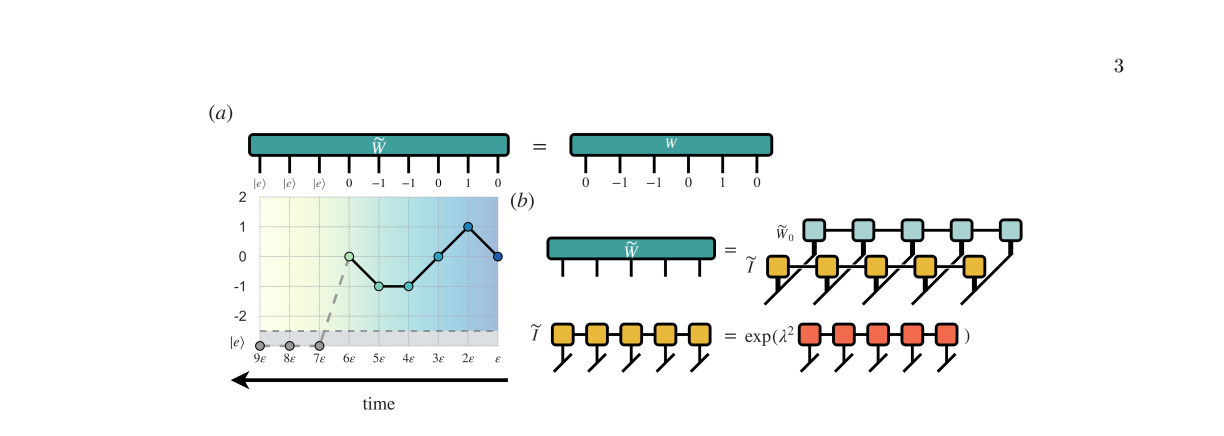
We show that the finite-temperature phonon influence functional can be expressed as the elementwise exponential of a low-rank matrix product state, enabling an efficient summation of electron worldlines. An embedding construction embeds worldlines of different propagation times into a single matrix product state. This construction yields the propagator over the full simulated time interval in a single calculation. We benchmark this approach against available finite-temperature density-matrix renormalization group results for the one-dimensional Holstein polaron. We further obtain numerically converged spectra for the two-dimensional Holstein polaron. The spectra reveal a progressive transfer of spectral weight from coherent spectral features into an incoherent background with increasing temperature.
from the abstract
Pith says
Machine review · deepseek-v4-flash · 21 Oct 2026 · what was read was not recorded · not checked by a person
It can be wrong. Challenge this review or reply to it.
Holds up. A well-executed extension of the process tensor method to finite-temperature polaron spectra, with convincing benchmarks and a clever embedding trick. This line is wrong
1 major objection · 5 minor
How often objections from reviews like this one are right: not yet measured
Not checked: figures, code, what the 64 references say.
The paper says, at Abstract and §I (b34)
The review did not quote this passage.
Pith says: Objection 1 of 1 · major
The paper states that the method is 'free of Hilbert space truncation'. However, the method relies on a finite bond dimension χ for the matrix product state representation of the worldline amplitude, which is itself a truncation of the effective Hilbert space, and also uses a Trotter discretization.
more of objection 1
While the authors demonstrate convergence with χ and ε, the wording 'free of Hilbert space truncation' could be misinterpreted as having no approximation at all. I recommend qualifying this statement to reflect that the only truncations are those of the MPS bond dimension and Trotter step, both of which are controlled and converged in practice.
5 minor objections
The paper says, at §II.C, Eq. (21)
Pith says: minor objection 1 of 5
In the derivation of the Debye-Waller factor, the matrix D is defined as δ_{qq'}/(e^{βω_q} - 1). The paper states that δC_β = z_M^† D z_M penalizes each worldline. It would be helpful to explicitly note that this factor originates from the thermal average over initial coherent states, as the Gaussian integral yields a normalization factor involving the Bose-Einstein distribution. The current presentation is correct but could be made more pedagogical.
The paper says, at §III.A, linear prediction
Pith says: minor objection 2 of 5
The use of linear prediction to extend the time series before Fourier transform is briefly mentioned. The authors should specify the order of the linear prediction and the range of data used for fitting, as the stability of peak positions and heights has been checked but the reader cannot reproduce the procedure without these details.
show 3 more
The paper says, at Fig. 1 caption
Pith says: minor objection 3 of 5
The caption defines the tilde as marking 'embedded quantities' but does not explicitly state that the empty state |e⟩ represents late-time slices beyond the physical worldline. A short explanation in the caption would improve readability.
The paper says, at Appendix A, Eq. (A4)
Pith says: minor objection 4 of 5
The matrix B_{β,V} has dimensions (2N+3)×(2N+3). The entry in the second row, fifth column is written as α^† Dα. It would be clearer to denote this as a scalar (sum over q) rather than a matrix expression, as α is a vector. The current notation is correct but could be simplified for the reader.
The paper says, at References
Pith says: minor objection 5 of 5
Ref. [46] is cited as 'Phys. Rev. B112, 165121 (2025)'. Please verify that this reference is indeed published and provide the full citation details (volume, page, year) consistently. Similarly, Refs. [25] and [26] are listed as arXiv preprints; if they have been published in the meantime, the published version should be cited.
What would settle it
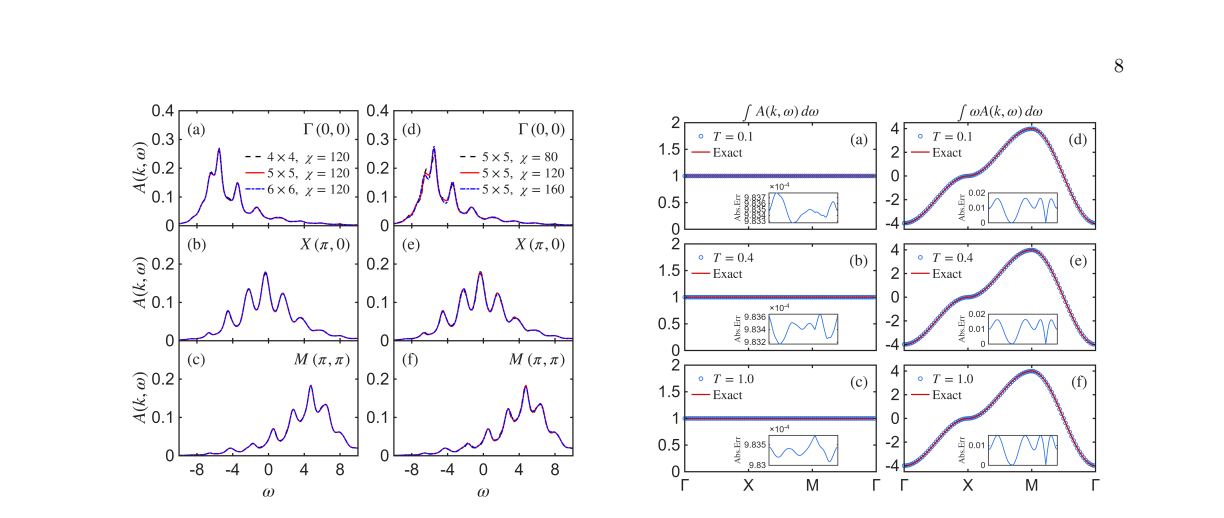
Re-run the 2D Holstein polaron at a different coupling strength (e.g., λ=3, ω0=1, T=0.5) on a 6×6 cluster with χ=120 and χ=160. If the spectral functions at Γ, X, M show changes larger than the level of variation seen in Fig. 4, the claim of robust convergence would need qualification for stronger couplings.
from the skeptic's reading
How the review went
4 readings by deepseek-v4-flash · 21 Oct 2026
- Reader holds up
- Skeptic agrees
- Editor wrote the verdict above
- Referee minor revision: 1 major objection, 5 minor
Not run on this paper: the simulated authors' defence.
Pith did not check this review's objections against the paper.
The review in full
The review in brief, machine-written
This is a solid paper. The authors extend their earlier zero-temperature process tensor approach to finite temperature, which is the natural next step. The main analytic work is the thermal average of the phonon influence functional using coherent states, leading to a Debye-Waller factor. The Carleman linearization to handle the bilinear term is a standard trick but applied cleanly here. The embedding construction that folds all time steps into a single MPS run is neat and cuts the computational cost substantially.
The benchmarks against 1D DMRG data are good—quantitative agreement at k=0, and the differences at k=π are minor and plausibly due to broadening. The 2D results appear converged: system size and bond dimension scans show little change, and sum rules are satisfied to 10−3 and 10−2. That level of internal consistency is reassuring, especially since no external 2D data exist.
The soft spots are the usual ones for tensor-network methods: accuracy depends on bond dimension χ and Trotter step ε. The authors acknowledge this, show convergence for their parameter sets, and note that the errors from Trotterization affect mainly high-energy features. That is honest and proportionate. The claim of being 'numerically exact' is standard in this community—it means the error is controlled and can be reduced systematically. I think that is fine here.
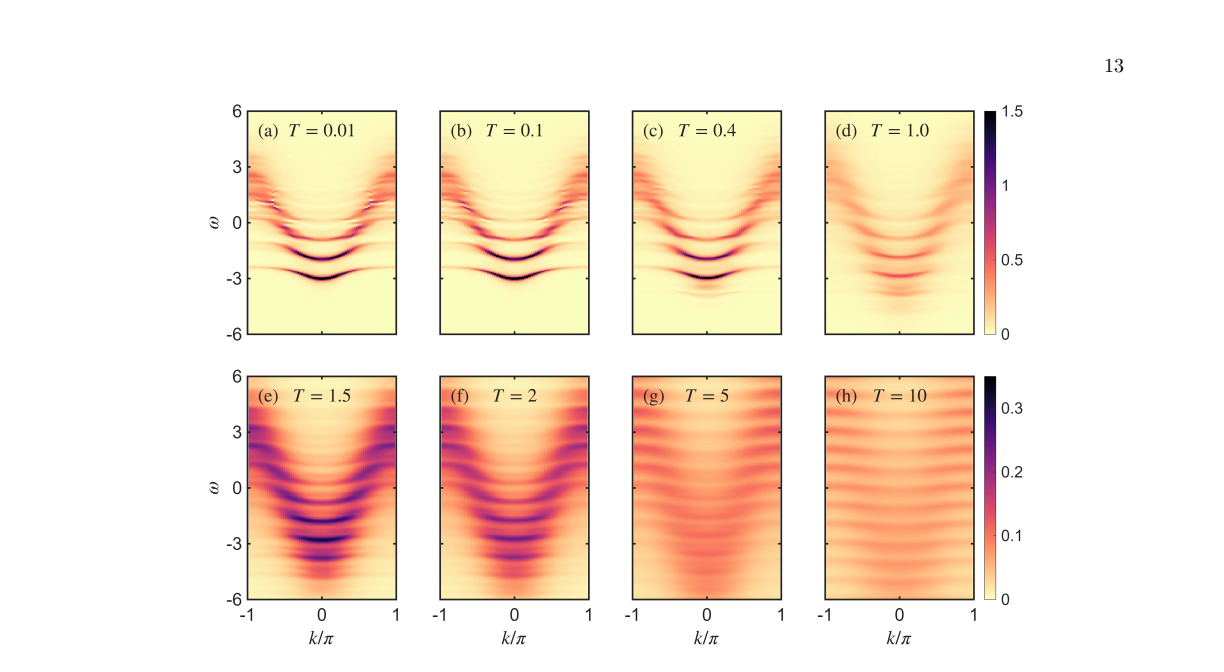
The temperature dependence results (Figs. 6-7) are physically reasonable: progressive loss of coherent weight, thermal satellite peaks, and eventual melt at T ≈ ω₀. The authors do not overinterpret—they note when the quasiparticle peak can no longer be separated.
Who is this for? Polaron theorists and method developers in condensed matter. It will be a useful reference for anyone wanting finite-temperature polaron spectra without analytic continuation.
Recommendation: This paper deserves a serious referee. The method is well-derived, benchmarked, and produces new results. It will be cited. I would accept it for publication after minor revisions (maybe a clearer discussion of the Trotter error quantification).
The strongest objection
The paper presents a well-derived and carefully benchmarked method. The central claim—that the process tensor approach yields numerically exact finite-temperature spectral functions for lattice polarons—is supported by analytical derivations, convergence tests (Fig. 4), sum-rule verification (Fig. 5), and quantitative agreement with 1D DMRG benchmarks (Fig. 3). The remaining concern, that accuracy depends on the MPS bond dimension and Trotter discretization, is explicitly acknowledged by the authors and is common to all tensor-network methods. The paper demonstrates convergence within the tested parameter regimes, and the errors from Trotterization and damping are shown to be small via sum rules. I find no additional load-bearing concern that the original reader did not already capture.
The reader's verdict ACCEPT with HIGH confidence is well-justified. The paper's derivation is sound, the benchmarks are convincing, and the limitations are honestly acknowledged. The weakest assumption—bond dimension convergence—is tested empirically; no hidden assumptions or internal inconsistencies were found. Therefore, no adjustment to the verdict is necessary.
The referee's report
If the claims hold, this work provides a numerically exact route to finite-temperature polaron spectral functions beyond one dimension, a regime where previously available methods were severely limited. The process tensor construction is general and could be extended to other mobile impurity problems. The benchmarks and sum-rule checks give high confidence in the numerical accuracy of the 2D results, which are essentially unavailable from other methods. The physical insights into thermal polaron melting are consistent with expectations from approximate treatments and extend them to higher dimensions.
Pith's reading of the paper (a machine's summary, not the authors')
This paper extends the process tensor method for lattice polarons to finite temperature. The key advance is showing that the finite-temperature phonon influence functional can be expressed as the elementwise exponential of a low-rank matrix product state, enabling efficient summation of electron worldlines without truncating the infinite phonon Hilbert space. An embedding construction allows obtaining the full time dependence of the propagator in a single calculation. The method is benchmarked against existing DMRG results for the one-dimensional Holstein polaron and applied to two dimensions, where it reveals a progressive transfer of spectral weight from coherent features into an incoherent background with increasing temperature, until the quasiparticle picture breaks down when temperature reaches the phonon energy scale.
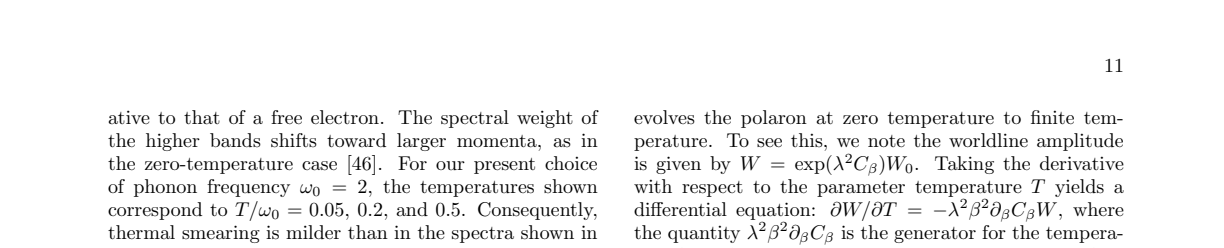
What carries the argument. The key machinery is the representation of the finite-temperature phonon influence functional as the elementwise exponential of a low-rank matrix product state. This is achieved by (1) computing the influence functional analytically in the phonon coherent-state basis, (2) using Carleman linearization to promote the bilinear thermal correction term to a component of an enlarged state vector, and (3) adapting an embedding construction that encodes worldlines of all propagation times into a single matrix product state, enabling the full time dependence to be obtained from one TDVP run. The flow equation in the coupling constant λ², integrated with the time-dependent variational principle, yields the worldline amplitude.
Core claim. The central discovery is that the finite-temperature polaron spectral function can be computed numerically exactly using a process tensor framework without Hilbert space truncation or analytic continuation. The authors show that the thermal average over phonons in the influence functional, when carried out in the coherent-state basis, yields a Debye-Waller factor that is bilinear in the coherent-state amplitudes. Using Carleman linearization, this bilinear term is incorporated into an enlarged matrix product state representation of the worldline amplitude without increasing computational complexity asymptotically. The resulting flow equation in the coupling constant, solved variationally with the time-dependent variational principle, produces the propagator at all times in a single run. The method is applied to the Holstein polaron in one and two dimensions, yielding spectra in quantitative agreement with DMRG in 1D and showing convergence in 2D with respect to system size and bond dimension.
The premise it rests on. The accuracy of the method depends on the bond dimension of the matrix product state used in the variational solution of the flow equation; while convergence is demonstrated for the chosen parameters, it is not guaranteed for all coupling strengths and temperatures, and the Trotter discretization and truncation of electron displacements introduce controlled but unquantified systematic errors.
If the paper is right (Pith's inferences, not the authors')
The method enables numerically exact calculation of finite-temperature polaron spectral functions in two dimensions, previously inaccessible to existing techniques.
The spectra reveal that the quasiparticle peak cannot be reliably separated from thermal features when temperature reaches the phonon energy scale, indicating thermal breakdown of the polaron quasiparticle picture.
The approach can be extended to calculate other dynamical quantities at finite temperature, such as time-dependent electron density profiles and mean-square displacement, using the same process tensor framework.
The embedding construction is a general tensor network technique that can be applied beyond this method, e.g., to study size dependence of nonequilibrium dynamics in spin chains.
The method applies without modification to three-dimensional models, as the derivation is dimension-independent.
The method could be combined with a temperature flow equation, as sketched in the paper, to obtain spectra across a range of temperatures from a single reference calculation, though its numerical convergence remains to be assessed.
The process tensor formulation might be extended to Bose and Fermi polarons by constructing appropriate influence functionals (e.g., using squeezed coherent states for Bose polarons), though fermionic statistics require different treatment.
The ability to compute numerically exact 2D spectra at finite temperature provides a benchmark for approximate methods such as dynamical mean-field theory, cumulant expansions, and momentum-average approximations.
Check this review
Pith stored no record of this review's passes and took no fingerprint of it. Reviews made by code from 13 Nov 2026 on carry both.
How often reviews like this one are right
Reviews like this one: written by deepseek-v4-flash, where what was read was not recorded.
How often objections from reviews like this one are right: not yet measured
Reviews by people
This review was written by a machine. No person has reviewed this paper on Pith yet. A scientist listed on Pith can review it for a fee, and their review is published here whatever it concludes.
The paper
Abstract
We develop a process tensor approach for calculating the finite-temperature spectral functions of lattice polarons. We show that the finite-temperature phonon influence functional can be expressed as the elementwise exponential of a low-rank matrix product state, enabling an efficient summation of electron worldlines. An embedding construction embeds worldlines of different propagation times into a single matrix product state. This construction yields the propagator over the full simulated time interval in a single calculation. We benchmark this approach against available finite-temperature density-matrix renormalization group results for the one-dimensional Holstein polaron. We further obtain numerically converged spectra for the two-dimensional Holstein polaron. The spectra reveal a progressive transfer of spectral weight from coherent spectral features into an incoherent background with increasing temperature.
The paper's own sentences, arranged, kept beside the review and separate from it. Each label is drawn from a closed vocabulary; the number beside it is the probability the classifier gave that label. No sentence in this record was written by a model.
abstract compiled · 2026-10-21
The authors' main claim, as the classifier picked it out 0.90
“The spectra reveal a progressive transfer of spectral weight from coherent spectral features into an incoherent background with increasing temperature.”
How the main claim is stated: asserted 1.00
What the abstract itself states, as probabilities: claims first 0.04 · states limitation 0.08 · human participants 0.01 · controlled comparison 0.38 · randomized assignment 0.01 · states quantitative result 0.07 · compares with prior results 0.97 · mentions code or data availability 0.02
The abstract, sentence by sentence
This table labels the abstract only (arXiv listing abstract v1). The number is the probability the classifier gave the label.
| Sentence | Role | The authors' own work | States the main conclusion | Strength |
|---|---|---|---|---|
| We develop a process tensor approach for calculating the finite-temperature spectral functions of lattice polarons. | contribution 0.95 | 0.96 | 0.10 | asserted 0.99 |
| We show that the finite-temperature phonon influence functional can be expressed as the elementwise exponential of a low-rank matrix product state, enabling an efficient summation of electron worldlines. | method 0.86 | 0.94 | 0.17 | asserted 1.00 |
| An embedding construction embeds worldlines of different propagation times into a single matrix product state. | method 0.97 | 0.90 | 0.06 | asserted 1.00 |
| This construction yields the propagator over the full simulated time interval in a single calculation. | method 0.77 | 0.92 | 0.10 | asserted 1.00 |
| We benchmark this approach against available finite-temperature density-matrix renormalization group results for the one-dimensional Holstein polaron. | method 0.75 | 0.93 | 0.05 | asserted 1.00 |
| We further obtain numerically converged spectra for the two-dimensional Holstein polaron. | result 0.56 | 0.96 | 0.12 | asserted 1.00 |
| The spectra reveal a progressive transfer of spectral weight from coherent spectral features into an incoherent background with increasing temperature. | result 0.65 | 0.95 | 0.57 | asserted 1.00 |
What kind of paper the classifier reports this is: method or tool 1.00 · evidence from simulation or computation 1.00
What was examined, and what was not
Sources read
- arXiv listing abstract v1
Not examined
- full text
- figures and tables
- references and citing sentences
- relations to other papers
Levels run
- P abstract
Not run
- S sections
- T body sentences
- C citations
- R cross-paper relations
How the labels were made
Compiled by classifier-1.13.0 via TypeSafe API, question bank abstract-p1-20260923, 2026-10-21: 1 request, 5,471 input tokens.
Every quoted sentence on this record is the authors'. Every label is from Pith's closed vocabulary, with the probability shown beside it. This record as JSON
Figures (8)



Showing 7 of the paper's 8 figures. Figures are the authors', reproduced from the paper.
References (64)
- [1] J. M. Ziman,Electrons and Phonons: The Theory of Transport Phenomena in Solids, International Series of Monographs on Physics (Clarendon Press, Oxford, 1960) on Pith
- [2] J. L. M. van Mechelen, D. van der Marel, C. Grimaldi, A. B. Kuzmenko, N. P. Armitage, N. Reyren, H. Hage- mann, and I. I. Mazin, Electron-phonon interaction and charge carrier mass enhancement in SrTiO 3, Phys. Rev. Lett.100, 226403 (2008) on Pith
- [3] S. Moser, L. Moreschini, J. Ja´ cimovi´ c, O. S. Bariˇ si´ c, H. Berger, A. Magrez, Y. J. Chang, K. S. Kim, A. Bost- wick, E. Rotenberg, L. Forr´ o, and M. Grioni, Tunable polaronic conduction in anatase TiO 2, Phys. Rev. Lett. 110, 196403 (2013) on Pith
- [4] C. Verdi, F. Caruso, and F. Giustino, Origin of the crossover from polarons to Fermi liquids in transition metal oxides, Nat. Commun.8, 15769 (2017) on Pith
- [5] J. L. Br´ edas and G. B. Street, Polarons, bipolarons, and solitons in conducting polymers, Acc. Chem. Res.18, 309 (1985) on Pith
- [6] I. N. Hulea, S. Fratini, H. Xie, C. L. Mulder, N. N. Ios- sad, G. Rastelli, S. Ciuchi, and A. F. Morpurgo, Tun- able Fr¨ ohlich polarons in organic single-crystal transis- tors, Nat. Mater.5, 982 (2006) on Pith
- [7] J. H. Fetherolf, D. Goleˇ z, and T. C. Berkelbach, A unifi- cation of the Holstein polaron and dynamic disorder pic- tures of charge transport in organic crystals, Phys. Rev. X10, 021062 (2020). 14 on Pith
- [8] A. D. Wright, C. Verdi, R. L. Milot, G. E. Eperon, M. A. P´ erez-Osorio, H. J. Snaith, F. Giustino, M. B. Johnston, and L. M. Herz, Electron–phonon coupling in hybrid lead halide perovskites, Nat. Commun.7, 11755 (2016) on Pith
- [9] L. M. Herz, Charge-carrier mobilities in metal halide per- ovskites: Fundamental mechanisms and limits, ACS En- ergy Lett.2, 1539 (2017) on Pith
- [10] K. Miyata, D. Meggiolaro, M. T. Trinh, P. P. Joshi, E. Mosconi, S. C. Jones, F. De Angelis, and X.-Y. Zhu, Large polarons in lead halide perovskites, Sci. Adv.3, e1701217 (2017) on Pith
- [11] D. Ghosh, E. Welch, A. J. Neukirch, A. Zakhidov, and S. Tretiak, Polarons in halide perovskites: A perspective, J. Phys. Chem. Lett.11, 3271 (2020) on Pith
- [12] C. Franchini, M. Reticcioli, M. Setvin, and U. Diebold, Polarons in materials, Nat. Rev. Mater.6, 560 (2021) on Pith
- [13] L. D. Landau, Electron motion in crystal lattices, in Collected Papers of L. D. Landau, edited by D. ter Haar (Pergamon, 1965) pp. 67–68, originally published in Phys. Z. Sowjetunion 3, 664 (1933) on Pith
- [14] H. Fr¨ ohlich, Electrons in lattice fields, Adv. Phys.3, 325 (1954) on Pith
- [15] T. Holstein, Studies of polaron motion: Part I. the molecular-crystal model, Ann. Phys. (N.Y.)8, 325 (1959) on Pith
- [16] A. S. Alexandrov and J. T. Devreese,Advances in Po- laron Physics, Springer Series in Solid-State Sciences, Vol. 159 (Springer Berlin Heidelberg, 2010) on Pith
- [17] A. Damascelli, Z. Hussain, and Z.-X. Shen, Angle- resolved photoemission studies of the cuprate supercon- ductors, Rev. Mod. Phys.75, 473 (2003) on Pith
- [18] Z. Wang, S. McKeown Walker, A. Tamai, Y. Wang, Z. Ristic, F. Y. Bruno, A. de la Torre, S. Ricc` o, N. C. Plumb, M. Shi, P. Hlawenka, J. S´ anchez-Barriga, A. Varykhalov, T. K. Kim, M. Hoesch, P. D. C. King, W. Meevasana, U. Diebold, J. Mesot, B. Moritz, T. P. Devereaux, M. Rad... on Pith
- [19] M. Kang, S. W. Jung, W. J. Shin, Y. Sohn, S. H. Ryu, T. K. Kim, M. Hoesch, and K. S. Kim, Holstein polaron in a valley-degenerate two-dimensional semiconductor, Nat. Mater.17, 676 (2018) on Pith
- [20] J. A. Sobota, Y. He, and Z.-X. Shen, Angle-resolved photoemission studies of quantum materials, Rev. Mod. Phys.93, 025006 (2021) on Pith
show 44 more
- [21] E. Jeckelmann and S. R. White, Density-matrix renormalization-group study of the polaron problem in the Holstein model, Phys. Rev. B57, 6376 (1998) on Pith
- [22] N. V. Prokof’ev and B. V. Svistunov, Polaron problem by diagrammatic quantum monte carlo, Phys. Rev. Lett. 81, 2514 (1998) on Pith
- [23] T. Holstein, Studies of polaron motion: Part II. the “small” polaron, Ann. Phys. (N.Y.)8, 343 (1959) on Pith
- [24] J. Bonˇ ca, S. A. Trugman, and M. Berciu, Spectral func- tion of the Holstein polaron at finite temperature, Phys. Rev. B100, 094307 (2019) on Pith
- [25] J. Shannigrahi, J. Bonˇ ca, and M. Berciu, Univer- sal thermal breakdown of polaron coherence in one, two, and three dimensions, arXiv preprint (2026), arXiv:2608.18529 [cond-mat.str-el] on PithPith's reviewarXiv
- [26] M. R. Carbone, S. Fomichev, B. Kloss, A. J. Mil- lis, M. Berciu, D. R. Reichman, and J. Sous, Finite- temperature Green’s function cluster expansion from thermofield doubles: Breakdown of the polaron picture, arXiv preprint (2026), arXiv:2608.18267 [cond-mat.str- el] on PithPith's reviewarXiv
- [27] E. V. L. de Mello and J. Ranninger, Dynamical properties of small polarons, Phys. Rev. B55, 14872 (1997) on Pith
- [28] S. Paganelli and S. Ciuchi, Tunnelling system coupled to a harmonic oscillator: an analytical treatment, J. Phys.: Condens. Matter18, 7669 (2006) on Pith
- [29] L. Chen and Y. Zhao, Finite temperature dynamics of a Holstein polaron: The thermo-field dynamics approach, J. Chem. Phys.147, 214102 (2017) on Pith
- [30] J. Jakliˇ c and P. Prelovˇ sek, Lanczos method for the calcu- lation of finite-temperature quantities in correlated sys- tems, Phys. Rev. B49, 5065 (1994) on Pith
- [31] J. Bonˇ ca, S. A. Trugman, and I. Batisti´ c, Holstein po- laron, Phys. Rev. B60, 1633 (1999) on Pith
- [32] D. Jansen, J. Bonˇ ca, and F. Heidrich-Meisner, Finite- temperature density-matrix renormalization group method for electron-phonon systems: Thermodynamics and Holstein-polaron spectral functions, Phys. Rev. B 102, 165155 (2020) on Pith
- [33] C. Zhang, E. Jeckelmann, and S. R. White, Density ma- trix approach to local hilbert space reduction, Phys. Rev. Lett.80, 2661 (1998) on Pith
- [34] V. Jankovi´ c and N. Vukmirovi´ c, Spectral and thermody- namic properties of the Holstein polaron: Hierarchical equations of motion approach, Phys. Rev. B105, 054311 (2022) on Pith
- [35] A. S. Mishchenko, N. Nagaosa, G. De Filippis, A. de Can- dia, and V. Cataudella, Mobility of Holstein polaron at finite temperature: An unbiased approach, Phys. Rev. Lett.114, 146401 (2015) on Pith
- [36] S. Ciuchi, F. de Pasquale, S. Fratini, and D. Feinberg, Dynamical mean-field theory of the small polaron, Phys. Rev. B56, 4494 (1997) on Pith
- [37] P. Mitri´ c, V. Jankovi´ c, N. Vukmirovi´ c, and D. Tanaskovi´ c, Spectral functions of the Holstein polaron: Exact and approximate solutions, Phys. Rev. Lett.129, 096401 (2022) on Pith
- [38] P. J. Robinson, I. S. Dunn, and D. R. Reichman, Cumu- lant methods for electron-phonon problems. I. perturba- tive expansions, Phys. Rev. B105, 224304 (2022) on Pith
- [39] P. J. Robinson, I. S. Dunn, and D. R. Reichman, Cu- mulant methods for electron-phonon problems. II. the self-consistent cumulant expansion, Phys. Rev. B105, 224305 (2022) on Pith
- [40] P. Mitri´ c, V. Jankovi´ c, N. Vukmirovi´ c, and D. Tanaskovi´ c, Cumulant expansion in the Holstein model: Spectral functions and mobility, Phys. Rev. B 107, 125165 (2023) on Pith
- [41] H. Nguyen, A. Mandal, A. Mahajan, and D. R. Reich- man, Mixed quantum-classical methods for polaron spec- tral functions, J. Chem. Phys.163, 114105 (2025) on Pith
- [42] M. Berciu, Green’s function of a dressed particle, Phys. Rev. Lett.97, 036402 (2006) on Pith
- [43] M. Berciu and G. L. Goodvin, Systematic improvement of the momentum average approximation for the Green’s function of a Holstein polaron, Phys. Rev. B76, 165109 (2007) on Pith
- [44] M. R. Carbone, D. R. Reichman, and J. Sous, Numer- ically exact generalized Green’s function cluster expan- sions for electron-phonon problems, Phys. Rev. B104, 035106 (2021). 15 on Pith
- [45] H. Wu, M. K. A. Baumgarten, T. Jiang, and J. Lee, Delocalized coupled-cluster theory for polaron structure and dynamics, arXiv preprint (2026), arXiv:2608.04979 [cond-mat.mtrl-sci] on PithPith's reviewarXiv
- [46] Q. Gao and Y. Wan, Summing real time Feynman paths of lattice polarons with matrix product states, Phys. Rev. B112, 165121 (2025) on Pith
- [47] R. P. Feynman, Slow electrons in a polar crystal, Phys. Rev.97, 660 (1955) on Pith
- [48] J. Keeling, E. M. Stoudenmire, M.-C. Ba˜ nuls, and D. R. Reichman, Process tensor approaches to non-markovian quantum dynamics, Phys. Rev. X16, 020502 (2026) on Pith
- [49] V. Link, H.-H. Tu, and W. T. Strunz, Open quantum sys- tem dynamics from infinite tensor network contraction, Phys. Rev. Lett.132, 200403 (2024) on Pith
- [50] D. J. J. Marchand and M. Berciu, Effect of dispersive optical phonons on the behavior of a Holstein polaron, Phys. Rev. B88, 060301 (2013) on Pith
- [51] F. Wegner, Flow-equations for Hamiltonians, Ann. Phys. (Berlin)506, 77 (1994) on Pith
- [52] J. Haegeman, J. I. Cirac, T. J. Osborne, I. Piˇ zorn, H. Ver- schelde, and F. Verstraete, Time-dependent variational principle for quantum lattices, Phys. Rev. Lett.107, 070601 (2011) on Pith
- [53] J. Haegeman, C. Lubich, I. Oseledets, B. Vandereycken, and F. Verstraete, Unifying time evolution and optimiza- tion with matrix product states, Phys. Rev. B94, 165116 (2016) on Pith
- [54] T. Carleman, Application de la th´ eorie des ´ equations int´ egrales lin´ eaires aux syst` emes d’´ equations diff´ erentielles non lin´ eaires, Acta Math.59, 63 (1932) on Pith
- [55] S. R. White and I. Affleck, Spectral function for theS= 1 Heisenberg antiferromagetic chain, Phys. Rev. B77, 134437 (2008) on Pith
- [56] T. Barthel, U. Schollw¨ ock, and S. R. White, Spectral functions in one-dimensional quantum systems at finite temperature using the density matrix renormalization group, Phys. Rev. B79, 245101 (2009) on Pith
- [57] P. E. Kornilovitch, Photoemission spectroscopy and sum rules in dilute electron-phonon systems, Europhys. Lett. 59, 735 (2002) on Pith
- [58] M. Newville, R. Otten, A. Nelson, T. Stensitzki, A. Ingar- giola, D. Allan, A. Fox, F. Carter, and M. Rawlik, LM- FIT: Non-linear least-squares minimization and curve- fitting for Python, Zenodo (2025), version 1.3.4 on Pith
- [59] A. Strathearn, P. Kirton, D. Kilda, J. Keeling, and B. W. Lovett, Efficient non-markovian quantum dynamics using time-evolving matrix product operators, Nat. Commun. 9, 3322 (2018) on Pith
- [60] M. R. Jørgensen and F. A. Pollock, Exploiting the causal tensor network structure of quantum processes to ef- ficiently simulate non-markovian path integrals, Phys. Rev. Lett.123, 240602 (2019) on Pith
- [61] F. Grusdt, N. Mostaan, E. Demler, and L. A. Pe˜ na Ardila, Impurities and polarons in bosonic quan- tum gases: a review on recent progress, Rep. Prog. Phys. 88, 066401 (2025) on Pith
- [62] P. Massignan, M. Zaccanti, and G. M. Bruun, Polarons, dressed molecules and itinerant ferromagnetism in ultra- cold Fermi gases, Rep. Prog. Phys.77, 034401 (2014) on Pith
- [63] A. Bohrdt, L. Homeier, C. Reinmoser, E. Demler, and F. Grusdt, Exploration of doped quantum magnets with ultracold atoms, Ann. Phys. (N.Y.)435, 168651 (2021) on Pith
- [64] Y. N´ u˜ nez Fern´ andez, M. K. Ritter, M. Jeannin, J.-W. Li, T. Kloss, T. Louvet, S. Terasaki, O. Parcollet, J. von Delft, H. Shinaoka, and X. Waintal, Learning tensor net- works with tensor cross interpolation: New algorithms and libraries, SciPost Phys.18, 104 (2025) on Pith
Challenges and discussion
Disagree with the review, or know something it missed? Leave a comment, or challenge this review formally: a challenge becomes a permanent entry in this paper's record, and its decision is published here.
Come back by email
A short list of the week's newly reviewed papers. Nothing is sent until you confirm from your inbox, and every email has a link that stops it. No account.
No comments yet.
Sign in to comment