Computation and Language · arXiv:2608.19437 v1 · submitted 19 Aug 2026 · 41 references
Are LLMs becoming similarly creative? Evidence from three years of models
The paper says
“Many benchmarks track Large Language Model (LLM) performance on tasks with verifiable answers, but less is known about how LLM performance is evolving on open-ended tasks, where creativity, originality and diversity may matter as much as quality.”
more of the abstract
As LLMs increasingly support human ideation and creative work, understanding trends in LLM performance on open-ended tasks is critical. This paper presents a preliminary analysis of LLM creative outputs spanning three years of model releases, examining model responses to Infinity-Chat100, a real-world collection of open-ended user queries, and the Alternate Uses Task, an established psychometric creativity assessment. Using sentence-embedding similarity, we examine trends in LLM responses to these prompts. Our findings show a statistically significant decrease in model output diversity over time, suggesting that LLM outputs may be converging in creative substance across models. If this trend persists, LLM-driven homogenization may progressively diminish human agency in human-AI co-creative work, demanding careful consideration of LLMs' role in the human creative process.
from the abstract
Pith says
Machine review · deepseek-v4-flash · 27 Aug 2026 · what was read was not recorded · not checked by a person
It can be wrong. Challenge this review or reply to it.
Holds up, with conditions. First longitudinal evidence of cross-provider semantic convergence in LLM creative outputs, but the trend's interpretation is undermined by an uncontrolled length/format confound and fragile inference. This line is wrong
3 major objections · 6 minor
How often objections from reviews like this one are right: not yet measured
Not checked: figures, code, what the 41 references say.
The paper says, at §4 Results / Table 1 / Figure 2
The review did not quote this passage.
Pith says: Objection 1 of 3 · major
The central claim that LLM responses are becoming 'less creative' or 'converging in creative substance' rests on the untested equivalence between cosine distance in all-MiniLM-L6-v2 embedding space and creative diversity. all-MiniLM-L6-v2 uses mean pooling over token embeddings, so the direction of the pooled vector depends on the full token distribution, including length- and format-related tokens; longer or more stylistically standardized responses could systematically reduce pairwise distances even if the underlying ideas are no more similar.
more of objection 1
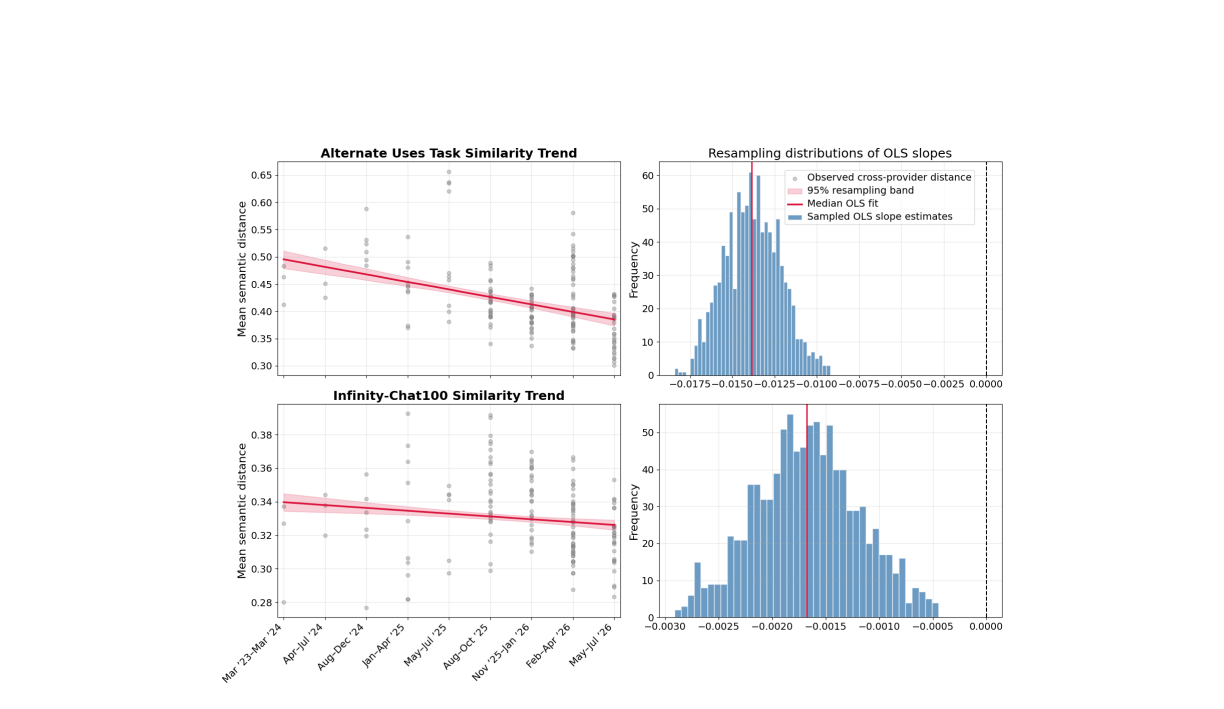
The AUT mean distance falls from approximately 0.50 to below 0.40 (Figure 2), and no analysis rules out a length or formatting artifact of this magnitude. The paper's own Future Work section (Section 5) lists 'response length constraints' as a needed robustness check, confirming that this threat is unresolved. I request a length-controlled analysis: report mean response length per bin, include length as a covariate, repeat the analysis with responses truncated to a common token budget, and compare the embedding-based distances with a lexical diversity measure such as Jaccard overlap or type-token ratio. Without such a check, the negative slope could be an artifact of changing verbosity or formatting conventions rather than a decline in creative diversity.
This objection may describe the copy Pith gave the reviewer, not the paper.
The paper says, at §3 Regression specification
The review did not quote this passage.
Pith says: Objection 2 of 3 · major
The unit of analysis is the model pair, but each model appears in many pairs within its release bin, so the observations are not independent. The ordinary least squares confidence intervals and the resampling intervals from family-balanced resampling do not account for this clustering: the resampling addresses unequal family representation, not the within-model correlation across pairs.
more of objection 2
This affects the statistical significance claim in Table 1. Please report cluster-robust standard errors with clustering by model (or a mixed-effects model with random intercepts for models), so that the interval widths reflect the effective number of independent model-level observations.
The paper says, at §3 Compute embeddings and semantic distances; §4 Results
The review did not quote this passage.
Pith says: Objection 3 of 3 · major
Only a single response at temperature 1.0 is generated per model per prompt, and the pairwise mean distance is computed from those single draws. The Limitations section acknowledges this, but the magnitude of the resulting sampling noise is not quantified.
more of objection 3
Because the Infinity-Chat slope is very small (-0.00167 per bin), it is important to show that the trend is not driven by one lucky or unlucky draw per model. I suggest repeated sampling (e.g., 5–10 generations per model per prompt) and re-estimating the slope distribution, or at least a variance decomposition of within-model versus between-model distance. This would clarify whether the observed convergence is a property of the output distributions or an artifact of undersampling them.
6 minor objections
The paper says, at §3 Model coverage
Pith says: minor objection 1 of 6
The paper states that 68 models were used and that the sample covers '33 closed weight models and 34 open weight models', but 33 + 34 = 67, and Appendix A, Table A1 says 'All 69 models'. Please reconcile these counts.
The paper says, at Appendix A, Table A1
Pith says: minor objection 2 of 6
Table A1 appears to have misaligned columns: several rows (e.g., minimax/minimax-010 and minimax/minimax-m16) show only three numeric entries for four numeric columns, and the Infinity-Chat100 missing column is blank for some rows. Please fix the table formatting.
show 4 more
The paper says, at §3 Regression specification
Pith says: minor objection 3 of 6
The slopes are reported per ordinal release bin, not per calendar unit, and the bins have unequal calendar durations because some months contain multiple releases while others contain none. Please state explicitly that the coefficient is per bin rather than per month or year, or transform the time variable to months so readers can compare rates across studies.
The paper says, at References
Pith says: minor objection 4 of 6
References [8] and [31] appear to be the same paper (Wang, Huang, Shen, and Uzzi, Nature Human Behaviour); please deduplicate or clarify why both are cited.
The paper says, at Throughout
Pith says: minor objection 5 of 6
The dataset name is written as 'Infinity-Chat100' in most of the paper but as 'InfinityChat' in Section 5's Limitations paragraph; please standardize the spelling.
The paper says, at Figure 2
Pith says: minor objection 6 of 6
Figure 2 would benefit from explicit panel labels (AUT versus Infinity-Chat) and a caption statement clarifying that the shaded bands are pointwise 95% intervals from the resampled regression lines, not confidence bands for the binned means.
What would settle it
Recompute the Table 1 slopes after: (1) measuring mean response length per bin and regressing it on bin index; (2) recomputing distances on length-controlled responses—e.g., truncating every response to its first 200 tokens and stripping bullet/numbering/header formatting—and also with a second, independently trained embedding model (all-mpnet-base-v2) and with TF-IDF over content words. If the AUT or Infinity-Chat slopes become non-significant, or shrink by more than 30% relative to the reported -0.01385 and -0.00167, the convergence claim cannot be attributed to creative substance without further support.
from the skeptic's reading
How the review went
4 readings by deepseek-v4-flash · 27 Aug 2026
- Reader holds up, with conditions
- Skeptic partly agrees
- Editor wrote the verdict above
- Referee major revision: 3 major objections, 6 minor
Not run on this paper: the simulated authors' defence.
Pith did not check this review's objections against the paper.
The review in full
The review in brief, machine-written
Two things to know. First, this is the first study I've seen that tracks LLM creative output diversity over time rather than just taking a snapshot; that framing is genuinely useful, and the negative slope survives a sensible family-balanced resampling. Second, don't take the "less creative" interpretation at face value: the embedding-based distance measure is untested against length and formatting shifts, and the statistical inference ignores the clustering structure of pairs.
What's new: prior work (Doshi & Hauser, Wenger & Kenett, Jiang et al.) is static. This paper collects responses from 68 models over three years on two prompt sets, computes cross-family cosine distances, and regresses them on time bins. The AUT slope is -0.01385 per bin, with all 1000 resamples negative; Infinity-Chat shows the same pattern but shallower. That is a real empirical pattern worth explaining.
What it does well: the data collection is substantial and transparent, the limitations section names most of the threats, and the family-balanced resampling is a reasonable step against confounded family representation. The paper is honest that this is preliminary.
Soft spots, in order of importance. The length/format confound is the one that could overturn the point estimate, not just widen the error bars. all-MiniLM-L6-v2 mean-pools token embeddings, so longer, more standardized responses from newer models could shrink cosine distances without any change in substantive diversity. The paper mentions response length constraints in future work rather than testing them; that should have been a robustness check. Second, the regression treats pairwise observations as independent even though each model appears in many pairs; the resampling addresses family composition but not this clustering, so the confidence intervals are likely too narrow. Third, a single response per model per prompt gives a point estimate, not a distribution; repeated sampling would strengthen the claim. Fourth, there is no human baseline, so "declining diversity" is relative to other LLMs, not to humans.
The stress-test note is right: the length confound is plausible and unaddressed, and the paper's own future-work list concedes as much. That does not make the pattern fake—the convergence could be real—but it means the headline claim is not yet fully supported by this analysis.
Who it's for: researchers working on algorithmic monoculture, human-AI co-creativity, and LLM evaluation methodology. It deserves a serious referee: the question is timely, and the data collection is non-trivial. The referee should push for a length-controlled analysis, clustered inference, and repeated sampling.
Recommendation: engage with it, but require those robustness analyses before accepting the interpretation.
The strongest objection
The central claim—that LLM responses have become increasingly similar in 'creative substance'—rests on the equivalence between cosine distance in all-MiniLM-L6-v2 embedding space and semantic diversity. This equivalence is untested against a concrete confound: response length and formatting. all-MiniLM-L6-v2 uses mean pooling over token embeddings, so vectors are systematically affected by document length; longer, more verbose responses (which plausibly increase across model generations) tend to share a length-induced direction, shrinking pairwise distances even when the underlying ideas are no more similar. The AUT slope of -0.01385 per bin corresponds to a fall from ~0.50 to ~0.40 in mean distance; a length/format artifact of this size is plausible. The paper reports no response-length trends and does not implement the 'response length constraints' robustness check it lists in Future Work (Section 5). The family-balanced resampling controls for model-family composition in the regression (Section 3), but it does not control for what the embedding measures. Other threats (non-independent pairs, single-response sampling) influence the uncertainty around the trend; this one can overturn the point estimate itself.
The reader's weakest assumption (embedding validity) is correct, and I sharpen it: the most damaging, testable version is the length/format confound. The metric is the sole operationalization of 'creative substance'; if it shrinks because responses have become longer or more uniformly formatted, then the slopes—-0.01385 and -0.00167, with all 1,000 resamplings negative—still measure something real (textual convergence) but not the creative convergence the abstract and key findings assert. This is not merely a concern about statistical inference: the non-independence and single-response issues affect CIs and would not change the direction of the point estimate; a length-driven embedding artifact could explain away the entire effect. The paper's own Limitations section acknowledges the possibility of stylistic confounds and Future Work lists 'response length constraints,' but no such analysis is reported. The concrete test settles the matter: if the negative slope survives length control and a second embedding method, the central claim is materially supported; if it does not, the headline interpretation must be weakened. I therefore keep the reader's CONDITIONAL verdict, pending that test.
The referee's report
If the finding is correct, it addresses a real gap: most benchmarks track verifiable performance, while longitudinal trends in the diversity of LLM outputs on open-ended tasks are largely unstudied. The paper's strengths are its cross-provider design, the use of two complementary prompt sets, the family-balanced resampling that addresses unequal family representation, the supplementary OLS diagnostics in the appendix, and the candid statement of limitations. The result would be relevant to the growing literature on algorithmic monoculture and to discussions of human-AI co-creativity. However, the central measurement assumption—that all-MiniLM-L6-v2 cosine distance is a valid proxy for creative diversity—is not validated, and the statistical inference treats non-independent pairwise observations as independent. These issues are load-bearing for the paper's central claim, so the result should be treated as preliminary until they are addressed.
Pith's reading of the paper (a machine's summary, not the authors')
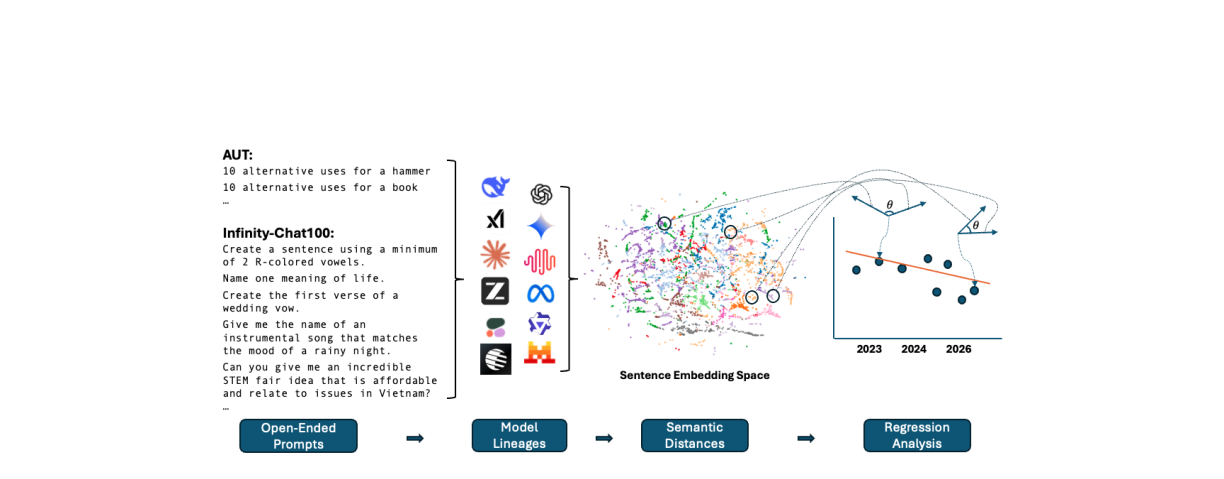
The paper argues that large language models have become less diverse in their responses to open-ended, creativity-heavy prompts between March 2023 and July 2026. Across 68 models from 12 providers, responses to the Alternate Uses Task and to 100 real-world user queries were embedded and compared, and the cosine distance between cross-provider pairs fell as release date advanced. The slope is negative in every one of 1,000 family-balanced resampling runs, with the strongest drop on the Alternate Uses Task, where originality is explicitly requested. If this trend holds, users who rely on different frontier models for ideation would receive increasingly similar suggestions, narrowing the idea space that human-AI co-creation can explore. The paper presents this as a preliminary result and a framework for tracking the trend.
What carries the argument. The measurement instrument is the cross-family cosine distance in sentence-embedding space. Each model's response to a prompt is embedded with the all-MiniLM-L6-v2 sentence transformer; for each pair of models from different providers in the same release bin, the mean cosine distance across prompts (10 for AUT, 100 for Infinity-Chat100) is the observation. A linear regression of this mean distance on the ordinal release-bin index yields the temporal slope. The Alternate Uses Task, a psychometric test in which participants generate unconventional uses for common objects, provides the controlled divergent-thinking setting, while Infinity-Chat100 provides a heterogeneous set of real-world open-ended requests. Comparing only cross-provider pairs removes within-family confounds, and family-balanced resampling down-weights providers with many models.
Core claim. On the paper's own terms, the discovery is that cross-family semantic distance between model responses to identical open-ended prompts declines over time: the Alternate Uses Task slope is $\beta = -0.01385$ per release bin with a 95% confidence interval of $[-0.01695, -0.01044]$, and the Infinity-Chat100 slope is $\beta = -0.00167$ with a 95% confidence interval of $[-0.00267, -0.00074]$, with all 1,000 resampling iterations producing negative slopes. Mean AUT distance falls from roughly 0.50 in the earliest release bin to below 0.40 in the most recent. The authors interpret this as evidence of decreasing diversity, or increasing homogeneity, of LLM creative outputs over time. They are careful to frame the trend as an association with the bundle of changes that define successive model generations, not as a causal effect of time itself.
The premise it rests on. The whole result depends on treating cosine distance between MiniLM embeddings of single responses as a faithful measure of creative diversity; if that distance mostly tracks response length, formatting, or the embedding model's own biases, the negative slope may reflect stylistic standardization rather than a genuine narrowing of creative substance.
If the paper is right (Pith's inferences, not the authors')
If the trend extends, future generations of models from different providers will offer increasingly interchangeable suggestions on open-ended creative tasks, reducing the value of 'ask several models' workflows.
The AUT result is the sharpest: even when explicitly instructed to produce original and unexpected uses, later models converge; a task designed to pull outputs apart no longer separates them.
Conversational assistants that support brainstorming and ideation would become less able to expose users to diverse possibilities, potentially narrowing the range of ideas human users encounter.
Because the comparison is cross-provider, the convergence cannot be explained by a single lab's training choices; it points to shared data, shared objectives, or distillation across the field.
The paper does not test this, but a natural next step is to sample multiple responses per model per prompt; if within-model diversity is stable while cross-model distance declines, the homogenization is an inter-model property rather than a sign of individual models collapsing to a single mode.
The paper's release bins each contain three monthly timestamps, so the reported slope is per release cohort, not per calendar year; converting the slope to a per-year rate would make the magnitude directly comparable across future studies.
The same measurement pipeline could be applied to non-text creative domains such as code generation, image captioning, or scientific hypothesis suggestion, testing whether convergence is a general property of foundation models or specific to text ideation.
Because the embedding model is fixed and static, the observed trend could partly reflect how MiniLM compresses novel phrasing; re-running the analysis with a newer embedding model or human semantic judgments would check whether the convergence is visible outside the chosen geometric representation.
Check this review
Pith stored no record of this review's passes and took no fingerprint of it. Reviews made by code from 13 Nov 2026 on carry both.
How often reviews like this one are right
Reviews like this one: written by deepseek-v4-flash, where what was read was not recorded.
How often objections from reviews like this one are right: not yet measured
Reviews by people
This review was written by a machine. No person has reviewed this paper on Pith yet. A scientist listed on Pith can review it for a fee, and their review is published here whatever it concludes.
The paper
Abstract
Many benchmarks track Large Language Model (LLM) performance on tasks with verifiable answers, but less is known about how LLM performance is evolving on open-ended tasks, where creativity, originality and diversity may matter as much as quality. As LLMs increasingly support human ideation and creative work, understanding trends in LLM performance on open-ended tasks is critical. This paper presents a preliminary analysis of LLM creative outputs spanning three years of model releases, examining model responses to Infinity-Chat100, a real-world collection of open-ended user queries, and the Alternate Uses Task, an established psychometric creativity assessment. Using sentence-embedding similarity, we examine trends in LLM responses to these prompts. Our findings show a statistically significant decrease in model output diversity over time, suggesting that LLM outputs may be converging in creative substance across models. If this trend persists, LLM-driven homogenization may progressively diminish human agency in human-AI co-creative work, demanding careful consideration of LLMs' role in the human creative process.
The paper's own sentences, arranged, kept beside the review and separate from it. Each label is drawn from a closed vocabulary; the number beside it is the probability the classifier gave that label. No sentence in this record was written by a model.
abstract compiled · 2026-09-23
The authors' main claim, as the classifier picked it out 1.00
“Our findings show a statistically significant decrease in model output diversity over time, suggesting that LLM outputs may be converging in creative substance across models.”
How the main claim is stated: hedged possibility 0.70
What the abstract itself states, as probabilities: claims first 0.05 · states limitation 0.64 · human participants 0.16 · controlled comparison 0.09 · randomized assignment 0.01 · states quantitative result 0.32 · compares with prior results 0.17 · mentions code or data availability 0.03
The abstract, sentence by sentence
This table labels the abstract only (arXiv listing abstract v1). The number is the probability the classifier gave the label.
| Sentence | Role | The authors' own work | States the main conclusion | Strength |
|---|---|---|---|---|
| Many benchmarks track Large Language Model (LLM) performance on tasks with verifiable answers, but less is known about how LLM performance is evolving on open-ended tasks, where creativity, originality and diversity may matter as much as quality. | gap 0.88 | 0.06 | 0.02 | asserted 0.76 |
| As LLMs increasingly support human ideation and creative work, understanding trends in LLM performance on open-ended tasks is critical. | background 0.95 | 0.04 | 0.02 | asserted 0.91 |
| This paper presents a preliminary analysis of LLM creative outputs spanning three years of model releases, examining model responses to Infinity-Chat100, a real-world collection of open-ended user queries, and the Alternate Uses Task, an established psychometric creativity assessment. | contribution 0.99 | 0.93 | 0.04 | asserted 0.96 |
| Using sentence-embedding similarity, we examine trends in LLM responses to these prompts. | method 1.00 | 0.93 | 0.02 | asserted 0.93 |
| Our findings show a statistically significant decrease in model output diversity over time, suggesting that LLM outputs may be converging in creative substance across models. | result 0.98 | 0.97 | 0.91 | hedged possibility 0.70 |
| If this trend persists, LLM-driven homogenization may progressively diminish human agency in human-AI co-creative work, demanding careful consideration of LLMs' role in the human creative process. | interpretation 0.99 | 0.06 | 0.13 | hedged possibility 0.98 |
What kind of paper the classifier reports this is: empirical study 1.00 · evidence from analysis of existing data 0.63
What was examined, and what was not
Sources read
- arXiv listing abstract v1
Not examined
- full text
- figures and tables
- references and citing sentences
- relations to other papers
Levels run
- P abstract
Not run
- S sections
- T body sentences
- C citations
- R cross-paper relations
How the labels were made
Compiled by classifier-1.13.0 via TypeSafe API, question bank abstract-p1-20260923, 2026-09-23: 1 request, 5,036 input tokens.
Every quoted sentence on this record is the authors'. Every label is from Pith's closed vocabulary, with the probability shown beside it. This record as JSON
Figures (2)
Figures are the authors', reproduced from the paper.
References (41)
- [1] Aaron Chatterji, Thomas Cunningham, David J. Deming, Zoe Hitzig, Christopher Ong, Carl Yan Shan, and Kevin Wadman. How people use chatgpt. Working Paper 34255, National Bureau of Economic Research, September 2025 on Pith
- [2] Eduardo Baptista. A year on from DeepSeek shock, get set for flurry of low-cost Chinese AI models. https://www.reuters.com/world/china/ year-deepseek-shock-get-set-flurry-low-cost-chinese-ai-models-2026-02-12/ , February 2026. Reuters. Accessed: 2026-06-26 on Pith
- [3] Anthropic. Anthropic economic index report: Uneven geographic and enterprise ai adoption. https://www.anthropic.com/research/ anthropic-economic-index-september-2025-report , September 2025. Accessed: 2026-06-26 on Pith
- [4] Alex Tamkin, Miles McCain, Kunal Handa, Esin Durmus, Liane Lovitt, Ankur Rathi, Saffron Huang, Alfred Mountfield, Jerry Hong, Stuart Ritchie, Michael Stern, Brian Clarke, Landon Goldberg, Theodore R. Sumers, Jared Mueller, William McEachen, Wes Mitchell, Shan Carter, Jack Clar... on PithPith's reviewarXiv
- [5] Anil R Doshi and Oliver P Hauser. Generative ai enhances individual creativity but reduces the collective diversity of novel content.Science advances, 10(28):eadn5290, 2024 on Pith
- [6] Liwei Jiang, Yuanjun Chai, Margaret Li, Mickel Liu, Raymond Fok, Nouha Dziri, Yulia Tsvetkov, Maarten Sap, Alon Albalak, and Yejin Choi. Artificial hivemind: The open-ended homogeneity of language models (and beyond), 2025. NeurIPS 2025 Datasets and Benchmarks Track oral on Pith
- [7] Emily Wenger and Yoed N. Kenett. Large language models are homogeneously creative.PNAS Nexus, 5(3):pgag042, March 2026 on Pith
- [9] Antoine Bellemare-Pepin, François Lespinasse, Philipp Thölke, Yann Harel, Kory Mathewson, Jay A. Olson, Yoshua Bengio, and Karim Jerbi. Divergent creativity in humans and large language models.Scientific Reports, 16:1279, 2026 on Pith
- [10] Fan Wu, Emily Black, and Varun Chandrasekaran. Generative monoculture in large language models. InInternational Conference on Learning Representations, volume 2025, pages 33068– 33107, 2025 on Pith
- [11] Jon Kleinberg and Manish Raghavan. Algorithmic monoculture and social welfare.Proceedings of the National Academy of Sciences, 118(22):e2018340118, June 2021 on Pith
- [12] Ilia Shumailov, Zakhar Shumaylov, Yiren Zhao, Yarin Gal, Nicolas Papernot, and Ross Ander- son. The Curse of Recursion: Training on Generated Data Makes Models Forget, May 2023. arXiv:2305.17493 [cs] on PithPith's reviewarXiv
- [13] Minyoung Huh, Brian Cheung, Tongzhou Wang, and Phillip Isola. The platonic representation hypothesis.arXiv preprint arXiv:2405.07987, 2024 on PithPith's reviewarXiv
- [14] Hung Vu, Galen Reeves, and Emily Wenger. What happens when generative ai models train recursively on each others’ outputs? InInternational Conference on Learning Representations, volume 2026, pages 142067–142086, 2026 on Pith
- [15] Peter West and Christopher Potts. Base Models Beat Aligned Models at Randomness and Creativity, April 2025. arXiv:2505.00047 [cs] on PithPith's reviewarXiv
- [16] Shomik Jain, Jack Lanchantin, Maximilian Nickel, Karen Ullrich, Ashia Wilson, and Jamelle Watson-Daniels. LLM Output Homogenization is Task Dependent, September 2025. arXiv:2509.21267 [cs]. 7 on PithPith's reviewarXiv
- [17] Dan Hendrycks, Collin Burns, Steven Basart, Andy Zou, Mantas Mazeika, Dawn Song, and Jacob Steinhardt. Measuring massive multitask language understanding.arXiv preprint arXiv:2009.03300, 2020 on PithPith's reviewarXiv
- [18] Rishi Bommasani, Drew A. Hudson, Ehsan Adeli, Russ Altman, Simran Arora, Sydney von Arx, Michael S. Bernstein, Jeannette Bohg, Antoine Bosselut, Emma Brunskill, Erik Brynjolfsson, S. Buch, Dallas Card, Rodrigo Castellon, Niladri S. Chatterji, Annie S. Chen, Kathleen A. Creel, ... on Pith
- [19] Carlos E Jimenez, John Yang, Alexander Wettig, Shunyu Yao, Kexin Pei, Ofir Press, and Karthik R Narasimhan. SWE-bench: Can language models resolve real-world github issues? In The Twelfth International Conference on Learning Representations, 2024 on Pith
- [20] Center for AI Safety, Scale AI, and HLE Contributors Consortium. A benchmark of expert-level academic questions to assess AI capabilities.Nature, 649:1139–1146, 2026 on Pith
- [21] Joy Paul Guilford, Paul R Christensen, Philip R Merrifield, and Robert C Wilson. Alternate uses, 1978 on Pith
show 21 more
- [22] Ellis Paul Torrance.Torrance test of creative thinking. Scholastic Testing Service, Inc., 1966 on Pith
- [23] Yunpu Zhao, Rui Zhang, Wenyi Li, and Ling Li. Assessing and understanding creativity in large language models.Machine Intelligence Research, 22(3):417–436, 2025 on Pith
- [24] Kumiko Nakajima, Jan Zuiderveld, and Sandro Pezzelle. Beyond divergent creativity: A human- based evaluation of creativity in large language models.arXiv preprint arXiv:2601.20546, 2026 on PitharXiv
- [25] Tuhin Chakrabarty, Philippe Laban, Divyansh Agarwal, Smaranda Muresan, and Chien-Sheng Wu. Art or artifice? large language models and the false promise of creativity. InProceedings of the 2024 CHI Conference on Human Factors in Computing Systems, pages 1–34, 2024 on Pith
- [26] Yufei Tian, Abhilasha Ravichander, Lianhui Qin, Ronan Le Bras, Raja Marjieh, Nanyun Peng, Yejin Choi, Thomas L Griffiths, and Faeze Brahman. Macgyver: Are large language models creative problem solvers? InProceedings of the 2024 Conference of the North American Chapter of the ... on Pith
- [27] Kai Ruan, Xuan Wang, Jixiang Hong, Peng Wang, Yang Liu, and Hao Sun. Evaluating llms’ divergent thinking capabilities for scientific idea generation with minimal context.Nature communications, 2026 on Pith
- [28] Massimo Stella, Thomas T Hills, and Yoed N Kenett. Using cognitive psychology to understand gpt-like models needs to extend beyond human biases.Proceedings of the National Academy of Sciences, 120(43):e2312911120, 2023. 8 on Pith
- [29] Jay A. Olson, Johnny Nahas, Denis Chmoulevitch, Simon J. Cropper, and Margaret E. Webb. Naming unrelated words predicts creativity.Proceedings of the National Academy of Sciences, 118(25):e2022340118, June 2021 on Pith
- [30] Kent F Hubert, Kim N Awa, and Darya L Zabelina. The current state of artificial intelligence generative language models is more creative than humans on divergent thinking tasks.Scientific reports, 14(1):3440, 2024 on Pith
- [31] Dawei Wang, Difang Huang, Haipeng Shen, and Brian Uzzi. A large-scale comparison of divergent creativity in humans and large language models.Nature Human Behaviour, 10(3):531– 540, 2026 on Pith
- [32] Mete Ismayilzada, Claire Stevenson, and Lonneke van der Plas. Evaluating creative short story generation in humans and large language models, 2025 on Pith
- [33] Weijia Xu, Nebojsa Jojic, Sudha Rao, Chris Brockett, and Bill Dolan. Echoes in ai: Quanti- fying lack of plot diversity in llm outputs.Proceedings of the National Academy of Sciences, 122(35):e2504966122, 2025 on Pith
- [34] Zhaoyi Joey Hou, Bowei Alvin Zhang, Yining Lu, Bhiman Kumar Baghel, Anneliese Brei, Ximing Lu, Meng Jiang, Faeze Brahman, Snigdha Chaturvedi, Haw-Shiuan Chang, Daniel Khashabi, and Xiang Lorraine Li. Creativityprism: A holistic evaluation framework for large language model cre... on Pith
- [35] Daniel Fein, Sebastian Russo, Violet Xiang, Kabir Jolly, Rafael Rafailov, and Nick Haber. Litbench: A benchmark and dataset for reliable evaluation of creative writing. InProceedings of the 19th Conference of the European Chapter of the Association for Computational Linguistic... on Pith
- [36] Ziliang Qiu and Renfen Hu. Deep associations, high creativity: A simple yet effective metric for evaluating large language models. InProceedings of the 2025 Conference on Empirical Methods in Natural Language Processing, pages 10870–10883, 2025 on Pith
- [37] Nataliya Kosmyna, Eugene Hauptmann, Ye Tong Yuan, Jessica Situ, Xian-Hao Liao, Ashly Vi- vian Beresnitzky, Iris Braunstein, and Pattie Maes. Your Brain on ChatGPT: Accumulation of Cognitive Debt when Using an AI Assistant for Essay Writing Task, December 2025. arXiv:2506.08872 [cs.AI] on PithPith's reviewarXiv
- [38] Barrett R Anderson, Jash Hemant Shah, and Max Kreminski. Homogenization effects of large language models on human creative ideation. InCreativity and Cognition, page 413–425. ACM, June 2024 on Pith
- [39] Open AI. Model Distillation in the API, 2024. https://openai.com/index/ api-model-distillation/ on Pith
- [40] Anthropic. Detecting and preventing distillation attacks, 2026. https://www.anthropic. com/news/detecting-and-preventing-distillation-attacks on Pith
- [41] Marek Urban, Jiˇrí Lukavsk`y, Cyril Brom, Veronika Hein, Filip Svacha, Filip Dˇechtˇerenko, and Kamila Urban. Prompting for creative problem-solving: A process-mining study.Learning and Instruction, 99:102156, 2025 on Pith
- [42] Nathanael Jo and Manish Raghavan. Incentives shape how humans co-create with generative AI, April 2026. arXiv:2604.03529 [cs.HC]. 9 A Appendix Model coverage details.Figure A1 shows all the models used in our analysis along with their public release dates. Data coverage detail... on PithPith's reviewarXiv
Cited by 2 Pith papers
Reviewed papers on Pith that cite this one. The full citation record
- Revisiting LLM Homogeneity Through a Multidimensional Lens cs.CL · Nov 2026
- Reinforcing Agentic Creativity in Scientific Ideation with Night Science cs.AI · Sep 2026
How the literature uses it
What this paper does with the arXiv papers it cites
What it cites · 15 sentences without a confident label
Uses the method or tool of 1 paper
-
Our analysis combines the Alternate Uses Tasks' [ref] assessment of divergent thinking with open-ended prompts from Infinity-Chat100 [ref] , which span six categories of real-world use, from creative content generation and alternative styles of writing, to information seeking, brainstorming and ideation.
Artificial Hivemind: The Open-Ended Homogeneity of Language Models (and Beyond) · Introduction · 0.95
Uses data or values from 1 paper
-
They were drawn from Infinity-Chat [ref] , a large dataset of real-world user interactions with language models, and span creative content generation, problem-solving, brainstorming, ideation, and other open-ended requests.
Artificial Hivemind: The Open-Ended Homogeneity of Language Models (and Beyond) · Methodology · 0.93
Cites as support 1 paper
-
Across real-world open-ended queries, models exhibit both intra-model repetition and inter-model convergence [ref] .
Artificial Hivemind: The Open-Ended Homogeneity of Language Models (and Beyond) · Introduction · 0.98
Challenges and discussion
Disagree with the review, or know something it missed? Leave a comment, or challenge this review formally: a challenge becomes a permanent entry in this paper's record, and its decision is published here.
Come back by email
A short list of the week's newly reviewed papers. Nothing is sent until you confirm from your inbox, and every email has a link that stops it. No account.
No comments yet.
Sign in to comment