Quantum Physics · arXiv:2608.20603 v1 · submitted 20 Aug 2026 · 6 references
Scaling Behavior of Parameterized Quantum Circuits from a Lie-Algebraic Perspective
The paper says
“Understanding how the performance of parameterized quantum circuits scales with available resources is important for characterizing their trainability and effective model capacity.”
more of the abstract
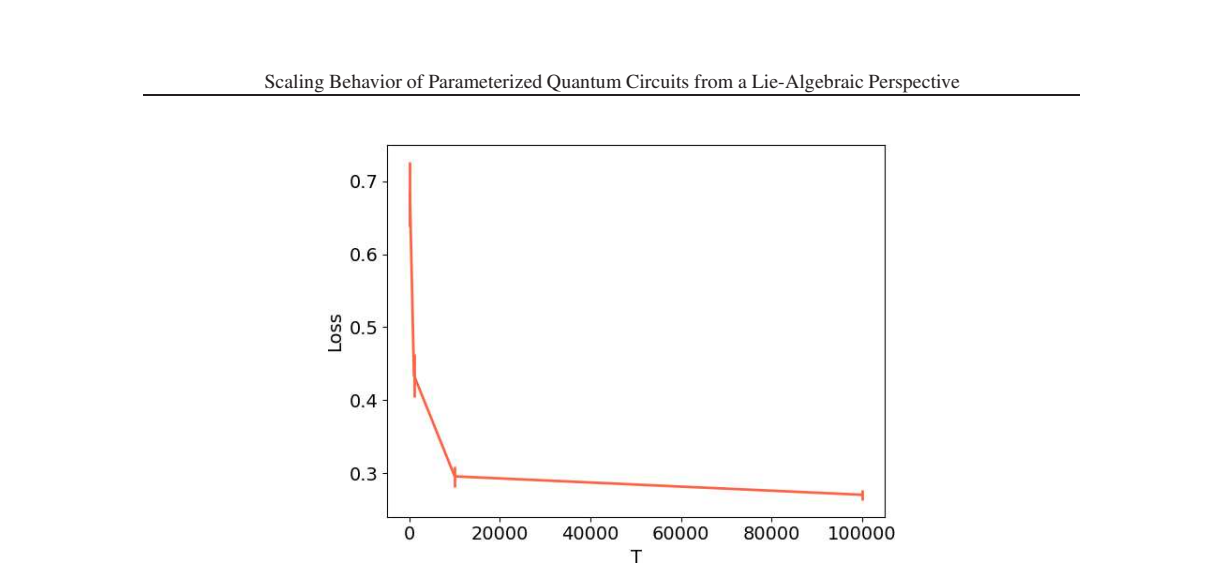
In this study, we numerically investigate data scaling, model scaling, and compute scaling in parameterized quantum circuits and examine Lie-algebraic quantities as alternative measures of model size. In addition to the number of circuit parameters, we consider the dimension of the dynamical Lie algebra, the observable-orbit dimension, and a Jacobian effective dimension defined as the rank of the Jacobian of the parameterized observable orbit. Using a regression task with randomly generated Pauli-string generators, we observe decreasing loss with increasing training dataset size, parameter size, and number of optimization iterations over the ranges investigated. For model scaling, the dynamical Lie algebra and observable orbit dimensions rapidly saturate as the parameter size increases, whereas the Jacobian effective dimension remains strongly correlated with the parameter size and exhibits comparable scaling behavior. These results suggest that the Jacobian effective dimension provides a geometry-aware measure of the locally accessible observable degrees of freedom of finite-depth parameterized quantum circuits and may serve as a useful scaling parameter beyond the nominal parameter size.
from the abstract
Pith says
Machine review · deepseek-v4-flash · 27 Aug 2026 · what was read was not recorded · not checked by a person
It can be wrong. Challenge this review or reply to it.
Holds up, with conditions. A clean but small numerical study whose abstract overclaims: Deff is essentially P in the tested regime, so 'beyond nominal parameter size' is unsupported. This line is wrong
3 major objections · 4 minor
How often objections from reviews like this one are right: not yet measured
Not checked: figures, code, what the 6 references say.
The paper says, at Abstract; Section 3, Fig. 4c
The review did not quote this passage.
Pith says: Objection 1 of 3 · major
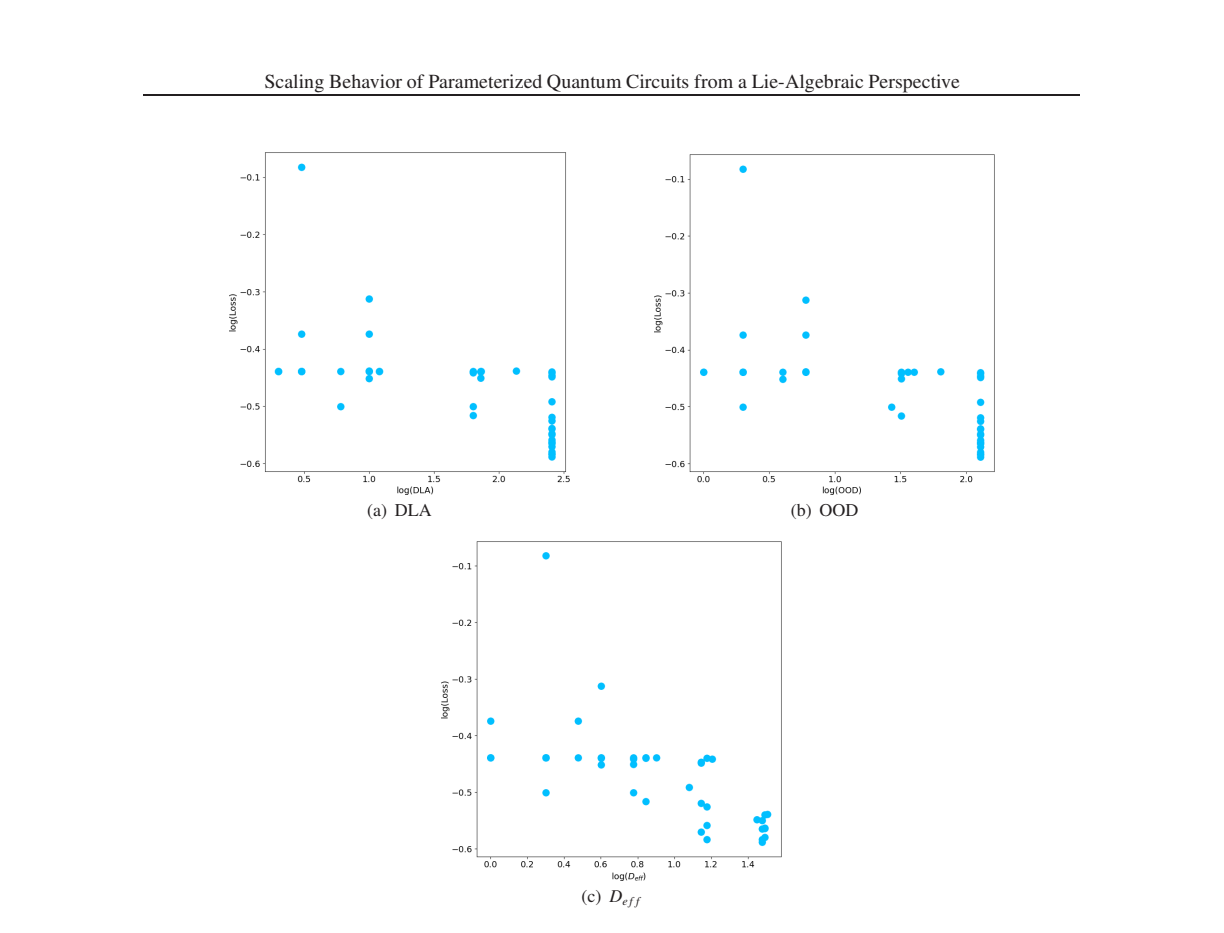
The claim that Deff is a scaling parameter 'beyond the nominal parameter size' is not supported by the data because Deff is nearly collinear with P (Pearson correlation 0.9997 over P in {2,4,8,16,32}) and its fitted slope (-0.12573) is statistically close to that of P (-0.13463).
more of objection 1
With only five values of P, the loss-versus-Deff plot in Fig. 4c is essentially a relabeled loss-versus-P plot with a linearly transformed horizontal axis; it cannot demonstrate that Deff provides additional predictive information. To support the 'beyond' claim, the paper would need to compare architectures with the same P but different Deff, or otherwise show that Deff explains variance in loss not captured by P.
The paper says, at Eq. (4); Section 4
The review did not quote this passage.
Pith says: Objection 2 of 3 · major
Deff is evaluated at a single post-training vector θ, and the paper does not test whether this point is representative across initializations or training trajectories. Section 4 explicitly lists studying the evolution of Deff during training as future work. If Deff varies substantially along the SPSA trajectory, the fitted loss-versus-Deff law may be an artifact of the terminal point and may conflate model scaling with compute scaling.
more of objection 2
This endpoint dependence is a load-bearing gap for the interpretation of Deff as an intrinsic capacity measure.
The paper says, at Section 3: data, model, and compute scaling fits
The review did not quote this passage.
Pith says: Objection 3 of 3 · major
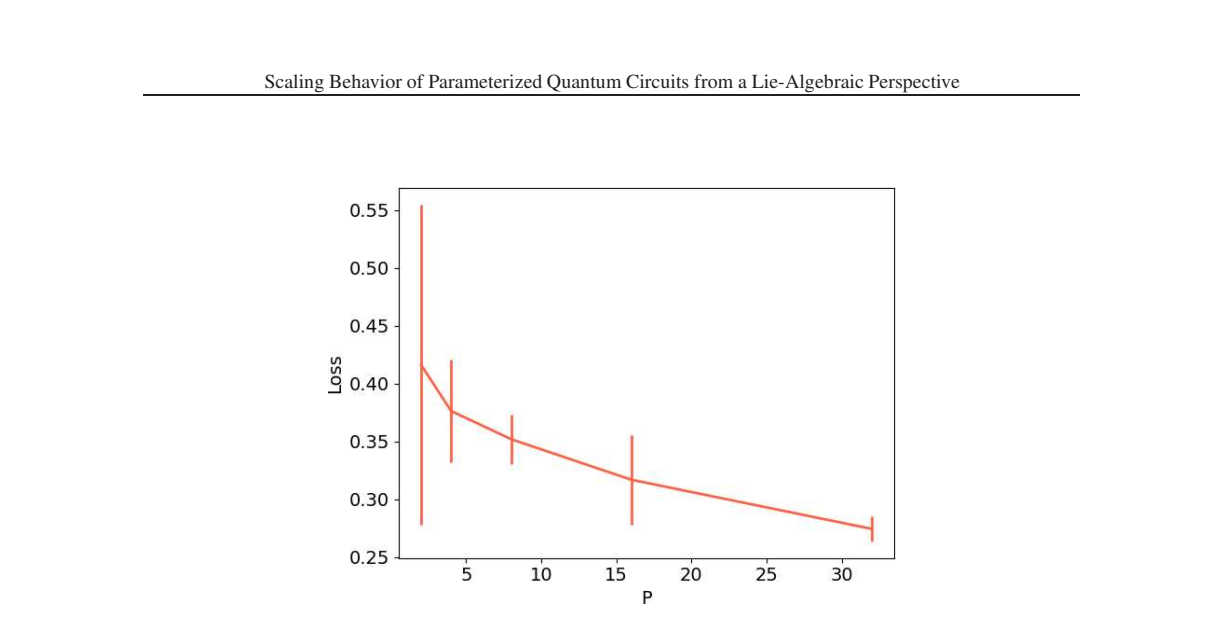
Each scaling law is fitted from only four to five points, and the reported p-values are based on repeated seeds rather than on the quality of the power-law fit itself. For example, the model-scaling fit uses P ∈ {2,4,8,16,32}, and the compute-scaling fit uses T ∈ {100,1000,10000,100000}, without assessing whether a power law is favored over alternative functional forms.
more of objection 3
The paper acknowledges this in Section 4, but the abstract's 'scaling behavior' language is stronger than the evidence warrants given the small number of points and the acknowledged saturation of DLA and OOD.
4 minor objections
The paper says, at Figure 4
Pith says: minor objection 1 of 4
The axes of the log-log plots in Figure 4 are not labeled, so the reader must infer which quantity is plotted on each axis from the caption and the text; adding explicit axis labels would improve readability.
The paper says, at Section 3, data scaling
Pith says: minor objection 2 of 4
For the smallest dataset size M=100, the batch size B=1000 exceeds the dataset size, meaning the optimizer effectively uses full-batch gradients; this detail should be stated explicitly because it affects the interpretation of the data-scaling curve at small M.
show 2 more
The paper says, at Section 4
Pith says: minor objection 3 of 4
The speculative paragraph about prospective quantum large language models and repetitive architectures is not connected to the numerical results and reads as an advertisement rather than a technical outlook; it should be removed or substantially trimmed.
The paper says, at Section 2, Eq. (4)
Pith says: minor objection 4 of 4
The notation U(θ)†OU(θ) in Eq. (4) should be defined more carefully: it is a function of θ whose Jacobian is computed, and the manuscript would benefit from explicitly stating that the rank is taken as a numerical rank with a specified tolerance, since exact rank determination is ill-conditioned in finite precision.
What would settle it
Construct two ansatz families with identical P and training budget but different generator content, e.g. (A) generators drawn with replacement from a small commuting set (low Deff) and (B) generic noncommuting Pauli-string generators (high Deff), for P = 8 and 16 at n = 4. Train both on the same regression task with matched M = 1000, B = 100, T = 5000, and record loss versus P and versus Deff. If loss is better predicted by Deff than by P across the two families, the beyond-P claim is supported; if loss tracks P and not Deff, the claim is refuted. In the same runs, evaluate Eq. (4) at initialization, at T/2, and at T to test whether the single post-training point in Section 3 is representative.
from the skeptic's reading
How the review went
4 readings by deepseek-v4-flash · 27 Aug 2026
- Reader holds up, with conditions
- Skeptic partly agrees
- Editor wrote the verdict above
- Referee major revision: 3 major objections, 4 minor
Not run on this paper: the simulated authors' defence.
Pith did not check this review's objections against the paper.
The review in full
The review in brief, machine-written
The paper is a clean, small numerical study of data, model, and compute scaling for random Pauli parameterized quantum circuits in a regression task. It tests three geometry-aware alternatives to parameter count — DLA dimension, observable-orbit dimension, and a Jacobian effective dimension Deff — and compares their utility as scaling variables. That comparison is new enough, and the paper is honest enough, that I'd send it to a referee. But the abstract's central claim doesn't survive contact with the paper's own numbers.
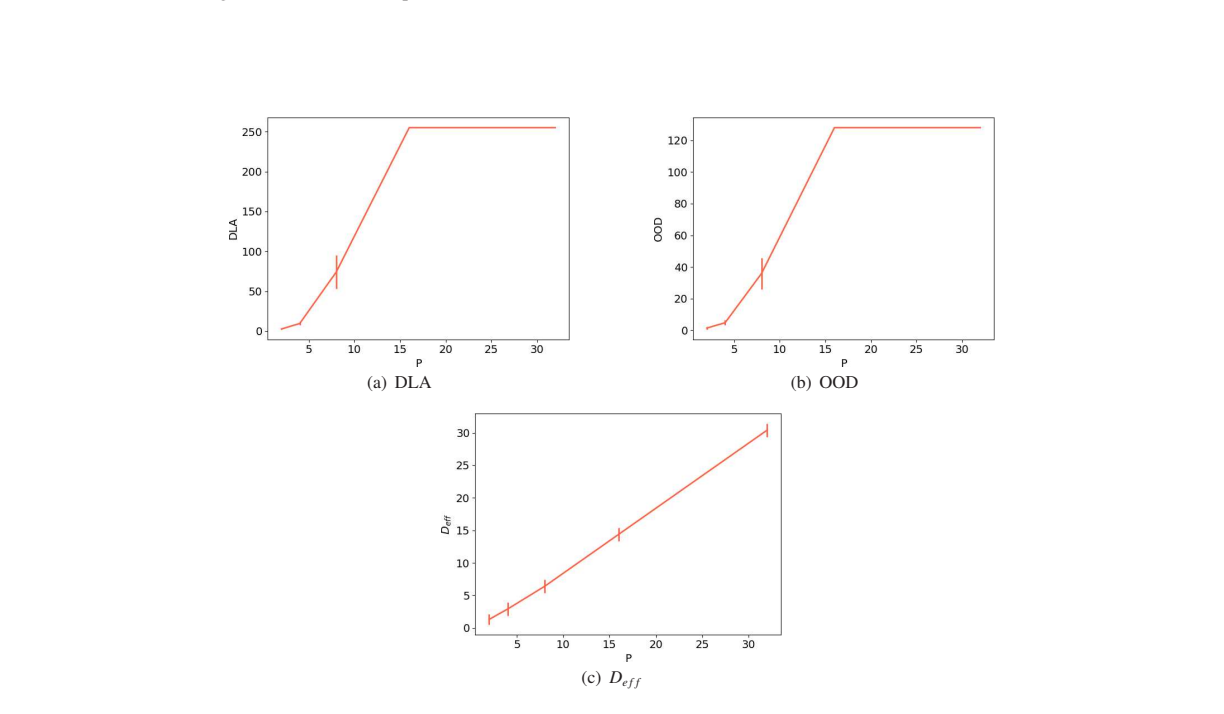
Deff is the rank of the Jacobian of the parameterized observable orbit. Over the tested parameter sizes P = 2, 4, 8, 16, 32, Deff correlates with P at 0.9997, and the fitted loss-scaling exponents are -0.12573 and -0.13463. Those are effectively the same line. So the loss-vs-Deff plot in Fig. 4c is loss-vs-P with a relabeled axis. The sentence 'may serve as a useful scaling parameter beyond the nominal parameter size' is an extrapolation no experiment in the paper supports. There are no same-P architectures with different Deff, which is the minimal test that would establish Deff carries independent information.
What the paper does well: DLA and OOD saturating at 255 and 128 clearly shows why global Lie-algebraic quantities fail as scaling variables in this regime, and the paper correctly says the fitted slopes there are hard to interpret. The data and compute scaling results look plausible, with p-values and standard deviations over ten seeds, though each fit uses only four or five points. The limitations section is explicit that Deff evolution during training is untested — a real gap, since Deff is evaluated at a single post-training theta and the reported law could be an endpoint artifact. No code or data is provided, so reproducing the numbers is not straightforward.
If I were refereeing, I'd ask for two things: remove or soften the 'beyond' claim unless new data support it, and add experiments where P is fixed and Deff varies (e.g., different ansatz architectures or generator subsets). The citation pattern is fine. As written, this is a reasonable mostly-negative result about DLA/OOD and a near-tautology about Deff. It deserves peer review, but with major revision.
The strongest objection
The central contribution is that Deff is not just a re-parametrization of P but a geometry-aware capacity measure 'beyond the nominal parameter size.' The reported facts point the other way: in Section 3, model scaling gives Deff a Pearson correlation of 0.9997 with P and a fitted slope -0.12573 vs -0.13463 for P; these are statistically indistinguishable in practice. Because P and Deff are nearly collinear over P in {2,4,8,16,32}, the loss-versus-Deff plot in Fig. 4c cannot demonstrate any added information; it is essentially the loss-versus-P plot with a linearly transformed axis. The abstract's 'beyond' wording is therefore an extrapolation not supported by any experiment in the paper, and no same-P architectures with different Deff are studied. Second, Eq. (4) defines Deff at the trained theta, but the paper does not compare initialization with post-training values; Sec. 4 explicitly lists this as future work ('it will be useful to study the evolution of Deff during training'). If Deff varies along the SPSA trajectory, the fitted loss-versus-Deff law may be an artifact of the terminal point and could conflate model and compute scaling. These two gaps make the central claim conditional rather than established.
The reader's CONDITIONAL verdict is the right one, and my stress-test does not move it. The strongest load-bearing concern is not an internal inconsistency but an unsupported novelty claim: the paper's own numbers show Deff is nearly perfectly collinear with P (0.9997) and has a comparable scaling slope, so the data do not demonstrate any utility beyond the nominal parameter count. This is reinforced by the paper's own admitted limitation that Deff is only evaluated at one post-training theta, leaving open whether the scaling relation is an artifact of the training endpoint. The same-P/different-Deff experiment and checkpointing of Eq. (4) would settle both questions. The lack of code and data is a reproducibility weakness but secondary to the conceptual gap; the statistical fits and the saturation of DLA/OOD are plausibly correct. Overall, the paper establishes Deff as a candidate measure but not as a demonstrated improvement over P, so the verdict remains CONDITIONAL.
The referee's report
If the Deff scaling claim were established, it would offer a principled geometric alternative to parameter count for finite-depth parameterized quantum circuits, potentially connecting Lie-algebraic expressivity to empirical scaling behavior. The study is carefully executed within a narrow setting: it uses repeated runs, reports standard deviations and p-values, and explicitly acknowledges the saturation of DLA and OOD. The numerical pipeline (SPSA, random Pauli generators, linear regression) is clearly described and appears reproducible. However, the central interpretive claim—that Deff carries information beyond P—is not supported by the reported data, and the single-post-training-point evaluation of Deff leaves an important confound unexplored. The paper's strength lies in its systematic documentation of scaling trends for this particular ansatz, but the headline result is currently conditional.
Pith's reading of the paper (a machine's summary, not the authors')
This paper asks which measure of model size predicts how the test loss of a parameterized quantum circuit falls as the circuit is scaled up. In numerical regression experiments with randomly generated Pauli-string generators on four and eight qubits, loss decreases with training sample size, parameter count, and SPSA iterations over the ranges studied. Among Lie-algebraic alternatives, the dynamical Lie algebra dimension and observable-orbit dimension saturate quickly, while the Jacobian effective dimension $D_{\rm eff}$, defined as the rank of the observable-orbit Jacobian at the trained parameters, remains strongly correlated with parameter count and yields a nearly identical loss-scaling exponent. The paper concludes that $D_{\rm eff}$ is a geometry-aware measure of the locally accessible directions of the observable orbit and may serve as a scaling parameter beyond the nominal parameter size.
What carries the argument. The object carrying the argument is the Jacobian effective dimension, $D_{\rm eff} = \mathrm{rank}\left[\partial \mathrm{vec}(U^\dagger O U)/\partial\theta_1, \ldots, \partial \mathrm{vec}(U^\dagger O U)/\partial\theta_P \right]$, evaluated at the trained parameter vector. It counts the number of linearly independent directions in the vectorized observable orbit generated by infinitesimal changes of the circuit parameters. The comparison that does the work is that DLA and OOD measure the whole Lie-group orbit and therefore saturate when the ansatz becomes controllable, while $D_{\rm eff}$ is a local quantity that remains sensitive to the finite depth of the ansatz and to parameter count.
Core claim. On the paper's own terms, the discovery is that in a random-Pauli ansatz the global Lie-algebraic dimensions stop being informative as scaling parameters: DLA saturates at $\dim \mathfrak{su}(16)=255$ and OOD at 128 once P reaches 16-32, so plotting loss against them produces flat curves whose slopes cannot be read as genuine exponents. In contrast, $D_{\rm eff}$ evaluated after training grows with P with a Pearson correlation of 0.9997 and gives a loss-scaling slope of $-0.12573$, close to the $-0.13463$ obtained with P itself. The author interprets $D_{\rm eff}$ as the number of observable directions that a finite-depth circuit can actually move in at a given parameter point, making it a geometry-aware measure of effective model size rather than a purely nominal resource count.
The premise it rests on. The results rest on the assumption that the Jacobian rank computed at a single post-training parameter vector represents the circuit's effective capacity across training trajectories and initializations; if $D_{\rm eff}$ changes substantially during training or depends on where optimization stops, the loss-versus-$D_{\rm eff}$ plots would reflect the training endpoint rather than an intrinsic scaling law.
If the paper is right (Pith's inferences, not the authors')
If $D_{\rm eff}$ is the right model-size measure, two circuits with the same number of parameters can have different effective capacities when their generators differ, so parameter count alone underdescribes the model.
Loss-versus-$D_{\rm eff}$ should collapse data from different ansatz architectures onto a common curve wherever $D_{\rm eff}$ remains below its DLA/OOD ceiling.
Because $D_{\rm eff} \le \min(P,\mathrm{OOD})$, it gives a computable ceiling on local expressibility, so a flat region in $D_{\rm eff}$ versus P marks the point where extra parameters stop adding accessible directions.
Tracking $D_{\rm eff}$ during and after training yields a diagnostic for when one more parameter, data point, or optimization step no longer improves predictive power.
The almost perfect correlation between $D_{\rm eff}$ and P (0.9997) in these random circuits means the data do not yet separate $D_{\rm eff}$ from the nominal parameter count; the 'beyond parameter size' claim would require architectures where $D_{\rm eff}$ lags P and loss tracks $D_{\rm eff}$ more tightly than P.
A direct testable extension is to compare $D_{\rm eff}$ at initialization with its post-training value; if it grows during training, the scaling law is partly an emergent property of the optimizer rather than a static ansatz property.
The cost of computing $D_{\rm eff}$ grows with Hilbert-space dimension and parameter count, so practical use as a scaling parameter will likely require randomized rank estimation or restriction to local observables.
For structured or repetitive architectures with interspersed measurements, DLA and OOD may remain below saturation, making them informative scaling variables in regimes where they fail here.
Check this review
Pith stored no record of this review's passes and took no fingerprint of it. Reviews made by code from 13 Nov 2026 on carry both.
How often reviews like this one are right
Reviews like this one: written by deepseek-v4-flash, where what was read was not recorded.
How often objections from reviews like this one are right: not yet measured
Reviews by people
This review was written by a machine. No person has reviewed this paper on Pith yet. A scientist listed on Pith can review it for a fee, and their review is published here whatever it concludes.
The paper
Abstract
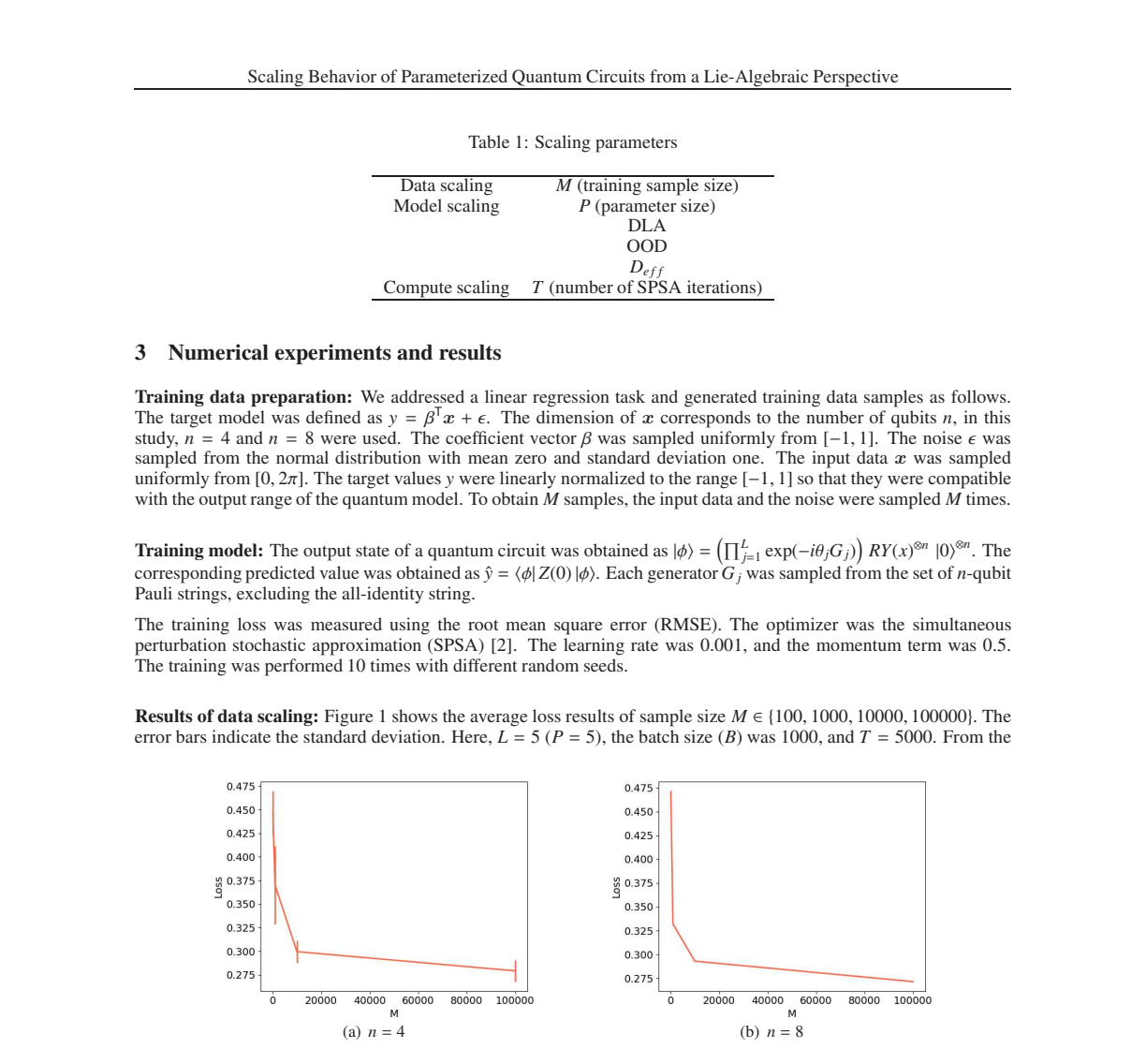
Understanding how the performance of parameterized quantum circuits scales with available resources is important for characterizing their trainability and effective model capacity. In this study, we numerically investigate data scaling, model scaling, and compute scaling in parameterized quantum circuits and examine Lie-algebraic quantities as alternative measures of model size. In addition to the number of circuit parameters, we consider the dimension of the dynamical Lie algebra, the observable-orbit dimension, and a Jacobian effective dimension defined as the rank of the Jacobian of the parameterized observable orbit. Using a regression task with randomly generated Pauli-string generators, we observe decreasing loss with increasing training dataset size, parameter size, and number of optimization iterations over the ranges investigated. For model scaling, the dynamical Lie algebra and observable orbit dimensions rapidly saturate as the parameter size increases, whereas the Jacobian effective dimension remains strongly correlated with the parameter size and exhibits comparable scaling behavior. These results suggest that the Jacobian effective dimension provides a geometry-aware measure of the locally accessible observable degrees of freedom of finite-depth parameterized quantum circuits and may serve as a useful scaling parameter beyond the nominal parameter size.
The paper's own sentences, arranged, kept beside the review and separate from it. Each label is drawn from a closed vocabulary; the number beside it is the probability the classifier gave that label. No sentence in this record was written by a model.
abstract compiled · 2026-09-23
The authors' main claim, as the classifier picked it out 1.00
“These results suggest that the Jacobian effective dimension provides a geometry-aware measure of the locally accessible observable degrees of freedom of finite-depth parameterized quantum circuits and may serve as a useful scaling parameter beyond the nominal parameter size.”
How the main claim is stated: hedged possibility 1.00
What the abstract itself states, as probabilities: claims first 0.03 · states limitation 0.21 · human participants 0.02 · controlled comparison 0.08 · randomized assignment 0.05 · states quantitative result 0.12 · compares with prior results 0.23 · mentions code or data availability 0.02
The abstract, sentence by sentence
This table labels the abstract only (arXiv listing abstract v1). The number is the probability the classifier gave the label.
| Sentence | Role | The authors' own work | States the main conclusion | Strength |
|---|---|---|---|---|
| Understanding how the performance of parameterized quantum circuits scales with available resources is important for characterizing their trainability and effective model capacity. | background 1.00 | 0.05 | 0.03 | asserted 1.00 |
| In this study, we numerically investigate data scaling, model scaling, and compute scaling in parameterized quantum circuits and examine Lie-algebraic quantities as alternative measures of model size. | contribution 0.99 | 0.94 | 0.05 | asserted 0.91 |
| In addition to the number of circuit parameters, we consider the dimension of the dynamical Lie algebra, the observable-orbit dimension, and a Jacobian effective dimension defined as the rank of the Jacobian of the parameterized observable orbit. | method 0.70 | 0.74 | 0.03 | asserted 0.93 |
| Using a regression task with randomly generated Pauli-string generators, we observe decreasing loss with increasing training dataset size, parameter size, and number of optimization iterations over the ranges investigated. | result 0.99 | 0.96 | 0.06 | asserted 1.00 |
| For model scaling, the dynamical Lie algebra and observable orbit dimensions rapidly saturate as the parameter size increases, whereas the Jacobian effective dimension remains strongly correlated with the parameter size and exhibits comparable scaling behavior. | result 1.00 | 0.95 | 0.31 | asserted 1.00 |
| These results suggest that the Jacobian effective dimension provides a geometry-aware measure of the locally accessible observable degrees of freedom of finite-depth parameterized quantum circuits and may serve as a useful scaling parameter beyond the nominal parameter size. | interpretation 1.00 | 0.71 | 0.87 | hedged possibility 1.00 |
What kind of paper the classifier reports this is: simulation study 0.98 · evidence from simulation or computation 1.00
What was examined, and what was not
Sources read
- arXiv listing abstract v1
Not examined
- full text
- figures and tables
- references and citing sentences
- relations to other papers
Levels run
- P abstract
Not run
- S sections
- T body sentences
- C citations
- R cross-paper relations
How the labels were made
Compiled by classifier-1.13.0 via TypeSafe API, question bank abstract-p1-20260923, 2026-09-23: 1 request, 5,103 input tokens.
Every quoted sentence on this record is the authors'. Every label is from Pith's closed vocabulary, with the probability shown beside it. This record as JSON
Figures (5)
Figures are the authors', reproduced from the paper.
References (6)
- [1] Abhinav Deshpande, Marcel Hinsche, Khadijeh Najafi, Kun al Sharma, Ryan Sweke, and Christa Zoufal. Dynamic parameterized quantum circuits: expressive and barren-pl ateau free. arXiv preprint arXiv:2411.05760 , 2025 on PithPith's reviewarXiv
- [2] Julien Gacon, Christa Zoufal, Giuseppe Carleo, and Stef an Woerner. Simultaneous Perturbation Stochastic Ap- proximation of the Quantum Fisher Information. Quantum, 5:567, Oct 2021 on Pith
- [3] Tobias Haug, Kishor Bharti, and M.S. Kim. Capacity and qu antum geometry of parametrized quantum circuits. PRX Quantum, 2:040309, Oct 2021 on Pith
- [4] Jared Kaplan, Sam McCandlish, Tom Henighan, Tom B. Brown , Benjamin Chess, Rewon Child, Scott Gray, Alec Radford, Jeffrey Wu, and Dario Amodei. Scaling laws for neural language models. arXiv preprint arXiv:2001.08361, 2020 on PithPith's reviewarXiv
- [5] Riccardo Rende, Alessandro Sinibaldi, Luciano Loris Vi teritti, Roeland Wiersema, Antoine Georges, and Giuseppe Carleo. Scaling laws for neural-network quantum s tates. arXiv preprint arXiv:2606.02794 , 2026 on PithPith's reviewarXiv
- [6] Danil Vyskubov, Kirill Vyskubov, Nouhaila Innan, and Mu hammad Shafique. Scaling laws for hybrid quantum neural networks: Depth, width, and quantum-centric diagno stics. arXiv preprint arXiv:2604.06007 , 2026. 7 on PithPith's reviewarXiv
Cited by 1 Pith paper
Reviewed papers on Pith that cite this one. The full citation record
- Augmenting Quantum Neural Networks with Contractive Layers quant-ph · Nov 2026
How the literature uses it
What this paper does with the arXiv papers it cites
What it cites · 1 sentence without a confident label
Cites as support 1 paper
-
As pointed out in [ref] , due to measurements inserted into part of the circuit, barren plateaus may be avoided.
Dynamic parameterized quantum circuits: expressive and barren-plateau free · Conclusion · 0.98
Cites as background 2 papers
-
Vyskubov et al. [ref] studied the scaling of hybrid quantum neural networks with circuit depth and qubit count, while Haug et al. [ref] identified scaling behavior in the expressive capacity of parameterized quantum circuits using an effective quantum dimension.
Scaling Laws for Hybrid Quantum Neural Networks: Depth, Width, and Quantum-Centric Diagnostics · Introduction · 0.82
-
In classical machine learning, performance has been studied as a function of quantities such as training data size, model size, and training compute: $loss ∝X^α$ [ref] .
Scaling Laws for Neural Language Models · Introduction · 0.97
Challenges and discussion
Disagree with the review, or know something it missed? Leave a comment, or challenge this review formally: a challenge becomes a permanent entry in this paper's record, and its decision is published here.
Come back by email
A short list of the week's newly reviewed papers. Nothing is sent until you confirm from your inbox, and every email has a link that stops it. No account.
No comments yet.
Sign in to comment