Computation and Language · arXiv:2608.21946 v2 · submitted 22 Aug 2026 · 12 references
EDGE: Experience-Distillation for Guided Exploration in Agentic Reinforcement Learning
The paper says
“Reinforcement learning with outcome-based objectives such as GRPO enables LLM-based agents to solve complex, long-horizon tasks, yet the reusable exploration patterns embedded in interaction trajectories are largely discarded after a single policy update.”
more of the abstract
Existing experience-augmented approaches retrieve historical guidance at inference time, but they apply experiences without accounting for the policy's evolving capability and create persistent dependencies on external retrieval. We propose EDGE (Experience-Distillation for Guided Exploration), a framework that treats retrieved experiences as temporary training-time scaffolds and progressively internalizes their benefits into the parametric policy. Concretely, EDGE partitions each rollout group into experience-conditioned and experience-free trajectories to estimate and admit only positive marginal gains without extra sampling, then distills the induced behavior into the base policy via a reverse-KL objective on its own empirical support. A co-evolutionary experience bank further synthesizes guidance from emerging failure modes and prunes obsolete entries as the policy evolves. Across embodied, web, and search-based QA tasks, EDGE improves over strong RL baselines by up to 12.5 points and remains effective without inference-time scaffolds or a proprietary reflector. The code is available at https://github.com/xvolcano02/EDGE.
from the abstract
Pith says
Machine review · deepseek-v4-flash · 27 Aug 2026 · what was read was not recorded · not checked by a person
It can be wrong. Challenge this review or reply to it.
Holds up, with conditions. A genuinely new and well-ablated training-time experience-distillation framework whose load-bearing gain gate rests on a 4+4 rollout contrast that the paper never validates. This line is wrong
3 major objections · 4 minor
How often objections from reviews like this one are right: not yet measured
Not checked: figures, code, what the 12 references say.
The paper says, at Section 3.1, Eq. (5); Appendix A.2; Table 3
The review did not quote this passage.
Pith says: Objection 1 of 3 · major
The gate Me = I(Δe > 0) that controls both distillation activation and teacher-rollout inclusion in the RL loss is estimated from only K=4 teacher and K=4 student rollouts (G=8). For binary rewards with success probabilities near 0.5, the standard deviation of Δe is roughly sqrt(0.25/4 + 0.25/4) = 0.35, so sign errors are frequent when the true marginal gain is small.
more of objection 1
Appendix A.2 acknowledges the high variance of Δe but smooths only the EMA used for pruning (Eq. 14), not the per-instance gate. The Hoeffding bound in Eq. (12) is vacuous at K=4 for the plausible margins in these tasks (for γ=0.1, the bound exceeds 1). Since Table 3 shows that removing the gain gate collapses overall success to 72.3%, 9.8 points below GRPO, the gate is load-bearing and its reliability is not established. Please add an empirical validation of gate sign accuracy, e.g., comparing the 4+4 gate against a high-sample ground-truth estimate of Ve(θ) on a subset of tasks, or reporting gate precision/recall over training. If the gate is noisy, the paper should also discuss whether the reported gains are robust to alternative, more reliable gating rules.
The paper says, at Section 4.2, Table 3
The review did not quote this passage.
Pith says: Objection 2 of 3 · major
The argument that the G/2+G/2 partition does not dilute the RL signal relies on ablated variants outperforming GRPO, but no direct control with all G=8 rollouts student-conditioned (i.e., EDGE without any teacher rollouts) is provided. When the gate is off, advantages are computed over only 4 student rollouts, halving the effective group size relative to GRPO.
more of objection 2
A control isolating the partition effect would strengthen the conclusion that the gains come from the gating/distillation mechanism rather than from a change in effective batch size.
The paper says, at Appendix A.1, Eq. (12)
The review did not quote this passage.
Pith says: Objection 3 of 3 · major
The theoretical risk-control claim for the gate is not supported by the provided concentration inequality. With K=4, the bound 2 exp(−K ε^2) is larger than 1 for ε < sqrt(ln 2 / 2) ≈ 0.59, so it provides no guarantee for the sign-error regime that matters in these experiments.
more of objection 3
The authors should either replace the bound with a tighter analysis (e.g., exact binomial confidence intervals for the difference of two proportions) or reframe the theoretical claim as a heuristic and rely on empirical calibration. This does not invalidate the empirical results, but the current phrasing overstates the theoretical support.
4 minor objections
The paper says, at Section 3.2, Eq. (6)
Pith says: minor objection 1 of 4
The notation for the student context c_S^<t and teacher context c_T^<t is not fully consistent; please clarify that the same token history is used in both passes, and define how the privileged context is concatenated at each step.
The paper says, at Table 1
Pith says: minor objection 2 of 4
The GRPO row for Qwen2.5-1.5B appears to have a misaligned sequence of numbers; please check that each column corresponds to the same subtask ordering as the other rows.
show 2 more
The paper says, at Section 4.2, Figure 2
Pith says: minor objection 3 of 4
The retention percentages are given for the 7B scale only; reporting the 1.5B retention would help confirm that internalization is not scale-specific.
The paper says, at Section 4.1
Pith says: minor objection 4 of 4
When the policy itself is used as the reflector in EDGE (self), please clarify whether a separate instance of the same trained policy is used or the exact checkpoint that is being trained, since this affects the interpretation of the self-reflection results.
What would settle it
At a fixed training checkpoint (e.g., step 100 and step 200 on ALFWorld with Qwen2.5-7B), select a random sample of tasks and compute the true marginal gain Ve using a large number of rollouts (e.g., 100 teacher and 100 student rollouts per task). Compare the sign of the actual Δe (from the 4+4 rollouts used in training) to the sign of Ve, reporting false-positive and false-negative rates. Additionally, run EDGE with an oracle gate that uses the large-sample Ve instead of Δe, and compare final task performance to the standard EDGE. If the gate's sign accuracy is near chance and the oracle-gate version performs notably better, the noisy gate is a genuine bottleneck and the reported gains may be at least partly due to other components; if the gate is reasonably accurate or the oracle provides no additional gain, the concern is resolved.
from the skeptic's reading
How the review went
4 readings by deepseek-v4-flash · 27 Aug 2026
- Reader holds up, with conditions
- Skeptic agrees
- Editor wrote the verdict above
- Referee major revision: 3 major objections, 4 minor
Not run on this paper: the simulated authors' defence.
Pith did not check this review's objections against the paper.
The review in full
The review in brief, machine-written
Two things to know. EDGE is a real step forward in making experience reuse in agentic RL a training-time scaffold rather than an inference-time retrieval dependency. The specific combination—paired-rollout marginal-gain gating, reverse-KL distillation on the student's own support, and a co-evolving experience bank that prunes by EMA utility—is new, and the ablations show each piece earns its keep. But the gate that decides whether to distill and whether teacher rollouts enter the RL loss is estimated from G/2=4 teacher and 4 student rollouts with binary rewards. The paper never measures whether the sign of that estimate is actually correct. The stress-test arithmetic is right: with success probabilities near 0.5, the standard deviation of the contrast is around 0.35, so sign flips are common. Appendix A.2 concedes the variance but only smooths the EMA used for pruning, not the per-instance gate.
What is actually good. The retention experiment (96.0% vs. 82.9% for SkillRL and 92.3% for EMPO2) is a clean test of the scaffold-to-parameter idea, and it passes. The training-dynamics plots and experience-gain tracking actually show non-stationary utility—the static bank's gain decays and goes negative, which directly supports the paper's core premise. The ablation without gain-gating collapsing 9.8 points below GRPO is striking and confirms the gate is load-bearing, not decorative. The QA experiments transfer to a newer backbone and work with self-reflection, which widens applicability. The code is released and the wall-clock overhead is reported. That is more than many agentic RL papers do.
Soft spots, in proportion. The gate-sign reliability is the big one, and it is under-analyzed rather than wrong. The paper gives concentration bounds but no empirical validation against a low-noise ground truth. A small experiment—comparing the 4+4 gate against a large-sample estimate on the same tasks, or reporting precision/recall of the gate's sign—would settle it. Also, the QA table (Table 2) has no error bars, unlike Table 1; those numbers look single-seed. Minor: the gate uses binary success even on WebShop, where a score exists; that is a modeling choice that wastes signal. And the code repo is cited without a commit hash, which matters for reproduction.
Bottom line: the paper deserves a serious referee and likely a conditional accept. The central mechanism is under-validated, but the empirical pattern is coherent and the method is clearly new. I would bring it to reading group.
The strongest objection
The central claim depends on gain-gated distillation and RL masking being driven by a reliable estimate of the true marginal utility Ve(θ). Eq. (5) estimates Δe from K=4 teacher and K=4 student rollouts with binary rewards. For success probabilities near 0.5, the standard deviation of Δe is about sqrt((0.25+0.25)/4)=0.35, so the sign of Δe is frequently wrong. Appendix A.2 explicitly acknowledges this high variance and only smooths the EMA used for pruning (Eq. 14), not the per-instance gate Me=I(Δe>0) that controls both distillation activation and teacher-rollout inclusion in the RL loss. The ablation (Table 3) shows that removing the gate collapses performance to 72.3%, 9.8 points below GRPO, so the gate is not peripheral: the method's advantage rests on decisions made from a 4+4 contrast. No experiment in the paper measures gate sign accuracy against a low-noise ground truth, so the central mechanism is unvalidated.
The paper's strongest claim is that EDGE's gain-gated, on-support distillation improves task performance and retains 96.0% after scaffold removal. The ablation w/o Gain-Gating (Table 3) demonstrates that the gate is essential: removing it drops ALFWorld success from 90.4% to 72.3%, below vanilla GRPO. Yet the gate is computed from only four teacher and four student rollouts per task, and the paper's own Appendix A.2 admits the high variance while providing no empirical validation of the sign accuracy of Δe. This is the most load-bearing concern because if the gate frequently misclassifies experiences, the method's advantage could stem from factors other than the claimed selective admission mechanism, and the reported improvements may not be robust across tasks or seeds. The reader's weakest assumption identifies exactly this gap. I agree with the reader's conditional verdict: the paper presents a coherent framework with strong empirical support, but the statistical reliability of the central gating mechanism must be quantified before full acceptance. The proposed concrete test directly measures gate accuracy and tests whether an oracle gate changes the outcome, which would settle whether the concern actually lands. No other potential issue (e.g., missing error bars on QA, absent commit hash) is as clearly tied to the validity of the central claim.
The referee's report
EDGE addresses a genuine limitation of current experience-augmented agentic RL—experience utility is policy-dependent and permanent retrieval creates inference-time dependencies—and the scaffold-to-parameter framing is a useful conceptual contribution. The empirical evaluation is solid: multiple environments, two model scales, ablations, sensitivity analysis, retention tests, and code release. The central gain-gated mechanism is plausible and the retention result is impressive. However, the critical load-bearing component, the marginal-gain gate, rests on a statistically coarse estimate with no direct validation, which currently prevents me from judging the reliability of the method's central mechanism.
Pith's reading of the paper (a machine's summary, not the authors')
The paper seeks to establish that reusable experience in agentic reinforcement learning should be a temporary training-time scaffold rather than a permanent retrieval dependency. It proposes EDGE, which partitions each GRPO rollout group into experience-conditioned and experience-free halves, estimates the marginal gain $\Delta_e$ from their outcome difference, and admits the experience into the RL update and distillation only when $\Delta_e>0$. The positive-gain behavior is then internalized into the policy with a reverse-KL objective on the student's own rollouts, while a co-evolving experience bank expands from new failure modes and prunes obsolete entries. On ALFWorld, WebShop, and seven search-based QA benchmarks, EDGE reports improvements over GRPO by up to 12.5 points, and retains 96.0% of scaffolded performance when all external experiences are removed at inference time, supporting the claim that useful guidance has moved into the parameters.
What carries the argument. The central object is the paired-rollout marginal gain $\Delta_e=\frac{1}{|T_T|}\sum_{\tau\in T_T}R(\tau)-\frac{1}{|T_S|}\sum_{\tau\in T_S}R(\tau)$, estimated for free by splitting a GRPO group of $G$ trajectories into $G/2$ teacher rollouts conditioned on the retrieved experience and $G/2$ student rollouts without it. The gain gate $\mathbb{I}(\Delta_e>0)$ does the decisive work: it decides whether teacher rollouts remain in the RL loss, whether distillation activates, and how the advantage baseline shifts. The second mechanism is gain-gated privileged distillation, a reverse-KL objective $D_{\mathrm{KL}}(\pi_{\mathrm{student}}\parallel\pi_{\mathrm{teacher}})$ evaluated on the student's own empirical support, which transfers scaffold-induced behavior without covariate shift from teacher-only states. The third is the co-evolving experience bank, which expands via a reflector's contrast of failed and successful trajectories and prunes entries whose EMA utility falls below a threshold, keeping the scaffold aligned with the policy's changing competence.
Core claim. EDGE's central claim is that experience utility is policy-dependent and non-stationary, so guidance should be admitted only when its measured marginal gain is positive and should be consolidated into the policy before it expires. The paper demonstrates this by showing that with the gain gate, exploration-heavy subtasks improve substantially, that removing the gate degrades performance below vanilla GRPO, and that the final policy reproduces 96.0% of its scaffolded performance with no experience retrieved at inference time. This reframes experience reuse as a dynamic scaffold-to-parameter transition rather than a retrieve-and-prompt augmentation.
The premise it rests on. The load-bearing premise is that the sign of the marginal gain computed from just four teacher and four student binary-reward rollouts per task says whether the experience truly helps; the paper acknowledges this contrast is high-variance but does not validate its sign accuracy, so frequent sign errors would let the gate block useful guidance or admit harmful guidance.
If the paper is right (Pith's inferences, not the authors')
At deployment, the trained agent needs neither the experience bank nor a separate reflector, removing inference-time token overhead and retrieval-noise sensitivity while keeping 96.0% of scaffolded performance.
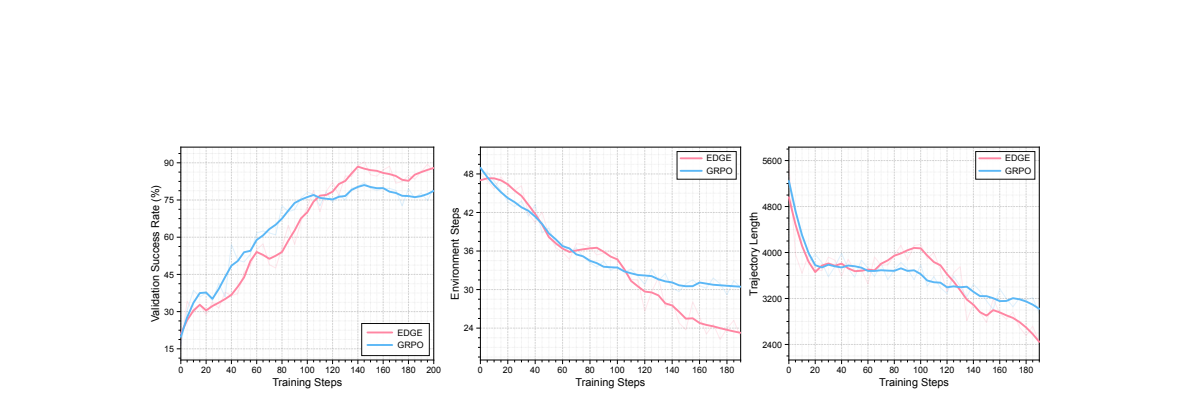
Exploration-intensive, long-horizon subtasks benefit most: on ALFWorld at 7B, Heat, Cool, and Pick2 improve by roughly 14–18 points over GRPO, while WebShop full-task success improves more than partial-credit score.
Experience guidance is actively harmful without gating: removing the gain gate drops EDGE to 72.3% on ALFWorld, below vanilla GRPO's 82.1%, so filtering by measured marginal gain is essential rather than cosmetic.
The co-evolutionary bank adapts to the policy: after step 100 the bank stops growing and begins to shrink, which the paper reads as the policy absorbing existing experiences faster than new failure modes create replacements.
Self-reflection with the policy itself as reflector retains 97.3% of GPT-4o-reflected QA performance, indicating the framework's gains do not depend on access to a proprietary reflection model.
The paper's gate rests on only four binary teacher and four binary student rollouts per task; a direct extension would replace the hard sign test with a confidence interval or an abstention band around $\Delta_e$, admitting experiences only when the measured gain is nonzero with high confidence.
The scaffold-to-parameter lifecycle suggests a training-efficiency schedule the paper does not test: deliberately retire an experience as soon as its EMA utility approaches zero, rather than waiting for a negative threshold, and measure how much rollout budget this saves.
The same partitioning changes GRPO's advantage baseline (pooled when the gate is on, student-only when off), so part of EDGE's effect may come from baseline recalibration rather than distillation; an ablation that applies the pooled baseline without distillation would isolate the two pathways.
The principle could transfer to latent, non-textual memory if the distillation target were a hidden-state or embedding-level teacher, which the paper lists as an open problem; a testable version would compare textual versus latent scaffolds on the same environments.
Check this review
Pith stored no record of this review's passes and took no fingerprint of it. Reviews made by code from 13 Nov 2026 on carry both.
How often reviews like this one are right
Reviews like this one: written by deepseek-v4-flash, where what was read was not recorded.
How often objections from reviews like this one are right: not yet measured
Reviews by people
This review was written by a machine. No person has reviewed this paper on Pith yet. A scientist listed on Pith can review it for a fee, and their review is published here whatever it concludes.
The paper
Abstract
Reinforcement learning with outcome-based objectives such as GRPO enables LLM-based agents to solve complex, long-horizon tasks, yet the reusable exploration patterns embedded in interaction trajectories are largely discarded after a single policy update. Existing experience-augmented approaches retrieve historical guidance at inference time, but they apply experiences without accounting for the policy's evolving capability and create persistent dependencies on external retrieval. We propose EDGE (Experience-Distillation for Guided Exploration), a framework that treats retrieved experiences as temporary training-time scaffolds and progressively internalizes their benefits into the parametric policy. Concretely, EDGE partitions each rollout group into experience-conditioned and experience-free trajectories to estimate and admit only positive marginal gains without extra sampling, then distills the induced behavior into the base policy via a reverse-KL objective on its own empirical support. A co-evolutionary experience bank further synthesizes guidance from emerging failure modes and prunes obsolete entries as the policy evolves. Across embodied, web, and search-based QA tasks, EDGE improves over strong RL baselines by up to 12.5 points and remains effective without inference-time scaffolds or a proprietary reflector. The code is available at https://github.com/xvolcano02/EDGE.
The paper's own sentences, arranged, kept beside the review and separate from it. Each label is drawn from a closed vocabulary; the number beside it is the probability the classifier gave that label. No sentence in this record was written by a model.
abstract compiled · 2026-09-23
The authors' main claim, as the classifier picked it out 0.99
“Across embodied, web, and search-based QA tasks, EDGE improves over strong RL baselines by up to 12.5 points and remains effective without inference-time scaffolds or a proprietary reflector.”
How the main claim is stated: asserted 1.00
What the abstract itself states, as probabilities: claims first 0.07 · states limitation 0.13 · human participants 0.04 · controlled comparison 0.91 · randomized assignment 0.04 · states quantitative result 0.98 · compares with prior results 0.96 · mentions code or data availability 0.98
The abstract, sentence by sentence
This table labels the abstract only (arXiv listing abstract v2). The number is the probability the classifier gave the label.
| Sentence | Role | The authors' own work | States the main conclusion | Strength |
|---|---|---|---|---|
| Reinforcement learning with outcome-based objectives such as GRPO enables LLM-based agents to solve complex, long-horizon tasks, yet the reusable exploration patterns embedded in interaction trajectories are largely discarded after a single policy update. | background 0.58 | 0.11 | 0.04 | asserted 1.00 |
| Existing experience-augmented approaches retrieve historical guidance at inference time, but they apply experiences without accounting for the policy's evolving capability and create persistent dependencies on external retrieval. | gap 0.71 | 0.04 | 0.03 | asserted 1.00 |
| We propose EDGE (Experience-Distillation for Guided Exploration), a framework that treats retrieved experiences as temporary training-time scaffolds and progressively internalizes their benefits into the parametric policy. | contribution 0.98 | 0.78 | 0.18 | asserted 1.00 |
| Concretely, EDGE partitions each rollout group into experience-conditioned and experience-free trajectories to estimate and admit only positive marginal gains without extra sampling, then distills the induced behavior into the base policy via a reverse-KL objective on its own empirical support. | method 1.00 | 0.89 | 0.07 | asserted 0.98 |
| A co-evolutionary experience bank further synthesizes guidance from emerging failure modes and prunes obsolete entries as the policy evolves. | method 0.96 | 0.82 | 0.04 | asserted 1.00 |
| Across embodied, web, and search-based QA tasks, EDGE improves over strong RL baselines by up to 12.5 points and remains effective without inference-time scaffolds or a proprietary reflector. | result 1.00 | 0.95 | 0.80 | asserted 1.00 |
| The code is available at https://github.com/xvolcano02/EDGE. | contribution 0.58 | 0.40 | 0.02 | asserted 0.90 |
What kind of paper the classifier reports this is: method or tool 1.00 · evidence from observation or experiment 0.91
What was examined, and what was not
Sources read
- arXiv listing abstract v2
Not examined
- full text
- figures and tables
- references and citing sentences
- relations to other papers
Levels run
- P abstract
Not run
- S sections
- T body sentences
- C citations
- R cross-paper relations
How the labels were made
Compiled by classifier-1.13.0 via TypeSafe API, question bank abstract-p1-20260923, 2026-09-23: 1 request, 5,734 input tokens.
Every quoted sentence on this record is the authors'. Every label is from Pith's closed vocabulary, with the probability shown beside it. This record as JSON
Figures (11)






Figures are the authors', reproduced from the paper.
References (12)
- [1] Clean bowl Navigates to destination before finding object Locate object before placing Retrieved on a related task at step 155;U=0.125 on Pith
- [2] Pillow on sofa Issuestakefrom source lacking target Verify source before taking Utility rises to0.578by step 200 (78 retrievals) on Pith
- [3] Pick2 search Unstructured search before collecting targets Search systematically before storing Retrieved on a related Pick2 task at step 166 on Pith
- [4] Freshness-aware prioritized experience re- play for llm/vlm reinforcement learning.Preprint, arXiv:2604.16918. OpenAI, :, Aaron Hurst, Adam Lerer, Adam P. Goucher, Adam Perelman, Aditya Ramesh, Aidan Clark, AJ Ostrow, Akila Welihinda, Alan Hayes, Alec Radford, Aleksander M ˛ a... on PithPith's reviewarXiv
- [8] Exgrpo: Learning to reason from experience. Preprint, arXiv:2510.02245. Haozhen Zhang, Quanyu Long, Jianzhu Bao, Tao Feng, Weizhi Zhang, Haodong Yue, and Wenya Wang. 2026a. Memskill: Learning and evolving memory skills for self-evolving agents.Preprint, arXiv:2602.02474. Kaiyi... on PitharXiv
- [12] No-op movement Repeats navigation after arrival Avoid repeated no-op moves Near-threshold utility; recovers toU=0.452by step 200 Table 6:Experience-bank co-evolution examples.Each case is extracted from saved failure trajectories, LLM reflection logs, retrieval logs, and utili... on Pith
- [2011] A reduction of imitation learning and struc- tured prediction to no-regret online learning. InPro- ceedings of the Fourteenth International Conference on Artificial Intelligence and Statistics, volume 15 of Proceedings of Machine Learning Research, pages 627–635, Fort Lauderda... on PithPith's reviewarXiv
- [2019] Causal confusion in imitation learning. In Advances in Neural Information Processing Systems, volume 32. Curran Associates, Inc. Runnan Fang, Yuan Liang, Xiaobin Wang, Jialong Wu, Shuofei Qiao, Pengjun Xie, Fei Huang, Huajun Chen, and Ningyu Zhang. 2026. Memp: Exploring agent ... on PithPith's reviewarXiv
- [2021] OpenReview.net. Charlie Snell, Dan Klein, and Ruiqi Zhong on Pith
- [2022] Learning by distilling context.Preprint, arXiv:2209.15189. Vladimir Vapnik and Akshay Vashist. 2009. A new learning paradigm: Learning using privileged infor- mation.Neural Networks, 22(5):544–557. Advances in Neural Networks Research: IJCNN2009. Hanlin Wang, Chak Tou Leong, J... on PithPith's reviewarXiv
- [2025] Group-in-group policy optimization for llm agent training. InAdvances in Neural Information Processing Systems, volume 38, pages 46375–46408. Curran Associates, Inc. Jonas Hübotter, Frederike Lübeck, Lejs Behric, An- ton Baumann, Marco Bagatella, Daniel Marta, Ido Hakimi, Idan... on PithPith's reviewarXiv
- [2026] What’s missing in screen-to-action? towards a UI-in-the-loop paradigm for multimodal GUI rea- soning. InFindings of the Association for Computa- tional Linguistics: ACL 2026, pages 17674–17690, San Diego, California, United States. Association for Computational Linguistics. Ze... on PitharXiv
Cited by 5 Pith papers
Reviewed papers on Pith that cite this one. The full citation record
- ModHarness-RL: Recasting Harnesses as Learnable and Evolving Programs for Agentic RL cs.AI · Nov 2026
- AutoScaffold: AI-Guided Scaffolding for Reinforcement Learning of Language Models cs.LG · Nov 2026
- Externalise the Memory: A Pre-Registered Study of Where an Embodied Agent's Experience Should Live cs.RO · Oct 2026
- SteerDistill: Quantizing LLM Agents via Closed-Loop Teacher Steering cs.AI · Nov 2026
- ENGRAM: From Agent Experience to Weights through Verified Consolidation cs.AI · Nov 2026
How the literature uses it
What this paper does with the arXiv papers it cites
What it cites · 8 sentences without a confident label
Uses the method or tool of 3 papers
-
Following [ref] , we generate new experiences from the agent's own rollout trajectories.
SkillRL: Evolving Agents via Recursive Skill-Augmented Reinforcement Learning · Experience Bank Evolution and Management · 0.96
-
We build on Group Relative Policy Optimization (GRPO) [ref] , which samples a group of $G$ parallel trajectories ${τ_i}_i=1^G$ per task and computes group-normalized advantages: [equation] The policy is updated by maximizing a clipped surrogate objective with KL regularization: [equation] where $ρ_i,t = π_θ(a_t |x, h_t, o_t) / π_θ_old(a_t |x, h_t, o_t)$ is the importance sampling ratio, $π_ref$ is the reference policy, and $β$ controls KL penalty strength.
DeepSeekMath: Pushing the Limits of Mathematical Reasoning in Open Language Models · Preliminaries · 0.95
-
For experience retrieval, we encode experiences with Qwen3-Embedding-0.6B [ref] and rank candidates by cosine similarity against the task instruction and initial observations.
Qwen3 Embedding: Advancing Text Embedding and Reranking Through Foundation Models · Experiment Setup · 1.00
Compares with 6 papers
-
The post-training baselines include GRPO [ref] , OPSD [ref] , EvolveR [ref] , GRPO augmented with Mem0 [ref] , SkillRL [ref] , and EMPO$^2$ [ref] .
DeepSeekMath: Pushing the Limits of Mathematical Reasoning in Open Language Models · Experiment Setup · 0.98
-
The post-training baselines include GRPO [ref] , OPSD [ref] , EvolveR [ref] , GRPO augmented with Mem0 [ref] , SkillRL [ref] , and EMPO$^2$ [ref] .
Mem0: Building Production-Ready AI Agents with Scalable Long-Term Memory · Experiment Setup · 0.98
-
The post-training baselines include GRPO [ref] , OPSD [ref] , EvolveR [ref] , GRPO augmented with Mem0 [ref] , SkillRL [ref] , and EMPO$^2$ [ref] .
EvolveR: Self-Evolving LLM Agents through an Experience-Driven Lifecycle · Experiment Setup · 0.98
Cites as background 20 papers
-
A growing body of work addresses this inefficiency by augmenting agents with external experience at inference time, through episodic reflections [ref] , persistent memory [ref] , or skill libraries [ref] .
SkillRL: Evolving Agents via Recursive Skill-Augmented Reinforcement Learning · Introduction · 0.87
-
A growing body of work addresses this inefficiency by augmenting agents with external experience at inference time, through episodic reflections [ref] , persistent memory [ref] , or skill libraries [ref] .
Mem0: Building Production-Ready AI Agents with Scalable Long-Term Memory · Introduction · 0.87
-
A growing body of work addresses this inefficiency by augmenting agents with external experience at inference time, through episodic reflections [ref] , persistent memory [ref] , or skill libraries [ref] .
Memp: Exploring Agent Procedural Memory · Introduction · 0.87
Challenges and discussion
Disagree with the review, or know something it missed? Leave a comment, or challenge this review formally: a challenge becomes a permanent entry in this paper's record, and its decision is published here.
Come back by email
A short list of the week's newly reviewed papers. Nothing is sent until you confirm from your inbox, and every email has a link that stops it. No account.
No comments yet.
Sign in to comment